20 Layered Safeguards for IoT
More
Depth: Practitioner
Progress saves as you read. Mark sections complete as you go; your progress appears in the sidebar.
20.1 Start Simple
This section: Start Simple — Picture a medicine fridge with a lock, a temperature alarm, and a daily review.
Plan for the Day One Guard Fails
Picture a medicine fridge with a lock, a temperature alarm, and a daily review. The lock may stop casual access. It cannot report a broken seal, restore lost records, or tell staff which stock was at risk during an outage.
Start with the harm and the people affected. List what must be kept private, accurate, and available. Give each risk more than one independent guard. Include a way to notice failure, a named person who responds, and a tested path back to safe service.
Test the layers separately. Use a wrong account, unplug a monitor, change an approved file, silence one alert, and restore from a known copy. The record should show which guard worked, which did not, and how long the gap lasted.
More controls do not always mean more safety. They can share one hidden weak point or create new work that nobody owns. The deeper sections group physical, technical, and team measures so every layer has a purpose, limit, owner, and review date.
Think about a field device that protects a pump, a freezer, or a medication cabinet. A password helps, but it is not enough if nobody notices tampering, nobody knows which firmware is approved, and nobody can recover cleanly after a failed update. Safeguards are the layers that keep one weak point from becoming a full failure.
This chapter starts from that plain idea: protect the thing, watch for trouble, respond when trouble appears, and keep evidence that the protection still matches the risk.
20.2 Overview: Protection in Layers
This section: Overview: Protection in Layers — Safeguards are the controls that protect personal data and the connected systems that handle it.
Safeguards are the controls that protect personal data and the connected systems that handle it. The central idea of good protection is that no single control is trusted on its own. Instead, several layers are arranged so that when one fails, another still stands. This approach is often called defense in depth, and it is the difference between a system that is one mistake away from disaster and one that can absorb a mistake.
Protection also has to cover more than prevention. A mature stance assumes that some controls will fail or be bypassed, so it plans to detect problems quickly, respond effectively, and recover afterward. Trying only to prevent, with no way to notice or react when prevention fails, is a brittle design that looks strong until the day it does not.
If you only need the intuition, this layer is enough: protect with several independent layers, match the strength of each control to the value of what it guards, and plan to detect, respond, and recover, not just to prevent.
Think of protecting a building. You do not rely only on the front door lock. You add an alarm so a break-in is noticed, a plan for who responds and how, and backups so you can recover if something is lost or damaged. You also layer them, so that one failure, a propped-open door, does not leave everything exposed. Safeguards apply the same thinking to data and devices.
For a smart-meter fleet, inspect Figure 20.1 to place layers around the whole service rather than one component. Governance names ownership; identification keeps inventory and data paths current; protection enforces identity and boundaries; detection watches drift; response isolates faults; recovery restores service. Evidence must connect those layers through tests, alerts, access reviews, and drills.
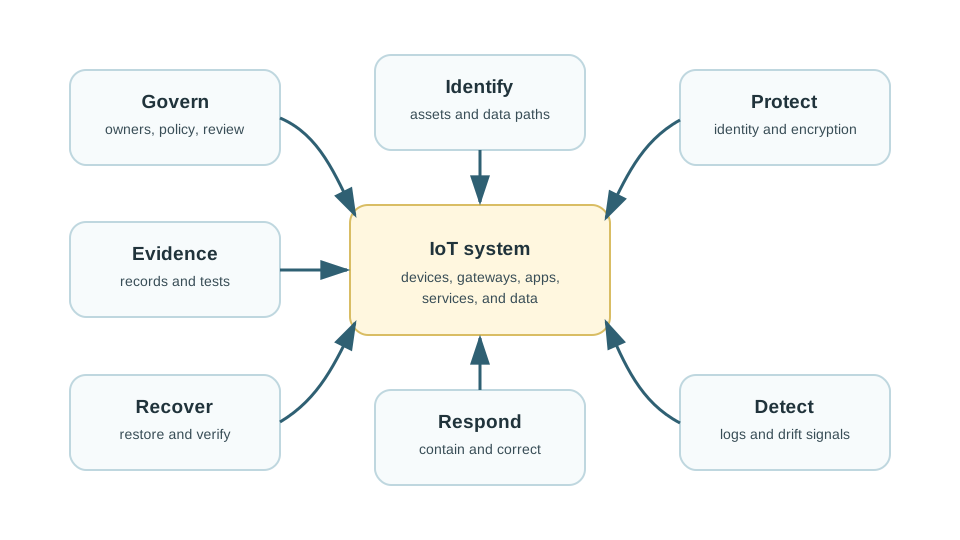
Read Figure 20.1 around the connected system from Govern and Identify into Protect, Detect, Respond, and Recover. Then inspect the evidence band that proves each transition works. No single layer substitutes for another: encryption cannot inventory an unknown device, and a detection alert cannot restore a failed gateway. The chapter next groups preventive, detective, and corrective controls within this lifecycle rather than presenting safeguards as an unordered list.
20.2.1 The Three Kinds of Control
Technical
Controls in the system itself, such as encryption, access control, network separation, and secure update mechanisms.
Organizational
Controls in how people work, such as policies, roles and responsibilities, training, and review processes.
Physical
Controls over the hardware and its setting, such as locked enclosures, tamper resistance, and controlled access to devices.
20.2.2 Beginner Examples
Work from the simplest case toward the broader design consequence. First, encrypting data and also limiting who can access it are two independent layers; if one is misconfigured, the other still helps. Next, an alarm that flags an unusual device login is detection; without it, a bypassed lock goes unnoticed. Finally, relying on a single firewall and calling the system secure is a single point of failure, not defense in depth.
20.2.3 Overview Knowledge Check
If you can explain layered protection and the prevent-detect-respond-recover lifecycle, you have the core idea. Continue to Practitioner to choose and tailor controls.
20.3 Practitioner: Choose, Tailor, and Operate Controls
This section: Practitioner: Choose, Tailor, and Operate Controls — The practical work is choosing controls that fit the risk, arranging them in independent layers, and operating the ones that need attention over time.
-

Choose the few signals this small device can send.
-

Define an unusual pattern before watching for it.
-

Alert a named owner, then test isolation and recovery.
The practical work is choosing controls that fit the risk, arranging them in independent layers, and operating the ones that need attention over time. A widely used way to organize this is the NIST Cybersecurity Framework, whose current version groups protection into a small set of functions.
20.3.1 The Protection Lifecycle
The framework organizes work into functions that together cover the whole lifecycle of protection. They are a useful checklist for making sure a design does not stop at prevention.
20.3.2 Information Assurance and Security Services
Information assurance is the operating view behind many safeguards: protect and defend information and the systems that handle it, while preserving availability, integrity, authentication, confidentiality, and non-repudiation. It also includes restoration, detection, and reaction capabilities, so it fits naturally with the protect-detect-respond-recover lifecycle rather than stopping at secrecy.
Use Figure 20.2 to cross a required security service with the information state and countermeasure family carrying the claim, so one protected cell is not mistaken for complete coverage.

Read Figure 20.2 one axis at a time. First choose the security need, such as privacy, integrity, or availability. Next locate the data in storage, processing, or transit. Then select technology, policy, or people as the control family. Their meeting point defines one evidence request instead of a broad security label. For availability, that evidence may include spare capacity, recovery drills, failover behaviour, and monitoring. An uptime slogan alone does not fill those cells.
Integrity also has levels. A healthcare, emergency, or financial record may need critical-level validation, traceability, and trustworthiness evidence, while a lower-impact analytics record may need lighter checks. Match the integrity requirement to the decision the data drives, and prove the relevant checks for capture, storage, retrieval, update, and transfer instead of labeling every dataset the same.
Authentication and non-repudiation make the service list practical. Authentication proves that a transmission, message, device, or person is the claimed originator and is allowed to receive or perform the requested action. Non-repudiation asks whether the exchange leaves enough evidence that a sender cannot later deny sending it and a recipient cannot deny receiving it. In IoT, those claims usually need signed events, trusted timestamps, protected logs, and clear identity ownership rather than only a password prompt.
20.3.3 Countermeasure Families and Data States
The countermeasure dimension should be recorded at the same granularity as the system. Technical controls include software controls such as firewalls, vulnerability scanners, protocol analyzers, and intrusion detection; hardware controls such as dedicated appliances, secure elements, and tamper-resistant storage; network controls such as VPNs, network access control, and secure access points; and cloud controls such as virtual security appliances, managed identity, logging, and policy enforcement. Organizational controls include operating procedures, configuration standards, authentication and password policies, acceptable-use rules, remote-access policies, network-maintenance rules, and incident-handling procedures. People controls include training and awareness so users and administrators know how to handle confidential information and run the controls correctly.
Management standards sit above individual controls. ISO/IEC 27001 and 27002 frame information security as a management system: identify risk, set policy, assign responsibility, manage assets, protect human-resource and physical boundaries, operate communications and systems controls, govern acquisition and maintenance, restrict access, handle incidents, preserve business continuity, and check compliance. A review should narrow that framework to the domains, control objectives, and controls that fit the IoT service rather than treating an ISO label as proof that every data state is protected.
20.3.4 Tailoring Controls to Risk
The most important practitioner judgment is matching the strength of a control to the value of what it guards. More sensitive data and higher-impact devices justify stronger, more numerous controls; routine data does not need the same weight. Tailoring avoids two failures at once: under-protecting the data that matters, and over-burdening low-risk features with controls no one will maintain. A control that is too heavy to sustain quietly decays, which is its own risk.
20.3.5 Monitoring and Response Readiness
Detection and response deserve special attention in IoT because devices are often constrained: limited logging, intermittent connectivity, and hardware that is hard to update. The practitioner move is to plan for these limits in advance. Decide what signals a device can realistically send, where they are collected, what counts as an anomaly, and who responds. Readiness is rehearsed, not assumed; a response plan that has never been exercised tends to fail when it is first needed.
20.3.6 Worked Reasoning: Three Controls, One Method
Protect the data path
Encrypt data and also restrict access, so the two layers cover each other. Match key handling to the sensitivity of the data.
Detect the unusual
Collect the few signals a constrained device can send, define what is abnormal, and alert on it, so a bypass is noticed.
Be ready to respond
Write and rehearse who isolates a compromised device, who notifies whom, and how service is recovered afterward.
20.3.7 Practitioner Knowledge Check
If you can choose, layer, tailor, and operate controls across the lifecycle, you can stop here. Continue to Under the Hood for independence, evidence, and where safeguards quietly fail.
20.4 Under the Hood: Independence, Evidence, and Failure Modes
This section: Under the Hood: Independence, Evidence, and Failure Modes — The deeper layer explains why layered defense only works when the layers are genuinely independent, and why a control that cannot be shown to work cannot be relied upon.
The deeper layer explains why layered defense only works when the layers are genuinely independent, and why a control that cannot be shown to work cannot be relied upon. The recurring failure is the appearance of depth without the substance.
20.4.1 Layers Must Be Independent
Defense in depth assumes that the layers fail independently, so that the chance of all of them failing at once is small. That assumption breaks when two layers share a common weakness. Two controls that both depend on the same credential, the same flat network, or the same unpatched component are not really two layers; one root cause defeats them together. A precise design checks that each added layer fails for different reasons than the others, because correlated failure is how a system that looks deeply protected collapses all at once.
20.4.2 The Governance Function
The current cybersecurity framework makes governance a function in its own right, alongside identify, protect, detect, respond, and recover. Governance is the work of setting the risk strategy, assigning roles and accountability, and overseeing that the other functions actually happen. It matters because controls without an owner and a shared direction drift: each team does something reasonable, but no one is accountable for whether the whole is adequate. Governance is what keeps the safeguards a system rather than a pile of disconnected measures.
20.4.3 Evidence Makes a Safeguard Real
A control you cannot demonstrate is, for practical purposes, a control you do not have. Each safeguard should be testable and produce a record: the access control exercised and logged, the backup restored in a drill, the response plan run as an exercise, the detection rule shown to fire on a real anomaly. The same security-of-processing duty that data protection law expects is satisfied not by owning controls but by being able to show they work and are matched to the risk.
20.4.4 Controls, Independence, and Failure Modes
20.4.5 Common Pitfalls
Review these failure modes in order. First, Checkbox controls. Listing controls as present without confirming they are configured and working. Next, All prevention, no detection. Building strong walls with no way to notice when one is breached. Then, Correlated layers. Adding a second control that shares a single point of failure with the first. Then, No response plan. Detecting an incident with no rehearsed plan for who acts and how. Finally, Untested recovery. Trusting backups that have never been restored, so recovery fails when it matters.
20.4.6 Under-the-Hood Knowledge Check
At this depth, safeguards are a system of independent layers across the whole protection lifecycle, governed, tailored to risk, and proven by evidence. Layer protection so failures are uncorrelated, cover detect, respond, and recover rather than only prevent, and keep records that show each control works. A trustworthy review does not count controls; it asks what a single failure could reach, and what evidence shows each safeguard actually holds.
20.5 Summary
This section: Summary — Plan to prevent a loss, detect it, respond, and recover.
Plan to prevent a loss, detect it, respond, and recover. First, safeguards are the controls that protect personal data and connected systems; good protection layers several independent controls so that one failure does not expose everything (defense in depth). Next, protection must cover the whole lifecycle, not only prevention: a mature stance assumes some controls fail and plans to detect, respond, and recover. Then, controls fall into technical, organizational, and physical kinds, and the NIST Cybersecurity Framework groups protection into functions, including govern, identify, protect, detect, respond, and recover. Then, information assurance reviews should name the security service, the data state, and the countermeasure family: technical controls, operational policy and practice, and education or awareness. Then, tailoring matches the strength of each control to the value of what it guards, avoiding both under-protected sensitive data and unsustainable over-protection of trivia. Then, layers only help when they fail independently; two controls that share a single point of failure, such as one credential or one flat network, are not really two layers. Finally, a safeguard is real only when it can be demonstrated: each control should be testable and produce evidence, from a restore drill to a fired detection rule to a rehearsed response plan.
Protection is a system of independent layers across the full lifecycle, governed, tailored to risk, and proven by evidence. Do not rely on a single control or on prevention alone; layer safeguards so failures are uncorrelated, plan to detect, respond, and recover, and keep records that show each control works. A trustworthy review does not count controls; it asks what one failure could reach and what evidence proves each safeguard holds.
20.6 See Also
This section: See Also
NIST Cybersecurity Framework for IoT
Go deeper on the govern, identify, protect, detect, respond, and recover functions.
Security Control Implementation
See how individual technical controls are selected, configured, and tested.
Connect safeguards to the legal duty to secure personal data with measures matched to its risk.
Find help
3 reviewed answers.
Where should I start in a module?
Open the module page from the sidebar to see its chapters in order. Use the module map to return to a topic you need.
Modules and pathsReviewed
What can I try when a project does not work?
Check the symptom, then work through the diagnostic steps. Keep the error message and the smallest example that reproduces it.
When you are stuckReviewed
How do interactive examples work?
Use the interactive guide to check how examples and simulations work before changing your project.
Interactive examples guideReviewed