12 Privacy-Preserving Techniques for IoT
More
Depth: Practitioner
Progress saves as you read. Mark sections complete as you go; your progress appears in the sidebar.
Keep Only What the Service Needs
Picture a care-home room sensor that must report whether help may be needed. The service needs a warning. It may not need a name, a full video, or a long record of each movement.
Begin with that useful result. List the smallest facts that can produce it. Remove fields that have no job. Use less detail when exact detail adds no value. Keep each record only as long as its stated use requires.
Next, follow every copy. A local device may turn images into a simple count. A site computer may send only that count. The central system may keep the result for a short, stated time. Each smaller hand-off reduces what a mistake could expose.
This simple path has a limit. Removing a name does not always hide a person. Rare events, exact times, and joined records can reveal identity again. A design therefore needs a test, an owner, and a new review when its data or purpose changes.
Use Practitioner to combine methods and record the choice. Use Under the Hood to test identity, release, model, and trust limits.
Privacy in plain words
A gateway is a local bridge that can reduce data before it leaves a site.
Start with the result the service must give. Keep only the data that helps make that result. Keep it for the shortest useful time. Share it with the fewest people.
Plain privacy check
- Name the useful result. Remove extra fields. Reduce exact detail. Set a short life.
- Keep work near the source. Send the small result. Limit who can read it. Log each release.
- Test a rare case. Test a joined data set. Check who stands out. Change the plan if needed.
- Check each stored copy. Check each shared copy. Check each old copy. Remove what has no job.
- Ask who can link records. Ask what they can learn. Ask what could cause harm. Reduce that path.
- Use Practitioner to choose. Use deeper checks next. State what each method protects. State what it leaves open.
Start With the Smallest Useful Signal
Picture a room sensor that only needs to say whether a space is in use. It may not need names, a full path, or a long record of each move.
First, ask what result the service needs. Remove fields, detail, and time spans that do not help produce that result.
Keeping more data can make later work easy, but it also makes loss and misuse more harmful. Hiding a name may still leave a clear pattern that points to one person.
That is the simple story, but it does not prove that one privacy method fits every flow. The later checks show what each method can and cannot protect.
Use the Practitioner sections to choose and join methods. Use the Under the Hood sections to test identity, release, model, and trust limits in more depth.
A gateway is a local bridge that can reduce data before it leaves a site.
Plain check
- Name the useful result. Remove extra fields. Reduce exact detail. Set a short life.
- Keep work near the source. Send the small result. Limit who can read it. Log each release.
- Test a rare case. Test a joined data set. Check who stands out. Change the plan if needed.
- Use Practitioner to choose. Use deeper checks next. State what each method protects. State what it leaves open.
Picture a camera at a building entrance. If the feature only needs an hourly count, the privacy-preserving design is not to collect video and hide it better; it is to count locally, send the number, and let the images disappear before they become a long-lived record.
The story of privacy techniques follows that order. Shrink what the system learns, separate identity from behavior, release summaries instead of raw trails, and then protect the remaining data with access controls, encryption, and evidence.
Privacy-preserving techniques are not interchangeable settings you flip on at the end. They are design choices, and the best one depends on what the system actually needs to learn. The strongest move is also the simplest: data you never collect, keep, or transmit cannot leak, be overused, or trigger a deletion request later. So the first question is not "how do we hide everything after collection?" but "what is the smallest amount of information that delivers the product?"
From there the techniques stack in a natural order. First reduce the data at the source. Then reduce identity, so records do not point straight at a person. Then release only what is needed, using aggregates, local results, or noisy statistics instead of raw records. A real IoT design usually combines several of these, because telemetry, location hints, account identifiers, and behavioral inferences flow through different parts of the system.
Privacy Priya
“The safest data is the data you never collected — justify every field before it reaches storage.”
Here Priya walks the technique stack in order: what gets minimized first, why each layer earns its place, and where the guarantee actually stops.
If you only need the intuition, this layer is enough: minimize first, then reduce identity, then release only summaries or results. Encryption is essential but it is not minimization, because an encrypted location trail is still a location trail. The aim is to change what the system holds, not just to lock it up.
Use Figure 12.1 to begin with purpose and reduce exposure before adding protection around the justified remainder instead of choosing from a menu of fashionable mechanisms.
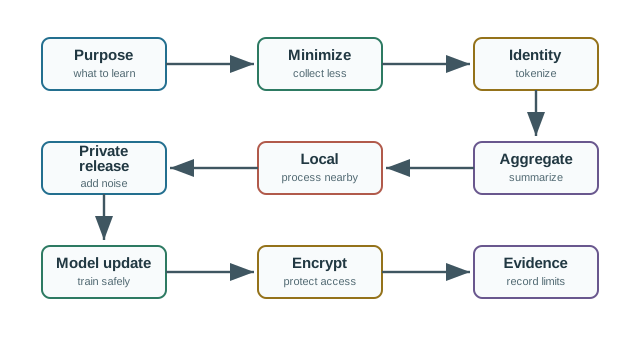
Read Figure 12.1 from purpose through minimization and identity reduction, then compare aggregation, local processing, privacy-preserving release, model updates, and encryption as later choices. Each step should reduce what crosses the next boundary or protect a justified remainder. Finish at evidence, because a named technique without a tested data path is only a claim. The chapter now examines the first reduction step in detail.
privacy preserving narrated tour
Play silently with captions on provisional storyboard timing; narration audio is pending. Production pacing is not protocol time. Choose Reduced motion for a complete still at each beat.
Play the tour to open the workbench. Pause, replay a beat, or read the full transcript below. Unsupported processes keep the existing frame and provide captions only.
Full transcript — privacy preserving (8 beats)
B1 — Wearable identity
You are the engineer preparing fitness trends for a wearable service. The wristband collects heart measurements and precise location alongside a person's name. You want useful trends without making that person's behavior easy to trace. How much identity can survive a privacy transformation?
Model caption: A wearable fitness service starts with a name, heart measurement, and precise location.
B2 — Minimize first
Begin with minimization: keep only the detail the purpose needs. For a fitness trend, that means reducing unnecessary personal detail before applying another technique. Pseudonymization means replacing a direct identifier with a substitute label, called a token, while keeping a controlled way to reconnect it.
Model caption: Reduce unnecessary detail first; a pseudonym substitutes a token with a controlled reconnect path.
B3 — Supplied sample comparison
Take the lab's wearable example. The raw sample names a person and gives a heart rate of one hundred eighteen beats per minute. The supplied protected sample has no name. It contains an average of one hundred sixteen beats per minute and a broad location zone.
Model caption: Raw sample: 118 beats per minute. Supplied protected sample: average 116 beats per minute, a location zone, and no name. These are supplied values, not a calculated average from the single raw reading.
B4 — Stable keys and release
The protected sample also retains the band identifier and adds a subject token. At privacy strength three, the token stays stable. The released sample uses a stable joining key and offers a group heart trend with restricted access. Useful analysis remains possible, alongside a way to connect behavior.
Model caption: The band identifier remains. At strength 3, the subject token and release joining key are stable; the restricted output is a group heart trend.
B5 — Utility calculation
For a worked calculation, use wearable data, pseudonymization, and an internal audience, with privacy strength three. The lab starts utility at eighty-eight, adds two for internal use to reach ninety, then subtracts ten for pseudonymization, leaving eighty.
Model caption: Teaching calculation: 88 + 2 = 90; 90 − 10 = 80. The asset displays the final score, not these intermediate steps.
B6 — Final teaching utility
Next, subtract one from strength three to get two. Multiply two by five to get ten, then subtract ten from eighty to get seventy. The selected technique adds zero bonus. Take the smaller of ninety-six and seventy, then the larger of twelve and seventy. The result is seventy percent utility in the lab's teaching model.
Model caption: 3 − 1 = 2; 2 × 5 = 10; 80 − 10 + 0 = 70. Minimum of 96 and 70: 70. Maximum of 12 and 70: 70. Final teaching utility: 70%.
B7 — Token is not anonymity
The misconception is that replacing a name with a token makes the data anonymous. It fails because someone with the reversing key can reconnect the person, and a stable token can connect behavior across datasets. Anonymity aims to make identifying someone again infeasible. Your service has reduced direct identification, while the data remains personal.
Model caption: A token is not anonymity. Someone with the reversing key can reconnect identity; a stable token can link behavior across datasets. This reconnection is explained, not simulated.
B8 — A label still identifies
A token changes the label; it does not erase the person.
Model caption: A token changes the label; it does not erase the person.
The One-Minute View
Reduce before protecting
Minimization changes the requirement, not just the safeguard. Fewer fields, lower precision, less frequency, shorter retention.
Combine, do not pick one
Good designs layer several techniques across device, gateway, and cloud, matched to where each kind of data lives.
Encryption is not minimization
Encryption protects confidentiality. It does not remove unnecessary raw data, decide who can decrypt it, or end its retention.
Beginner Examples
Work from the simplest case toward the broader design consequence. First, A camera that needs a head count can count people on the device and send only the number, never the video. Next, A thermostat that needs occupancy can report a state change instead of a continuous, minute-by-minute stream. Finally, "We encrypt the data" answers confidentiality. It does not answer whether the raw trail should have been stored at all.
Check the Minimization Move
If you can explain why minimization comes first and why encryption is not a substitute for it, you have the core idea. Continue to Practitioner to choose and combine the techniques.
Build the Technique Stack
The practical job is to assemble a technique set that fits the data, the purpose, and the architecture, then to leave evidence for the next reviewer. Work the stack from cheapest and strongest to most specialized.
Minimization: The Four Levers
Minimization is the first technique because it removes the requirement rather than adding a guard. Pull four levers: collect fewer fields (drop identifiers, media, and account data the purpose does not need); reduce frequency (event summaries or daily totals instead of raw high-rate streams); coarsen precision (a zone or room instead of exact coordinates); and shorten retention (convert raw inputs to summaries, then delete the raw once the purpose is met).
Minimization becomes actionable when the team can turn four independent levers. Use Figure 12.2 to test whether a feature really needs every field, every sample, exact precision, and the proposed retention period.
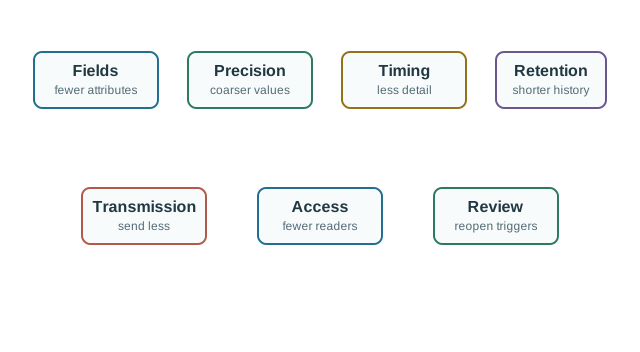
In Figure 12.2, inspect fields first, then precision, frequency, and retention. A door-occupancy feature might drop identifiers, keep only a room-level result, emit changes rather than raw motion, and expire events after aggregation. Follow the outer checks for transmission, access, and review so reductions survive beyond collection. Those choices define the smallest useful signal before the rest of the technique stack is selected.
Selecting the Rest of the Stack
Worked Reasoning: Household Energy Insights
A team wants to give users energy insights and the operator peer-group comparisons. Walk the stack instead of centralizing everything:
- Minimize: collect only the meter totals the display needs, not second-by-second draw.
- Process locally: compute appliance hints on the device or gateway where possible, so raw load shapes never leave the home.
- Aggregate with a threshold: upload daily summaries and suppress any peer-group cell that is too small to hide an individual.
- Reduce identity: pseudonymize service records with a context-specific key, not a single shared device ID.
- Protect access: encrypt storage and separate key access from broad application access.
- Record the trigger: note that any future partner export or model-training use reopens the review.
The same pattern recurs across deployments: a smart building counts motion locally and uploads zone counts; a wearable computes user-facing metrics on device and aggregates population insights; a fleet summarizes status at the gateway and refuses to join maintenance logs to user profiles.
Priya’s Data Diet
- Collect: only the meter totals the display needs, not second-by-second draw.
- Justify: appliance hints computed on the device or gateway, so raw load shapes never leave the home.
- Expire: convert raw inputs to summaries, then delete the raw once the purpose is met — the same rule that shortens retention.
Leave an Evidence Record
Every technique choice should leave a short, specific trail so a later reviewer understands the decision and knows what reopens it: the purpose served, the technique used, the threat it reduces, the test that proved it works, the limit that remains, and the trigger (a new data source, actor, model, export, or request) that requires a fresh review.
Check the Small-Cell Failure
If you can build a layered technique set and record why each piece was chosen, you can stop here. Continue to Under the Hood for how differential privacy, federated learning, and identity reduction actually work, and where they fail.
Know Each Mechanism's Guarantee
A technique's limit is the point beyond which its privacy guarantee no longer applies. The deeper layer explains what each technique promises, which data it protects, and what remains exposed. The recurring lesson is that every technique has a precise scope, and using it outside that scope quietly removes the protection.
Anonymization vs Pseudonymization
Pseudonymization replaces a direct identifier with a token but keeps a key that can reverse it, so pseudonymous data is still personal data and still regulated. Anonymization aims to make re-identification infeasible even with effort, after which the data is no longer personal. The gap between them is re-identification through quasi-identifiers: fields like precise location and exact time that are unique in combination, joinable to outside data. A token that stays stable across services is especially risky, because it becomes a cross-dataset tracker even with the name removed. Use per-context keyed hashing, and treat an output as anonymous only after testing direct identifiers, rare combinations, and plausible auxiliary joins.
Differential Privacy
Differential privacy is a release technique for aggregate results. It adds noise calibrated to the query's sensitivity, meaning how much one contributor can change the answer, so the presence or absence of any single person or device has only a bounded effect on what is published. Two properties matter in practice. First, it protects the released statistic, not the raw records, so it does nothing if many services can still read the underlying data. Second, repeated releases consume a cumulative privacy budget; many small queries erode the guarantee, so the budget must be tracked. It is a poor fit for single-user decisions, safety alarms, exact device diagnostics, very small groups, or any team that cannot maintain a budget and analyze sensitivity. The noise level is a deliberate design parameter; this chapter keeps it qualitative rather than inventing a value.
Differential privacy protects a released aggregate, not the raw database behind it. Inspect Figure 12.3 to follow where calibrated noise enters and which guarantee applies to the output.
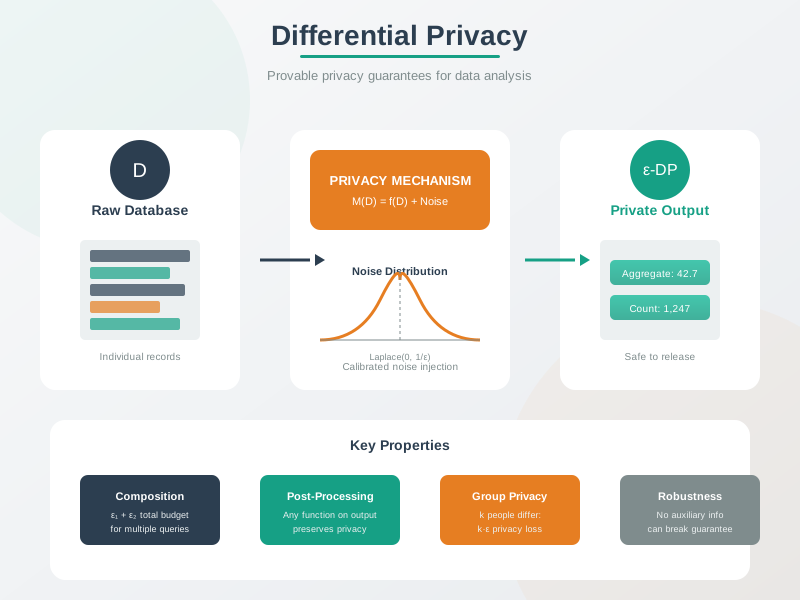
Read Figure 12.3 from individual records into the query and privacy mechanism, then inspect the calibrated noise before the statistic is released. The epsilon guarantee bounds how much one contributor can change the output; it does not secure the source records or make unlimited repeated queries safe. This is why the chapter places differential privacy after minimization and access control and requires cumulative budget tracking.
Federated Learning
Federated learning trains a shared model from distributed updates: each device or gateway learns locally on its own data, sends only a model update, and receives a new global model. This reduces raw-data centralization, but it does not erase privacy risk, because the updates themselves can reveal rare or memorized behavior. Sound designs clip updates so no single device dominates the model, aggregate updates before anyone inspects them (often with secure aggregation so the server sees only the sum), add noise when updates could expose rare patterns, monitor for poisoning and drift, and keep a rollback path. The honest summary: treat the update channel as a sensitive data flow and review it like any other.
Encryption, Access, and Advanced Computation
Encryption gives confidentiality in transit and at rest, but the technique question is whether the raw data should exist, who can decrypt it, and what happens when the purpose ends. Separate key access from broad application access, and use role boundaries, approval paths, audit logs, and short-lived grants for any exceptional raw-data use. For narrow, high-sensitivity workflows, specialized methods such as secure enclaves, secure multi-party computation, and homomorphic encryption can compute on protected data, but they are targeted tools, not general replacements for minimization.
Mechanisms and Failure Modes
Priya’s Data Diet
Read the parts as one connected control chain. First, Collect: minimization's guarantee — “the data simply is not there to leak or reuse.&rdquo. Next, Justify: each field tied to a purpose, per the row's own evidence-to-request column. Finally, Expire: raw inputs deleted on a schedule — the failure mode is “collect now, decide later,” which keeps everything forever.
Common Pitfalls
Review these failure modes in order. First, Encrypting instead of minimizing. An encrypted raw trail is still a raw trail; remove what is not needed first. Next, Trusting a stable token. A consistent pseudonym becomes a cross-service tracker; key it per context. Then, Publishing small cells. Aggregates of one or two people are not anonymous; set and enforce a threshold. Then, Applying differential privacy to raw access. It protects releases, not the underlying records, and the budget must be tracked. Finally, Treating federated updates as safe by default. Clip, aggregate, and test the update path for leakage.
Check the Differential Privacy Fit
At this depth, each technique is a precise guarantee with a precise scope: minimization removes data, pseudonymization is reversible and still personal, aggregation needs a group threshold, differential privacy protects releases under a tracked budget, and federated learning keeps raw data local but not its updates. A trustworthy review names the technique, the threat it handles, the test that proved it, and the limit that remains.
12.1 Summary
This section: Summary — Choose privacy techniques from the data the system needs, beginning with minimization.
Choose privacy techniques from the data the system needs, beginning with minimization. First, privacy techniques are design choices, not interchangeable switches; choose them by what the system needs to learn, and combine several across device, gateway, and cloud. Next, minimize first: fewer fields, lower frequency, coarser precision, and shorter retention change the requirement rather than adding a guard. Then, identity reduction lowers exposure, but pseudonymization is reversible and still personal data, and a stable token can track behavior across datasets. Then, aggregation publishes group summaries; it fails for small groups, rare cells, and repeated differencing queries, so enforce a minimum group size and suppress. Then, differential privacy protects aggregate releases by adding noise scaled to sensitivity, under a cumulative privacy budget; it does not protect raw records and suits many-contributor statistics, not single-user decisions. Then, local and edge processing keep raw signals near the source and send only results; debug and raw-export paths must be reviewed because they bypass the guard. Then, federated learning keeps raw training data on the device but its updates can leak, so clip, aggregate, add noise where needed, and test the update path. Finally, encryption gives confidentiality but is not minimization; separate key access from application access, and reserve enclaves, MPC, and homomorphic encryption for narrow high-sensitivity workflows.
Treat privacy techniques as a stack, not a single feature. Minimize first, reduce identity carefully, aggregate or process locally when you can, add differential privacy when publishing statistics, and use encryption plus access boundaries to protect what remains. Each technique has a precise scope; record the purpose, the test, and the limit so the decision survives the next product change.
12.2 See Also
This section: See Also
Privacy Threats in IoT
Revisit the collection, inference, tracking, profiling, and sharing risks these techniques are meant to counter.
Privacy by Design Foundations
Turn technique choices into product defaults and architecture decisions from the start.
Privacy by Design Implementation
See minimization, pseudonymization, and local processing built into data paths and runtime gates.
Safeguards and Protection
Add the access control, encryption, monitoring, and evidence that protect whatever data remains.
Find help
3 reviewed answers.
Where should I start in a module?
Open the module page from the sidebar to see its chapters in order. Use the module map to return to a topic you need.
Modules and pathsReviewed
What can I try when a project does not work?
Check the symptom, then work through the diagnostic steps. Keep the error message and the smallest example that reproduces it.
When you are stuckReviewed
How do interactive examples work?
Use the interactive guide to check how examples and simulations work before changing your project.
Interactive examples guideReviewed