6 Privacy Threats: Collection to Profiling
More
Depth: Practitioner
Progress saves as you read. Mark sections complete as you go; your progress appears in the sidebar.
6.1 A Working Device Can Still Expose Someone
This section: A Working Device Can Still Expose Someone — An IoT privacy threat often starts with a device doing its assigned job.
An IoT privacy threat often starts with a device doing its assigned job. The speaker listens for commands, the thermostat records comfort, the meter measures energy, and the camera watches a doorway. The harm appears when those normal signals are combined, kept, or shared until they describe a person more clearly than the person expected.
6.2 The Core Idea: Privacy Is Not Security
This section: The Core Idea: Privacy Is Not Security — Most people picture a privacy problem as a hacker breaking in.
Most people picture a privacy problem as a hacker breaking in. In the Internet of Things, the harder and more common problem is the opposite: devices that work exactly as designed, quietly collecting and sharing far more about people than anyone intended. A privacy threat is not mainly about an attacker defeating a lock. It is about whether sensitive facts about a person can be collected, combined, inferred, retained, or shared at all.
The cleanest way to hold the distinction is a house. Security is the locks, the alarm, and the strong door that keep intruders out. Privacy is the curtains and the choice of who gets to look inside. You can have excellent security and poor privacy at the same time: a house with the best locks in the neighborhood and no curtains is perfectly protected from burglars and completely exposed to anyone walking past.
If you only need the intuition, this layer is enough: security asks "can attackers get in?" while privacy asks "should this data exist, and where should it go?" Most IoT privacy harm comes from legitimate, working-as-designed collection, not from a break-in. A thermostat that logs the temperature every minute is behaving correctly, yet that same log reveals when you wake, when you leave, and when your home is empty.
This matters because IoT puts always-on sensors into homes, bodies, vehicles, and cities. Each device gathers a thin slice of data that looks harmless on its own. The threat appears when those slices are combined, when they are kept far longer than needed, and when they flow to companies the person has no relationship with. The right first questions are not "how do we protect this data?" but "do we need to collect it, how long must we keep it, who else will see it, and what could someone learn from it?"
6.2.1 The One-Minute View
Privacy is not security
Security keeps attackers out; privacy decides what data exists and where it flows. A secure device can still over-collect and over-share.
Legitimate collection, real harm
Most IoT privacy damage comes from devices doing their job, not from breaches. The data was meant to be collected; the harm is in how it is used.
Inference is the engine
Innocuous signals combined over time reveal sensitive facts, such as routines, health, and occupancy, that no single reading exposed.
6.2.2 Beginner Examples
Work from the simplest case toward the broader design consequence. First, A smart speaker can be fully encrypted and never breached, yet still send audio-derived data to several companies by design. That is a privacy problem, not a security one. Next, A fitness tracker's "anonymous" activity map can expose a person's home, workplace, and daily route, because a movement pattern is nearly as unique as a fingerprint. Finally, "We encrypt everything" answers a security question. It says nothing about whether the data should have been collected, how long it is kept, or who it is shared with.
6.2.3 Overview Knowledge Check
If you can explain why a secure device can still be a privacy threat, you have the core idea. Continue to Practitioner for the five threat families and how to spot them in a real deployment.
6.3 Practitioner: Five Threat Families
This section: Practitioner: Five Threat Families — In practice, IoT privacy threats fall into five families.
In practice, IoT privacy threats fall into five families. They rarely act alone: excessive collection feeds aggregation, which powers profiling; location tracking enriches the profile; and third-party sharing spreads it across organizations. Naming the family for each risk turns a vague worry into a concrete checklist.
6.3.1 The Five Families and What to Check
6.3.2 Worked Reasoning: Anonymized IDs
A landlord equips a 200-unit building with per-unit smart thermostats, smart locks, water-flow sensors, and electricity meters, and argues it is fine because "we only see unit numbers, not names." Walk the inference instead of accepting the label:
- Thermostat setpoint changes mark wake time, departure, return, and bedtime: a full daily schedule.
- Water flow timing reveals shower and cooking habits, and whether someone is home at midday.
- Electricity load shapes expose appliance use, cooking, entertainment, and even an electric-vehicle charge overnight.
- Combined, the streams show household size, overnight guests, and multi-day absences (a burglary window).
Now the punchline: the data is not anonymous, it is pseudonymous. The landlord already holds the unit-to-tenant mapping in the lease, so a unit number is just a reversible label. Unit numbers do not make these readings anonymous; keeping the lease mapping separate with strict access can reduce exposure, but the readings remain personal data. The right question is not "is this data anonymized?" but "does this data need to exist at all?" A privacy-preserving redesign keeps the useful outcomes, such as leak alerts and monthly billing totals, while collecting a tiny fraction of the raw readings.
6.3.3 What History Has Taught
Anonymized can de-anonymize
A widely reported fitness app published an aggregate "anonymous" activity map; in sparsely populated areas it traced sensitive sites and routines. Anonymization fails when the population is small or distinctive.
Purpose drifts
Home cameras and wearables collected for convenience or health have been repurposed for surveillance partnerships and subpoenaed as evidence. Data outlives its original purpose.
Unexpected monetization
Robot-vacuum maps of home layouts were openly discussed as a saleable data product. Users rarely expect spatial data to become inventory for sale.
These are not exotic breaches; they are ordinary products used as built. A journalist-run experiment that filled a home with everyday smart devices found their traffic flowing to dozens of separate companies, most of which the household had never heard of, with the data never pausing even when the devices sat idle.
6.3.4 Practitioner Knowledge Check
If you can name the family for a given risk and reason through what the combined data reveals, you can stop here. Continue to Under the Hood for why inference works and why "anonymous" data leaks.
6.4 Under the Hood: Inference Risks
This section: Under the Hood: Inference Risks — The deeper layer explains the mechanisms that turn telemetry into a person.
The deeper layer explains the mechanisms that turn telemetry into a person. Three ideas do most of the work: aggregation as evidence, re-identification through quasi-identifiers, and leakage through side channels and passive signals.
6.4.1 Aggregation as Accumulating Evidence
Each sensor is a noisy, partial witness to a hidden fact such as "is anyone home?" A smart meter, a thermostat, and a lock each predict occupancy imperfectly, but they make partially independent errors, so combining them sharply reduces the remaining uncertainty. In information terms, the joint information several sources carry about a target can be greater or smaller than the sum of their individual contributions, depending on synergy and redundancy. The practical consequence is that adding a few "harmless" streams can move an attacker from a rough guess to near-certainty, which is exactly why privacy degrades fast as devices accumulate. The amounts here are qualitative on purpose; the lesson is the direction, not a fabricated bit count.
6.4.2 Re-ID and Quasi-Identifiers
"Anonymous" usually means "names removed," which is far weaker than it sounds. The fields that remain, such as precise location, exact timestamps, and device traits, are quasi-identifiers: individually non-identifying, but jointly unique. k-anonymity formalizes a defense: every released record must be indistinguishable from at least k-1 others on the quasi-identifiers. It fails when those quasi-identifiers are left too fine-grained, so a record stands alone (effectively a group of one). The fix is to generalize (a city block instead of an intersection, an hour instead of a minute) and to suppress tiny groups. Raising k alone does not help if precise quasi-identifiers still allow linkage to outside data. Published research has shown that only a handful of time-stamped location points is often enough to single out an individual in a large dataset.
6.4.3 Anonymization and Linkage
Keep two terms distinct. Anonymization aims to make re-identification infeasible even with effort, and truly anonymous data is no longer personal data. Pseudonymization replaces identifiers with a token but keeps a key that can reverse it, so pseudonymous data is still personal data and still regulated. Most "anonymized" datasets are really pseudonymized, and they fall to a linkage attack: joining the released data with auxiliary information (a lease, a voter roll, a social profile) to restore identity. Linkage is easiest when the population is small or distinctive, which is why aggregate maps can expose a remote facility while hiding in a crowded city.
6.4.4 Side Channels and Passive Tracking
Some leakage rides on signals that were never meant to carry content. Side channels expose information through timing, power draw, or traffic shape: non-intrusive load monitoring infers which appliances run from a single power feed, and packet sizes and timing can betray activity even under encryption. Passive tracking exploits identifiers that devices broadcast just by being on, such as Wi-Fi probe requests and Bluetooth advertisements, which let infrastructure follow phones and wearables, including those of non-users who never opted in. These channels matter because they bypass the consent and access controls placed on the "real" data path.
6.4.5 Mechanisms and Failure Modes
6.4.6 Common Pitfalls
Review these failure modes in order. First, Treating low-sensitivity data as safe. Power and temperature look dull yet reveal wake times, appliances, and possible health conditions. Next, Reviewing streams in isolation. Aggregation risk lives in the combination; assess data sets together. Then, Trusting the word "anonymized." Without a re-identification test against auxiliary data, it usually means pseudonymized. Then, Ignoring passive and side channels. Probe requests, advertisements, and traffic shape track people outside the consented data path. Finally, Keeping everything forever. Indefinite retention turns a momentary reading into a permanent dossier; minimize and delete.
6.4.7 Under-the-Hood Knowledge Check
-
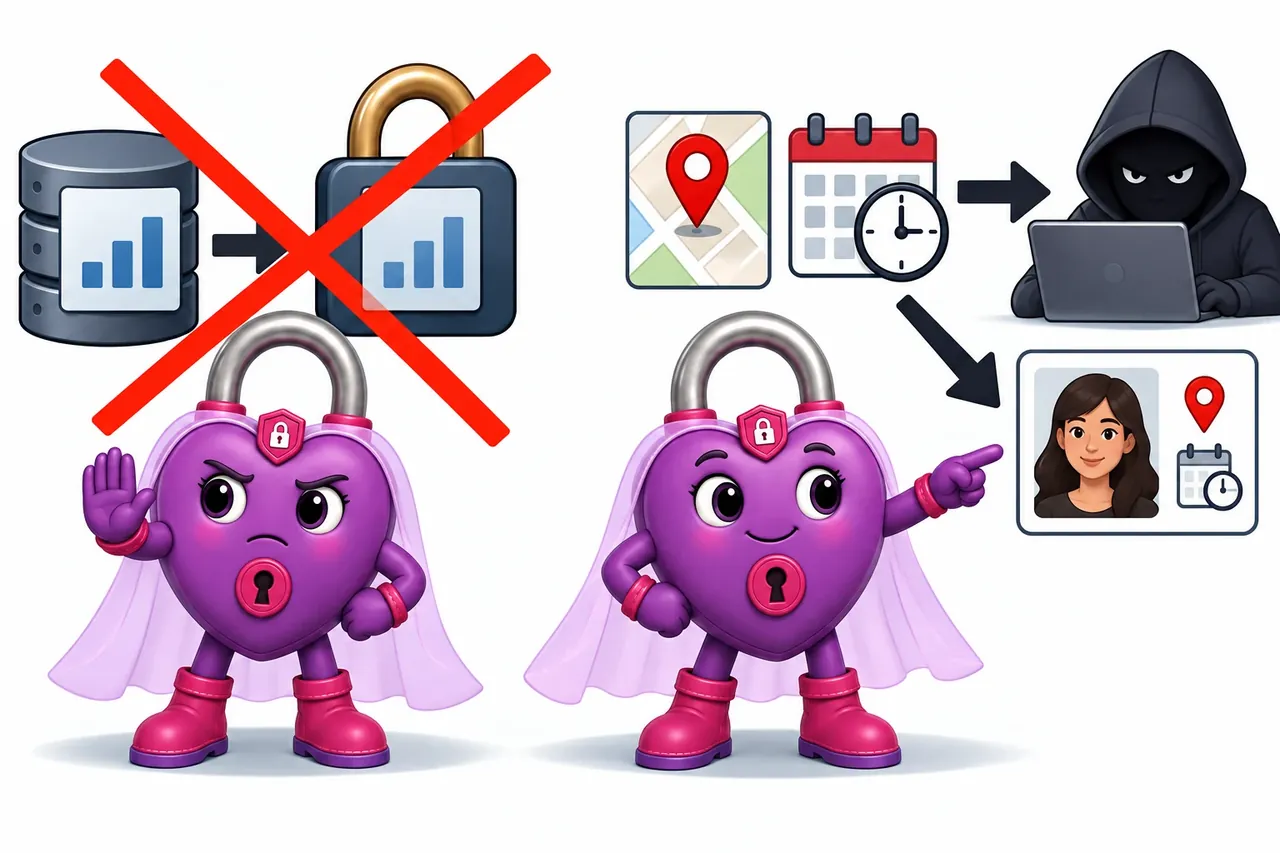
Wrong idea: encrypt the vehicle count to stop re-identification. It fails because the unique place and time reveal the record, while the count is only a summary.
At this depth, an IoT privacy threat is a chain: routine collection feeds aggregation, fine-grained quasi-identifiers enable re-identification through linkage, and side channels leak around the controls entirely. A trustworthy review tests the combination, assumes the attacker has auxiliary data, and asks first whether the data needs to exist at all.
The diagram Figure 6.1 brings these three privacy mechanisms together.

In the diagram Figure 6.1, routine device signals may look harmless in isolation. Combining streams can reveal routines, occupancy, and absences; linking precise quasi-identifiers to auxiliary data can restore identity; and side channels or passive identifiers can reveal activity, presence, and movement outside the consented data path. Traffic shape can leak activity even when content is encrypted.
6.5 Summary
This section: Summary — Look for harm in how data is kept, used, or shared.
Look for harm in how data is kept, used, or shared. First, privacy and security are different questions: security keeps attackers out, while privacy decides what data should exist and where it should flow. A secure device can still be a privacy threat. Next, most IoT privacy harm comes from legitimate, working-as-designed collection, retention, and sharing, not from a break-in. Then, five threat families cover the field: unauthorized or excessive collection, aggregation and inference, location tracking, behavioral profiling, and third-party sharing. They compound rather than act alone. Then, aggregation is the engine: partially independent “harmless” streams combine into near-certain inferences about routines, occupancy, and health. Then, “Anonymized” usually means “names removed.” Quasi-identifiers such as precise location and time remain unique, and linkage to auxiliary data restores identity, especially in small or distinctive populations. Then, pseudonymization keeps a reversible key, so pseudonymous data is still personal data; unit-level or token-level labels give no protection when the controller already holds the mapping. Then, k-anonymity defends releases only when quasi-identifiers are generalized and tiny groups are suppressed; raising k alone does not fix fine-grained records. Finally, side channels (power, timing, traffic shape) and passive identifiers (Wi-Fi probes, Bluetooth advertisements) leak behavior and presence around the consented data path.
IoT privacy threats rarely look like an attack. They are the result of routine collection that is aggregated, retained, and shared until ordinary telemetry describes a person. Before asking how to protect the data, ask whether it needs to exist, how long it must be kept, who will see it, and what can be inferred from it. “We encrypt everything” is a security answer to a privacy question.
6.6 See Also
This section: See Also
6.6.1 Privacy Techniques
Move from threats to mitigations: minimization, pseudonymization, aggregation, local processing, and differential privacy.
6.6.2 Privacy Principles
Ground the threats in purpose limitation, data minimization, storage limitation, and consent.
6.6.3 Privacy Regulations
See how GDPR and similar regimes turn these risks into legal duties and data-subject rights.
6.6.4 Privacy by Design
Learn to build privacy in from the start rather than bolting it on after collection.
Find help
3 reviewed answers.
Where should I start in a module?
Open the module page from the sidebar to see its chapters in order. Use the module map to return to a topic you need.
Modules and pathsReviewed
What can I try when a project does not work?
Check the symptom, then work through the diagnostic steps. Keep the error message and the smallest example that reproduces it.
When you are stuckReviewed
How do interactive examples work?
Use the interactive guide to check how examples and simulations work before changing your project.
Interactive examples guideReviewed