2 Privacy and Compliance Route Map
More
Depth: Practitioner
Progress saves as you read. Mark sections complete as you go; your progress appears in the sidebar.
2.2 Start With the Story
This section: Start With the Story — Imagine a smart building app that says it only uses occupancy data to lower heating costs.
Imagine a smart building app that says it only uses occupancy data to lower heating costs. A reviewer should be able to follow that claim from the sensor event to the gateway, dashboard, retention rule, support role, deletion behavior, and evidence record. If raw motion events later feed a new analytics model, the old privacy answer is no longer enough.
That is the plain-language goal of this route. Treat privacy compliance as a product story with proof: name the data, state the purpose, reduce what is collected, protect what remains, and write down what would make the team review the decision again. The regulations matter, but they become useful only after the data story is visible.
2.3 Learning Objectives
This section: Learning Objectives
By the end of this module route, you will be able to:
- Map an IoT data flow from device collection to downstream use.
- Separate data purpose, consent or notice, retention, access, sharing, and deletion questions.
- Recognize privacy risks in mobile sensing, location data, identifiers, telemetry, and inferred behavior.
- Connect safeguards and zero-trust boundaries to privacy outcomes.
- Build a review record that supports audits and change review.
- Route yourself to the right privacy, safeguard, or zero-trust chapter.
2.4 Prerequisites
This section: Prerequisites — You should already be comfortable with device data flows, application protocols, authentication basics, and network segmentation.
You should already be comfortable with device data flows, application protocols, authentication basics, and network segmentation. Useful refreshers include IoT Protocols Overview, Authentication and Access Control, and Encryption Principles.
This module is educational and engineering-focused. It teaches how to create reviewable privacy evidence. It does not replace current advice from qualified compliance, security, or regulatory specialists for a specific product, region, or organization.
2.5 Module Route
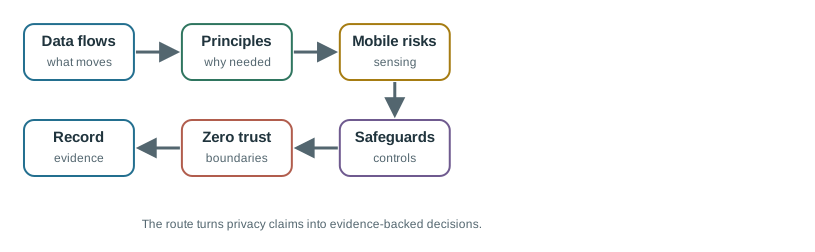
This section: Module Route — Use Figure 2.1 to follow a smart-building occupancy count from device to dashboard.
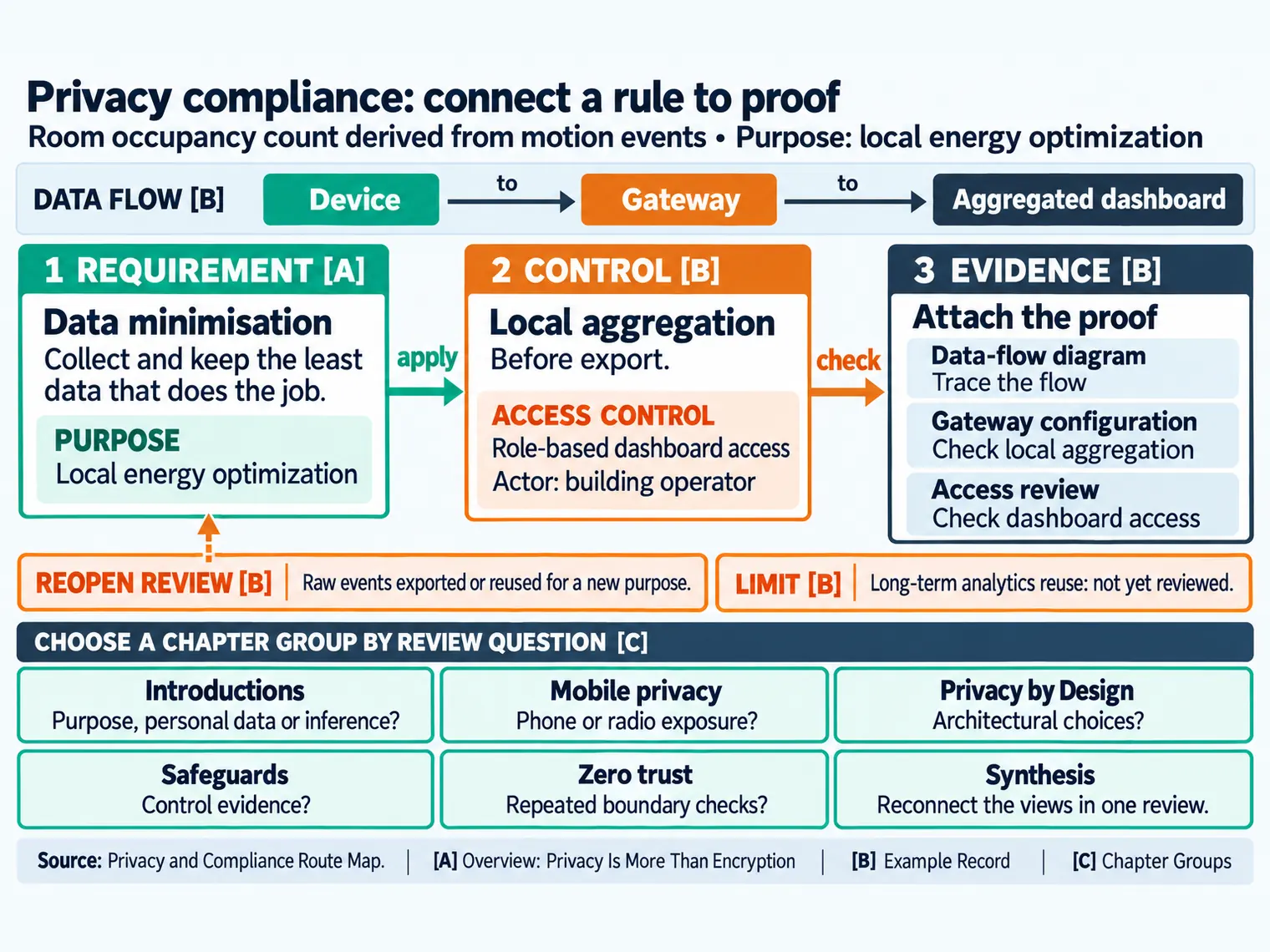
Use Figure 2.1 to follow a smart-building occupancy count from device to dashboard.
Motion events start at the device. The gateway aggregates them locally, and only a room occupancy count reaches the dashboard for energy use. The building operator has role-based access; gateway settings and access reviews are evidence for those limits. A dashed path proposes raw motion events for a new analytics model. That changes both the data detail and the purpose, so the privacy record must reopen before the new flow begins. Keep the data-flow diagram, gateway configuration, owner, and review trigger with the decision. The solid and dashed paths show why approval of a count does not automatically approve raw-event reuse.
Start
2.5.1 Build the data map
Use the introduction chapters to identify personal data, purposes, actors, and data movement.
Principles
2.5.2 Apply privacy rules
Use the principles chapters to check minimization, purpose fit, transparency, retention, and user control.
Mobile
2.5.3 Inspect sensing risk
Use the mobile privacy chapters to evaluate location, wireless traces, device identifiers, and inferred behavior.
Safeguards
2.5.4 Attach controls
Use safeguard chapters to connect encryption, access, logging, retention, deletion, and incident evidence.
Zero Trust
2.5.5 Limit blast radius
Use zero-trust chapters to define device identity, segmentation, continuous checks, and policy boundaries.
Record
2.5.6 Preserve evidence
Keep review records current when data, purpose, users, regions, service providers, or model behavior changes.
2.6 Data Lifecycle
This section: Data Lifecycle — Privacy review starts with data movement.
Privacy review starts with data movement. Use Figure 2.2 to inspect every state in which a control can fail or a purpose can quietly expand.
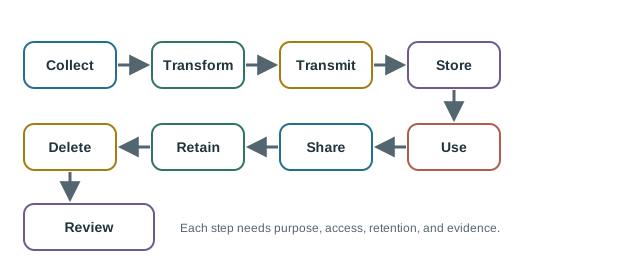
Follow Figure 2.2 from collection through transformation, transmission, storage, use, and sharing. Then inspect retention and deletion as operational states rather than policy words, and finish at review, which reopens the record when data or purpose changes. A safeguard at one stage cannot stand in for the others. The ordered questions below turn each lifecycle transition into evidence a reviewer can request.
For each stage of the lifecycle, record the decision and its evidence:
- Collect: State what the device, sensor, gateway, application, or interface captures.
- Transform: Record filtering, aggregation, labelling, inference, pseudonymisation, or feature extraction.
- Transmit: Trace device, gateway, cloud, mobile, partner, and operational paths.
- Store: Name stores, retention needs, backups, and access groups.
- Use: Connect each use to a stated purpose.
- Share: Identify every internal or external recipient.
- Delete or retain: Define the behavior across live systems, logs, backups, exports, and derived records.
- Review: Reopen the record whenever data, purpose, region, user group, or safeguard changes.
2.7 Review Questions
This section: Review Questions — The quickest way to improve a privacy chapter or design review is to ask consistent questions.
The quickest way to improve a privacy chapter or design review is to ask consistent questions. Inspect the board in Figure 2.3 so necessity comes before safeguards and evidence.
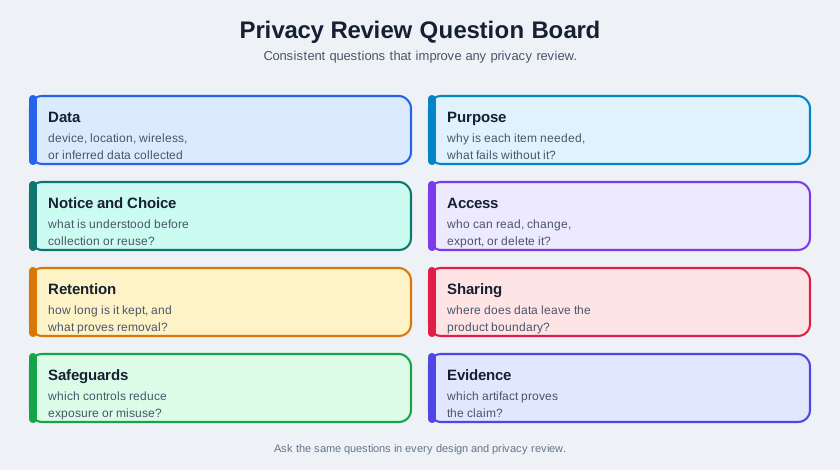
Read Figure 2.3 from data and purpose into notice, choice, and access. Continue through retention and sharing boundaries before asking which safeguard reduces the identified risk and which artifact proves that behavior. This order prevents a control inventory from replacing the privacy argument. The record fields that follow preserve the answers so later changes can be compared against the original decision.
Data
What personal, sensitive, device, location, wireless, or inferred data is collected?
Purpose
Why is each data item needed, and what product behavior would fail without it?
Notice and choice
What does the user, operator, or organization understand before data is collected or reused?
Access
Who can read, change, export, correlate, or delete the data?
Retention
How long is the data kept, and what evidence proves removal or reduction?
Sharing
Where does data leave the original product boundary?
Safeguards
Which controls reduce collection, exposure, misuse, retention, or unauthorized access?
Evidence
Which artifact proves the claim: data-flow map, configuration, test, policy, audit note, or deletion log?
2.8 Chapter Groups
This section: Chapter Groups — Choose the chapter group that matches the review question in front of you.
Choose the chapter group that matches the review question in front of you. Inspect the map in Figure 2.4 to move from foundational vocabulary toward design, safeguards, boundaries, and synthesis without skipping the data question.
In Figure 2.4, begin with introductions when purpose, personal data, or inference is unclear. Move to mobile privacy for phone and radio exposure, Privacy by Design for architectural choices, safeguards for control evidence, and zero trust for repeated boundary checks. Synthesis reconnects those views in one review. The next map focuses on safeguards while keeping that wider route visible.
Intro
2.8.1 Build the foundation
Read Introduction to Privacy, Privacy Fundamentals, Privacy Principles, Privacy Regulations, and Privacy Techniques.
Mobile
2.8.2 Inspect sensing surfaces
Read Mobile Privacy, Mobile Data Collection, Mobile Location, Wi-Fi Sensing Privacy, and Leak Detection.
Privacy Design
2.8.3 Build privacy into the system
Read Privacy-by-Design Foundations, Patterns, Implementation, Schemes, and Assessment.
Safeguards
2.8.4 Attach evidence-backed controls
Read Safeguards and Protection, Security Controls, NIST Framework, and GDPR Compliance.
Zero Trust
2.8.5 Limit identity and network risk
Read Zero-Trust Fundamentals, Architecture, Device Identity, Implementation, Network Segmentation, and Zero-Trust Security.
Synthesis
2.8.6 Connect privacy and security
Read Security and Privacy Overview and Introduction to Privacy Compliance when you need a combined route.
2.9 Safeguard Map
This section: Safeguard Map — Controls should connect to a privacy risk, not float as a generic security checklist.
Controls should connect to a privacy risk, not float as a generic security checklist. Use Figure 2.5 to trace each control family back to the exposure it reduces and the evidence it should leave.
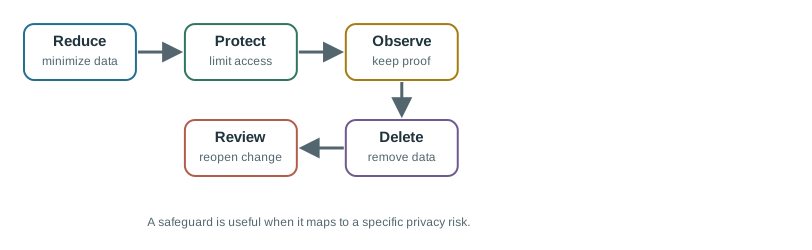
Read Figure 2.5 from reduction to protection, observation, and deletion. Reduction removes unnecessary exposure; protection constrains justified data; observation reveals misuse or drift; deletion ends the approved lifetime. Review triggers reconnect the map when any assumption changes. This makes safeguards a lifecycle argument rather than a shopping list, and it supplies the control and evidence fields in the review record below.
Reduce
2.9.1 Minimize data
Collect less, transform earlier, aggregate where useful, and avoid unnecessary identifiers.
Protect
2.9.2 Control access
Use identity, authorization, encryption, and segmentation to limit who can reach data.
Observe
2.9.3 Keep evidence
Log access, changes, exports, deletions, policy decisions, and incident response actions.
Delete
2.9.4 Make removal real
Define deletion behavior for live records, logs, backups, exports, derived features, and model inputs.
Review
2.9.5 Reopen on change
Trigger review when collection, purpose, sharing, region, retention, or user population changes.
2.10 Privacy Review Record
This section: Privacy Review Record — Use a record when a design, lab, case study, or assessment makes a privacy claim.
Use a record when a design, lab, case study, or assessment makes a privacy claim. Figure 2.6 shows the minimum chain needed to make that claim testable and maintainable.
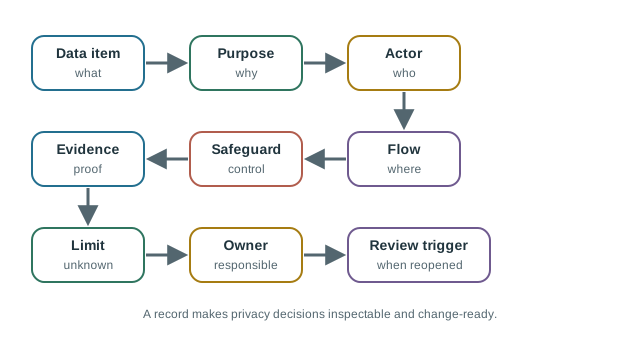
In Figure 2.6, start with the data item, purpose, actor, and flow; together they define the claim’s scope. Then name the safeguard and observed evidence, record the safeguard’s limit, assign an owner, and specify the event that reopens review. Each later chapter can add depth to those fields, but the chain must remain intact so a technical control never loses its privacy rationale.
Data item
Name the data or inference being reviewed.
Purpose
State the product, operations, safety, support, analytics, or security reason for using it.
Actor
Identify the user, operator, administrator, partner, service, or model that interacts with it.
Flow
Trace where the data moves and where it is stored.
Safeguard
Name the control that reduces privacy risk.
Evidence
Attach the artifact that proves the statement.
Limit
State what remains unknown, untested, or outside the current review.
Review trigger
Define the change that reopens the record.
Data item: room occupancy count derived from motion events. Purpose: local energy optimization. Actor: building operator. Flow: device to gateway, then aggregated dashboard. Safeguard: local aggregation before export and role-based dashboard access. Evidence: data-flow diagram, gateway configuration, and access review. Limit: long-term analytics reuse is not yet reviewed. Review trigger: reopen if raw events are exported or reused for a new purpose.
2.11 Knowledge Check
This section: Knowledge Check
2.12 What to Read Next
This section: What to Read Next
Compliance
2.12.1 Start the route
Use Introduction to Privacy Compliance for the next chapter.
Principles
2.12.2 Check the rules
Use Privacy Principles when reviewing data minimization, purpose fit, transparency, retention, and user control.
Mobile
2.12.3 Inspect sensing
Use Mobile Privacy when the product uses location, wireless traces, app permissions, or device identifiers.
Safeguards
2.12.4 Attach controls
Use Safeguards and Protection when the review needs concrete controls and evidence.
Privacy compliance work is reviewable evidence: map the data, state the purpose, attach safeguards, keep proof, and reopen the record when the product changes.
Overview: Privacy Is More Than Encryption
Encryption protects data from outsiders, but privacy is a wider problem: it is also about what the people who are allowed to see the data can infer about individuals, and about not collecting more than you need in the first place. A perfectly encrypted database of everyone's exact location is still a privacy disaster the moment an authorised insider queries it.
Two ideas anchor privacy engineering. Data minimisation says collect and keep the least data that does the job. De-identification says weaken the link between records and the people they describe. Regulations like the GDPR encode these as principles, but they are good engineering regardless of jurisdiction.
A useful compliance record is therefore not a legal slogan. It is a small evidence package that connects a product purpose to the data fields, devices, roles, storage locations, retention rules, safeguards, and review triggers that make the purpose defensible. If a door sensor only needs hourly occupancy counts for energy control, the record should make raw motion events, permanent identifiers, and unrelated analytics exports look suspicious until someone explains why they are needed.
That record also has to name the people affected by the system, not only the account owner. IoT products often observe visitors, household members, workers, tenants, patients, delivery drivers, or passersby who never accepted an app prompt. Privacy compliance asks whether those bystanders can be informed, whether the data can be aggregated at the edge, whether the service team can diagnose issues without seeing sensitive raw traces, and what change would force the review to reopen.
Use Figure 2.7 to turn the broad distinction between security and privacy into one ordered review path.
Read Figure 2.7 from mapping data and actors to stating a bounded purpose. Then minimize fields and retention before selecting safeguards and proof. The final step is not “done”: it records the change that reopens the decision. That order connects the overview to the module route above and ensures encryption protects only data that the system can first justify collecting.
Intuition: the safest data is the data you never collected. Everything you do gather is a liability to be minimised, de-identified, and given an expiry — not a trophy to be kept forever.
Overview Knowledge Check
Practitioner: Pseudonymisation, Anonymisation, and k-Anonymity
De-identification comes in degrees, and the difference is legally and practically important:
Pseudonymisation: replace identifiers with tokens; REVERSIBLE if you
                  hold the mapping -> still personal data under GDPR
Anonymisation:    irreversible; done properly, no longer personal data
k-anonymity:      each record is indistinguishable from at least k-1
others on the quasi-identifiers (age, ZIP, sex, ...)
For a practitioner, the key question is who can reverse the protection and with what auxiliary information. A tokenised device identifier may look safe in a dashboard, but if the support team keeps a lookup table, the record is still personal data for operational purposes. A dataset may also become personal data again when combined with a tenant roster, public property records, shift schedules, or precise location traces. The compliance record should name those linkable sources instead of treating "no name column" as the finish line.
Good de-identification is also purpose-specific. A fault-diagnosis export may need timestamp order but not exact home address. A public benchmark may need region, device class, and month but not full ZIP code or raw event time. A retention policy can keep short-lived raw logs for support while publishing only aggregated summaries. These decisions should be visible in the review: which fields were generalised, which were suppressed, which remain reversible, who holds the mapping, and which downstream use is not allowed without a fresh privacy review.
Worked example: raising k by generalising
A row with { age: 34, ZIP: 90210, sex: F, diagnosis } may be
unique -> re-identifiable, k = 1.

Generalise the quasi-identifiers:
  age 34   -> age range 30-39
  ZIP 90210 -> region 902**
Now many rows share { 30-39, 902**, F }, so any one record
belongs to a group of 20 matching records -> k = 20.

The diagnosis is still useful for statistics, but no single
person stands out.
The lesson: removing the name is not anonymisation. It is the combination of quasi-identifiers that re-identifies people, so de-identification must generalise or suppress those, not just delete the obvious identifier.
Practitioner Knowledge Check
Under the Hood: Differential Privacy and Its Guarantee
Ad hoc masking keeps failing to re-identification, which is why modern privacy leans on techniques with provable guarantees.
Differential privacy is different from ordinary masking because it defines the guarantee against a neighboring dataset: one version contains a person's record and the other does not. The published mechanism should behave almost the same in both cases. That is what lets a reviewer reason about the risk to one participant even when an attacker knows many other facts about the population. The promise is not that every answer is exact; the promise is that one person's participation has a bounded effect on what outsiders can learn from the released output.
The privacy budget is the operational control. A small epsilon gives stronger privacy but adds more noise, so the result may be less useful for fine-grained engineering decisions. A large epsilon gives more accuracy but weaker privacy. Repeated releases spend budget, and overlapping queries can leak information through differencing, so production systems need query limits, aggregation thresholds, audit logs, and a documented reason for each release. Differential privacy works best when it is paired with minimisation, retention limits, access control, and a clear decision about which statistics are worth publishing.
k-anonymity's own weaknesses
If all k matching records share the same sensitive value (a homogeneity attack), you learn it anyway. Extensions like l-diversity and t-closeness patch this, but the arms race shows the limits of generalisation alone.
Differential privacy
Add calibrated random noise so that whether any single individual is in the dataset barely changes any published result. It gives a provable guarantee rather than hoping no combination re-identifies someone.
The epsilon budget
Differential privacy is tuned by epsilon: smaller epsilon means more noise and stronger privacy; larger epsilon means more accuracy and weaker privacy. It is used in production by Apple, Google, and the US Census Bureau.
Even aggregates can leak
Releasing many overlapping statistics allows differencing attacks that isolate one person. Location-and-time traces are especially re-identifying, so aggregate carefully and limit query power.
So privacy by design means building these in from the start: minimise what you collect, de-identify with methods matched to the threat (k-anonymity for simple release, differential privacy for strong guarantees), set retention limits, and treat every dataset as a liability. The goal is not merely to lock the data away but to ensure that even legitimate use cannot quietly expose the people inside it.
Under-the-Hood Knowledge Check
2.13 Summary
This section: Summary — This module covers privacy, compliance, safeguards, mobile privacy, privacy by design, and zero-trust security for IoT systems.
This module covers privacy, compliance, safeguards, mobile privacy, privacy by design, and zero-trust security for IoT systems. It connects legal obligations with engineering controls and operational review.
Find help
3 reviewed answers.
Where should I start in a module?
Open the module page from the sidebar to see its chapters in order. Use the module map to return to a topic you need.
Modules and pathsReviewed
What can I try when a project does not work?
Check the symptom, then work through the diagnostic steps. Keep the error message and the smallest example that reproduces it.
When you are stuckReviewed
How do interactive examples work?
Use the interactive guide to check how examples and simulations work before changing your project.
Interactive examples guideReviewed