18 Which Privacy Laws Apply to IoT
More
Depth: Practitioner
Progress saves as you read. Mark sections complete as you go; your progress appears in the sidebar.
-

Which privacy rules apply to this child's wearable?
18.1 Start Simple
This section: Start Simple — Picture a wearable sold online, used by a child, and supported by a team in another country.
Map the People and Data Before Naming a Law
Picture a wearable sold online, used by a child, and supported by a team in another country. A rule remembered from one launch meeting may not cover the person, place, data, or role involved today. Begin with the real situation, not a familiar law name.
Write who the data describes, where that person is, what the device senses, why it is used, who decides that purpose, and every country the record enters. Separate the raw signal from the result shown to a user. Mark children, health, location, identity, and other sensitive cases for qualified review.
Use a current official source for each possible duty. Record the source, date checked, responsible owner, and next review date. Then test a request to view, correct, remove, or transfer a record through the actual product path. A policy sentence is weak evidence if the system cannot carry out the promised action.
This map is not legal advice and does not decide every edge case. Laws and guidance change. The deeper sections provide a review workflow while keeping final applicability with qualified people and current sources.
Imagine a connected camera is sold in several countries, records visitors at the door, stores clips in the cloud, and lets a support team inspect logs when something breaks. The first privacy question is not “which law sounds familiar?” It is “whose data is this, where are they, what kind of data is captured, who decides the purpose, and where do we verify the current rule?”
That is the story behind regulation mapping: turn a vague legal worry into a concrete data situation, then check the right source and keep the evidence.
18.2 Overview: Map the Situation, Do Not Memorize the Law
This section: Overview: Map the Situation, Do Not Memorize the Law — Privacy regulation for IoT is less about reciting statutes and more about mapping: given a specific product and deployment, which frameworks apply, to which data, and in which role.
Privacy regulation for IoT is less about reciting statutes and more about mapping: given a specific product and deployment, which frameworks apply, to which data, and in which role. The reason to map rather than memorize is practical. Privacy laws differ by place, change over time, and frequently overlap, so a remembered figure or deadline goes stale quickly. The durable skill is to identify the applicable frameworks and then verify the current specifics against the official source.
IoT makes this sharper because a single device can be sold across regions, sit in a home or a body, and capture audio, video, location, health signals, or data about children. The same product can therefore fall under several regimes at once, and the answer to "what do we owe?" depends on whose data it is, what kind of data, and whether your organization decides how the data is used or merely processes it for someone else.
If you only need the intuition, this layer is enough: ask whose data you handle (jurisdiction), what kind it is (sensitivity), and what your role is (decider or processor). More than one framework can apply, and you confirm the details at the official source rather than from memory.
Think of it like shipping a physical product internationally. You do not memorize every country's rules; you determine where it is going, what category it falls into, and who is responsible, then check the current requirements for each destination. Privacy mapping is the same discipline applied to data.
For a smart doorbell, the first pass is not “which law do we prefer?” Inspect Figure 18.1 and ask where residents and visitors are, what the sensors collect, who decides the purpose, where data transfers, and which official source confirms the current duty. Each resulting row needs an owner and revisit date because the map is operational evidence.
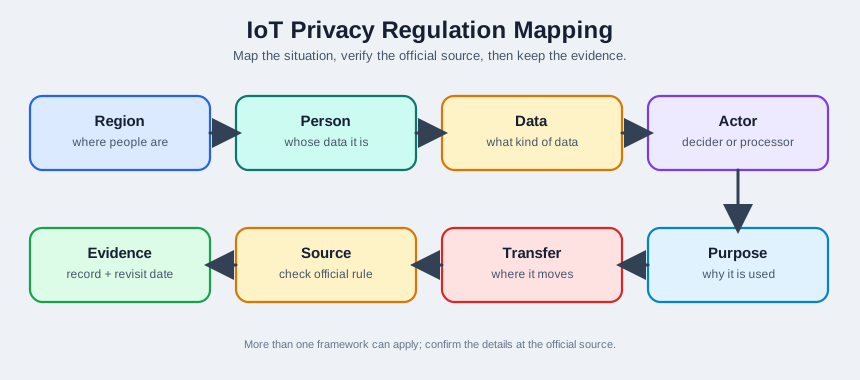
Read Figure 18.1 from region and affected person through data, actor, purpose, and transfer. Only then check the authoritative source and record the resulting obligation, evidence, owner, and review date. The route does not decide legal applicability by itself; it structures the facts and source verification needed for qualified review. That discipline prevents a memorized regulation name from replacing a current, situation-specific mapping.
18.2.1 The One-Minute View
Whose data: jurisdiction
What applies often depends on where the people are, not only where your servers or headquarters sit.
What kind: sensitivity
Health, biometrics, precise location, and data about children typically trigger stronger duties.
Your role: decider or processor
Who decides why and how data is used shapes who owes which obligations.
18.2.2 Frameworks You Will Commonly Encounter
Read the parts as one connected control chain. First, GDPR, the European Union General Data Protection Regulation, centered on personal data of people in the EU, with roles of controller and processor. Next, CCPA, the California Consumer Privacy Act as amended, giving California consumers rights over their personal information. Then, COPPA, the United States Children's Online Privacy Protection Act, focused on the online collection of personal information from children under 13. Finally, HIPAA, the United States Health Insurance Portability and Accountability Act, covering protected health information held by covered entities and their business associates.
18.2.3 Overview Knowledge Check
If you can ask the three mapping questions, you have the core idea. Continue to Practitioner for the workflow and how to handle privacy requests.
18.3 Practitioner: A Mapping Workflow
This section: Practitioner: A Mapping Workflow — Map a product the same way each time, and record the result so it can be reviewed.
Map a product the same way each time, and record the result so it can be reviewed. The workflow does not require you to know every clause; it requires you to identify what applies and to confirm the current specifics at the official source. Keep brittle details, such as exact response windows and penalty amounts, out of your internal notes and instead point to where the authoritative answer lives, because those details change.
18.3.1 The Mapping Steps
Read the parts as one connected control chain. First, Jurisdiction. List where the affected people are, not just where you operate. Next, Data type. Classify what the device collects, flagging sensitive categories such as health, biometrics, precise location, and anything about children. Then, Role. Determine whether you decide the purposes and means, or process on another organization's behalf, for each data flow. Then, Obligations. Identify the high-level duties that follow, such as having a lawful basis, honoring rights, and applying safeguards, then confirm the specifics at the source. Then, Request paths. Define how a person exercises their rights and how you will fulfill them. Finally, Evidence. Record the mapping, the source references, and the owner, with a date to revisit.
18.3.2 Handling Privacy Requests
Whatever the framework, a privacy request follows a similar shape, and the safe approach is to build the path once and reuse it. Verify the requester's identity proportionately, locate every place the data lives, including device-local stores and backups, take the requested action, and record what was done. The specific rights and the time you have to respond vary by law, so the workflow should treat those parameters as values to look up rather than constants to hard-code.
18.3.3 Practitioner Knowledge Check
If you can run the mapping and build a reusable request path, you can stop here. Continue to Under the Hood for why mapping beats memorizing, and the traps that mislead teams.
18.4 Under the Hood: Why Mapping Beats Memorizing
This section: Under the Hood: Why Mapping Beats Memorizing — The deeper layer explains the reasoning behind a source-checking, evidence-keeping approach, and names the assumptions that quietly produce non-compliance.
The deeper layer explains the reasoning behind a source-checking, evidence-keeping approach, and names the assumptions that quietly produce non-compliance. None of the traps here is about a specific number; they are about misreading the situation.
For the connected-camera example, make one row for visitor clips: identify where the visitors are, classify the captured data, and name who decides its purpose. Then attach the official source, resulting duty, owner, and review date; a familiar law name alone leaves that row unfinished.
18.4.1 Specifics Change, So Cite the Source
Response windows, monetary penalties, qualifying thresholds, and even the list of applicable laws shift as regulations are amended and as new ones are enacted in more jurisdictions. A team that hard-codes a remembered deadline or fine into its process will eventually be wrong. The durable practice is to record where the authoritative answer lives and to check it when it matters, so the process stays correct as the law moves. This is also why this chapter states obligations at a high level and points you to the source for the rest.
18.4.2 The Decider-Versus-Processor Distinction Drives Duties
Many obligations hinge on whether your organization decides the purposes and means of processing or acts on another's instructions. In GDPR terms this is the controller-versus-processor distinction; other frameworks draw a similar line with different words. Getting the role wrong misassigns who must honor rights, who must hold a lawful basis, and who must put agreements in place. In IoT this is subtle, because the same company can be a decider for its own product analytics and a processor when it runs a white-label service for another brand.
18.4.4 Requests Must Reach the Real Data, and Pseudonymous Is Not Out of Scope
Two failures recur. First, a request is honored in the main database while copies persist in device-local storage, caches, logs, and backups, so the action is incomplete. Second, a team assumes that because data is pseudonymized it falls outside the rules; but pseudonymous data is generally still personal data, because a reconnect path exists. A mapping that treats pseudonymization as an exemption will miss obligations it actually has.
18.4.5 Mechanisms and Failure Modes
18.4.6 Common Pitfalls
Review these failure modes in order. First, Memorizing specifics. Hard-coding a deadline or penalty instead of citing the source that defines it. Next, Home-country tunnel vision. Assuming only your own location's law applies. Then, Misreading the role. Treating a processor flow as a controller flow, or the reverse. Then, Under-rating data. Ignoring sensitive meaning that processing can infer. Finally, Pseudonymous equals exempt. Assuming tokenized data is outside the rules when a reconnect path exists.
18.4.7 Under-the-Hood Knowledge Check
At this depth, privacy regulation mapping is a repeatable analysis rather than a memory test: identify jurisdiction, data type, and role; state obligations at a high level and cite the source for the specifics; build request handling that reaches every copy; and keep evidence with a review date. A trustworthy review asks whether the role is right, whether sensitive meaning was recognized, and whether the specifics were verified at the source rather than recalled.
18.5 Summary
This section: Summary — Map each data flow to the laws, data type, and team role.
Map each data flow to the laws, data type, and team role. First, privacy regulation for IoT is a mapping skill: identify which frameworks apply, to which data, and in which role, rather than memorizing statutes that change. Next, three questions drive applicability: whose data (jurisdiction, often where the people are), what kind (sensitivity), and your role (decider or processor). Then, common frameworks include GDPR, CCPA, COPPA, and HIPAA; more than one can apply to the same IoT product at once. Then, state obligations at a high level and verify the specifics, such as response windows and penalties, at the official source, because those details change. Then, build a reusable privacy-request path: verify proportionately, locate every copy, fulfill the right that applies, and record what was done. Then, the decider-versus-processor role drives who owes what; the same company can be a decider for one flow and a processor for another. Finally, sensitive meaning can be inferred from mundane feeds, and pseudonymous data is generally still personal data, so neither can be treated as automatically out of scope.
Do not try to memorize privacy law; learn to map it. Ask whose data, what kind, and what your role is; expect several frameworks to apply at once; and cite the official source for the specifics instead of hard-coding a deadline or penalty that will change. Build request handling that reaches every copy of the data, and keep evidence with a review date. The review question is whether the mapping is right and current, not whether someone recalled a number.
18.6 See Also
This section: See Also
Privacy Principles and Ethics in IoT
Connect regulatory duties back to the underlying privacy principles they encode.
Go deeper on GDPR roles, lawful bases, and rights for connected products.
See how building privacy in supports the obligations these frameworks impose.
Place regulation mapping within the wider compliance program and its evidence.
Find help
3 reviewed answers.
Where should I start in a module?
Open the module page from the sidebar to see its chapters in order. Use the module map to return to a topic you need.
Modules and pathsReviewed
What can I try when a project does not work?
Check the symptom, then work through the diagnostic steps. Keep the error message and the smallest example that reproduces it.
When you are stuckReviewed
How do interactive examples work?
Use the interactive guide to check how examples and simulations work before changing your project.
Interactive examples guideReviewed