19 Building an IoT Privacy Program
More
Depth: Practitioner
Progress saves as you read. Mark sections complete as you go; your progress appears in the sidebar.
19.1 Start Simple
This section: Start Simple — Picture a team about to ship a new smart-home feature.
Picture a team about to ship a new smart-home feature. The engineers know which sensors are active, the product manager knows why the data is useful, support knows what users ask for, and legal knows what promises the notice makes. Compliance starts when those separate facts become one working record instead of scattered assumptions.
This chapter treats privacy compliance as that record-keeping discipline: data, purpose, choice, safeguards, assessment, and review all tied to the product that actually ships.
19.2 Overview: Compliance Is the Floor, Not the Ceiling
This section: Overview: Compliance Is the Floor, Not the Ceiling — Privacy compliance is meeting the legal and regulatory obligations that apply when a product handles personal data.
Privacy compliance is meeting the legal and regulatory obligations that apply when a product handles personal data. For connected products this is almost always in scope, because devices sense people in homes, on bodies, in vehicles, and at work, and that sensing produces personal data the moment it can be linked to a person.
The crucial mindset is that compliance is a floor, not a ceiling. A product can satisfy every rule and still over-collect or treat people poorly, so compliance does not guarantee privacy. At the same time, a product that ignores the rules is exposed regardless of how good its intentions are. The practical heart of compliance is accountability: you must be able to demonstrate, with records, that you handle personal data lawfully and as you promised.
If you only need the intuition, this layer is enough: know what personal data you handle and why, give people the notice and choices the law requires, protect the data, and keep records that demonstrate all of it. Treat compliance as the minimum and aim higher.
Think of a restaurant kitchen. Compliance is meeting the food-safety code and being able to show the inspection log on request. It does not guarantee the food is good, and a great chef does far more than the code requires, but no one is allowed to operate without it, and the records are how the kitchen proves it is safe. Privacy compliance plays the same role for a connected product.
For an IoT product, the useful program starts before the privacy notice is written. Inspect Figure 19.1 as the route: record the change, map personal data and telemetry, then link each use to purpose, choice, safeguards, assessment, and evidence. A smart-camera release should inventory clips, metadata, identifiers, storage, retention, and vendors before it updates the notice.
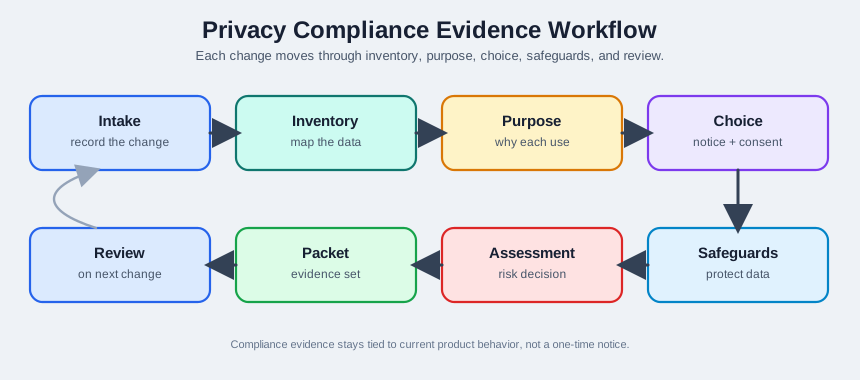
Read Figure 19.1 from intake through inventory, purpose, choice, safeguards, and assessment into the evidence packet. Then follow the loop back when the next product change occurs. The public promise stays tied to measured behavior only if every stage has an owner and current artifact. That continuing loop is why compliance is a floor for accountable operation rather than a one-time policy-writing exercise.
19.2.1 The One-Minute Compliance View
Know your data
Keep an inventory of what personal data the product handles, where it flows, who receives it, and how long it is kept.
Honor obligations and rights
Provide clear notice, the lawful basis or choices the law requires, and the individual rights people are entitled to.
Keep evidence current
Maintain records that demonstrate compliance, and update them whenever the product or its data flows change.
19.2.2 Beginner Examples
Work from the simplest case toward the broader design consequence. First, A product that meets every legal requirement but still collects more than it needs is compliant yet not especially private. Next, A clear, accurate privacy notice is part of compliance, but only if it matches what the product actually does. Finally, compliance is demonstrated with records, so "we comply" without supporting evidence is not enough.
19.2.3 Overview Knowledge Check
If you can see compliance as demonstrable accountability and a minimum bar, you have the core idea. Continue to Practitioner to build a compliance program for a real product.
19.3 Practitioner: Build an Evidence-First Program
This section: Practitioner: Build an Evidence-First Program — A working compliance program turns obligations into a small set of living artifacts.
A working compliance program turns obligations into a small set of living artifacts. The order matters: you cannot honor rights or write an honest notice until you know what data you hold, so the inventory comes first and the rest builds on it.
19.3.1 The Core Artifacts
Read the parts as one connected control chain. First, Data inventory and flow map. List each type of personal data, where it is collected, where it flows, every recipient including third-party SDKs and cloud vendors, and how long it is kept. Next, Purpose and basis records. For each use, record the specific purpose and the lawful basis or the choice that authorizes it. Then, Notice and choice workflows. Provide clear notice and the consent, opt-out, or rights mechanisms the applicable regimes require. Then, Impact assessments. Assess higher-risk processing with a structured assessment, often called a data protection impact assessment, before it ships. Then, Vendor and processor records. Track who processes data on your behalf and the contracts and oversight that govern them. Finally, Change review. Re-check the artifacts whenever the product, data flows, or vendors change, so the records stay true.
19.3.2 Obligations and Their IoT Evidence
19.3.3 The IoT-Specific Hard Parts
Notice without a screen
Many devices have no display, so plan how notice and choice reach the user and any bystanders.
Continuous sensing
Always-on capture makes minimization and purpose limitation harder and more important.
Third-party flows
Bundled SDKs and cloud vendors create recipients that the inventory and vendor records must cover.
19.3.4 Worked Example: A Smart Home Camera
A smart camera streams video and audio, derives motion events, and stores clips in the cloud. An evidence-first program walks the artifacts in order rather than starting with a policy document.
The point is sequence and evidence: the inventory drives an honest notice, the assessment catches the high-risk parts, and every claim has a record behind it.
19.3.5 Practitioner Knowledge Check
If you can build the core artifacts and keep them current, you can stop here. Continue to Under the Hood for the obligations that recur across regimes and what accountability really demands.
19.4 Under the Hood: Obligations, Roles, and Accountability
This section: Under the Hood: Obligations, Roles, and Accountability — The deeper layer explains the structure beneath specific laws.
The deeper layer explains the structure beneath specific laws. Although regimes differ in detail, most modern privacy laws share a common backbone, and understanding that backbone lets a team design once and map to many jurisdictions rather than chasing each rule separately.
19.4.1 The Common Backbone
Across major regimes such as the European Union's General Data Protection Regulation and California's consumer privacy law, a recurring set of obligations appears, even where the wording and thresholds differ. A team that satisfies these in a principled way is well positioned in most jurisdictions, though the exact requirements, defined terms, and limits always have to be confirmed against the specific law that applies.
- Lawful basis and transparency. A valid reason to process and clear notice about it.
- Purpose limitation and minimization. Specified purposes and only the data they need.
- Individual rights. Mechanisms for access, correction, deletion, portability, and, where applicable, opting out of sale or sharing.
- Security and protection by design and default. Safeguards built in, with the protective state as the default.
- Accountability. Records that demonstrate compliance, including assessments of high-risk processing.
- Breach handling and vendor oversight. A plan to respond to incidents and to govern processors and cross-border transfers.
19.4.2 Compliance, Privacy, and Security Are Different Jobs
Precise teams separate three ideas. Compliance is meeting external rules. Privacy is the broader goal of respecting people and limiting exposure. Security is protecting the data, which is a means that supports both. They overlap heavily, but conflating them causes mistakes: a secure system can still over-collect, a compliant system can still be invasive, and a privacy-minded design still has to prove compliance with records. Keeping the three distinct lets a team aim past the floor while still meeting it.
19.4.3 Roles and Accountability
Many regimes distinguish the party that decides why and how data is processed from the party that processes it on the first party's behalf, often called the controller and the processor. The distinction matters because obligations and contracts attach differently to each role, and an IoT vendor is frequently both, depending on the data flow. Underneath all of it sits accountability: regulators increasingly expect an organization to demonstrate compliance with current evidence, not to assert it. Stale records, an inventory that no longer matches the product, or an assessment never updated after a redesign are themselves compliance failures, because they break the ability to demonstrate.
19.4.4 Failure Modes and Fixes
19.4.5 Common Pitfalls
Review these failure modes in order. First, Paperwork theater. Records that exist but never change the product are not compliance. Next, Copy-paste notice. A borrowed policy that does not match the product misleads users and regulators. Then, Forgetting third parties. SDKs and vendors are recipients that the inventory and vendor records must cover. Then, Letting records go stale. An inventory or assessment that no longer matches reality breaks accountability. Finally, Treating compliance as one-time. Obligations are continuous, so reviews must be periodic and triggered by change.
19.4.6 Under-the-Hood Knowledge Check
At this depth, privacy compliance is a backbone of shared obligations expressed through living evidence. Design to the common backbone, keep the roles and records straight, and treat accountability as the duty to demonstrate, with current artifacts, that the product handles personal data as the law requires and as you promised.
19.5 Summary
This section: Summary — Connect each legal obligation to the records that can demonstrate how personal data is handled.
Connect each legal obligation to the records that can demonstrate how personal data is handled. First, privacy compliance is meeting the legal obligations for handling personal data, and for connected products that is almost always in scope. Next, compliance is a floor, not a ceiling: a product can meet every rule and still over-collect, so privacy work continues beyond compliance. Then, the practical heart of compliance is accountability, the duty to demonstrate lawful handling with current records rather than assertions. Then, an evidence-first program builds living artifacts in order: a data inventory and flow map first, then purpose and basis records, notice and choice workflows, impact assessments, vendor records, and change review. Then, ioT raises specific challenges, including notice without a screen, continuous sensing, bystander capture, and data flowing to bundled SDKs and cloud vendors. Finally, most modern regimes share a common backbone of lawful basis, purpose limitation, minimization, individual rights, security by design, accountability, breach handling, and vendor oversight, while the exact terms must be confirmed against the law that applies.
Treat compliance as demonstrable accountability and as a minimum bar. Know what personal data you handle and why, provide the notice and choices the law requires, protect the data, and keep living records that prove it, updated whenever the product changes. Design to the common backbone shared across regimes, and aim past the floor toward real privacy.
19.6 See Also
This section: See Also
Privacy Regulation Mapping for IoT
Map the common backbone to specific regimes and obligations for IoT products.
Privacy Principles and Ethics in IoT
Connect compliance obligations to the underlying privacy principles and ethics.
Introduction to Privacy in IoT
Start with the broader idea of privacy that compliance is meant to protect.
Find help
3 reviewed answers.
Where should I start in a module?
Open the module page from the sidebar to see its chapters in order. Use the module map to return to a topic you need.
Modules and pathsReviewed
What can I try when a project does not work?
Check the symptom, then work through the diagnostic steps. Keep the error message and the smallest example that reproduces it.
When you are stuckReviewed
How do interactive examples work?
Use the interactive guide to check how examples and simulations work before changing your project.
Interactive examples guideReviewed