9 Privacy Architecture Schemes
More
Depth: Practitioner
Progress saves as you read. Mark sections complete as you go; your progress appears in the sidebar.
Draw the Data Boundary Before Choosing a Scheme
Picture a baby monitor that can detect crying inside the room. One design sends every sound to a remote service. Another makes the first decision on the device and sends only a small alert. The same feature creates very different exposure.
Start with a simple map. Mark what is sensed, where the raw record first exists, who needs the result, how long each copy remains, and every place it crosses into another system. Ask whether the decision can use a smaller record, a shorter life, or local work.
Now test the side doors. Turn on logs, support access, backup, error reports, and a failed connection. Check that raw or identifying detail does not cross a boundary through a path the main diagram forgot. Record the owner and the proof for every allowed crossing.
No design removes all risk, and local work can limit some useful services. State that trade-off plainly. The deeper sections compare whole-system schemes and smaller design patterns, then show how to leave evidence that the chosen boundary still holds.
Start With Where the Data Lives
Picture a smart speaker, a door camera, and a health patch on the same kitchen counter. Each one can sense something intimate, but each one can also answer a smaller question: did someone say the wake word, is there motion at the door, is the heart-rate trend unusual? The privacy decision begins with where those answers are produced and whether the raw stream ever has to leave the device.
A privacy scheme is the overall architecture shape of a system. It is chosen so that privacy follows from where data lives and moves rather than from a single clever feature. A single pattern is one move, such as aggregating readings or separating identifiers. A scheme arranges many such patterns into a coherent whole that decides what stays on the device, what crosses to a hub, and what ever reaches the cloud.
This matters in everyday IoT because the largest privacy outcomes are settled by data geography. Once you decide that raw video never leaves the camera, a long list of downstream risks simply cannot happen. Once you decide that raw streams flow to the cloud, you spend the rest of the project trying to contain a problem you created at the architecture stage.
If you only need the intuition, this layer is enough: decide the geography of the data first. Keep what you can on the device, draw clear boundaries between sensitive and less sensitive zones, and let only the smallest, least identifying data cross each boundary.
A scheme decides where several privacy patterns operate together. Use Figure 9.1 to inspect the geography of raw streams, local transformation, and the smaller result released beyond the fog boundary.
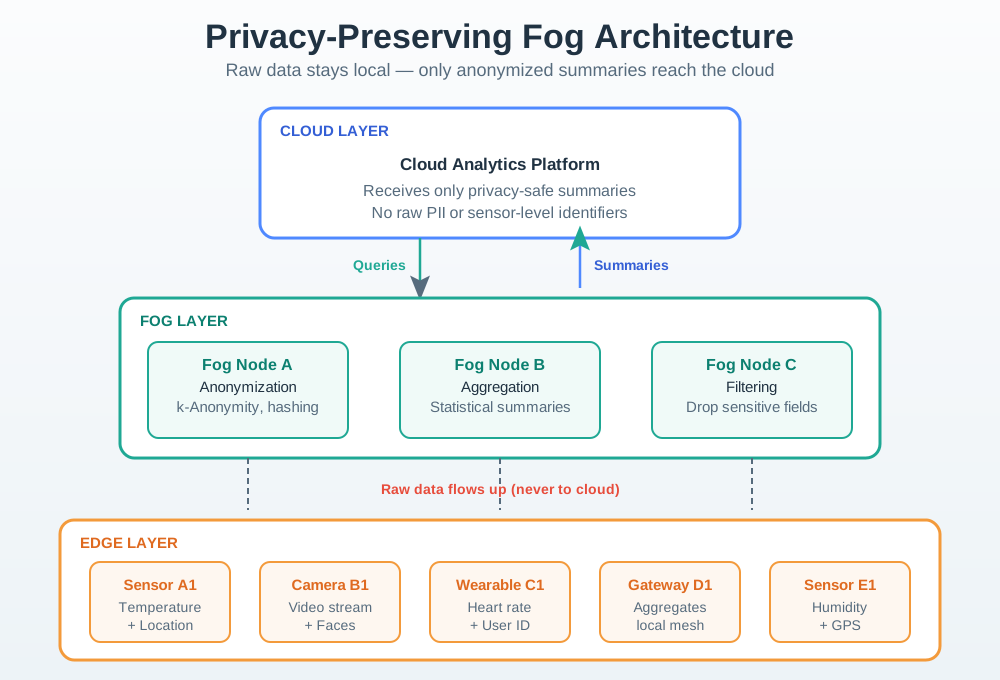
Read Figure 9.1 from sensors, cameras, and wearables into the fog layer. There, filtering, aggregation, and identity reduction change the representation before release; only bounded summaries continue to cloud analytics, while raw identifying detail stays behind or is discarded. That ordered path shows how a scheme coordinates techniques and boundaries. The strategy vocabulary below names the reusable choices within that architecture.
Think of designing a house. A single technique, like a load-bearing wall, is a pattern. The floor plan is the scheme: it decides which rooms are private, where the doors are, and how people move between them. A good floor plan makes privacy effortless; a bad one leaves you hanging curtains forever. Privacy schemes are floor plans for data.
The Strategy Vocabulary
Schemes are assembled from a small set of privacy design strategies, articulated by Jaap-Henk Hoepman. Four are about the data itself, and four are about the process around it.
Data strategies
Minimise what you collect, separate data so it cannot be easily combined, abstract it into coarser or aggregate form, and hide it from those who should not see it.
Process strategies
Inform people honestly, give them control, enforce the policy in the system, and be able to demonstrate that you do.
A scheme combines them
A local-first design, for example, leans on minimise and hide for data and on enforce and demonstrate for process, all at once.
Start With Simple Boundaries
- A doorbell that computes a motion alert on the device and keeps no clip is using a local-first scheme, not just one pattern.
- Splitting identity from sensor readings into separate stores is the separate strategy turned into a scheme boundary.
- Sending raw streams to the cloud and adding access rules later is not a privacy scheme; the geography already lost the protection.
Check the Scheme Scope
If you can see why architecture geography settles most privacy outcomes, you have the core idea. Continue to Practitioner to choose among the common schemes.
Choose the Smallest Data Path That Works
The practical work is selecting a scheme that fits the feature's real need and the sensitivity of the data, then combining a few patterns to realize it. Start with the smallest useful output. If a room dashboard only needs occupied or empty, do not build an architecture around storing every motion event first. Most IoT privacy schemes are variations on four shapes.
The Common Schemes
Walkthrough: Selecting a Scheme
Trace the sequence from its starting condition to its decision. First, Name the result the feature needs. State the smallest output that satisfies the feature, such as occupied or not, rather than the raw input. Next, Place the boundary as early as possible. Ask whether the result can be produced on the device, so raw data never crosses. Then, Sort data by sensitivity. Group data into tiers and assign each tier to a zone with a defined crossing rule. Then, Decide who holds and controls the data. Choose whether the system or the person is the primary keeper, and how control is exercised. Finally, Define the analytics path. Decide what de-identified or aggregate form, if any, may cross into analytics, and forbid the raw form.
The Evidence Packet
A scheme is only real when you can show it. The practitioner output is an evidence packet: a small set of artifacts that prove the scheme holds. It typically includes a data-flow map showing where each boundary sits, the crossing rules for each boundary, the default state of optional flows, and a test that exercises a boundary to show raw data does not cross. The packet is what an assessor or auditor reviews, and what a future change is checked against.
Worked Reasoning: Three Products, Three Schemes
Occupancy sensor
Local-first: compute presence on the device, send only the occupied state. Raw motion never leaves, so most downstream risk disappears.
Health hub
Privacy zones plus personal data store: keep raw vitals in a controlled zone the user owns, expose summaries across a guarded boundary.
Fleet dashboard
Analytics boundary: only aggregated, de-identified metrics cross into analytics; the raw per-device stream stays behind the boundary.
Check the Smallest Data Path
If you can pick a scheme and assemble its evidence packet, you can stop here. Continue to Under the Hood for the strategy mapping, boundary enforcement, and where schemes quietly fail.
Make Every Boundary Prove Itself
The deeper layer explains how the strategy vocabulary maps onto each scheme and why a boundary is only protective when something enforces it. A scheme drawn on a diagram is a plan; a scheme that holds is one where every crossing is guarded and tested, including the quiet crossings through logs, caches, backups, and support tools.
Strategies Behind Each Scheme
A Boundary Is Only Real If It Is Enforced
The recurring lesson is that drawing a zone boundary does nothing on its own. A boundary becomes protective only when a control sits on every crossing and refuses traffic that breaks the rule. The same separation strategy that limits linkability fails the moment one unguarded path lets identity and readings be rejoined. This is why the evidence packet includes a test that exercises a boundary: it proves the guard exists and works, rather than assuming the diagram is the system.
Separation Limits Linkability
The separate strategy is powerful because much privacy harm comes from combination. Two harmless-looking data sets can become sensitive when joined, because the join re-identifies a person or reveals a pattern. Keeping identifiers in one zone and readings in another, with a guarded and audited crossing, means an attacker who reaches one zone still cannot reconstruct the whole picture. The protection comes from the boundary holding, not from either data set being secret on its own.
Schemes Have Trade-offs
No scheme is free. Local-first shifts work onto the device and complicates updates. Privacy zones add boundaries that must be maintained. A personal data store adds permission machinery. An analytics boundary is only as good as its de-identification. A precise designer states the trade-off out loud and chooses the scheme whose costs the team can actually sustain, because an unmaintained scheme decays into the very leakage it was meant to prevent.
Common Pitfalls
Review these failure modes in order. First, Drawn but not guarded. A zone boundary that exists in the diagram while traffic crosses it freely in the running system. Next, Local-first that phones home. A device that computes locally yet still uploads the raw stream, undoing the geography. Then, De-identification in name only. Renaming a field instead of removing the link, so the analytics data can be re-identified. Then, Leak through the side door. Raw data crossing a boundary indirectly through logs, caches, or backups. Finally, An unsustainable scheme. Choosing a complex scheme the team cannot maintain, so it quietly erodes after launch.
Check the Boundary Evidence
At this depth, a privacy scheme is a deliberate geography of data backed by enforced, tested boundaries. Decide where data lives, place each boundary as early as possible, guard every crossing including the side doors, and keep an evidence packet that proves it. A trustworthy scheme is not the prettiest diagram; it is the one whose every boundary you can show holding.
Build One Privacy-Trust Choice
9.2 Summary
This section: Summary — Map where data lives and crosses boundaries before selecting a privacy scheme.
Map where data lives and crosses boundaries before selecting a privacy scheme. First, a privacy scheme is the overall architecture shape of a system; it arranges several patterns to decide where data lives, is processed, and crosses boundaries, while a single pattern is one move. Next, the largest privacy outcomes are settled by data geography: deciding what stays on the device, what reaches a hub, and what ever reaches the cloud. Then, schemes are assembled from privacy design strategies articulated by Hoepman: minimise, separate, abstract, and hide for data; inform, control, enforce, and demonstrate for process. Then, the common IoT schemes are local-first, privacy zones, personal data store, and analytics boundary, each with a clear best fit and a trade-off. Then, a boundary is only protective when a control sits on every crossing, including logs, caches, and backups; the separate strategy limits linkability only while the boundary holds. Finally, the practitioner output is an evidence packet, a data-flow map, crossing rules, default states, and a boundary test, that proves the scheme holds and lets later changes be checked against it.
Choose the geography of the data first, because architecture settles most privacy outcomes before a line of policy is written. Pick a scheme that fits the need and the team’s capacity, guard every crossing including the side doors, and keep an evidence packet that shows each boundary holding. A trustworthy scheme is the one whose boundaries you can demonstrate, not just draw.
9.3 See Also
This section: See Also
Privacy Patterns and Data Tiers
Learn the individual minimization, aggregation, and separation patterns that schemes arrange.
Privacy by Design Implementation
Turn a chosen scheme into enforced runtime gates, protective defaults, and release evidence.
Privacy by Design Foundations
Ground your scheme choices in the seven principles and the strategy vocabulary they draw on.
Find help
3 reviewed answers.
Where should I start in a module?
Open the module page from the sidebar to see its chapters in order. Use the module map to return to a topic you need.
Modules and pathsReviewed
What can I try when a project does not work?
Check the symptom, then work through the diagnostic steps. Keep the error message and the smallest example that reproduces it.
When you are stuckReviewed
How do interactive examples work?
Use the interactive guide to check how examples and simulations work before changing your project.
Interactive examples guideReviewed