26  Zero Trust Architecture

26.1 Learning Objectives

By the end of this chapter, you will be able to:

  • Design complete zero trust architectures for IoT systems
  • Integrate zero trust components: Identity Provider, Policy Engine, and Enforcement Points
  • Evaluate cloud-based zero trust implementations (AWS, Azure, Google Cloud)
  • Apply lessons from real-world implementations at Google, Microsoft, and Siemens
In 60 Seconds

Zero trust architecture moves IoT security from perimeter defense to continuous verification — every device, user, and network flow is authenticated and authorized independently. Core implementation involves microsegmentation (isolating device groups), identity verification (device certificates + behavioral analytics), and least privilege access (minimum permissions for each device function).

Key Concepts

  • Zero Trust Architecture (ZTA): Security model assuming no implicit trust for any entity inside or outside the network perimeter; every access request requires authentication and authorization.
  • Microsegmentation: Network architecture dividing infrastructure into small isolated zones with fine-grained access controls between segments, limiting lateral movement after compromise.
  • Device Identity: Cryptographic certificates, hardware identifiers, or behavioral profiles uniquely identifying each IoT device for authentication in zero trust environments.
  • Least Privilege Access: Security principle granting each device, user, and service only the minimum permissions needed for their specific function; reduces blast radius of compromises.
  • Continuous Verification: Zero trust practice re-authenticating and re-authorizing every request rather than trusting established sessions; detects credential theft and behavioral anomalies.
  • Policy Decision Point (PDP): Zero trust component evaluating access requests against policies and device context to make authorization decisions.
  • Policy Enforcement Point (PEP): Zero trust component receiving PDP decisions and enforcing access control by allowing or blocking network traffic and API calls.

Zero trust architecture is a security approach where nothing is automatically trusted, even devices already inside your network. Think of it like a building where every door requires a badge scan, not just the front entrance. Traditional security was like a castle with walls – once you got past the gate, you could go anywhere. Zero trust means every room, every hallway, every elevator checks your identity before letting you through. For IoT devices, this is critical because a compromised sensor should not be able to access the entire network.

“This chapter puts all the zero trust pieces together into a complete architecture,” Max the Microcontroller said. “Identity providers, policy decision points, enforcement mechanisms, and continuous monitoring – all working as one system.”

Sammy the Sensor traced a request through the system. “When I want to send data to the cloud, here is what happens: First, the identity provider verifies who I am using my certificate. Then the policy decision point checks: Is Sammy allowed to send temperature data to this cloud endpoint at this time of day? The policy engine says yes, the enforcement point opens a micro-tunnel just for this one request, and monitoring watches the entire transaction.”

“Real companies like Google and Microsoft use zero trust every day,” Lila the LED noted. “Google’s BeyondCorp system treats every network as untrusted – even their own internal network. Employees must authenticate and be authorized for every single resource, whether they are in the office or at a coffee shop. No VPN needed!”

“The key components are the Policy Decision Point, the Policy Enforcement Point, and the Trust Engine,” Bella the Battery listed. “The decision point makes the allow/deny call. The enforcement point carries it out. And the trust engine continuously calculates a trust score for every device based on its behavior, patch level, and health status. It is a living, breathing security system!”

26.2 Introduction

A complete zero trust architecture for IoT requires multiple integrated components working together: identity providers, policy decision points, enforcement mechanisms, and continuous monitoring. This chapter explores comprehensive implementation architectures, traces a complete request through the system, examines cloud-based implementations, and presents real-world case studies from industry leaders.

26.3 Implementation Architecture

⏱️ ~18 min | ⭐⭐⭐ Advanced | 📋 P11.C02.U08

26.3.1 Zero Trust Components

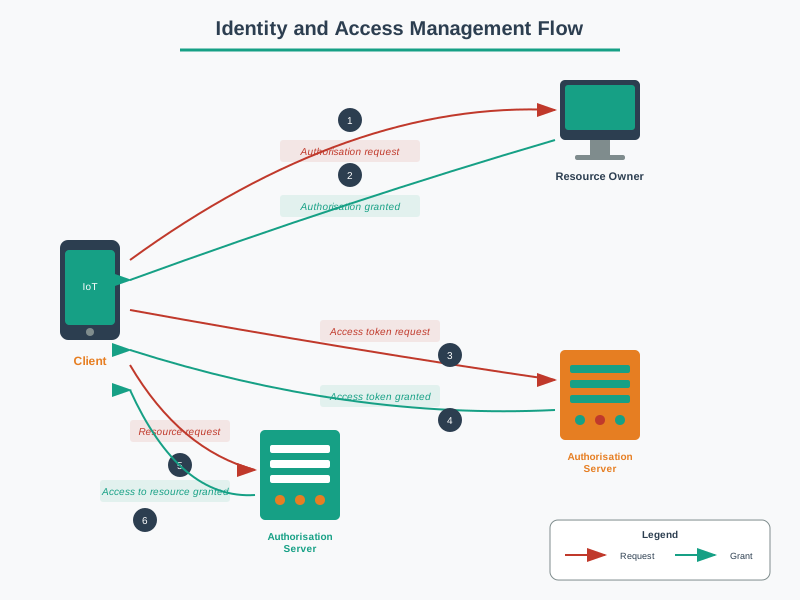
1. Identity Provider (IdP)

  • Manages device and user identities
  • Issues and revokes certificates/tokens
  • Examples: Microsoft Entra ID, Okta, Keycloak
  • For IoT: Often integrated with device provisioning service

2. Policy Decision Point (PDP)

  • Central policy engine that makes authorization decisions
  • Evaluates requests against policies
  • Considers identity, context, risk score
  • Returns ALLOW/DENY decisions

3. Policy Enforcement Points (PEP)

  • Network enforcement: Firewalls, routers, SDN controllers
  • Application enforcement: API gateways, service meshes, proxies
  • Deployed close to resources being protected

4. Continuous Monitoring

  • SIEM (Security Information and Event Management)
  • Log aggregation and analysis
  • Anomaly detection systems
  • Behavioral analytics

5. Device Attestation Service

  • Verifies device firmware integrity
  • Validates TPM/secure element attestation reports
  • Maintains database of known-good firmware hashes

6. Threat Intelligence

  • Feeds of known malicious IPs, domains, signatures
  • IoT-specific threat intelligence (MITRE ATT&CK for ICS)
  • Integration with vulnerability databases (CVE, ICS-CERT)

26.3.2 Complete Zero Trust Architecture Diagram

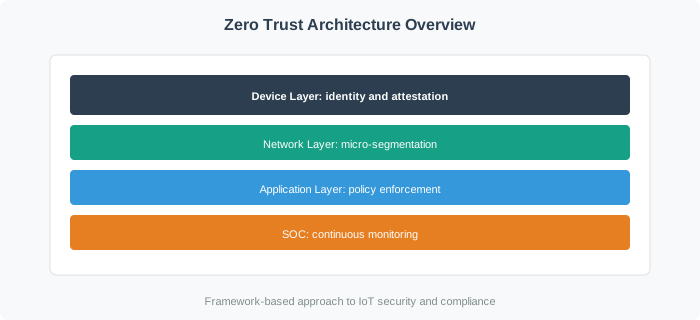
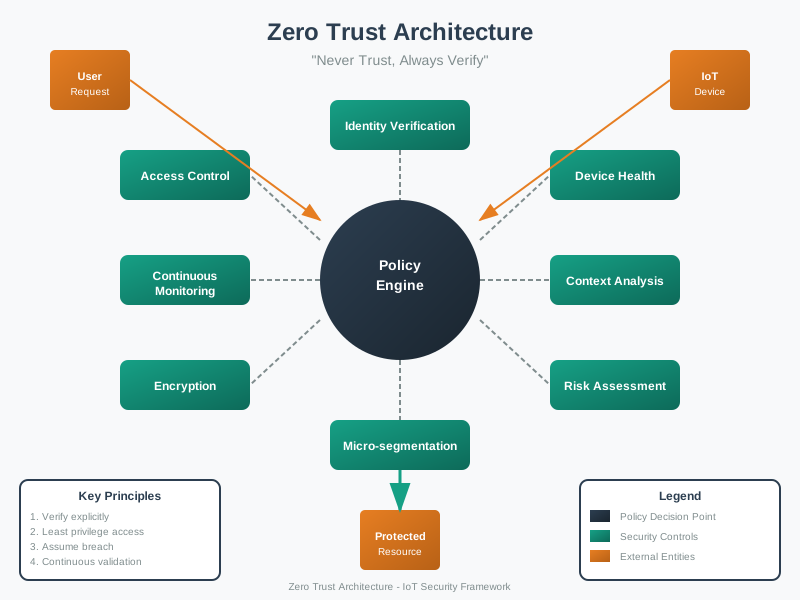
Complete zero trust architecture diagram showing layers from IoT devices through identity provider, policy decision point, policy enforcement points, and security operations center, with data flows for authentication, authorization, and continuous monitoring
Figure 26.1: Complete Zero Trust Architecture: Device Layer to Security Operations Center Integration

26.3.3 Request Flow Walkthrough

Let’s trace a complete request through the zero trust architecture:

Scenario: An industrial temperature sensor wants to upload data to a cloud database.

Step 1: Device Authentication

Device: temp-sensor-042
Action: Connect to IoT Gateway
Gateway: Request X.509 certificate
Device: Present certificate signed by device CA
Gateway: Verify certificate signature, check revocation status
Result: Device identity confirmed

Step 2: Firmware Attestation

Gateway: Request TPM attestation
Device: TPM signs current PCR values
Device: Send attestation report
Gateway → Attestation Service: Verify report
Attestation Service: Check PCR values against known-good firmware
Result: Firmware integrity confirmed (hash matches v2.1.4)

Step 3: Context Collection

Collect:
- Device location: Factory Floor 3, Cell B (verified via GPS/network)
- Time: 2:45 PM on Tuesday
- Recent behavior: Last 100 uploads normal (48 bytes every 60 sec)
- Firmware status: v2.1.4 (latest version)
- Device health: No alerts, no recent anomalies

Step 4: Policy Evaluation

Policy Decision Point evaluates:
- Identity: Valid certificate ✓
- Attestation: Firmware verified ✓
- Location: Expected location ✓
- Time: Normal business hours ✓
- Behavior: Baseline normal ✓
- Resource: Temperature database (appropriate for sensor) ✓
- Trust score: 75/100 (LOW RISK — higher score = higher trust)

Decision: ALLOW with standard monitoring

Step 5: Network Enforcement

Network PEP (Firewall):
- Open connection: temp-sensor-042 → cloud.example.com:443
- Apply rate limiting: Max 10 requests/minute
- Enable deep packet inspection
- Log connection metadata

Step 6: Application Enforcement

API Gateway:
- Verify JWT token (issued by IdP)
- Check token scope: "temperature:write"
- Validate request body: {"temp": 72.5, "timestamp": "2025-12-15T14:45:00Z"}
- Data size check: 52 bytes (within normal range)
- Forward to database service

Step 7: Continuous Monitoring

Behavioral monitoring:
- Compare to baseline: ✓ Normal
- Check for anomalies: None detected
- Update device behavioral profile
- Log transaction for audit trail

Step 8: Response (if anomaly detected)

IF anomaly detected:
  Calculate risk score
  IF risk > threshold:
    - Quarantine device (block all network access)
    - Alert SOC
    - Trigger incident response workflow
    - Preserve forensic evidence

26.3.4 Cloud-Based Zero Trust Implementations

AWS IoT Zero Trust Architecture:

  • AWS IoT Core: Device registry and authentication
  • AWS IoT Device Defender: Continuous monitoring and anomaly detection
  • AWS IAM: Fine-grained authorization policies
  • AWS Security Hub: Centralized security findings
  • AWS CloudTrail: Audit logging

Azure IoT Zero Trust Architecture:

  • Azure IoT Hub: Device provisioning and management
  • Azure Defender for IoT: Threat detection and behavioral analytics
  • Microsoft Entra ID: Identity and access management
  • Azure Sentinel: SIEM and orchestration
  • Azure Key Vault: Certificate and key management

Google Cloud IoT Zero Trust Architecture:

  • IoT Core (deprecated August 2023; migrated to partner solutions like Clearblade IoT Core): Device management and authentication
  • Chronicle: Security analytics and threat detection
  • Cloud Identity-Aware Proxy: Application-level access control
  • Binary Authorization: Container and firmware verification
  • VPC Service Controls: Network perimeter security

26.4 Real-World Implementations

⏱️ ~10 min | ⭐⭐ Intermediate | 📋 P11.C02.U09

26.4.1 Google BeyondCorp

Google pioneered the zero trust approach with BeyondCorp, eliminating VPNs and perimeter-based security for their 100,000+ employees.

Key Principles:

  1. Access based on device and user identity, not network location
  2. All access goes through identity-aware proxies
  3. Continuous trust evaluation
  4. Every request is fully authenticated and authorized

Implementation for IoT:

  • Device inventory and health status database
  • Identity-aware proxies in front of all resources
  • User/device context (location, security posture, corporate vs. personal)
  • Dynamic access policies based on risk

Results:

  • Employees work from anywhere without VPN
  • Reduced attack surface (no perimeter to breach)
  • Improved user experience (seamless access)
  • Better visibility and control

Lesson for IoT: Network location is irrelevant. Every device must prove its identity and health continuously.

26.4.2 Microsoft Zero Trust for IoT

Microsoft Azure provides comprehensive zero trust capabilities for IoT deployments.

Azure Defender for IoT:

  • Agentless monitoring (works with legacy devices)
  • Asset discovery and inventory
  • Behavioral analytics and anomaly detection
  • Integration with Microsoft Defender XDR

Device Behavioral Profiling:

Example: Manufacturing Plant with 10,000 IoT devices

Device: PLC-Assembly-Line-3
Baseline Profile:
- Communication: Only with HMI station 10.2.50.15
- Traffic: 2KB every 5 seconds (sensor readings and control commands)
- Protocols: Modbus TCP port 502, HTTPS port 443
- Activity hours: 6 AM - 10 PM weekdays (production shifts)

Anomaly Detected:
- Device communicating with external IP address (not in whitelist)
- Traffic volume: 500MB (250,000x baseline)
- Protocol: SSH on port 22 (never used before)
- Time: 2:30 AM Sunday (outside production hours)

Automated Response:
1. Quarantine device immediately
2. Alert SOC with full context
3. Generate incident report
4. Preserve network traffic for forensics
5. Notify plant operations team

Integration with Azure Services:

  • Microsoft Entra ID: Device identity
  • Azure IoT Hub: Secure device connectivity
  • Azure Sentinel: Security orchestration and response
  • Azure Policy: Compliance enforcement

26.4.3 Siemens Industrial Edge

Siemens implements zero trust for industrial IoT and edge computing.

Architecture:

  • Trusted Platform Module (TPM) in edge devices
  • Secure boot and firmware attestation
  • Certificate-based device authentication
  • Micro-segmentation for industrial networks

Use Case: Automotive Manufacturing

  • 50,000 sensors and controllers across production lines
  • Zero trust segmentation isolates each production cell
  • Compromised robot arm cannot access paint shop systems
  • Continuous monitoring detects anomalous PLC behavior
  • Automated response prevents safety incidents

26.5 Worked Example: Manufacturing Plant Zero Trust

26.6 Worked Example: Zero Trust Implementation for Manufacturing Plant

Scenario: PrecisionParts Manufacturing operates a facility with 500 IoT devices across 3 production lines: CNC machining (200 devices), quality inspection (150 devices), and material handling (150 devices). After a competitor suffered a ransomware attack that shut down production for 2 weeks, management has mandated zero trust implementation. The current network is flat with all devices on a single VLAN.

Goal: Implement zero trust architecture to protect production systems while maintaining <10ms latency for real-time control loops and achieving 99.9% uptime requirements.

What we do: Catalog all 500 devices and establish unique identities for each.

Device Classification:

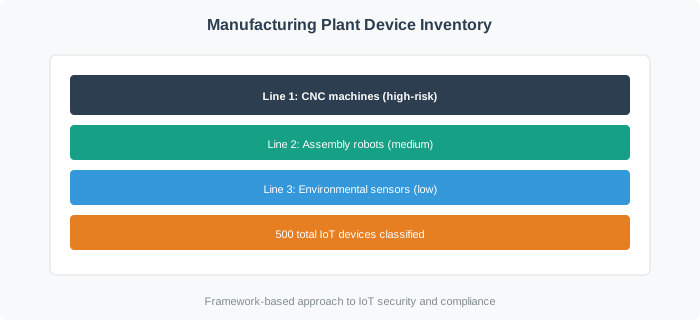
Manufacturing plant device inventory diagram showing 500 IoT devices categorized across three production lines: CNC machining with controllers, monitors, coolant systems, and safety interlocks; quality inspection with vision systems, CMM machines, scanners, and test stations; material handling with AGVs, conveyors, RFID readers, and robotic arms, with orange highlighting for safety-critical devices
Figure 26.2: Manufacturing plant device inventory showing 500 IoT devices across three production lines: CNC machining with controllers, monitors, coolant systems, and safety interlocks; Quality inspection with vision systems, CMM machines, scanners, and test stations; Material handling with AGVs, conveyors, RFID readers, and robotic arms. Orange indicates safety-critical devices.

Identity Assignment:

  • Hardware identity: Deploy secure elements (Microchip ATECC608B) on devices supporting hardware crypto
  • Certificate-based identity: X.509 certificates issued by internal PKI with CN=device-type-line-serial
  • Legacy devices: 127 devices lack crypto capability; deploy gateway proxies with mutual TLS termination

Why: Zero trust requires verifiable device identity. Without unique cryptographic identity, any device could impersonate another. Hardware-backed identity prevents credential theft even if firmware is compromised.

What we do: Classify devices by risk level to apply appropriate security policies.

Risk Assessment Criteria:

Safety Impact (40% weight):
- HIGH: Can cause physical harm (CNC, robots, AGVs)
- MEDIUM: Can damage products or equipment
- LOW: Informational only (sensors, scanners)

Production Impact (30% weight):
- CRITICAL: Production stops if device fails
- IMPORTANT: Degraded operation without device
- SUPPORT: Convenience or monitoring only

Data Sensitivity (20% weight):
- CONFIDENTIAL: Proprietary manufacturing data
- INTERNAL: Operational metrics
- PUBLIC: Non-sensitive status information

Attack Surface (10% weight):
- HIGH: Internet-connected, complex software stack
- MEDIUM: Internal network, standard protocols
- LOW: Isolated, simple firmware

Resulting Classification: | Category | Count | Examples | Risk Level | |———-|——-|———-|————| | Safety-Critical | 120 | CNC controllers, robots, AGVs | RED | | Production-Critical | 180 | Vision systems, CMM, conveyors | ORANGE | | Operational | 150 | Sensors, scanners, monitors | YELLOW | | Support | 50 | Environmental sensors, displays | GREEN |

Why: Risk-based classification enables proportionate security. Safety-critical devices receive strictest controls (hardware attestation, real-time monitoring) while support devices use standard policies. This prevents security overhead from impacting production.

What we do: Design network segments that enforce least-privilege communication.

Segment Policy Examples:

# CNC-Safety segment (VLAN 110)
segment: cnc-safety
risk_level: RED
allowed_flows:
  - src: cnc-safety
    dst: cnc-historian  # Data collection server
    ports: [502]        # Modbus TCP
    protocol: tcp
    latency_sla: 5ms
  - src: cnc-safety
    dst: safety-plc     # Safety controller
    ports: [44818]      # EtherNet/IP
    protocol: udp
    latency_sla: 2ms
denied_flows:
  - src: cnc-safety
    dst: internet
    action: block_and_alert
  - src: cnc-safety
    dst: corporate
    action: block_and_log

Why: Micro-segmentation limits blast radius. If an AGV is compromised, it cannot reach CNC controllers. Each segment has explicit allow-lists; all other traffic is denied. Production line isolation prevents cross-line contamination.

What we do: Deploy enforcement points that apply policies in real-time.

Policy Decision Point Configuration:

# Real-time policy evaluation
def evaluate_access_request(request):
    device = verify_device_identity(request.certificate)
    context = {
        "device_id": device.id,
        "device_health": get_device_attestation(device),
        "request_time": request.timestamp,
        "resource": request.target,
        "action": request.method,
        "risk_score": calculate_risk_score(device, request)
    }

    # Policy evaluation with <5ms SLA
    decision = policy_engine.evaluate(context)

    if decision.allow:
        audit_log.record(request, "ALLOW", context)
        return AccessToken(
            scope=decision.scope,
            ttl=decision.session_duration,
            constraints=decision.constraints
        )
    else:
        audit_log.record(request, "DENY", context)
        security_alert(device, decision.reason)
        return AccessDenied(reason=decision.reason)

Why: Enforcement points must operate at wire speed without adding latency that impacts production. Hierarchical enforcement (gateway → network → application) provides defense in depth while maintaining performance SLAs.

What we do: Implement real-time monitoring and behavioral analysis.

Behavioral Baselines:

device_type: cnc_controller_fanuc
baseline_profile:
  communication_pattern:
    destinations:
      - cnc-historian.mfg.local (95% of traffic)
      - safety-plc.mfg.local (4% of traffic)
      - ntp.mfg.local (1% of traffic)
    protocols:
      - Modbus/TCP: 80%
      - EtherNet/IP: 15%
      - NTP: 5%
    hourly_volume: 50-150 MB
    connection_rate: 10-50 new connections/hour

  operational_pattern:
    active_hours: 06:00-22:00 (production shift)
    idle_current: 0.5-1.0 A
    active_current: 2.0-8.0 A
    spindle_rpm_range: 0-12000

  firmware_state:
    version: 31i-B5-Plus
    hash: sha256:a1b2c3d4...
    last_update: 2025-09-15

Anomaly Detection Rules:

CRITICAL: CNC controller communicating with unknown destination
  → Immediate quarantine, alert SOC
  → Impact: Potential data exfiltration or C2 communication

HIGH: Device firmware hash mismatch
  → Isolate device, prevent production use
  → Impact: Possible firmware tampering or corruption

MEDIUM: Traffic volume 3x above baseline
  → Increased monitoring, alert operator
  → Impact: May indicate reconnaissance or data staging

LOW: Connection during non-production hours
  → Log for review, no immediate action
  → Impact: Could be legitimate maintenance

Why: Static authentication is insufficient. Devices can be compromised after initial verification. Continuous monitoring detects behavioral changes indicating compromise, enabling rapid response before damage spreads.

Outcome: Zero trust implementation protecting 500 manufacturing devices across 3 production lines with defense-in-depth architecture.

Key Decisions Made:

  1. Hardware identity over software: Invested in secure elements for 373 devices; legacy proxies for 127 devices lacking crypto support. Hardware identity prevents credential theft.

  2. Risk-based segmentation: Created 6 network segments by production line and criticality rather than 500 per-device microsegments. Balanced security with manageability.

  3. Gateway enforcement for legacy: Deployed protocol-aware gateways that terminate TLS and validate Modbus/EtherNet-IP commands rather than requiring device upgrades.

  4. Behavioral baselines per device type: Created 12 baseline profiles covering all device types rather than 500 individual baselines. Reduces false positives while catching anomalies.

  5. Safety-aware response: Implemented graduated response that maintains safety functions during incident response. Production stops only as last resort.

Implementation Metrics:

  • Deployment time: 6 months (phased by production line)
  • Latency impact: <2ms added (within 10ms SLA)
  • Uptime achieved: 99.95% (exceeded 99.9% target)
  • False positive rate: 0.1% (acceptable for manufacturing)
  • Security incidents detected: 3 in first quarter (2 insider threats, 1 malware)

Lessons Learned:

  • Start with device inventory; you cannot protect what you cannot identify
  • Engage production engineers early; they know normal device behavior
  • Test policies in monitor-only mode before enforcement
  • Legacy device integration requires creative solutions (proxies, gateways)
  • Safety-critical systems need special handling in incident response

26.8 See Also

Explore complete zero trust architectures and implementations:

Zero Trust Series:

Security Fundamentals:

Implementation Topics:

26.9 Summary

Zero Trust Security represents a fundamental shift in how we protect IoT systems. Key takeaways:

  1. Never Trust, Always Verify: Trust is never implicit based on network location. Every device, every request, every time must be authenticated and authorized.

  2. Perimeter Security Has Failed: With millions of IoT devices, cloud services, and mobile access, the network perimeter no longer exists. Zero trust eliminates the concept of “inside” versus “outside.”

  3. Strong Device Identity: Hardware-based identity (TPM, secure elements) provides unforgeable device authentication. Certificate-based authentication with device attestation proves firmware integrity.

  4. Least Privilege Access: Devices only access resources necessary for their function. A temperature sensor cannot access security cameras or employee databases.

  5. Micro-Segmentation: Network segmentation creates small, isolated zones. Compromising one device doesn’t grant access to the entire network.

  6. Continuous Verification: Authentication at connection time is insufficient. Behavioral monitoring and anomaly detection identify compromised devices even after successful authentication.

  7. Assume Breach: Design systems assuming attackers are already inside. Focus on limiting damage, detecting anomalies, and responding rapidly.

  8. Risk-Based Decisions: Calculate real-time risk scores based on device health, behavior, context, and resource sensitivity. Adjust security requirements dynamically.

  9. Automated Response: Human response is too slow. Automated quarantine, blocking, and alerting contain threats within seconds.

  10. Zero Trust is a Journey: Implementing zero trust is not a single project. It requires organizational change, architectural transformation, and continuous improvement.

Policy decision latency is the time from access request to authorization decision. It determines maximum sustainable request rate.

Policy Engine Throughput (per serial evaluator): \[\text{Max Requests/sec} = \frac{1}{\text{Latency}_{\text{decision}} + \text{Latency}_{\text{network}}}\]

Distributed Cache Hit Rate: \[P_{\text{hit}} = \frac{\text{Cache Hits}}{\text{Total Requests}}\]

Effective Latency with Caching: \[L_{\text{eff}} = P_{\text{hit}} \times L_{\text{cache}} + (1 - P_{\text{hit}}) \times L_{\text{PDP}}\]

Working through an example:

Given: Manufacturing facility with 1,200 IoT devices - Each device: 10 requests/second average - Total load: \(1,200 \times 10 = 12,000\) requests/sec - Policy Decision Point (PDP) latency: \(L_{\text{PDP}} = 30\) ms - Local cache latency: \(L_{\text{cache}} = 2\) ms - Cache hit rate: \(P_{\text{hit}} = 95\%\)

Step 1: Calculate PDP-only throughput (no cache) \[\text{Max}_{\text{PDP}} = \frac{1}{0.030} = 33.3 \text{ requests/sec (INSUFFICIENT)}\]

Step 2: Calculate effective latency with cache \[L_{\text{eff}} = 0.95 \times 2 + 0.05 \times 30 = 1.9 + 1.5 = 3.4 \text{ ms}\]

Step 3: Calculate cache-enabled throughput \[\text{Max}_{\text{cache}} = \frac{1}{0.0034} = 294 \text{ requests/sec per PEP}\]

Step 4: Number of Policy Enforcement Points needed \[\text{PEPs} = \frac{12,000}{294} = 40.8 \approx 41 \text{ distributed PEPs}\]

Result: Without caching, a single PDP thread supports 33 requests/sec – insufficient for 12,000 req/sec load (360x shortfall). With 95% cache hit rate, each PEP handles 294 req/sec, requiring 41 distributed PEPs to meet demand.

In practice: Zero trust policy engines become bottlenecks at scale. Distributed caching with 60-second TTL reduces PDP load by 95%, enabling real-time authorization for thousands of devices. Cache invalidation on policy change ensures security.

Use the sliders below to explore how device count, request rate, cache hit rate, and PDP latency affect the number of required Policy Enforcement Points.

26.10 Knowledge Check

Common Pitfalls

Zero trust is an architectural philosophy requiring comprehensive changes to identity management, network segmentation, monitoring, and access control — not just eliminating VPNs. Organizations that “implement zero trust” by adding multi-factor authentication while maintaining implicit network trust have not actually implemented zero trust.

Zero trust principles apply equally to device-to-device communication and service-to-service API calls in IoT systems. A zero trust architecture where users are continuously verified but IoT devices communicate freely among themselves provides partial protection that attackers can exploit.

Every access request requiring policy evaluation adds latency. High-frequency IoT sensor reporting (1-second intervals from thousands of devices) can generate significant authorization overhead. Design zero trust architectures with appropriate caching, session tokens, and policy optimization to maintain acceptable performance.

Zero trust requires knowing every device to manage device identity. Organizations implementing zero trust without a complete IoT asset inventory create policies for known devices while unknown devices operate without controls. Complete asset discovery before implementing zero trust enforcement.

26.11 What’s Next

If you want to… Read this
Learn cryptographic foundations for zero trust Encryption Architecture
Secure individual IoT devices IoT Device and Network Security
Implement zero trust network segmentation Zero Trust Network Segmentation
Establish device identity in zero trust Zero Trust Device Identity
Deploy complete zero trust implementation Zero Trust Implementation

Zero trust security is not optional for modern IoT deployments. As the Target breach, Mirai botnet, and countless other incidents have demonstrated, perimeter security cannot protect millions of connected devices. By implementing zero trust principles—strong identity, least privilege access, micro-segmentation, and continuous verification—you can build IoT systems that are resilient, secure, and trustworthy.

← Network Segmentation Safeguards and Protection →