Analyze Real-World Monetization: Evaluate Peloton and Ring’s multi-revenue strategies
Apply Smart Data Pricing Frameworks: Design connectivity and service pricing models
Calculate Business Metrics: Compute LTV, CAC, and ROI from case study data
Extract Strategic Lessons: Apply learnings from successful IoT companies to new ventures
Compare Business Model Archetypes: Contrast hardware-plus-subscription versus ecosystem-platform approaches
Key Concepts
This chapter provides in-depth case studies and advanced pricing frameworks:
Peloton Case Study: Hardware + subscription model with 30-35% hardware margins, 65-70% subscription margins
Ring Case Study: Four-phase evolution from hardware to ecosystem platform
Smart Data Pricing: How to charge (usage, time, location), whom to charge (two-sided, sponsored), what to charge for (priority, transactions, services)
If you are short on time, focus on these essentials:
Peloton’s dual revenue model demonstrates that hardware margins (30-35%) are necessary but insufficient – subscription margins (65-70%) provide long-term sustainability
Ring’s four-phase evolution shows the standard IoT monetization trajectory: hardware launch, subscription introduction, ecosystem expansion, strategic acquisition
Smart Data Pricing has three dimensions: how to charge (usage/time/location), whom to charge (two-sided/sponsored), and what to charge for (priority/transactions/services)
The LTV:CAC ratio must exceed 3:1 for a sustainable IoT business; both Peloton (2.8:1) and Ring demonstrate why this benchmark matters
Key formula: LTV = Hardware Margin + (Monthly Subscription x Average Retention Months)
For Beginners: Understanding IoT Business Case Studies
Why study how companies make money from IoT?
Learning from real companies helps you avoid common mistakes and understand what actually works. Here are the key patterns:
Hardware + Subscription: Sell a device, then charge monthly for services. Example: Peloton’s $1,445 bike plus $44/month classes.
Freemium to Paid: Give basic features free, then charge for premium extras. Example: Ring’s free live view plus $3-10/month video storage.
Platform Play: Build an ecosystem that others build on. Example: Ring + Alexa + Neighbors.
Sponsored Data: Someone else pays for your connectivity. Example: a car maker covers the cellular data in your vehicle.
Simple analogy: Think of a gaming console. The console (hardware) is often sold at a loss, but the company makes money from game sales and online subscriptions. IoT works the same way – the device gets you in the door, and services keep revenue coming.
One number to remember: A healthy IoT business earns at least 3x in customer lifetime value what it spends to acquire that customer.
Sensor Squad: How Smart Companies Make Money from IoT
Hey Sensor Squad! Let’s learn how companies turn smart devices into successful businesses!
Sammy the Sensor says: “Think about your favorite video game. The game console is like the IoT device – it’s cool, but the REAL value comes from all the games and online features you use month after month. Companies like Peloton sell exercise bikes (the console) and then charge for workout classes (the games)!”
Lila the LED asks: “But why would anyone pay every month? Because Ring’s doorbell camera lets you see who’s at your door for free. But if you want to SAVE those videos and watch them later, that costs $3 a month. Most people say: ‘That’s worth it!’ About 1 in 4 users pay for extra features.”
Max the Microcontroller explains: “Smart Data Pricing is like how your phone plan works – some apps might not count against your data limit (that’s called ‘zero rating’), or a company might pay for your data (that’s ‘sponsored data’). Imagine if your smart watch’s health data was free to send because a health company paid for it!”
Bella the Battery reminds us: “The big lesson is: selling a device once gives you money ONCE. But a monthly subscription gives you money EVERY month. That’s why companies love subscriptions – it’s like getting an allowance instead of a one-time birthday gift!”
49.2 How It Works: Dual Revenue Model (Hardware + Subscription)
How It Works: Peloton’s Hardware-Subscription Flywheel
The big picture: Peloton sells premium exercise equipment at healthy margins, then generates recurring high-margin revenue through monthly content subscriptions, with each revenue stream reinforcing the other.
Step-by-step breakdown:
Hardware acquisition: Customer pays $1,445 for Bike (manufacturing cost $1,000), generating $445 upfront margin. Real example: 2.9M devices sold generating $1.5B hardware revenue (60% of total) at 30-35% gross margin.
Subscription conversion: 100% of hardware buyers require $44/month All-Access Membership for full value (live classes, leaderboards, metrics tracking). Real example: 2.9M members × $44/month = $127M monthly recurring revenue at 65-70% gross margin.
Network effects retention: Leaderboards and social features create engagement (20 workouts/month vs 5 for traditional gyms), reducing monthly churn to 2.7%. Real example: Average member stays 30 months, generating $1,320 subscription value beyond hardware.
Why this matters: The dual revenue model is essential - hardware margins (30-35%) cover acquisition costs, while subscription margins (65-70%) fund ongoing R&D and content production. The combined economics yield a 2.52:1 LTV:CAC ratio, below the healthy 3:1 target, explaining Peloton’s post-pandemic challenges.
49.3 Peloton’s Multi-Revenue Model
~8 min | Intermediate | P03.C05.U07
Peloton Interactive demonstrates successful IoT monetization combining hardware, subscriptions, and data analytics with published financial metrics:
Revenue Breakdown (FY2023 actual data):
Connected Fitness Products: $1.5B (60%). Premium hardware including the $1,445 Bike, $2,495 Bike+, and $3,195 Tread.
Subscription: $1.0B (40%). $44/month All-Access Membership with about 30 months of average retention.
Total Revenue: $2.5B. Combined ecosystem model balancing upfront and recurring revenue.
Phase 4 (2021-Present): Pricing optimization ($1,895 -> $1,445 bike to address demand normalization)
Strategic Insights:
Hardware as Customer Acquisition: Peloton invests $1,000+ in marketing/sales to acquire customers, recovers via hardware margin ($445) and 30-month subscription LTV ($1,320)
Subscription Compounding: Monthly recurring revenue grows from new members while existing members generate predictable cash flow (65%+ margins)
Data Monetization Opportunity: 6 billion workouts tracked (heart rate, output, cadence, leaderboard engagement) - potential for aggregated fitness insights, equipment optimization data, health insurance partnerships
Content Investment: $100M+ annual content production (live classes, on-demand library) driving subscription value and retention
Content cost scaling (instructors, production studios, music licensing)
Hardware commoditization (competitors offering $500 bikes with similar features)
This example demonstrates both the power and challenges of IoT monetization: hardware creates ecosystem lock-in, subscriptions generate recurring revenue, but unit economics must balance acquisition costs with lifetime value while adapting to market dynamics.
49.4 Ring Doorbell: From Hardware to Ecosystem
~10 min | Advanced | P03.C05.U08
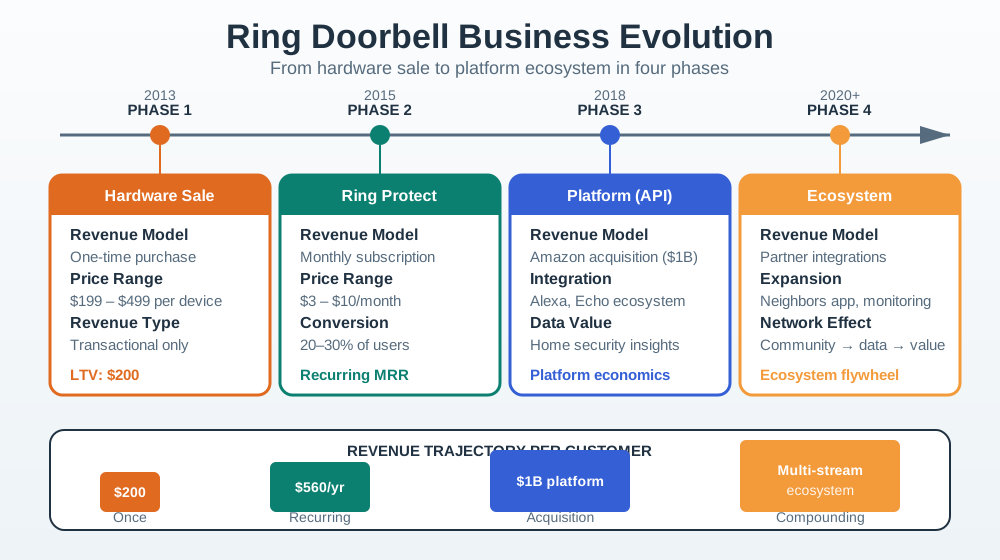
Ring’s Business Model Evolution (2013-Present)
Ring demonstrates how IoT business models must evolve over time:
Ring Doorbell monetization evolution through four business phases
Figure 49.1
49.4.1 Key Metrics
Hardware: One-time device sales at $199-$499 per unit.
Subscription: Recurring revenue at $3-$10/month with 20-30% conversion.
Acquisition: $1 billion Amazon exit validated the model.
Ecosystem: Additional platform value from third-party integrations.
49.4.2 Lessons Learned
Hardware is the wedge, not the business: Ring’s $1B valuation came from recurring revenue potential, not hardware margins
Subscription conversion is key: 20-30% conversion to paid plans drives lifetime value
Ecosystem lock-in creates value: Integration with Alexa, Neighbors app, and professional monitoring increased switching costs
Data network effects: More users = better neighborhood security insights = more valuable platform
Result: Current unit economics are unsustainable (1.79:1 LTV:CAC). The company must execute on all three levers simultaneously to reach the 3:1 target. Most impactful: reduce churn from 3.4% to 2.5% through product improvements (notification reliability, app performance, customer success outreach).
Key insight: Subscription businesses fail when they focus only on customer acquisition while ignoring churn. At 3.4% monthly churn, the average subscriber lifetime is only 29 months – far below the 36-48 months assumed in most business plans. Always calculate churn-adjusted LTV, never naive LTV.
49.4.3 Interactive Smart Home Security Metrics
Calculate subscription business health for your smart home security startup:
Comparing these two case studies reveals distinct IoT monetization archetypes and their respective strengths:
Figure 49.2: Peloton vs Ring IoT monetization comparison
Hardware Strategy: Peloton uses premium $1,445+ hardware with high margins; Ring uses accessible $199 hardware with lower margins. Implication: Peloton monetizes hardware, while Ring uses hardware as an acquisition funnel.
Subscription Model: Peloton requires a $44/month subscription for full value; Ring offers optional $3-10/month upgrades. Implication: high ARPU versus broader conversion.
Conversion Rate: Peloton is effectively near 100% because the hardware depends on the subscription; Ring converts 20-30% from free to paid. Implication: very different unit economics.
LTV per Customer: Peloton reaches about $2,765 per customer, while Ring lands closer to $500-800. Implication: Peloton wins per-customer value, Ring wins through scale.
Network Effects: Peloton’s moat is social community; Ring’s is geographic neighborhood security. Implication: different defensibility patterns.
Exit/Valuation: Peloton peaked as an $8B public company; Ring sold to Amazon for $1B. Implication: Ring’s platform potential drove acquisition premium.
Key Risk: Peloton faces demand volatility and high CAC; Ring faces commoditization and privacy concerns. Implication: both still depend on strong execution beyond the hardware.
Archetype Insight: Peloton represents the “premium hardware + mandatory subscription” archetype (similar to Tesla FSD, Apple Fitness+), while Ring represents the “accessible hardware + freemium conversion + ecosystem” archetype (similar to Nest, Wyze, Arlo). Your choice depends on whether you target a smaller premium market or a broader mass market.
49.6 Smart Data Pricing Framework
~15 min | Advanced | P03.C05.U09
Smart Data Pricing (SDP) is a framework for structuring IoT connectivity and service pricing based on three fundamental dimensions: how to charge, whom to charge, and what to charge for. This framework emerged from telecommunications and has direct applications to IoT monetization.
49.6.1 How to Charge: Pricing Mechanisms
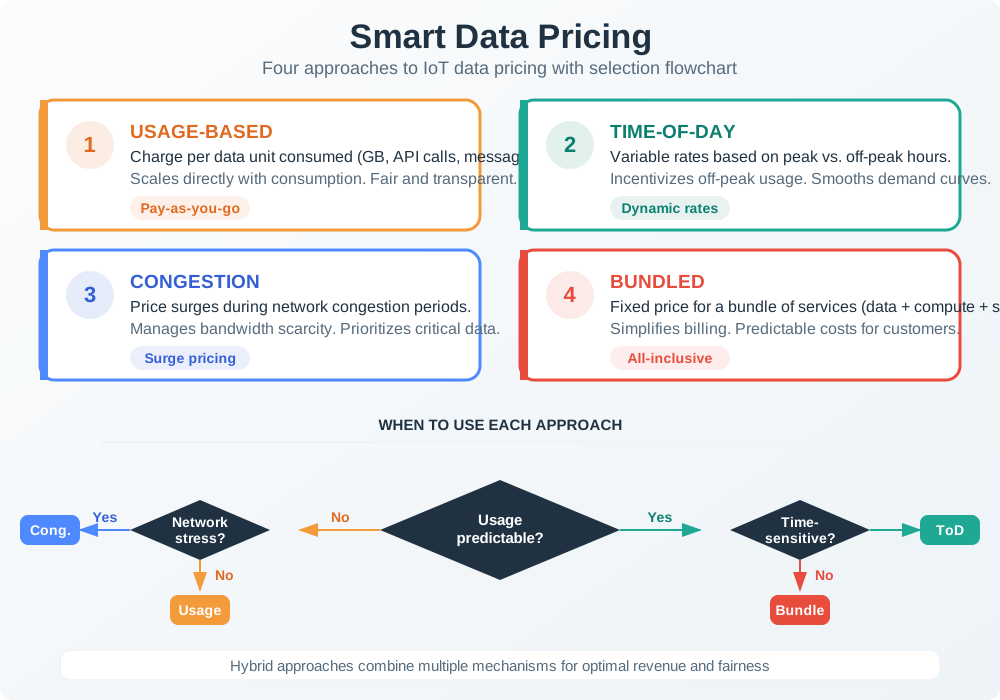
Smart Data Pricing mechanisms decision tree
Figure 49.3
Usage-Based Pricing: Charge based on actual consumption measured in data volume (per MB), number of transactions, API calls, or device activations. This aligns cost with value delivered and ensures fairness.
Time-Based Pricing: Differential rates based on time of day, day of week, or seasonal demand patterns. Peak hours cost more, off-peak hours discounted to shape demand and optimize resource utilization.
Location-Based Pricing: Geographic zone pricing reflecting infrastructure costs, regulatory differences, or market valuations. Urban areas may have premium rates compared to rural zones.
Prepaid vs Postpaid: Prepaid requires upfront payment providing cost control and eliminating billing risk. Postpaid invoices monthly based on actual usage, offering convenience but requiring credit management.
49.6.2 Whom to Charge: Market Structures
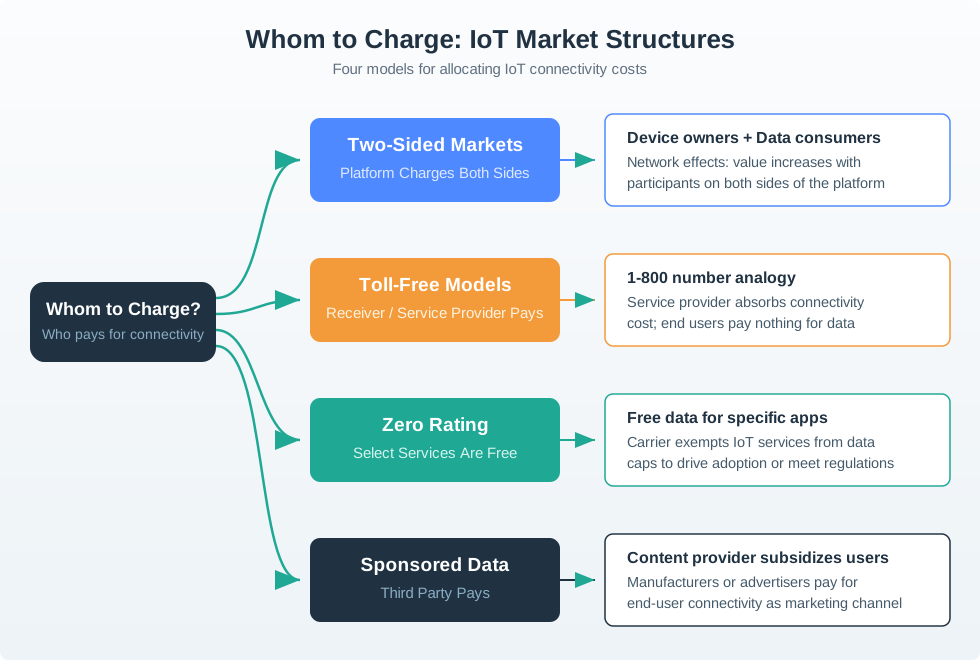
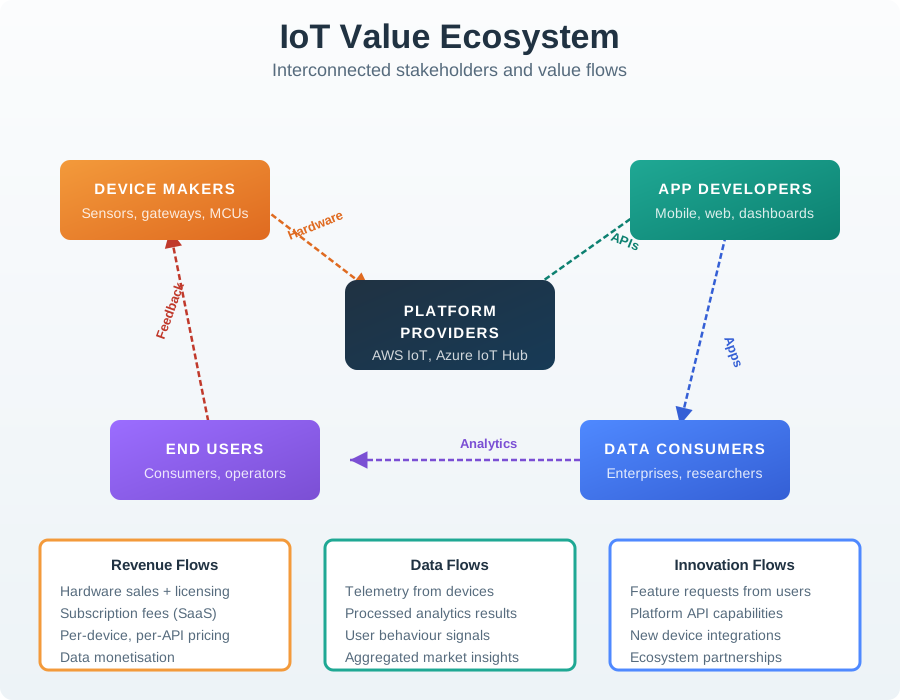
IoT market structures showing who pays for connectivity
Figure 49.4
Two-Sided Markets: IoT platforms charge both device owners (for connectivity, management) and data consumers (for analytics, insights). Creates network effects where value increases with participants on both sides.
Toll-Free Models: Similar to 1-800 phone numbers, the receiver (service provider, application owner) pays for connectivity instead of device owner. Useful for manufacturer-managed devices where end users shouldn’t see data costs.
Zero Rating: Specific IoT services or applications don’t count against data caps. Carrier offers free data for select use cases (emergency services, health monitoring) to drive adoption or meet regulatory requirements.
Sponsored Data: Third parties (manufacturers, service providers, advertisers) pay for end-user device connectivity. Example: Car manufacturer pays cellular data costs for connected vehicles rather than charging customers monthly fees.
49.6.3 What to Charge For: Value Components
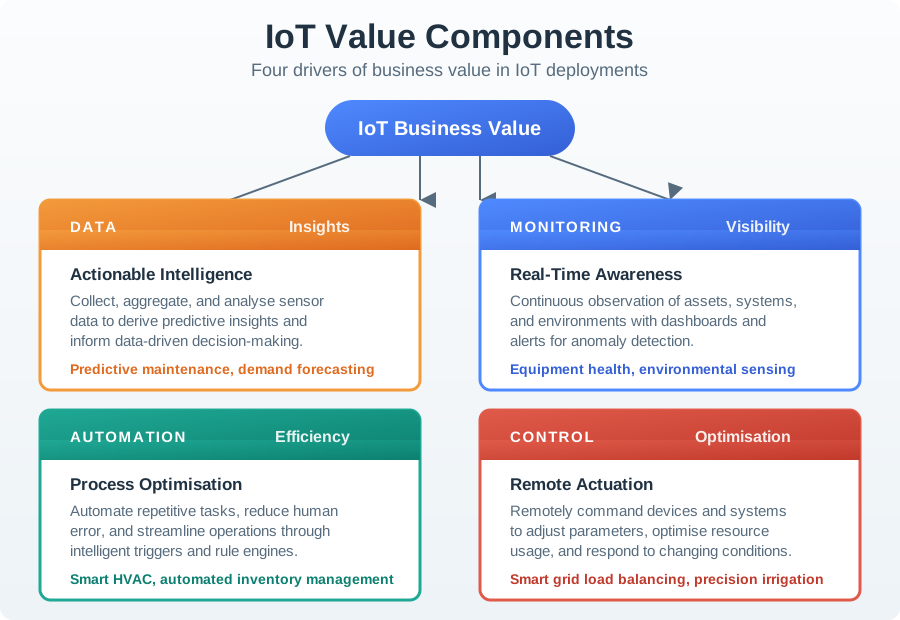
IoT value components showing what to charge for
Figure 49.5
Paid Priority: Premium pricing for guaranteed Quality of Service (QoS) - lower latency, higher bandwidth, reliability SLAs. Industrial IoT, autonomous vehicles, healthcare applications pay premium for mission-critical performance.
Transaction-Based: Charge per event, API call, device message, or sensor reading. Aligns costs directly with activity levels and scales automatically with usage.
Cloud Service Pricing: Infrastructure components billed separately - CPU hours, storage GB, network bandwidth MB, database queries. Common in AWS IoT Core, Azure IoT Hub pricing models.
IoT Service Pricing: Platform features like device management, firmware updates, analytics dashboards, rule engines, and integration APIs charged as bundled subscriptions or add-on modules.
49.6.4 Real-World Carrier Examples
AT&T Sponsored Data (2014-2018):
Content providers could partner with AT&T to pay for customer data consumption
User accesses sponsored content (videos, apps) without counting against data cap
Pricing: Content provider pays $0.015 per MB for sponsored traffic
Use case: HBO sponsors streaming to drive subscriptions without user data concerns
Outcome: Limited adoption due to net neutrality concerns, program deprecated
T-Mobile Binge On and Music Freedom (2014-2017):
Zero-rated specific streaming services (Spotify, Netflix, Pandora)
Users consume unlimited music/video from selected partners without data charges
Revenue model: Free for T-Mobile customers, marketing value drives customer acquisition
Controversy: Net neutrality violations (favoring specific services), FCC investigation
Evolution: Shifted to unlimited data plans making zero-rating less relevant
Verizon Precision Pricing for IoT (2020-Present):
NB-IoT/LTE-M plans: $2-10/device/year based on data allowance
Prepaid data pools: 10,000 devices share 100 GB/month for $500
Sponsored data for connected cars: Automakers pay $5/vehicle/month
QoS tiers: Basic ($2/device), Priority ($8/device with latency guarantees)
49.6.5 Smart Data Pricing Evolution Timeline
2008: First smartphone data caps. Impact: the market shifts from unlimited plans to tiered pricing such as $30 for 2GB.
2011: AT&T introduces sponsored data. Impact: content providers can subsidize user connectivity.
2014: T-Mobile launches Music Freedom. Impact: zero-rating proves there is demand for sponsored services.
2016: NB-IoT and LTE-M launch. Impact: IoT-specific pricing drops to roughly $2-5/device/year, far below consumer plans.
2018: Net neutrality repeal in the US. Impact: paid priority and sponsored-data experiments become easier to expand.
Client/IoT Device Manufacturers: Device sales plus possible subscription add-ons, often $20-200 per sensor module.
Chip Suppliers: Component sales and licensing, commonly $5-15 per cellular IoT chipset.
Strategic Insight: Successful IoT monetization requires understanding the entire value chain. A smart agriculture solution generates revenue at multiple layers: device manufacturer sells sensors ($50 margin), cellular carrier charges connectivity ($3/year), cloud provider bills for storage ($20/year), and application provider captures subscription fees ($100/year). Total ecosystem value: $173/device/year distributed across 4+ stakeholders.
Cross-Reference: Cellular IoT Pricing Economics
The Smart Data Pricing framework directly applies to cellular IoT deployments. For detailed technical implementation and cost optimization strategies, see:
IoT Business Models - Foundational frameworks connecting to pricing strategies
Understanding cellular network signaling costs helps optimize IoT data plans-reducing signaling overhead by 30% through adaptive DRX can lower monthly costs from $5 to $3.50 per device at scale.
49.7 Future Monetization Research Directions
~5 min | Advanced | P03.C05.U10
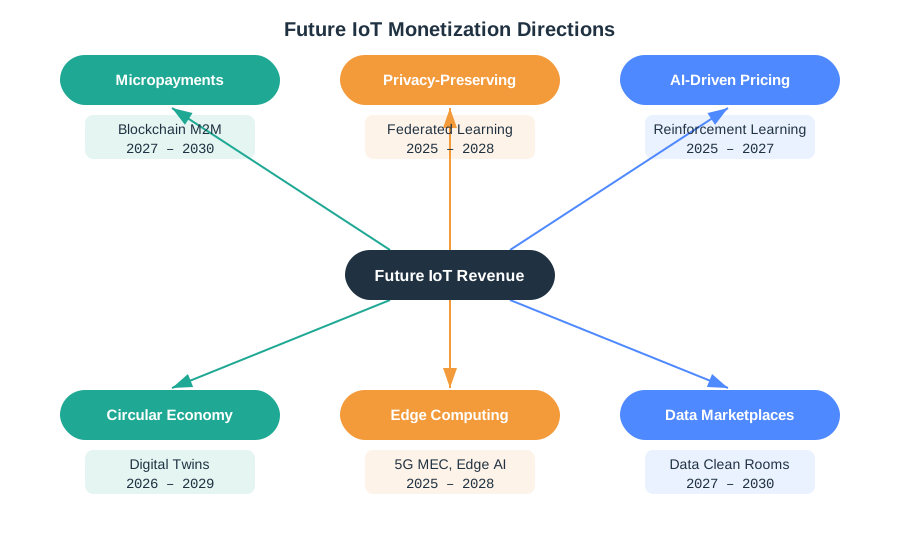
The IoT monetization landscape continues to evolve. Six emerging directions will shape how companies generate revenue from connected devices over the next decade:
Figure 49.7: Future IoT monetization research directions
Micropayment Systems: Can blockchain enable machine-to-machine transactions at sub-cent costs? Enablers include IOTA Tangle, Lightning Network, and DAG-style systems. Estimated maturity: 2027-2030.
Privacy-Preserving Monetization: How can firms monetize insights while protecting individual privacy? Enablers include federated learning, differential privacy, and homomorphic encryption. Estimated maturity: 2025-2028.
AI-Driven Pricing: How can ML optimize pricing across millions of devices in real time? Enablers include reinforcement learning, multi-armed bandits, and causal inference. Estimated maturity: 2025-2027.
Circular Economy Models: How can IoT support product-as-a-service and sustainability revenue? Enablers include digital twins, asset tracking, and carbon-credit verification. Estimated maturity: 2026-2029.
Edge Computing Economics: How does edge computing change processing economics and revenue capture? Enablers include edge AI inference, 5G MEC, and confidential computing. Estimated maturity: 2025-2028.
Cross-Sector Data Marketplaces: What governance enables secure, privacy-preserving cross-industry data exchange? Enablers include data clean rooms, consent APIs, and semantic interoperability. Estimated maturity: 2027-2030.
Common Pitfall: Overestimating New Revenue Channels
Many IoT companies add “data monetization” or “AI-driven pricing” to their business plan without concrete implementation paths. Before pursuing future monetization directions, ensure your core revenue model (hardware + subscription) is proven and sustainable (LTV:CAC > 3:1). New channels should supplement, not replace, proven revenue streams.
49.8 Visual Reference Gallery
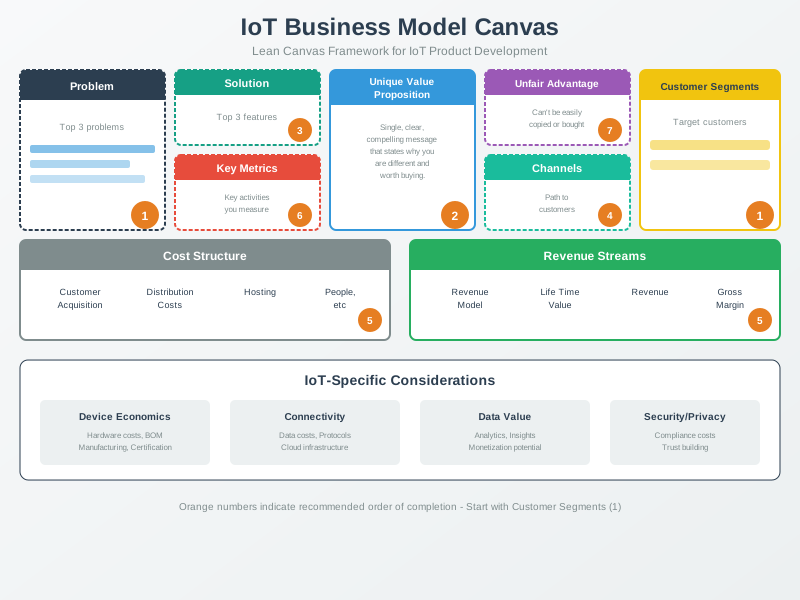
Visual: IoT Business Planning Frameworks
IoT Business Plans
Effective IoT monetization starts with comprehensive business planning that aligns technology capabilities with market needs and sustainable revenue models.
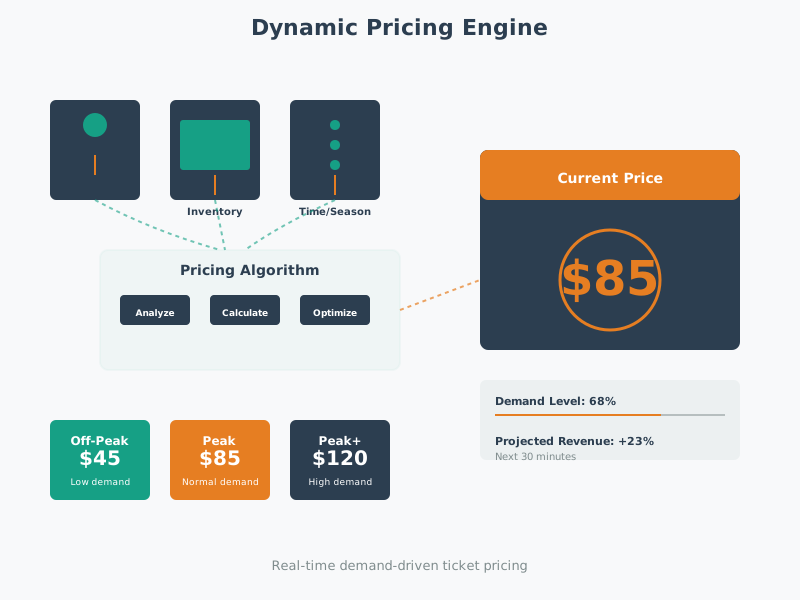
Visual: Dynamic Pricing Systems
Dynamic Pricing Architecture
Dynamic pricing enables IoT platforms to optimize revenue by adjusting prices in real-time based on demand, capacity, customer segments, and competitive factors.
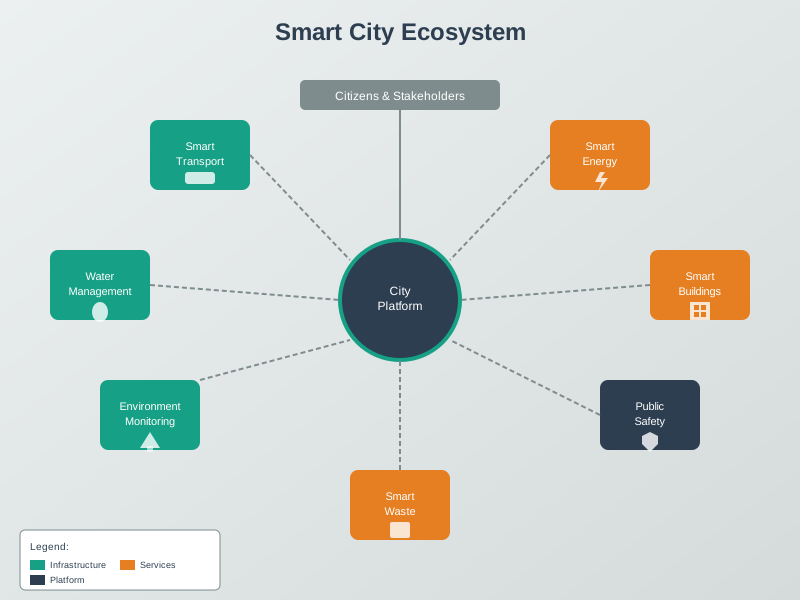
Visual: Platform Ecosystem Economics
Smart City Ecosystem
IoT platforms create powerful network effects where value compounds as more device makers, developers, and users participate, enabling multiple monetization streams.
49.9 Concept Relationships
How monetization strategies connect to IoT architecture and business models:
Ring’s freemium conversion (20-30%) connects to Software and Service Revenue as a benchmark for freemium-to-paid subscription conversion.
Peloton’s LTV:CAC ratio (2.8:1) connects to Direct Monetization Strategies because it shows why anything below 3:1 is hard to sustain.
Smart Data Pricing (NB-IoT) connects to Cellular IoT Fundamentals because $2-10/device/year plans enable outcome-based IoT economics.
Pooled data plans connect to LPWAN Fundamentals because they can cut costs by 70% or more versus individual-device plans.
Sponsored data models connect to IoT Business Models because manufacturers often pay cellular costs to unlock connected services.
49.10 See Also
Related chapters for deeper monetization implementation:
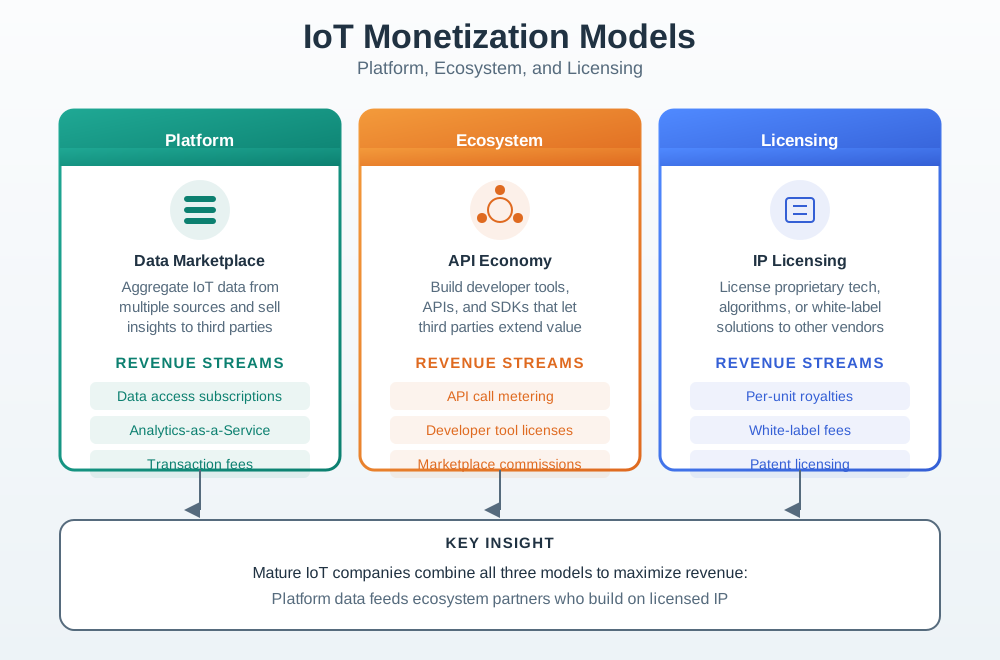
Data Monetization - Aggregated insights, predictive analytics, and privacy-preserving techniques
IoT Business Models - Product-as-a-Service, platform ecosystems, and business model frameworks
Connected Vehicles - V2X deployment cost-benefit analysis and sponsored connectivity
Smart Cities - Municipal IoT ROI calculations and TCO models
In 60 Seconds
This chapter covers iot monetization case studies, explaining the core concepts, practical design decisions, and common pitfalls that IoT practitioners need to build effective, reliable connected systems.
Interactive Quiz: Match IoT Monetization Concepts
Interactive Quiz: Sequence the Steps
49.11 Summary
This chapter examined real-world IoT monetization through case studies and advanced pricing frameworks.
49.11.1 Key Concepts Covered
Peloton Case Study: Dual revenue from hardware plus subscription creates lock-in, but the business still needs sustainable unit economics. Critical metric: LTV:CAC = 2.8:1, below the 3:1 target.
Ring Case Study: Hardware is the wedge; subscription conversion and ecosystem expansion drive long-term value. Critical metric: 20-30% freemium conversion.
Comparative Analysis: Premium-subscription and accessible-ecosystem models trade off market penetration against ARPU.
Smart Data Pricing: The framework organizes pricing around how to charge, whom to charge, and what to charge for. Critical metric: pooled plans can reduce cost by 70% or more.
Carrier Examples: Sponsored data, zero-rating, and QoS tiers show how pricing is implemented in practice. Critical metric: $2-10/device/year for NB-IoT.
Future Directions: Micropayments, privacy-preserving ML, and circular-economy models are likely to shape the next wave of IoT revenue. Critical metric: most of these themes mature in the 2025-2030 window.
49.11.2 Five Rules for IoT Monetization
Hardware is necessary but insufficient – subscription and service revenue generates 5-9x higher lifetime value than one-time product sales
LTV:CAC must exceed 3:1 – if you spend $50 to acquire a customer, they must generate at least $150 in lifetime value
Choose your archetype deliberately – premium-subscription (Peloton) and accessible-ecosystem (Ring) require fundamentally different strategies, not just different pricing
Map the full value chain – a single IoT deployment generates revenue across 4-8 stakeholders; position yourself where margins are highest
Design recurring revenue from day one – retrofitting subscriptions onto hardware-only products rarely works; the subscription value must be intrinsic to the product experience
Key Takeaway
In one sentence: Hardware sales alone will not sustain an IoT business – recurring revenue from subscriptions, services, and data generates 5-9x higher lifetime value than one-time product sales.
Remember this rule: Your LTV:CAC ratio must exceed 3:1 to be sustainable. If you are spending $50 to acquire a customer, they must generate at least $150 in lifetime value. Subscriptions compound over time while hardware margins erode – design recurring revenue into your product from day one.
49.12 What’s Next
Monetization Overview: Review the complete IoT monetization framework and strategy landscape.
Architecture Foundations: Study the architecture patterns and components that enable the business models discussed here.
IoT Business Models: Go deeper into Product-as-a-Service, platform ecosystems, and business model selection frameworks.