11 LPWAN Fundamentals
MVU: Most Valuable Understanding
LPWAN is NOT about choosing the “best” technology - it’s about matching the right technology to your specific constraints. The key insight is that LPWAN fills the gap between short-range (Wi-Fi/BLE) and cellular networks with a unique trade-off: extreme range (2-40 km) and battery life (5-15 years) in exchange for low data rates (Sigfox 100 bps uplink through LoRaWAN up to ~22 kbps). Choose LoRaWAN for private network control and flexibility; Sigfox for ultra-simple global coverage; NB-IoT for mission-critical reliability with cellular security.
11.1 Low-Power Wide-Area Networks (LPWAN)
Low-Power Wide-Area Network (LPWAN) technologies represent a class of wireless communication protocols specifically designed for IoT applications that require long-range connectivity with minimal power consumption. LPWAN fills the gap between short-range technologies (like Wi-Fi and Bluetooth) and traditional cellular networks, enabling battery-powered devices to communicate over distances of several kilometers while lasting years on a single battery.
Learning Objectives
By the end of this chapter series, you will be able to:
- Explain LPWAN fundamentals: Distinguish the defining characteristics that separate LPWAN from short-range and cellular wireless technologies
- Compare key protocols: Analyze LoRaWAN, Sigfox, NB-IoT, and LTE-M based on their technical characteristics, spectrum use, and trade-off profiles
- Evaluate trade-offs: Assess LPWAN technologies against range, power, data rate, and cost constraints for a given deployment scenario
- Select appropriate solutions: Apply decision frameworks to justify the choice of LPWAN technology for specific use cases
- Calculate coverage and battery life: Construct link budget calculations and compute deployment range and multi-year battery estimates
- Diagnose deployment failures: Identify and correct duty cycle violations, collision issues, and misconfigured spreading factors in real deployments
For Beginners: What is LPWAN and Why Does It Matter?
Think of LPWAN as the “marathon runner” of wireless technologies - built for endurance, not speed.
Imagine you need to monitor water levels in 100 tanks spread across a 10-kilometer farm. Wi-Fi can’t reach that far. Cellular data is expensive for simple readings. Bluetooth is way too short-range. What do you use?
That’s exactly what LPWAN solves!
The LPWAN Trade-off:
| What You GET | What You GIVE UP |
|---|---|
| Range: 2-40 kilometers | Data rate: Only kilobits/second |
| Battery life: 5-15 years | Latency: Seconds to minutes |
| Low cost: ~$10 per device | Payload size: 10-250 bytes |
Real-world analogy: LPWAN is like a postal service for sensors. You can send small postcards (data packets) to addresses very far away (long range), and the postman uses a bicycle instead of a truck (low power). But you can’t send packages (large files) or expect same-day delivery (low latency).
When to use LPWAN:
- Smart agriculture (soil moisture, weather stations)
- Asset tracking (containers, vehicles, livestock)
- Smart utilities (water meters, gas meters)
- Environmental monitoring (air quality, flood sensors)
- Smart buildings (parking sensors, waste management)
When NOT to use LPWAN:
- Video streaming (too slow)
- Real-time control (too much latency)
- Frequent updates (duty cycle limits)
- Large data transfers (payload too small)
Sensor Squad: Sammy’s Long-Distance Adventure!
Meet the Sensor Squad! Sammy the Temperature Sensor wants to send messages to the Cloud Castle, but it’s REALLY far away!
The Problem: Sammy lives in a farm field, kilometers away from any Wi-Fi signal. He needs to tell the Farmer App what temperature it is, but his tiny voice (Wi-Fi) can’t travel that far!
“I’ve been shouting all day, but nobody can hear me!” sighs Sammy. “And I’m so tired from trying!”
Lila the Light Sensor has an idea: “What if we use a SUPER LOUD whisper instead of shouting? That’s what LPWAN does!”
Max the Motion Sensor explains: “With LPWAN, you speak very slowly and clearly - like spelling out each letter - so the message can travel super far. It’s like when you’re far from your friend and you wave your arms really big instead of making tiny gestures!”
Bella the Button draws a picture:
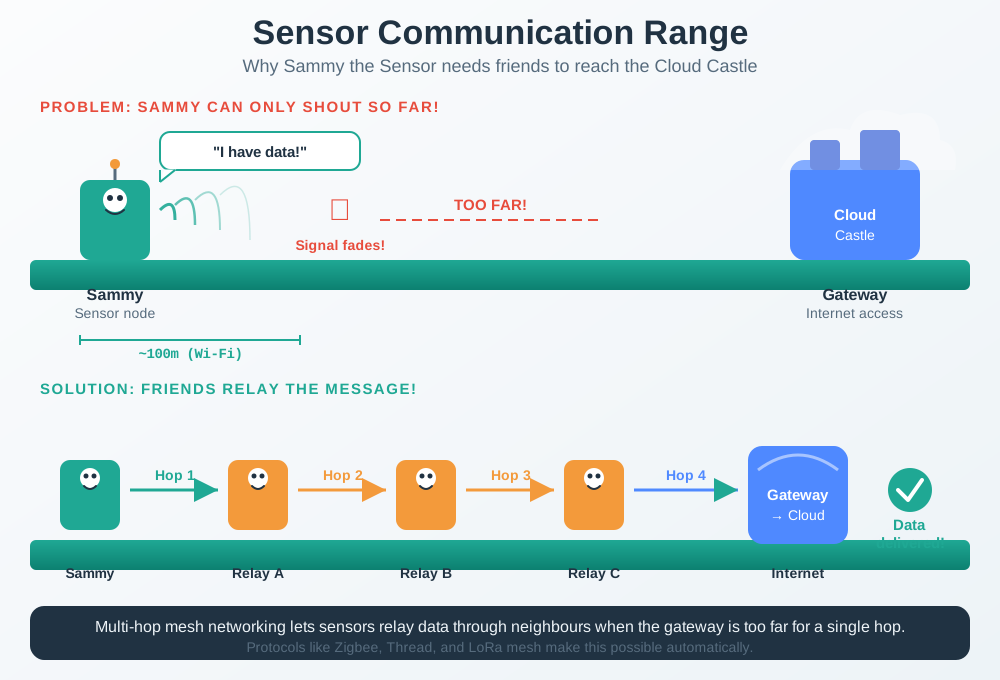
The Magic of LPWAN:
- LoRaWAN is like a walkie-talkie network - you can set up your own base station!
- Sigfox is like a global postcard service - already built everywhere!
- NB-IoT is like using the phone company’s towers - super reliable!
Sammy’s Rule: “If I only need to send small messages far away and I want my battery to last YEARS, I use LPWAN. If I need to send videos or talk really fast, I need something else!”
The Happy Ending: Sammy joined the LPWAN network and now sends his temperature readings 5 kilometers to the barn, using so little energy that his battery will last 10 YEARS! The Farmer App always knows the field temperature.
The Lesson: LPWAN is like having a super-efficient, long-distance postal service for tiny sensor messages!
11.2 LPWAN Technology Landscape
Understanding where LPWAN fits in the broader wireless connectivity landscape helps clarify when to choose these technologies over alternatives.
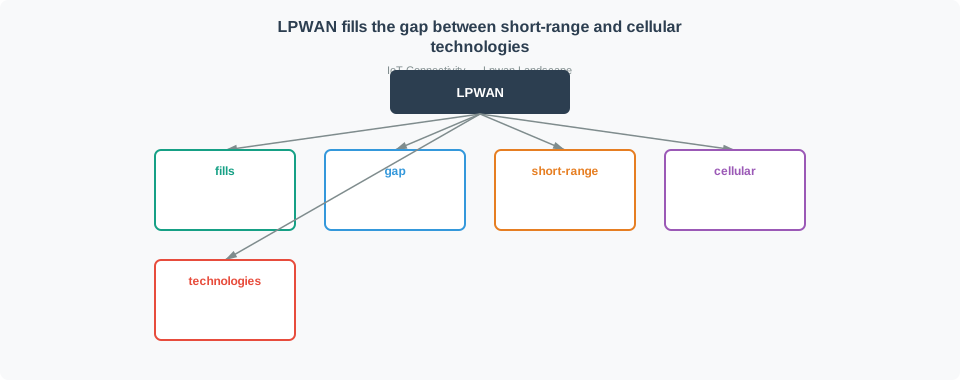
The diagram above illustrates the fundamental positioning of LPWAN technologies. Notice how LPWAN fills a crucial gap: scenarios requiring both long range (kilometers, not meters) and low power (years of battery life, not days) where traditional technologies fall short.
11.2.1 The LPWAN Trade-off Triangle
Every LPWAN technology makes trade-offs between three critical factors:
11.3 Chapter Overview
This comprehensive guide to LPWAN fundamentals has been organized into focused chapters for easier learning:
11.3.1 1. LPWAN Overview and Introduction
Start here to understand what LPWAN is and why it matters:
- What problem LPWAN solves
- The three main LPWAN technologies (LoRaWAN, Sigfox, NB-IoT)
- Key trade-offs: range vs power vs data rate
- Real-world LPWAN examples
- Historical context and evolution
11.3.2 2. LPWAN Technology Comparison
Detailed technical comparison of all major LPWAN technologies:
- LoRaWAN, Sigfox, NB-IoT, and LTE-M side by side
- Market landscape and adoption patterns
- Architecture differences and trade-off profiles
- Spectrum allocation (ISM vs. licensed cellular)
11.3.3 3. LPWAN Technology Selection
Choose the right LPWAN technology for your project:
- Decision flowchart for technology selection
- Comprehensive use case matrix
- Selection rules by deployment scenario
- Hybrid deployment strategies
11.3.4 4. LPWAN Cost Analysis
Calculate and compare total cost of ownership:
- 50,000-device deployment case study
- LoRaWAN vs NB-IoT break-even analysis
- Duty cycle compliance and regulatory overview
- Hidden costs: battery replacement and logistics
11.4 Quick Reference: LPWAN Comparison
| Technology | Range | Data Rate | Battery Life | Best For |
|---|---|---|---|---|
| LoRaWAN | 2-15 km | 0.3-22 kbps | 5-15 years | Private networks, agriculture |
| Sigfox | 10-40 km | 100 bps uplink / 600 bps downlink | 10-20 years | Ultra-simple sensors |
| NB-IoT | 1-10 km | ~21-127 kbps | 5-10 years | Mission-critical, smart cities |
| LTE-M | 1-10 km | up to 375 kbps (Cat-M1) | 5-10 years | Mobile assets, fleet tracking |
Putting Numbers to It
For a smart parking sensor sending occupancy status (1-byte payload) every 5 minutes, LPWAN technologies show dramatic differences in range and energy:
LoRaWAN (SF12, 125 kHz BW, 14 dBm TX power): \[ \begin{align*} \text{Link budget} &= P_{TX} + G_{TX} - L_{path} + G_{RX} - M \\ &= 14 \text{ dBm} + 2 \text{ dB} - (20\log_{10}(d) + 20\log_{10}(f) + 32.45) + 2 \text{ dB} - 10 \text{ dB} \\ \text{Sensitivity SF12} &= -137 \text{ dBm (theoretical)} \\ \text{Range (urban)} &\approx 2\text{-}5 \text{ km, } \text{(rural)} \approx 10\text{-}15 \text{ km} \end{align*} \]
Energy per message at SF12 (51-byte frame, ~293 bps effective, EU868 max 25 mW TX): \[ \text{Airtime} \approx 1.32 \text{ sec (LoRa ToA calculator, SF12/BW125)}, \quad \text{Energy} = 25 \text{ mW} \times 1.32 \text{ s} = 33 \text{ mJ} \]
Sigfox (100 bps, 14 dBm TX power, ~25 mW): \[ \begin{align*} \text{Sensitivity} &= -142 \text{ dBm (Ultra Narrow Band)} \\ \text{Range (urban)} &\approx 10 \text{ km, (rural)} \approx 40 \text{ km} \\ \text{Airtime} &= \frac{12 \text{ bytes} \times 8}{100} = 0.96 \text{ sec} \\ \text{Energy/msg} &= 25 \text{ mW} \times 0.96 \text{ s} = 24 \text{ mJ} \end{align*} \]
NB-IoT (23 dBm TX power = 200 mW, carrier-grade): \[ \begin{align*} \text{MCL} &= 164 \text{ dB (Maximum Coupling Loss)} \\ \text{Range} &\approx 1\text{-}10 \text{ km (superior building penetration)} \\ \text{Energy/msg} &= 200 \text{ mW} \times 0.2 \text{ s (fast TX)} = 40 \text{ mJ} \end{align*} \]
Battery life comparison (2000 mAh at 3.3 V, 288 messages/day):
Converting mJ → mAh: \(\text{mAh} = \frac{\text{mJ}}{V \times 3600} = \frac{\text{mJ}}{3.3 \times 3600} = \frac{\text{mJ}}{11{,}880}\)
LoRaWAN: \(\frac{33 \text{ mJ} \times 288}{11{,}880} \approx 0.8 \text{ mAh/day}\) → sleep current dominates in practice → ~5 years
Sigfox: \(\frac{24 \text{ mJ} \times 288}{11{,}880} \approx 0.58 \text{ mAh/day}\) → optimised sleep → ~10 years
NB-IoT: \(\frac{40 \text{ mJ} \times 288}{11{,}880} + \text{PSM overhead} \approx 1.7 \text{ mAh/day}\) → PSM mode → ~5-7 years
The key insight: Sigfox’s ultra-narrow bandwidth (100 bps) and lower TX power (25 mW at 14 dBm vs 200 mW for NB-IoT at 23 dBm) combine with a very short airtime (0.96 s) to give the best energy-per-message figure, but at the cost of severely limited throughput and a 140-message/day uplink cap.
11.5 Prerequisites
Before diving into LPWAN, you should be familiar with:
- Networking Basics: Fundamental networking concepts
- Mobile Wireless Technologies: Cellular and wireless technologies
- (Optional) Wireless Sensor Networks: WSN architectures
Key Concepts
- LPWAN Fundamentals: The core technical principles of LPWAN: sub-GHz propagation, link budget analysis, duty cycle regulation, modulation schemes, and network architectures.
- Spreading Factor vs Data Rate: LoRa’s spreading factor (SF) tradeoff: SF7 = 5.5 kbps (short range), SF12 = 0.25 kbps (maximum range); each SF increment doubles air time and extends range ~2x.
- Unlicensed vs Licensed Spectrum: LoRaWAN and Sigfox use unlicensed sub-GHz bands (duty cycle regulated); NB-IoT and LTE-M use licensed cellular spectrum (carrier-managed, no duty cycle limits).
- Network Architecture Comparison: LoRaWAN: star-of-stars with private/community gateways; Sigfox: national network with operator gateways; NB-IoT: cellular eNodeB infrastructure; each creates different operational dependencies.
11.6 What’s Next
| Chapter | Focus | Why Read It |
|---|---|---|
| LPWAN Overview and Introduction | What LPWAN is, why it exists, and the three dominant technologies | Build your foundation before diving into technical comparisons |
| LPWAN Technology Comparison | Side-by-side analysis of LoRaWAN, Sigfox, NB-IoT, and LTE-M across range, data rate, cost, and spectrum | Select the right technology for your project with confidence |
| LPWAN Technology Selection Guide | Decision flowchart, use-case matrix, and hybrid deployment strategies | Apply a structured framework instead of guessing which technology fits |
| LPWAN Cost Analysis | Total cost of ownership, break-even analysis for 50,000-device deployments, and hidden battery-replacement costs | Justify your LPWAN budget and calculate 5-year ROI before committing |
| LoRaWAN Overview | LoRa modulation, LoRaWAN class A/B/C devices, network architecture, and ADR | Go deep on the most widely deployed private LPWAN technology |
| NB-IoT Fundamentals | Narrowband-IoT radio interface, PSM/eDRX power modes, and carrier deployment | Understand carrier-grade LPWAN for smart cities and utilities |
11.7 Knowledge Check: LPWAN Fundamentals
Test your understanding of LPWAN concepts before diving into the detailed chapters.
Worked Example: Designing an LPWAN Farm Network with Real Budget Constraints
Scenario: A 300-hectare vineyard in Napa Valley needs soil moisture and weather monitoring. The owner has $15,000 budget and wants 5+ years of battery life.
Step 1: Coverage calculation
Field dimensions: 1500m x 2000m
LoRaWAN gateway range (rural): ~5 km radius
Required gateways: 1 (centered, covers entire property)
Step 2: Sensor placement
Soil moisture sensors: Every 25 hectares = 12 sensors
Weather stations: 1 every 100 hectares = 3 stations
Total nodes: 15
Step 3: Link budget calculation for worst-case node (corner, 2.5 km from gateway)
TX power (EU868, SF12): +14 dBm
Gateway sensitivity (SF12): -137 dBm
Path loss (2.5 km, rural): 120 dB (Friis formula)
Obstacles (vineyard rows): -10 dB
Link margin: 14 - 120 - 10 - (-137) = 21 dB ✓ (>10 dB needed)
Step 4: Duty cycle compliance (EU868 1% limit)
Per sensor per day:
- Transmissions: 24 (hourly readings)
- Time-on-air (SF12, 12 bytes): 1.48 s
- Daily duty: 24 × 1.48 = 35.5 s
- Compliance check: 35.5 / 86400 = 0.04% ✓ (well under 1%)
Step 5: Battery life calculation
Soil moisture sensor (2x AA lithium, 3000 mAh each = 6000 mAh):
- TX current: 120 mA for 1.48s = 49.3 μAh
- Sleep current: 5 μA for 3599s = 5 mAh
- Daily: 24 × (49.3 μAh + 5 mAh) = 121.2 mAh
- Battery life: 6000 / 121.2 = 49.5 months ≈ 4 years

Weather station (solar + 5000 mAh backup):
- TX: 3× daily (wind/rain/temp) = 147.9 μAh
- Sensors active 10s/hour: 10 mA × 24 × 10s = 666 μAh
- Daily total: 814 μAh
- Solar panel (10W): Supplies 1500 mAh/day (sunny), infinite runtime
Step 6: Cost breakdown
LoRaWAN gateway (Laird RG1xx): $450
12× soil sensors (@$35): $420
3× weather stations (@$180): $540
Solar kits for weather stations: $150
ChirpStack server (Raspberry Pi): $75
Antennas + mounting: $200
Installation labor (3 days): $2,400
Total: $4,235 (within $15,000 budget)
Decision: LoRaWAN selected because:
- Private network (no recurring fees)
- Meets 4-year battery requirement
- 21 dB link margin provides reliability despite foliage
- EU868 duty cycle compliance
- Total cost 28% of budget
Decision Framework: LoRaWAN vs Sigfox vs NB-IoT Selection
| Criterion | Weight | LoRaWAN | Sigfox | NB-IoT | Notes |
|---|---|---|---|---|---|
| Initial cost | 20% | 9/10 (no subscription) | 10/10 (lowest device cost) | 6/10 (device cost high) | LoRa module $6, Sigfox $4, NB-IoT $12 |
| Recurring cost | 25% | 10/10 ($0/yr) | 7/10 ($8/device/yr) | 5/10 ($2/device/yr) | 100 devices over 5 years: LoRa $0, Sigfox $4000, NB-IoT $1000 |
| Coverage (rural) | 15% | 8/10 (deploy own gateway) | 9/10 (Sigfox coverage map) | 6/10 (carrier dependent) | Check coverage map before deciding |
| Uplink capacity | 10% | 10/10 (140 msg/day) | 6/10 (140 msg/day, but 12 bytes max) | 10/10 (no daily limit) | Sigfox 140 msg limit is hard constraint |
| Downlink capacity | 5% | 9/10 (unlimited, but use sparingly) | 3/10 (4 msg/day) | 10/10 (no limit) | Sigfox downlink severely limited |
| Battery life | 15% | 9/10 (5-10 years) | 10/10 (10-15 years) | 7/10 (5-8 years) | All adequate, Sigfox best due to simplicity |
| Data rate | 5% | 8/10 (up to 22 kbps at SF7/BW500) | 5/10 (100 bps uplink) | 9/10 (~127 kbps peak DL) | LoRa adapts SF, Sigfox fixed ultra-low |
| Security | 5% | 8/10 (AES-128) | 7/10 (Sigfox encryption) | 10/10 (LTE security) | All adequate for most IoT |
Score calculation:
LoRaWAN: (9×0.20) + (10×0.25) + (8×0.15) + (10×0.10) + (9×0.05) + (9×0.15) + (8×0.05) + (8×0.05) = 8.95
Sigfox:  (10×0.20) + (7×0.25) + (9×0.15) + (6×0.10) + (3×0.05) + (10×0.15) + (5×0.05) + (7×0.05) = 7.85
NB-IoT:  (6×0.20) + (5×0.25) + (6×0.15) + (10×0.10) + (10×0.05) + (7×0.15) + (9×0.05) + (10×0.05) = 6.75
Decision rules:
- Choose LoRaWAN if: Private network control, rural area without carrier coverage, >140 uplink msg/day needed, no recurring cost tolerance
- Choose Sigfox if: Global roaming required, ultra-simple sensors (<12 bytes), minimal device cost, existing Sigfox coverage
- Choose NB-IoT if: Mission-critical reliability, dense urban area with carrier coverage, need >250 bytes payload, downlink-heavy application
Common Mistake: Ignoring Duty Cycle Limits in EU868 Deployments
The mistake: A smart agriculture startup deployed 500 LoRaWAN sensors in Spain, each transmitting every 5 minutes with SF12 (time-on-air: 1.48s). They hit EU868’s 1% duty cycle limit and experienced 90% packet loss during peak hours.
Why it happens: Developers calculate battery life and coverage but forget regulatory duty cycle. EU868 allows only 36 seconds of transmission per hour (1% of 3600s) per device on the default g1 sub-band (868.0-868.6 MHz).
The math of the mistake:
Transmissions per hour: 12 (every 5 min)
Time-on-air per TX: 1.48s (SF12, 12 bytes)
Total airtime per hour: 12 × 1.48 = 17.76s
Duty cycle: 17.76 / 3600 = 0.49% ✓ (under 1%, should work!)
But wait - what about collisions with 500 devices?
500 devices × 12 TX/hour = 6,000 TX/hour on 8 channels
Collision probability (simplified): 1 - e^(-(6000/8)/3600) ≈ 18%
Effective TX success: 82% × 49% duty compliance = 40% success rate
The fix:
Switch to SF7 (time-on-air: 56ms) for devices with good link budget:
12 × 0.056 = 0.67s/hour = 0.02% duty cycle
Collision probability drops to 2.8%
Success rate: 97%
Use confirmed uplinks sparingly (each confirmation doubles airtime):
If every uplink needs ACK: 17.76 × 2 = 35.52s/hour = 0.99% (at limit!)
Use confirmed only for critical alarms, not all data
Stagger transmissions (add random delay 0-300s at boot):
Prevents all 500 sensors transmitting at :00, :05, :10 minutes
Spreads load across the hour
Real numbers from the fix:
- Before: 40% packet delivery, customer complaints, network unusable
- After (SF7 + staggered): 97% delivery, 0.02% duty cycle, compliant
- Battery life impact: SF7 uses more TX power but shorter airtime = net positive (5.2 years → 6.1 years)
Lesson: Always calculate per-device duty cycle × number of devices × collision probability before deploying LPWAN at scale. Duty cycle compliance per device does NOT guarantee network capacity.
11.8 Interactive: LPWAN Battery Life Estimator
Use this calculator to estimate battery life for your LPWAN deployment based on technology, message frequency, and battery size.
Common Pitfalls
1. Starting With Advanced Topics Before Fundamentals
LPWAN fundamentals (link budget, spreading factors, network architecture) are essential for correctly evaluating deployment options. Skipping fundamentals and jumping directly to deployment configuration produces poorly optimized systems.
2. Not Understanding the Duty Cycle Constraint’s Impact on Application Design
EU868 duty cycle limits are hard constraints that affect application design, not just radio configuration. If your application requires 1 message per minute at SF12 (violated duty cycle), you must redesign the application, not just change the radio settings.
Related LPWAN Chapters
Specific Technologies:
- LoRaWAN Overview - Deep dive into LoRa
- Sigfox - Ultra-narrow band protocol
- NB-IoT - Cellular LPWAN
- LPWAN Comparison - Detailed comparison
Architecture:
Learning Hubs:
- Simulations Hub - Interactive tools
- Quiz Navigator - Test your knowledge