These knowledge checks test LPWAN deployment decision-making through real-world scenarios: operator bankruptcy risk mitigation for global logistics, private vs. public network selection for agriculture, reliability requirements for smart city parking (99.9% needs NB-IoT), and link budget calculations including building penetration loss and fade margins that can turn a theoretical 10 km link into a failed deployment.
Knowledge Check
Test your understanding of LPWAN concepts with these scenario-based questions.
{#fig-mermaid-lpwan-fundamentals-3-3f6984} 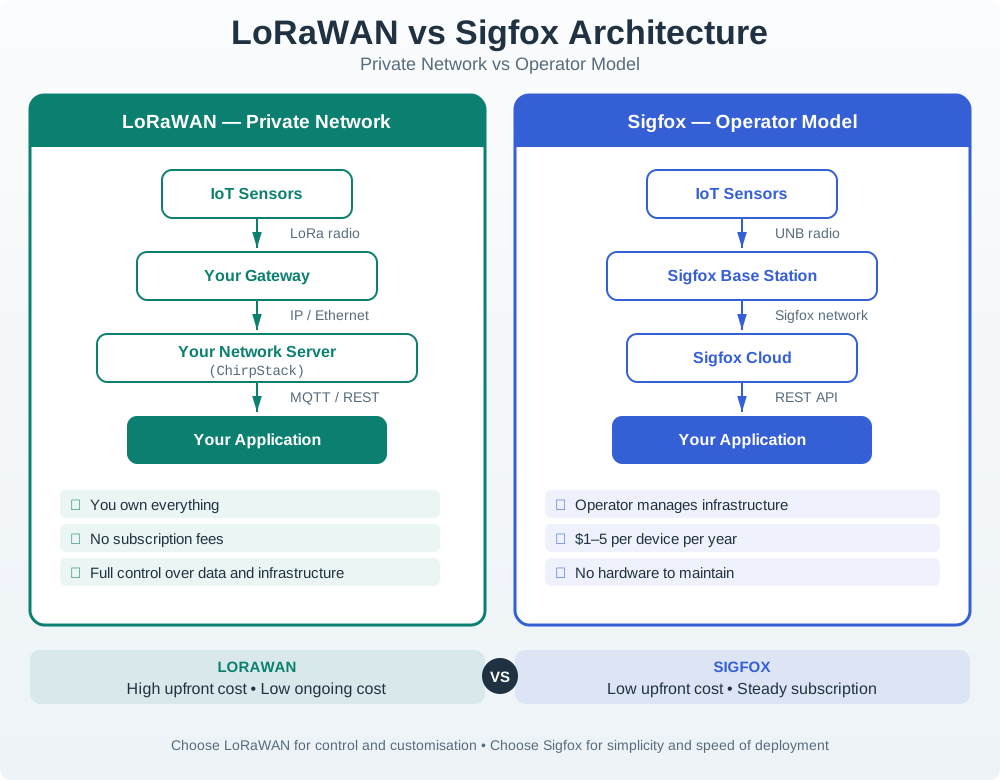
LoRaWAN private network vs Sigfox operator model comparison
{fig-alt=“Comparison of LoRaWAN private network model (you own gateways and network server, full control, no subscription fees) versus Sigfox operator model (operator-owned base stations and backend, subscription-based, limited control via HTTP callbacks). Highlights infrastructure ownership and cost structure differences for agricultural IoT deployment.”}
Why Private Network Matters for Agriculture:
Cost Comparison (1,000 sensors, 10 years):

LoRaWAN (Private):
- Sensors: 1,000 x €15 = €15,000
- Gateways: 5 x €500 = €2,500
- Network server: €0 (ChirpStack free)
- 10-year cost: €17,500 (€1.75/sensor/year)

Sigfox:
- Sensors: 1,000 x €10 = €10,000
- Subscription: 1,000 x €1.50 x 10 = €15,000
- 10-year cost: €25,000 (€2.50/sensor/year)

LoRaWAN becomes cheaper after year 3!
Additional LoRaWAN Advantages for Agriculture:
1. No coverage dependency:
   - Rural farms often have no Sigfox coverage
   - Deploy your own gateways where needed

2. Control and privacy:
   - Soil data stays on your servers
   - No third-party access to farm data

3. Flexibility:
   - Adjust SF/BW for range vs battery
   - Add gateways as farm expands
Why Other Options Are Wrong:
A - Signal penetration: - Both use sub-GHz frequencies with similar penetration - LoRa CSS and Sigfox UNB have comparable link budgets (~150 dB) - Not a differentiator
C - Data rates: - LoRaWAN: 0.3-50 kbps (varies by SF) - Sigfox: 100-600 bps - LoRaWAN is faster, but 20-byte hourly readings work on either - FUOTA is possible but rarely used in agriculture
D - Licensed spectrum: - BOTH use unlicensed ISM bands (868 MHz EU, 915 MHz US) - Neither uses licensed spectrum - This statement is factually incorrect