Industrial Ethernet protocols (PROFINET, EtherNet/IP, EtherCAT) extend standard Ethernet with deterministic, real-time capabilities required for machine control, where missing a 100ms deadline can cause equipment damage. Time-Sensitive Networking (TSN) is emerging as a converged IT/OT standard providing guaranteed latency on standard Ethernet hardware.
50.1 Industrial Ethernet: PROFINET, EtherCAT, and TSN
Learning Objectives
By the end of this section, you will be able to:
Compare major industrial Ethernet protocols (PROFINET, EtherNet/IP, EtherCAT) by cycle time, node capacity, and vendor ecosystem
Distinguish real-time classes (NRT, RT, IRT) and explain their deterministic networking requirements
Design EtherCAT networks for high-speed motion control using distributed clocks
Configure PROFINET for Siemens automation systems with correct device roles and Frame IDs
Evaluate Time-Sensitive Networking (TSN) standards for converged IT/OT deployments
Select the appropriate industrial Ethernet protocol for a given application by applying a structured decision matrix
Calculate position error accumulation from cycle time jitter to justify protocol selection
50.2 Prerequisites
Before diving into this chapter, you should be familiar with:
PROFINET: Siemens-led industrial Ethernet standard for automation; supports three communication channels: TCP/IP (configuration), RT (real-time, 1-10ms cycle), IRT (isochronous real-time, <1ms cycle).
TSN (Time-Sensitive Networking): IEEE 802.1 standards extending standard Ethernet with time-bounded delivery, traffic shaping, and frame preemption for deterministic industrial Ethernet.
EtherCAT: Beckhoff’s industrial Ethernet protocol where the master broadcasts frames that each slave node reads/inserts into as the frame passes through, achieving sub-100µs cycle times.
Real-Time (RT) Communication: PROFINET RT uses standard Ethernet frames bypassing TCP/IP stack with cycle times of 1-10ms; suitable for most automation applications.
Isochronous Real-Time (IRT): PROFINET IRT uses time-synchronized frames with <1ms and microsecond-level jitter; required for motion control and drives.
GSDML File: PROFINET’s device description file (Generic Station Description Markup Language) declaring module slots, submodules, and parameters; used by engineering tools for automatic device configuration.
Office Ethernet: Designed for files, emails, web browsing - “Best effort” delivery—packets arrive eventually - A 100ms delay? Nobody notices
Industrial Ethernet: Designed for machine control - Deterministic delivery—packets MUST arrive on time - A 100ms delay? Robot crashes, product ruined
The Challenge: Standard Ethernet wasn’t built for this. When you plug a printer and a robot controller into the same switch, the printer’s large print job can delay the robot’s control packets.
The Solutions:
Modified Ethernet (PROFINET IRT, EtherCAT): Change how Ethernet works
Priority Mechanisms (TSN): Add strict scheduling to standard Ethernet
Dedicated Networks: Keep industrial traffic separate
Real-World Analogy:
Standard Ethernet = Regular highway (everyone shares, traffic jams possible)
Industrial Ethernet = Emergency vehicle lane (guaranteed access for critical traffic)
Sensor Squad: The Fast Lane
“Regular Ethernet works fine for my web browsing, so why do factories need special Ethernet?” asked Sammy the Sensor.
Max the Microcontroller explained: “Imagine a highway with no speed limits and no lane rules. Most of the time, traffic flows fine. But during rush hour, you might wait 10 seconds at a bottleneck. That’s normal Ethernet – usually fast, but no guarantees. Now imagine a robot arm that MUST receive its command within 1 millisecond. A 10-second delay means a crashed robot.”
“Industrial Ethernet protocols like PROFINET, EtherCAT, and EtherNet/IP add a reserved fast lane,” said Lila the LED. “Critical control messages get priority – they ALWAYS arrive on time, even when the network is busy. It’s like an ambulance lane on a highway.”
Bella the Battery was impressed: “EtherCAT is the fastest – it can update 1,000 devices in just 30 microseconds by passing a single packet through all devices in a chain. PROFINET IRT guarantees delivery within 250 microseconds using reserved time slots. These numbers sound tiny, but in a factory making cars or chips, they’re the difference between precision and disaster!”
50.4 Industrial Ethernet Landscape
Understanding Industrial Ethernet Determinism
Core Concept: Determinism means guaranteed, predictable timing—a control command sent will arrive within a known time window with minimal variation (jitter), regardless of other network traffic.
Why It Matters: Standard Ethernet uses best-effort delivery where packets may be delayed by other traffic. For motion control (robot arms, CNC machines), a delayed command can cause collisions, product defects, or safety hazards. Industrial Ethernet protocols solve this through various mechanisms: time-slotted scheduling (PROFINET IRT), processing-on-the-fly (EtherCAT), or IEEE TSN standards (802.1Qbv time-aware shaper).
Key Takeaway: Match your cycle time requirement to the protocol: <100 microseconds requires EtherCAT or PROFINET IRT; 1-10 milliseconds works with PROFINET RT or EtherNet/IP; >10 milliseconds can use standard Ethernet with OPC-UA or MQTT.
50.4.1 Protocol Market Share
Figure 50.1: Industrial Ethernet market share distribution in 2024
Alternative View: Real-Time Performance Spectrum
This diagram shows the real-time performance spectrum: from soft real-time (standard Ethernet) to hard real-time (specialized protocols like EtherCAT and PROFINET IRT).
50.4.2 Protocol Comparison
Protocol
Vendor
Cycle Time
Nodes
Primary Use
PROFINET RT
Siemens
1ms - 10ms
512
Factory automation, general I/O
PROFINET IRT
Siemens
250μs - 1ms
512
Motion control, synchronized axes
EtherNet/IP
Rockwell
1-10ms
Unlimited
Process, discrete
EtherCAT
Beckhoff
31.25μs - 100μs
65,535
High-speed motion control
CC-Link IE
Mitsubishi
125μs - 10ms
254
Asia-Pacific automation
POWERLINK
B&R
200μs - 10ms
253
CNC, packaging
SERCOS III
Bosch
31.25μs
511
Precision motion control
50.5 PROFINET
50.5.1 Architecture
Figure 50.2: PROFINET performance classes from NRT to IRT
50.5.2 PROFINET Device Roles
Role
Function
Example
IO Controller
Master device, initiates communication
PLC (S7-1500)
IO Device
Slave device, responds to controller
Remote I/O, drives
IO Supervisor
Configuration and diagnostics
Engineering station
50.5.3 PROFINET Frame Structure
| Ethernet Header | VLAN Tag | Frame ID | Cyclic Data | Status | FCS |
| 14 bytes        | 4 bytes  | 2 bytes  | Variable    | 4 bytes| 4 bytes|
Accumulated: \(50\text{ mm}\) — unusable for precision welding
Quality impact: Automotive specification requires ±2 mm weld accuracy. EtherCAT easily meets this (0.5 mm error). Standard Ethernet fails completely (50 mm drift). This 10× cycle time improvement costs only ~$200 more per robot controller but prevents $10,000+ in scrap per misaligned frame!
50.10 Understanding Check
Knowledge Check
Scenario: You’re designing a semiconductor wafer handling system with: - 6-axis robot arm (synchronized 8 axes total) - 50+ I/O points for vacuum, sensors - Vision system for alignment - Integration with MES for recipe management - Requirement: 100μs motion synchronization
Questions:
Which industrial Ethernet would you choose for motion control?
How would you handle the vision system integration?
What about MES connectivity?
How would you ensure 100μs synchronization?
Solution
1. Motion Control: EtherCAT
100μs requirement eliminates PROFINET RT and EtherNet/IP
EtherCAT achieves 50-100μs cycles easily
Distributed Clocks for sub-microsecond synchronization
Native support in most servo drive manufacturers
2. Vision System Integration: Option A: Separate GigE Vision network (keeps determinism) Option B: EtherCAT with CoE (CAN over EtherCAT) for triggers - Vision processing done off-network - Only trigger/result over EtherCAT (~μs for signal) - Camera images via separate GigE (bulk data)
3. MES Connectivity: OPC-UA via Gateway
EtherCAT master exposes OPC-UA server
MES connects as OPC-UA client
Non-deterministic traffic isolated from motion network
Recipe download before motion, not during
4. Ensuring 100μs Synchronization:
Distributed Clocks Configuration:
- Reference clock: EtherCAT master
- DC slaves: All servo drives
- Propagation delay: Auto-measured at startup
- Sync0 signal: Triggers synchronized motion
- Jitter: <100ns (100× better than requirement)
Network topology:
Master → Drive1 → Drive2 → ... → Drive8 → I/O
Daisy-chain minimizes jitter
Total propagation: 8 × 1μs = 8μs
Plenty of margin for 100μs cycle
Auto-Gradable Quick Check
Interactive Quiz: Match Concepts
🏷️ Label the Diagram
💻 Code Challenge
📝 Order the Steps
:
50.11 Summary
PROFINET dominates Siemens ecosystems with RT (10ms) and IRT (<1ms) classes
EtherCAT achieves the fastest cycles (<100μs) with processing on the fly
EtherNet/IP (Rockwell) uses standard TCP/UDP with CIP application layer
TSN is the future – deterministic standard Ethernet enabling IT/OT convergence
Distributed Clocks (EtherCAT) or PTP (TSN) enable sub-microsecond synchronization
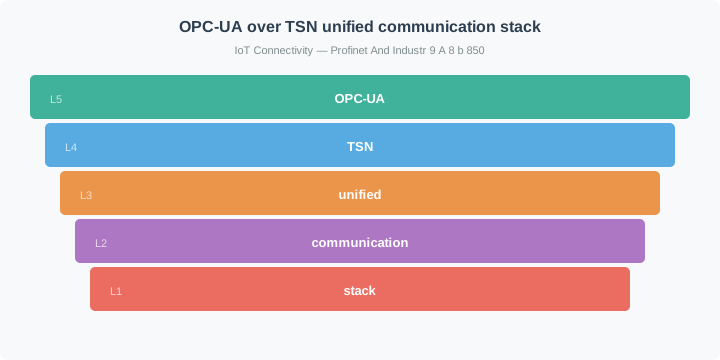
OPC-UA over TSN is emerging as the unified industrial standard
Real-world ROI: BMW achieved 18-month payback on EtherCAT migration through 75% scrap reduction and 15% throughput increase
50.12 Concept Relationships
Industrial Ethernet protocols solve the determinism challenge through different mechanisms:
Determinism = Predictable Timing: Standard Ethernet is “best effort” - packets arrive when they arrive. Industrial control requires guaranteed delivery within time window (e.g., servo motor command MUST arrive within 250 µs). Three approaches: (1) PROFINET IRT uses time-slotted scheduling, (2) EtherCAT uses processing-on-the-fly, (3) TSN uses IEEE 802.1 standards. All achieve same goal (determinism) via different physics.
Cycle Time Drives Protocol Selection: The worked example (packaging line) demonstrates decision tree: 100 µs requirement → EtherCAT (only option). 500 µs → PROFINET IRT or EtherCAT. 10 ms → PROFINET RT, EtherNet/IP, or standard Ethernet + OPC-UA. Cycle time is the PRIMARY selection criterion, not features or vendor preference.
TSN Convergence Vision: Current state = protocol silos (PROFINET for Siemens, EtherCAT for Beckhoff, EtherNet/IP for Rockwell). TSN future = unified transport layer (IEEE 802.1Qbv time-aware shaper + 802.1AS clock sync) with OPC-UA information model on top. OPC-UA over TSN eliminates protocol lock-in while preserving determinism. OPC-UA Fundamentals explains information model side.
Real-World Complexity: BMW case study shows EtherCAT migration delivered 18-month ROI through 75% scrap reduction + 15% throughput increase. BUT this wasn’t just protocol swap - it was full re-engineering (robot programs rewritten, PLC logic updated, operator training). Technology selection is 20% of project; integration is 80%.
50.13 See Also
Protocol Comparisons:
OPC-UA Fundamentals - OPC-UA provides integration layer ABOVE real-time protocols. PROFINET controls servo (1 ms cycle), OPC-UA reads status (100 ms poll). Complementary, not competitive.
Modbus Protocol - Modbus = no determinism guarantees. PROFINET RT = <10 ms deterministic. Different problem domains (Modbus for slow I/O, PROFINET for motion control).