44 IoT Real-Time Protocols
44.1 Learning Objectives
By the end of this chapter, you will be able to:
- Explain VoIP Architecture: Describe the complete protocol stack (SIP, RTP, SRTP, RTCP) for real-time audio/video in IoT devices
- Compare RTP vs Messaging Protocols: Distinguish when to use RTP instead of MQTT/CoAP based on latency, packet-loss tolerance, and data type
- Design Secure Streaming: Configure encryption (SRTP, TLS) and authentication for real-time IoT streams accessible from the internet
- Select Appropriate Protocols: Justify the choice between SIP, RTSP, and WebRTC for specific IoT device types and deployment scenarios
- Calculate Latency Budgets: Apply the 150ms end-to-end threshold to evaluate whether a proposed protocol stack meets real-time conversation requirements
- Analyze Hybrid Architectures: Assess when to combine messaging protocols (MQTT) with real-time protocols (RTP/SIP) in a single IoT system
For Beginners: IoT Real-Time Protocols
Some IoT applications cannot tolerate any delay – a self-driving car needs to react in milliseconds, not seconds. Real-time protocols are designed to guarantee that data arrives on time, every time. Think of them as an express lane on a highway where critical traffic always gets through without waiting.
Most Valuable Understanding (MVU)
Real-time IoT protocols (RTP/SIP/WebRTC) prioritize latency over reliability: they run over UDP, skip lost packets rather than retransmit, and require <150ms end-to-end delay for acceptable human perception. Use them for continuous audio/video streams (doorbells, intercoms), but stick with MQTT/CoAP for discrete sensor data.
This is the fundamental trade-off: messaging protocols (MQTT, CoAP) guarantee delivery but accept latency, while real-time protocols (RTP) guarantee timing but accept packet loss. A video doorbell that retransmits lost packets would have unwatchable, stuttering video. Instead, it skips the lost frame and continues - the human eye interpolates the gap.
The 150ms Rule: Human conversation becomes awkward when one-way end-to-end delay exceeds 150ms (ITU-T G.114). This is why real-time IoT devices use UDP (no TCP handshake overhead) and SIP/RTP (designed for media timing) instead of HTTP/MQTT.
44.2 Prerequisites
Before diving into this chapter, you should be familiar with:
- Application Protocols Overview: Basic understanding of IoT application protocols and when to use lightweight protocols
- Transport Fundamentals: UDP vs TCP characteristics, including why UDP is preferred for latency-sensitive media
Sensor Squad: The Video Doorbell Adventure!
Hey there, future IoT engineer! Let’s learn about real-time protocols with the Sensor Squad!
Sammy the Sensor just got a new job: being the brain of a smart video doorbell! But there’s a problem - when someone rings the doorbell, Sammy needs to send live video to your phone SUPER fast!
The Big Difference:
Lila the Light sends temperature readings using MQTT. If a message gets lost, no big deal - another one comes in a minute! It’s like sending postcards: “It’s 72 degrees!” … (lost in mail) … “It’s 73 degrees!” You didn’t miss much!
But Sammy’s video doorbell is different. Imagine if your video call worked like postcards: - “Hi, I’m at your door–” (lost) - “–nd I have a package–” (lost) - “–ease open up!” (arrived)
You’d only hear “ease open up!” That makes no sense!
The Magic of RTP (Real-time Transport Protocol):
Instead of waiting for lost messages like MQTT does, RTP uses a different magic trick:
| Protocol | Lost Message Strategy | Why |
|---|---|---|
| MQTT | Wait and resend | “I MUST deliver this temperature!” |
| RTP | Skip it, keep going | “Show the next video frame instead!” |
Max the Motor explains: “When you’re watching a video, your eyes are SO fast that if we skip one tiny frame (1/30th of a second), you don’t even notice! But if we WAITED to resend it, you’d see the video freeze - yuck!”
The 150 Millisecond Rule:
Bella the Button discovered something cool: humans get confused if a phone call has more than 150 milliseconds (0.15 seconds) of delay!
- Under 150ms: “Hello!” … “Hi there!” (normal conversation)
- Over 300ms: “Hello!” … … … “Hi there!” (awkward, talking over each other)
That’s why video doorbells use UDP (super fast, no waiting) instead of TCP (reliable, but slow)!
Real-World Doorbell Flow:
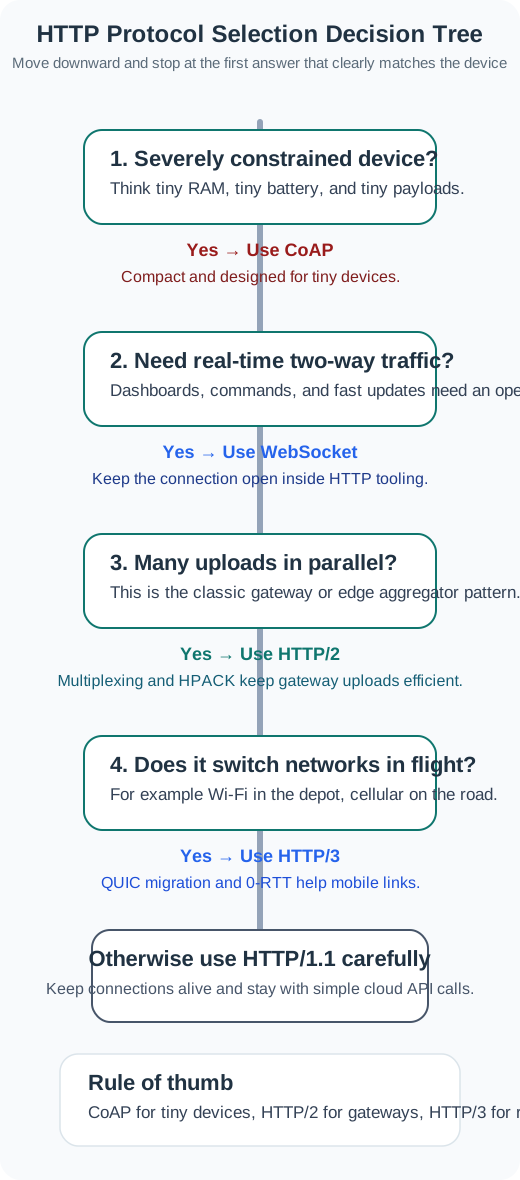
Fun Fact: Your favorite video doorbell uses BOTH types of protocols! MQTT for notifications (needs to arrive), RTP for live video (needs to be fast). It’s like having a postcard for important news AND a phone call for live conversations!
Try This: Next time you use a video call, notice how sometimes a face looks “blocky” for a second, then gets clear again. That’s the protocol skipping some lost data and catching up - just like Sammy’s doorbell!
44.3 Real-time Protocols for IoT
While MQTT and CoAP handle most IoT data exchange scenarios, some applications require real-time audio and video streaming with strict latency requirements. Video doorbells, baby monitors, voice assistants, and intercom systems all need protocols designed specifically for continuous media streams.
44.3.1 IoT Protocol Ecosystem: Where Real-Time Fits
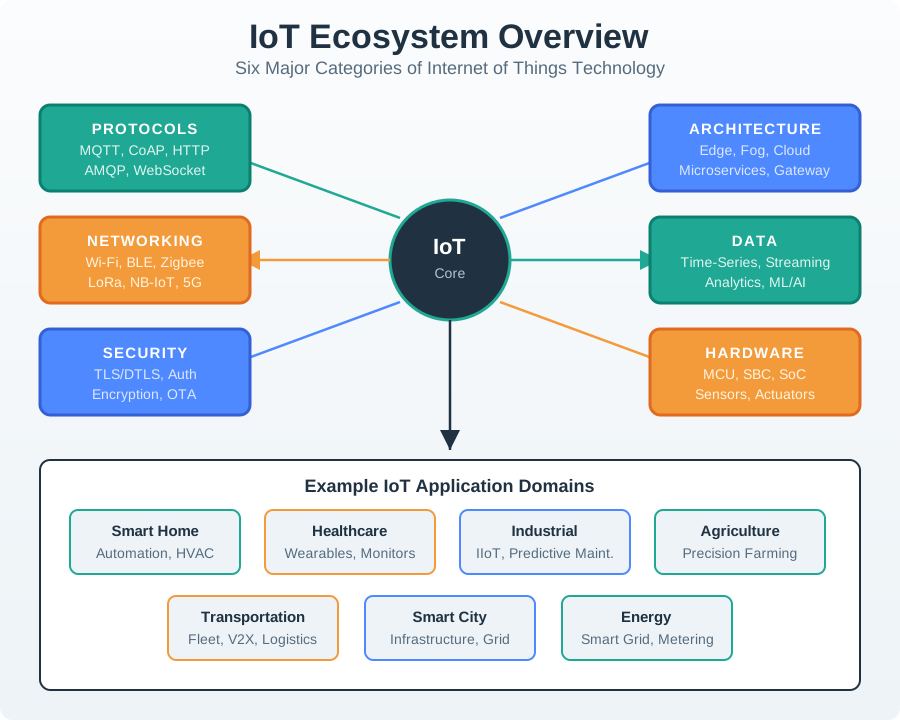
This ecosystem view shows that modern IoT devices often use both messaging and real-time protocols - each optimized for its specific purpose.
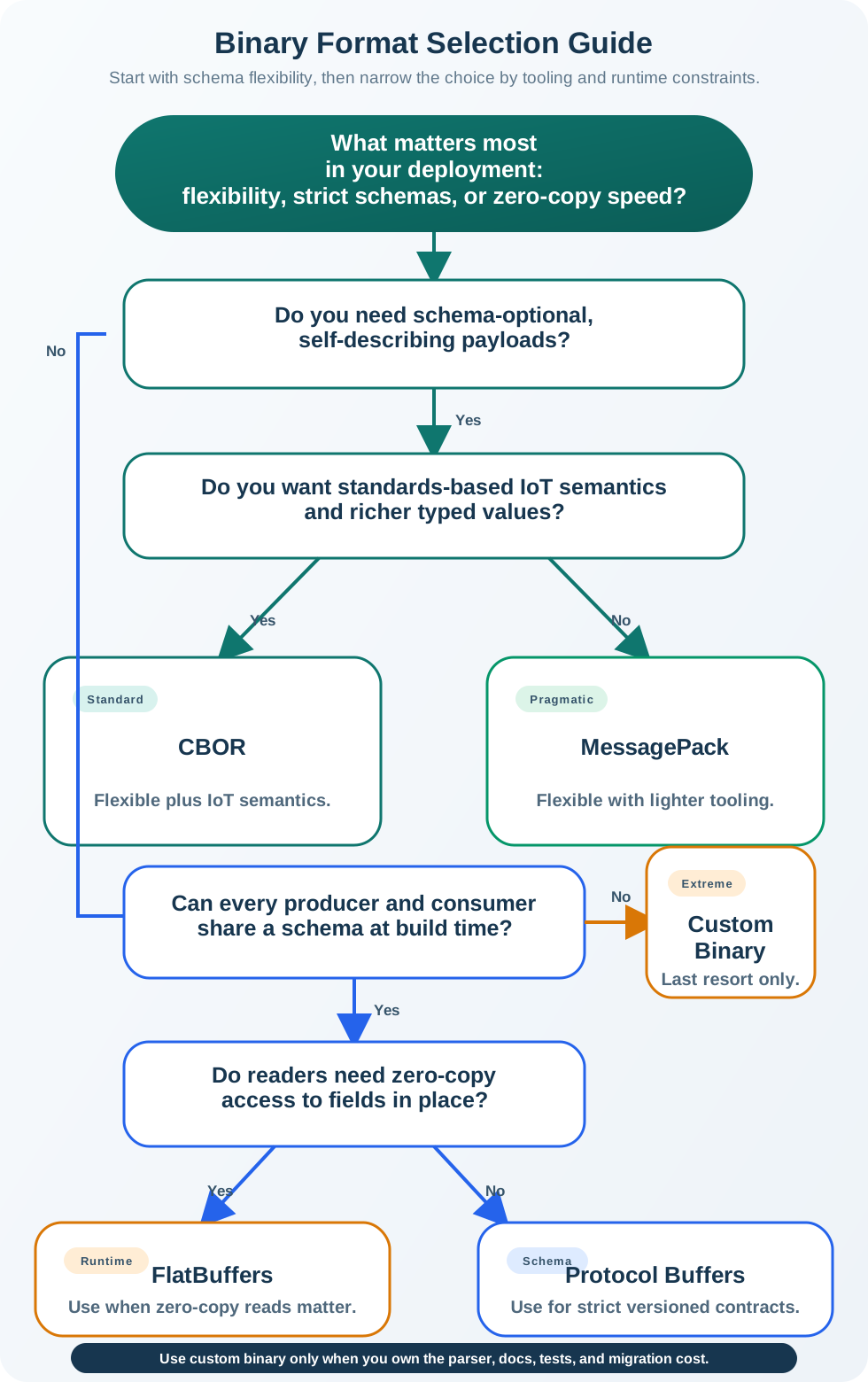
44.3.2 Real-Time Protocol Decision Flow
44.4 VoIP and SIP Architecture
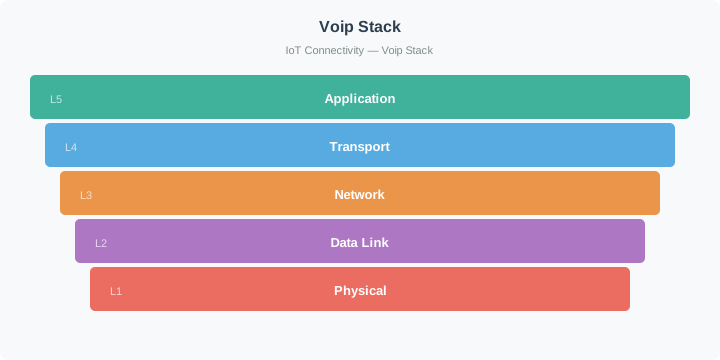
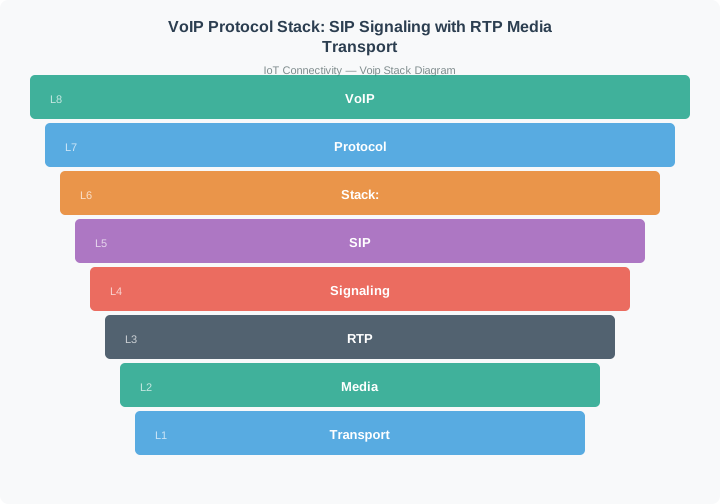
Voice over IP (VoIP) enables real-time voice and video communication over IP networks. The protocol stack for VoIP consists of several layers working together:
44.4.1 SIP Call Flow for Video Doorbell
44.5 Key Protocol Components
| Protocol | RFC | Purpose | IoT Relevance |
|---|---|---|---|
| SIP | RFC 3261 | Session Initiation Protocol - multimedia session control | Call setup for video doorbells, intercoms |
| RTP | RFC 3550 | Real-time Transport Protocol - media stream delivery | Audio/video streaming from cameras |
| RTCP | RFC 3550 | RTP Control Protocol - quality monitoring | Adaptive bitrate for constrained networks |
| UDP | RFC 768 | User Datagram Protocol - connectionless transport | Low-latency delivery (no TCP handshake) |
| SRTP | RFC 3711 | Secure RTP - encrypted media | Privacy for baby monitors, doorbells |
| zRTP | RFC 6189 | Key exchange for SRTP | End-to-end encryption setup |
| TLS | RFC 8446 (TLS 1.3) | Transport Layer Security - encrypted signaling | Secure SIP (SIPS) on port 5061 |
44.6 SIP Ports and Security
SIP Port Assignments
| Port | Protocol | Security | Use Case |
|---|---|---|---|
| 5060 | SIP over UDP/TCP | Unencrypted | Internal/trusted networks |
| 5061 | SIPS over TLS | Encrypted | Internet-facing devices |
For IoT devices accessible from the internet (video doorbells, remote intercoms), always use port 5061 with TLS encryption to prevent eavesdropping and session hijacking.
44.7 Real-time IoT Applications
Common IoT Use Cases:
| Device | Protocol | Why |
|---|---|---|
| Video Doorbell | SIP + SRTP | Two-way audio/video with visitor, needs secure encrypted stream |
| Baby Monitor | RTP (or RTSP) | One-way video stream, low latency critical for responsiveness |
| Smart Intercom | SIP + RTP | Full duplex audio between rooms, session-based communication |
| Voice Assistant | WebRTC or proprietary | Browser/app integration, cloud speech processing |
| Security Camera | RTSP + RTP | Continuous streaming, ONVIF standard interoperability |
44.8 WebRTC for Browser-Based IoT
WebRTC (Web Real-Time Communication) has become increasingly important for IoT devices that need browser-based access. It provides peer-to-peer audio/video streaming with built-in NAT traversal and encryption.
44.8.1 WebRTC Connection Architecture
WebRTC Components:
| Component | Purpose | IoT Use Case |
|---|---|---|
| getUserMedia | Access camera/microphone | Smart display video call |
| RTCPeerConnection | Establish P2P connection | Direct device-to-browser stream |
| STUN | Discover public IP/port | NAT traversal for home networks |
| TURN | Relay when direct fails | Symmetric NAT, firewall scenarios |
| DTLS-SRTP | Encrypted media | Secure by default |
WebRTC vs SIP for IoT
Choose WebRTC when:
- Browser access required (no app installation)
- NAT traversal is complex (STUN/TURN built-in)
- You want encryption by default
Choose SIP + RTP when:
- Integrating with existing VoIP infrastructure
- Need PSTN gateway (phone network)
- SIP-based intercom systems
44.9 Comparison: Real-time vs Messaging Protocols
When should you use VoIP/RTP instead of MQTT/CoAP?
44.9.1 Protocol Architecture Comparison
| Requirement | MQTT/CoAP | VoIP/RTP |
|---|---|---|
| Data Type | Sensor readings, commands, telemetry | Continuous audio/video streams |
| Latency Tolerance | 100ms - seconds acceptable | <150ms required (human perception) |
| Packet Loss | Retransmit (reliability critical) | Skip/interpolate (continuity critical) |
| Bandwidth | Low (bytes to KB per message) | High (64kbps - 2Mbps continuous) |
| Connection Model | Message-based (discrete) | Session-based (continuous stream) |
| Typical Payload | JSON, CBOR, binary sensor data | PCM audio, H.264/H.265 video |
When to Use RTP vs MQTT for IoT Audio
Use RTP/SRTP when:
- Streaming continuous audio/video (doorbell live view)
- Two-way voice communication (intercom, doorbell talk)
- Latency under 150ms is critical
- You need synchronized audio/video playback
Use MQTT when:
- Sending audio clips/recordings (doorbell motion event)
- Push notifications with audio alert
- Speech-to-text results from cloud processing
- Audio metadata (noise level, voice detection events)
Hybrid approach (common in smart doorbells):
Motion detected → MQTT notification to phone app
User opens app → SIP session established
Live video/audio → RTP/SRTP stream
User speaks → RTP audio to doorbell speaker
Call ends → SIP session terminated
Event recorded → Video clip stored, MQTT notification
44.10 Security for Real-time IoT
Real-time audio and video streams require strong security to prevent eavesdropping:
44.10.1 Security Layer Architecture
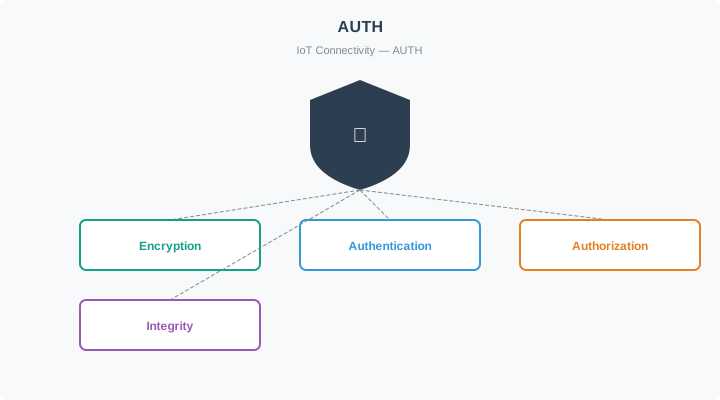
| Security Layer | Protocol | Protects |
|---|---|---|
| Signaling Encryption | TLS (SIPS on port 5061) | Call setup, session details |
| Media Encryption | SRTP | Audio/video content |
| Key Exchange | zRTP, DTLS-SRTP | Secure key negotiation |
| Authentication | Digest auth, certificates | Caller/device identity |
Security Best Practice for IoT Doorbells
Many consumer IoT devices have been compromised due to unencrypted streams. Always ensure:
- SRTP enabled - Not just RTP (encrypted vs plaintext audio/video)
- TLS for SIP - Port 5061, not 5060
- Strong authentication - Not default credentials
- End-to-end encryption - zRTP prevents cloud provider access to content
44.11 RTP Packet Structure
Understanding RTP helps diagnose audio/video issues in IoT deployments:
44.11.1 RTP Header Format
| Field | Bits | Purpose |
|---|---|---|
| V | 2 | Version (always 2) |
| P | 1 | Padding flag |
| X | 1 | Extension header present |
| CC | 4 | CSRC count |
| M | 1 | Marker (frame boundary) |
| PT | 7 | Payload type (codec identifier) |
| Sequence | 16 | Packet ordering/loss detection |
| Timestamp | 32 | Media timing (audio sample count) |
| SSRC | 32 | Stream identifier |
RTP Header Overhead: 12 bytes minimum (vs CoAP’s 4 bytes, MQTT’s 2 bytes)
The larger header is justified for streaming media because: - Sequence numbers detect packet loss and reordering - Timestamps enable jitter buffering and synchronization - SSRC allows multiple streams in one session
Putting Numbers to It
Let’s calculate the latency budget for a smart doorbell and understand why the 150ms threshold matters.
Human perception threshold (ITU-T G.114): Interactive speech requires \(L < 150\) ms end-to-end for natural conversation.
Doorbell latency breakdown: \[L_{\text{total}} = L_{\text{camera}} + L_{\text{encode}} + L_{\text{network}} + L_{\text{decode}} + L_{\text{display}}\]
Component latencies:
- Camera capture: \(L_c = 33\) ms (30 fps frame time)
- H.264 encode: \(L_e = 20\) ms (hardware encoder)
- Network (Wi-Fi + Internet): \(L_n = 50\) ms (RTT/2)
- Client decode: \(L_d = 15\) ms (phone hardware)
- Display render: \(L_r = 16\) ms (60 Hz display)
Total: \[L_{\text{total}} = 33 + 20 + 50 + 15 + 16 = 134 \text{ ms}\]
With \(134\) ms \(< 150\) ms, two-way conversation is feasible using RTP/SIP. If we used MQTT (TCP handshake \(\approx 1.5 \times \text{RTT}\)), network latency would be \(75\) ms, pushing total to \(159\) ms, exceeding the threshold and creating awkward conversation delays.
Common Pitfalls
1. Conflating Real-Time with Low-Latency
Real-time means meeting a deadline consistently, not necessarily having the lowest average latency. A system with 50ms latency that always meets its deadline is more ‘real-time’ than one with 10ms average but occasional 500ms spikes.
2. Using MQTT for Hard Real-Time Control
MQTT does not provide timing guarantees — broker processing delays and network jitter make it unsuitable for hard real-time control (motor control, safety systems). Use deterministic protocols like EtherCAT or TSN for hard real-time IoT.
3. Not Testing Protocol Performance Under Full Load
Real-time application protocols perform differently under low vs high message rates. Test protocol latency and jitter at maximum expected message throughput, not just at low load.
:
44.12 Visual Reference Gallery
Visual: Application Protocols Landscape
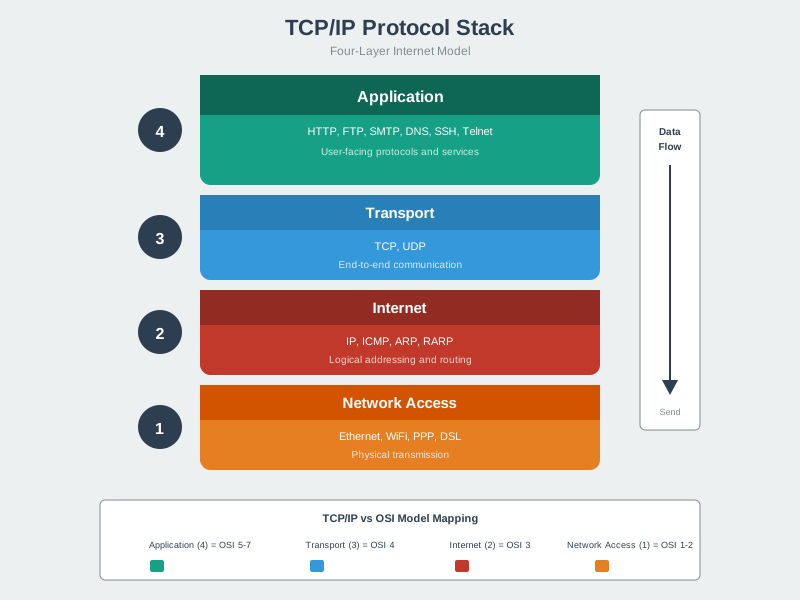
This comprehensive overview shows how the major IoT application protocols relate to each other, helping guide protocol selection based on device constraints and communication patterns.
Visual: CoAP vs MQTT Comparison
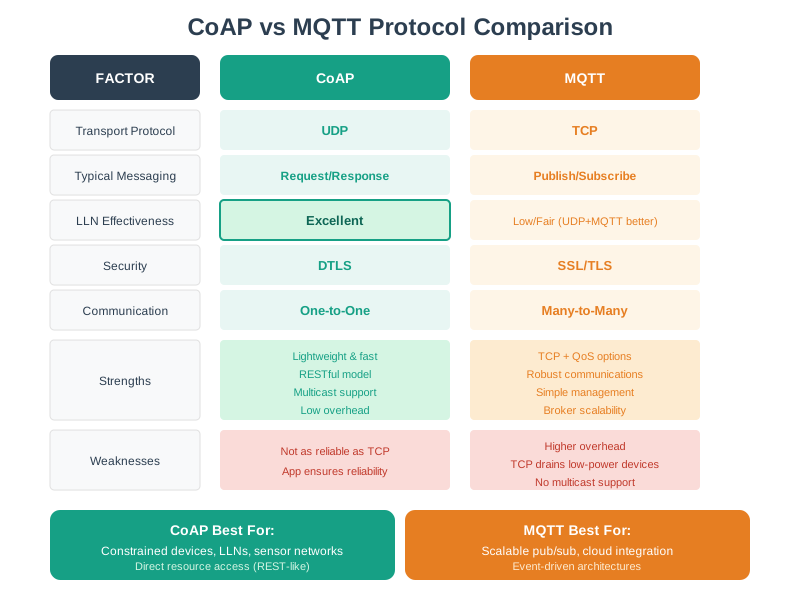
Understanding the fundamental differences between CoAP (RESTful, UDP-based) and MQTT (pub/sub, TCP-based) is essential for selecting the right protocol for specific IoT scenarios.
44.13 Worked Example: Smart Doorbell — Protocol Stack Design with Latency Budget
Scenario: RingView, a video doorbell manufacturer, designs the communication stack for a new 1080p doorbell with two-way audio. When a visitor presses the button, the homeowner’s phone (anywhere on the internet) must show live video and enable conversation within 2 seconds of the button press.
44.13.1 Latency Budget Breakdown
The 2-second end-to-end target must be allocated across every component:
| Component | Budget | Protocol | Notes |
|---|---|---|---|
| Button press detection | 20 ms | GPIO interrupt | Hardware latency |
| Push notification to phone | 800 ms | MQTT QoS 1 over TCP/TLS | Firebase/APNs cloud routing |
| Phone app wake + UI render | 400 ms | Local | iOS/Android cold start |
| SIP session setup | 200 ms | SIP over TLS (port 5061) | INVITE → 200 OK → ACK |
| ICE/STUN NAT traversal | 300 ms | WebRTC ICE | Worst case with TURN relay |
| First video frame render | 280 ms | RTP/H.264 over UDP | IDR frame + decode |
| Total | 2,000 ms | Meets 2-second target |
44.13.2 Protocol Selection: Why Not Just MQTT?
RingView’s first prototype used MQTT for everything — including video streaming. Here is why that failed:
| Metric | MQTT (TCP) for Video | RTP (UDP) for Video |
|---|---|---|
| Transport | TCP (reliable, ordered) | UDP (best-effort) |
| Lost packet handling | TCP retransmits — video freezes for 50-200 ms waiting | RTP skips — next frame arrives in 33 ms (30 fps) |
| Jitter buffer | Not designed for media timing | 60 ms adaptive jitter buffer smooths network variation |
| Measured latency (p95) | 380 ms (TCP retransmissions on cellular) | 85 ms (UDP with FEC) |
| Video freeze events/hour | 12-18 (each TCP retransmission = freeze) | 0-1 (occasional artifact, no freeze) |
| Audio round-trip (2-way) | 420 ms (above 150 ms threshold — conversation awkward) | 110 ms (natural conversation) |
44.13.3 Bandwidth and Power Analysis
The doorbell runs on a rechargeable 6,800 mAh battery with a 5V solar trickle charger:
| Stream | Codec | Bitrate | Daily Usage | Daily Energy |
|---|---|---|---|---|
| Video (1080p, 30 fps) | H.264 High Profile | 2.5 Mbps | 45 min/day (avg 15 events x 3 min) | 112 mAh |
| Audio (two-way) | Opus, 16 kHz | 32 kbps (up) + 32 kbps (down) | 20 min/day | 8 mAh |
| MQTT (notifications + telemetry) | N/A | 0.5 kbps average | 24 hr keep-alive | 15 mAh |
| Idle (PIR wake, Wi-Fi sleep) | N/A | 0 | 23 hr | 48 mAh |
| Daily total | 183 mAh | |||
| Battery life | 6,800 / 183 = 37 days (without solar) |
44.13.4 Security Stack
Every real-time stream must be encrypted — a doorbell transmitting unencrypted video is a surveillance vulnerability:
| Layer | Protocol | Key Exchange | Cipher |
|---|---|---|---|
| Signaling | SIP over TLS 1.3 (port 5061) | ECDHE P-256 | AES-128-GCM |
| Media (video + audio) | SRTP (not RTP) | DTLS-SRTP key derivation | AES-128-CTR with HMAC-SHA1 |
| Notifications | MQTT over TLS 1.3 (port 8883) | Certificate pinning | AES-256-GCM |
The Hybrid Architecture Lesson
RingView’s production doorbell uses three protocols simultaneously:
MQTT (TCP): Push notifications (“Someone is at your door”), device telemetry (battery level, Wi-Fi RSSI), configuration commands. TCP’s reliability is essential — a missed notification means a missed visitor.
SIP/SRTP (UDP): Live video and two-way audio. UDP’s “skip lost packets” behavior is essential — a 33 ms video frame arriving 200 ms late is worse than not arriving at all (it causes stutter). The next frame is already more relevant.
HTTPS (TCP): Recorded clip upload to cloud storage (30-second pre-roll + event). Reliability matters for recordings — every frame must arrive. TCP’s retransmission overhead is acceptable because recording upload happens in the background after the live session.
The mistake is choosing one protocol for everything. MQTT cannot deliver acceptable live video. RTP cannot guarantee notification delivery. Each protocol serves the task it was designed for.
44.14 Concept Relationships
Understanding how real-time protocols connect to the broader IoT ecosystem helps contextualize their unique role:
Protocol Stack Dependencies:
- Transport Layer: RTP runs over UDP (not TCP), while SIP can use TCP or UDP for signaling. See Transport Fundamentals for UDP vs TCP characteristics.
- Application Layer: Real-time protocols are application-layer protocols, but with fundamentally different design goals than REST/HTTP. See Application Protocols Overview for the full landscape.
Architectural Integration:
- Edge Computing: Real-time stream processing often happens at the edge to meet latency requirements. See Edge-Fog Computing for deployment patterns.
- IoT Reference Models: Real-time protocols typically operate in the communication and data ingestion layers. See IoT Reference Models for architectural context.
Security Integration:
- Encryption: SRTP provides media encryption while TLS/DTLS secures signaling. See Cryptography Fundamentals for encryption principles.
- Authentication: SIP digest authentication and certificate-based auth protect session establishment. See Authentication & Access.
Technology Trade-offs:
- vs MQTT/CoAP: These messaging protocols optimize for reliability and power efficiency, while RTP/SIP optimize for latency and continuity. Neither is “better”—they solve different problems.
- vs WebRTC: WebRTC bundles signaling, NAT traversal, and media in one framework; SIP+RTP separates concerns for flexibility.
Complementary Technologies:
- Codecs: RTP carries encoded media (H.264, H.265, Opus, PCM). Codec choice dramatically affects bandwidth and quality.
- NAT Traversal: STUN/TURN servers enable WebRTC connections across firewalls and symmetric NATs—critical for IoT devices behind home routers.
44.15 See Also
Protocol Deep Dives:
- MQTT Fundamentals - Compare pub/sub messaging with real-time streaming
- CoAP Fundamentals - RESTful IoT protocol for sensor data (not streaming)
- HTTP/REST for IoT - Request-response patterns vs streaming
Network Foundations:
- Transport Layer Protocols - UDP characteristics essential for RTP
- Network Performance Metrics - Latency, jitter, and packet loss analysis
Architecture Patterns:
- M2M Communication - Device-to-device streaming scenarios
- Protocol Selection Framework - Decision trees for choosing between protocols
Security Considerations:
- IoT Security Fundamentals - Threat models for video/audio streams
- End-to-End Encryption - zRTP and DTLS-SRTP key exchange
Industrial Applications:
- OPC-UA - Industrial real-time data exchange (different use case)
- WirelessHART - Industrial wireless with timing guarantees
Research and Standards:
- RFC 3550 (RTP/RTCP) - Core real-time transport protocol specification
- RFC 3261 (SIP) - Session Initiation Protocol specification
- RFC 3711 (SRTP) - Secure Real-time Transport Protocol
- WebRTC Working Group - IETF standards for browser-based real-time communication
44.16 Summary
This chapter covered real-time protocols for IoT audio and video applications - the protocols that power video doorbells, baby monitors, smart intercoms, and voice assistants:
44.16.1 Key Concepts Covered
The Fundamental Trade-off: Real-time protocols prioritize latency over reliability. They run over UDP, skip lost packets rather than retransmit, and target <150ms end-to-end delay for acceptable human interaction.
Protocol Stack for Real-Time IoT:
- SIP (Session Initiation Protocol) - Session control (call setup/teardown)
- RTP (Real-time Transport Protocol) - Media stream delivery over UDP
- SRTP - Encrypted media for privacy (ALWAYS use for internet-facing devices)
- WebRTC - Browser-native real-time communication
When to Use Real-Time vs Messaging Protocols:
Use RTP/SIP/WebRTC Use MQTT/CoAP Continuous audio/video streams Discrete sensor readings Two-way voice/video calls Commands and telemetry Latency-critical (<150ms) Latency-tolerant (seconds OK) High bandwidth (64kbps-2Mbps) Low bandwidth (bytes-KB) Security Requirements:
- Always use SRTP (not plain RTP) for media encryption
- Use TLS/port 5061 for SIP signaling (not port 5060)
- Implement zRTP for end-to-end encryption
- Never use default credentials
Hybrid Architectures Are Common: Smart doorbells use MQTT for notifications AND RTP for live streaming - the best protocol for each task.
44.16.2 The 150ms Rule
Human conversation becomes awkward when one-way end-to-end delay exceeds 150 milliseconds (ITU-T G.114). This is why real-time IoT devices use UDP-based protocols (no TCP handshake overhead) and specialized media protocols designed for timing, not guaranteed delivery.
44.17 What’s Next?
| Chapter | Focus | Why Read It |
|---|---|---|
| Application Protocols Overview | Full landscape of IoT application protocols | Understand where RTP/SIP fits among MQTT, CoAP, HTTP, and AMQP in a complete protocol taxonomy |
| MQTT Fundamentals | Publish-subscribe messaging for sensor data | Compare guaranteed-delivery MQTT with the latency-first RTP approach used in this chapter |
| CoAP Fundamentals | Lightweight RESTful protocol over UDP | Explore the other major UDP-based IoT protocol, optimised for constrained devices rather than streaming |
| Transport Layer Protocols | UDP vs TCP characteristics in depth | Build the network-layer understanding needed to diagnose RTP jitter and packet-loss problems |
| IoT Security Fundamentals | Threat models for connected devices | Apply security thinking to video doorbells and baby monitors after learning SRTP/zRTP in this chapter |
| Edge-Fog Computing | Processing at the network edge | Learn how to place media transcoding and jitter-buffer logic at the edge to reduce end-to-end latency |