13 E2: Device-to-Gateway Encryption
More
Depth: Practitioner
Progress saves as you read. Mark sections complete as you go; your progress appears in the sidebar.
Picture a building sensor handing a sealed work order to the floor gateway. E2 is the design where that gateway is the approved desk that opens the envelope, checks the sender, rejects stale copies, and acts locally. If the gateway should only forward the envelope without reading it, this page has already taught the most important lesson: choose E3 instead.
13.1 Learning Objectives
This section: Learning Objectives
By the end of this chapter, you will be able to:
- Explain exactly where E2 encryption terminates and which component owns plaintext.
- Design an E2 packet envelope with per-device identity, nonce or counter, authenticated metadata, ciphertext, and tag.
- Define replay protection that survives reset, sleep, loss, and gateway restart.
- Decide when a trusted gateway justifies E2 and when an untrusted gateway requires E3.
- Specify release evidence for key provisioning, gateway key storage, negative tests, rotation, and revocation.
13.2 Prerequisites
This section: Prerequisites
- Encryption: Architecture and Levels for E1-E5 boundaries and plaintext ownership.
- E1: Link Layer Encryption for local link protection and commissioning.
- Symmetric Encryption for IoT for AEAD, nonces, and bulk encryption choices.
- Public Key Cryptography for certificates, onboarding, and role separation.
13.3 Choose E2 Only When the Gateway May Read
This section: Choose E2 Only When the Gateway May Read — E2 is not the same thing as end-to-end device-to-cloud encryption.
E2 is not the same thing as end-to-end device-to-cloud encryption. In E2, the gateway is trusted to authenticate and decrypt device payloads. That makes E2 useful for local automation, filtering, aggregation, and safety actions, but it also means gateway compromise can expose data for devices whose keys the gateway can access. Inspect Figure 13.3 to locate the exact point where ciphertext becomes plaintext before accepting that trust choice. Read Figure 13.1 in that order.
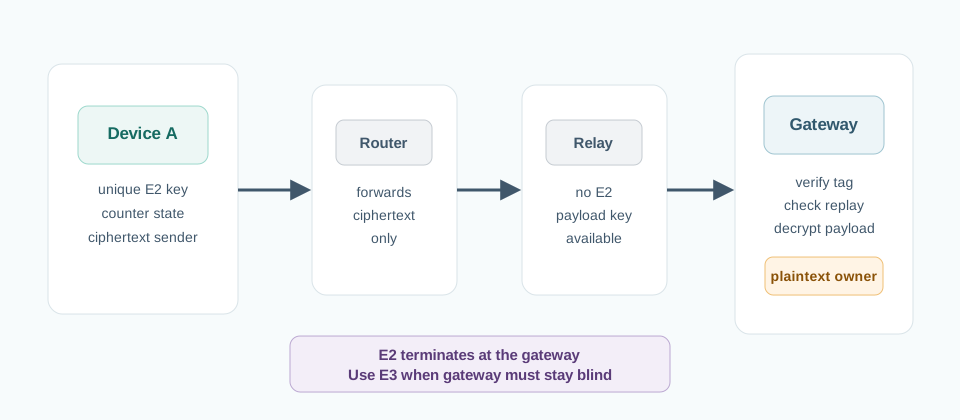
Follow Figure 13.3 from the device, through intermediate routers, to the trusted gateway. The payload stays encrypted while the routers forward it, but the gateway terminates E2 and may read it. That final plaintext boundary is what enables local action and creates the gateway-compromise risk. The next design step is therefore to scope gateway access and device keys deliberately, not to describe the whole path loosely as end-to-end encryption. Read Figure 13.1 in that order.
Each device has its own key
One extracted device credential should not let an attacker impersonate the rest of the fleet.
The gateway may read payloads
The gateway can validate, decrypt, filter, aggregate, and act locally because it is a plaintext owner.
Old packets must fail
Authenticated counters or sequence numbers, checked against receiver replay state for each key epoch, reject old packets; nonce uniqueness alone does not.
E2 is not zero trust
If the gateway is third-party, semi-public, or outside your control, route sensitive payloads to E3.
In E2, the gateway is an approved plaintext owner. If that sentence is not acceptable for the deployment, do not use E2 for that payload.
13.4 Build the Packet So the Gateway Can Prove It
This section: Build the Packet So the Gateway Can Prove It — Read Figure 13.2 from the device identifier and key identifier into the counter or nonce, authenticated metadata, ciphertext, and final authentication tag.
An E2 packet should let the receiver check three facts before it releases plaintext: which enrolled credential authenticated it, whether the message has already been accepted, and whether the protected bytes were modified. Use Figure 13.2 to inspect where each check travels and why the gateway must validate the envelope before exposing the decrypted payload.
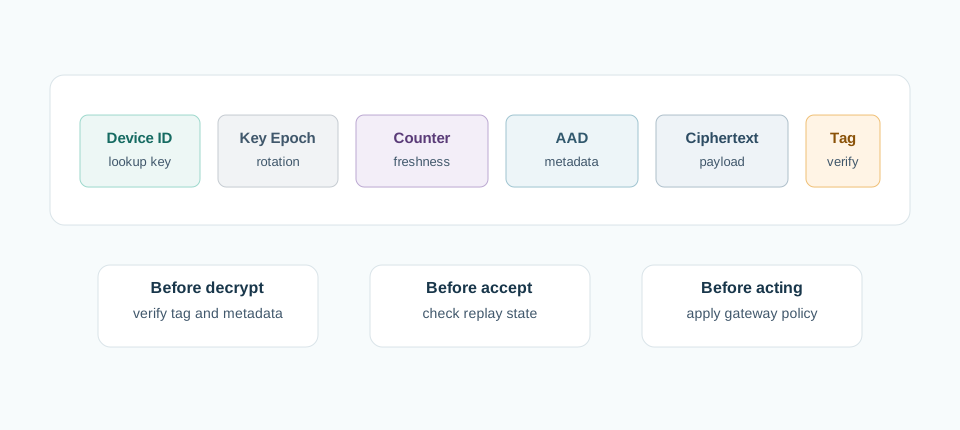
Read Figure 13.2 from the device identifier and key identifier into the counter or nonce, authenticated metadata, ciphertext, and final authentication tag. Identity selects the expected device and key scope; freshness state rejects an old envelope; authenticated metadata binds visible routing context to the protected message; and the tag detects modification before plaintext is accepted. This packet structure turns the E2 trust boundary into a reviewable receive procedure rather than a claim that encryption is present.
For new designs, prefer an authenticated encryption mode or protocol profile that binds associated data, nonce, ciphertext, and tag. Do not invent a custom CBC/HMAC packet unless a reviewed protocol, library, and test suite already define the exact composition and failure behavior.
13.5 Make Freshness Survive Reboots and Loss
This section: Make Freshness Survive Reboots and Loss — Replay protection is not just a sequence number field.
Replay protection is not just a sequence number field. The device, gateway, and recovery process must agree what happens after sleep, reset, packet loss, clock drift, key rotation, and gateway failover.
Persist enough counter, epoch, or nonce state so reboot does not reuse values under the same key.
Record the last accepted counter, replay window, or protocol state per device and per key epoch.
Use a bounded acceptance window only when the protocol can tolerate out-of-order delivery.
Make old and new keys distinguishable so counters do not collide across key updates.
Log replay, tag failure, unknown device, expired key, and rollback events without leaking secrets.
Nonce reuse under the same key can break common AEAD security assumptions. A production design must specify how nonce or counter uniqueness is maintained, measured, and tested.
13.6 Use DTLS When the Gateway Link Is Datagram-Based
This section: Use DTLS When the Gateway Link Is Datagram-Based — Many constrained E2 links use UDP-based application protocols such as CoAP rather than a reliable TCP stream.
Many constrained E2 links use UDP-based application protocols such as CoAP rather than a reliable TCP stream. Ordinary TLS expects reliable, ordered bytes, so it is the wrong transport shape for lossy datagram links. DTLS is the TLS family protocol adapted for datagrams: it protects records that may be lost, reordered, or retransmitted while still requiring authentication, confidentiality, integrity, and replay handling.
This does not make DTLS a substitute for the E2 trust decision. DTLS can secure the device-to-gateway session, but the gateway is still a plaintext owner once the session terminates there. If that plaintext ownership is not acceptable, the payload needs E3 object protection even if the local hop also uses DTLS.
13.7 Choose Credentials the Device Can Protect
This section: Choose Credentials the Device Can Protect — Certificate-based DTLS can be appropriate when devices can store and validate certificates and the deployment needs PKI-style identity management.
Certificate-based DTLS can be appropriate when devices can store and validate certificates and the deployment needs PKI-style identity management. Very small sensors may instead use raw public keys or a pre-shared key profile. PSK mode avoids certificate-chain storage and heavy certificate validation on the device, but it moves the hard work into provisioning and lifecycle evidence.
The PSK must identify one device or a tightly bounded derivation path, not the whole fleet. A single shared firmware secret turns one extracted device into a fleet-wide compromise. A good E2 review therefore pairs the authentication mode with key ownership, storage, rotation, and revocation evidence.
Certificate mode:
  Strong PKI identity model, but heavier certificate storage and validation.

Raw public key:
  Lighter than a certificate chain, but still needs enrollment and pinning policy.

Pre-shared key:
Small device footprint, but only safe when keys are per-device and rotatable.13.8 Prove DTLS Survives Spoofing, Sleep, and Rotation
This section: Prove DTLS Survives Spoofing, Sleep, and Rotation — UDP lets an attacker spoof source addresses more easily than TCP.
UDP lets an attacker spoof source addresses more easily than TCP. A DTLS gateway should use a stateless cookie exchange to check return routability before allocating expensive handshake state or amplifying traffic toward a victim: the gateway returns a cookie, and the client echoes it before the gateway commits more resources.
Battery life is the other deployment issue. Sleepy devices should not repeat full handshakes every time they wake if the protocol and risk model allow resumption. Session resumption reduces round trips and computation, but the release evidence must still prove replay windows, credential expiry, key updates, and revoked-device behavior.
13.9 Choose E2, E3, or E4 by Plaintext Ownership
This section: Choose E2, E3, or E4 by Plaintext Ownership — E2, E3, and E4 answer different trust questions.
-

First, name everyone allowed to read the plain data.
-

Choose the layer that keeps that exact boundary.
-

Test the keys and refuse readers outside it.
E2, E3, and E4 answer different trust questions. The right answer depends on who may see plaintext, not on which name sounds stronger. Inspect Figure 13.1 before selecting a layer so the gateway’s approved role remains explicit. Read Figure 13.3 in that order.
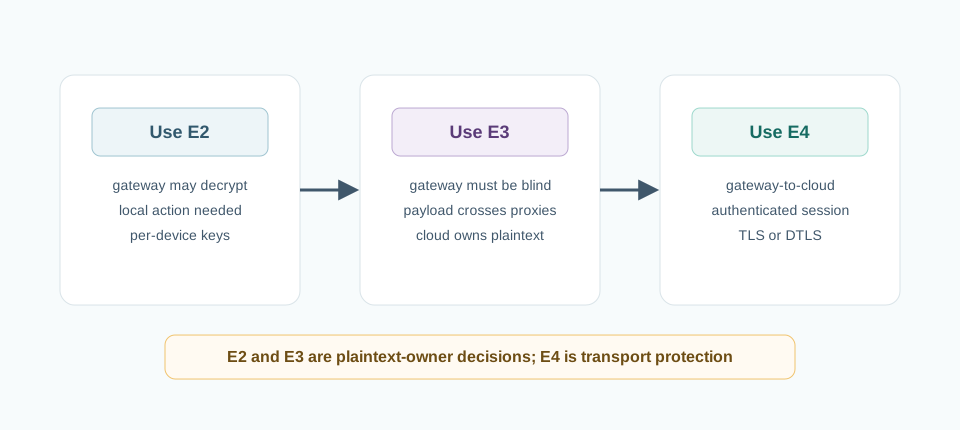
Read Figure 13.1 by plaintext ownership. The E2 path ends at a trusted gateway that verifies and decrypts device data; the E3 path keeps the selected payload opaque until the cloud or application endpoint; and E4 protects an authenticated transport session, which may begin at the gateway after it has already seen plaintext. That comparison connects the layer labels to a concrete review question: name every permitted reader first, then require keys and negative tests for that boundary. Read Figure 13.3 in that order.
13.10 E2 Is Appropriate When
Review the evidence as an ordered release decision. First verify The gateway is owned, hardened, monitored, and revocable. Then verify Local automation or safety response needs plaintext during cloud outage. Then verify Filtering, aggregation, compression, or protocol translation is a required gateway function. Then verify Device-level revocation matters more than keeping the gateway blind. Finally verify The gateway key store is treated as sensitive production infrastructure.
13.11 Treat the Gateway Key Store as the Boundary
This section: Treat the Gateway Key Store as the Boundary — The E2 gateway is both a verifier and a key holder.
The E2 gateway is both a verifier and a key holder. Its key store is therefore part of the security boundary, not a normal configuration file.
Enroll unique device credentials
Manufacturing, commissioning, or onboarding should create one device identity and one active E2 key record per device.
Limit gateway key access
Use protected storage, process isolation, service identity, audit logs, and least privilege for gateway key lookups.
Support overlap and retry
Rotation needs key epochs, rollback-safe activation, and recovery from devices that miss an update window.
Contain one-device compromise
Disable one device key without replacing every other device or accepting unauthenticated fallback messages.
If every device uses the same E2 key, the gateway cannot identify which device really sent a message, and one extraction becomes a fleet compromise. E2 depends on per-device accountability.
13.12 Build the Trusted Building Gateway Case
This section: Build the Trusted Building Gateway Case
A building operator owns temperature and occupancy sensors, floor gateways, and the cloud tenant. Gateways run local HVAC safety logic during cloud outages, so they are approved to read operational payloads. Visitor-count payloads are sensitive and should remain opaque to the gateway.
13.12.1 Step 1: Split Payloads by Plaintext Owner
13.12.2 Step 2: Approve the E2 Envelope
Work through the sequence from the first action to the final observation. Begin with Use one enrolled E2 credential per device, with key epoch and rotation state. Then Put device identity, message type, key epoch, route, and counter in authenticated metadata when they need to remain readable. Then Use the selected AEAD mode or reviewed envelope exactly as specified by the platform or protocol. Then Accept plaintext only after authenticated decryption succeeds, and do not use payload fields before that check. Then Reject replayed, rolled-back, duplicated, wrong-key, wrong-device, and wrong-epoch messages. End by Log security failures without storing decrypted secrets unnecessarily.
13.12.3 Step 3: Define Release Evidence
Release evidence must cover these checks. An unknown device is rejected before payload processing. A valid device with the wrong key fails authentication. Tampered authenticated metadata fails verification. A replayed authenticated counter or sequence number is rejected by receiver state. Device reboot does not reuse nonce or counter values under the same key. Gateway restart preserves or reconstructs replay state safely. A retired key epoch is rejected after the rotation window closes. Revoking one device does not affect unrelated devices. The sensitive visitor-count payload is routed to E3 and remains opaque to the gateway. Operational logs distinguish unknown device, replay, tag failure, expired key, and policy rejection.
13.13 Avoid the E2 Mistakes That Expose Plaintext
This section: Avoid the E2 Mistakes That Expose Plaintext
Calling E2 end-to-end
E2 terminates at the gateway. Do not use E2 for payloads the gateway must not read.
Using one fleet key
A shared E2 key removes device accountability and turns one extracted key into a fleet-wide incident.
Reusing nonces after reset
Sleep and reset behavior must not cause nonce or counter reuse under the same key.
Decrypting before verification
The gateway should authenticate the envelope and freshness before releasing plaintext to application logic.
Ignoring gateway compromise
If gateway compromise is in scope, use E3 for sensitive fields or remove plaintext duties from the gateway.
No key replacement path
A device key must be rotatable, revocable, and recoverable without insecure accept-anything modes.
13.14 Knowledge Check
This section: Knowledge Check
13.15 Release Evidence Checklist
This section: Release Evidence Checklist — Review the evidence as an ordered release decision.
Before production, an E2 design should be reduced to testable evidence:
Review the evidence as an ordered release decision. First verify The gateway is explicitly approved as a plaintext owner for each E2 payload. Then verify Sensitive fields the gateway must not inspect are routed to E3 or object protection. Then verify Each device has unique active key material or a unique path to derive it. Then verify Device identity, message type, key epoch, counter or nonce, and routing metadata are authenticated as required. Then verify Nonce or counter uniqueness is defined across reset, sleep, packet loss, and key rotation. Then verify Gateway key access is isolated, audited, and backed by least privilege. Then verify Unknown device, wrong key, bad tag, tampered metadata, replay, expired epoch, revoked device, and rollback tests fail closed. Then verify Rotation supports overlap, retry, recovery, and retirement of old epochs. Then verify Operational logs distinguish security failures without storing decrypted secrets unnecessarily. Finally verify Measurements use representative hardware, packet size, radio duty cycle, and gateway load rather than copied benchmark numbers.
13.17 What’s Next
This section: What’s Next — Continue with E3-E4: Transport Encryption to separate opaque device-to-cloud payload protection from authenticated gateway-to-cloud transport.
Continue with E3-E4: Transport Encryption to separate opaque device-to-cloud payload protection from authenticated gateway-to-cloud transport.
| Next Chapter | Use it for |
|---|---|
| E3-E4: Transport Encryption | Device-to-cloud object protection and TLS/DTLS transport decisions |
| E5: Key Renewal and Asymmetric | Rotation, revocation, and long-lived credential renewal |
| Key Management | Storage, ownership, key derivation, and operational lifecycle |
13.18 Summary
This section: Summary — Device-to-gateway encryption protects data as it moves from constrained devices into local gateways.
Device-to-gateway encryption protects data as it moves from constrained devices into local gateways. It must account for local attackers, shared network media, gateway trust, credential storage, and what happens when gateways relay data onward.
13.19 Key Takeaway
This section: Key Takeaway — Device-to-gateway security should define both ends of trust.
Device-to-gateway security should define both ends of trust. Encrypt the link, authenticate the device and gateway, and decide whether the gateway is allowed to see plaintext or only forward protected payloads.
Find help
3 reviewed answers.
Where should I start in a module?
Open the module page from the sidebar to see its chapters in order. Use the module map to return to a topic you need.
Modules and pathsReviewed
What can I try when a project does not work?
Check the symptom, then work through the diagnostic steps. Keep the error message and the smallest example that reproduces it.
When you are stuckReviewed
How do interactive examples work?
Use the interactive guide to check how examples and simulations work before changing your project.
Interactive examples guideReviewed