10 Key Renewal and Rotation (E5)

More
Depth: Practitioner
Progress saves as you read. Mark sections complete as you go; your progress appears in the sidebar.
10.1 Keys Age, So Renewal Is Part of the Design
This section: Keys Age, So Renewal Is Part of the Design — Picture a water meter that wakes only once a month.
Prove the Old Key Stops Working
Picture a water meter that wakes only once a month. Its owner changes while it is asleep, and the old service key should no longer be trusted. A new key is useful only if the meter receives it safely and the old one is retired without locking out a valid device.
For this renewal, telemetry is the device’s reported key and contact status; it cannot by itself prove activation. Write the renewal record around one device: current key identity, new key identity, allowed overlap, delivery state, activation time, owner, and recovery rule. Keep the device clock and last contact beside the decision. A protected update path is separate from proof that the new key took effect.
Test an offline device, a late update, a repeated update, a wrong owner, a failed activation, a restart, and use of the retired key. Check that failure closes safely, remains visible, and has a bounded repair path. Record when old trust is removed from every side.
This flow does not define every key system or device lifetime. The deeper sections show how generation, delivery, overlap, activation, proof, rollback, and retirement keep long-lived encryption from depending on one secret forever.
Start with a meter that wakes up once a month. It may miss a maintenance window, change owners, survive a service repair, and still need to reject a stolen old key. E5 is the plan that lets the product refresh trust without locking that device out or letting stale keys live forever.
The lower encryption levels protect traffic, payloads, and sessions, but they all run on keys, and keys do not stay safe forever. E5 is the renewal level: the discipline of refreshing the symmetric keys that E1 to E4 depend on, over the years a device stays in the field. A strong cipher becomes operationally weak if one key protects years of telemetry, survives an ownership change, stays trusted after a repair, or cannot be retired during an incident.
The common misunderstanding is that E5 means "use public-key cryptography for every message." It does not. Bulk traffic still uses fast symmetric protection; E5 is the controlled transition that replaces those symmetric keys when a trigger says it is time, using authenticated key establishment, context-bound derivation, a versioned activation with overlap, revocation, and an audit record. Renewal is a state machine, not an ad hoc key swap.
If you only need the intuition, this layer is enough: long-lived keys accumulate risk, so plan to replace them. A renewal must be triggered by policy, authenticated, derived with context, activated with a finite overlap so devices are not stranded, and revocable. And remember the key distinction: rotation limits future exposure, but it is not forward secrecy.
Think of changing the locks on a building on a schedule, and also whenever a key is lost or a tenant leaves. You hand out the new keys before the old locks stop working, so nobody is stranded outside, then you decommission the old cylinder. You also keep a record of who changed what and why. Doing this only once, years ago, and never again is how a building ends up trusting keys held by people who left long ago.
Inspect Figure 10.1 to see how that controlled handover closes old trust without stranding current devices.
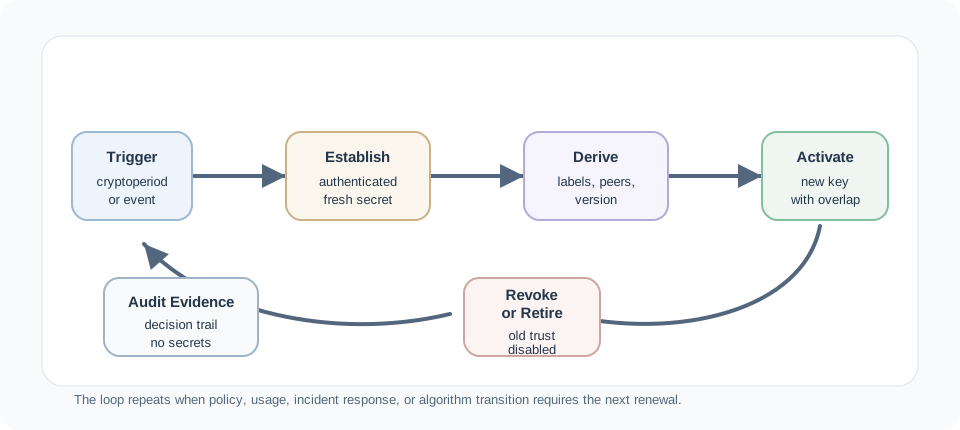
Read Figure 10.1 from the trigger to the audit step. The trigger records why a new key is needed. The next steps set up fresh key material and bind it to the right use. A short overlap lets devices with weak links move across without a lockout. Activation makes the new key the main choice. Retirement or revocation then closes the old path. The audit log records each choice but never stores the secret itself. The loop shows that renewal is normal field work, not a one-time repair.
The One-Minute View: Why Renewal Exists
Long-lived keys are risky
One key protecting years of data, or surviving ownership and service changes, accumulates exposure. Plan to replace keys, not just to choose a strong one.
Renewal is a controlled transition
A real renewal has a trigger, authenticated establishment, context-bound derivation, versioned activation with overlap, revocation, and audit, not just a new key pushed out.
Rotation is not forward secrecy
Replacing a key limits how much future data one compromise covers. Protecting already-captured past traffic needs fresh ephemeral key agreement, which is forward secrecy.
Beginner Examples: Where Old Keys Linger
These examples show why renewal must retire old keys as well as add new ones. A meter using the same gateway key since manufacture lets one secret protect years of readings. If that secret leaks, the whole history is exposed, with no clean way to retire the key. A device sold or moved to a new owner should get fresh keys. The previous owner's copies should stop being trusted. Pushing a new key once a year is insufficient if the old key works forever or renewal messages can be replayed. Renewal needs versioning, a finite overlap, and freshness.
Overview Knowledge Check
If you can explain why long-lived keys are risky and that renewal is a controlled transition, you can stop here. Continue to Practitioner to run the renewal flow and its review gates.
10.2 Run the Renewal Flow and Its Gates
This section: Run the Renewal Flow and Its Gates — Follow one renewal from trigger to audit.
The practical job is to turn "we rotate keys" into an enforceable flow with evidence at each gate: a trigger that the system acts on, authenticated establishment of fresh material, context-bound derivation, a versioned activation with a finite overlap, and a revocation check. An E5 design has three separate cryptographic jobs, identity, key establishment, and traffic protection, and the common failure is blurring them or skipping the overlap and revocation steps.
Follow one renewal from trigger to audit. The learner should be able to point to the moment trust is checked, the moment fresh material appears, the moment the new version becomes primary, and the moment the old version stops working. Read Figure 10.2 in that order.
Walkthrough: A Single Renewal Without Stranding Devices
Follow the sequence from decision to evidence. First, Detect and record the trigger. The service or device detects that renewal is due, from a cryptoperiod, usage limit, ownership change, suspected exposure, or algorithm transition, and records the reason. Next, Authenticate the peers. Both sides validate current identity and authorization before any renewal attempt, so an unknown or disabled peer cannot install a key. Next, Establish fresh material. Use an approved key-establishment method, ideally ephemeral key agreement, or a reviewed key-transport design, to create fresh secret input bound to a freshness value. Next, Derive purpose-bound keys. Pass the shared secret through a KDF that binds the output to purpose, identities, transcript, key version, and algorithm suite. Next, Activate with overlap for planned renewal. Make the new key primary while accepting the old key only inside a finite, observable overlap window; suspected compromise may require immediate revocation instead. Finally, Retire and record. Disable or destroy the old key at the end of a planned window, and write an audit record that proves what changed without exposing secrets.
Now inspect Figure 10.2 to locate those renewal steps across identity, fresh establishment, derivation, and traffic-key scope before approving activation.
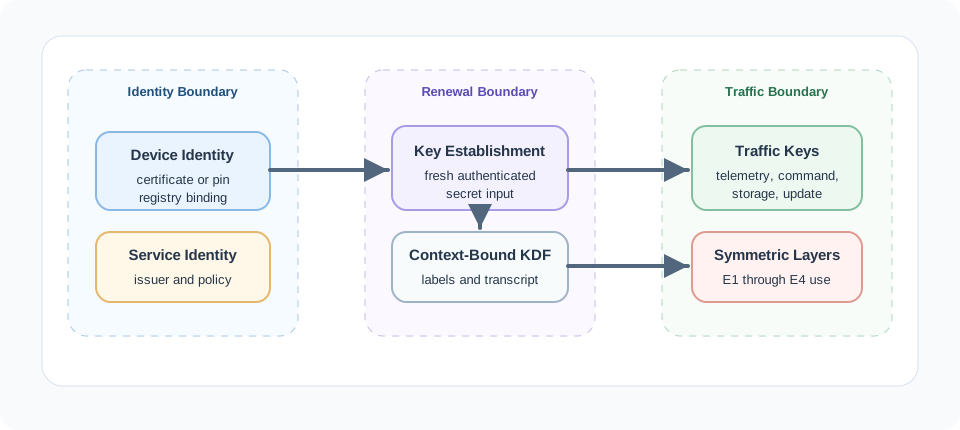
Read Figure 10.2 from long-lived identity into authenticated fresh secret input and the context-bound KDF, then follow the outputs to purpose-specific traffic keys for E1 through E4. Identity proves which peer may renew; establishment supplies new secret material; derivation binds it to peers, transcript, version, and purpose; and the traffic boundary limits where each result is used. Keeping those jobs separate is what lets renewal change traffic keys without confusing them with identity credentials or widening their scope.
Renewal Review Gates: Evidence Before Activation
Each gate needs evidence of how renewal works in production, not just that a library call exists. The release test is the failure case that must be rejected.
Worked Review: A Meter Fleet's "Yearly Key Push" Under Scrutiny
A utility fleet renews data keys only during manual maintenance, by sending a new key to each device. The reviewer walks the gates and finds the gaps.
What works
There is at least an intent to replace keys, and per-device credentials already authenticate the transport, so identity is partly in place.
What the gates expose
The trigger is an operator calendar, not an enforceable cryptoperiod; renewal messages carry no epoch, so replay is possible; one derived key covers telemetry and commands; old keys are deleted immediately; and a disabled device can still request a replacement.
Conclusion
Make the trigger system-enforced, add freshness and key versions, split derived keys by purpose, use a finite overlap with straggler tracking and a recovery path, and check revocation before installing any new key.
Practitioner Knowledge Check
If you can run the renewal flow and defend each gate with evidence, you can stop here. Continue to Under the Hood for forward secrecy, overlap windows, and certificate rollover.
10.3 Forward Secrecy, Overlap, and Issuer Rollover
This section: Forward Secrecy, Overlap, and Issuer Rollover — The advanced question is what a future compromise can reveal.
The deeper layer explains the mechanism behind the sharpest E5 distinction, rotation versus forward secrecy, and the engineering of overlap windows and certificate rollover that keep renewal from becoming an availability or trust failure.
The advanced question is what a future compromise can reveal. Rotation limits how long one key remains useful, but forward secrecy is what protects old recorded traffic after a later long-term key leak.
Rotation Versus Forward Secrecy: Future Risk and Past Traffic
These are often confused, and the difference is exactly what an attacker who records traffic cares about. Rotation periodically replaces a key, which limits how much future data any one compromised key can cover. It does nothing for traffic already captured before the rotation. Forward secrecy is stronger: each renewal runs a fresh ephemeral key agreement (such as ECDHE) and deletes the ephemeral private material once the key is derived, so a later compromise of long-term keys cannot reconstruct the earlier session keys. The crucial corollary is that key transport, encrypting a new symmetric key to a device's long-term public key, can be a valid, authenticated way to deliver a key, but it does not provide forward secrecy: if that long-term private key later leaks, every recorded renewal it protected can be decrypted. Forward secrecy requires ephemeral establishment plus deletion, not just periodic replacement.
Cryptoperiods and Enforceable Triggers: Make the Schedule Real
A cryptoperiod is the approved time or usage interval for a key. Established guidance such as NIST SP 800-57 treats choosing it as a risk decision based on the algorithm and key type, the amount of data protected, how exposed the key is, the operating environment, and the impact of compromise; for IoT, intermittent connectivity and field-service realities also shape the schedule. The rule that matters for review is that the trigger must be enforceable by the system. A cryptoperiod written in a document means nothing if the device and service do not actually track key version, activation time, expiry, and revocation state and act on them.
KDF Context Is a Security Boundary: Bind Each Key to a Job
After establishment, the shared secret is never used directly as a traffic key. It passes through a KDF that binds the output to context: the product and key-schedule version, the device and service identities, the transcript hash, a purpose label such as telemetry or update or storage, a direction label, the key version or epoch, and the algorithm suite. That binding is what stops a key derived for one role from being accepted in another. The way to prove it is negative test vectors that change one context field at a time, so a telemetry key fails for command authentication, a key derived under one identity fails for another, and a key from a previous epoch fails after its window closes.
Overlap Windows and Lockout Prevention: Keep Devices In, Then Close the Door
For planned rotation, no overlap can strand intermittent devices that were offline at activation; unlimited overlap creates a permanent old-key bypass. Make planned overlap explicit, observable, and finite: the new key becomes primary for outbound messages, a defined set of old key versions is accepted for inbound messages during a grace window, the service tracks which devices have not yet rotated, and devices that reconnect after the window enter a recovery path instead of silently using an old key. At the end of the window the old key is disabled or destroyed. If the old key is suspected compromised, revoke it immediately and use a separate recovery path. A good release gate can simulate offline devices, delayed messages, duplicate renewal commands, stale versions, and a revoked device attempting renewal.
Inspect Figure 10.3 to see how a finite grace window balances continued access with the need to reject stale credentials.
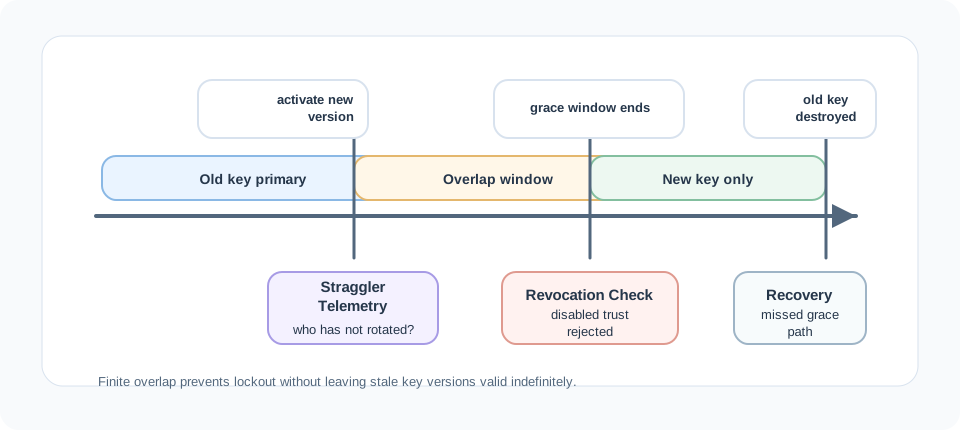
In Figure 10.3, the old key starts as the main key. The new version then becomes active. Both work only during a short grace window, after which the old key is disabled and destroyed. The lower row shows how to control that change. Straggler data finds devices that have not moved. A revocation check blocks trust that has been withdrawn. Recovery serves devices that missed the window. This order avoids needless lockouts while still proving that stale keys cease to work.
Certificate and Issuer Rollover: Move the Trust Chain Carefully
E5 renewal often includes certificate renewal, not just symmetric replacement, and certificate rollover carries extra blast-radius concerns because an issuer key validates many devices. A device certificate should be renewed before expiry and bound to the same registry identity and authorization. An intermediate issuer rollover must accept old and new chains during migration, then remove trust for the old issuer at a planned cutover. Both depend on a working revocation path so devices and services can reject revoked certificates, disabled issuers, and blocked key versions. If an issuer private key is compromised, the response is not merely to rotate the next device key: the trust chain itself must be distrusted, affected certificates replaced, and a trust update delivered through a channel still authenticated by an uncompromised anchor or recovery path.
Mechanisms and Failure Modes: What to Inspect
Common Pitfalls: Renewal Designs That Fail Quietly
Follow the sequence from decision to evidence. First, Confusing rotation with forward secrecy. Rotation limits future exposure; protecting captured past traffic needs ephemeral key agreement and deletion of ephemeral secrets. Next, One key for many purposes. A single derived key across telemetry, commands, and storage lets one error cross boundaries; separate outputs with KDF context. Next, Deleting the old key too early. Immediate deletion locks out devices offline during rollover; use a finite overlap and a recovery path. Next, Renewing before checking revocation. A revoked identity must not obtain fresh material; check revocation and registry state first. Next, Logging secrets as evidence. Audit records must prove what changed without raw symmetric keys, private keys, recovery tokens, or unredacted key-transport payloads. Finally, Unenforceable triggers. A cryptoperiod the system does not track and act on is not a control.
Under-the-Hood Knowledge Check
At this depth, E5 is a controlled lifecycle of independent guarantees: enforceable triggers, authenticated establishment that can add forward secrecy, context-bound derivation, finite overlap that prevents lockout, revocation checked before any install, and audit evidence that omits secrets. Get it right and a fleet's keys stay fresh and revocable for years; get it wrong and rotation becomes either a stale-key illusion or an availability outage.
10.4 Summary
This section: Summary — E5 is the renewal level that refreshes the symmetric keys E1 to E4 depend on; it does not mean using public-key cryptography for every message.
E5 is the renewal level that refreshes the symmetric keys E1 to E4 depend on; it does not mean using public-key cryptography for every message. Long-lived keys accumulate risk, so renewal bounds the data and time under any one key and provides a path to retire trust after ownership changes, repairs, or incidents.
A renewal is a controlled transition: trigger, authenticated establishment, context-bound derivation, versioned activation with overlap, revocation, and audit. Rotation limits future exposure but is not forward secrecy; forward secrecy needs fresh ephemeral key agreement and deletion of ephemeral private material, and key transport alone does not provide it.
A cryptoperiod is a risk-based interval (NIST SP 800-57), and its trigger must be enforceable by the system, not written only in a document. A finite, observable overlap window prevents lockout of offline devices while still expiring stale keys, with straggler telemetry and a recovery path.
Certificate and issuer rollover need old-and-new chain support, revocation, and, on issuer compromise, distrust of the chain through an uncompromised anchor.
Key renewal should be automatic, observable, and recoverable. Trigger it by enforceable policy, establish fresh material with authentication and, where it matters, forward secrecy, derive purpose-bound keys, activate with a finite overlap so devices are not stranded, and check revocation before installing. Rotation that can strand devices or silently fail is an availability risk, not a security gain.
10.5 See Also
This section: See Also
Encryption Key Management
The full key lifecycle, generation, storage, and separation, that E5 renewal extends over time.
Public Key Cryptography
The ephemeral key agreement, signatures, and certificates that authenticate and add forward secrecy to renewal.
Encryption Architecture and Levels
See where E5 sits in the E1-E5 model and which levels its renewed keys protect.
Find help
3 reviewed answers.
Where should I start in a module?
Open the module page from the sidebar to see its chapters in order. Use the module map to return to a topic you need.
Modules and pathsReviewed
What can I try when a project does not work?
Check the symptom, then work through the diagnostic steps. Keep the error message and the smallest example that reproduces it.
When you are stuckReviewed
How do interactive examples work?
Use the interactive guide to check how examples and simulations work before changing your project.
Interactive examples guideReviewed