17 Cipher Challenge Game

More
Depth: Practitioner
Progress saves as you read. Mark sections complete as you go; your progress appears in the sidebar.
-

Which repeated pattern gives the secret away?
17.1 Start With the Pattern You Can Break
This section: Start With the Pattern You Can Break — Picture a puzzle that rewards finding repeated patterns in a secret message.
Prove the Lesson Ends in a Safe Release Rule
Picture a puzzle that rewards finding repeated patterns in a secret message. The same trick becomes a product failure if a team copies the classroom method into a device.
A protocol means an agreed set of rules for exchanging information. A secure one must name the reviewed mechanism, key handling, unique inputs, integrity check, and rejection behavior.
Play the weak case, then alter, repeat, reorder, and replay messages against the production rule. Keep the input, key label, output, change, accept or reject result, and software version so another person can repeat the lesson.
This game demonstrates selected failures, not proof of a new cipher. The deeper sections cover attacker models, authenticated encryption, key practice, review, and release evidence.
Imagine a game round where the ciphertext looks harmless until repeated letters, reused nonces, or a missing integrity check gives the attacker a clue. That clue is the lesson. The learner should leave knowing why a classroom cipher is safe for practice, why it is unsafe for deployment, and which production evidence would block the same failure.
Use the game as a bridge from puzzle to release review: spot the pattern, name the real cryptographic risk, choose a reviewed control, and write the test that proves a device will reject the unsafe case.
A cipher game is useful when it teaches pattern recognition, attacker thinking, and safe production choices. It becomes risky when learners confuse a classroom cipher with a deployable cryptographic design. Use the game to practice classifying ciphers, finding failure modes, choosing authenticated encryption, and writing release evidence.
17.2 Learning Objectives
This section: Learning Objectives
By the end of this chapter, you will be able to:
- Use simple cipher challenges to explain why secrecy cannot depend on obscurity.
- Distinguish teaching ciphers from production cryptographic mechanisms.
- Identify attack clues such as patterns, repeated keys, missing integrity, and nonce misuse.
- Choose evidence for authenticated encryption, key management, and protocol validation.
- Turn a game result into a release gate that blocks unsafe custom cryptography.
17.3 Prerequisites
This section: Prerequisites
- Encryption Principles and Crypto Basics for confidentiality, integrity, and keys.
- Symmetric Encryption for block ciphers, stream ciphers, and AEAD modes.
- Hash Functions and Message Authentication for integrity and message authentication concepts.
- Key Management for IoT for key lifecycle and rotation.
17.4 What the Game Is Teaching
This section: What the Game Is Teaching — The game is not asking learners to build production cryptography.
The game is not asking learners to build production cryptography. It is asking them to notice what breaks weak designs:
- A Caesar shift leaks structure because every letter moves by the same amount.
- A substitution cipher hides letters but still leaks repeated patterns and language statistics.
- A repeated XOR key can leak relationships between messages.
- Encryption without authentication can leave tampering undetected.
- A strong algorithm can still fail if keys, nonces, identities, or protocol context are wrong.
Inspect Figure 17.1 as a route from the puzzle clue to the production control and retained release decision.
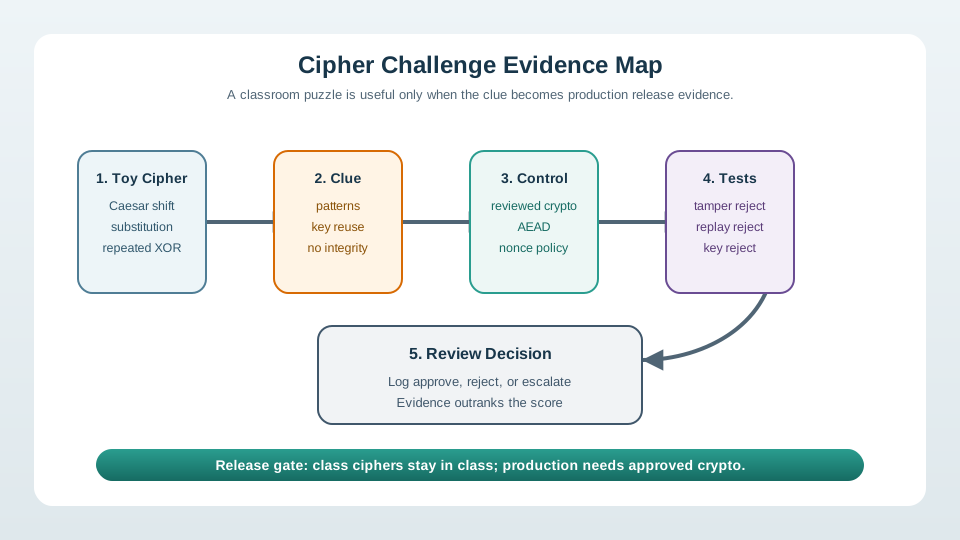
Read Figure 17.3 from the toy cipher to the attacker clue, then to the safe control, release test, and review decision. The first two stages explain what failed; the control states the production remedy; the test proves that remedy under failure conditions; and the decision records whether the evidence is sufficient. That progression is the chapter’s running purpose: use play to practise the reasoning that a real review demands, not to promote puzzle ciphers as deployable mechanisms. Read Figure 17.1 in that order.
Classroom ciphers are deliberately weak so the weakness is visible. Production systems should use standardized, reviewed cryptographic mechanisms through vetted protocol and library implementations. Do not ship a design because it performed well in a game.
17.5 Break Ciphers to Learn Their Limits
This section: Break Ciphers to Learn Their Limits — Cipher challenges are useful because breaking a code teaches what makes one strong.
Cipher challenges are useful because breaking a code teaches what makes one strong. Classical ciphers such as a Caesar shift or a full substitution alphabet can feel secure because the output looks like gibberish. They fail quickly because they leak statistics of the original language into the ciphertext.
The production lesson is not “choose a cleverer secret alphabet.” It is to translate the classroom failure into a release rule: use reviewed algorithms, authenticate data as well as hiding it, manage keys and nonces, and record negative tests. A puzzle answer matters only when it explains what an attacker learned and which real control would prevent the same class of failure.
That translation keeps the game honest. A Caesar puzzle can teach pattern leakage, but it cannot justify a production cipher. A one-time-pad puzzle can teach perfect secrecy, but only if the learner also states the key-length, randomness, distribution, and single-use conditions that make the theory true.
A substitution cipher gives every letter a disguise, but it wears the same disguise every time. Count how often each disguise appears and the most common one is probably a common plaintext letter. The pattern of the language shines through the costume.
17.6 Reuse Turns Theory Into Failure
This section: Reuse Turns Theory Into Failure — There is exactly one classical scheme that is provably unbreakable: the one-time pad.
There is exactly one classical scheme that is provably unbreakable: the one-time pad. Its security depends entirely on one rule: the random key is as long as the message, truly random, distributed safely, and used once. Break the single-use rule and the unbreakable becomes breakable.
Review the game as an evidence trail. The learner should identify the reused material, show the algebra that makes the key cancel, explain why the leakage is about plaintext relationships rather than direct key recovery, and map the lesson to a real control. In deployed systems that control is usually nonce or keystream uniqueness, not a bigger alphabet or a hidden algorithm.
One-time pad: C = P XOR K

C1 = P1 XOR K
C2 = P2 XOR K
C1 XOR C2 = P1 XOR P2
For IoT telemetry, this becomes a packet-design question. Which field is the nonce or counter? Where is it stored across reboot? What happens after factory reset? Which log would reveal reuse? The game is complete only when the answer names those operational checks.
Reusing the same one-time-pad key removes the key from C1 XOR C2, leaving P1 XOR P2. An attacker can use known words, spaces, protocol fields, or message templates to separate the plaintexts without ever learning the key directly.
17.7 Modern Cipher Reviews Look Beyond the Primitive
This section: Modern Cipher Reviews Look Beyond the Primitive — Modern ciphers defeat frequency analysis by design, but a release review still needs more than a strong primitive name.
Modern ciphers defeat frequency analysis by design, but a release review still needs more than a strong primitive name. The reviewer needs to know the mode of operation, key owner, nonce or counter rule, integrity mechanism, downgrade behavior, and failure handling. AES in an unsafe mode, or AES-GCM with nonce reuse, can fail even though AES itself is strong.
Confusion and diffusion are design goals, not release evidence by themselves. Confusion makes the relationship between key and ciphertext complex. Diffusion spreads each plaintext bit across many ciphertext bits. Those properties help explain why modern ciphertext should not visibly preserve input structure, but the review still needs protocol traces, test vectors, library/API settings, and rejection cases.
If two similar sensor messages produce outputs with obvious shared patterns, the construction or mode is suspect. That observation should lead to questions about IV or nonce uniqueness, padding, compression before encryption, metadata outside the protected envelope, and whether the system uses authenticated encryption. The evidence should record which library and mode produced the trace.
17.7.1 Confusion
Substitution boxes and key mixing make key-to-output relationships hard to infer.
17.7.2 Diffusion
Small plaintext changes spread across many ciphertext bits so language statistics do not survive.
17.7.3 Misuse Still Breaks Strong Ciphers
Strong primitives fail when the mode, nonce, key lifecycle, or authentication checks are wrong.
17.7.4 Kerckhoffs’s Principle
Security should depend on the secret key, not on hiding the algorithm.
17.8 Challenge Levels
This section: Challenge Levels
17.9 Feedback Loop for Learners
This section: Feedback Loop for Learners — Every round should end with a short evidence note.
Every round should end with a short evidence note. That note is more important than the score because it proves the learner can move from “I solved it” to “I know why this design is unsafe.”
Inspect Figure 17.2 to see how observation becomes a testable control and a gate decision rather than stopping at the answer.
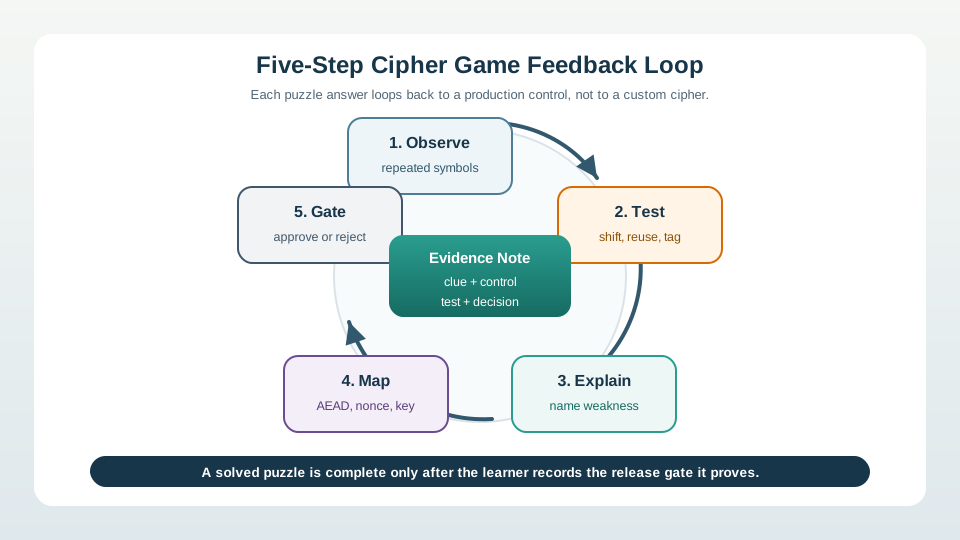
Follow Figure 17.2 from observe to test, explain, map, and gate. Observation identifies a clue without overclaiming; a small hypothesis test checks the suspected weakness; explanation names why it matters; mapping selects the production control; and the gate records the decision and evidence. The learner can repeat the loop when a hypothesis fails. That ordered reasoning, rather than the score, is what transfers from a cipher challenge to a real design review.
17.10 From Puzzle to Production Evidence
This section: From Puzzle to Production Evidence — A game answer is not release evidence until it names the production control.
A game answer is not release evidence until it names the production control. For example, “I cracked the Caesar shift” is a puzzle result. “The design has a small key space and no approved algorithm, so it fails the cryptographic-mechanism gate” is review evidence. Use Figure 17.1 to see which production obligations must replace the toy-cipher shortcut.
Those observations are useful only if the learner can move from a visible clue to a defensible engineering decision. Use Figure 17.3 to follow that transition before treating a solved puzzle as proof of cryptographic understanding.
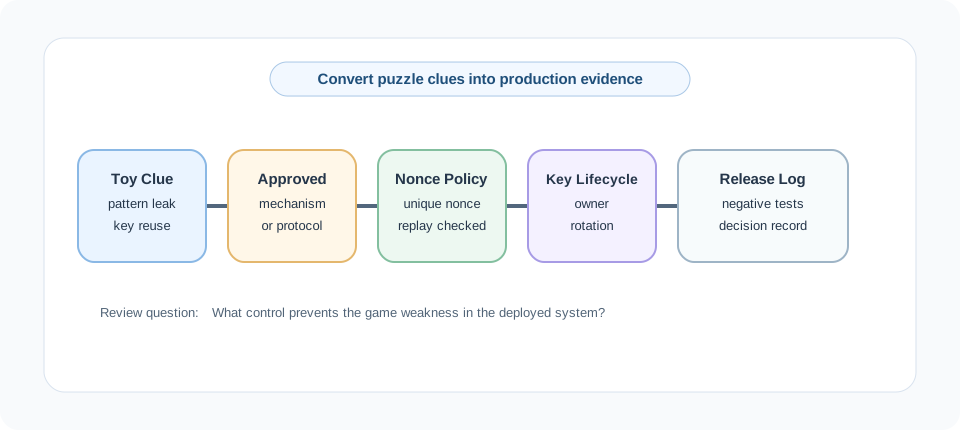
Follow Figure 17.1 from the puzzle clue into five concrete controls: an approved mechanism, authenticated encryption where confidentiality and integrity are required, a nonce policy, a bounded key lifecycle, and a retained release log. Each step closes a weakness the game can reveal but cannot itself remediate. The path completes the chapter’s narrative by converting learner insight into the evidence language used to approve, reject, or escalate a production design. Read Figure 17.3 in that order.
Repeated letters
Repeated symbols tell the learner that structure leaks through weak transformations.
Known plaintext
If an attacker knows or guesses part of a message, repeated key streams or simple transforms can reveal more.
Authenticated encryption
Use a standardized AEAD construction or a protocol that supplies confidentiality and integrity together.
Release log
Record approved algorithm, key source, nonce behavior, test vectors, and rejection cases.
17.11 Worked Example: Weak Telemetry Puzzle
This section: Worked Example: Weak Telemetry Puzzle — The game shows three encrypted telemetry strings.
The game shows three encrypted telemetry strings. Two strings have the same device prefix and the same repeating pattern in the encrypted output. A learner guesses that a repeated key stream or deterministic toy cipher is being used.
The production evidence should include:
- The approved algorithm or protocol profile for telemetry confidentiality and integrity.
- A nonce or sequence policy that prevents reuse under the same key.
- Tests that reject modified ciphertext and associated data, detect nonce reuse by the sender under one key, and reject replay at the receiver.
- Key generation, provisioning, rotation, and revocation responsibilities.
- Logs that distinguish authentication failure, replay, unsupported algorithm, and key-policy rejection.
17.12 Common Game-to-Production Mistakes
This section: Common Game-to-Production Mistakes
Shipping a teaching cipher
Caesar, substitution, XOR puzzles, and home-built variants are for learning. They are not production cryptographic mechanisms.
Ignoring integrity
A game may focus on hiding text, but IoT commands and firmware also need tamper detection and origin evidence.
Counting only key length
Large keys do not fix nonce reuse, wrong modes, unauthenticated metadata, weak identity checks, or leaked private material.
Skipping negative tests
A demo that decrypts valid data is incomplete. Release tests must prove that bad data is rejected.
Using score as assurance
A high game score does not prove secure implementation. Assurance comes from standards fit, test evidence, and lifecycle controls.
No recovery plan
Devices need a way to rotate keys, replace trust anchors, retire algorithms, and recover from compromise without disabling validation.
17.13 Practical Rules for Cipher Challenges
This section: Practical Rules for Cipher Challenges — These rules connect cipher challenges to production review.
These rules connect cipher challenges to production review. Label classroom ciphers clearly as learning tools, not deployable mechanisms. Ask learners to name the attacker clue, not only the answer. Map every solved puzzle to a safe production control. Prefer authenticated encryption or protocol-provided security over encryption-only examples. Include nonce, key lifecycle, identity, and integrity questions in the game flow. Use reviewed standards and protocol profiles rather than custom algorithms. Require negative tests for modified ciphertext, repeated nonce, wrong key, replay, and downgrade. Keep score secondary to explanation quality and release evidence. Separate toy math from real implementation APIs and deployment policy. Record what the learner would approve, reject, or escalate in a real review.
17.14 Knowledge Check
This section: Knowledge Check
17.15 Release Evidence Checklist
This section: Release Evidence Checklist — Review the evidence as an ordered release decision.
Before production, convert the game outcome into evidence:
Review the evidence as an ordered release decision. First verify The design uses approved cryptographic mechanisms or protocol profiles, not classroom ciphers. Then verify Confidentiality, integrity, authentication, replay protection, and downgrade behavior are each assigned to a control. Then verify Nonce, sequence, IV, and key-stream reuse are blocked by design and tested in release. Then verify Keys are generated, provisioned, rotated, revoked, and destroyed under documented ownership. Then verify Metadata and associated data are classified and authenticated where the protocol requires it. Then verify Modified ciphertext, modified associated data, wrong key, duplicate nonce, replay, and unsupported algorithm all fail closed. Then verify Logs distinguish cryptographic failure categories without exposing secrets. Then verify The learner or reviewer records whether the production design is approved, rejected, or escalated. Then verify Custom algorithms, hidden transformations, debug bypasses, and plaintext fallback are explicitly blocked. Finally verify Migration and recovery paths exist for key compromise, algorithm retirement, and trust-anchor changes.
17.17 What’s Next
This section: What’s Next — Continue with Hash Functions and Message Authentication to connect cipher-game attack clues to the integrity, MAC, tag, and digest evidence that production systems rely on.
Continue with Hash Functions and Message Authentication to connect cipher-game attack clues to the integrity, MAC, tag, and digest evidence that production systems rely on.
17.18 Summary
This section: Summary — Encryption games provide interactive practice with cryptographic choices, attacker models, and failure cases.
Encryption games provide interactive practice with cryptographic choices, attacker models, and failure cases. They help learners test whether they understand the difference between secrecy, integrity, authentication, and key management.
17.19 Key Takeaway
This section: Key Takeaway — Use cryptography games to build design intuition, then translate the lesson back to real systems: identify the attacker, the protected asset, the key owner, and the failure mode.
Use cryptography games to build design intuition, then translate the lesson back to real systems: identify the attacker, the protected asset, the key owner, and the failure mode.
Find help
3 reviewed answers.
Where should I start in a module?
Open the module page from the sidebar to see its chapters in order. Use the module map to return to a topic you need.
Modules and pathsReviewed
What can I try when a project does not work?
Check the symptom, then work through the diagnostic steps. Keep the error message and the smallest example that reproduces it.
When you are stuckReviewed
How do interactive examples work?
Use the interactive guide to check how examples and simulations work before changing your project.
Interactive examples guideReviewed