33 Protocol Selection: Series Map

More
Depth: Practitioner
Progress saves as you read. Mark sections complete as you go; your progress appears in the sidebar.
33.1 In 60 Seconds
This section: In 60 Seconds — Picture a team choosing a link for a parking sensor.
Reject Bad Fits Before Picking a Winner
Picture a team choosing a link for a parking sensor. One option reaches far but sends little. Another sends more but drains the battery. A familiar choice may still fail the site.
A protocol is a shared set of communication rules. Choose one from the job, not from its name. First state the hard limits: distance, power, message size, wait time, loss, safety, site control, and years of support. Remove any choice that cannot meet a hard limit.
Compare only the choices that remain. Use the same installed test, traffic, weather, and failure cases for each. Record what passed, what failed, and which fact could change the answer. Then run a small field trial before the full build.
A score table can help, but a high total must not hide one failed safety or service need. No protocol is best for every device, and a paper claim is not field proof.
Use Practitioner to build the decision record and test plan. Use Under the Hood to inspect radio, network, trust, and operations limits.
Protocol selection is a decision process, not a protocol ranking. This series teaches learners to define the communication boundary, collect deployment evidence, eliminate candidates that fail hard constraints, compare only viable finalists, and validate the recommendation before rollout. This overview explains how the chapters fit together and how to use them without treating any protocol family as a universal answer.
33.2 Start With the Story
This section: Start With the Story — You will organize a protocol decision around constraints, viable families, and the evidence needed to justify a choice.
You will organize a protocol decision around constraints, viable families, and the evidence needed to justify a choice. Start by naming the link and its hard requirements before following the chapter sequence.
Follow one protocol decision across four beats to see how constraints replace familiarity as the selection rule.
-

Packet Pete: “We know this protocol, so why not start there?”
-

Bex: “These deployments share small messages, not the same hard constraints.”
-

The team: “Reject impossible fits first, then compare the finalists with evidence.”
-

Test Tessa: “The field record supports the choice for this deployment, not every deployment.”
Read the story panels from the familiar option to the field-validated decision. The contrasting deployments first expose why small payloads do not imply shared range, power, latency, security, or maintenance needs. Elimination gates remove every family that fails a hard constraint before softer trade-offs are compared. The final field record tests the survivor against the real environment, turning preference into a scoped engineering argument that can be reviewed later.
33.3 Learning Objectives
This section: Learning Objectives
By the end of this overview, you will be able to:
- Describe the protocol-selection series and when to use each chapter.
- Explain why connectivity decisions begin with deployment evidence rather than protocol names.
- Identify the difference between hard constraints, comparison criteria, and validation evidence.
- Map common protocol families to the types of requirements they are usually asked to satisfy.
- Use a decision record to keep protocol recommendations auditable.
33.4 Quick Check: Protocol Requirements
This section: Quick Check: Protocol Requirements
33.5 Minimum Viable Understanding
This section: Minimum Viable Understanding — A protocol recommendation should answer a bounded question: which link, for which device class, in which environment, under which ownership and operations assumptions?
A protocol recommendation should answer a bounded question: which link, for which device class, in which environment, under which ownership and operations assumptions? If those boundaries are missing, the recommendation is not ready.
33.6 How to Use: How It Works: Use The Selection Series
This section: How to Use: How It Works: Use The Selection Series
- Frame the challenge. Start with the competing constraints so the team understands why no protocol is best everywhere.
- Apply the systematic workflow. Use evidence gates to eliminate impossible candidates before comparing finalists.
- Practice with scenarios. Test the method on realistic deployment patterns before applying it to a live design.
- Check for anti-patterns. Look for favorite-protocol thinking, hidden assumptions, and unsupported rankings.
33.6.1 Beginner Example
A learner who knows only one wireless name should begin with the challenge chapter to understand how range, energy, payload, latency, security, and operations compete. Familiarity becomes useful background once the communication problem has a clear boundary: the link, device class, environment, and ownership assumptions.
Next, use the systematic framework to ask what the deployment must demonstrate. Gather evidence, identify hard constraints, and remove candidates that fail them before comparing surviving options. A high comparison score should not compensate for a failed requirement. Use scenario practice to apply this sequence, then identify the weakest assumptions for validation. Keep the reasons for elimination and the planned checks in a decision record that another engineer can review.
33.6.2 Intermediate Example
A project team choosing between short-range and wide-area lanes should first name the link, device class, site, and ownership boundary. These details establish which deployment the recommendation covers. Gather evidence about range, power, payload, latency, security, and operations, then identify the requirements that act as pass or fail gates. Remove candidates that fail a hard constraint and record the specific evidence behind each rejection. Compare the surviving options using documented criteria, including their maintenance responsibilities. A favorable score elsewhere cannot compensate for a failed requirement. Use field tests, current traces, or integration trials to check weak assumptions, and retain the recommendation, dependencies, and open risks in the decision record.
33.6.3 Advanced Example
A review board can use the series to trace how a recommendation develops from the deployment problem to a documented choice. The challenge chapter establishes competing requirements and communication boundaries. The systematic method connects deployment evidence to hard constraints, rejected candidates, and viable finalists. Scenario practice gives reviewers a way to examine how the workflow is applied before a live deployment. The anti-pattern check then exposes familiar-protocol preferences, hidden assumptions, and unsupported rankings. The final decision record should connect the recommendation to its comparison criteria, operations assumptions, and validation results. It should also identify open risks, accountable owners, and changes that would require another review, so the board can assess the reasoning within its stated scope.
33.7 Concept Check: Bounded Question
This section: Concept Check: Bounded Question — What is missing from the recommendation “use the familiar protocol because the team knows it”?
What is missing from the recommendation “use the familiar protocol because the team knows it”?
Answer: It lacks the decision boundary, deployment evidence, eliminated candidates, and validation plan.
33.8 Concept Check: Series Route
This section: Concept Check: Series Route — Why does the series include scenarios after the systematic workflow?
Why does the series include scenarios after the systematic workflow?
Answer: Scenarios let learners practice applying the workflow before they use it on a real deployment with higher consequences.
33.9 Try It Yourself
This section: Try It Yourself — Write a one-sentence protocol decision question for a real or imagined device.
Write a one-sentence protocol decision question for a real or imagined device. Include link, device class, environment, and ownership assumptions.
Challenge: Add the chapter from this series you would read next and explain what evidence it should produce.
33.10 See Also
This section: See Also
Protocol Selection: The Challenge
Protocol Selection: The Challenge frames the competing constraints and layer boundaries before the systematic workflow.
Protocol Framework Systematic
Protocol Framework Systematic gives the repeatable evidence workflow.
Protocol Framework Scenarios
Protocol Framework Scenarios lets learners practice matching scenarios to protocol-family lanes.
Protocol Framework Anti-Patterns
Protocol Framework Anti-Patterns helps catch unsupported rankings and hidden assumptions.
33.11 How This Series Fits Together
This section: How This Series Fits Together — The series is organized as a progression from problem framing to scenario practice.
The series is organized as a progression from problem framing to scenario practice.
Pause at the figure Figure 33.1 before applying How This Series Fits Together. Its Protocol Selection Framework and The Challenge labels show why Protocol-selection series map showing the challenge chapter, systematic selection workflow, scenario practice, anti-pattern review, and related protocol-family deep dives needs an evidence check for How This Series Fits Together here.
For How This Series Fits Together, the visual sequence in Figure 33.1 opens with Protocol Selection Framework, where it highlights Protocol Selection Framework. The Challenge follows to show how it highlights The Challenge; Why range, energy, payload, and operations compete then uses Why range, energy, payload, and operations compete to assign operational ownership. That progression connects Protocol-selection series map showing the challenge chapter, systematic selection workflow, scenario practice, anti-pattern review, and related protocol-family deep dives to the next How This Series Fits Together check.
33.12 The Decision Flow
This section: The Decision Flow — This overview uses the same decision flow as the rest of the series.
This overview uses the same decision flow as the rest of the series.
The decision flow in Figure 33.2 starts by naming the link, device class, site, and owner. Those details bound the deployment that a protocol must serve. Evidence inputs then cover site conditions, power, payload, latency, security, and operations. Hard constraints turn those needs into pass or fail gates, so a candidate that cannot meet one is removed before scores are compared. The surviving options can be ranked with reasons, but weak assumptions still need field tests, current traces, or integration trials. Keep the final choice and open risks in the decision record so later evidence can challenge it.
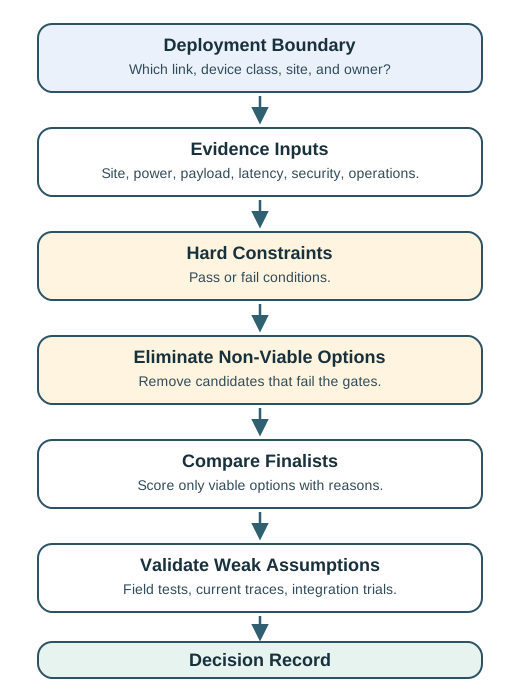
Follow Figure 33.2 from Deployment Boundary into Evidence Inputs before checking Site, power, payload, latency, security, operations. The first highlights Deployment Boundary, the second uses Evidence Inputs to hold review evidence, and the last uses Site, power, payload, latency, security, operations to assign operational ownership. This ordered reading preserves Protocol-selection decision flow from deployment boundary through evidence inputs, hard constraints, finalist comparison, validation, and decision record in the The Decision Flow evidence chain.
The sequence matters:
- Define the deployment boundary.
- Gather evidence about the device, site, payload, ownership, and operations model.
- Mark the hard constraints.
- Eliminate candidates that fail those constraints.
- Compare only the surviving finalists.
- Validate the weakest assumptions.
- Record the recommendation and open risks.
Weighted comparison belongs after elimination. A candidate that fails a required coverage, power, payload, security, integration, or operations condition should not be rescued by a high score elsewhere.
33.13 Protocol Families as Design Lanes
This section: Protocol Families as Design Lanes — Protocol families are useful starting points, not fixed answers.
Protocol families are useful starting points, not fixed answers. The same family can be a good fit in one deployment and a poor fit in another when ownership, power, mobility, payload, or validation evidence changes.
A reliable Protocol Families as Design Lanes review needs the figure Figure 33.3. Its Evidence-First Selection and Short-Range Device Links markers reveal where Protocol-family map showing short-range device links, indoor mesh, local high-throughput links, low-power wide-area sensing, carrier-managed wide-area service, and application-layer messaging enters the running decision.
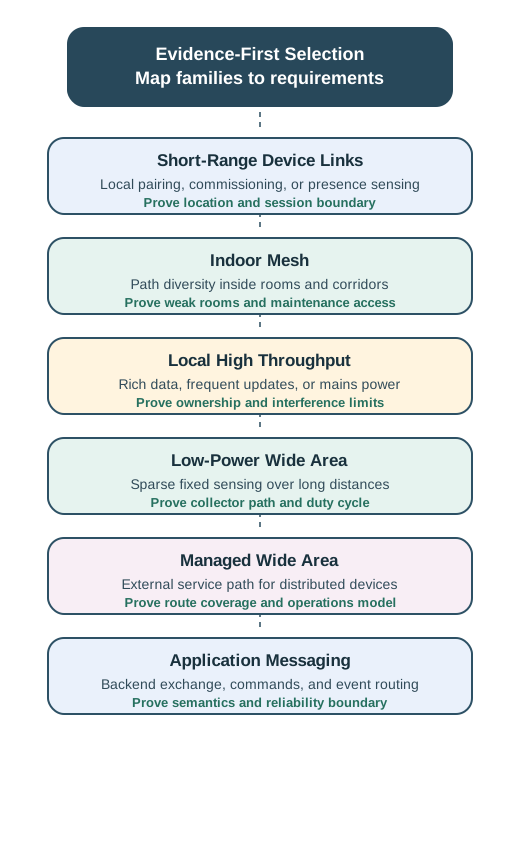
For Protocol Families as Design Lanes, the visual sequence in Figure 33.3 opens with Evidence-First Selection, where it uses Evidence-First Selection to hold review evidence. Short-Range Device Links follows to show how it uses Short-Range Device Links to locate a communication boundary; Indoor Mesh then highlights Indoor Mesh. That progression connects Protocol-family map showing short-range device links, indoor mesh, local high-throughput links, low-power wide-area sensing, carrier-managed wide-area service, and application-layer messaging to the next Protocol Families as Design Lanes check.
33.14 Decision Records
This section: Decision Records — The most useful artifact from this series is a protocol decision record.
The most useful artifact from this series is a protocol decision record. It should be short enough to read, but specific enough that another engineer can audit the reasoning.
A good record includes:
- the bounded decision question;
- the deployment evidence used;
- hard constraints and eliminated candidates;
- finalists and scoring criteria;
- lifecycle categories and operations assumptions;
- validation tests that could overturn the recommendation;
- open risks and owners.
Inspect Figure 33.4 and ask whether every finalist is being judged with the same evidence fields.
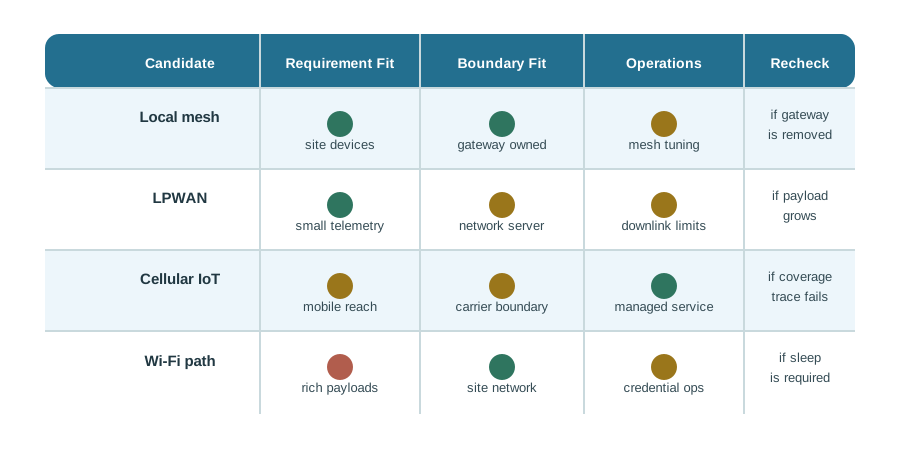
Read Figure 33.4 across one row. Need fit states the pass rule and why the option remains. Boundary fit names the radio, gateway, broker, address, and safety needs that a score may hide. The work field names the burden and owner for setup, checks, updates, faults, and final removal. The last field names a later change that voids the old result. Ask the same four questions of each final option. The matrix saves the proof used for the choice and tells the next team when to open that choice again.
The matrix is not a universal ranking. It is a compact record of why a candidate survived, which boundary assumption it depends on, what operations burden it creates, and what future change would force the team to recheck the decision.
This prevents a protocol choice from becoming tribal knowledge. It also gives future maintainers a way to understand what evidence was available when the decision was made.
33.15 How to Use: What This Overview Removes
This section: How to Use: What This Overview Removes — The series still teaches cost, range, energy, and protocol-family trade-offs, but it does so through evidence categories and linked deep dives rather than stale arithmetic.
Several shortcuts are intentionally not used in this cleaned overview:
- no one-size-fits-all protocol rankings;
- no fixed price examples that age quickly;
- no interactive calculators whose assumptions look more precise than the evidence;
- no generic code helper that pretends protocol selection is a few if-statements;
- no broad educational videos that pull learners away from the chapter task;
- no child-story framing that dilutes a professional engineering decision.
The series still teaches cost, range, energy, and protocol-family trade-offs, but it does so through evidence categories and linked deep dives rather than stale arithmetic.
Common Pitfalls
This section: Common Pitfalls — Inspect the story panel and ask which operational responsibilities remain after a protocol has been selected.
Inspect the story panel and ask which operational responsibilities remain after a protocol has been selected.
-

Wrong: Picking the link ends the choice. Name who runs, updates, replaces, and repairs each part.
Read the panel from the crossed-out radio badge to the owner tags attached to the surrounding system. A successful link resolves only one technical choice; gateway operation, service plans, access points, device keys, monitoring, updates, replacement, and incident response still need accountable owners. The correction frames the pitfalls that follow: protocol layers, switching rules, field evidence, and maintenance duties must remain visible in the decision record.
33.15.1 Mixing Protocol Layers
“Which is better: an application message protocol or a wireless access technology?” is usually the wrong question. Select the radio link, network path, transport, and application messaging layer separately when they solve different problems.
33.15.2 Treating Radio Choice as One Static Winner
Heterogeneous-network designs often have more than one usable radio access technology. A phone, gateway, or vehicle may see Wi-Fi, LTE-M, NB-IoT, BLE, Zigbee, or a private radio path at the same time, and the best answer can change with load, price, mobility, battery state, and measured throughput. If the device is allowed to switch, the decision record should name the switching authority, the measured utility signal, the hysteresis or hold-down rule, and the evidence that prevents route flapping.
Game-style RAT-selection examples are useful as warnings, not as rollout rules. A local improvement for one client can make the shared system worse or create endless switching when every client chases the same apparent best path. Keep the practical record simple: which radios are candidates, what makes a candidate ineligible, what measurement proves a switch is worthwhile, how long the new choice must remain better, and who can override the automated choice when operations risk changes.
33.15.3 Treating the Overview as the Decision
This overview explains where to begin and how the chapters connect. Reading the map does not supply the deployment evidence needed to justify a protocol recommendation. Use it to identify the next review step: establish the communication boundary, apply the systematic workflow, practise with scenarios, and check for common selection errors. The actual decision still requires hard constraints, evidence for rejected candidates, and a comparison of viable finalists. Field validation should address the weakest assumptions before rollout. Produce a decision record that names the recommendation, its supporting evidence, operations responsibilities, and open risks. This gives reviewers and future maintainers a scoped argument they can examine when deployment conditions change.
33.15.4 Letting Familiarity Replace Evidence
Prior team experience is useful, but a familiar protocol still needs evidence for the intended deployment. Range tests address coverage at the site, current traces inform the power assessment, and payload budgets describe the communication demand. Operations plans and integration checks address responsibilities and compatibility that familiarity alone does not establish. Apply hard constraints to the familiar option alongside other candidates, then compare those that remain using the same evidence fields and test conditions. Record specific reasons for rejection rather than a general preference. Where coverage, power, or operations assumptions remain weak, use a pilot or integration trial to examine them. Keep the supporting evidence and recheck triggers with the recommendation.
33.15.5 Ignoring Maintenance Ownership
Protocol choice includes responsibility for gateways, service plans, access points, device keys, monitoring, firmware updates, replacements, and incident response. A successful radio link leaves these operating duties to be assigned. Different candidates place different burdens on the organization: an owned LoRaWAN deployment requires gateway, backhaul, and network-server operations, while NB-IoT or LTE-M introduces carrier coverage, service-plan, and support dependencies. Wi-Fi brings access-point ownership and credential rotation into the decision. Compare these responsibilities alongside technical fit and maintenance access. Record the work, its owner, and the assumptions on which the recommendation depends. Changes to gateway locations, carrier coverage, security boundaries, or support ownership can then become explicit triggers for reviewing the choice.
33.16 Knowledge Check
This section: Knowledge Check
Label the Series Map
Match the Review Area to Its Evidence
Order the Series Workflow
Constraint Check
33.17 Requirements Become Protocol Gates
This section: Requirements Become Protocol Gates — Because no protocol wins on every axis, the reliable way to choose one is to work backward from requirements rather than forward from a favorite technology.
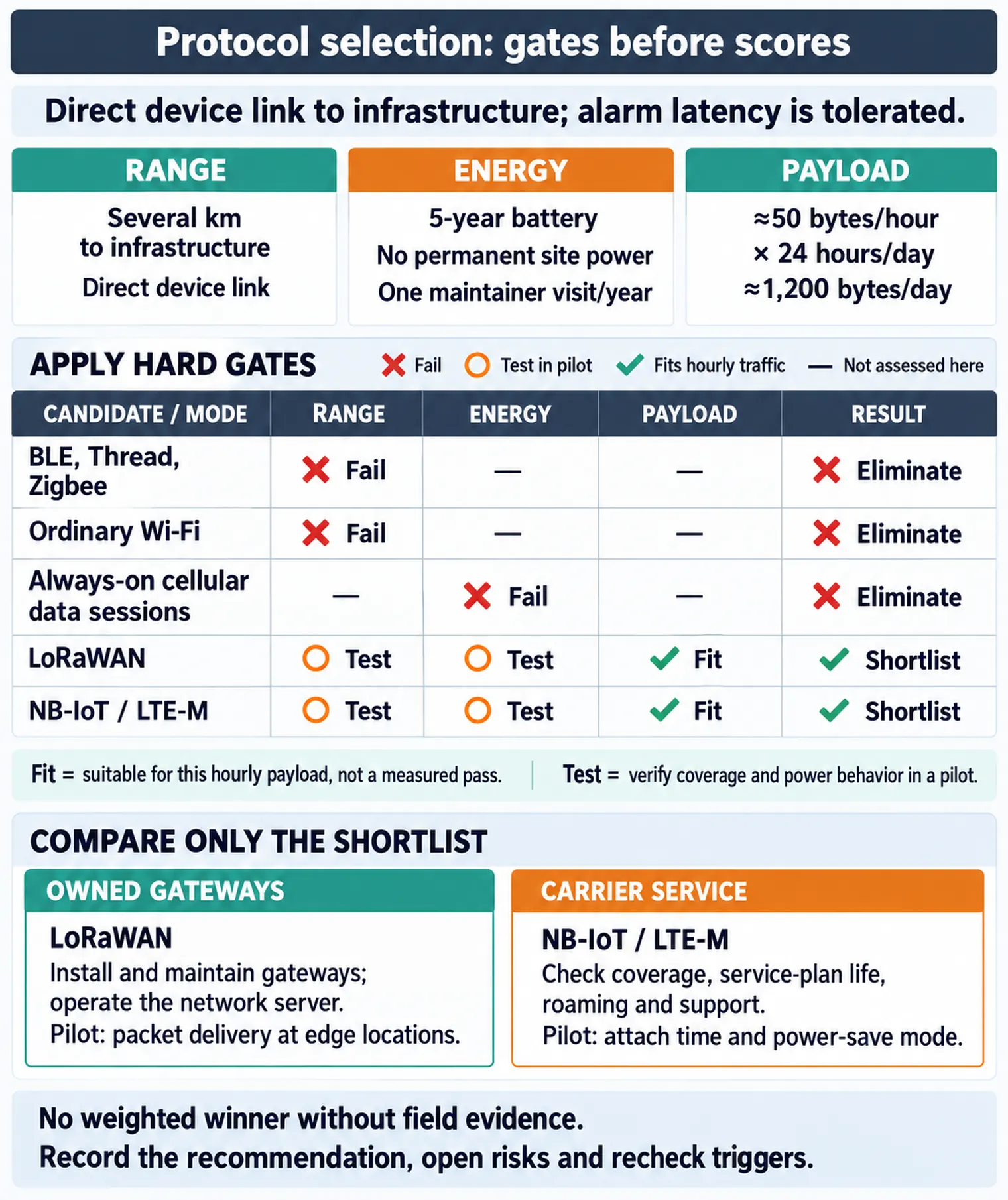
Because no protocol wins on every axis, the reliable way to choose one is to work backward from requirements rather than forward from a favorite technology. A protocol choice is a claim about a bounded communication problem: which device class, which link, which site conditions, which owner, which payload, which failure mode, and which operating life. When those boundaries are explicit, BLE, Thread, Zigbee, Wi-Fi, LoRaWAN, NB-IoT, LTE-M, MQTT, CoAP, and AMQP stop looking like a ranked list and start looking like tools for different jobs.
This overview separates the radio or device link from the network path and from application messaging. A wearable may use BLE to reach a phone, HTTPS or MQTT from the phone to a cloud API, and a different provisioning flow for updates. A building sensor may use Thread or Zigbee for a local mesh and MQTT between the gateway and broker. A remote meter may use LoRaWAN through an owned gateway fleet or NB-IoT through a carrier network. None of those answers is meaningful until the deployment boundary and evidence are stated.
The method in one line is: state the bounded link, collect evidence, mark hard constraints, shortlist only viable protocols, validate weak assumptions, and record the decision.
33.17.1 Convert Requirements Into Gates
In practice, the selection meeting should begin with a short evidence worksheet, not with a protocol table. Capture the device class, physical location, expected movement, ownership boundary, payload size, reporting cadence, maximum acceptable data age, battery or power source, installation constraints, security boundary, provisioning method, monitoring owner, and replacement plan. Then convert the facts into gates. Gates are pass/fail constraints; comparison scores are used only after a candidate survives the gates.
| Requirement | Question | What it constrains |
|---|---|---|
| Range | Metres or kilometres? | Kilometres rule out BLE and ordinary Wi-Fi for the direct device link, pointing toward LPWAN or cellular |
| Payload and frequency | Bytes per hour or Mbit/s? | Large or frequent payloads rule out LoRaWAN and NB-IoT |
| Battery life | Mains power or years on a cell? | Multi-year battery life rules out high-duty Wi-Fi and always-on radios |
| Latency | Real time or tolerant? | Real-time control rules out duty-cycled LPWAN downlink |
| Scale and mobility | How many devices, and do they move? | National roaming favors cellular; dense indoor node counts may favor mesh |
Consider a device that needs a 5-year battery, sends about 50 bytes once an hour, sits several kilometres from infrastructure, has no permanent site power at the node, tolerates alarm latency, and can be visited by a maintainer only once per year. Multi-kilometre range eliminates BLE, Thread, Zigbee, and ordinary Wi-Fi for the direct device link. The 5-year battery eliminates always-on cellular data sessions and high-duty radios. The tiny hourly payload makes LPWAN’s low data rate acceptable. What survives is an LPWAN lane: LoRaWAN if the team can install, monitor, and maintain gateways and a network server, or NB-IoT/LTE-M if carrier coverage, service-plan life, roaming, and support are acceptable.
The practitioner move is to preserve why alternatives were rejected. A good note says “Wi-Fi rejected because measured current trace and credential operations miss the maintenance target,” not just “Wi-Fi was worse.” It says “LoRaWAN finalist depends on owned gateway uptime and duty-cycle limits,” or “NB-IoT finalist depends on carrier coverage trace and subscription life.” That wording gives reviewers something to test and prevents a later team from reviving an eliminated candidate without addressing the evidence that eliminated it.
Use pilot tests for the weakest assumptions. For LoRaWAN, that may be a packet-delivery and SNR trace at edge locations with the intended spreading-factor policy. For NB-IoT or LTE-M, it may be attach time, coverage, power-save mode behavior, and provider support. For Wi-Fi, it may be reconnect behavior, access-point roaming, credential rotation, and current draw during association. For Thread or Zigbee, it may be router density, commissioning, channel coexistence, and behavior after a powered router disappears.
33.17.2 Binding Constraint And Total Cost
A good selection recognizes that one requirement is usually the binding constraint: the demand that eliminates the most options or creates the largest operating risk. If 5-year battery life is non-negotiable, resolve the power axis before arguing about dashboard integrations. If the device must roam nationally, resolve carrier coverage, SIM/eSIM operations, and support ownership before optimizing protocol elegance. If the payload is video or frequent firmware images, resolve throughput and power source before comparing low-power radios. Leading with the binding constraint prevents a team from falling for a protocol that is excellent on a dimension the deployment does not actually need.
Total cost of ownership is part of that constraint analysis. LoRaWAN may avoid per-device carrier subscriptions, but someone must place gateways, maintain backhaul, monitor packet loss, handle network-server upgrades, protect keys, and manage duty-cycle expectations. NB-IoT or LTE-M may remove gateway operations, but the fleet inherits carrier coverage, contract, module-certification, roaming, service-plan, and support risks. Wi-Fi may reuse building infrastructure, but access-point ownership, credential rotation, captive portals, and power draw become operating assumptions. BLE may be cheap and low power, but it often depends on a nearby phone, gateway, or commissioning workflow.
After hard gates, a weighted score can help compare finalists, but the weight choices must be documented. A high ecosystem score cannot rescue a radio that fails measured coverage. A low module price cannot rescue a design that requires truck rolls every few months. A vendor roadmap cannot replace a field trace. Under the hood, the method is controlling decision risk: it records the assumptions that would invalidate the recommendation and assigns recheck triggers such as payload growth, firmware-update changes, gateway relocation, carrier coverage change, new security boundary, or support-owner change.
Two LPWANs can both satisfy technical filters for a metering project. LoRaWAN has no carrier subscription, but requires deploying gateways across the city, choosing antenna sites, maintaining backhaul, and operating the network server. NB-IoT has no gateway fleet to build, but charges per device and depends on carrier coverage and support. Over a ten-year fleet life, the decision hinges on operations, contract risk, maintenance access, and revalidation triggers, not just the radio spec. The correct record says which risk the organization is prepared to own.
33.18 Summary
This section: Summary — This overview is the map for the protocol-selection series.
This overview is the map for the protocol-selection series. The core habit is simple: define the boundary, gather evidence, eliminate impossible candidates, compare viable finalists, validate weak assumptions, and record the decision. The detailed chapters show why the trade-offs exist, how to apply the workflow, how to practice it in scenarios, and how to avoid common mistakes.
33.19 What’s Next
This section: What’s Next — Continue with the challenge chapter to establish the competing constraints and layer boundaries.
Continue with the challenge chapter to establish the competing constraints and layer boundaries. Learners who can already rank hard constraints and distinguish link, network, transport, and application layers may move directly to systematic selection with a bounded deployment question.
Learn why range, energy, payload, latency, security, scalability, and operations compete.
After you can rank hard constraints and distinguish protocol layers, use an evidence-led workflow to eliminate, compare, validate, and record a protocol choice.
Practice the workflow across fixed sensors, body-to-phone sensing, mobile assets, and building retrofits.
Review the shortcuts that cause protocol decisions to drift away from evidence.
33.20 Key Takeaway
This section: Key Takeaway — Protocol selection is a constraints matrix, not a brand choice.
Protocol selection is a constraints matrix, not a brand choice. State the application requirements, score candidate protocols, and document why the chosen tradeoffs are acceptable.
Find help
3 reviewed answers.
Where should I start in a module?
Open the module page from the sidebar to see its chapters in order. Use the module map to return to a topic you need.
Modules and pathsReviewed
What can I try when a project does not work?
Check the symptom, then work through the diagnostic steps. Keep the error message and the smallest example that reproduces it.
When you are stuckReviewed
How do interactive examples work?
Use the interactive guide to check how examples and simulations work before changing your project.
Interactive examples guideReviewed