37 Protocol Anti-Patterns

More
Depth: Practitioner
Progress saves as you read. Mark sections complete as you go; your progress appears in the sidebar.
37.1 In 60 Seconds
This section: In 60 Seconds — Picture a team choosing a radio for a coin-cell tracker.
Make the Attractive Claim Earn Its Place
Picture a team choosing a radio for a coin-cell tracker. One person knows the product well, another points to a long range figure, and the buyer likes its low unit price. None of those facts yet proves that the tracker will report from a metal store room for three years.
Write the hard needs before naming a favourite. Record the real place, useful data size, send pace, response deadline, stored energy, install count, support owner, and recovery need. Mark each need as a firm limit or a preference. Reject any choice that misses a firm limit before scoring the rest.
Test final hardware at final sites with nearby traffic, low energy, lost links, restarts, and staff handover. Measure useful delivery, retries, current, and recovery time. A coverage map or peak figure is only a lead for the test.
Keep the choice easy to reopen. Store the rejected options, weak facts, fallback, and change that forces a new review. Familiarity can cut learning time, but it cannot erase a mismatch.
This opening does not name one best choice for every site. Practitioner builds the comparison and pilot. Under the Hood examines the competing limits and why a true headline can still support the wrong decision.
Protocol anti-patterns happen when a team chooses from habit, marketing, or one impressive number before it lists the real deployment requirements. The safer pattern is to name the constraints, demand evidence for risky claims, pilot before rollout, and keep uncertain choices reversible.
37.2 Start With the Story
This section: Start With the Story — You will spot protocol choices based on familiarity or weak evidence and replace them with checks against deployment requirements.
You will spot protocol choices based on familiarity or weak evidence and replace them with checks against deployment requirements. Start with the claimed range, bandwidth, or coverage and ask how it was verified.
Watch a reasonable-sounding shortcut unravel across four beats when the team tests it against the deployment.
-

Packet Pete: “This familiar option sounds reasonable enough.”
-

Test Tessa: “The map and the slogan have not tested this site.”
-

Bex: “Replace familiarity and broad claims with hard-constraint evidence.”
-

The team: “Accept only what the deployment evidence supports.”
37.3 When a Reasonable-Sounding Choice Is the Wrong One
This section: When a Reasonable-Sounding Choice Is the Wrong One — An anti-pattern is a choice that feels reasonable and is common, yet predictably leads to rework.
An anti-pattern is a choice that feels reasonable and is common, yet predictably leads to rework. In protocol selection, almost every anti-pattern shares one root: the protocol was chosen from familiarity, marketing, or a single impressive number, instead of from the deployment's actual requirements.
A protocol is not "good" or "bad" in the abstract. It is a fit or a mismatch for a specific set of constraints: range, data rate, power, node count, environment, region, and ecosystem. The anti-pattern is skipping those requirements and reasoning from one attractive attribute.
If you only need the intuition, this layer is enough: protocol anti-patterns come from deciding on familiarity or a single spec number instead of the full requirement set, and the cure is to list the requirements first and demand real evidence for each candidate.
Picture buying a vehicle by top speed alone, then finding it cannot carry the load, fit the garage, or afford the fuel. The number was real; it was the wrong number to decide on.
A realistic IoT anti-pattern often starts with a true statement that is used outside its boundary. LoRaWAN can be a strong fit for sparse battery sensors, but that does not make it suitable for dense low-latency control. Wi-Fi can move more data, but that does not make it the default for a coin-cell device. Cellular coverage may exist in the area, but that does not prove signal inside a metal cabinet. The mistake is letting one true claim replace the full requirement match.
A safer review turns the attractive claim into a test row. A BLE body sensor needs current traces, reconnect timing, and phone OS behavior, not just "low energy." A LoRaWAN parking sensor needs gateway placement, duty-cycle limits, downlink needs, and enclosure tests, not just "long range." An NB-IoT or LTE-M tracker needs route coverage, power-save behavior, SIM operations, and fallback rules, not just "carrier network." A Thread or Zigbee retrofit needs router density, channel planning, border-router ownership, and floor-by-floor measurements, not just "mesh."
Follow one illustrative parking-sensor pilot through Figure 37.1. The tempting claim is that LoRaWAN’s long range makes one gateway enough for 120 sealed sensors on two concrete basement levels. The loop makes the claim testable: Define constraints creates four release conditions, while Measure payload and power records the real wake, join, transmit, receive, and sleep exchange against the five-year battery requirement.
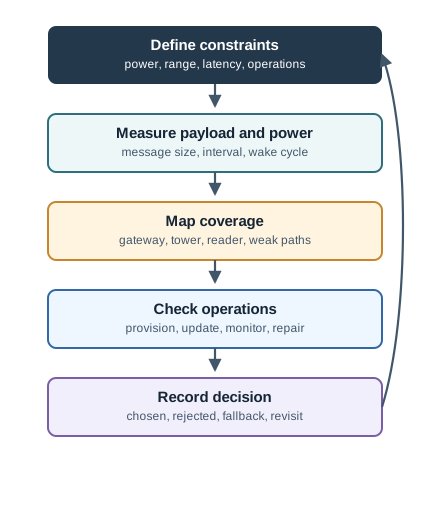
Read Figure 37.1 as claim → test → result → record. In Map coverage, the red one-gateway bar stops at 113 of 120 final locations and exposes seven concrete shadows; the green comparison adds a second gateway and reaches all 120 with at least 10 dB measured margin. Check operations adds 20/20 forced rejoins, 14-second p95 delivery, sub-five-minute outage alerting, and named service ownership. Record decision then keeps what was chosen, what was rejected, and the changes that send the team back to Define constraints. These numbers describe the worked site, not a universal LoRaWAN guarantee.
The Headline Anti-Patterns
Use what we know
Choosing the team's usual protocol regardless of whether it fits this deployment.
Trust the spec number
Treating a best-case range or peak data rate as what you will actually get.
Ignore the ecosystem
Picking a protocol with thin tooling, few vendors, or an unstable specification.
Figure 37.2 maps each attractive shortcut to the evidence it suppresses. Read Familiarity first and Range stretch as two different ways to decide too early: the first skips the battery trace, while the second skips the concrete site’s gateway geometry.

In Figure 37.2, Bandwidth guess replaces a peak-rate comparison with a 120-node delivery test against the 60-second requirement. Coverage trust treats a provider map as a hypothesis and tests the enclosure at every install point. Novelty bet demands interoperable tools, updates, recovery, and support ownership before hardware lock-in. The closing Correct with evidence band shows that every shortcut returns to the same full requirement match.
Beginner Examples
- A protocol that worked for a short-range product is reused for a long-range one without checking the range.
- A high-speed radio is chosen for a job that mostly needs reliable, low-power short messages.
- A new protocol is adopted because it is exciting, but few tools or vendors support it yet.
Anti-Pattern Root Cause Knowledge Check
If this gives you the warning signs, you can stop here. Continue to Practitioner for the evidence that exposes each anti-pattern.
37.4 Apply It: Catch Each Anti-Pattern With Evidence
This section: Apply It: Catch Each Anti-Pattern With Evidence — The practical job is to recognize each anti-pattern, name the evidence that would expose it, and apply a safer corrective move.
The practical job is to recognize each anti-pattern, name the evidence that would expose it, and apply a safer corrective move. The unifying habit is to derive requirements first and replace claims with measurements where it matters.
The Anti-Pattern Catalog
Figure 37.3 shows what “with evidence” means in the same pilot. Each row retains the original claim, the named test, its result, and the way that result changes the decision; a green result without those four fields is not evidence.

Read Figure 37.3 across Power, Payload, Coverage, and Operations. The battery model includes reserve, the payload test reports delivered event timing rather than headline rate, the site survey forces a second gateway, and recovery tests force an owned runbook. The Decision record then carries the chosen LoRaWAN architecture, the rejected Wi-Fi battery fit and one-gateway claim, the NB-IoT fallback, and the two measurable revisit triggers.
Walkthrough: A Requirements-First Evaluation
- Write the requirements. Range, data per message and per second, latency, power and battery life, node count and topology, mobility, environment, regulatory region, ecosystem maturity, and cost.
- List candidates by class, not brand. Avoid anchoring on a familiar name before the requirements are set.
- Score each candidate against every requirement, with evidence. Replace claims with measurements where it matters: field range, measured goodput, on-site coverage.
- Flag the anti-patterns. Ask explicitly whether any choice is driven by familiarity, a single number, or hype.
- Pilot before committing when uncertain. A small real-world trial exposes mismatches before they become fleet-wide rework.
- Prefer reversible decisions under uncertainty. When requirements or ecosystem are unsettled, favor choices that are cheaper to change later.
Incremental Practice
Beginner
For a long-range, low-data sensor, name the requirement a high-speed protocol would fail to justify itself against.
Intermediate
A vendor advertises a peak data rate; describe the test that reveals your usable throughput.
Advanced
Build a requirements-versus-candidate scoring table and mark which cells need measured evidence rather than datasheet claims.
Coverage Evidence Knowledge Check
If your job is to vet a protocol choice, you can stop here. Continue to Under the Hood for why each mismatch bites and what it costs.
37.5 Under the Hood: Why Each Mismatch Bites
This section: Under the Hood: Why Each Mismatch Bites — The deeper layer explains the mechanism behind each anti-pattern, because knowing why a number misleads is what makes the corrective move convincing.
The deeper layer explains the mechanism behind each anti-pattern, because knowing why a number misleads is what makes the corrective move convincing.
Peak Versus Sustained Throughput
An advertised data rate is a best-case figure for a single link, at short distance, with low overhead. Usable goodput is lower once you account for protocol headers and acknowledgements, retransmissions on a real channel, duty-cycle or regulatory limits on how often you may transmit, contention when many nodes share the medium, and the rate reduction radios apply at longer distances. Planning from the peak overcommits the link.
Best-Case Versus Real Range
A rated range assumes line of sight, an ideal antenna, and no obstacles, which is optimistic indoors. Real range depends on path loss, obstacles, fading, and interference, so it must be measured on site rather than read from a datasheet.
Coverage Map Versus On-Site Reality
Wide-area coverage maps are modeled or aggregated and cannot capture a specific basement, a metal enclosure, or a rural edge. Coverage is location-specific, and only an on-site test settles whether a given install point has a usable signal.
Spec Maturity Versus Interoperability
A young protocol may have an unstable specification, few interoperable implementations, thin tooling, and uncertain long-term support. These are real project risks even when the radio performance looks excellent, and an immature ecosystem can cost more than a modest technical shortfall.
The Cost of Late Discovery
Reversibility and Lock-In
Some choices are easy to change, such as a software protocol parameter, while others are hard, such as a radio chip, a certified module, or a provider contract. Under uncertainty, a reversible choice is worth a modest performance cost because it preserves the option to correct course without replacing hardware.
Common Pitfalls
- Deciding before the requirements exist. Later evaluation can rationalize the first choice instead of testing it.
- Treating one impressive number as the decision. Range, throughput, and power must all be satisfied together.
- Accepting claims where measurements are cheap. Field range, goodput, and on-site coverage are testable.
- Underweighting ecosystem maturity. Tooling, interoperability, and longevity are requirements, not afterthoughts.
- Making an irreversible choice under uncertainty. Lock-in turns a wrong guess into expensive rework.
Throughput Reality Knowledge Check
At this depth, every protocol anti-pattern is a requirement mismatch hidden by an attractive number. The defense is the same each time: establish the full requirement set, demand real evidence for the claims that matter, and keep the costly decisions reversible until the evidence is in.
37.6 Summary
This section: Summary
- A protocol anti-pattern is a common, reasonable-sounding choice that predictably leads to rework, usually rooted in deciding from familiarity, marketing, or one spec number.
- A protocol is a fit or a mismatch for a specific requirement set, not good or bad in the abstract.
- The headline anti-patterns are familiarity-driven choice, range overconfidence, peak-throughput assumption, coverage-map overconfidence, and immature-ecosystem risk.
- The cure is to derive the full requirement set first, then score candidates against all of it with real evidence.
- Field range tests, measured sustained goodput, and on-site coverage tests replace optimistic claims where it matters most.
- Mismatches get far more expensive the later they are found, so pilot under uncertainty and prefer reversible, low-lock-in choices.
37.7 Key Takeaway
This section: Key Takeaway — Choose a protocol by matching the full requirement set with measured evidence rather than a single attractive number or habit, and when uncertain, pilot first and prefer the choice that is cheapest to reverse.
Choose a protocol by matching the full requirement set with measured evidence rather than a single attractive number or habit, and when uncertain, pilot first and prefer the choice that is cheapest to reverse.
37.8 See Also
This section: See Also
Systematic Protocol Selection
The requirements-first method these anti-patterns violate.
Protocol Selection Scenarios
Worked deployment scenarios that apply the trade-offs in practice.
Protocol Selection Framework
The overview that ties requirements, scenarios, and anti-patterns together.
Find help
3 reviewed answers.
Where should I start in a module?
Open the module page from the sidebar to see its chapters in order. Use the module map to return to a topic you need.
Modules and pathsReviewed
What can I try when a project does not work?
Check the symptom, then work through the diagnostic steps. Keep the error message and the smallest example that reproduces it.
When you are stuckReviewed
How do interactive examples work?
Use the interactive guide to check how examples and simulations work before changing your project.
Interactive examples guideReviewed