34 Why Protocol Choice Is Hard
More
Depth: Practitioner
Progress saves as you read. Mark sections complete as you go; your progress appears in the sidebar.
34.1 In 60 Seconds
This section: In 60 Seconds — Picture a farm sensor that must last through winter and report a burst pipe quickly.
Eliminate Choices With Evidence, Not Habit
Picture a farm sensor that must last through winter and report a burst pipe quickly. One familiar network reaches the shed but drains the battery. Another saves energy but cannot meet the warning time. No single option wins every need.
A protocol is an agreed set of message and timing rules. A gateway is a device that joins one network to another. Latency means the time from sending to a useful result. Write the hard limits for range, energy, message size, warning time, safety, and upkeep before naming a favourite.
Build a short list, then change one condition at a time. Add a wall, lose the gateway link, increase message size, delay a reply, and restart a device. Record which option fails each limit, what evidence supports the rejection, and what extra service or field work a surviving choice requires.
This first screen cannot predict every site condition or future version. It only makes the current trade clear. The deeper sections separate the radio, network, transport, and application duties so the final choice is a stack of bounded decisions rather than one product label.
IoT protocol selection is difficult because the strongest requirements usually compete. A radio that reaches farther often sends less data or needs more energy. A high-throughput link may need mains power or short range. A protocol that looks simple at the device may require gateway, service, update, and monitoring work. Start with hard constraints, separate protocol layers, and keep evidence for every eliminated option.
34.2 Start With the Story
This section: Start With the Story — You will explain competing protocol constraints and build a shortlist that excludes choices your deployment cannot support.
You will explain competing protocol constraints and build a shortlist that excludes choices your deployment cannot support. Start by separating hard limits from preferences and identifying which network layer each candidate serves.
Follow the difficult choice across four beats to see why familiarity cannot replace deployment evidence.
-

Packet Pete: “We already know this radio. Why not begin with it?”
-

Bex: “Small messages do not make these four deployments the same problem.”
-

The team: “Eliminate every failed hard constraint before scoring the survivors.”
-

Test Tessa: “The field record supports this deployment choice, not a universal winner.”
Read the story panels from the familiar radio to the bounded field result. The opening preference becomes unreliable once parking, wearable, logistics, and building deployments reveal conflicting range, power, timing, security, and operational constraints. Hard-stop gates remove candidates that cannot satisfy the deployment. Measurements then validate the surviving choice at the real site, making the conclusion defensible for that context without claiming a universally best protocol.
The mathematical gist. Antenna gain adds directly to the link budget, while free-space loss grows as . For this chapter’s 14 dBm, 868 MHz LoRaWAN example with −130 dBm sensitivity, 0 dBi gateway gain permits 144 dB of free-space loss or about 435 km; 6 dBi permits 150 dB or about 869 km. The factor is , so 6 dB nearly doubles the free-space ceiling without promising real-world coverage.

34.3 Protocol Selection: The Challenge
This section: Protocol Selection: The Challenge — Protocol selection is not a popularity contest.
Protocol selection is not a popularity contest. It is a constraint-ranking problem. The hard part is that an IoT deployment asks for several things at once:
- reach the device;
- fit the energy source;
- carry the payload at the required freshness;
- respond within the latency budget;
- scale to the device count;
- protect the data and control path;
- interoperate with the rest of the stack;
- remain operable after installation.
No single protocol wins every dimension. The goal is to identify which constraint is non-negotiable, then find the smallest set of protocol candidates that can survive it.
34.4 Learning Objectives
This section: Learning Objectives
By the end of this chapter, you will be able to:
- Explain why range, energy, throughput, latency, coverage, security, scalability, interoperability, and operations compete.
- Rank hard constraints before comparing protocol names.
- Separate physical/link choices from network, transport, and application-layer choices.
- Avoid layer-confusion questions such as “MQTT or Wi-Fi?”
- Use a first-pass shortlist before doing weighted scoring or detailed lifecycle-cost work.
- Record what evidence is still missing before a protocol can be selected.
Quick Check: Challenge Reasoning
Protocol selection starts with the dominant constraint. A camera, a wearable, a buried meter, an indoor light switch, and a mobile asset do not belong to the same connectivity class because their payload, range, power source, latency, and operations assumptions differ.
34.5 Why This Is Hard
This section: Why This Is Hard — The challenge is not that the protocol landscape is random.
Most failed protocol decisions begin with one of three shortcuts:
- choosing a familiar protocol before checking power and coverage;
- comparing protocol names that operate at different layers;
- optimizing one dimension while ignoring the deployment system around it.
The challenge is not that the protocol landscape is random. The challenge is that every reasonable option is optimized for a different job.
The map in Figure 34.1 ranks link needs; check reach, power, speed, delay, safety, and upkeep.
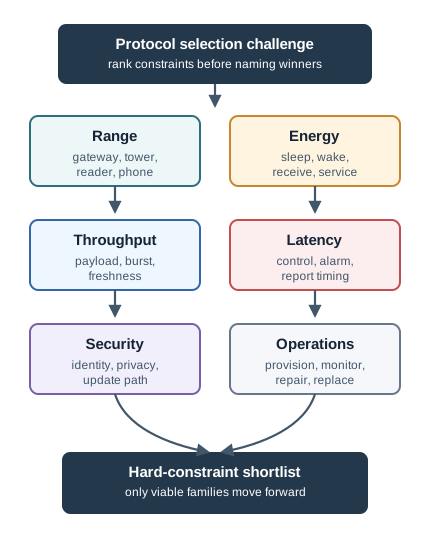
Read Figure 34.1 from range and energy down through throughput, latency, security, and operations. The paired boxes expose different questions, from reaching infrastructure to maintaining devices after installation. Only candidates that satisfy the hard constraints reach the shortlist at the bottom, before any preference scoring begins.
34.6 Selection Dimensions
This section: Selection Dimensions — Use these dimensions as a review checklist before naming a winner.
Use these dimensions as a review checklist before naming a winner.
34.7 The Constraint Triangle
This section: The Constraint Triangle — The common teaching shortcut is a triangle: range, energy, and throughput cannot all be optimized at once.
The common teaching shortcut is a triangle: range, energy, and throughput cannot all be optimized at once. The triangle is useful, but it should not be treated as a magic formula.
34.7.1 High Throughput
Useful for images, audio, firmware transfer, dense local backhaul, dashboards, and user-facing interactions. The trade-off is usually higher active energy, shorter practical range, or stronger infrastructure requirements.
34.7.2 Long Reach
Useful for sparse outdoor sensing, utility metering, agriculture, remote assets, and hard-to-wire sites. The trade-off is usually lower payload rate, stricter duty behavior, delayed downlink, or site-specific coverage validation.
34.7.3 Low Energy
Useful for devices that sleep most of the time and are expensive to service. The trade-off is usually smaller payloads, limited receive windows, less frequent reporting, or gateway/topology planning.
The safest reading is: the dominant constraint chooses the first candidate family. Secondary constraints then decide which member of that family survives.
Turn the triangle into measurements before it becomes a debate. A LoRaWAN field sensor needs received-signal margin, duty-cycle, downlink, and battery-life evidence for the real site. A BLE wearable needs phone-reconnect behavior, advertising interval, current trace, and privacy evidence. A Wi-Fi camera needs airtime, roaming, firmware-update, and mains-power assumptions. A Thread or Zigbee control network needs router density, commissioning success, route repair, channel planning, and local-failure behavior. The challenge answer is stronger when it names the test that would eliminate each tempting family.
34.8 Layer Boundaries
This section: Layer Boundaries — Many protocol arguments are actually layer mistakes.
Many protocol arguments are actually layer mistakes. MQTT, CoAP, HTTP, Wi-Fi, BLE, LoRaWAN, IPv6, TCP, and UDP are not all alternatives to each other.
Inspect Figure 34.2 and look for the distinct job each boundary performs before a message reaches the medium.
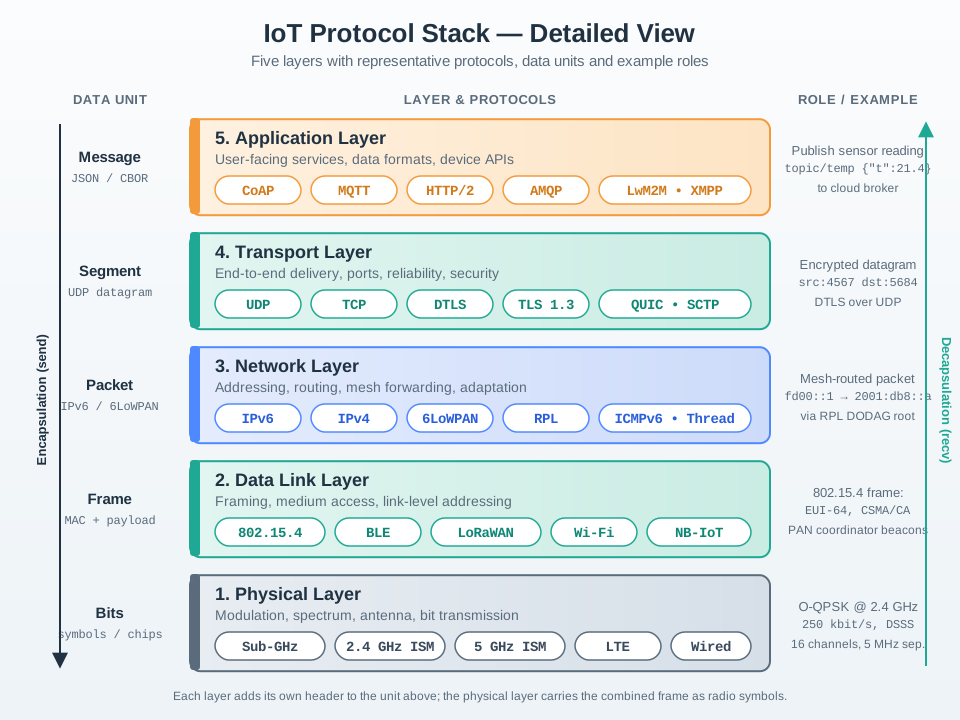
Descend Figure 34.2 from application meaning to physical transmission. CoAP, MQTT, HTTP, or AMQP define what the message means. UDP, TCP, DTLS, TLS, or QUIC carry it with particular ports, ordering, acknowledgement, and protection behavior. IPv6 and 6LoWPAN supply addressing, routing, compression, and fragmentation across services and constrained links. Wi-Fi, Ethernet, or IEEE 802.15.4 share one local medium through frame and retry rules, while the physical layer moves bits over a band or wire. This order supports the framework challenge: protocol selection is a set of compatible boundary contracts, so a familiar application protocol cannot repair an unsuitable route, frame budget, or radio path.
34.8.1 Layer Review
34.8.2 Physical And Link
Examples: Ethernet, Wi-Fi, BLE, IEEE 802.15.4, LoRa radio, cellular radio.
This layer answers how bits reach the next hop.
34.8.3 Network And Adaptation
Examples: IPv4, IPv6, 6LoWPAN, RPL, LoRaWAN network behavior.
This layer answers how packets are addressed, adapted, or routed.
34.8.4 Transport
Examples: TCP, UDP, QUIC, DTLS context.
This layer answers how endpoints exchange streams, datagrams, sessions, or protected transport.
34.8.5 Application
Examples: MQTT, CoAP, HTTP, AMQP, custom payload contracts.
This layer answers how application data is named, encoded, requested, published, or acknowledged.
“Should we use MQTT or Wi-Fi?” compares an application protocol with a link-layer technology. A complete stack might use both: Wi-Fi for local connectivity, IP and TCP for transport, and MQTT for application messaging.
34.9 First-Pass Shortlisting
This section: First-Pass Shortlisting — A first-pass shortlist is not the final decision.
A first-pass shortlist is not the final decision. It prevents impossible options from wasting design time.
The list in Figure 34.3 starts with the link job; drop choices that fail a hard limit.
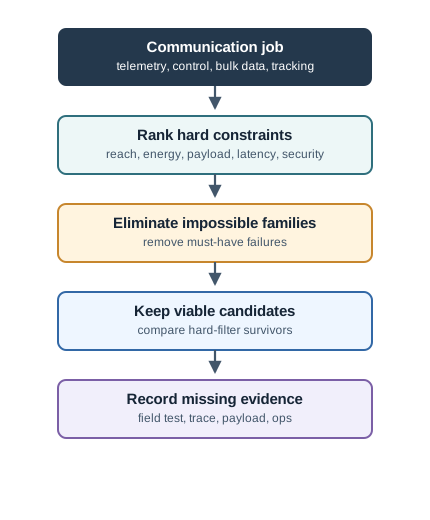
The route in Figure 34.3 cuts poor link choices first; keep proof for each one left.
Use this sequence:
- Define the communication job. Is it telemetry, control, configuration, bulk transfer, discovery, local automation, tracking, or backhaul?
- Rank hard constraints. Identify what must not fail: power source, reach, latency, payload, security boundary, mobility, or operations.
- Eliminate impossible families. Remove options that cannot satisfy the hard constraint without redesigning the system.
- Keep a shortlist. Compare only the candidates that remain viable.
- Record missing evidence. Note field tests, current traces, payload measurements, standards profiles, or operations checks still required.
34.10 Example Challenge Reviews
This section: Example Challenge Reviews — These examples show the shape of the reasoning without pretending that one protocol is always correct.
These examples show the shape of the reasoning without pretending that one protocol is always correct.
34.10.1 Remote Telemetry
Dominant constraint: reach and energy.
Likely first-pass direction: LPWAN or cellular IoT candidates, depending on coverage evidence, payload freshness, operations, and ownership model.
Do not decide from: nominal maximum data rate alone.
34.10.2 Local Control
Dominant constraint: latency, reliability, and local coverage. Evaluate whether control messages reach a useful result within the required delay, including when local equipment fails.
Likely first-pass direction: local star or mesh candidates, depending on power source, room geometry, gateway placement, and maintenance access. For mesh candidates, check router availability, commissioning, and route repair because topology and power assumptions affect whether local coverage remains usable.
Do not decide from: radio module price alone. Gateway installation, monitoring, replacement, and field service also shape the deployment decision. Keep candidates provisional until site measurements support the timing and coverage requirements.
34.10.3 High-Data Device
Dominant constraint: throughput and user experience. Required payload delivery must be checked alongside delay and energy use; a headline data rate alone does not establish application performance.
Likely first-pass direction: Wi-Fi, Ethernet, or cellular broadband candidates, depending on power source, mobility, coverage, and backhaul. Higher throughput may require stronger infrastructure or more active energy, so compare candidates against the complete communication path and realistic workloads.
Do not decide from: sensor-node energy assumptions. Devices carrying images, audio, or firmware transfers have different communication demands from sparse telemetry. Record measured payload, coverage, and power evidence before treating the shortlist as a selection.
34.10.4 Moving Asset
Dominant constraint: coverage across changing locations. Evaluate reach along the intended routes together with acceptable reporting delay, because coverage evidence must match where communication is needed.
Likely first-pass direction: carrier, gateway, or hybrid designs depending on routes, handoff, dead zones, and reporting criticality. Compare these options against power, infrastructure ownership, recurring fees, and maintenance requirements as well as coverage.
Do not decide from: one static site test. Test changing locations and connectivity loss, then record which hard constraints each candidate satisfies or fails. Keep missing route and handoff evidence visible so reviewers can distinguish a provisional shortlist from a supported deployment decision.
34.11 Common Pitfalls
This section: Common Pitfalls
If requirements demand long reach, high throughput, tiny energy use, low latency, low cost, and no infrastructure, the problem is under-ranked. The correct next step is constraint negotiation, not protocol shopping.
“LoRaWAN or MQTT” and “Wi-Fi or CoAP” are layer mistakes. First identify the connectivity layer, then complete network, transport, security, and application decisions around it.
The radio part is not the deployment. Gateways, subscriptions, antenna work, commissioning, monitoring, replacement, and field service can dominate the real decision.
Advertised range, data rate, and power numbers are starting points. Real sites need antenna placement, interference, payload, retries, receive behavior, and operations evidence.
34.12 Knowledge Check
This section: Knowledge Check
Knowledge Check: Dominant Constraint
Knowledge Check: Protocol Layers
Matching Check
Ordering Check
34.13 Place Each Candidate In Trade-Off Space
This section: Place Each Candidate In Trade-Off Space — Protocol choice is hard because the things teams usually want, long range, high data rate, and low power, pull against one another.
Protocol choice is hard because the things teams usually want, long range, high data rate, and low power, pull against one another. Radio physics ties them together: reaching farther for a given power usually means spending airtime on fewer bits through narrower bandwidth, lower coding rate, spreading, or more conservative modulation. Pushing many bits per second usually needs wider bandwidth, cleaner signal conditions, shorter practical range, stronger infrastructure, or more energy.
So every IoT radio is a point in a trade-off space. The honest question is not “which protocol is best?” but “which compromise fits this job?” A battery soil sensor that reports moisture every 30 minutes can tolerate tiny payloads and seconds of delay, so LoRaWAN or NB-IoT may be reasonable after coverage checks. A machine-vision camera on the same farm needs steady megabits per second and mains power, so Wi-Fi or Ethernet is more realistic. Same site, different communication job, different shortlist.
| Technology | Typical reach class | Typical data-rate class | Power posture |
|---|---|---|---|
| BLE | Room to nearby-phone range | About 1-2 Mbit/s at the PHY, less at the application | Low when duty-cycled |
| Zigbee or IEEE 802.15.4 | Room/building range, often extended by mesh | 250 kbit/s PHY for 2.4 GHz 802.15.4 | Low with careful sleep and routing design |
| Wi-Fi | Local access-point range | Tens to hundreds of Mbit/s depending on generation and link quality | Higher active energy; often mains or rechargeable |
| LoRaWAN | Long-range LPWAN class | Small, infrequent payloads at low data rates | Very low for sparse uplinks |
| NB-IoT | Cellular wide-area class | Small telemetry payloads, operator and coverage dependent | Low power with cellular power-saving modes |
Use the table as a placement aid, not as a winner list. Want long reach and years on a battery? LoRaWAN may fit, but the accepted cost is low throughput and constrained downlink behavior. Want to move a firmware image quickly? Wi-Fi may fit, but the accepted cost is access-point planning and higher active energy. Want a dense building control network? Thread or Zigbee may fit, but the accepted cost is commissioning, router density, route repair, and channel planning.
34.14 Summary
This section: Summary — Protocol selection is difficult because useful requirements compete.
Protocol selection is difficult because useful requirements compete. The first task is not to choose the most familiar protocol; it is to rank hard constraints, understand which layer each technology belongs to, and remove options that cannot meet the deployment evidence. Once the shortlist is real, later chapters can compare candidates systematically.
34.15 See Also
This section: See Also
34.15.1 Protocol Selection Framework
34.15.2 Systematic Selection
34.15.3 Protocol Anti-Patterns
34.15.4 Selection Scenarios
34.15.5 Protocol Selector Wizard
34.15.6 Radio Basics
34.15.7 Path Loss and Link Budgets
34.15.8 Core Topology Shapes
34.15.9 Energy-Aware Design
34.16 What’s Next
This section: What’s Next
34.16.1 Apply A Process
Systematic Selection turns this challenge review into a repeatable elimination and scoring workflow.
34.16.2 Test Scenarios
Selection Scenarios applies the constraints to realistic deployment situations.
34.16.3 Avoid Mistakes
Protocol Anti-Patterns shows what happens when teams skip the constraint checks in this chapter.
34.16.4 Use the Selector
Protocol Selector Wizard provides the wider shortlist helper for review.
34.17 Key Takeaway
This section: Key Takeaway — A protocol recommendation should survive challenge.
A protocol recommendation should survive challenge. Defend it against latency, power, range, payload, reliability, security, cost, gateway, and lifecycle constraints.
Find help
3 reviewed answers.
Where should I start in a module?
Open the module page from the sidebar to see its chapters in order. Use the module map to return to a topic you need.
Modules and pathsReviewed
What can I try when a project does not work?
Check the symptom, then work through the diagnostic steps. Keep the error message and the smallest example that reproduces it.
When you are stuckReviewed
How do interactive examples work?
Use the interactive guide to check how examples and simulations work before changing your project.
Interactive examples guideReviewed