27 Sensor Dynamics and Response Time
More
Depth: Practitioner
Progress saves as you read. Mark sections complete as you go; your progress appears in the sidebar.
27.1 In 60 Seconds
This section: In 60 Seconds — Picture a pressure sensor that looks smooth but reports a short safety event too late.
Measure One Change Before Choosing the Sample Rate
Picture a pressure sensor that looks smooth but reports a short safety event too late. Sampling faster cannot recover motion that the sensor itself did not follow.
An analog-to-digital converter means the circuit that turns a measured voltage into a number; it is shortened to ADC. Bandwidth means the range of change rates a sensor or signal path can follow usefully.
Apply the same step several times and record the raw response before and after the ADC. Keep sensor identity, range, sample times, bandwidth estimate, rise time, final value, noise, and missed threshold time.
This test describes one sensor and setup, not every field condition. The deeper sections connect time constant, bandwidth, sampling, filtering, and a defensible measurement claim.
A sensor does not jump to a new value the instant the world changes. It eases toward the new value at a speed set by its own physics. That delay, called the sensor’s dynamic response, decides what a measurement can actually capture. Choosing a sample rate or a filter without knowing how fast the sensor itself can move is how teams end up sampling a slow curve very fast, or trusting a fast sensor reading that the sensor never truly reached.
27.2 Start With the Story
This section: Start With the Story — You will judge whether a sensor responds quickly enough for the events your system must detect.
You will judge whether a sensor responds quickly enough for the events your system must detect. Start with its response to a sudden change before choosing a sample rate.
Follow one physical step across four beats to see why sampling must respect the sensor’s own response time.
-

Physics Phoebe: “The environment changed now, but the sensor needs time to respond.”
-

Remi: “More fresh samples do not remove the sensor's physical lag.”
-

The team: “Match the sample plan to the response and keep the transient evidence.”
-

Remi: “Now the downstream reading carries the response limit with it.”
Read the story panels from the reference step to the verified response trace. The sensor rises after the environment changes, and dense samples in the second panel document that lag without removing it. A sampling plan based on the measured response then preserves the transient and its timing. The settled trace carries that response limit downstream, so later software can distinguish fresh timestamps from genuinely fast physical measurements.
27.3 Sensors Ease Toward the Truth
This section: Sensors Ease Toward the Truth — Drop a thermometer into a glass of cold water and it does not read the cold temperature immediately.
Drop a thermometer into a glass of cold water and it does not read the cold temperature immediately. It slides toward it over a few seconds, fast at first and then slowing as it gets close. That gradual approach is the sensor's response, and almost every physical sensor has one: thermal mass, chemical diffusion, mechanical inertia, or filtering all slow the reaction to a change.
The important idea is that the sensor, not only the converter, sets how fast you can measure. A reading taken before the sensor has settled is a snapshot of the sensor catching up, not of the world. Sampling faster cannot recover detail the sensor was too slow to follow.
If you only need the intuition, this layer is enough: every sensor has a response time. Match your sampling and filtering to how fast the sensor can actually move, not to an idealized signal. A fast sample rate on a slow sensor records the same slow curve in finer detail.
The single most useful number is the response time, often summarized by a time constant: a slow sensor takes seconds to follow a step, while a fast one takes milliseconds. Knowing it tells you whether the sensor can see the events you care about at all.
For example, a refrigerated cabinet may use an NTC thermistor inside a stainless probe. When the door opens, warm air reaches the probe first, but the probe body and potting compound slow the bead. The logger can sample every 100 ms and still show a rounded climb. The design question is not whether the ADC can collect more points; it is whether the thermal assembly can follow the shortest door-open event the product must alarm on.
Compare the abrupt input step with the rising sensor output in Figure 27.1. The marked time constants show how the reading gradually approaches the final value.
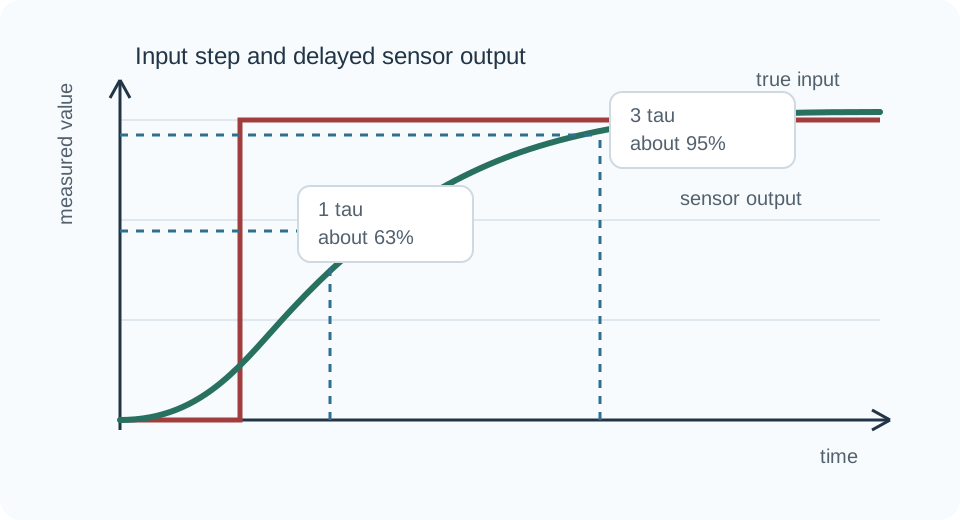
Follow the output curve in Figure 27.1 from one time constant at about 63 percent to three at about 95 percent. The input has already changed; extra samples only add points along the same delayed response.
The One-Minute View
Sensors lag change
A sudden input is followed gradually, not instantly. The lag is the sensor's physics, not a software bug.
The sensor sets the ceiling
The fastest event a sensor can report is limited by its response time, regardless of how fast you sample.
Match sampling to the sensor
Pick a sample rate and filter from the sensor's real response, so you neither miss events nor oversample a slow curve.
Beginner Examples
- A slow temperature probe averaged over seconds is ideal for room comfort but useless for catching a fast thermal spike.
- A fast pressure sensor can follow a sharp pulse, but only if the sampling keeps up with it.
- Reporting a temperature one second after a step change may report the sensor mid-climb, not the true temperature.
Sensor Response Knowledge Check
If this gives you the idea, you can stop here. Continue to Practitioner when you need to match sampling and filtering to a specific sensor.
The mathematical gist. A first-order sensor closes a fixed fraction of its remaining gap each second, so produces the exponential response . The same time constant sets its dB bandwidth, : for this chapter’s s thermistor that is Hz, and no faster ADC setting can restore a half-second spike that the probe’s physics has already smoothed away.

27.4 Apply It: Match Sampling to the Sensor
This section: Apply It: Match Sampling to the Sensor — The practical job is to compare how fast the sensor can move against how fast the thing you measure actually changes, then choose a sample rate and filter that respect both.
The practical job is to compare how fast the sensor can move against how fast the thing you measure actually changes, then choose a sample rate and filter that respect both. The sensor's datasheet response time is the starting evidence.
Walkthrough: From Response Time to Sample Plan
- Find the response time. Read the sensor's time constant or its time to reach 90 percent of a step from the datasheet or a bench test.
- Name the fastest real event. Decide the quickest change the application must capture, such as a thermal spike or a pressure pulse.
- Compare the two. If the event is faster than the sensor can follow, no sample rate will recover it; you need a faster sensor.
- Set the sample rate. If the sensor can follow the event, take several samples across the sensor's response so the curve is well described.
- Account for lag and drift. Record the response delay, any hysteresis, and expected drift so validation does not mistake them for real change.
Worked Example: A Two-Second Thermistor
For an illustrative thermistor with a 2-second time constant, a sudden step reaches about 95% of its final value after about 6 seconds. Sampling it 100 times per second does not measure temperature faster; it records the same slow climb in fine detail. If the process being measured spikes and falls within half a second, this sensor physically cannot report the peak, and the fix is a faster sensor, not a faster ADC.
The same time constant also sets the sensor's usable bandwidth. A slow sensor is, in effect, a low-pass filter on the world.
The bands in Figure 27.2 show what the sensor can follow; do not sample noise for no gain.
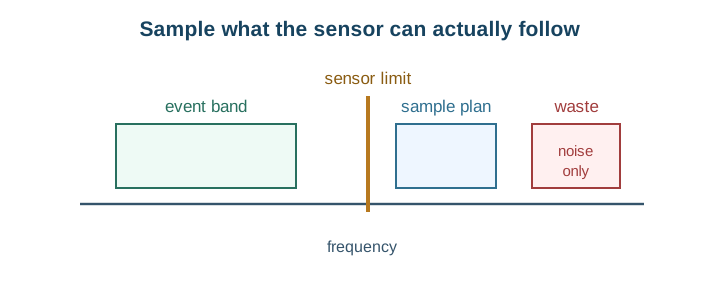
Read along the frequency axis in Figure 27.2, comparing the event band with the sensor limit. The region beyond useful coverage is marked as waste and noise; a faster sample plan cannot remove physical lag.
Dynamic Effects to Record
Inspect the worked review in Figure 27.3 as a challenge to Dynamic Effects to Record. Event fixes the deadline before Response test measures the sensor; Bandwidth choice and Filter budget then make every added delay visible before Validate repeats the test in the production assembly.
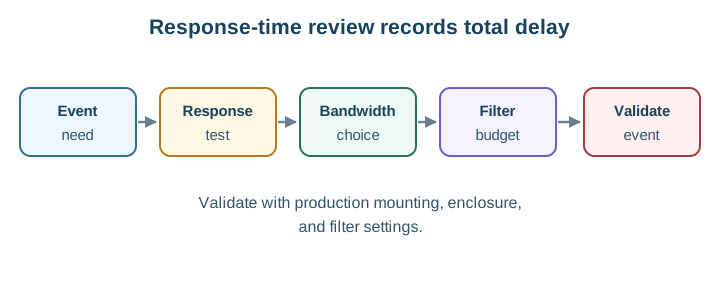
Inspect Figure 27.3 at Event: the release must reach 95 percent of a temperature step within 7,000 ms. Response test turns the measured 2,000 ms time constant into a 6,000 ms sensor contribution; Bandwidth choice records both the 0.080 Hz sensor limit and a 500 ms worst-case sampling wait. Filter budget adds the smoother’s 250 ms group delay rather than hiding it. Finally, Validate repeats the mounted, enclosed, production-filtered step test: every one of 10 trials must reach at least 95 percent by 7,000 ms. The resulting 6,750 ms total leaves 250 ms of margin and turns the figure into a bounded Dynamic Effects to Record decision.
Incremental Practice
Beginner
For a slow comfort-temperature sensor, justify why sampling once every few seconds preserves all the useful information.
Intermediate
Given a 1-second time constant, estimate how long until a step is roughly 95 percent complete, and set a sensible sample rate.
Advanced
For a sensor that overshoots a step before settling, decide whether to wait for settling or to filter the ringing, and justify the trade.
Oversampling Knowledge Check
If you can match a sample plan to a sensor's response, you can stop here. Continue to Under the Hood for the response math and the failure modes behind it.
27.5 Under the Hood: Response Math and Failure Modes
This section: Under the Hood: Response Math and Failure Modes — Most sensor responses are well described as first-order or second-order systems.
Most sensor responses are well described as first-order or second-order systems. The math turns a vague "it is slow" into specific numbers for delay, bandwidth, overshoot, and settling.
First-Order Response and Its Constants
A first-order sensor following a step approaches the final value exponentially. The fraction completed depends only on how many time constants have passed:
- After 1 time constant, about 63 percent of the change is complete.
- After 3 time constants, about 95 percent is complete.
- After 5 time constants, about 99 percent is complete.
This is why response is often quoted as a time to reach 90 percent, which is about 2.3 time constants, and why "settled" usually means several time constants have elapsed.
Bandwidth Is the Same Fact in Frequency
A slow time constant is a low-pass filter on the input. The half-power bandwidth follows directly:
A 2-second time constant corresponds to a -3 dB bandwidth below 0.1 Hz, so signals that change several times per second are strongly attenuated. Sampling much faster than this response scale still produces closely correlated points on the lagging response; anti-alias protection must nevertheless cover whatever attenuated high-frequency content reaches the ADC.
Inspect Figure 27.4 and ask which mechanical element supplies inertia, restoration, and damping before following proof-mass displacement into the differential-capacitance readout.

In Figure 27.4, spring k and damper b constrain the proof mass m, while C1 rises as C2 falls to turn displacement x into an electrical signal. The resonance boundary at ω0 is not a useful measurement boost: operation stays well below it so displacement remains a stable proxy for acceleration.
27.5.1 Second-Order Behavior: Damping
A moving sensor element does not jump instantly to its final position. A proof mass contributes inertia, a suspension contributes a restoring force, and motion through the suspension or surrounding gas dissipates energy. Write each force separately before combining them:
Here is proof mass, is viscous damping coefficient, is spring stiffness, is displacement, is velocity, and is acceleration. Newton’s law gives the driven equation of motion
Dividing by exposes the two parameters that shape the transient:
The natural frequency in hertz is
This is a resonance boundary, not a claim that measurements remain flat all the way to . As excitation approaches resonance, amplitude and phase error grow; a measurement bandwidth is normally chosen comfortably below it and verified from the actual transfer function. When , the sensor is underdamped and rings. At it is critically damped. When , it is overdamped and approaches the final value without overshoot but more slowly.
An accelerometer turns base acceleration into relative proof-mass displacement. At frequencies well below resonance, dynamic terms are small enough that the spring force balances the inertial force in magnitude:
The sign depends on the chosen axis: the mass deflects opposite the base acceleration, so firmware must preserve the mechanical and electrical sign conventions. The derivation also shows the trade-off. A softer spring or larger mass produces more displacement per unit acceleration, improving displacement sensitivity, but lowers and therefore narrows the usable dynamic range.
The readout completes the instrument. Differential capacitive plates are well suited to micrometre and sub-micrometre travel because a small gap change produces a measurable capacitance imbalance, and the opposing capacitors reject some common motion and parasitics. Inductive displacement sensing is often a better fit for larger travel and rugged conductive targets, but needs coils, excitation, and magnetic-field management. Neither method changes the mechanics: it only determines how faithfully becomes an electrical estimate.
An early reading from an underdamped sensor can be higher or lower than the true value. That is why a complete sensor specification records natural frequency, damping or step-response evidence, measurement bandwidth, overshoot, and settling tolerance rather than reporting rise time alone.
The transfer function makes the response families explicit. With zero initial conditions, the Laplace transform gives
The characteristic roots are
For , the square root is imaginary, so the output rings at inside a decaying envelope . At , the two real poles coincide at . For , two different negative real poles remain and the slower one controls the long tail. The familiar step-response estimates now have a cause:
Turn those symbols into observable evidence in the interactive below. Start with the Proof mass: underdamped preset, then walk the four stages from applied acceleration through displacement, poles, and the exact fixed-grid 2% settling check. Watch the final displacement alongside overshoot: the first is the static sensitivity result, while the second belongs to the transient.
Use the Critical damping counterexample preset for the one-click comparison. It changes only damping, removes the 72.9% overshoot, and leaves the final 10.0 mm displacement unchanged; that is the direct test of the misconception that more damping changes final sensitivity.
Walk the coefficients. Let and . Then and critical damping requires . If , then , predicted overshoot is about , and the 2% settling estimate is . Raising to removes overshoot at critical damping. At , and the poles are approximately and ; that first pole explains the visibly slower final approach.
Inspect Figure 27.5 from the ideal step through first- and second-order traces to connect the model roots with measured rise, overshoot, swing, and settle time.
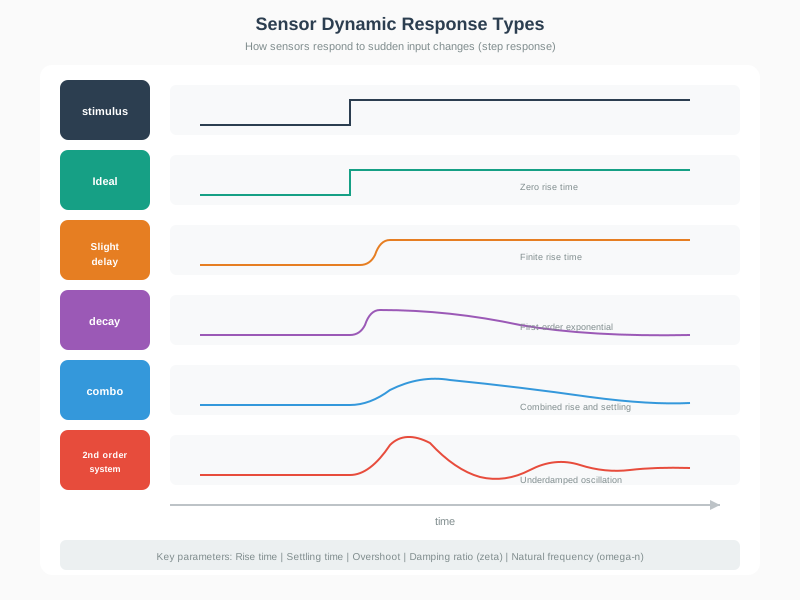
Follow the second-order trace in Figure 27.5 from its first peak through the shrinking swings until it stays inside the settle band. The height above the final value is . The time between peaks maps to , and the falling height follows . The chart gives a visible reading of the same , , and terms found above, so it is not a new class to learn by rote.
Hysteresis and Drift Are Separate Errors
Hysteresis means the reading depends on whether the input is rising or falling, so a value approached from below differs from the same value approached from above. Drift means the output slowly changes with constant input, due to aging or temperature, which is why calibration has a finite useful life. Neither is captured by response time, and both must be measured separately.
Common Pitfalls
- Oversampling a slow sensor. A high sample rate cannot add detail the sensor was too slow to capture.
- Reading before settling. Early samples include transient or overshoot error, not the true value.
- Confusing resolution with speed. More bits do not make a slow sensor follow a fast event.
- Ignoring hysteresis and drift. Both produce errors that response time alone never reveals.
Sensor Bandwidth Knowledge Check
At this depth, sensor dynamics are the real bandwidth limit of a measurement. Characterize the response time, convert it to a bandwidth, respect settling and damping, and measure hysteresis and drift separately, so the sample plan fits the sensor's physics rather than an idealized signal.
Inspect Figure 27.6 and ask how changing damping moves the same mass-and-spring system between ringing and a slow tail.

Follow Figure 27.6 from force balance to the transfer function, poles, and three transients. For and , the natural frequency is . Damping ratio then places the poles: low damping gives complex poles and overshoot, critical damping coincides at , and higher damping creates a slow real pole that lengthens the tail. The plotted responses connect those roots to a sensor’s settling behavior. This supports the chapter’s modeling argument: mass and stiffness set the natural time scale, while damping determines how safely and quickly the measurement approaches its final value.
27.6 Checkpoint: Summary
This section: Checkpoint: Summary
- Every physical sensor eases toward a new value over time; that response time, not the ADC, sets the fastest event it can capture.
- A first-order sensor completes about 63 percent of a step in one time constant, 95 percent in three, and 99 percent in five.
- The time constant sets the dB bandwidth: , so a slow sensor is a low-pass filter on the world.
- Sampling faster than the sensor’s bandwidth adds correlated, lagging points rather than new information.
- Second-order sensors can overshoot, so settling time, not only rise time, decides when a reading is trustworthy.
- Hysteresis and drift are separate errors that response time does not reveal and must be measured on their own.
A measurement can only be as fast as the sensor that makes it. Characterize the response time, turn it into a bandwidth, and choose sampling and filtering from the sensor’s real dynamics, not from an idealized signal.
27.7 See Also
This section: See Also
ADC Sampling Fundamentals
Connect the sensor's bandwidth to sample-rate and anti-alias decisions at the converter.
Quantization and Digital Filtering
Choose resolution and filters that suit how the sensor actually moves.
Signal Processing Essentials
See where response time fits in the full sensor-to-evidence pipeline.
Find help
3 reviewed answers.
Where should I start in a module?
Open the module page from the sidebar to see its chapters in order. Use the module map to return to a topic you need.
Modules and pathsReviewed
What can I try when a project does not work?
Check the symptom, then work through the diagnostic steps. Keep the error message and the smallest example that reproduces it.
When you are stuckReviewed
How do interactive examples work?
Use the interactive guide to check how examples and simulations work before changing your project.
Interactive examples guideReviewed