43 Protocol Papers Guide

More
Depth: Practitioner
Progress saves as you read. Mark sections complete as you go; your progress appears in the sidebar.
43.1 In 60 Seconds
This section: In 60 Seconds — Picture a paper that claims a field network saves energy and still delivers every warning.
Test a Paper’s Claim Against One Packet Path
Picture a paper that claims a field network saves energy and still delivers every warning. The title and chart are not enough. A reader needs to know the devices, traffic, failures, measurements, and limits behind that claim.
Internet Protocol means the addressing rules used to move network packets. IPv6 means version 6 of those rules. 6LoWPAN means a way to carry IPv6 over small low-power radios. Routing Protocol for Low-Power and Lossy Networks (RPL) means rules for choosing paths in such a network. Constrained Application Protocol (CoAP) means a compact request method for small devices. Transport layer security means protection for a network exchange. Datagram Transport Layer Security (DTLS) applies it to separate messages.
Trace one reported result from setup to receiver. Ask what happens when a relay fails, a packet repeats, the load grows, and a device restarts. Record which evidence supports the claim and which case remains untested.
This runway does not decide whether the paper is correct. The deeper guide shows how to read methods, compare measures, spot hidden assumptions, and turn findings into a design decision.
This chapter helps you read two protocol papers without treating them as current specifications. Palattella et al. explain why IEEE 802.15.4e TSCH, 6LoWPAN, RPL, and CoAP needed to fit together for low-power IPv6 networks. Raza et al. show why applying DTLS to CoAP over 6LoWPAN was possible but heavy enough to motivate later object-security work such as OSCORE and EDHOC.
43.2 Start With the Story
This section: Start With the Story — You will extract stack-design and security-overhead lessons from protocol papers, then identify the standards and implementation checks needed today.
You will extract stack-design and security-overhead lessons from protocol papers, then identify the standards and implementation checks needed today. Start by separating each paper’s original claim from your current deployment question.
Follow the two protocol papers across four beats to separate paper-era reasoning from current standards and measurements.
-

Packet Pete: “These papers expose two pressures in the constrained stack.”
-

Test Tessa: “A paper-era proposal is not a current deployment specification.”
-

Bex: “Map each contribution to the standards and security questions it leaves us.”
-

The team: “Use current standards and target measurements for the engineering decision.”
Read the story panels from the two research contributions to the present-day test. The papers expose stack-design and security-overhead pressures, but the boundary in the second panel prevents either proposal from becoming an automatic specification. Separate reading lanes connect each claim to the standards questions it raises. Current RFCs, implementations, and measurements then carry the decision, preserving the papers as reasoning evidence without treating them as deployment authority.
43.3 Learning Objectives
This section: Learning Objectives
By the end of this chapter, you will be able to:
- Read protocol papers as design evidence rather than as deployment checklists.
- Separate paper-era proposals from later IETF RFC outcomes.
- Explain how 6TiSCH combines TSCH scheduling, IPv6 adaptation, routing, and constrained application protocols.
- Describe why DTLS overhead became a central constrained-security concern.
- Compare transport security, object security, and lightweight key establishment at a conceptual level.
- Build a short reading record that preserves assumptions, evidence, limitations, and follow-up standards.
43.4 Reading Contract
This section: Reading Contract — Use the papers to learn design pressure, vocabulary, and trade-off reasoning.
Use the papers to learn design pressure, vocabulary, and trade-off reasoning. Use current RFCs, implementation guides, and measurement on the target platform for engineering decisions.
Inspect Figure 43.1 and look for how a historical design pressure becomes a current RFC and implementation check.
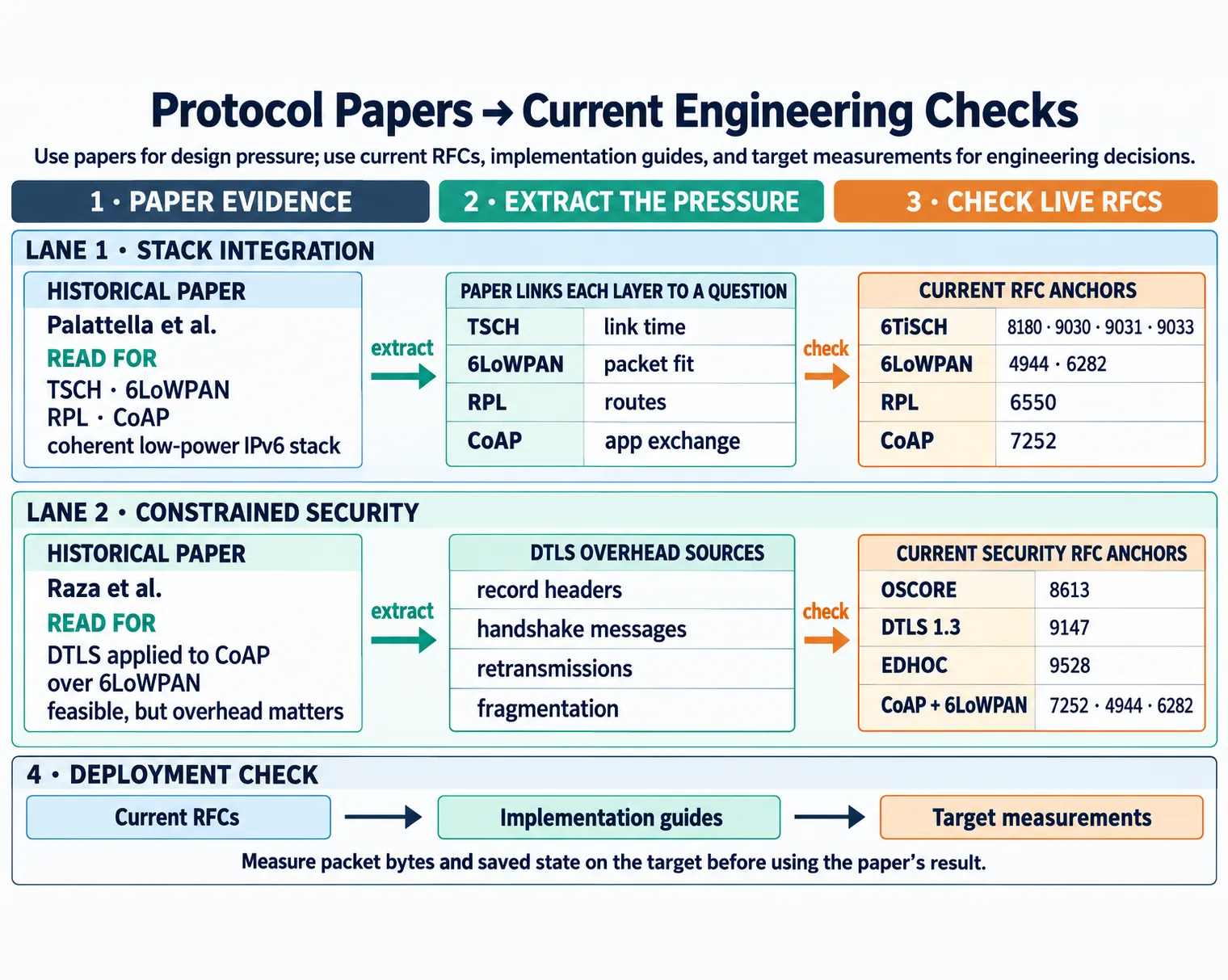
Follow Figure 43.1 through the stack lane first. The paper links TSCH, 6LoWPAN, RPL, and CoAP to link time, packet fit, routes, and app exchange. The current-RFC column checks today’s terms and rule text. The security lane then follows the added headers, handshakes, retries, and fragments from DTLS or OSCORE. EDHOC shows one way to set up shared context. The paper gives the reason, while the RFC gives the live pact. Extract the layer pressure, check the live standard, and measure packet bytes and saved state on the target before using the paper’s result.
43.5 Papers Covered
This section: Papers Covered
This guide focuses on two papers because they expose the same core problem from different layers:
M. R. Palattella, N. Accettura, X. Vilajosana, T. Watteyne, L. A. Grieco, G. Boggia, and M. Dohler, “Standardized Protocol Stack for the Internet of (Important) Things.”
- Venue: IEEE Communications Surveys & Tutorials, 15(3), 1389-1406
- DOI: https://doi.org/10.1109/SURV.2012.111412.00158
- Read for: how TSCH, 6LoWPAN, RPL, and CoAP were framed as a coherent standards-based stack.
S. Raza, H. Shafagh, K. Hewage, R. Hummen, and T. Voigt, “Lithe: Lightweight Secure CoAP for the Internet of Things.”
- Venue: IEEE Sensors Journal, 13(10), 3711-3720
- DOI: https://doi.org/10.1109/JSEN.2013.2277656
- Read for: why DTLS header, handshake, and fragmentation overhead mattered for constrained CoAP systems.
43.6 Standards Trail
This section: Standards Trail — Do not memorize every RFC number as a checklist.
Do not memorize every RFC number as a checklist. Use this trail to keep paper-era language aligned with current terminology.
- RFC 4944 and RFC 6282: 6LoWPAN adaptation and IPv6 header compression context.
- RFC 6550: RPL routing context for low-power and lossy networks.
- RFC 7252: CoAP application protocol context.
- RFC 8180: minimal 6TiSCH operation.
- RFC 9030: 6TiSCH architecture.
- RFC 9031: Constrained Join Protocol for 6TiSCH.
- RFC 9033: 6TiSCH Minimal Scheduling Function.
- RFC 8613: OSCORE for object security with CoAP.
- RFC 9147: DTLS 1.3.
- RFC 9528: EDHOC authenticated key exchange for constrained settings.
Inspect Figure 43.2 and ask which part of a paper-era protocol claim must be checked against a later RFC.
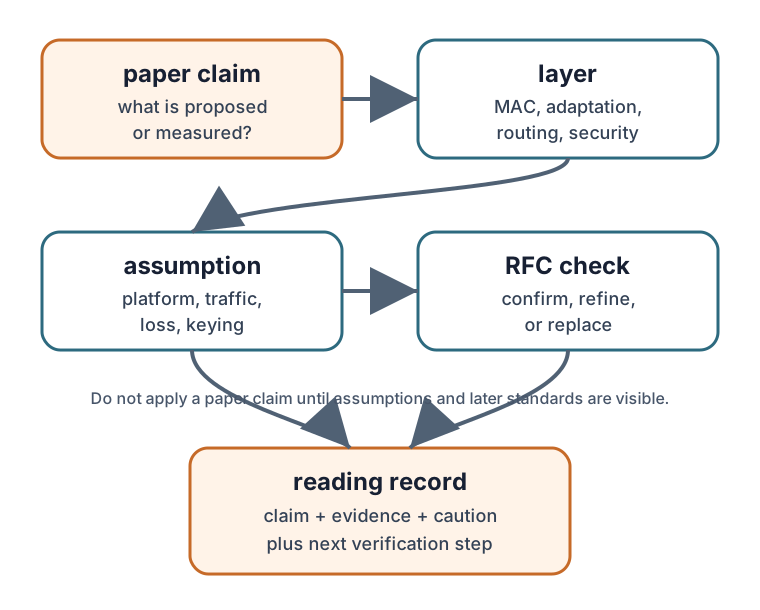
Follow Figure 43.2 from the paper claim to the live rule. First record the exact idea and where its proof appears. Class it as link, packet fit, route, app, or security work. That choice points to the right standards family. The examples link 6LoWPAN, RPL, CoAP, 6TiSCH, OSCORE, DTLS 1.3, and EDHOC to current RFCs. The next field states which terms or steps changed and what still needs a test. An old paper can preserve a useful design need. Only the live rule and target code set today’s interface, byte cost, state, and shared duty.
43.7 Lane 1: Palattella et al.
This section: Lane 1: Palattella et al.
43.7.1 Why Read It
Palattella et al. is useful because it shows a complete stack argument. The paper is not only about one MAC mode. It explains why a low-power IPv6 system needs a link schedule, an adaptation layer, routing, and an application protocol to work together.
Read it to answer four questions:
- What problem does TSCH solve that ordinary contention-based access does not solve?
- How does 6LoWPAN make IPv6 plausible over small link-layer frames?
- Why does routing in low-power and lossy networks need its own assumptions?
- Where does CoAP fit when the network is not shaped like the open web?
43.7.2 What To Extract
Create a note for each layer. Keep the wording short and evidence-based.
Link layer: Record the role of time slots, channel hopping, synchronization, and scheduled cells. Do not treat the paper’s examples as universal timing constants.
Adaptation layer: Record why header compression and fragmentation matter. Note which constraints come from the link frame and which come from IPv6 semantics.
Routing layer: Record why RPL-like routing is different from shortest-path routing in stable wired networks.
Application layer: Record why CoAP keeps REST-like interaction while avoiding the assumptions of browser-oriented HTTP.
43.7.4 Checkpoint: Checks While Reading
Use these checks to prevent drift from paper understanding into unsupported claims:
- If the paper gives an example schedule, ask whether it is a concept example or a required standard behavior.
- If the paper compares protocol families, ask which comparison was historical and which remains true in current systems.
- If the paper describes reliability, ask whether it comes from scheduling, retransmission, route repair, or application behavior.
- If the paper describes low-power operation, ask which layer contributes to sleeping and which layer only carries packets.
43.8 Lane 2: Raza et al.
This section: Lane 2: Raza et al.
43.8.1 Why Read It
Raza et al. is useful because it makes constrained security concrete. The paper does not simply say “security adds overhead.” It shows where overhead appears in the stack, why fragmentation amplifies it, and why header compression alone cannot remove every handshake burden.
Read it to answer four questions:
- Which bytes are application data, protocol headers, security headers, or handshake material?
- Why does a multi-message handshake stress a small-frame network?
- What does compression improve, and what does it leave unchanged?
- Why did later work explore OSCORE and EDHOC instead of only making DTLS smaller?
43.8.2 What To Extract
Threat boundary: Record whether the paper protects the transport path, the CoAP object, or both.
Overhead source: Separate record headers, handshake messages, retransmissions, and fragmentation.
State assumption: Record whether the design assumes pre-shared keys, certificates, session reuse, or later key establishment.
Proxy behavior: Record whether intermediaries need to read, cache, translate, or forward protected CoAP messages.
Inspect Figure 43.3 and look for how the protected boundary changes between DTLS, OSCORE, and EDHOC.
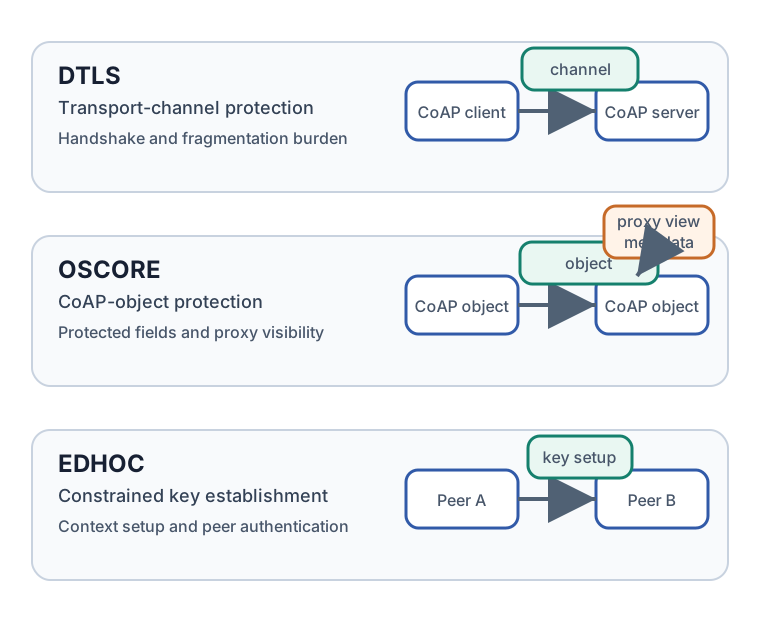
Compare the three mechanisms in Figure 43.3 by job rather than by acronym. DTLS protects a transport channel, bringing handshake, record-header, retransmission, and fragmentation costs. OSCORE protects CoAP objects end to end across permitted intermediaries, changing what a proxy may read, cache, translate, or forward. EDHOC establishes fresh keying material for a constrained security context; it does not replace the protection that later uses that context. The follow-up RFCs anchor a current standards check. This supports the protocol-paper guide because overhead cannot be discussed as one byte count: record the threat boundary, key assumptions, session reuse, proxy behavior, message exchange, and fragmentation for the target path.
43.8.4 Checkpoint: Checks While Reading
- Do not copy exact measurement numbers into a modern design without the platform, radio, implementation, and traffic pattern.
- Do not conclude that DTLS is unusable; the paper demonstrates feasibility while showing why overhead matters.
- Do not conclude that OSCORE replaces every transport-security use case; it protects CoAP objects and changes intermediary visibility.
- Do not ignore key establishment. OSCORE still needs a security context, and EDHOC is one constrained way to establish one.
43.9 Cross-Paper Synthesis
This section: Cross-Paper Synthesis — Read the two papers together as a stack-design exercise.
Read the two papers together as a stack-design exercise.
Constrained IoT protocols are shaped by interactions across layers. A link-layer schedule changes when packets can move. An adaptation layer changes how packets fit. A routing layer changes where packets move. A security layer changes packet size, state, replay behavior, and intermediary visibility.
Use this synthesis record:
Claim: What does the paper say?
Layer: Which layer owns the mechanism?
Constraint: Is the constraint frame size, synchronization, energy use, memory, loss, security state, or interoperability?
Evidence: Is the evidence a design argument, model result, prototype, measurement, or later RFC?
Modern check: Which RFC or implementation evidence should be checked before applying it now?
Caution: What would be unsafe to generalize?
43.10 Common Pitfalls
This section: Common Pitfalls
The papers are historically important, but they are not the final protocol specifications. Use them to understand why the design moved in a certain direction, then check the RFCs for current normative language.
Frame sizes, handshake sizes, memory use, and energy measurements depend on implementation details. Preserve the paper’s reasoning pattern, but do not turn one setup into a universal rule.
DTLS, OSCORE, and EDHOC solve related but different problems. The right comparison is not “which one is newer”; it is whether the system needs channel protection, object protection, key establishment, proxy traversal, cache behavior, or a combination.
A protocol stack is not ready just because the data path is described. Secure join, schedule creation, route repair, key update, diagnostics, and recovery behavior are part of the real system boundary.
43.11 Knowledge Check
This section: Knowledge Check
43.11.1 Knowledge Check: Paper Versus RFC
43.11.2 Knowledge Check: Constrained Security
43.11.3 Matching Check: Reading Evidence
43.11.4 Ordering Check: Read A Protocol Paper
43.12 Deep Dive: Layer The Paper Claim Before Using It
This section: Deep Dive: Layer The Paper Claim Before Using It — Protocol survey papers organize IoT protocols by the layer they occupy.
Protocol survey papers organize IoT protocols by the layer they occupy. For constrained devices, the stack is a slimmed-down cousin of the classic internet stack: IEEE 802.15.4 at the link layer, 6LoWPAN for adaptation, IPv6 plus RPL for networking, UDP for transport, and CoAP at the application layer. Keep that layer map visible while reading, because a claim about “low overhead” means different things at the MAC schedule, adaptation header, routing state, security context, and application-message layers.
The stack is shaped by a physical constraint: an IEEE 802.15.4 frame has a 127-byte maximum physical-layer packet size before MAC headers, security fields, addressing, and checksums consume space. A full IPv6 header is 40 bytes before UDP, CoAP, routing headers, and payload. That is why 6LoWPAN is not decorative. RFC 4944 and RFC 6282 define fragmentation and header compression so IPv6 can survive where one careless header can dominate the packet. RPL, standardized in RFC 6550, then adds a routing model for lossy and low-power networks rather than assuming stable Ethernet-like paths.
Challenge Deep Dive: Layer The Paper Claim Before Using It with the visual in Figure 43.4: Why 6LoWPAN header compression is not decorative names one checkpoint and IPv6 names another. Their relationship frames A 127-byte IEEE 802.15.4 frame split into IPv6, UDP, 802.15.4, and security header overhead, leaving about 33 bytes for data, plus a note that IPv6’s own 1280-byte MTU still forces fragmentation.

The byte budget in Figure 43.4 shows how IPv6, UDP, 802.15.4, and security headers leave about 33 bytes of a 127-byte frame for data, while IPv6’s 1280-byte MTU still requires fragmentation.
| Layer | Constrained IoT reading lane | Classic internet comparison |
|---|---|---|
| Application | CoAP, sometimes MQTT-SN or gateway-mediated application contracts | HTTP or brokered application protocols |
| Transport | UDP, often with application-level reliability decisions | TCP for connection-oriented byte streams |
| Network | IPv6 plus RPL routing assumptions | IPv4 or IPv6 over more stable links |
| Adaptation | 6LoWPAN compression and fragmentation | Usually none needed |
| Link/PHY | IEEE 802.15.4, TSCH, channel hopping, scheduled cells | Ethernet or Wi-Fi links with larger frames and different power assumptions |
When a paper says scheduling improves reliability, ask whether it means TSCH slot timing, 6TiSCH schedule negotiation, RPL parent stability, CoAP retransmission behavior, or the application sampling policy. When it says security overhead is acceptable, ask whether the overhead appears as a larger link-layer frame, extra 6LoWPAN fragments, a longer handshake, persistent state in RAM, or more radio-on time. That translation prevents a survey conclusion from becoming a vague endorsement of a whole stack.
43.12.1 UDP, CoAP, And Security Context
The choice of UDP and CoAP over TCP and HTTP is deliberate. TCP keeps connection state and performs handshakes, retransmission timers, congestion control, in-order byte streams, and recovery behavior that can be costly for a device that sleeps for minutes and wakes to send a few bytes. UDP is connectionless. CoAP, standardized in RFC 7252, then adds compact REST-like methods, binary headers, message identifiers, token matching, and optional confirmable messages with acknowledgments.
The trade is explicit: CoAP over UDP gives low overhead and sleep-friendliness but weaker built-in guarantees than TCP. Applications choose confirmable messages where they need them and non-confirmable messages where loss is acceptable. MQTT makes a different architectural bet. It runs over TCP, uses a broker, and can be excellent for devices or gateways that can maintain a session and benefit from publish-subscribe fan-out. MQTT-SN adapts that model for sensor networks, but the same reading discipline applies: check who keeps state, who retransmits, where the broker or gateway sits, and what happens during sleep, loss, and reconnect.
Security sharpens the layer question. DTLS protects a channel below the application, but handshake size, record overhead, and state can matter on small nodes. DTLS 1.3 in RFC 9147 changes details relative to older DTLS papers. OSCORE in RFC 8613 protects CoAP messages at the object layer, which can survive proxies that terminate transport connections. EDHOC in RFC 9528 is a compact authenticated key establishment protocol for constrained settings. A paper about secure CoAP is incomplete unless you ask whether it assumes pre-shared keys, certificate chains, raw public keys, OSCORE contexts, or a particular join process.
A useful reading record names the proposed protocol choice, the layer it affects, the workload it assumes, the RFC or implementation to validate against, and the measurement needed before deployment. For example: “Use CoAP confirmable PUT for fifteen-minute telemetry; validate against RFC 7252 behavior in the target stack; measure retransmissions and radio-on time under expected loss.” That sentence is more reliable than “paper recommends CoAP,” because it preserves the constraint that made the recommendation true.
43.13 Summary
This section: Summary — Palattella et al.
Palattella et al. help you understand the integration problem: a low-power IPv6 stack only works when link scheduling, adaptation, routing, and application behavior are designed together. Raza et al. help you understand the security problem: strong protection is possible on constrained devices, but overhead, fragmentation, and state management decide whether a design is practical.
The durable lesson is not a single protocol recommendation. The durable lesson is the method: identify the layer, preserve the assumption, compare with current standards, and measure before applying the claim.
43.15 What’s Next
This section: What’s Next — Continue with Paper Reading Guides: Security to connect constrained protocol security with authentication, key management, firmware update, and network-defense papers.
Continue with Paper Reading Guides: Security to connect constrained protocol security with authentication, key management, firmware update, and network-defense papers.
43.16 Key Takeaway
This section: Key Takeaway — Protocol papers should be read for purpose, layer, message model, assumptions, comparison baseline, evaluation metrics, and deployment limits.
Protocol papers should be read for purpose, layer, message model, assumptions, comparison baseline, evaluation metrics, and deployment limits. A protocol result only applies under its stated conditions.
Find help
3 reviewed answers.
Where should I start in a module?
Open the module page from the sidebar to see its chapters in order. Use the module map to return to a topic you need.
Modules and pathsReviewed
What can I try when a project does not work?
Check the symptom, then work through the diagnostic steps. Keep the error message and the smallest example that reproduces it.
When you are stuckReviewed
How do interactive examples work?
Use the interactive guide to check how examples and simulations work before changing your project.
Interactive examples guideReviewed