41 Architecture Papers Guide

More
Depth: Practitioner
Progress saves as you read. Mark sections complete as you go; your progress appears in the sidebar.
41.1 In 60 Seconds
This section: In 60 Seconds — A protocol is a set of rules that lets systems exchange data.
Read for the Choice in Front of You
A protocol is a set of rules that lets systems exchange data. Picture a team choosing how a field sensor should send an alarm. Four respected papers sit on the table, but each was written for a different question and time.
Begin with the decision, not the first page. Write down the system boundary, the people or devices involved, and the failure that matters. Then ask each paper what it claims, what proof it gives, and which facts it assumes. Mark old examples as history until current tests support them.
Build one short reading record. Name the useful idea, the figure or section that supports it, the limit, and the design choice it may inform. Compare records before the team adopts a term or pattern.
A paper can guide thought, but it cannot prove that a present-day product will work. Local laws, threats, radio conditions, and service terms may have changed. The deeper sections show how the four papers frame architecture and where a fresh source or field test is still needed. Architecture papers are useful when they are read for vocabulary, system boundaries, assumptions, and design trade-offs. This guide organizes four foundational IoT papers into reading lanes: Atzori for the early IoT vision, Gubbi for cloud-centered architecture, Al-Fuqaha for taxonomy across technologies and protocols, and Bormann for constrained application protocol design. The goal is a reusable reading record, not memorization of every section.
41.2 Start With the Story
This section: Start With the Story — You will use architecture papers to build a reading record that separates reusable ideas from historical assumptions.
You will use architecture papers to build a reading record that separates reusable ideas from historical assumptions. Start by matching your design question to a paper about vision, cloud architecture, taxonomy, or constrained protocols.
Follow the four architecture papers across four beats to preserve their distinct scopes before building a current synthesis.
-

Bex: “Begin with the architecture question, then choose the matching paper lane.”
-

Test Tessa: “Different artifacts and historical assumptions cannot become one recipe.”
-

The team: “Keep each paper's model and limits attached to its contribution.”
-

Packet Pete: “The synthesis informs this decision; the follow-up evidence still tests it.”
Read the story panels from the four question lanes to the tested synthesis. Vision, cloud, taxonomy, and constrained-protocol papers begin with different scopes, so the second panel prevents their claims from collapsing into one recipe. The evidence records preserve each model’s assumptions and trade-offs. Their later convergence informs an architecture decision, while the separate validation check keeps historical insight from being mistaken for current implementation proof.
41.3 Architecture Papers Guide
This section: Architecture Papers Guide — The papers in this chapter are not all the same kind of artifact.
The papers in this chapter are not all the same kind of artifact. Some are broad surveys, one is a cloud architecture vision, and one is a focused protocol-design paper. Read them as complementary evidence for architecture decisions: what vocabulary they establish, what system model they assume, what constraints they prioritize, and what questions they leave open.
41.4 Learning Objectives
This section: Learning Objectives
By the end of this chapter, you will be able to:
- Identify the main contribution of each architecture paper without relying on citation-count claims.
- Extract architecture vocabulary, layer boundaries, protocol assumptions, and unresolved questions from a paper.
- Compare survey papers with focused design papers.
- Build a reading record that links claims to figures, sections, and follow-up chapters.
- Use paper context without treating older claims as current deployment guidance.
- Choose the next paper based on the architecture question you are trying to answer.
- Start with the architecture question, not with page one.
- Record each paper’s scope, assumptions, and contribution.
- Separate historical framing from reusable design principles.
- Treat surveys as maps and focused papers as design rationales.
- Do not copy old deployment examples into modern designs without checking current constraints.
41.5 How to Use: How It Works: Read Architecture Papers As Evidence
This section: How to Use: How It Works: Read Architecture Papers As Evidence — Read each paper through the architecture question you are trying to answer.
Read each paper through the architecture question you are trying to answer.
- Set the reading question. Decide whether you need vocabulary, layer boundaries, taxonomy, cloud architecture, or constrained-protocol rationale.
- Extract the paper’s model. Record the system boundary, assumptions, figures, and terminology the paper uses.
- Separate reusable principle from historical context. Keep durable design logic but mark dated technologies or deployment examples.
- Write a synthesis note. Connect the paper to one current design decision and one follow-up chapter.
41.6 Incremental Examples
This section: Incremental Examples — Beginner Example: Use Atzori et al.
Beginner Example: Use Atzori et al. to build vocabulary for “things,” identity, and communication without treating early examples as current product guidance.
Intermediate Example: Use Gubbi et al. to compare cloud-centered assumptions with today’s edge and gateway options.
Advanced Example: Compare a broad survey with Bormann’s constrained protocol paper to separate taxonomy from protocol-design rationale.
41.6.1 Concept Check: Survey Or Rulebook?
Why is a survey paper not automatically a deployment rulebook?
Answer: a survey organizes a field, establishes terminology, and presents models for comparing technologies or responsibilities. These contributions help frame a design question, but their scope and historical assumptions limit what they support about a present deployment.
A deployment decision still needs current constraints, measurements, security posture, and implementation evidence. Connect a useful survey claim to its supporting figure, section, or table, then identify which assumptions need checking. A layer diagram can clarify responsibilities without supplying measured performance. Preserve the reusable reasoning, mark dated examples as historical context, and validate the proposed choice against the current system boundary and operating conditions.
41.6.2 Concept Check: Reading Record
What should a paper note include beyond the citation?
Answer: include the reading question, paper scope, key assumptions, reusable claims, dated context, and the design decision the paper informs. Record the system model and component responsibilities so the claim can be understood within the boundaries the paper uses.
Tie each useful claim to a figure, section, table, or stated constraint. This evidence location lets another reader inspect the basis of the note. Explain the claim’s limits and distinguish reusable reasoning from historical examples. Finish by naming a follow-up chapter or current check needed for the decision. The record should show both what the paper contributes and which questions remain unresolved.
41.6.3 Try It Yourself
Choose one paper lane that fits your architecture question: vision, cloud architecture, taxonomy, or constrained protocol design. Write a six-line reading record covering the question, model, one useful figure, one assumption, one dated point, and one follow-up chapter.
Make the question specific enough to identify the decision the paper may inform. Describe the model through its system boundary and component responsibilities. For the figure, state which useful claim it supports. Explain how the selected assumption limits that claim, and mark the dated point as historical context requiring a current check. Choose the follow-up chapter to address an unresolved question. Review whether the record links the paper’s contribution to a design choice without treating its historical examples as current implementation evidence.
41.7 See Also
This section: See Also
41.7.1 Paper Reading Guides
Paper Reading Guides - gives the general reading method used here.
41.7.2 Architecture Planner
Architecture Planner - applies paper evidence to a concrete architecture decision.
41.7.3 Protocol Papers Guide
Protocol Papers Guide - continues the reading workflow for connectivity and protocol choices.
41.8 Four Reading Lanes
This section: Four Reading Lanes — Use this map to choose the right paper for the question in front of you.
Use this map to choose the right paper for the question in front of you.
Inspect Figure 41.1 and choose the reading lane that can answer the architecture question now facing the project.
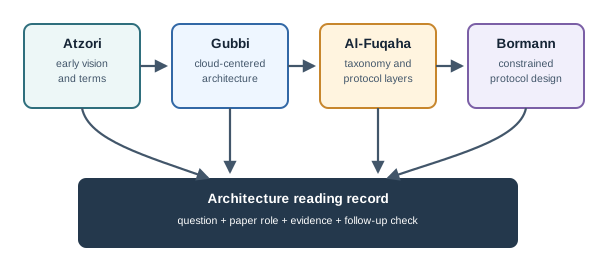
Read Figure 41.1 across its four question lanes. Atzori gives early IoT terms and broad aims. Gubbi focuses on gateway, cloud, data, and app roles. Al-Fuqaha offers a layer map and risks that span fields. Bormann explains small REST systems and compact protocol choices. Each lane ends with the question, paper role, proof location, assumptions, current check, and design effect. The papers are not a ranked course. Old terms must stay apart from reasoning that still holds. Pick a source for the choice it can inform, extract a claim that can be checked, then verify today’s rules and site facts before a design change.
41.8.1 Atzori et al. (2010)
Paper: “The Internet of Things: A Survey”
Read for early IoT vocabulary, the three-vision framing, enabling technologies, and the way the field connected objects, networks, and semantics.
41.8.2 Gubbi et al. (2013)
Paper: “Internet of Things (IoT): A Vision, Architectural Elements, and Future Directions”
Read for cloud-centered architecture, data handling, gateway roles, and the transition from local sensing to connected services.
41.8.3 Al-Fuqaha et al. (2015)
Paper: “Internet of Things: A Survey on Enabling Technologies, Protocols, and Applications”
Read for a broad taxonomy of IoT technologies, protocol layers, application areas, and research challenges. Use the categories to locate technologies within the paper’s layer model and organize follow-up questions. A taxonomy supports comparison, but deployment decisions still require current constraints and implementation evidence. Record which comparison dimensions remain useful, where a supporting section or figure appears, and which assumptions need updating. This connects the survey’s map to a design question while keeping historical technology descriptions separate from current guidance.
41.8.4 Bormann et al. (2012)
Paper: “CoAP: An Application Protocol for Billions of Tiny Internet Nodes”
Read for constrained protocol design rationale, REST mapping, compact message structure, and selective reliability.
41.9 Paper Selection Matrix
This section: Paper Selection Matrix
41.10 Reading Workflow
This section: Reading Workflow — Do not read every paper the same way.
Do not read every paper the same way. A survey should produce a map. A focused protocol paper should produce a design-rationale record.
Inspect Figure 41.2 and look for where a reusable architecture principle is separated from historical context.
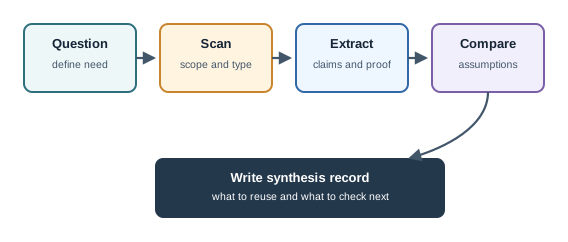
Begin Figure 41.2 with one design question. It may ask about terms, a layer edge, a map, a cloud role, or a small protocol. Record the year, venue, paper type, and problem first. This stops a survey from being read as a build rule. Tie each useful claim to a figure, section, table, or stated limit. Then ask what tool, scale, threat, or work rule has changed since print. The final record keeps reusable logic apart from old examples and links it to one choice. A paper earns weight through a clear claim and a current check, not through citation count.
Scan context Record year, venue, paper type, and what problem the authors were addressing.
Extract claims Capture the vocabulary, layer model, protocol assumption, or design rule the paper contributes.
Check evidence Tie each useful claim to a figure, section, table, or stated design constraint.
Compare assumptions Ask what has changed since publication and what still applies.
Map to course topics Link the paper to protocol selection, reference models, edge/fog, data representation, or CoAP.
Write a record Summarize what the paper helps decide and which questions still need current evidence.
41.11 Paper Notes
This section: Paper Notes
41.11.1 Atzori et al. (2010): IoT Vision And Vocabulary
Atzori, Iera, and Morabito helped frame IoT as the convergence of things-oriented, internet-oriented, and semantic-oriented views. Read this paper when you need the historical vocabulary behind connected objects, identification, sensing, middleware, and application domains.
41.11.1.1 Selection Workflow: Read For
- The three-vision framing.
- How RFID, sensing, and networked objects were connected.
- Early open issues that still shape architecture discussions.
41.11.1.2 Selection Workflow: Reading Record
- What does each vision emphasize?
- Which technologies are treated as enabling layers?
- Which assumptions now need updating?
41.11.2 Gubbi et al. (2013): Cloud-Centered IoT Architecture
Gubbi, Buyya, Marusic, and Palaniswami described an IoT architecture in which cloud services play a central role in data storage, processing, and application delivery. Read this paper when you want to understand how IoT moved from local sensing networks toward service-oriented architectures.
41.11.2.1 Selection Workflow: Read For
- Device, gateway, network, cloud, and application responsibilities.
- Data management as an architecture problem.
- Why later edge/fog patterns respond to cloud-centered assumptions.
41.11.2.2 Selection Workflow: Reading Record
- Which work is assigned to devices and gateways?
- Which work is assigned to cloud services?
- Which latency, data, or control assumptions should be revisited?
41.11.3 Al-Fuqaha et al. (2015): Broad IoT Taxonomy
Al-Fuqaha, Guizani, Mohammadi, Aledhari, and Ayyash provide a broad survey of enabling technologies, protocols, and application issues. Read this paper as a taxonomy and comparison guide, not as a current product recommendation.
41.11.3.1 Selection Workflow: Read For
- Protocol layers and technology categories.
- Architecture models and application areas.
- Research challenges that help organize follow-up reading.
41.11.3.2 Selection Workflow: Reading Record
- Which layer does each technology belong to?
- Which comparison dimensions are still useful?
- Which sections need current standards or practice updates?
41.11.4 Bormann et al. (2012): Constrained Protocol Rationale
Bormann, Castellani, and Shelby explain why CoAP adapts web-style interaction for constrained nodes and networks. Read this paper when you need to understand why a compact binary application protocol, UDP transport, message IDs, and confirmable/non-confirmable messages were selected.
41.11.4.1 Selection Workflow: Read For
- How REST concepts are mapped into a constrained protocol.
- The role of the fixed header, message type, code, message ID, and token.
- Selective reliability and proxy interaction.
41.11.4.2 Selection Workflow: Reading Record
- Which problem was HTTP not solving well?
- Which fields support request/response matching and reliability?
- Which later RFCs or CoAP chapters should be read next?
41.12 Synthesis Record
This section: Synthesis Record — A useful paper guide ends with a synthesis record that another learner can inspect.
A useful paper guide ends with a synthesis record that another learner can inspect.
The record in Figure 41.3 keeps a paper claim and its proof together; check the Atzori example.
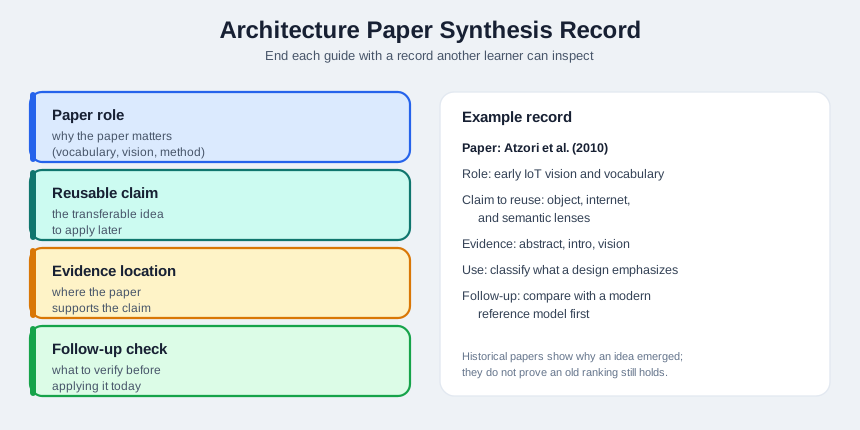
Follow the left column of Figure 41.3 from paper role through reusable claim and evidence location to follow-up check. The example on the right links historical vocabulary to a design question and asks for a modern comparison. This record preserves a useful idea without treating an older paper as proof of current performance.
Paper: Atzori et al. (2010)
Role: vocabulary and early IoT vision
Claim to reuse: IoT can be read through object, internet, and semantic lenses
Evidence location: abstract, introduction, vision discussion
Architecture use: classify what a system design emphasizes
Follow-up check: compare with a modern reference model before applyingOlder papers are valuable because they show why an architecture or protocol idea emerged. They do not automatically prove that an old comparison, deployment example, or technology ranking still holds.
41.13 Knowledge Check
This section: Knowledge Check
41.13.1 Knowledge Check: Choosing A Paper
41.13.2 Knowledge Check: Reading Records
41.13.3 Match Paper To Reading Lane
41.13.4 Order The Reading Workflow
41.13.5 Label The Paper Review Record
41.14 Deep Dive: Reading Architecture Papers Through Layered Models
This section: Deep Dive: Reading Architecture Papers Through Layered Models — IoT architecture surveys almost always describe systems as a stack of layers, but there is no single canonical model.
IoT architecture surveys almost always describe systems as a stack of layers, but there is no single canonical model. The two most common teaching lenses are the three-layer model and the five-layer model. The three-layer model groups work as perception, network, and application. The five-layer model adds explicit processing or middleware concerns and a business layer. Read the layer diagram as the paper’s boundary-setting tool: it says what the authors treat as device work, network work, platform work, application work, and organizational work.
The reading order in Figure 41.4 builds context before an architecture comparison. WSN foundations introduce node limits and the vocabulary behind device work. Protocol standards then show how constrained networking and security choices are described. The architecture and surveys lane brings Atzori, Bormann, Gubbi, and Al-Fuqaha together so a reader can compare viewpoints and boundaries in their papers. Security research follows once the stack and its trust surfaces are clearer. This order helps a design review keep a paper’s model in context. A three-layer or five-layer diagram can organize the system, but the paper’s assumptions and current deployment needs still decide how far its claim travels.
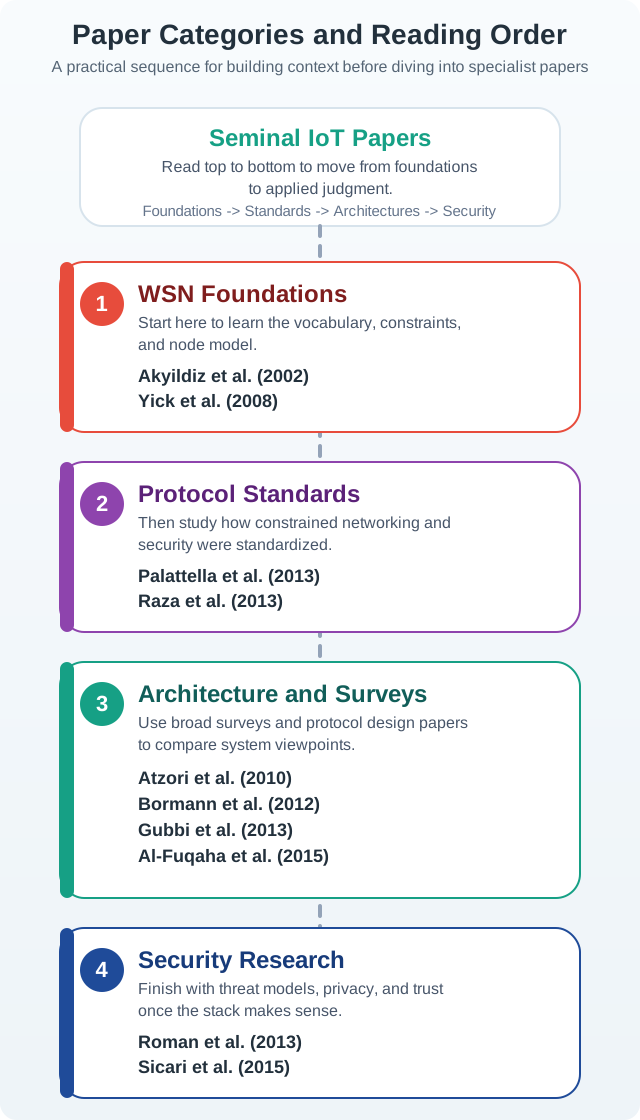
The lane in Figure 41.4 groups four IoT papers; read their claims after the basic limits.
These models are lenses, not laws. Knowing them lets you place any paper’s system quickly: sensors, tags, and actuators are perception; radios, routing, gateways, and backhaul are network or transport; middleware, storage, and stream processing may be folded into application or split into their own processing layer; dashboards, alerts, and domain services are application; governance, pricing, and operational decisions are often called business. The same smart-building system can be drawn as three layers in an introductory survey or as five layers in a paper focused on platform responsibilities.
The four papers in this guide should be read with that distinction in mind. Atzori et al. gives early vocabulary and the things-oriented, internet-oriented, and semantic-oriented views. Gubbi et al. emphasizes cloud-centered architecture and the move from sensing to service delivery. Al-Fuqaha et al. provides a broad taxonomy across enabling technologies, protocols, and applications. Bormann et al. is narrower: it explains why CoAP maps REST-style interaction onto constrained nodes using compact messages and selective reliability. None of those papers should be treated as a frozen modern reference architecture; each gives a model to test against current constraints.
41.14.1 Three-Layer Versus Five-Layer
The five-layer model refines the middle and top of the stack, which is where much IoT complexity actually lives. In a design review, use the three-layer model when you need a fast sketch of who senses, who transports, and who serves the user. Use the five-layer model when the argument depends on platform detail: data normalization, device management, digital-twin state, event processing, analytics, access control, billing, reporting, or operational accountability. The model choice should follow the decision, not the other way around.
| Five-layer | Role | Maps to three-layer |
|---|---|---|
| Perception | Sensors, actuators, tags | Perception |
| Transport or network | Move data across networks | Network |
| Processing or middleware | Store, filter, manage data and devices | Usually folded into application |
| Application | Domain services and dashboards | Application |
| Business | Models, decisions, value | Usually folded into application |
Smart parking makes the difference concrete. Ground sensors detect occupancy at the perception layer; a LoRaWAN network carries the counts; a middleware platform stores them and manages the devices; a driver app shows free bays; and dynamic pricing and revenue reporting sit on top. Through the three-layer lens the middle three may collapse into “application”, which is why a survey using the five-layer model can describe the same system in more useful detail. If your architecture question is “where do packets flow?”, three layers may be enough. If your question is “where do stale occupancy values get filtered and who owns pricing decisions?”, five layers preserve the responsibility boundary.
Turn that into a paper-reading checklist. For Atzori, record whether a claim is about objects, internet connectivity, or semantics. For Gubbi, ask what work the cloud platform performs and which functions would move to a gateway, edge node, or fog tier in a latency-sensitive deployment. For Al-Fuqaha, treat each taxonomy row as a classification aid, then check whether current standards and devices still match the paper’s categories. For Bormann, map CoAP’s message fields and reliability choices to the application and transport boundary rather than treating it as a general architecture survey.
Practitioners should also note what each model hides. A three-layer sketch can hide identity lifecycle, time synchronization, schema evolution, and OTA update ownership. A five-layer sketch can make a system look more separable than it is: a firmware sleep policy can affect cloud freshness, and a business rule can change radio traffic by altering sampling intervals. Write those hidden couplings into the reading record as follow-up checks before using the paper to support a design.
41.14.2 Why Models Differ, And Where Fog Fits
Because no standards body mandates one model, authors choose the lens that fits their argument. A security paper may prefer the five-layer model to talk about middleware threats; a networking paper may use three layers and zoom into the network layer. There are also service-oriented architecture variants that model the system as interacting services, and fog or edge extensions that insert a computing layer between the network and the cloud to handle latency-sensitive processing near the data. That variation is not noise; it shows which responsibilities the paper needs to make visible.
The practical skill is to read past the layer names to the functions. Ask of any paper: where is sensing, where is transport, where is data managed, where are decisions made, where is identity enforced, where is state stored, and where is computing pushed toward the edge? Those functions are stable even when the diagrams differ. A paper may call the gateway a transport element, a middleware component, or an edge node; what matters is whether it filters data, translates protocols, buffers during outages, terminates security sessions, or makes local control decisions.
Fog and edge placement make this especially important. In a cloud-centered model, the gateway may forward data upward and leave analytics, storage, and applications to the cloud. In a fog-augmented model, a gateway, micro data center, or substation controller may run local rules, aggregate sensor streams, and respond when cloud connectivity is unavailable. That difference changes latency, privacy exposure, bandwidth, failure mode, and update responsibility. A good reading record therefore captures not only the layer diagram, but the reason compute is placed there and the evidence the authors give for that placement.
Two papers can describe similar smart-grid systems while using different layer counts: one might use a three-layer diagram, while the other uses a fog-augmented five-layer diagram with a substation compute tier. They are not contradictory. The second paper simply resolves the network/application region into transport, fog processing, cloud application, and business layers. Recognizing that lets you compare their contributions by function rather than being misled by layer counts. If the smart-grid use case needs protection relay timing, local anomaly detection, or outage operation, the fog tier is architecturally meaningful; if it only batches meter readings for monthly reporting, the simpler cloud-centered model may be adequate.
Model differences also affect evidence quality. A survey figure can give you vocabulary but not the measured latency of an edge rule. A cloud architecture paper can explain service composition but may not capture today’s device-management, certificate-rotation, or data-sovereignty constraints. A protocol paper can justify CoAP’s compact message format but cannot choose your business layer. Use architecture papers as structured evidence: extract the functions, preserve assumptions, then validate the decision with current standards, implementation behavior, and measurements.
41.15 Checkpoint: Summary
This section: Checkpoint: Summary
Architecture paper reading is a disciplined extraction task:
- Choose the paper based on the architecture question.
- Record the paper type, scope, and assumptions.
- Extract claims with evidence locations.
- Compare historical assumptions with current course material.
- Write a synthesis record that another learner can reuse.
Common Pitfalls
This section: Common Pitfalls
An influential paper may be the wrong starting point for a specific question. Choose by role: vision, taxonomy, cloud architecture, or protocol rationale.
Technology assumptions change. Preserve the historical rationale, then verify current constraints before applying it.
A survey organizes the field. A design paper explains why one design was chosen. Use each paper for the job it can actually support.
Notes are weak when they do not point back to a section, figure, table, or stated assumption. Evidence locations make review possible.
41.17 Key Takeaway
This section: Key Takeaway — Read architecture papers by identifying the system model, assumptions, component responsibilities, evaluation method, and limits.
Read architecture papers by identifying the system model, assumptions, component responsibilities, evaluation method, and limits. The diagram is not enough without evidence that the architecture works.
Find help
3 reviewed answers.
Where should I start in a module?
Open the module page from the sidebar to see its chapters in order. Use the module map to return to a topic you need.
Modules and pathsReviewed
What can I try when a project does not work?
Check the symptom, then work through the diagnostic steps. Keep the error message and the smallest example that reproduces it.
When you are stuckReviewed
How do interactive examples work?
Use the interactive guide to check how examples and simulations work before changing your project.
Interactive examples guideReviewed