26 Thread Protocol Comparison
More
Depth: Practitioner
Progress saves as you read. Mark sections complete as you go; your progress appears in the sidebar.
26.1 Begin With the Job, Not the Name
This section: Begin With the Job, Not the Name — A protocol means an agreed set of rules for passing data.
A protocol means an agreed set of rules for passing data. Bandwidth means how much data a link can carry in a given time. IEEE 802.15.4 is a low-power radio and link standard. IPv6 is a network address and packet plan. Zigbee is a separate stack that can use the same low-power radio. Picture a set of door sensors and one mains-powered border node. Start with the service they must provide.
Write down message size, send rate, power, reach, repair path, app rules, and product support. Then compare Thread and each nearby choice on the same rows. Test one join, one lost parent, one full path to the app, and one update. Record what each layer supplies. Do not give a radio feature credit for an app feature owned elsewhere.
Shared radio roots do not make two stacks the same. Direct Internet addressing can aid fit, but it does not remove app or security work. A broad product family may ease buying, but it may bind the design to a different set of rules. For a Thread comparison, build the evidence table and trial; check radio, network, app, border, and release boundaries before accepting the result.
Use one row per need. Can a sleepy leaf join? Can it reach the border node? Can the app read the value? Can the team replace a failed unit? Can the product receive safe updates? Can the site run when the wider link is down? Write yes, no, or not yet. Add the proof beside each answer.
Run the same small trial for each serious choice. Use the same room, message, cell, and fault. Join five times. Remove a parent. Restart the border node. Change an app rule. Save time, loss, power, and repair work. A fair test keeps the job fixed while the choice changes.
End with the open gap. A choice may win on power and lose on app fit. Another may be easy to buy and hard to own. State which trade the project accepts. State what new fact would reopen it. This keeps the table useful after the first demo.
26.2 Thread Protocol Comparison Evidence
This section: Thread Protocol Comparison Evidence — Protocol comparison is not a scoreboard.
Protocol comparison is not a scoreboard. A useful Thread comparison starts with the behavior being claimed, the deployment boundary, and the evidence needed to accept or reject each candidate. Thread, Zigbee, Wi-Fi, Bluetooth LE, Z-Wave, and Matter solve different parts of an IoT system. Comparing them well means separating radio behavior, network behavior, application behavior, ecosystem constraints, and release evidence.
This chapter keeps the comparison bounded. It does not claim that Thread replaces every earlier protocol, that Zigbee is obsolete, that Wi-Fi is the wrong path for every IoT device, or that Matter automatically proves a Thread deployment. It shows how to build a decision record that a reviewer can retest later.
26.3 In 60 Seconds
This section: In 60 Seconds
- Thread is an IPv6 mesh networking protocol for constrained devices; it still needs a Border Router for off-mesh IP paths.
- Zigbee is usually compared with Thread because both can use the IEEE 802.15.4 radio family, but Zigbee and Thread differ above that radio layer.
- Wi-Fi is usually the right evidence path when bandwidth and direct IP infrastructure matter more than constrained-device power.
- Bluetooth LE is usually the right evidence path when proximity, phone pairing, peripheral behavior, or short interaction windows dominate.
- Z-Wave comparisons need ecosystem, controller, regional, and certification evidence rather than simple radio slogans.
- Matter is an application-layer interoperability path. Matter can use Thread, Wi-Fi, and Ethernet, so Matter evidence is not the same as Thread network evidence.
- The best protocol choice is the one whose evidence matches the product claim, not the one with the most attractive generic feature list.
26.4 Learning Objectives
This section: Learning Objectives
By the end of this chapter, you will be able to:
- Compare Thread with nearby IoT protocols without relying on brittle feature tables.
- Separate radio, network, application, ecosystem, power, and release evidence.
- Explain why Thread-versus-Zigbee comparisons must distinguish shared radio assumptions from different network and application layers.
- Identify when Wi-Fi, Bluetooth LE, Z-Wave, Zigbee, or Thread is the better evidence path for a bounded claim.
- Build a protocol comparison record that includes assumptions, rejection reasons, owners, and retest triggers.
26.5 Quick Check: Thread Comparison
This section: Quick Check: Thread Comparison
26.6 Start With the Claim
This section: Start With the Claim — A protocol comparison should begin with the claim that the product, lab, or deployment needs to prove.
A protocol comparison should begin with the claim that the product, lab, or deployment needs to prove.
Product behavior
What must the device do: report small telemetry, stream media, unlock a door, bridge legacy devices, pair with a phone, or join a Matter fabric?
Boundary
Where does the claim end: device radio, mesh, Border Router, local controller, gateway, Matter fabric, phone app, dashboard, or cloud service?
Constraint
Which limits matter: power state, latency tolerance, data volume, site coverage, installed infrastructure, commissioning flow, or operations ownership?
Evidence
Which observations prove the choice: attachment, routing, application command, bridge behavior, battery model, support process, failure drill, or release retest?
A claim such as “Thread is better than Zigbee” is too broad to verify. A claim such as “this battery-operated Matter sensor can report through a Thread Border Router in the intended building zone and still has an owner for retest” can be reviewed.
26.7 What Each Comparison Really Tests
This section: What Each Comparison Really Tests — Do not compare protocols only by name.
Do not compare protocols only by name. Compare the evidence each protocol would need.
Thread
Tests whether a constrained IPv6 mesh, Border Router boundary, commissioning path, and application layer evidence support the claim.
Zigbee
Tests whether an established Zigbee stack, coordinator or gateway boundary, application-profile behavior, and legacy operations path support the claim.
Wi-Fi
Tests whether bandwidth, direct IP infrastructure, access-point coverage, security policy, and power source support the claim.
Bluetooth LE
Tests whether phone proximity, peripheral behavior, pairing, gateway needs, and short-range interaction evidence support the claim.
Z-Wave
Tests whether the controller ecosystem, regional radio plan, device class, installation process, and certification route support the claim.
Matter
Tests application interoperability. It does not replace the need to prove the underlying Thread, Wi-Fi, Ethernet, bridge, or controller path.
This framing prevents a common comparison error: treating one protocol’s strongest use case as if it were the same as another protocol’s weakest use case.
26.8 Evidence Map and Network Model Fit
This section: Evidence Map and Network Model Fit — The comparison should move from requirement to evidence, not from protocol name to winner.
The comparison should move from requirement to evidence, not from protocol name to winner. Use the evidence map to check whether the decision record names the requirement claim, radio evidence, network evidence, application evidence, operations evidence, and release record.
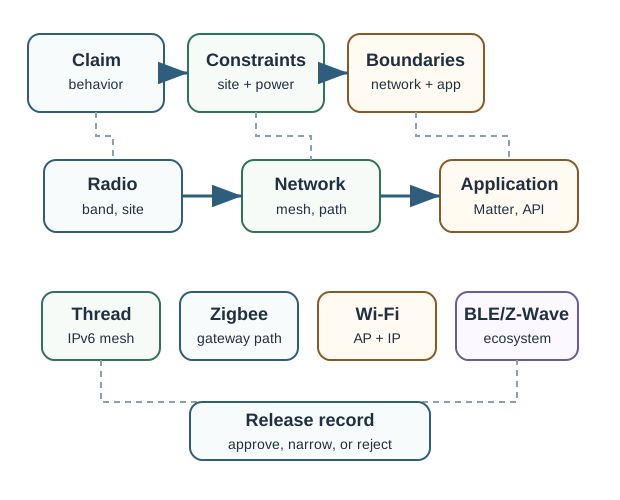
Thread
Low-power IEEE 802.15.4 mesh with IPv6 reachability through a routing Border Router.
Zigbee
Low-power IEEE 802.15.4 mesh with a mature non-IP application ecosystem and translating gateway boundary.
Bluetooth LE
Short-range, phone-friendly interaction path where proximity and pairing are part of the product behavior.
Wi-Fi
Higher-bandwidth IP path for powered devices where access-point coverage, security policy, and throughput dominate.
26.9 Thread Versus Zigbee
This section: Thread Versus Zigbee — Thread and Zigbee are often compared because both may sit on the IEEE 802.15.4 radio family.
Thread and Zigbee are often compared because both may sit on the IEEE 802.15.4 radio family. That shared radio ancestry does not make them interchangeable.
Thread comparison evidence should focus on:
- Whether IPv6 addressing, routing, and Border Router behavior are part of the product claim.
- Whether Matter or another application layer has separate acceptance evidence.
- Whether commissioning, credentials, role behavior, and external service paths have owners.
- Whether the team can operate multiple Border Routers, partitions, and parent-child behavior without turning diagnostics into proof of product readiness.
Zigbee comparison evidence should focus on:
- Whether the deployment already has Zigbee controllers, gateways, devices, and support processes.
- Whether the application behavior is already expressed through Zigbee clusters or profiles.
- Whether gateway translation, bridge ownership, and controller compatibility are acceptable release boundaries.
- Whether the team is comparing a current Zigbee system to a future Thread system using the same site, device, and support assumptions.
The strongest Thread argument is usually not that the radio is inherently better. It is that IP-native mesh behavior, Border Router routing, and Matter application paths may reduce translation boundaries in a new design. The strongest Zigbee argument is usually not that old technology is automatically safer. It is that an existing deployment may already have proven devices, tooling, and operations evidence.
26.10 Low-Power IP Reachability Test
This section: Low-Power IP Reachability Test — A sharp Thread-versus-Zigbee test is: must the device be both a low-power mesh node and directly reachable as an IP endpoint without a protocol-translating gateway?
A sharp Thread-versus-Zigbee test is: must the device be both a low-power mesh node and directly reachable as an IP endpoint without a protocol-translating gateway? If yes, Thread is the stronger network-model candidate because the Border Router routes IPv6. If the actual release path depends on a mature Zigbee controller, gateway, and cluster ecosystem, Zigbee may still be the better evidence-backed choice.
26.11 Thread Versus Wi-Fi
This section: Thread Versus Wi-Fi — Thread and Wi-Fi answer different questions.
Thread and Wi-Fi answer different questions. Wi-Fi is often better when the product needs sustained bandwidth, direct access to existing IP networks, or a mains-powered device with mature enterprise network support. Thread is often better when a constrained device needs small messages, mesh reach, low-power states, and a bounded Border Router path.
Good comparison records avoid universal power or latency numbers. The useful question is: what traffic, power state, reporting interval, association behavior, and recovery expectation did the team actually test?
Use Thread when the evidence shows:
- Small messages, tolerant timing, and constrained-device power behavior.
- Mesh or parent-child behavior matters more than high throughput.
- The off-mesh path can be owned through one or more Border Routers.
- The application claim is compatible with Matter or another suitable application layer.
Use Wi-Fi when the evidence shows:
- The device has adequate power for Wi-Fi association and retransmission behavior.
- The data volume, media behavior, or local IP integration needs Wi-Fi’s higher capacity path.
- Existing access points, security policy, segmentation, and support processes are the release boundary.
- A mesh of constrained sleepy devices is not the main requirement.
26.12 Thread Versus Bluetooth LE
This section: Thread Versus Bluetooth LE — Bluetooth LE is strongest when the phone or a nearby controller is part of the normal interaction.
Bluetooth LE is strongest when the phone or a nearby controller is part of the normal interaction. It is a good fit for many peripherals, wearables, commissioning helpers, proximity tasks, and short-range exchanges. Thread is stronger when the product claim needs a persistent low-power mesh with an owned IP path beyond phone proximity.
Ask these questions before selecting either path:
- Is the phone present for every required runtime behavior?
- Does the product need remote behavior when no phone is nearby?
- Is gateway ownership acceptable, or does the product require a normal IP path through a Border Router?
- Is the interaction short and user-driven, or periodic and infrastructure-driven?
- Is the comparison about runtime networking, commissioning, or both?
26.13 Thread Versus Z-Wave
This section: Thread Versus Z-Wave — Z-Wave comparisons need more than a range slogan.
Z-Wave comparisons need more than a range slogan. A fair comparison records the local radio plan, device ecosystem, controller support, certification route, availability of installers, and operational expectations. Thread comparisons should record Border Router and Matter/controller boundaries with the same care.
Neither protocol is automatically correct from the name alone. A building with existing Z-Wave controller operations may have a stronger release record than a new Thread design that has not yet proven Border Router coverage, application behavior, or support ownership. A new Matter-focused design may make Thread easier to support if the Border Router and application path are part of the product environment.
26.14 Matter Changes the Question
This section: Matter Changes the Question — Matter does not make Thread and Wi-Fi the same.
Matter does not make Thread and Wi-Fi the same. Matter defines application behavior above the network. A Matter light, lock, sensor, or bridge still needs evidence for its transport path, commissioning path, access control, controller behavior, and failure handling.
For a Matter product, keep three records separate:
Transport record
Which network carries the messages: Thread, Wi-Fi, Ethernet, or a bridge path?
Fabric record
Which controllers, fabrics, credentials, ACLs, and commissioning handoffs are in scope?
Product record
Which application behavior, cluster, endpoint, firmware state, and user-facing feature is being accepted?
If a team says “Matter-ready,” ask which of those records is complete. A Thread transport result alone does not prove the Matter product claim.
26.15 Why Matter Favors Thread for Low-Power Mesh
This section: Why Matter Favors Thread for Low-Power Mesh — Thread and Zigbee both can use IEEE 802.15.4, so the reason Matter favors Thread for low-power mesh is not that the radio suddenly changed.
Thread and Zigbee both can use IEEE 802.15.4, so the reason Matter favors Thread for low-power mesh is not that the radio suddenly changed. The important difference is above the radio. Matter is IP-based, and Thread is IP-native, so a Matter message can traverse a Thread mesh through a routing Border Router. A non-IP mesh can still be bridged, but then the gateway or bridge becomes part of the product evidence record.
This does not mean “Thread equals Matter.” Matter still needs commissioning, fabric, ACL, endpoint, cluster, and controller evidence. It only means Thread is a natural low-power transport candidate when the product claim is a local IP-based Matter device rather than a translated legacy device path.
26.16 Knowledge Check: Which Evidence Path Fits?
This section: Knowledge Check: Which Evidence Path Fits?
26.17 Build a Comparison Record
This section: Build a Comparison Record — A comparison record should be short enough to maintain and specific enough to retest.
A comparison record should be short enough to maintain and specific enough to retest.
Claim: The device must report small state changes in a Matter environment after normal installation.
Thread evidence: Attachment, role, parent-child behavior, Border Router path, Matter commissioning, and product state report.
Zigbee evidence: Existing controller or bridge path, cluster behavior, gateway ownership, and ecosystem compatibility.
Wi-Fi evidence: Power budget, association behavior, coverage, security policy, and application report.
BLE evidence: Phone proximity, pairing, remote gateway need, and user interaction window.
Decision: Approve Thread only if the Border Router and Matter product record are in scope; otherwise narrow the claim.
Retest trigger: Changed controller, Border Router, firmware, placement, application layer, or support owner.
The record deliberately includes rejected candidates. Rejection reasons are useful evidence. They prevent the team from repeating the same comparison when a stakeholder asks later why a different protocol was not selected.

26.18 Worked Review: Existing Zigbee Site
This section: Worked Review: Existing Zigbee Site — A facility has an installed Zigbee lighting and sensing system.
A facility has an installed Zigbee lighting and sensing system. A new project asks whether to move the next sensor release to Thread.
Bad comparison: Thread is newer and Matter-focused, so all new sensors should migrate.
Better comparison: Existing Zigbee devices, gateways, scenes, support scripts, and operations records already prove the current release path. Thread may be a good future path, but migration needs evidence for controller compatibility, Border Router placement, Matter behavior, device commissioning, support ownership, and coexistence with the existing radio plan.
Decision: Keep the current Zigbee path for the release if the new product claim does not require Matter or IP-native mesh behavior. Start a separate Thread pilot if the next release claim depends on Matter interoperability or gateway reduction.
The decision is not anti-Thread. It is evidence-bound. It avoids replacing a proven release path with an unproven one just because a protocol name sounds more current.
26.19 Worked Review: New Matter Sensor
This section: Worked Review: New Matter Sensor — A product team is designing a new small sensor for a smart-home ecosystem and has no existing Zigbee installed base to preserve.
A product team is designing a new small sensor for a smart-home ecosystem and has no existing Zigbee installed base to preserve.
Bad comparison: Thread wins because it is the Matter protocol.
Better comparison: Matter can run over more than one transport path. For a constrained sensor, Thread may be the better network path if the design proves attachment, low-power behavior, Border Router routing, Matter commissioning, access control, and state reporting. Wi-Fi remains a candidate if the product has power and bandwidth reasons. BLE may remain a commissioning or local-interaction path, but not the full remote runtime path unless a gateway is included.
Decision: Select Thread for the runtime path only after the Border Router and Matter evidence records are part of the release gate.
26.20 Common Comparison Drift
This section: Common Comparison Drift
Feature-list drift
The comparison lists protocol features but never ties them to the product claim or release boundary.
Shared-radio confusion
The comparison treats Thread and Zigbee as identical because they can share radio technology, or treats them as completely unrelated because the application layers differ.
Matter overclaim
The comparison treats Matter support as proof of network reliability, power behavior, or product readiness.
Power-number drift
The comparison copies battery or current numbers without the traffic pattern, sleep state, firmware behavior, environment, and retest condition.
Gateway blind spot
The comparison praises or rejects a protocol without naming the Border Router, bridge, hub, controller, phone, or cloud boundary that actually owns the path.
Installed-base erasure
The comparison ignores existing devices, support tools, trained installers, controller rules, and operational records.
26.21 Protocol Comparison Checklist
This section: Protocol Comparison Checklist — Use this checklist before accepting a protocol decision.
Use this checklist before accepting a protocol decision.
Claim scoped
The comparison says what product behavior is being reviewed and what is outside scope.
Candidate evidence listed
Each candidate has the evidence it would need, not only a feature label.
Boundary named
Border Router, gateway, controller, bridge, phone, dashboard, and cloud responsibilities are explicit.
Application separated
Matter, Zigbee clusters, BLE profiles, web APIs, and product behavior are not confused with the network layer.
Rejection reasons recorded
Rejected protocols have evidence-based reasons and retest triggers.
Release owner assigned
Someone owns the decision record and knows when it must be retested.
26.22 Knowledge Check: Existing System Decision
This section: Knowledge Check: Existing System Decision
26.23 Match the Evidence
This section: Match the Evidence
26.24 Order the Comparison Review
This section: Order the Comparison Review
26.25 Summary
This section: Summary
Thread protocol comparison is strongest when it is evidence based:
- Thread is a strong candidate for constrained IPv6 mesh designs, especially when the product claim includes Matter and an owned Border Router path.
- Zigbee remains a strong candidate when installed infrastructure, profiles, controllers, gateways, and operations records already support the release claim.
- Wi-Fi is a strong candidate for powered, higher-bandwidth, direct-IP products where access-point and security-policy evidence is in scope.
- Bluetooth LE is a strong candidate for phone-proximity, peripheral, commissioning, and short-interaction claims, but remote runtime behavior needs gateway evidence.
- Z-Wave comparisons need ecosystem, controller, regional, certification, installation, and operations evidence.
- Matter changes the application-layer comparison, but it does not remove the need to prove the underlying transport and release path.
26.26 Key Takeaway
This section: Key Takeaway — Thread Protocol Comparison Evidence should compare Thread against alternatives using IPv6 mesh behavior, power, roles, security, Matter fit, operations, and deployment evidence.
Thread Protocol Comparison Evidence should compare Thread against alternatives using IPv6 mesh behavior, power, roles, security, Matter fit, operations, and deployment evidence.
26.27 Concept Relationships
This section: Concept Relationships
- Thread and Zigbee both need radio and deployment evidence, but Thread comparison emphasizes IPv6 mesh and Border Router boundaries while Zigbee comparison emphasizes controller, gateway, and application-profile boundaries.
- Thread and Wi-Fi both can support IP-connected systems, but their evidence differs around power state, traffic volume, infrastructure ownership, and mesh behavior.
- Thread and Bluetooth LE often work in different parts of the same product story: Thread for persistent infrastructure behavior, BLE for proximity, commissioning, or peripheral interaction.
- Thread and Matter are not the same layer. Matter product evidence must be kept separate from Thread network evidence.
- Protocol selection and deployment review connect through the decision record: assumptions, owner, rejection reasons, and retest triggers keep the comparison from drifting into marketing claims.
26.28 What’s Next
This section: What’s Next
- Thread Review Protocol Comparison extends this comparison into review-style practice questions and worked examples.
- Thread Security and Matter reviews how Thread security evidence connects to Matter application boundaries.
- Thread Deployment Guide turns a selected Thread path into site, Border Router, and operational release evidence.
- Zigbee Review Protocol Selection applies similar evidence discipline from the Zigbee side of the protocol decision.
Find help
3 reviewed answers.
Where should I start in a module?
Open the module page from the sidebar to see its chapters in order. Use the module map to return to a topic you need.
Modules and pathsReviewed
What can I try when a project does not work?
Check the symptom, then work through the diagnostic steps. Keep the error message and the smallest example that reproduces it.
When you are stuckReviewed
How do interactive examples work?
Use the interactive guide to check how examples and simulations work before changing your project.
Interactive examples guideReviewed