33 The Smart-Home Fragmentation Problem
More
Depth: Practitioner
Progress saves as you read. Mark sections complete as you go; your progress appears in the sidebar.
33.1 Start With the Device Experience
This section: Start With the Device Experience — Imagine a home with a lamp, lock, and motion sensor from different makers.
Imagine a home with a lamp, lock, and motion sensor from different makers. Each device works in its own app, yet one shared “leave home” action cannot control all three. The problem is not only the radio. The devices may use different setup steps, names, trust rules, and cloud services.
Start by listing those separate islands. Test setup, local control, shared control, loss of the internet, a second home admin, and a bridge to an older device. Record which part works directly and which part depends on a vendor or bridge.
Matter gives products a shared application language and setup path. It does not replace the underlying network, update policy, device quality, or every older product. A Matter logo also does not prove that one specific feature works across every chosen platform.
Go deeper in two steps. The Practitioner sections collect each evidence family and worked review record. Under the Hood explains the application-layer fix, shared admins, bridges, and local-control limits.
Make one row for each product. Name its setup tool, main app, network, trust owner, local control, cloud need, update path, and removal path. Add the exact feature that the shared home action needs. Do not replace a blank with a guess.
Test one new product first. Add it to the first home. Share it with a second admin. Use it from a second platform. Turn off the internet. Remove and add it again. Keep the result for each feature, not just the setup result.
Then test an old product through a bridge. Mark which features the bridge maps and which it does not. Restart the bridge. Remove its cloud path. Check who owns its update. A bridge can help a move, but it can also keep an old trust or service link in the new home.
Write the release claim in narrow words. State the tested products, versions, platforms, features, and failure cases. Add a retest trigger for an update or new admin. This keeps “works with Matter” from becoming a claim that the evidence never proved.
Use one plain home task as the first check. Add a lamp from one maker and a motion sensor from another. Set a rule that turns on the lamp after motion. Run it from each approved home app. Keep the setup and run result for both.
Now change one thing at a time. Add a second admin. Turn off the outside link. Restart the border unit. Update the lamp. Remove and add the sensor. Check that the rule, names, rights, and local path still match the claim.
Try one feature that is not shared. The lamp may have a maker-only scene or effect. Mark it as outside the common claim. Do not call the whole device bad, and do not hide the gap. A clear edge helps people choose the right app or product.
Finish with a home support note. State who fixes setup, the local network, the bridge, the maker cloud, and the common app. Give each fault a first check. Shared use becomes real when the home can recover, not only when setup passes once.
Start with a user expecting a Matter device to join, advertise, and respond through a controller without caring which vendor built each piece. The Smart-Home Fragmentation Problem is the evidence route for deciding whether that expectation is realistic.
Keep one device story in view: commissioning, fabric membership, interaction model, transport, and certification all have to line up. The advanced details are useful when they explain where that story can break.
33.2 Matter Fragmentation Evidence
This section: Matter Fragmentation Evidence — Matter was created because smart-home devices could be close together physically while remaining separated by ecosystem, app, cloud, hub, data-model, commissioning, and security boundaries.
Matter was created because smart-home devices could be close together physically while remaining separated by ecosystem, app, cloud, hub, data-model, commissioning, and security boundaries. The problem was not only that users had too many apps. It was that controllers, devices, bridges, and services often lacked a shared way to identify devices, commission them securely, describe capabilities, authorize control, and operate locally.
This chapter reviews fragmentation as an evidence problem. It explains what a reviewer should prove before saying “Matter solves this” and what should remain outside the claim.
33.3 In 60 Seconds
This section: In 60 Seconds
- Pre-Matter smart homes often split devices across ecosystem-specific apps, hubs, clouds, data models, and certification paths.
- Fragmentation can appear as setup friction, controller lock-in, duplicated automations, missing cross-vendor control, cloud dependency, or stale bridge mappings.
- Matter addresses the application interoperability layer with a common data model, secure commissioning, local IPv6 operation, and multi-admin fabrics.
- Matter does not make every product support every feature, remove the need for Thread border routers, or automatically fix legacy bridge behavior.
- Transport and application claims must stay separate: Thread, Wi-Fi, Ethernet, and bridge paths do not prove the same evidence.
- A strong review states the fragmentation problem, the Matter mechanism that addresses it, the remaining boundary, and the retest trigger.
33.4 Learning Objectives
This section: Learning Objectives
By the end of this chapter, you will be able to:
- Explain smart-home fragmentation without reducing it to app count or brand preference.
- Separate ecosystem, data-model, transport, commissioning, security, and operations evidence.
- Identify which Matter mechanisms address which fragmentation symptoms.
- Recognize claims that Matter should not be asked to prove.
- Write a bounded interoperability decision for a Matter migration, bridge, or controller rollout.
33.5 Quick Check: Matter Fragmentation
This section: Quick Check: Matter Fragmentation
33.6 Prerequisites
This section: Prerequisites
This chapter assumes you have reviewed:
- Matter Overview, for Matter’s purpose and smart-home context.
- Thread Network Architecture, for the mesh transport often used by battery Matter devices.
- Matter Architecture Evidence, for nodes, fabrics, controllers, bridges, and endpoint boundaries.
- Matter Device Types and Clusters Evidence, for endpoint, device-type, cluster, feature, and behavior evidence.
33.7 Fragmentation Review Claim
This section: Fragmentation Review Claim — The claim is deliberately bounded.
Use a claim that can be checked against records:
Matter fragmentation review claim: A Matter migration or product decision is justified only when the existing fragmentation symptom, the affected users or devices, the Matter mechanism that addresses it, the remaining non-Matter boundary, and the retest trigger are all recorded.
The claim is deliberately bounded. Matter improves interoperability at the application layer, but a reviewer still needs evidence for the chosen transport, device type, fabric, bridge, controller, and operating condition.
33.8 Fragmentation Evidence Map
This section: Fragmentation Evidence Map — The first figure shows how to move from a vague fragmentation complaint to a reviewable Matter decision.
The first figure shows how to move from a vague fragmentation complaint to a reviewable Matter decision.
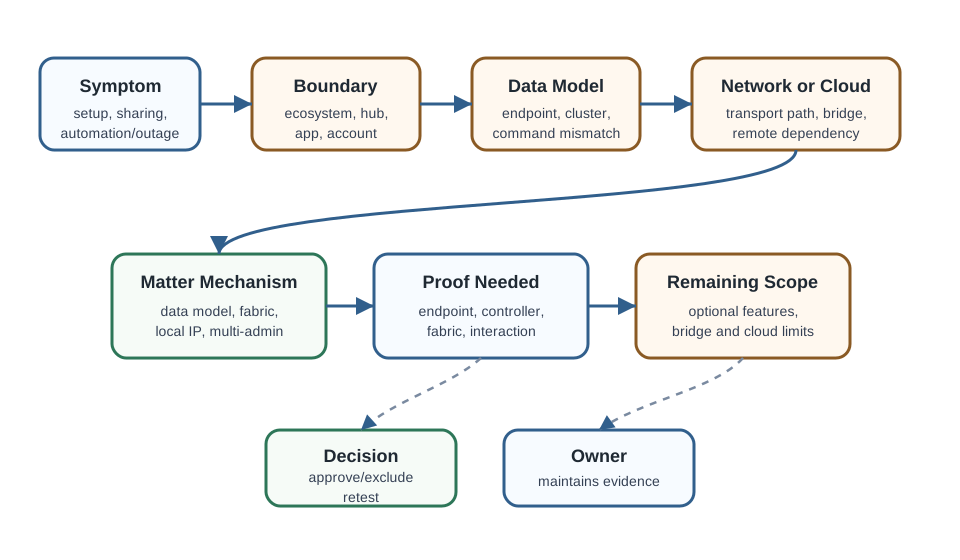
This map keeps the review honest. “It does not work across apps” might mean incompatible data models, unsupported device types, wrong fabric membership, missing bridge evidence, network reachability failure, or controller UI limitations.
33.9 Pre-Matter Control Islands
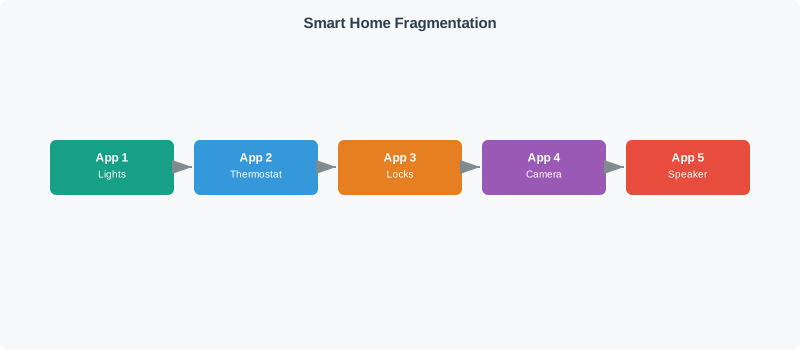
This section: Pre-Matter Control Islands — The fragmentation problem was visible to users as a row of separate control islands: one app for lights, another for thermostats, another for locks, another for cameras, and another for media devices.
The fragmentation problem was visible to users as a row of separate control islands: one app for lights, another for thermostats, another for locks, another for cameras, and another for media devices. The deeper issue was that each island also carried its own data model, onboarding path, trust domain, cloud dependency, and operations record.
33.10 Evidence Families
This section: Evidence Families — Fragmentation review needs several evidence families.
Fragmentation review needs several evidence families.
33.11 Why Fragmentation Happened
This section: Why Fragmentation Happened — Smart-home fragmentation grew from several design choices that were reasonable inside one ecosystem but painful across ecosystems.
Smart-home fragmentation grew from several design choices that were reasonable inside one ecosystem but painful across ecosystems.
33.12 Separate Application Models
This section: Separate Application Models — Different platforms described devices in different ways.
Different platforms described devices in different ways. A light, sensor, lock, thermostat, or switch could expose similar real-world behavior while presenting different APIs, attributes, permissions, and automation semantics. Without a shared data model, controllers had to guess, translate, or ignore behavior.
33.13 Separate Commissioning Paths
This section: Separate Commissioning Paths — Many devices were onboarded through ecosystem-specific apps or hubs.
Many devices were onboarded through ecosystem-specific apps or hubs. Setup could work well inside one ecosystem while remaining difficult to transfer or share with another. The setup experience became part of the lock-in.
33.14 Separate Trust Domains
This section: Separate Trust Domains — Each ecosystem had its own account, credential, permission, and owner model.
Each ecosystem had its own account, credential, permission, and owner model. That separation helped each platform secure its own environment, but it made cross-ecosystem administration difficult. A device controlled in one app was not automatically safe or authorized in another.
33.15 Separate Network Assumptions
This section: Separate Network Assumptions — Some devices depended on Wi-Fi, some on low-power mesh networks, and some on proprietary bridges.
Some devices depended on Wi-Fi, some on low-power mesh networks, and some on proprietary bridges. Transport differences are not bad by themselves, but they became a source of fragmentation when the application layer and operations model also differed.
33.16 Separate Cloud and Lifecycle Dependencies
This section: Separate Cloud and Lifecycle Dependencies — Some product experiences relied on vendor cloud services for control, automation, diagnostics, or account linking.
Some product experiences relied on vendor cloud services for control, automation, diagnostics, or account linking. That made local behavior, privacy expectations, product retirement, and outage recovery hard to reason about.
33.17 What Matter Changes
This section: What Matter Changes — Matter addresses fragmentation by standardizing the application interoperability layer while still allowing different physical transports and product designs.
Matter addresses fragmentation by standardizing the application interoperability layer while still allowing different physical transports and product designs.
These mechanisms address different parts of fragmentation. A common data model helps controllers understand behavior. Secure commissioning helps onboarding. Local operation helps resilience. Multi-admin helps ecosystem choice. None of those mechanisms proves all the others automatically.
33.18 Before and After Matter
This section: Before and After Matter — The practical review should compare the old boundary with the new Matter evidence, not just ask whether the logo is present.
The practical review should compare the old boundary with the new Matter evidence, not just ask whether the logo is present.
| Concern | Before Matter | With Matter Evidence |
|---|---|---|
| Buying a device | Check whether the product works with one specific ecosystem. | Verify the certified device type, clusters, features, controller support, and excluded behavior. |
| Apps and hubs | Multiple apps, account models, bridges, and protocol-specific hubs. | A device can be commissioned into compatible ecosystems, but each fabric and controller still needs evidence. |
| Protocols | Zigbee, Z-Wave, proprietary Wi-Fi cloud paths, and bridges stayed separate. | Matter uses a common data model over IP transports such as Thread, Wi-Fi, Ethernet, or a bridge path. |
| Control | Local behavior was often mixed with vendor cloud behavior. | Local Matter control can be proven separately from remote access, account services, updates, and vendor extensions. |
Multi-admin is the clearest cross-ecosystem example: a single Matter device can be shared with more than one administrative fabric, so different controllers can operate the same physical endpoint under their own credentials and access-control records. That is not credential copying, and it is not proof that every controller exposes identical UI behavior.
33.19 Why the Application Layer Is the Fix
This section: Why the Application Layer Is the Fix — Matter does not solve fragmentation by replacing every radio.
Matter does not solve fragmentation by replacing every radio. Fragmentation persisted because incompatibilities appeared at several layers at once: device description, commissioning, authorization, interaction behavior, bridge mapping, cloud dependency, and operations ownership. A common radio alone would still leave incompatible device models and trust records.
Matter standardizes the layer where controllers and devices need to agree: nodes, endpoints, device types, clusters, attributes, commands, events, commissioning, fabrics, secure sessions, and interaction patterns. A Thread light and a Wi-Fi light can therefore present comparable Matter behavior to a controller even though their transport paths differ.
33.20 What Matter Does Not Prove Alone
This section: What Matter Does Not Prove Alone — Matter is not a universal guarantee.
Matter is not a universal guarantee. A careful review should not overstate it.
- Matter support does not mean every optional device feature is supported.
- A Thread border router is network infrastructure, not a proprietary application hub replacement for every scenario.
- A bridge can expose legacy devices through Matter, but the bridge can still hide, remap, or limit child-device behavior.
- A controller UI may choose not to show every standard capability even when the endpoint exposes it.
- A product can be Matter-certified for one device type without supporting unrelated device types or vendor-specific behavior.
- Local operation can still depend on local network health, controller availability, fabric credentials, ACLs, and firmware behavior.
33.21 Interoperability Scope Check
This section: Interoperability Scope Check
33.22 Before-Matter Evidence
This section: Before-Matter Evidence — A pre-Matter review should describe the actual fragmentation symptom, not just the brand names involved.
A pre-Matter review should describe the actual fragmentation symptom, not just the brand names involved.
This approach avoids vague claims such as “Matter fixes everything.” It also prevents a network migration from being mistaken for an interoperability migration.
33.23 Matter Response Record
This section: Matter Response Record — The second figure shows the review record for connecting a fragmentation symptom to a Matter response.
The second figure shows the review record for connecting a fragmentation symptom to a Matter response.
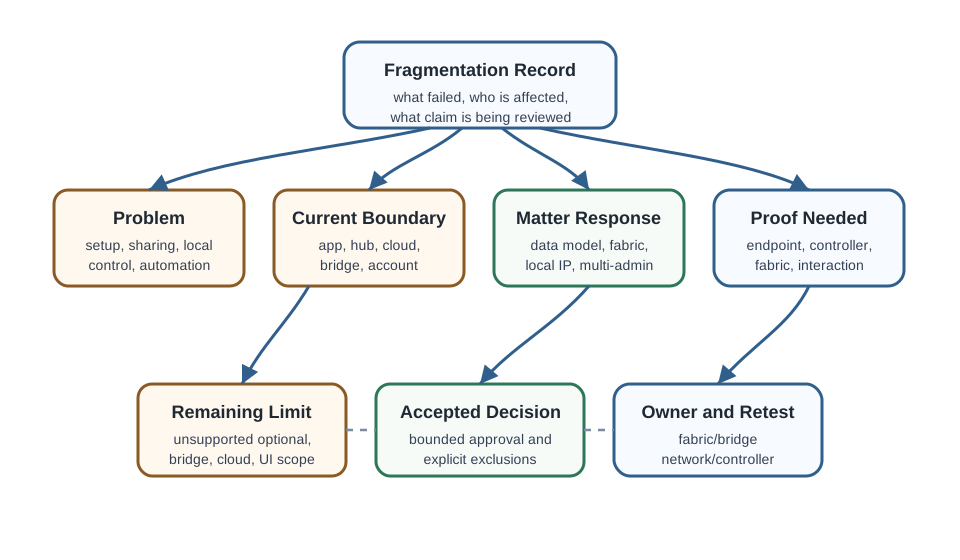
Use this record when a team proposes Matter as the answer to a product, deployment, or support problem. The record should make the accepted scope and the remaining boundary visible.
33.24 Multi-Admin Is Not a Shortcut
This section: Multi-Admin Is Not a Shortcut — Multi-admin is one of Matter’s most important responses to ecosystem lock-in.
Multi-admin is one of Matter’s most important responses to ecosystem lock-in. It allows a device to be commissioned into more than one fabric, so different ecosystems can control the same physical device through separate credentials.
That does not mean all administrators have the same permissions or that every controller shows the same behavior. A multi-admin review still needs evidence for:
- Which fabrics the device joined.
- Which controller or administrator owns each fabric.
- Which endpoint and device type each controller can see.
- Which interactions each controller can perform.
- Which ACLs, owner records, and retest triggers apply.
The strongest statement is not “the device works everywhere.” It is “the reviewed device, fabric, endpoint, and interaction worked for these controllers under these conditions.”
33.25 Bridges and Legacy Devices
This section: Bridges and Legacy Devices — Matter can reduce fragmentation for legacy devices through bridges.
Matter can reduce fragmentation for legacy devices through bridges. A bridge can represent devices that use another technology as Matter endpoints. This is useful, but it creates a review boundary.
Bridge evidence should answer:
- Which physical or logical child device is represented by each Matter endpoint?
- Which device type and clusters are exposed for the child endpoint?
- Which behavior is native, translated, limited, cached, or unsupported?
- Which bridge firmware, child-device pairing, or endpoint remapping would require retest?
Bridge approval should not say that the legacy device became fully native Matter. It should say what the bridge exposed and what was verified.
33.26 Local Control and Cloud Boundaries
This section: Local Control and Cloud Boundaries — Matter is designed for local operation over IP, but local control still needs evidence.
Matter is designed for local operation over IP, but local control still needs evidence. A reviewer should check whether the required controller, fabric, network path, border router, endpoint, command, and subscription behavior work without relying on a remote cloud path for the reviewed operation.
Cloud services may still provide account features, remote access, updates, analytics, voice integration, or vendor-specific functions. Those features should remain separate from the local Matter control claim.
33.27 Worked Review Records
This section: Worked Review Records
33.28 Record 1: Cross-Ecosystem Light Control
This section: Record 1: Cross-Ecosystem Light Control
Scenario: A household wants one lighting device to be controlled from two ecosystems without replacing the device for each platform.
Evidence found: The device can join the first fabric, open a commissioning window for a second administrator, expose the same lighting endpoint and clusters to both controllers, and accept the reviewed on/off and level interactions locally.
Decision: Approve the multi-admin lighting claim for the reviewed endpoint and interactions. Keep scenes, color behavior, remote access, and untested controllers outside the approval.
33.29 Record 2: Bridge-Based Migration
This section: Record 2: Bridge-Based Migration
Scenario: A building has legacy sensors behind a bridge and wants a Matter controller to use them in automations.
Evidence found: The bridge exposes each child sensor as a Matter endpoint with descriptor and cluster evidence. One child endpoint lacks the event behavior expected by the automation.
Decision: Approve only the child endpoints and behaviors that were evidenced. Keep the missing event behavior and any endpoint remapping as open migration risks.
33.30 Record 3: Local Operation Claim
This section: Record 3: Local Operation Claim
Scenario: A product team claims that Matter removes the core cloud dependency for lock state and lock operation inside the home.
Evidence found: Local controller-to-device interactions succeed on the reviewed fabric and endpoint, while remote access and account notifications still use cloud services.
Decision: Approve the local lock operation claim for the reviewed local path. Exclude remote access, account services, and notification delivery from the local-control claim.
33.31 Common Mistakes
This section: Common Mistakes
- Treating Matter as a brand badge instead of an evidence-backed interoperability claim.
- Saying Thread support proves Matter support.
- Saying Matter support proves every optional feature, UI behavior, automation, or vendor extension.
- Treating a bridge as if every child device became native Matter.
- Treating one controller’s success as proof that every ecosystem, fabric, and administrator will behave the same way.
- Ignoring cloud services that still support remote access, accounts, updates, analytics, or vendor-specific behavior.
- Reusing stale descriptor or endpoint records after firmware, bridge, fabric, or controller changes.
- Using outdated market statistics, hub counts, or cost claims instead of reviewing the actual deployment boundary.
33.32 Match the Fragmentation Evidence
This section: Match the Fragmentation Evidence
33.33 Order the Fragmentation Review
This section: Order the Fragmentation Review
33.34 Release Checklist
This section: Release Checklist — Use this checklist before accepting a Matter fragmentation claim.
Use this checklist before accepting a Matter fragmentation claim.
33.35 Approval Decision Check
This section: Approval Decision Check
33.36 Summary
This section: Summary — Smart-home fragmentation is a boundary problem.
Smart-home fragmentation is a boundary problem. Devices can be physically nearby while separated by application models, commissioning paths, trust domains, transports, bridges, clouds, and operations ownership. Matter addresses key parts of that problem with a common data model, secure commissioning, local IPv6 operation, and multi-admin fabrics.
The review discipline is scope. Do not say “Matter fixes fragmentation” without naming the symptom, the Matter mechanism, the proof, the remaining limitation, and the retest trigger.
33.37 Key Takeaway
This section: Key Takeaway — Matter Fragmentation Evidence should align Matter protocol stack, fabrics, commissioning, clusters, transports, interoperability, certification, and deployment evidence.
Matter Fragmentation Evidence should align Matter protocol stack, fabrics, commissioning, clusters, transports, interoperability, certification, and deployment evidence.
33.38 Concept Relationships
This section: Concept Relationships
- Matter Overview introduces the purpose and ecosystem context behind Matter.
- Matter Architecture Evidence explains the node, controller, fabric, bridge, and endpoint boundaries behind interoperability decisions.
- Matter Protocol Stack Evidence explains how transport, secure session, interaction, and data-model evidence fit together.
- Matter Device Types and Clusters Evidence shows how endpoint behavior is approved through device types, clusters, features, and interactions.
33.39 What’s Next
This section: What’s Next — Next, Matter Architecture Evidence turns the fragmentation problem into a concrete architecture review: nodes, fabrics, controllers, bridges, transports, endpoint models, and bounded operating decisions.
Next, Matter Architecture Evidence turns the fragmentation problem into a concrete architecture review: nodes, fabrics, controllers, bridges, transports, endpoint models, and bounded operating decisions. Later, Matter Transport Platforms separates Thread, Wi-Fi, Ethernet, and bridge path evidence from application interoperability evidence.
Find help
3 reviewed answers.
Where should I start in a module?
Open the module page from the sidebar to see its chapters in order. Use the module map to return to a topic you need.
Modules and pathsReviewed
What can I try when a project does not work?
Check the symptom, then work through the diagnostic steps. Keep the error message and the smallest example that reproduces it.
When you are stuckReviewed
How do interactive examples work?
Use the interactive guide to check how examples and simulations work before changing your project.
Interactive examples guideReviewed