34 Matter Protocol Stack

More
Depth: Practitioner
Progress saves as you read. Mark sections complete as you go; your progress appears in the sidebar.
Matter interoperability depends on two connected review surfaces: the protocol stack that carries protected messages, and the data model that names what those messages mean. A useful review does not stop at saying that Matter is IP-based or cluster-based. It checks the transport boundary, session state, message reliability, interaction path, endpoint structure, cluster support, attribute and command behavior, and the evidence that proves a controller will see the same device model another controller sees.
This chapter reviews Matter protocol stack and data-model evidence for advanced learners. It focuses on transport independence, IPv6 reachability, message and exchange behavior, MRP reliability, secure sessions, the interaction model, the data-model hierarchy, endpoint-cluster conformance, and bounded approval decisions.
34.1 Start With the Device Experience
This section: Start With the Device Experience — Picture a tenant who adds a new door sensor and expects a hall light from another maker to react.
Follow One Action Through the Whole Stack
Picture a tenant who adds a new door sensor and expects a hall light from another maker to react. The phone says both devices joined, but the light stays dark after the door opens. The product owner must find which layer accepted the device and which layer failed the action.
Write one user action as a trace. Name the device, its shared home, the target function, the person allowed to act, and the result the user should see. Then follow join, trust, session, request, device path, reply, and visible outcome. Keep the same time and device identity across each record.
Test a wrong device path, a missing feature, an expired session, a lost reply, a repeated request, and a sleeping device that wakes late. Check that a rejected action is clear and safe. Being able to reach a device does not prove that the action is allowed or supported.
Keep local safety independent of a distant service. A lock, heater, or alarm must retain its safe rule when a phone or remote account is unavailable.
This opening does not certify two products or cover every stack detail. Practitioner maps the user action to test evidence. Under the Hood separates message exchange, secure sessions, data paths, retries, and the limits that each layer owns.
Use a short release check. Can the team name the action? Does each step keep the same device and time? Does a denied act stay safe? Can a second person repeat the trace? Is each open gap owned? If any answer is no, stop and repair the record.
Start with a user expecting a Matter device to join, advertise, and respond through a controller without caring which vendor built each piece. Matter Protocol Stack is the evidence route for deciding whether that expectation is realistic.
Keep one device story in view: commissioning, fabric membership, interaction model, transport, and certification all have to line up. The advanced details are useful when they explain where that story can break.
34.2 In 60 Seconds
This section: In 60 Seconds
- Matter separates application behavior from the underlying Thread, Wi-Fi, or Ethernet network path.
- IPv6 reachability is necessary but not enough. Review also needs secure-session, exchange, interaction, and data-model evidence.
- MRP adds reliability behavior for Matter messages over UDP paths, but the approval should still be bounded by retry, duplicate, timeout, and sleepy-device evidence.
- PASE and CASE evidence belongs to the secure-session layer; it should not be confused with link-layer security or application authorization.
- The data model organizes a node into endpoints, clusters, attributes, commands, and events.
- Endpoint 0 is the root and utility area; application endpoints expose device functions.
- A clean approval states the stack boundary, target path, cluster evidence, device-type expectation, interaction outcome, and retest trigger.
34.3 Learning Objectives
This section: Learning Objectives
By the end of this chapter, you will be able to:
- Review Matter stack evidence without collapsing transport, session, message, interaction, and data-model responsibilities.
- Explain how the same application model can run over different IP-capable network paths.
- Evaluate data-model evidence for nodes, endpoints, clusters, attributes, commands, events, and device types.
- Identify wrong-layer, wrong-endpoint, unsupported-cluster, stale-descriptor, and overbroad-conformance claims.
- Write bounded protocol-stack and data-model review decisions with accepted evidence, open gaps, and retest triggers.
34.4 Quick Check: Matter Stack
This section: Quick Check: Matter Stack
34.5 Prerequisites
This section: Prerequisites
This chapter assumes you have reviewed:
- Matter Overview, for why Matter exists and where it fits in the smart-home protocol landscape.
- Matter Architecture, for nodes, fabrics, controllers, bridges, and ecosystems.
- Matter Interaction Evidence, for Read, Write, Subscribe, Invoke, Timed Request, and commissioning flow.
- Matter Fabric Security Evidence, for PASE, CASE, operational certificates, and ACL boundaries.
- Thread Network Architecture, for the low-power mesh path that often carries Matter over Thread.
34.6 Protocol Stack Review Claim
This section: Protocol Stack Review Claim — The claim is intentionally narrow.
Use a claim that can be checked against records:
Matter stack review claim: A Matter device model is ready for the reviewed scenario only when the network path, secure session, message reliability behavior, interaction target, endpoint-cluster structure, attribute or command semantics, device-type expectation, and retest trigger all support the same bounded approval.
The claim is intentionally narrow. Evidence that a device has an IPv6 address does not prove cluster conformance. Evidence that a controller established a secure session does not prove the requested command exists. Evidence that one endpoint works does not prove a bridge or multi-endpoint device is modeled correctly.
34.7 Stack Evidence Map
This section: Stack Evidence Map — The first figure shows the evidence path from network transport to application approval.
The first figure shows the evidence path from network transport to application approval.
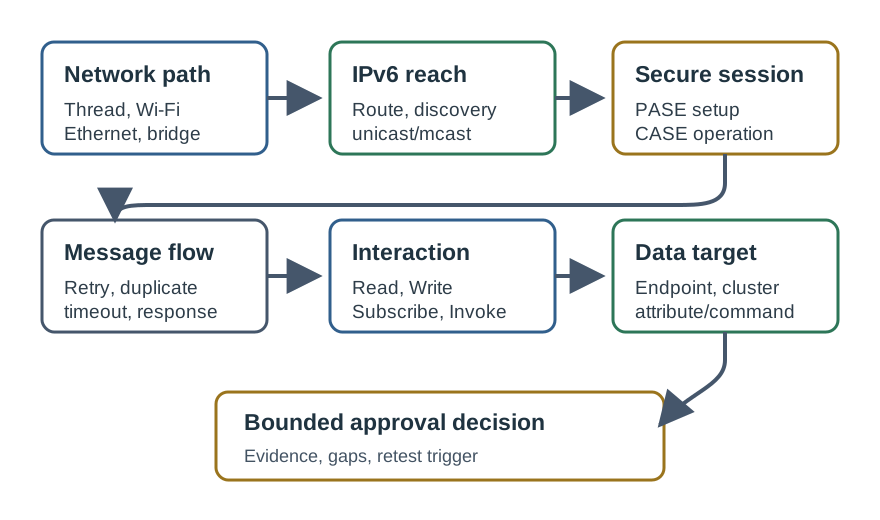
This map prevents a common review failure: approving the whole Matter stack from one visible app action. The reviewer needs to know which layer supplied which evidence and which layer remains unproven.
34.8 Evidence Families
This section: Evidence Families — Matter stack and data-model review needs several evidence families.
Matter stack and data-model review needs several evidence families.
34.9 Layer Boundaries
This section: Layer Boundaries — Good Matter review separates what each layer proves.
Good Matter review separates what each layer proves.
34.10 Portable Layer Stack
This section: Portable Layer Stack — The useful portability question is not whether Thread, Wi-Fi, Ethernet, and bridge paths behave identically.
The useful portability question is not whether Thread, Wi-Fi, Ethernet, and bridge paths behave identically. They do not. The question is whether the upper Matter layers keep the same meaning while each lower path supplies its own reachability, timing, reliability, and retest evidence.
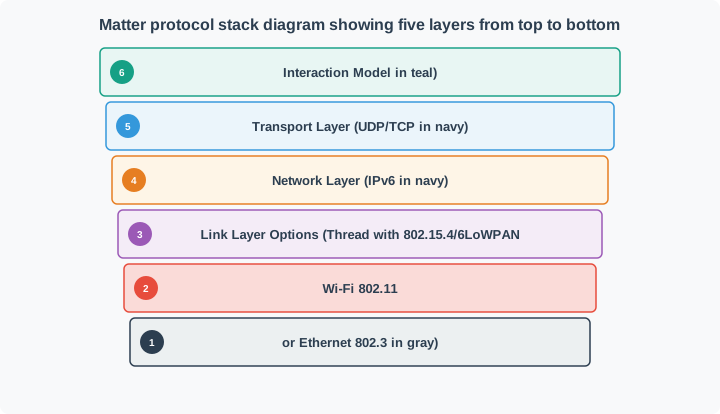
Operational Matter traffic uses the selected IP-capable network path. In practice that usually means Matter messages over IPv6/UDP with Matter reliability behavior; Bluetooth transport is commissioning evidence, not proof that the device remains controlled over BLE after it joins a fabric.
Layer separation is what makes the same application model portable. A controller should not need different On/Off cluster logic for a Thread light and a Wi-Fi light; it needs the same upper-layer path plus different lower-layer evidence about reachability, timing, and failures.
34.11 Layer Separation Check
This section: Layer Separation Check
34.12 Transport Independence Review
This section: Transport Independence Review — Matter aims to keep the application model stable across different network paths.
Matter aims to keep the application model stable across different network paths. That does not mean every path has identical performance, reliability, power behavior, or troubleshooting evidence.
For a transport-independence claim, review:
- Whether the same endpoint and cluster model appears through each supported path.
- Whether discovery and reachability evidence match the path under review.
- Whether sleepy-device, multicast, bridge, or border-router behavior changes the interaction evidence.
- Whether a path migration changes timing, retry, report, or subscription behavior.
- Whether the approval is scoped to one path or to several separately tested paths.
This keeps the claim bounded. “The light is Matter-compatible” is too broad. “Endpoint 1 exposes the expected On/Off and Level Control behavior over the reviewed Thread path, with CASE session, ACL, interaction, and report evidence” is reviewable.
34.13 Message Reliability Evidence
This section: Message Reliability Evidence — MRP and exchange behavior should be reviewed through outcomes, not slogans.
MRP and exchange behavior should be reviewed through outcomes, not slogans.
34.14 Security Layer Evidence
This section: Security Layer Evidence — Matter security should be reviewed at the right layer.
Matter security should be reviewed at the right layer.
PASE is commissioning bootstrap evidence. CASE is operational-session evidence. Link-layer security and Wi-Fi security may protect the network path, but they do not replace Matter secure-session evidence. Likewise, a CASE session does not replace ACL evidence for a command.
34.15 Data Model Evidence Path
This section: Data Model Evidence Path — The second figure shows the review path from node identity to exact data-model target.
The second figure shows the review path from node identity to exact data-model target.
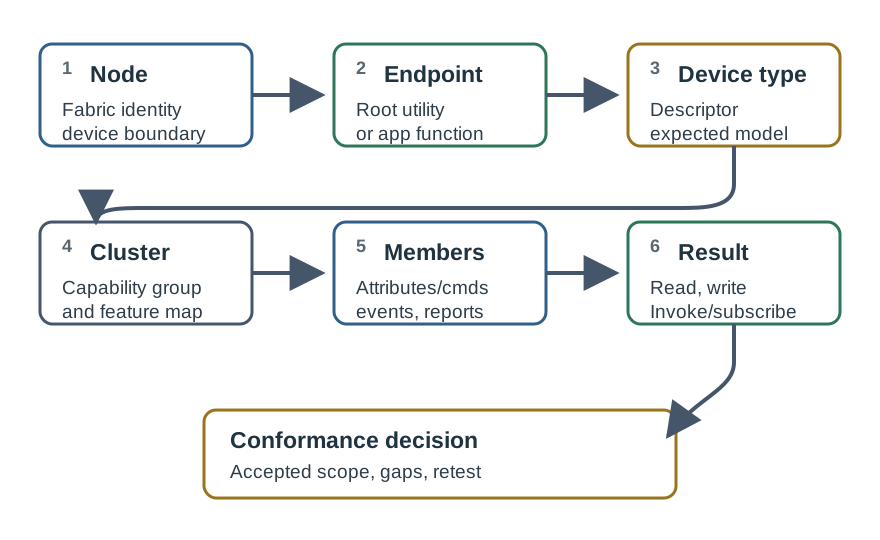
Data-model review should be precise enough that another reviewer can reproduce the target path. A product name, room name, or marketing device category is not enough.
34.16 Node and Endpoint Evidence
This section: Node and Endpoint Evidence — A Matter node is the addressable device identity within a fabric.
A Matter node is the addressable device identity within a fabric. Endpoints expose root utilities and application functions.
34.17 Cluster Evidence
This section: Cluster Evidence — Clusters are reusable capability groups.
Clusters are reusable capability groups. A review should identify which cluster instance is present on which endpoint and whether the required behavior for the scenario is implemented.
For each cluster under review, record:
- The endpoint that hosts the cluster.
- Whether the cluster is server-side, client-side, or both for the scenario.
- Which required and optional features are relevant.
- Which attributes are read, reported, persisted, or writable.
- Which commands are accepted, rejected, or unsupported.
- Which events are emitted and how they are consumed.
This catches a common modeling mistake: treating cluster names as universal proof. The same cluster type can appear on multiple endpoints, and each endpoint instance needs its own evidence.
34.18 Attribute Evidence
This section: Attribute Evidence — Attributes are data values.
Attributes are data values. Review them as typed, scoped, and access-controlled values.
34.19 Command Evidence
This section: Command Evidence — Commands are actions, not attributes.
Commands are actions, not attributes. An invoke review should preserve command identity, arguments, status, resulting state, and any timed requirement.
34.20 Device Type and Conformance Evidence
This section: Device Type and Conformance Evidence — Device type evidence connects a device’s claimed category to the clusters and behavior a controller can expect.
Device type evidence connects a device’s claimed category to the clusters and behavior a controller can expect.
34.21 Quick Stack Check
This section: Quick Stack Check
34.22 Worked Review Records
This section: Worked Review Records
34.23 Record 1: Multi-Outlet Device Modeled as One Endpoint
This section: Record 1: Multi-Outlet Device Modeled as One Endpoint
Scenario: A smart power strip claims independent outlet control, but the review record shows only one application endpoint with one On/Off cluster.
Evidence found: The physical device is reachable and secure sessions work, but the endpoint model does not prove independent control for each outlet.
Decision: Do not approve the multi-outlet model. Require descriptor and cluster evidence for each independently controlled application endpoint, plus interaction outcomes per endpoint.
34.24 Record 2: Bridge Endpoint Changes After Firmware Update
This section: Record 2: Bridge Endpoint Changes After Firmware Update
Scenario: A bridge exposes several devices. After firmware update, a controller sends a command to the previous endpoint and receives an unsupported-path response.
Evidence found: Network and CASE evidence are healthy. The endpoint mapping changed and the controller cache is stale.
Decision: Keep transport and session approved, but reopen data-model approval. Refresh descriptor evidence, endpoint mapping, cluster lists, and affected subscriptions.
34.25 Record 3: Attribute Read Accepted, Write Rejected
This section: Record 3: Attribute Read Accepted, Write Rejected
Scenario: A controller reads a level attribute but cannot write a new value.
Evidence found: The read path is valid, but the write record lacks proof of writable access, value constraints, and required ACL privilege.
Decision: Treat the write as unapproved until the attribute access, value boundary, privilege, status, and resulting report evidence are recorded.
34.26 Failure Signatures
This section: Failure Signatures — Classify failures by the layer where the evidence breaks.
Classify failures by the layer where the evidence breaks.
34.27 Common Mistakes
This section: Common Mistakes
-
Approving the whole stack because the device appears in a controller app.
-
Treating Thread, Wi-Fi, Ethernet, IPv6, Matter session, and Matter data model as one undifferentiated layer.
-
Assuming a secure CASE session authorizes every data-model operation.
-
Using one endpoint’s cluster evidence to approve another endpoint.
-
Treating product marketing category as device-type conformance evidence.
-
Ignoring descriptor changes after firmware updates or bridge reconfiguration.
-
Keeping command-line tutorials or code snippets where the chapter should explain evidence quality.
-
Using brittle packet-budget arithmetic as a universal design rule instead of reviewing measured behavior in the scenario.
34.28 Match the Stack Evidence
This section: Match the Stack Evidence
34.29 Order the Review Path
This section: Order the Review Path
34.30 Data Model Check
This section: Data Model Check
34.31 Review Checklist
This section: Review Checklist
Use this checklist before accepting a protocol-stack or data-model claim:
34.32 Summary
This section: Summary — Matter protocol-stack review is strongest when each layer keeps its job.
Matter protocol-stack review is strongest when each layer keeps its job. The network path proves reachability. The secure-session layer proves the right commissioning or operational session. Message and exchange evidence proves response, retry, duplicate, and timeout behavior. The interaction model proves how the controller accessed a target. The data model proves what the target means. A bounded approval ties those records to a specific endpoint, cluster, attribute, command, event, device-type expectation, and retest boundary.
34.33 Key Takeaway
This section: Key Takeaway — Matter Protocol Stack Evidence should align Matter protocol stack, fabrics, commissioning, clusters, transports, interoperability, certification, and deployment evidence.
Matter Protocol Stack Evidence should align Matter protocol stack, fabrics, commissioning, clusters, transports, interoperability, certification, and deployment evidence.
34.34 Concept Relationships
This section: Concept Relationships
- Network Path and Application Model: The same Matter data model can run over different IP-capable paths, but each path still needs evidence.
- PASE and CASE: PASE supports commissioning bootstrap; CASE supports operational sessions.
- MRP and UDP: MRP adds Matter-level reliability behavior for relevant UDP message exchanges.
- Endpoint and Cluster: Endpoints expose device functions; clusters group related attributes, commands, and events.
- Device Type and Conformance: Device type expectations should be supported by descriptor, cluster, feature, and behavior evidence.
- Interaction and Data Model: Interactions act on data-model paths; the path determines what is being read, written, subscribed to, invoked, or timed.
34.35 What’s Next
This section: What’s Next
- Matter Interaction Evidence applies the stack and data-model review to Read, Write, Subscribe, Invoke, Timed Request, and commissioning outcomes.
- Matter Fabric Security Evidence deepens the session, certificate, ACL, and multi-admin trust review.
- Matter Device Types and Clusters focuses on device-type expectations and cluster conformance.
- Matter Implementation connects these review records to production implementation work.
- Matter Device Implementation and Commissioning applies stack evidence to onboarding, recovery, and operational readiness.
Find help
3 reviewed answers.
Where should I start in a module?
Open the module page from the sidebar to see its chapters in order. Use the module map to return to a topic you need.
Modules and pathsReviewed
What can I try when a project does not work?
Check the symptom, then work through the diagnostic steps. Keep the error message and the smallest example that reproduces it.
When you are stuckReviewed
How do interactive examples work?
Use the interactive guide to check how examples and simulations work before changing your project.
Interactive examples guideReviewed