19 Zigbee 3.0, Matter, and Bridges
More
Depth: Practitioner
Progress saves as you read. Mark sections complete as you go; your progress appears in the sidebar.
19.1 In 60 Seconds
This section: In 60 Seconds — Zigbee is a low-power device network.
Zigbee is a low-power device network. A protocol is a set of rules for an exchange. Firmware is the code stored on the device.
Zigbee future and standards review is not a prediction exercise. It is an evidence exercise. A reviewer separates what a published Zigbee specification supports, what a Matter bridge exposes, what Thread provides as an IP mesh, what a product roadmap has actually committed to, and what must be retested before a standards claim is approved.
A strong review does not say that Zigbee is disappearing, that Matter automatically replaces Zigbee, or that a chip, hub, or version label proves migration readiness. It says which standards boundary was checked, which bridge or dual-protocol behavior was observed, which certification scope applies, and which change would reopen the decision.
19.2 Learning Objectives
This section: Learning Objectives
By the end of this chapter, you will be able to:
- review Zigbee standards claims without turning live market statements into durable course content,
- separate Zigbee, Thread, and Matter responsibilities in future-facing architecture decisions,
- evaluate bridge-mediated interoperability as a translation claim rather than native protocol equivalence,
- build migration evidence around hardware capability, firmware custody, certification scope, and support ownership, and
- define retest triggers for standards updates, bridge changes, controller changes, and product roadmap changes.
19.3 Quick Check: Zigbee Standards
This section: Quick Check: Zigbee Standards
19.4 Start With the Future Claim
This section: Start With the Future Claim — Picture a team told that an old device will work with a new home system.
Picture a team told that an old device will work with a new home system. The claim may depend on a hub, a bridge, a new test, or a new product.
First, name the device, software version, link, and user task. Then state which group or test backs each part of the claim.
A bridge can keep useful gear in service, but it may not carry each feature or trust rule. A road map can guide plans, but it is not proof of shipped support.
A Zigbee version claim needs the corresponding standards evidence and test case for the device profile in use.
Use the Practitioner sections to build a standards review record. Use the Under the Hood sections to inspect bridge, trust, test, and change limits in more depth.
Zigbee is a low-power device network. A protocol is a set of rules for an exchange. Firmware is the code stored on the device.
Plain check
- Name the exact device. Name the exact build. Name the user task. Name the claimed path.
- Check native support. Check bridge support. Keep those claims apart. Name each missing feature.
- Check the network role. Check the app role. Check the trust edge. Check the test scope.
- Save the source date. Save the test date. Mark the product state. Mark the road map state.
- Retest after code change. Retest after hub change. Retest after rule change. Keep old proof dated.
- Use Practitioner to record. Use deeper bridge checks. Test the weak edge. State each limit.
Begin by writing the claim in a form that can be approved or rejected.
Weak claim: Zigbee will be replaced by the newest smart-home standard.
Stronger claim: this deployed Zigbee device remains supported through this hub, exposes these behaviors through this bridge, follows this published specification boundary, and requires retest after bridge firmware, controller behavior, certification scope, or device firmware changes.
The stronger claim is reviewable. It separates evidence from market direction.
19.5 Standards Evidence Families
This section: Standards Evidence Families — Use these evidence families when a chapter, design review, or product plan makes a future-facing Zigbee claim.
Use these evidence families when a chapter, design review, or product plan makes a future-facing Zigbee claim.
Specification evidence identifies the published Zigbee, Matter, Thread, or related standard in scope. It should name the behavior being relied on, not just the standard family.
Implementation evidence shows what the actual device, hub, bridge, controller, firmware, and app do. A standards label does not prove complete behavior.
Bridge evidence shows which Zigbee clusters or commands are translated, which behavior is omitted, how failures appear, and who owns the bridge updates.
Certification evidence shows the scope of tested behavior. Certification for one device, role, bridge function, or software version should not be stretched to unrelated behavior.
Operations evidence shows support ownership, update custody, backup records, rollback or recovery path, monitoring, and retest triggers.
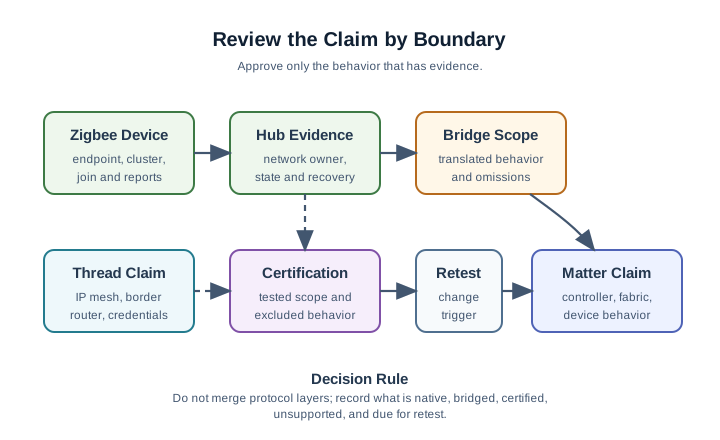
The boundary map keeps a future-facing claim reviewable. A Zigbee device claim needs endpoint and cluster evidence. A hub claim needs coordinator, trust-center, and controller evidence. A bridge claim needs translation evidence. Thread and Matter claims need their own network and application proof. Certification and retest boundaries tell the reviewer when a past approval is no longer enough.
19.6 Zigbee 3.0 Unification Boundary
This section: Zigbee 3.0 Unification Boundary — Zigbee 3.0 is often described as profile unification.
Zigbee 3.0 is often described as profile unification. In a standards review, that statement is useful only when it is tied to a concrete behavior.
Approve claims such as:
- the device behavior was reviewed against the expected Zigbee application behavior,
- the endpoint and cluster evidence matches the function being claimed,
- interoperability was tested with the intended coordinator, hub, or controller path, and
- older profile assumptions were not used as proof of a new product claim.
Do not approve claims such as:
- all Zigbee devices are automatically interchangeable,
- joining proves application interoperability,
- a unified standard removes the need for endpoint and cluster review, or
- a product label proves correct behavior in every ecosystem.
19.7 Profile Unification Evidence
This section: Profile Unification Evidence — Before Zigbee 3.0, smart-home products were often discussed through separate application-profile families such as Home Automation and Light Link.
Before Zigbee 3.0, smart-home products were often discussed through separate application-profile families such as Home Automation and Light Link. Zigbee 3.0 consolidated that fragmentation into a unified application layer built around standard Zigbee Cluster Library behavior and common Base Device Behavior expectations. That made cross-vendor review easier, but it did not remove the need to prove the actual endpoint, cluster, commissioning, security, and hub path being claimed.
Use the unification claim as a starting point, not as the approval itself.
| Evidence item | Review use |
|---|---|
| Device endpoint and cluster list | Confirms the function is represented by standard behavior. |
| Joining and security path | Confirms commissioning matches the intended product and hub scope. |
| Hub or coordinator behavior | Confirms the reviewed path, not just the device label. |
| Certification and firmware scope | Confirms which version and behavior were actually tested. |
19.8 Knowledge Check: Zigbee 3.0 Evidence
This section: Knowledge Check: Zigbee 3.0 Evidence
19.9 Matter Boundary
This section: Matter Boundary — Matter is an application and ecosystem interoperability layer.
Matter is an application and ecosystem interoperability layer. It can operate over IP transports such as Thread, Wi-Fi, and Ethernet. That boundary matters.
A Matter claim should identify:
- the Matter device type or bridge behavior being exposed,
- the controller path used during testing,
- the fabric, commissioning, and access-control assumptions in scope,
- whether the behavior is native Matter behavior or bridge-mediated behavior, and
- what changes require retest.
Matter does not make a Zigbee radio speak IP. Matter also does not prove that every Zigbee cluster, attribute, command, group, scene, or vendor extension has a matching Matter behavior.
19.10 Thread Boundary
This section: Thread Boundary — Thread is an IP mesh networking technology built for low-power devices.
Thread is an IP mesh networking technology built for low-power devices. It is not the same thing as Matter, and it is not a direct substitute for every Zigbee behavior.
Thread evidence answers network-layer questions:
- which device participates in the Thread mesh,
- which border-router path connects the mesh to the larger IP network,
- how commissioning and credentials are handled,
- what routing or partition behavior was observed, and
- which IP application uses the network.
Thread evidence does not automatically approve a Matter application claim. Matter evidence does not automatically approve a Thread network claim. Keep those reviews separate.
19.11 Matter, Thread, and Zigbee Layer Map
This section: Matter, Thread, and Zigbee Layer Map — Matter, Thread, and Zigbee occupy different parts of the system.
Matter, Thread, and Zigbee occupy different parts of the system. A claim that mixes them should be rewritten until each layer has its own evidence record.
| Layer | Zigbee | Thread | Matter |
|---|---|---|---|
| Radio | IEEE 802.15.4 | IEEE 802.15.4 | Runs over Thread, Wi-Fi, or Ethernet |
| Network | Zigbee network layer, not native IP | IPv6 over 6LoWPAN mesh | Uses IP transport supplied by the network |
| Application model | Zigbee Cluster Library clusters | Not the application model | Matter data model, fabrics, and controllers |
| Review boundary | Endpoint, cluster, coordinator, trust center, hub behavior | role, border router, credentials, routing, partition behavior | device type, fabric, controller, access control, bridge behavior |
Existing Zigbee devices usually participate in a Matter ecosystem through a bridge. The bridge represents selected Zigbee behavior as Matter endpoints; it does not turn the Zigbee devices into native Thread or native Matter devices.
19.12 Knowledge Check: Matter Bridge Participation
This section: Knowledge Check: Matter Bridge Participation
19.13 Bridge Evidence
This section: Bridge Evidence — Bridges are a practical way to expose existing Zigbee devices to another ecosystem, but they change the claim being reviewed.
Bridges are a practical way to expose existing Zigbee devices to another ecosystem, but they change the claim being reviewed.
The native claim is: this Zigbee device performs this Zigbee behavior through this Zigbee path.
The bridge claim is: this bridge exposes this selected behavior to this other controller, with this translation, this omission list, this failure mode, and this update owner.
Bridge evidence should include:
- which Zigbee device behavior is visible through the bridge,
- which behavior is not exposed,
- how commands, state updates, scenes, groups, and reporting are translated,
- how offline, hub-restart, and controller-change cases behave,
- how security and identity are represented on both sides, and
- who is responsible for bridge firmware, support, and retesting.
19.14 Bridge Translation and Trust Boundary
This section: Bridge Translation and Trust Boundary — A Zigbee-to-Matter bridge maps Zigbee Cluster Library behavior into Matter device behavior.
A Zigbee-to-Matter bridge maps Zigbee Cluster Library behavior into Matter device behavior. Simple on/off and level-control behavior may map cleanly, but manufacturer-specific clusters, scenes, groups, reporting edge cases, and diagnostic behavior may be omitted or represented differently. The review record should say which behavior is preserved, which behavior changes, which behavior disappears, and who owns the bridge rule.
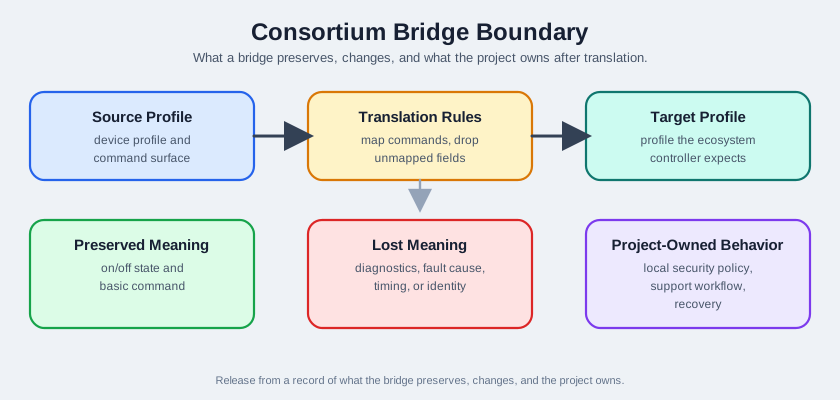
The bridge is also a trust boundary. The Matter fabric trusts the bridge, and the bridge vouches for Zigbee devices that the fabric does not see directly. A bridge claim is therefore narrower than a native-device claim: approve only the behavior that was observed through the named bridge, controller, firmware, and support path.
19.15 Knowledge Check: Bridge Translation Boundary
This section: Knowledge Check: Bridge Translation Boundary
19.16 Migration Evidence Without Budget Drift
This section: Migration Evidence Without Budget Drift — Migration review should avoid hard-coded budget figures, market-size claims, named-chip assumptions, and date-bound roadmaps.
Migration review should avoid hard-coded budget figures, market-size claims, named-chip assumptions, and date-bound roadmaps. Those numbers age quickly and can mislead learners.
Use a durable migration record instead:
- Existing device evidence: radio, memory, firmware custody, update path, certification boundary, and support status.
- Bridge path evidence: hub capability, translation scope, controller behavior, support owner, and failure behavior.
- New hardware evidence: product requirements, protocol responsibilities, certification plan, operations ownership, and installed-base impact.
- Roadmap evidence: decision owner, source document, dependency list, and review date.
- Retest trigger: standards change, controller change, bridge firmware change, device firmware change, or product-scope change.
The review should not recommend a migration path because it is fashionable. It should approve the path whose assumptions have evidence.
19.17 Knowledge Check: Matter and Thread Boundary
This section: Knowledge Check: Matter and Thread Boundary
19.18 Certification Scope
This section: Certification Scope — Certification evidence is important, but it must be read at the right scope.
Certification evidence is important, but it must be read at the right scope.
Ask:
- Which product, firmware, bridge, controller, device type, or cluster behavior was covered?
- Was the tested behavior native, bridged, or controller-specific?
- Which software or hardware configuration was in scope?
- Which behavior was explicitly out of scope?
- What change makes the certification evidence stale for this decision?
Certification does not remove the need for local deployment evidence. A certified component can still be misconfigured, bridged incompletely, paired with an unsupported controller path, or deployed outside its tested assumptions.
19.19 Standards Version and Roadmap Claims
This section: Standards Version and Roadmap Claims — Version and roadmap claims need custody.
Version and roadmap claims need custody. Do not write them as timeless facts unless the chapter is intentionally tied to a dated source.
For durable course content, prefer:
- “Check the published specification version used by this product.”
- “Record which device behavior changed between the reviewed version and the planned version.”
- “Retest bridge behavior after a controller, firmware, or certification-scope change.”
- “Treat vendor roadmap statements as planning inputs, not as proof of delivered behavior.”
Avoid:
- exact launch dates unless the lesson is about historical chronology,
- device-count or market-share claims that are not needed for the concept,
- named-vendor rankings or ecosystem predictions,
- blanket statements that one standard replaces another, and
- permanent-compatibility claims that have no retest condition.
19.20 Matching Quiz: Evidence Family to Review Question
This section: Matching Quiz: Evidence Family to Review Question
19.21 Build a Standards Review Record
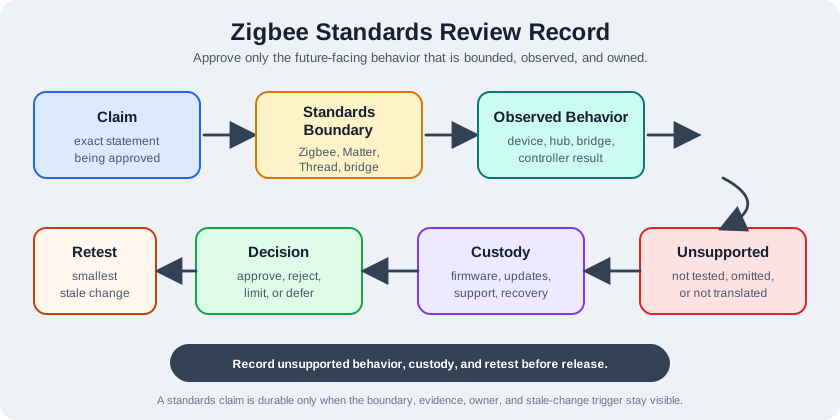
This section: Build a Standards Review Record — Use this record whenever a Zigbee chapter or design plan makes a future-facing standards claim.
Use this record whenever a Zigbee chapter or design plan makes a future-facing standards claim.
- Claim: the exact statement being approved.
- Standard boundary: Zigbee, Matter, Thread, bridge, controller, or certification scope.
- Observed behavior: device, hub, bridge, controller, and user-visible result.
- Unsupported behavior: behaviors that were not tested or are not translated.
- Custody: owner for firmware, bridge updates, controller compatibility, support, and recovery.
- Decision: approve, reject, approve with limits, or defer.
- Retest trigger: the smallest change that makes the decision stale.
19.22 Worked Review: Existing Zigbee Device Through a Bridge
This section: Worked Review: Existing Zigbee Device Through a Bridge — Scenario: A team says an installed Zigbee sensor is ready for a Matter ecosystem because the hub advertises bridge support.
Scenario: A team says an installed Zigbee sensor is ready for a Matter ecosystem because the hub advertises bridge support.
Review path:
- State the exact user-visible behavior being approved.
- Confirm the native Zigbee behavior first: join path, endpoint, cluster, reporting, and hub state.
- Confirm the bridge behavior: what is exposed, what is omitted, and how state changes are mapped.
- Test controller behavior through the target ecosystem path.
- Record failure behavior when the bridge restarts, the Zigbee device goes offline, or the controller changes.
- Approve only the behavior that was observed through the specific bridge path.
Decision: The installed sensor can be approved for selected bridged behavior, not for blanket Matter-native equivalence.
19.23 Worked Review: New Product Roadmap Claim
This section: Worked Review: New Product Roadmap Claim — Scenario: A roadmap says the next product should support Zigbee today and Matter later.
Scenario: A roadmap says the next product should support Zigbee today and Matter later.
Review path:
- Separate the product requirements into Zigbee behavior, Matter behavior, Thread or Wi-Fi transport assumptions, bridge assumptions, and operations obligations.
- Identify which hardware and firmware custody assumptions make later support possible.
- Check whether certification and support plans cover native behavior, bridge behavior, or both.
- Record which customer-facing claim can be made before the later behavior is delivered.
- Define the retest event before the later claim can be published.
Decision: The roadmap can preserve optionality, but the course or product claim should not promise later interoperability until the implementation evidence exists.
19.24 Ordering Quiz: Review a Future-Facing Standards Claim
This section: Ordering Quiz: Review a Future-Facing Standards Claim
19.25 Common Standards Drift
This section: Common Standards Drift — Watch for these patterns during review.
Watch for these patterns during review.
Prediction drift: The chapter describes what the market will do instead of what the learner can verify.
Protocol mixing: Matter, Thread, Wi-Fi, Ethernet, Zigbee, and bridges are treated as one interchangeable layer.
Bridge overclaim: A bridge exposes selected behavior, but the text implies native equivalence.
Certification stretch: Certification evidence for one scope is used to approve another scope.
Roadmap proof: Planned support is treated as delivered support.
Cost fixation: A made-up spreadsheet becomes the lesson instead of the migration evidence model.
Device-count claims: Large installed-base numbers are used to create authority even though they are not needed for the review decision.
19.26 Knowledge Check: Bridge Claim Scope
This section: Knowledge Check: Bridge Claim Scope
19.27 Standards Review Checklist
This section: Standards Review Checklist
Before approving a future-facing Zigbee standards claim, confirm that the review:
- states the claim in testable form,
- separates Zigbee, Matter, Thread, bridge, controller, and certification responsibilities,
- identifies whether behavior is native or bridge-mediated,
- records what is unsupported or untested,
- avoids brittle date, vendor, budget, market-share, and device-count claims,
- names firmware, bridge, controller, support, and recovery custody,
- defines the retest trigger, and
- links the claim to learner-useful evidence rather than market prediction.
19.28 Summary
This section: Summary — Zigbee future and standards review should be evidence-first and boundary-aware.
Zigbee future and standards review should be evidence-first and boundary-aware. Zigbee, Matter, Thread, bridges, controllers, and certification scopes answer different questions. A durable chapter approves only the behavior that was observed, names the standard boundary that supports it, records unsupported behavior, and defines the retest trigger.
The safest future-facing claim is not the broadest claim. It is the claim that a learner can inspect, test, and maintain when standards, products, bridges, and controllers change.
19.29 Key Takeaway
This section: Key Takeaway — Approve future-facing Zigbee standards claims only when Zigbee, Matter, Thread, bridge, certification, unsupported behavior, custody, and retest boundaries are recorded separately.
Approve future-facing Zigbee standards claims only when Zigbee, Matter, Thread, bridge, certification, unsupported behavior, custody, and retest boundaries are recorded separately.
19.30 Concept Relationships
This section: Concept Relationships
- Zigbee Fundamentals and Architecture Evidence Review explains the architecture boundaries that standards claims rely on.
- Zigbee Application Profile Evidence Review provides the endpoint and cluster evidence needed before bridge claims are approved.
- Thread Protocol Comparison Evidence separates Thread network evidence from Zigbee and Matter claims.
- Matter Architecture Evidence reviews Matter fabric, controller, and device-type boundaries.
- Matter Protocol Overview Evidence gives the broader Matter context for bridge and controller claims.
19.31 What’s Next
This section: What’s Next — Next, continue with Zigbee Hands-On and Future, where future-facing review is applied to practical evidence collection and deployment decisions.
Next, continue with Zigbee Hands-On and Future, where future-facing review is applied to practical evidence collection and deployment decisions.
Find help
3 reviewed answers.
Where should I start in a module?
Open the module page from the sidebar to see its chapters in order. Use the module map to return to a topic you need.
Modules and pathsReviewed
What can I try when a project does not work?
Check the symptom, then work through the diagnostic steps. Keep the error message and the smallest example that reproduces it.
When you are stuckReviewed
How do interactive examples work?
Use the interactive guide to check how examples and simulations work before changing your project.
Interactive examples guideReviewed