9 6LoWPAN Failure Patterns

More
Depth: Practitioner
Progress saves as you read. Mark sections complete as you go; your progress appears in the sidebar.
6LoWPAN failures are usually not single-layer mysteries. A visible symptom such as missing telemetry can come from oversized application payloads, weak compression context, fragment reassembly pressure, border-router queueing, RPL parent churn, link-layer interference, or a security policy that the review did not test. A good debugging chapter therefore needs evidence discipline, not a list of slogans.
This chapter treats pitfalls as reviewable failure patterns. Each pattern starts with the symptom, identifies the likely boundary, lists the evidence to inspect, and states the correction that should be validated before a release claim is accepted.
9.1 Start With the IPv6 Packet That Must Fit
This section: Start With the IPv6 Packet That Must Fit
9.1.1 Find the Boundary That Broke
The Internet Protocol is a set of rules for addressed packets. IPv6 means Internet Protocol version 6. It is the current address and packet format used here. 6LoWPAN means IPv6 over Low-Power Wireless Personal Area Networks. It is an adaptation that helps small radio frames carry those packets. Firmware is the software stored inside a device. A payload is the useful content carried in a message. Routing Protocol for Low-Power and Lossy Networks (RPL) helps devices choose paths.
Picture a sensor that stops reporting after its message grows. The larger packet may need several radio frames. Losing one frame can lose the whole packet. A route or memory limit may make the same symptom look like a cloud fault.
Save the original packet and every frame used to carry it. Record size, compression context, path, reassembly result, and device memory. Test one lost frame, a changed parent, a restart, and a larger message. Check whether the repair fixes the named boundary without hiding stale data.
One successful ping does not prove the workload. The deeper sections explain compression, fragments, routes, border behaviour, and retest triggers.
Start with one sleepy constrained node that still needs IPv6 behavior. 6LoWPAN Failure Patterns is the place to ask how a packet is compressed, fragmented, routed, and handed to the border router without losing the design claim.
The start-simple move is to write the evidence record first: original packet, adapted frames, route or parent state, reassembly outcome, and the retest trigger when the link or payload changes.
9.2 In 60 Seconds
This section: In 60 Seconds
- Debug 6LoWPAN from the observed symptom back to packet, link, routing, and border-router evidence.
- Fragmentation is a risk multiplier because every fragment must arrive before the IPv6 packet can be reconstructed.
- IPHC compression failures usually mean the receiver cannot reconstruct an elided field from link addresses, shared context, or known header state.
- Border routers need workload evidence, not just “it pings” evidence, because they translate between different packet-size and custody expectations.
- RPL parent choices should be judged by path behavior and objective-function evidence, not by signal strength alone.
- Multicast, firmware transfer, verbose payloads, and sleepy-node reassembly buffers need special review because their failures are easy to hide during a small demo.
- A fix is not complete until the retest shows the symptom changed and the new design does not create a different hidden failure.
9.3 Learning Objectives
This section: Learning Objectives
By the end of this chapter, you will be able to:
- Diagnose common 6LoWPAN failure patterns using evidence from packet captures, counters, routing state, and border-router logs.
- Distinguish fragmentation pressure from compression-context, RPL, link-quality, and application-payload problems.
- Review whether a proposed fix addresses the real boundary instead of only masking the symptom.
- Build a concise debugging record that names the symptom, evidence, fix, retest result, and remaining risk.
- Avoid quality drift in 6LoWPAN troubleshooting by rejecting brittle battery, cost, capacity, and vendor claims that are not supported by measurement.
9.4 Quick Check: 6LoWPAN Pitfall Review
This section: Quick Check: 6LoWPAN Pitfall Review
9.5 Prerequisites
This section: Prerequisites
This chapter assumes you have reviewed:
- 6LoWPAN Overview Evidence, for the adaptation-layer role.
- 6LoWPAN Header Compression Evidence, for IPHC context and reconstruction checks.
- 6LoWPAN Fragmentation and Reassembly Evidence, for fragment custody and timeout behavior.
- 6LoWPAN Deployment Evidence Framework, for release records and border-router ownership.
9.6 Debugging Claim
This section: Debugging Claim — This keeps the chapter away from broad advice such as “keep payloads small” without proof.
Use a claim that can be inspected:
6LoWPAN debugging claim: A pitfall is fixed only when the team can show the original symptom, the packet or state evidence that explains it, the changed design decision, the retest evidence, and the boundary where the fix no longer applies.
This keeps the chapter away from broad advice such as “keep payloads small” without proof. A compact payload is useful only if the capture confirms fewer fragments, the receiver confirms successful reconstruction, and the application still receives the information it needs.
9.7 Debugging Review Path
This section: Debugging Review Path — Use Figure 9.1 as the normal path from symptom to accepted fix.
Use Figure 9.1 as the normal path from symptom to accepted fix.
Inspect Figure 9.1 to ask which radio, address, context, fragment, route, or security boundary first explains the observed fault.
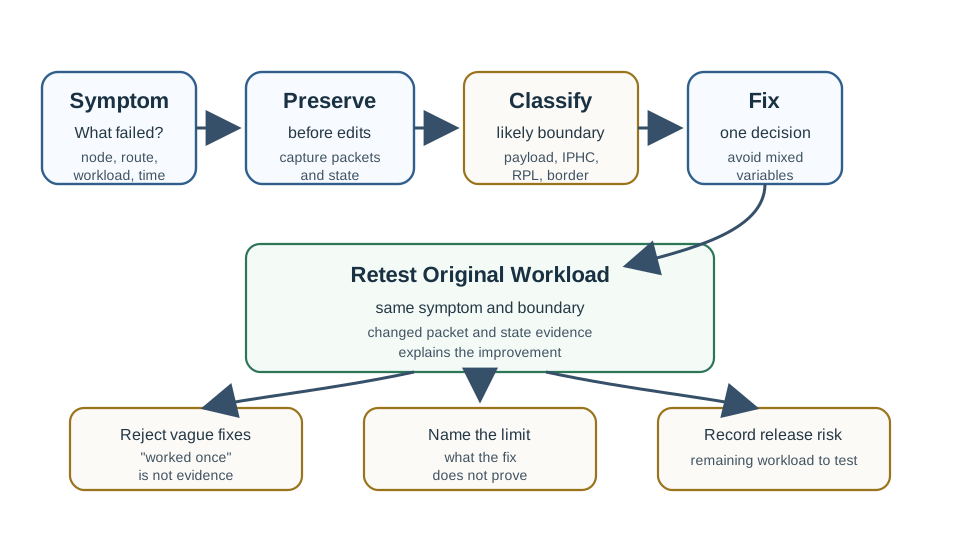
Read Figure 9.1 from the observed symptom to the first boundary that can explain it. Confirm radio reach and link delivery before blaming compression; then check address context, fragmentation, forwarding roles, and the border-router route in order. Avoid changing several layers at once because a mixed intervention destroys the comparison. The decision box asks what failed and what evidence changed after the smallest fix. Record packet captures, node roles, context versions, fragment counters, and end-to-end receipt so a recovered demo becomes a repeatable diagnosis rather than a lucky reset.
The path is deliberately evidence-first. Start with the symptom that the system actually shows, then preserve packet captures and state snapshots before changing configuration. If the first attempted fix changes several variables at once, the retest cannot prove which decision corrected the issue.
9.8 Pitfall Families
This section: Pitfall Families — Most 6LoWPAN problems fall into a small number of families.
Most 6LoWPAN problems fall into a small number of families. The useful review question is not “which family sounds familiar?” but “which evidence would distinguish this family from its neighbors?”
9.9 Failure Map
This section: Failure Map — Use Figure 9.2 to keep a symptom from being assigned to the wrong layer too early.
Use Figure 9.2 to keep a symptom from being assigned to the wrong layer too early.
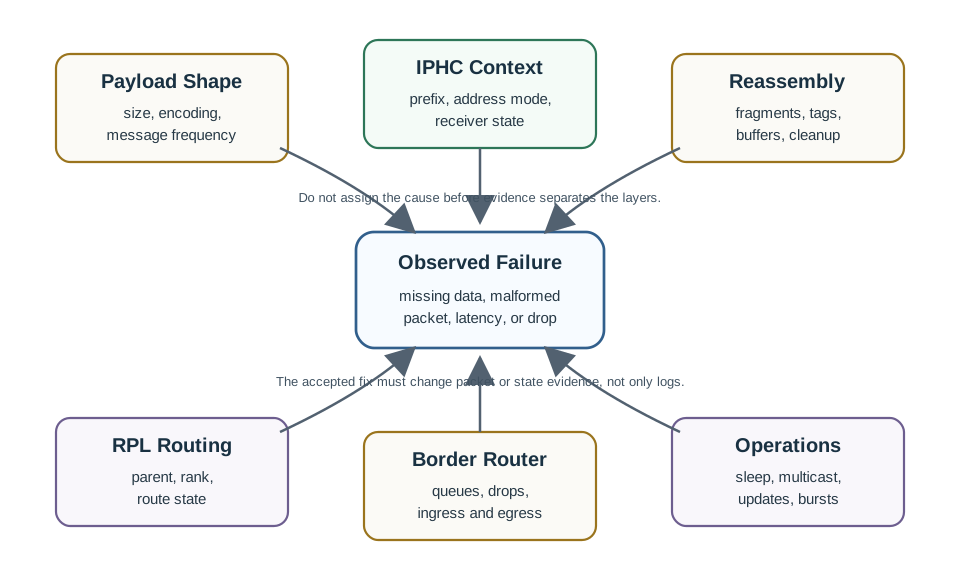
The map helps prevent a common debugging mistake: treating an observed packet drop as a radio problem before checking payload shape, header compression, and reassembly state. A link can be acceptable for small messages and still fail a workload that forces fragmentation or queue buildup.
9.10 Symptom Triage Ledger
This section: Symptom Triage Ledger — Use the symptom to choose the first evidence boundary.
Use the symptom to choose the first evidence boundary. The ledger does not replace packet capture or node state, but it keeps the review from chasing unrelated explanations too early.
| Symptom | Likely boundary | First evidence to check |
|---|---|---|
| Large packets fail while small packets pass | Fragmentation loss amplification | Frame count, fragment tags, per-frame loss, and reassembly cleanup counters |
| Reconstructed destination or prefix is wrong | IPHC compression-context mismatch | Context identifiers, prefix distribution, context version, and receiver-side context state |
| Drops appear only during bursts | Reassembly buffer or border-router queue pressure | Concurrent fragmented datagrams, queue depth, timeouts, duplicate fragments, and drops |
| One sleepy node fails while peers work | Parent, polling, or awake-window mismatch | Parent link, poll interval, route state, and whether fragments arrive during the awake window |
| Downward commands fail after upward telemetry succeeds | RPL downward route or command packet shape | Downward route state, border-router retries, command size, and receiver acknowledgement |
For example, if a partial firmware rollout makes global addresses decompress to the wrong prefix while link-local traffic still works, the first review boundary is IPHC context drift. The capture should show whether updated and non-updated nodes assign the same meaning to the compressed header context identifier.
9.11 Fragmentation Pressure
This section: Fragmentation Pressure — Fragmentation is not wrong by itself.
Fragmentation is not wrong by itself. It is a warning that the design is depending on multiple smaller frames to recreate one IPv6 packet. That dependency increases the number of events that must succeed before the application sees one message.
The most useful retest compares the same application meaning before and after the fix. For example, “status report delivered as one constrained packet” is stronger evidence than “a smaller sample payload worked.”
9.12 Fragmentation Release Gate
This section: Fragmentation Release Gate — Use Figure 9.3 when a fix claims that a larger payload is ready for release.
Use Figure 9.3 when a fix claims that a larger payload is ready for release. The gate starts with packet size and frame budget, then forces the review to count fragments, reassembly buffers, timeout behavior, loss counters, fallback behavior, and the final release decision.
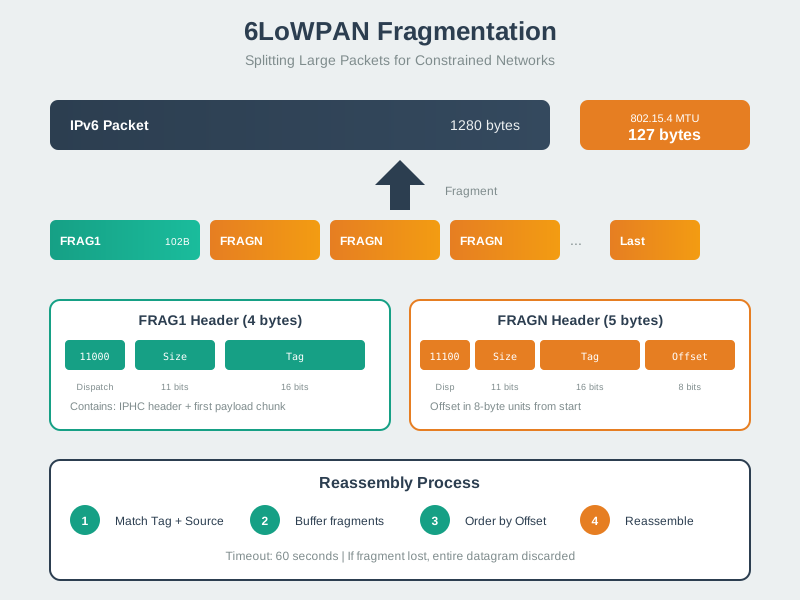
The gate is intentionally conservative. A single clean large transfer is not enough. The release record should state the normal and maximum packet size, how many fragments the workload creates, what loss or timeout behavior was observed, and what fallback exists when the constrained path cannot carry the payload reliably.
9.13 Compression Context Failures
This section: Compression Context Failures — IPHC saves bytes by omitting fields the receiver can infer.
IPHC saves bytes by omitting fields the receiver can infer. If the sender and receiver disagree about link-layer address derivation, context identifiers, prefix lifetimes, or next-header expectations, compression becomes a decoding problem rather than a bandwidth benefit.
This pitfall often appears after a border-router replacement, firmware update, commissioning change, or address-plan change. The capture should show whether the compressed packet can be reconstructed under the context that the receiver actually holds.
9.14 Border-Router Boundary Mistakes
This section: Border-Router Boundary Mistakes — The border router is not just a forwarding box.
The border router is not just a forwarding box. It is the custody boundary between a normal IPv6 environment and a constrained link where packet shape, retry behavior, neighbor discovery, and queueing have different costs.
The common review error is to test only upward telemetry. A production system also needs evidence for downward commands, retries, commissioning bursts, and any update or configuration path that may be larger than routine sensor data.
9.15 Multicast and Group Traffic
This section: Multicast and Group Traffic — Group traffic can be useful for discovery, coordination, and announcement patterns.
Group traffic can be useful for discovery, coordination, and announcement patterns. It becomes risky when the design expects every receiver to reconstruct a fragmented message without per-receiver recovery evidence.
Review multicast claims with these questions:
- Is the group message small enough for the tested constrained path?
- If one receiver misses part of the message, how is that receiver identified?
- Is recovery unicast, application-level, or delayed until the next periodic state?
- Does the sender need all receivers to act, or only a best-effort subset?
- Does the retest include sleepy nodes and nodes at weaker positions in the mesh?
A group notification followed by per-node or per-block recovery is easier to verify than a large group transfer that assumes all receivers saw the same fragments.
9.16 RPL and Parent-Selection Pitfalls
This section: RPL and Parent-Selection Pitfalls — Routing failures can look like adaptation failures because both produce missing packets.
Routing failures can look like adaptation failures because both produce missing packets. Separate them by preserving route state at the time of the symptom.
Route evidence should be captured near the failure window. A stable route after the network has recovered does not explain the earlier drop unless the logs also preserve the transition.
9.17 Reassembly and Memory Pressure
This section: Reassembly and Memory Pressure — Reassembly state is temporary custody.
Reassembly state is temporary custody. It should be created when the first fragment arrives, updated as fragments arrive, released when the packet is complete, and cleaned up when the packet cannot be completed.
Review the implementation or stack configuration for these conditions:
- Incomplete reassembly contexts expire and release memory.
- Duplicate fragments do not grow buffer use without bound.
- A burst from one peer cannot starve unrelated traffic without detection.
- Fragment tags are tracked together with source identity and size evidence.
- Cleanup counters are visible enough to explain missing application messages.
- The retest includes incomplete and out-of-order fragment behavior, not only complete packets.
The point is not to memorize one timeout value across all stacks. The point is to prove that incomplete packets do not quietly consume memory until the node fails.
9.18 Silent Adaptation Failures
This section: Silent Adaptation Failures — 6LoWPAN bugs are hard because the adaptation layer often fails without a useful application-level error.
6LoWPAN bugs are hard because the adaptation layer often fails without a useful application-level error. A lost fragment, mismatched compression context, or exhausted reassembly buffer can leave the datagram malformed, incomplete, or dropped while the sender only sees a missing response. There is no universal 6LoWPAN error that says “fragment 3 of 5 never arrived.”
The discipline that breaks the deadlock is measurement. Put an 802.15.4 sniffer on the air to see fragments and compressed headers, count per-frame loss and fragment counts, verify compression-context versions, and bound concurrent reassemblies to the buffers a node actually has. Turning “the network is flaky” into “a three-fragment datagram at measured per-frame loss” makes the review solvable.
9.19 Worked Review: Missing Telemetry After Payload Change
This section: Worked Review: Missing Telemetry After Payload Change — The important review detail is that the application meaning changed.
Symptom: Temperature reports were reliable during commissioning but became intermittent after the application added diagnostic fields to the same reporting message.
Evidence: Captures show the old report traveled as a single constrained frame while the new report requires fragmentation. Receiver counters show incomplete reassembly during busy periods.
Fix: Split routine telemetry from diagnostic detail. Keep the routine report compact and request diagnostics only when needed through a paced application exchange.
Retest: Run the old and new report patterns under the same route and interference conditions, then compare delivered application records, fragment counts, and reassembly cleanup counters.
The important review detail is that the application meaning changed. The fix should preserve the data needed for operations while reducing the routine packet-shape pressure.
9.20 Worked Review: Compression Context Drift
This section: Worked Review: Compression Context Drift — This fix is not “disable compression.” Disabling compression may hide the immediate symptom while increasing packet size and creating new fragmentation pressure.
Symptom: A group of nodes can hear traffic but cannot reconstruct packets after a border-router replacement.
Evidence: The sender uses context-based compression for a prefix that some receivers have not learned. The failed receivers show neighbor state but no valid reconstructed IPv6 packet.
Fix: Restore context distribution and version tracking as part of border-router commissioning. Include context visibility in the deployment checklist.
Retest: Capture before and after context distribution from a receiver that previously failed, then confirm the reconstructed IPv6 source and destination match the intended packet.
This fix is not “disable compression.” Disabling compression may hide the immediate symptom while increasing packet size and creating new fragmentation pressure. The better review asks why the receiver did not have the context that compression depended on.
9.21 Worked Review: Downward Command Loss
This section: Worked Review: Downward Command Loss — This pattern shows why layer isolation matters.
Symptom: Sensor reports arrive at the server, but downward configuration commands fail for nodes several hops away.
Evidence: Upward parent routes are stable, but downward routing records are missing or stale. Border-router logs show command retries without matching receiver acknowledgement.
Fix: Review the RPL mode, downward route maintenance, command size, and retry policy together. A route-only fix is incomplete if the command still fragments under normal conditions.
Retest: Send representative commands through the longest approved path, preserve route state during the test, and confirm application-level acknowledgement from the constrained node.
This pattern shows why layer isolation matters. Upward telemetry success does not prove downward control readiness.
9.22 Common Mistakes
This section: Common Mistakes
Avoid these review mistakes:
9.23 Debugging Record Checklist
This section: Debugging Record Checklist
Before accepting a 6LoWPAN pitfall fix, collect a record with:
9.24 Summary
This section: Summary — 6LoWPAN pitfall review is strongest when it treats debugging as evidence work.
6LoWPAN pitfall review is strongest when it treats debugging as evidence work. The same visible symptom can come from payload shape, compression context, reassembly custody, border-router behavior, routing instability, group traffic, or operational blind spots. The reviewer should preserve captures and state before changing configuration, apply a focused fix, and retest the original workload.
The most important habit is boundary clarity. Do not approve a fix because it made one demo message pass. Approve it when the evidence shows the original failure mechanism changed and the corrected design still respects constrained-link limits.
9.25 Key Takeaway
This section: Key Takeaway — 6LoWPAN Pitfall Debugging Evidence should review 6LoWPAN architecture against header compression, fragmentation, RPL behavior, security, interoperability, and deployment evidence.
6LoWPAN Pitfall Debugging Evidence should review 6LoWPAN architecture against header compression, fragmentation, RPL behavior, security, interoperability, and deployment evidence.
9.26 Concept Relationships
This section: Concept Relationships
- 6LoWPAN debugging depends on 6LoWPAN Overview Evidence, because every pitfall traces back to the adaptation-layer boundary.
- Fragmentation pressure belongs with 6LoWPAN Fragmentation and Reassembly Evidence, where fragment custody and reconstruction are reviewed in detail.
- Compression-context failures belong with 6LoWPAN Header Compression Evidence, where IPHC reconstruction assumptions are inspected.
- Route instability belongs with 6LoWPAN Routing with RPL, where RPL parent choice and downward routing behavior are reviewed.
- Release readiness belongs with 6LoWPAN Deployment Evidence Framework, where fixes become deployment records.
9.27 What’s Next
This section: What’s Next
Continue with these chapters:
- 6LoWPAN Routing with RPL, to review parent selection, rank movement, and downward routing behavior.
- 6LoWPAN Lab Simulation Evidence, to practice controlled capture-based troubleshooting.
- 6LoWPAN Hands-On and Security Evidence, to connect packet evidence to practical security and lab validation.
- 6LoWPAN Comprehensive Review, to consolidate compression, fragmentation, routing, deployment, and debugging evidence.
9.28 Knowledge Check: First Evidence
This section: Knowledge Check: First Evidence
9.29 Knowledge Check: Context Drift
This section: Knowledge Check: Context Drift
9.30 Matching Quiz: Symptom to Evidence
This section: Matching Quiz: Symptom to Evidence
9.31 Ordering Quiz: Debugging Flow
This section: Ordering Quiz: Debugging Flow
Find help
3 reviewed answers.
Where should I start in a module?
Open the module page from the sidebar to see its chapters in order. Use the module map to return to a topic you need.
Modules and pathsReviewed
What can I try when a project does not work?
Check the symptom, then work through the diagnostic steps. Keep the error message and the smallest example that reproduces it.
When you are stuckReviewed
How do interactive examples work?
Use the interactive guide to check how examples and simulations work before changing your project.
Interactive examples guideReviewed