27 Thread Security and Matter Boundary

More
Depth: Practitioner
Progress saves as you read. Mark sections complete as you go; your progress appears in the sidebar.
27.1 In 60 Seconds
This section: In 60 Seconds — Picture a lock that joins a Thread mesh and appears in a Matter app.
Picture a lock that joins a Thread mesh and appears in a Matter app. The join proves a network path. It does not prove that every app user may open the door. Those claims live at different layers.
Thread protects the local mesh path. Matter protects device identity, working sessions, fabric scope, commands, and rights at the app layer. Start with one claim. Ask which layer owns it and which record proves it. Keep device join, mesh traffic, border routing, fabric entry, and command rights as separate checks. A badge or one working command cannot stand in for all five.
Use this boundary route:
- Which device may join the mesh?
- Who approved that join?
- How is mesh traffic protected?
- What does the Border Router expose?
- Which fabric owns the device?
- Which controller may send a command?
- Which command is that controller allowed?
- Can an old message be reused?
- How is access removed?
- Which change starts a new review?
Thread and Matter work together, but they do not prove the same thing. Practitioner writes the five-part security record. Under the Hood covers commissioning, mesh keys, fabric identity, sessions, and rights. Those details may block a working demo. They never turn network access into app permission.
Retell the layers. Mesh entry is one check. Mesh traffic is another. Border routing is another. Fabric entry is another. App rights are another. Each check has evidence. Each record has an owner. Old messages stay old. Removed users lose access. Changed trust starts a new review.
Thread security review should not be reduced to “the device joined” or “the product supports Matter.” Thread protects the local mesh path. Matter protects the application fabric, device identity, sessions, commands, and permissions. A release claim is trustworthy only when the evidence shows the right layer for the claim being approved.
The strongest review separates five boundaries: how a device joins, how mesh traffic is protected, how the Border Router connects the mesh to the IP network, how Matter fabric identity is established, and how application permissions are enforced after commissioning.
27.2 Learning Objectives
This section: Learning Objectives
By the end of this chapter, you will be able to:
- Separate Thread network security evidence from Matter application and fabric evidence.
- Review commissioning evidence without assuming that joining proves authorization.
- Identify which security claims belong to the device, Border Router, controller, fabric, application, or operations process.
- Evaluate replay, tampering, rogue-device, and over-permission claims through bounded evidence.
- Build a security review record with clear retest triggers.
27.3 Quick Check: Thread Matter Boundary
This section: Quick Check: Thread Matter Boundary
27.4 Start With the Security Claim
This section: Start With the Security Claim — Security review starts with a precise claim.
Security review starts with a precise claim.
"The system is secure" is not reviewable. A useful claim says what is protected and where the proof lives:
- only expected devices can join the mesh,
- mesh traffic is protected from casual capture or modification,
- old captured messages cannot be reused as fresh commands,
- the Border Router exposes only the intended boundary,
- a controller can issue only the commands it is allowed to issue,
- a device identity can be traced to the expected product evidence, or
- support can remove or rotate access after ownership, controller, firmware, or placement changes.
Each claim needs its own evidence. A Matter badge, a successful join, or a working command does not prove every layer.
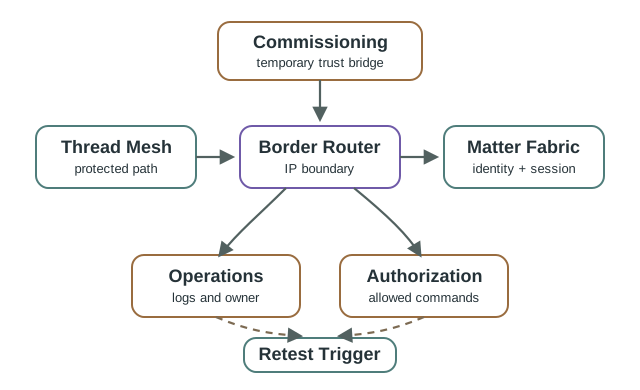
27.5 Layer Boundaries
This section: Layer Boundaries — Treat Thread and Matter as related but separate evidence layers.
Treat Thread and Matter as related but separate evidence layers.
Thread mesh evidence shows whether the device can communicate over the Thread network using the intended mesh path and protected link behavior.
Commissioning evidence shows whether the onboarding path proves the device and commissioner are allowed to exchange the credentials needed for the next step.
Border Router evidence shows what crosses between the Thread mesh and the rest of the IP network. This is a boundary record, not just a reachability test.
Matter fabric evidence shows the application identity and trust relationship used after commissioning.
Matter access-control evidence shows which node, user, automation, service, or controller may read, write, or invoke product behavior.
If these layers are mixed together, reviews tend to over-approve. A local Thread packet test does not prove Matter command authorization. A Matter command success does not prove that every mesh recovery path is acceptable.
27.6 How Thread and Matter Security Actually Work
This section: How Thread and Matter Security Actually Work — The evidence layers above map onto specific, named mechanisms.
The evidence layers above map onto specific, named mechanisms. Knowing the real names turns an abstract review into a concrete one.
Thread mesh protection is IEEE 802.15.4 link security. Every frame on a Thread mesh is encrypted and integrity-protected at the 802.15.4 MAC layer using AES-128 in CCM* mode. The shared secret is the Thread Network Key, a 128-bit key held by every node in the mesh, and a monotonic key sequence counter lets the network rotate that key without re-commissioning devices. Link and route management ride on MLE (Mesh Link Establishment) messages. So "traffic protection is active on the mesh path" concretely means 802.15.4 AES-CCM* framing keyed by the current Thread Network Key, with a frame counter rejecting stale frames.
Thread commissioning is DTLS with J-PAKE. A new device is a Joiner; the entity that admits it is a Commissioner, which may run on the mesh or externally through the Border Router's Border Agent. The Joiner and Commissioner run a DTLS handshake authenticated by J-PAKE (a password-authenticated key exchange), keyed by the device's printed Joining Device Credential — a short passphrase often carried in a QR code. Only after that mutual proof does the Commissioner hand the Joiner the operational credentials, including the Thread Network Key, over the encrypted channel, so the network key never crosses the air in the clear. An external Commissioner in turn authenticates to the network with the PSKc, a key derived from the human commissioning passphrase, the network name, and the Extended PAN ID. That is what "the commissioner and device proved they were allowed to exchange credentials" actually is.
The Border Router is where the mesh meets IP. The Thread Border Router bridges the 802.15.4 mesh to an adjacent IPv6 link such as Wi-Fi or Ethernet. It runs the Border Agent that admits external commissioning and advertises Thread services using SRP (Service Registration Protocol) together with mDNS on the infrastructure side. The boundary you review is exactly what this device forwards between mesh and IP.
Matter commissioning is PASE over the setup passcode. Matter's first secure session is PASE (Passcode-Authenticated Session Establishment), built on SPAKE2+ and keyed by the device's setup passcode — the numeric value carried in the QR, NFC, or manual pairing payload alongside a discriminator. Over that session the commissioner validates the device's DAC (Device Attestation Certificate) chain to a trusted PAA (Product Attestation Authority) and its Certification Declaration (CD) to verify product provenance and certification scope, and then installs a NOC (Node Operational Certificate) issued by the fabric's operational Root CA, along with the fabric's IPK (Identity Protection Key).
Matter operational sessions are CASE. After commissioning, nodes and controllers communicate over CASE (Certificate-Authenticated Session Establishment), a mutually authenticated session built from each side's NOC. A fabric is identified by a Fabric ID and its Root CA, and each node carries a Node ID. A device can hold NOCs from several fabrics at once, which is how multi-admin works.
Matter authorization is the ACL. "Which controller may invoke which command" is enforced by the Access Control List stored in each node's Access Control Cluster. Each entry maps a subject — a Node ID, a CASE Authenticated Tag, or a group — to a privilege of View, Operate, Manage, or Administer, scoped to endpoints and clusters. Reviewing over-permission is, concretely, reviewing ACL entries.
With these names in hand, each evidence family below points at a specific mechanism: mesh evidence tests 802.15.4 CCM* and the network key, commissioning evidence tests J-PAKE and PASE, fabric evidence tests NOCs and CASE, and access-control evidence tests ACL entries.
27.7 Commissioning Evidence
This section: Commissioning Evidence — Commissioning is a temporary bridge between an untrusted device state and a trusted operating state.
Commissioning is a temporary bridge between an untrusted device state and a trusted operating state. Review it as a sequence of evidence gates.
Ask:
- How does the commissioner know it is talking to the intended physical device?
- Which setup secret, code, or out-of-band step is in scope?
- Which channel carries temporary commissioning traffic?
- What credential or fabric evidence remains after commissioning finishes?
- What temporary state is discarded or disabled after onboarding?
- What happens if commissioning is interrupted, repeated, delegated, or performed by the wrong owner?
The review should prove the transition. It should not treat "commissioning completed" as a complete security finding.
27.8 Mesh Protection Evidence
This section: Mesh Protection Evidence — Thread mesh protection is reviewed at the network path.
Thread mesh protection is reviewed at the network path.
Evidence should show:
- the device joined the intended Thread network, not a look-alike path,
- traffic protection is active on the mesh path,
- sequence or freshness checks reject stale traffic,
- tampered messages are not accepted as valid messages,
- parent changes or router changes do not bypass the security claim, and
- removal or credential changes have an owner and retest process.
This evidence supports mesh-path claims. It does not automatically approve Matter permissions, remote access, account recovery, cloud behavior, or user-level authorization.
27.9 Matter Fabric Evidence
This section: Matter Fabric Evidence — Matter fabric evidence belongs at the application trust layer.
Matter fabric evidence belongs at the application trust layer.
A strong fabric review records:
- which fabric is being approved,
- which controller or administrator owns the fabric change,
- which device identity evidence was checked,
- which operational credential is used after commissioning,
- which sessions or secure application exchanges are in scope,
- which access-control entries authorize the release behavior, and
- how fabric removal, transfer, or multi-admin changes reopen the review.
Matter is not only a command vocabulary. For security review, it is also the identity, session, and authorization layer above the transport.
27.10 Border Router Boundary Evidence
This section: Border Router Boundary Evidence — The Border Router is a security boundary because it connects the Thread mesh to another IP network.
The Border Router is a security boundary because it connects the Thread mesh to another IP network. A review should ask what can cross that boundary and who owns the evidence.
Useful evidence includes:
- which external network or controller path is part of the release claim,
- whether local mesh behavior is being separated from external reachability,
- whether a controller can discover, reach, and command only the intended devices,
- what happens when a Border Router is replaced or loses connectivity,
- whether operational logs can explain boundary failures, and
- which owner retests after network, router, controller, credential, or fabric changes.
Do not approve a Border Router boundary from a single successful ping or command. A boundary claim needs scope, permission, failure, and ownership evidence.
27.11 Knowledge Check: Layer Separation
This section: Knowledge Check: Layer Separation
27.12 Build a Security Boundary Record
This section: Build a Security Boundary Record — Use one record that keeps layers separate.
Use one record that keeps layers separate.
Release claim: State the behavior being approved, such as local reporting, remote status, unlock, update, or admin transfer.
Thread evidence: Record mesh attachment, protected traffic, freshness behavior, and recovery path that support the claim.
Commissioning evidence: Record how the device and commissioner proved they were allowed to exchange credentials.
Matter evidence: Record fabric identity, operational credential, session, and access-control scope.
Boundary evidence: Record the Border Router, controller, cloud, service, or operations boundary that crosses the mesh.
Retest trigger: Name what reopens the record: device reset, ownership transfer, new controller, Border Router replacement, firmware update, credential change, or policy change.
Thread mesh protection, Matter session security, and command authorisation are related but distinct claims. Inspect Figure 27.2 to keep those boundaries visible in the release record.
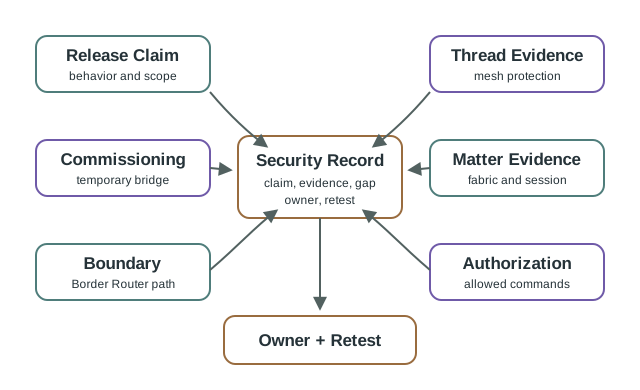
In Figure 27.2, Release Claim fixes the behaviour and scope first. Thread Evidence covers mesh protection, while Commissioning calls out the temporary bridge used to establish credentials; neither proves the Matter Evidence for fabric membership and secure sessions. The Boundary box then names the Border Router path, and Authorization records the commands the subject may issue. The last Owner + Retest box is deliberately downstream of all five: a firmware, fabric, Border Router, or access-control change reopens the claim. That ordering supplies the template for the boundary record fields below.
27.13 Threat Evidence Without Overclaiming
This section: Threat Evidence Without Overclaiming — Security threat review is useful only when the evidence maps to the threat.
Security threat review is useful only when the evidence maps to the threat.
Replay evidence should show that old traffic is not accepted as fresh traffic. The exact internal mechanism belongs to implementation evidence, but the release review needs a repeatable stale-message result or an equivalent protocol-conformance record.
Tampering evidence should show that changed protected traffic is rejected or fails validation. It should not rely on the assumption that an attacker cannot observe radio traffic.
Rogue-device evidence should show that an unexpected device cannot complete the approved onboarding path without the required commissioning evidence.
Over-permission evidence should show that a controller, user, automation, or service cannot perform commands beyond its approved access-control scope.
Boundary evidence should show that Thread-local behavior and external-controller behavior are reviewed separately.
The review does not need dramatic attack stories. It needs a clean mapping from threat to evidence.
27.14 Worked Review: Commissioning Succeeds, Permission Fails
This section: Worked Review: Commissioning Succeeds, Permission Fails — Scenario: A device is commissioned into the expected fabric.
Scenario: A device is commissioned into the expected fabric. It reports status correctly, but a secondary controller can invoke a command that was supposed to be restricted.
Review path:
- Keep the commissioning result as evidence only for onboarding.
- Record the Matter fabric and controller identity that produced the unexpected command.
- Compare the observed command with the intended access-control scope.
- Check whether the issue is device policy, controller policy, fabric configuration, or operations procedure.
- Reopen the release claim for command authorization while preserving any mesh evidence that still remains valid.
Approval answer: Do not approve the command claim. Commissioning success and Thread reachability do not prove the command permission boundary.
27.15 Worked Review: Border Router Replacement
This section: Worked Review: Border Router Replacement — Scenario: A Border Router is replaced during maintenance.
Scenario: A Border Router is replaced during maintenance. Local Thread devices can still exchange local messages, but a controller path from the IP network behaves differently.
Review path:
- Separate local mesh evidence from external controller evidence.
- Confirm which release claims require the Border Router boundary.
- Check discovery, routing, session establishment, and command authorization through the new boundary.
- Record whether logs and ownership make the failure diagnosable.
- Add Border Router replacement as a retest trigger.
Approval answer: Approve only the local claims that remain proven. Boundary-dependent claims stay open until the new path is reviewed.
27.16 Common Security Review Drift
This section: Common Security Review Drift — Each mistake removes an evidence boundary the reviewer needs.
Watch for these mistakes:
- treating Matter support as proof that Thread mesh security is complete,
- treating Thread join success as proof that Matter authorization is complete,
- approving controller commands without checking access-control scope,
- ignoring ownership transfer or multi-controller changes,
- treating Border Router reachability as a complete boundary review,
- keeping temporary commissioning evidence as if it were operational evidence,
- using vendor or product reputation instead of release evidence, and
- relying on a single happy-path command as proof of security.
Each mistake removes an evidence boundary the reviewer needs.
27.17 Knowledge Check: Boundary Failure
This section: Knowledge Check: Boundary Failure
27.18 Match the Security Evidence
This section: Match the Security Evidence
27.19 Order the Security Review
This section: Order the Security Review
27.20 Security Review Checklist
This section: Security Review Checklist
Before approving a Thread and Matter security claim, confirm:
- the release behavior is stated narrowly enough to test,
- Thread mesh evidence is not being used as Matter authorization evidence,
- Matter fabric evidence is not being used as Thread path evidence,
- commissioning evidence is separated from operational evidence,
- the Border Router boundary is reviewed when external reachability is in scope,
- access-control evidence covers the actual command or data behavior,
- failure and change cases have been reviewed, and
- the owner and retest triggers are written down.
27.21 Summary
This section: Summary — Thread and Matter security are strongest when their boundaries stay visible.
Thread and Matter security are strongest when their boundaries stay visible. Thread protects the mesh path. Matter provides the application fabric, identity, secure sessions, and command authorization above that path. Commissioning connects the two for a short transition, and the Border Router connects the mesh to the wider IP network.
The review should approve only the claim that the evidence actually proves. If a claim crosses layers, every layer it depends on needs evidence.
27.22 Key Takeaway
This section: Key Takeaway — Thread Security and Matter Boundary Evidence Review should clarify Thread’s secure IPv6 mesh boundary, Matter integration points, credentials, border-router trust, and deployment evidence.
Thread Security and Matter Boundary Evidence Review should clarify Thread’s secure IPv6 mesh boundary, Matter integration points, credentials, border-router trust, and deployment evidence.
27.23 Concept Relationships
This section: Concept Relationships
- Thread topology evidence explains which devices and paths the security evidence must cover.
- Border Router evidence connects local mesh security to controller and operations paths.
- Matter architecture evidence explains the fabric, device model, and interaction layer above Thread.
- Matter fabric security evidence deepens the identity, certificate, session, and access-control review.
- Deployment evidence turns the review record into an operations and retest process.
27.24 What’s Next
This section: What’s Next
- Thread Deployment Evidence Guide - Apply security and boundary evidence to a deployed Thread network.
- Thread Comprehensive Evidence Review - Rehearse Thread evidence across topology, operation, deployment, security, and Matter boundaries.
- Matter Fabric Security Evidence - Deepen the Matter-side identity, fabric, and access-control review.
- Matter Protocol Stack Evidence - Place Matter security and interaction evidence in the full Matter stack.
- Zigbee Comprehensive Review - Compare Thread and Matter security evidence with Zigbee review boundaries.
Find help
3 reviewed answers.
Where should I start in a module?
Open the module page from the sidebar to see its chapters in order. Use the module map to return to a topic you need.
Modules and pathsReviewed
What can I try when a project does not work?
Check the symptom, then work through the diagnostic steps. Keep the error message and the smallest example that reproduces it.
When you are stuckReviewed
How do interactive examples work?
Use the interactive guide to check how examples and simulations work before changing your project.
Interactive examples guideReviewed