20 Zigbee Protocol Selection
More
Depth: Practitioner
Progress saves as you read. Mark sections complete as you go; your progress appears in the sidebar.
20.1 In 60 Seconds
This section: In 60 Seconds — A protocol is a shared set of rules for exchanging messages.
A protocol is a shared set of rules for exchanging messages. Zigbee is a protocol for low-power devices that send small messages over a local wireless network. A gateway is a device that passes those messages to another network.
Choosing Zigbee is not a popularity contest. Ask whether it fits the message pattern, site, other products, gateway owner, security owner, operating team, and reasons to test again. Compare the same evidence for every option.
Do not approve Zigbee only because the team knows it. Do not reject it only because another protocol is newer. Approve the choice whose evidence matches the project claim and whose handoff risks have owners.
20.2 Learning Objectives
This section: Learning Objectives
By the end of this chapter, you will be able to:
- Define a reviewable protocol-selection claim,
- Compare Zigbee against alternatives without market or vendor drift,
- Identify the gateway owner, product links, and operating duties,
- Separate workload evidence from roadmap assumptions,
- Decide when Zigbee is a good fit, weak fit, or conditional fit, and
- Record acceptance decisions and retest triggers.
20.3 Quick Check: Zigbee Selection
This section: Quick Check: Zigbee Selection
20.4 Start With the Selection Claim
This section: Start With the Selection Claim — Begin with a claim that can be tested.
Begin with a claim that can be tested.
Weak claim: Zigbee is the best protocol for the project.
Stronger claim: Zigbee fits the workload inside this named site. The team can support the mesh and device behavior. A named owner runs the gateway. The expected product links are realistic. The security owner and operating team accept their duties. The record also states which changes require a new test.
The stronger claim avoids treating protocol selection as a brand preference. It names the fit evidence, the handoff boundary, the owner, and the condition that can change the decision.
20.5 Protocol Selection Evidence Families
This section: Protocol Selection Evidence Families — Use these evidence families before accepting a protocol-selection record.
Use these evidence families before accepting a protocol-selection record.
Workload evidence records the message pattern, endpoint behavior, energy constraints, throughput need, local control expectation, and failure tolerance.
Deployment evidence records the site boundary, topology expectation, router availability, gateway placement, and acceptance test.
Interoperability evidence records what the system must work with, where translation is acceptable, and which behaviors must remain native.
Gateway evidence records whether Zigbee-to-application translation is acceptable, who owns the bridge, and what happens when the bridge changes.
Security evidence records coordinator and Trust Center custody, commissioning control, key ownership, and device removal responsibility.
Operations evidence records who owns monitoring, replacement, network changes, support limits, and retesting.
Alternative evidence records why another protocol is stronger or weaker for the same bounded claim.
20.6 Zigbee Fit Sweet Spot
This section: Zigbee Fit Sweet Spot — Zigbee builds on the IEEE 802.15.4 standard for low-power radio links.
Zigbee builds on the IEEE 802.15.4 standard for low-power radio links. A mesh lets devices pass messages for one another and find a new path after a link fails. The Zigbee Cluster Library (ZCL) gives products shared commands for lights, heating, locks, and sensors. Zigbee fits many low-power devices that need reliable local control and send little data across a building.
Zigbee does not fit every job. It cannot carry high-rate traffic such as video. It does not use Internet Protocol (IP) at each device, so cloud or IP systems need a gateway. A battery-powered router is also a poor choice because a router must keep its radio on. Choose Zigbee only when this profile fits the project.
Figure 20.1 joins seven checks. They cover the workload, site, product links, gateway, security, operations, and other options. Together they lead to a fit decision and a reason to test again.
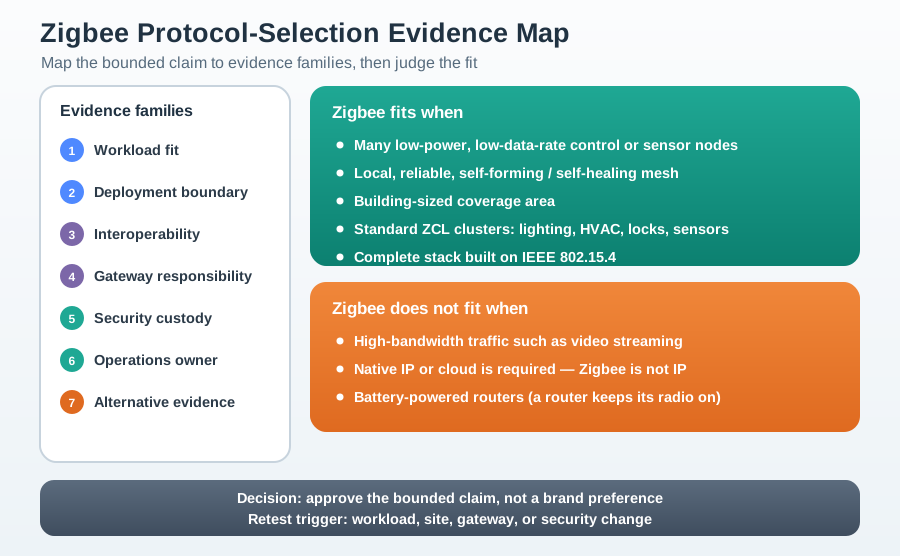
Read Alternative evidence to see why another option was not chosen. Read Security custody to see who controls joining and keys. The choice is ready only when both checks, and the other five checks, support the same bounded claim.
20.7 Knowledge Check: Zigbee Fit Sweet Spot
This section: Knowledge Check: Zigbee Fit Sweet Spot
20.8 When Zigbee Is a Strong Fit
This section: When Zigbee Is a Strong Fit — Zigbee is a strong fit when the review evidence supports a local low-power mesh with a managed gateway boundary.
Zigbee is a strong fit when the review evidence supports a local low-power mesh with a managed gateway boundary.
Review:
- endpoint workloads that are compact and event-oriented,
- powered devices that can support a routing backbone,
- a clear coordinator and Trust Center owner,
- a gateway handoff that the project accepts,
- application behavior that matches ZCL or profile evidence,
- operations that can maintain joins, replacements, and exceptions, and
- deployment evidence from a representative boundary.
Do not overstate the fit. A strong Zigbee decision still needs a record of where the claim applies and what it excludes.
20.9 When Zigbee Is a Weak Fit
This section: When Zigbee Is a Weak Fit — Zigbee is a weak fit when the project needs a different architectural boundary.
Zigbee is a weak fit when the project needs a different architectural boundary.
Review for weak fit when:
- native IP reachability is required from the endpoint,
- the application cannot accept a gateway translation boundary,
- the workload needs sustained high-throughput behavior,
- the operating team cannot own coordinator or Trust Center custody,
- the site cannot support a stable powered-router backbone,
- interoperability expectations are broader than the chosen Zigbee profile evidence, or
- deployment changes will be frequent but retesting ownership is unclear.
Weak fit does not mean Zigbee is bad. It means the evidence does not support the selection claim without additional controls or a narrower boundary.
20.10 Compare Alternatives by Evidence, Not Labels
This section: Compare Alternatives by Evidence, Not Labels — Protocol alternatives should be compared against the same claim.
Protocol alternatives should be compared against the same claim.
Review each candidate by asking:
- What workload evidence does it satisfy?
- Where is the gateway, border, or controller boundary?
- What does it require operations to own?
- Which security custody model must be supported?
- Which interoperability behavior is native and which is translated?
- Which deployment conditions were tested?
- What change requires retesting?
Avoid decisions based only on age, trend, or ecosystem language. The right protocol is the one whose evidence fits the boundary and whose risks are owned.
20.11 Compare Zigbee, Thread, BLE, and Wi-Fi by Evidence
This section: Compare Zigbee, Thread, BLE, and Wi-Fi by Evidence — The common short-list choices differ on concrete axes, not marketing labels.
The common short-list choices differ on concrete axes, not marketing labels. Zigbee and Thread both run IEEE 802.15.4 mesh, but Thread is IPv6-native through 6LoWPAN and reaches IP networks through a border router, whereas Zigbee is not IP and needs a gateway to translate its ZCL application layer. BLE is phone-friendly with shorter per-hop range; Wi-Fi offers high bandwidth and direct IP at higher power and without a native low-power mesh.
| Protocol | PHY / topology | IP-native? | Best fit |
|---|---|---|---|
| Zigbee | IEEE 802.15.4 mesh | No; gateway plus ZCL | Mature standardized device clusters and building mesh. |
| Thread | IEEE 802.15.4 mesh | Yes; IPv6/6LoWPAN | IP-native mesh with Matter as a common application layer. |
| BLE | Star or mesh | No; usually via phone or gateway | Phone-to-device, short range, and commissioning workflows. |
| Wi-Fi | Star through access point | Yes | High bandwidth, mains-powered devices, and direct IP. |
| Z-Wave | Proprietary mesh, single-alliance certification | No; hub-mediated | Very low idle power and a controlled, single-source interoperability model. |
The frequent Zigbee-versus-Thread decision usually reduces to a bounded architecture question: does the project value Zigbee’s mature ZCL device ecosystem and gateway model, or Thread’s native IPv6 mesh plus a Matter application layer?
Zigbee’s most common home-automation competitor is not Thread but Z-Wave. The comparison is a workload-fit question, not a brand question. Z-Wave’s proprietary mesh and single-alliance certification model give it a reputation for turnkey, low-effort installation, and its devices are built for very low idle power. Zigbee answers with a lower device cost and an open, multi-vendor alliance that publishes and evolves the standard rather than one company controlling it. Neither trait decides a selection claim by itself: the review still needs workload, gateway, security-custody, and operations evidence for whichever protocol is chosen.
20.12 Knowledge Check: Zigbee Versus Thread
This section: Knowledge Check: Zigbee Versus Thread
20.13 Knowledge Check: Selection Claim Scope
This section: Knowledge Check: Selection Claim Scope
20.14 Gateway and Interoperability Boundary
This section: Gateway and Interoperability Boundary — The gateway boundary is often the key selection issue.
The gateway boundary is often the key selection issue.
Review:
- whether endpoint behavior must be native outside the Zigbee network,
- which application or monitoring system consumes gateway data,
- whether translation changes command meaning or timing expectations,
- who owns gateway replacement and configuration changes,
- which interoperability behavior is proven rather than assumed, and
- which gateway change requires retesting.
A Zigbee selection can be correct when the gateway boundary is intentional and owned. It is fragile when the project expects native behavior beyond that boundary without evidence.
20.15 Gateway Boundary and RF Coexistence
This section: Gateway Boundary and RF Coexistence — Because Zigbee is not IP, a Zigbee network needs a gateway when its devices must communicate with IP, MQTT, cloud, or another external application service; local Zigbee device-to-device control does not require one.
Because Zigbee is not IP, a Zigbee network needs a gateway when its devices must communicate with IP, MQTT, cloud, or another external application service; local Zigbee device-to-device control does not require one. When used, that gateway is a possible single point of failure and an interoperability boundary. Cross-vendor behavior depends on both sides speaking standard Zigbee 3.0 and ZCL; manufacturer-specific clusters reduce portability the moment they are used.
The second underplanned factor is 2.4 GHz RF coexistence. Zigbee shares the 2.4 GHz band with Wi-Fi and BLE. Zigbee channels 15, 20, 25, and 26 fall in the gaps between common Wi-Fi channels 1, 6, and 11, so channel planning is selection evidence, not a late tuning task. A Zigbee network placed on a channel that overlaps a busy Wi-Fi access point will suffer retries and latency.
20.16 Knowledge Check: Gateway and Coexistence
This section: Knowledge Check: Gateway and Coexistence
20.17 Selection Review Record
This section: Selection Review Record — Use a protocol-selection record before accepting a recommendation.
-

Write the claim, workload, site, and gateway boundary first.
-

Add product fit, security owner, operations owner, and other options.
-

Record the decision and retest trigger; both owners must accept their work.
Use a protocol-selection record before accepting a recommendation.
Figure 20.2 shows ten fields in the selection record. They are the claim, workload, site, gateway, product links, security owner, operations owner, other options, decision, and reason to test again.
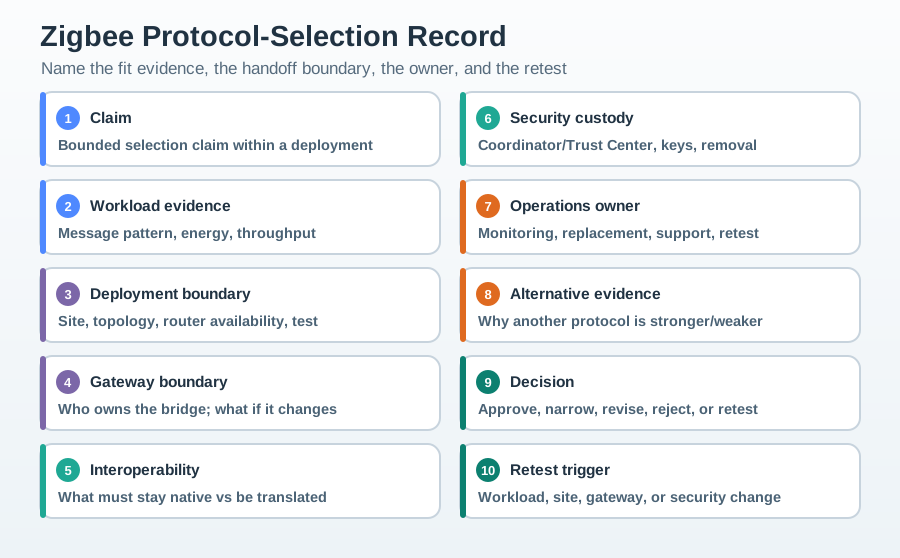
Read Security custody for ownership of joining, keys, and device removal. Read Operations owner for monitoring, replacement, and later changes. Both owners must accept their work before the decision can pass.
The record should include:
- Claim: what protocol choice is being recommended.
- Boundary: where the selection applies and what it excludes.
- Workload evidence: message pattern, energy constraints, throughput need, and failure tolerance.
- Deployment evidence: topology, site, router, and gateway conditions.
- Gateway boundary: accepted translation point and owner.
- Interoperability evidence: native behavior, translated behavior, and known gaps.
- Security custody: coordinator, Trust Center, commissioning, and removal ownership.
- Alternative evidence: why other candidates were not selected for this boundary.
- Decision: accept, revise, reject, or retest.
- Retest trigger: workload, gateway, site, firmware, security, or interoperability change.
20.18 Worked Review: Existing Zigbee Site Expansion
This section: Worked Review: Existing Zigbee Site Expansion — Scenario: A site already operates a Zigbee deployment and wants to add more endpoint types.
Scenario: A site already operates a Zigbee deployment and wants to add more endpoint types.
Review path:
- Limit the claim to the existing site boundary.
- Confirm coordinator, gateway, and operations ownership.
- Review whether the new endpoint workload matches the existing deployment evidence.
- Check interoperability and application behavior at the gateway boundary.
- Record accepted exceptions and retest triggers.
Decision: Zigbee can be a strong fit if the new endpoints match the existing evidence and the gateway handoff remains owned.
20.19 Worked Review: New IP-Centric System
This section: Worked Review: New IP-Centric System — Scenario: A new system expects endpoints to participate directly in IP-based operations with minimal translation.
Scenario: A new system expects endpoints to participate directly in IP-based operations with minimal translation.
Review path:
- Define the native endpoint behavior that is required.
- Identify whether a Zigbee gateway boundary is acceptable.
- Compare Zigbee against alternatives using the same workload evidence.
- Record security and operations responsibilities for each candidate.
- Decide whether Zigbee is accepted, rejected, or conditionally narrowed.
Decision: Zigbee is weak fit if the project cannot accept gateway translation for the required endpoint behavior.
20.20 Matching Quiz: Selection Evidence Family
This section: Matching Quiz: Selection Evidence Family
20.21 Ordering Quiz: Protocol Selection Sequence
This section: Ordering Quiz: Protocol Selection Sequence
20.22 Common Selection Drift
This section: Common Selection Drift — Familiarity drift: choosing Zigbee because the team knows it without proving project fit.
Familiarity drift: choosing Zigbee because the team knows it without proving project fit.
Trend drift: rejecting Zigbee because another protocol is newer without checking the deployment boundary.
Gateway drift: ignoring the translation boundary until application behavior fails.
Interoperability drift: treating profile or cluster names as proof of end-to-end behavior.
Roadmap drift: using future claims to approve a present deployment without retest ownership.
Operations drift: selecting a protocol that nobody can maintain after release.
Comparison drift: comparing protocols against different assumptions instead of the same claim.
20.23 Knowledge Check: Selection Readiness
This section: Knowledge Check: Selection Readiness
20.24 Protocol Selection Checklist
This section: Protocol Selection Checklist
Before accepting a Zigbee protocol-selection record, confirm that it:
- States the selection claim and boundary,
- Describes the workload evidence,
- Records deployment and topology evidence,
- Identifies the gateway boundary and owner,
- Separates native and translated interoperability behavior,
- Records coordinator and Trust Center custody,
- Compares alternatives against the same assumptions,
- Lists known gaps and accepted exclusions,
- Names the operations owner, and
- Defines retest triggers for workload, gateway, site, firmware, security, and interoperability changes.
20.25 Summary
This section: Summary — Choosing Zigbee is an evidence review.
Choosing Zigbee is an evidence review. It is a strong fit when the workload, site, gateway owner, product links, security owner, and operating team all support the claim. It is a weak fit when the project needs behavior that requires an unsupported translation or has no clear owner.
Do not choose or reject Zigbee from trend language alone. Approve only the protocol decision whose evidence is bounded, compared fairly, and owned after release.
20.26 Key Takeaway
This section: Key Takeaway — Review the network shape, product commands, radio interference, security, device roles, growth, maintenance, and field evidence before choosing Zigbee.
Review the network shape, product commands, radio interference, security, device roles, growth, maintenance, and field evidence before choosing Zigbee.
20.27 Concept Relationships
This section: Concept Relationships
- Zigbee Deployment Readiness Evidence Review supplies the deployment evidence used in selection decisions.
- Zigbee Protocol Stack Evidence Review explains the gateway and application-boundary evidence.
- Zigbee Network Topologies Evidence Review supports mesh and router-fit review.
- Thread Protocol Comparison provides comparison context for IP-native mesh decisions.
- Matter Architecture provides context for application-layer interoperability boundaries.
20.28 What’s Next
This section: What’s Next — Next, continue with Zigbee Review: Worked Examples, where the selection and deployment evidence is applied to concrete review scenarios without drifting into brittle assumptions.
Next, continue with Zigbee Review: Worked Examples, where the selection and deployment evidence is applied to concrete review scenarios without drifting into brittle assumptions.
Find help
3 reviewed answers.
Where should I start in a module?
Open the module page from the sidebar to see its chapters in order. Use the module map to return to a topic you need.
Modules and pathsReviewed
What can I try when a project does not work?
Check the symptom, then work through the diagnostic steps. Keep the error message and the smallest example that reproduces it.
When you are stuckReviewed
How do interactive examples work?
Use the interactive guide to check how examples and simulations work before changing your project.
Interactive examples guideReviewed