LPWAN networks use three distinct architectural models: LoRaWAN’s star-of-stars topology with privately deployed gateways forwarding to a central network server, Sigfox’s fully operator-managed base stations delivering data via HTTP callbacks, and NB-IoT/LTE-M’s integration with existing 4G/5G cellular core networks. Your choice determines who owns the infrastructure, how much you pay, and what level of control you retain.
23.1 Learning Objectives
By the end of this chapter, you will be able to:
Design LoRaWAN Networks: Plan star-of-stars topologies with gateways and network servers
Configure Sigfox Deployments: Explain how operator-managed networks function and configure callback mechanisms for data delivery
Compare LPWAN Topologies: Analyze architectural differences between LoRaWAN, Sigfox, and NB-IoT
Select Backhaul Connectivity: Justify the choice of gateway-to-server connection (Ethernet, Wi-Fi, or cellular) based on deployment constraints
Evaluate Network Scalability: Assess capacity limits and coverage requirements for LPWAN deployments
23.2 Prerequisites
Before diving into this chapter, you should be familiar with:
LPWAN Fundamentals: Understanding core LPWAN characteristics and technology trade-offs is essential for evaluating different architectural approaches
Network Topologies: Knowledge of star, mesh, and hybrid topologies provides context for understanding LPWAN-specific topology choices
LoRaWAN Overview: Familiarity with LoRaWAN basics, device classes, and protocol fundamentals is necessary for understanding detailed architectural design
Wireless Sensor Networks: WSN architecture principles and multi-hop communication concepts help contextualize LPWAN deployment strategies
Key Concepts
Star-of-Stars Topology: LoRaWAN’s architecture where many end devices connect to multiple gateways, which all connect to a single network server; provides coverage redundancy without routing complexity.
Network Server: The central coordinator in LoRaWAN managing device authentication, deduplication of multi-gateway messages, ADR (Adaptive Data Rate), and uplink/downlink scheduling.
LoRaWAN Device Classes: A (battery-optimized, uplink-only receive windows), B (scheduled receive windows), C (always-on receive) — balancing power consumption vs downlink latency.
Sigfox Ultra-Narrowband: Sigfox’s 100 Hz bandwidth signal occupying minimal spectrum, enabling long range but limiting to 140 uplink messages/day and 4 downlink messages/day.
NB-IoT Architecture: NB-IoT uses existing cellular infrastructure (eNodeB) with IoT-optimized RAN features; managed devices through 3GPP-standard attach procedures.
ADR (Adaptive Data Rate): LoRaWAN’s mechanism for dynamically adjusting spreading factor and transmit power based on signal quality, balancing data rate against range and energy.
23.3 For Beginners: LPWAN Network Architectures
If you’re deploying hundreds or thousands of IoT sensors across a city, campus, or farm, you face a critical design question: How should your network be structured? LPWAN architectures answer this question differently than traditional networks.
LoRaWAN: Star-of-Stars (DIY Model) Think of LoRaWAN like setting up your own cellular network. You buy gateways (like cell towers) and place them strategically. Sensors send data to any gateway in range—often multiple gateways receive the same transmission (redundancy!). Gateways forward everything to your network server (in the cloud), which deduplicates, decrypts, and routes to your application. You control everything: gateway placement, network configuration, data ownership.
Sigfox: Operator-Managed (Subscription Model) Sigfox is like using Verizon or AT&T for IoT. The Sigfox company operates the base stations—you just buy sensors and subscribe. Your sensors transmit; Sigfox infrastructure receives and forwards data to your server via callbacks (webhooks). Simple, but you’re dependent on Sigfox coverage and subject to their limits (140 messages/day).
NB-IoT/LTE-M: Cellular (Telco Model) Uses existing cell towers from AT&T, Vodafone, T-Mobile, etc. Sensors have SIM cards like phones. Maximum coverage (wherever cell service exists), but higher power consumption and recurring cellular data costs.
Term
Simple Explanation
Star-of-Stars
Devices → Gateways → Network Server (LoRaWAN topology)
Gateway
Antenna receiving LoRa transmissions and forwarding to network server
Network Server
Central system managing security, routing, deduplication
Backhaul
Internet connection from gateway to network server (Ethernet/4G)
Operator-Managed
Network run by company (Sigfox)—you just subscribe
Private Network
You own and control all infrastructure (LoRaWAN)
Callbacks
Webhooks—Sigfox pushes data to your HTTP endpoint
Device Class
LoRaWAN A/B/C—determines power use vs downlink capability
Sensor Squad: The Long-Range Network
“I need to send data from a farm 10 kilometers away, but there’s no WiFi or cell signal out there!” said Sammy the Sensor.
Max the Microcontroller grinned. “That’s exactly what LPWAN architectures are for! LoRaWAN uses a star-of-stars layout – your sensor talks to a gateway on a hilltop, the gateway forwards to a network server in the cloud. One gateway can cover an entire farm.”
“Sigfox is even simpler,” said Lila the LED. “Your sensor just broadcasts into the air, and any Sigfox base station in range picks it up. No pairing, no handshake. It’s like shouting in a valley – whoever hears you, relays the message.”
Bella the Battery loved the power savings: “NB-IoT piggybacks on existing cell towers, so no new infrastructure needed. And all three architectures are designed for tiny data – a few bytes every hour. That means I can power Sammy for 5 to 10 years on a single battery. The architecture determines the range, the cost, and my battery life!”
Videos Hub - Visual explanations of star-of-stars topology and gateway operation
Quizzes Hub - Test your understanding of LoRaWAN, Sigfox, and NB-IoT architectures
Knowledge Map - See how LPWAN architectures connect to topology, routing, and deployment strategies
Why These Matter: LPWAN architectures require understanding trade-offs between coverage, cost, and control. The simulations hub helps visualize gateway placement, while the knowledge map shows how architecture choices affect protocol selection and application design.
Common Misconception: “LPWAN = Always Long Range”
The Myth: Many assume all LPWAN technologies automatically provide 10+ km range in any environment.
The Reality: Range is highly deployment-specific:
LoRaWAN Urban Reality: Typical urban range is 2-5 km, not 15 km
Buildings, interference, and antenna height drastically reduce theoretical range
Gateway at ground level: ~500m-1km effective coverage
Gateway on rooftop: 3-5 km typical, 10 km possible with clear line-of-sight
Sigfox Base Station Density: Operator claims “40 km range” refer to rural open field conditions
Urban deployments: Base stations every 2-5 km for reliability
Indoor penetration: Signals attenuate 20-30 dB through buildings
NB-IoT Coverage Limitations: Uses cellular towers, but indoor coverage can be poor
NB-IoT has 20 dB better penetration than LTE-M, but still struggles in basements
~164 dB link budget (NB-IoT) vs ~146 dB (LTE-M) vs ~157 dB (LoRaWAN SF12)
Key Insight:Always conduct a site survey before deploying LPWAN networks. Theoretical range calculations (Friis equation) assume free space—real deployments require accounting for: - Building penetration loss (10-30 dB) - Foliage attenuation (0.5-1 dB per tree) - Interference from other ISM band devices (Wi-Fi, Bluetooth) - Antenna gain and height (every 6 dB doubles range)
Example: A farm deployment claiming “15 km LoRaWAN range” likely uses: - Gateway on 30m tower or silo (height advantage) - High-gain directional antennas (8-12 dBi) - Rural environment with minimal interference - Line-of-sight to most sensors
Replicating this in a city with gateway on a 10m building rooftop? Expect 2-3 km maximum.
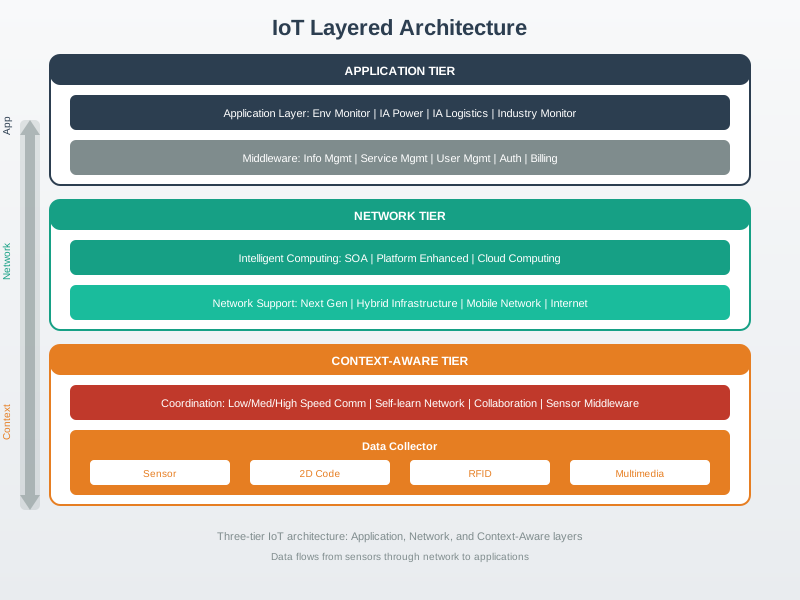
IoT multi-tier architecture showing network support layer where LPWAN operates
Source: NPTEL Internet of Things Course, IIT Kharagpur - This architecture shows how LPWAN technologies fit within the Network Support Technology layer, connecting the Context-Aware Tier (sensors, RFID, data collectors) to the Application Tier (middleware, cloud services, industry applications). LPWAN provides the “low, medium, and high speed communication” bridge in this layered model.
Understanding the differences between LPWAN technologies helps you choose the right solution for your deployment. This comprehensive comparison covers the three major LPWAN options:
Feature
LoRaWAN
Sigfox
NB-IoT / LTE-M
Deployment Model
Private or operator
Operator-managed only
Telco operator (licensed)
Network Ownership
You own (private) or subscribe
Subscription only
Cellular subscription
Spectrum
Unlicensed ISM (868/915 MHz)
Unlicensed ISM (868/915 MHz)
Licensed cellular bands
Range
2-15 km (urban/rural)
10-40 km (excellent)
Cellular coverage (km)
Data Rate
0.3-50 kbps (adaptive)
100 bps (very limited)
NB-IoT: 250 kbps, LTE-M: 1 Mbps
Payload Size
Up to 242 bytes
12 bytes uplink, 8 bytes downlink
Flexible (1-1000+ bytes)
Messages per Day
Unlimited (fair use)
140 uplink, 4 downlink (hard limit)
Unlimited (data plan limits)
Latency
Seconds (Class A), ms (Class C)
Seconds to minutes
<1 second (LTE-M), seconds (NB-IoT)
Battery Life
5-10 years typical
10-15 years (ultra-low power)
5-10 years (PSM/eDRX modes)
Bi-directional
Yes (Class A/B/C options)
Limited (4 downlinks/day)
Yes (full duplex)
Mobility Support
Limited (stationary focus)
Good (handoff between stations)
Excellent (cellular handoff)
Infrastructure Cost
$500-1000 per gateway
None (operator-managed)
None (cellular towers exist)
Device Cost
$5-20 (modules)
$5-15 (modules)
$10-30 (modules)
Setup Complexity
Medium (deploy gateways)
Easy (just subscribe)
Easy (SIM card)
Network Scalability
High (add gateways)
Limited (operator capacity)
Very high (cellular infrastructure)
Security
AES-128 (end-to-end)
AES-128 (operator-managed)
3GPP cellular security
Geolocation
TDOA (with 3+ gateways)
RSSI-based (built-in)
Cell tower triangulation
Standards Body
LoRa Alliance
Sigfox (proprietary)
3GPP (international standard)
Which LPWAN Should You Choose?
Choose LoRaWAN when:
You want to own the network (no recurring subscription fees)
You need flexible data rates and payload sizes (up to 242 bytes)
You need bidirectional communication (downlinks to devices)
You’re deploying in areas without Sigfox or cellular coverage
You need unlimited messages per day
You have budget for gateway infrastructure ($500-1000 per gateway)
Infrastructure: $0 (operator-managed)
Device modules: 1000 × $10 = $10,000
Subscription: 1000 × $10/year × 5 years = $50,000
Total 5-year cost: $60,000 ($12 per device/year)
NB-IoT (Cellular):
Infrastructure: $0 (cellular towers)
Device modules: 1000 × $20 = $20,000
Data plan: 1000 × $5/month × 60 months = $300,000
Total 5-year cost: $320,000 ($64 per device/year)
Key Insight: LoRaWAN private networks have higher upfront cost but lowest ongoing cost. Cellular has highest cost but best coverage and reliability. Sigfox is middle ground between DIY and cellular.
23.5 Worked Example: LoRaWAN Gateway Placement for a 200 km² Vineyard Region
A wine cooperative in Napa Valley wants to monitor soil moisture, temperature, and leaf wetness across a 200 km² (20,000-hectare) vineyard region using LoRaWAN. The terrain is gently rolling hills (30 m elevation change), with rows of 2 m tall grapevines. Design the gateway deployment.
Step 1: Establish the link budget.
Parameter
Value
Source
Transmit power (ERP)
+14 dBm
US ISM 915 MHz max
TX antenna gain
+2 dBi
Sensor whip antenna
RX antenna gain
+6 dBi
Gateway fiberglass omni
Receiver sensitivity (SF10, 125 kHz)
-134 dBm
SX1276 datasheet
Required SNR margin
10 dB
For 99% reliability
Available path loss
14 + 2 + 6 - (-134) - 10 = 146 dB
Step 2: Convert path loss to range using the Okumura-Hata rural model.
For 915 MHz at gateway height 15 m (mounted on water tank) and sensor height 1 m:
Add 6 dB foliage loss (grapevine canopy in summer): effective range drops to ~1.8 km.
Step 3: Calculate coverage area per gateway.
Gateway coverage radius: 1.8 km
Coverage area (circle): π × 1.8² ≈ 10.2 km² (1,020 hectares)
That calculation is for a low-mounted gateway. LoRaWAN gateways on elevated positions achieve significantly more. Re-calculating with the gateway on a 25 m tower (common agricultural silo height):
The Okumura-Hata model is calibrated for urban/suburban environments. For open agricultural land with line-of-sight from a 25 m tower, empirical LoRaWAN deployments consistently report 3–5 km reliable range at SF10.
Using the empirical value of 3 km (conservative, accounts for foliage and terrain):
Coverage area per gateway: π × 3² = 28.3 km² (2,830 hectares)
Gateways needed: 200 km² / 28.3 km² = 7.1 – round up to 8 gateways
Step 4: Factor in gateway redundancy.
LoRaWAN’s strength is multi-gateway reception. For 99.9% uptime, we want every sensor reachable by at least 2 gateways. Overlapping coverage by 30% means:
Effective unique coverage per gateway: 28.3 km² × 0.7 = 19.8 km²
Gateways needed: 200 km² / 19.8 km² = 10.1 – deploy 10 gateways
Step 5: Total deployment cost (5-year TCO).
Item
Quantity
Unit Cost
Total
Outdoor LoRaWAN gateway (Kerlink/Multitech)
10
$1,200
$12,000
Solar power kit (panel + battery + charge controller)
Soil moisture + temperature + leaf wetness sensor nodes
400
$45
$18,000
Network server (TTN/ChirpStack cloud, 5 years)
1
$100/mo x 60
$6,000
Installation labour (2 days, 2 technicians)
1
$3,000
$3,000
Total
$44,500
Per sensor per year
$22.25
Compare with NB-IoT: 400 sensors × $8/mo cellular plan × 60 months = $192,000 – over 4x more expensive and dependent on cell coverage that may not reach every vineyard row.
Putting Numbers to It
The link budget calculation above uses the Okumura-Hata model for path loss estimation. Here’s why those formulas give us the 2.2 km range:
This means each gateway covers \(\pi \times 2.2^2 \approx 15.2~\text{km}^2\) per the model, but empirical agricultural deployments achieve \(28.3~\text{km}^2\) (3 km radius) due to open terrain. Using 30% overlap for redundancy:
Cost per km² of coverage: \(12,000 / (10 \times 20~\text{km}^2) = \$60/\text{km}^2\) infrastructure investment, amortized over unlimited sensors within that zone.
23.5.1 Interactive: LoRaWAN Gateway Planner
Show code
viewof farmKm2 = Inputs.range([1,500], {value:200,step:1,label:"Farm area (km²)"})viewof gatewayRangeKm = Inputs.range([0.5,8], {value:3,step:0.5,label:"Gateway range (km)"})viewof overlapPct = Inputs.range([0,50], {value:30,step:5,label:"Overlap for redundancy (%)"})viewof gatewayCostUSD = Inputs.range([500,2000], {value:1200,step:100,label:"Gateway unit cost ($)"})
This gateway placement problem is a specialized version of the sink placement problem in Wireless Sensor Networks. WSN theory says optimal sink (gateway) placement minimizes the maximum hop count and balances traffic load. In LoRaWAN’s single-hop star topology, the “hop count” is always 1, so the problem reduces to geometric coverage: place gateways so every sensor is within radio range of at least k gateways (where k = 2 for redundancy). The vineyard’s rolling terrain makes this harder than flat-earth calculations suggest – always validate with a site survey using a portable LoRa tester before committing to permanent gateway locations.
23.6 LoRaWAN Star‑of‑Stars
~15 min | Intermediate | P09.C03.U02
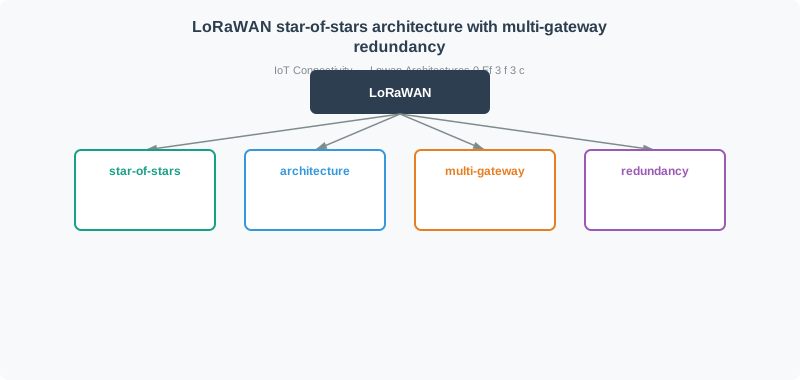
LoRaWAN uses a star‑of‑stars topology: battery devices send LoRa frames to nearby gateways; gateways forward to a network server, which routes to application servers.
Figure 23.1: LoRaWAN star-of-stars architecture with multi-gateway redundancy
Alternative View: Device Class Comparison
This diagram compares the three LoRaWAN device classes, showing how each trades off power consumption against downlink latency and receive window availability.
Key points: - Uplink frames can be received by multiple gateways; the network server de‑duplicates - Class A/B/C end device classes trade battery vs. latency - Gateways are stateless packet forwarders; backhaul via Ethernet/Wi-Fi/Cellular
23.7 Sigfox Operator Model
~10 min | Intermediate | P09.C03.U03
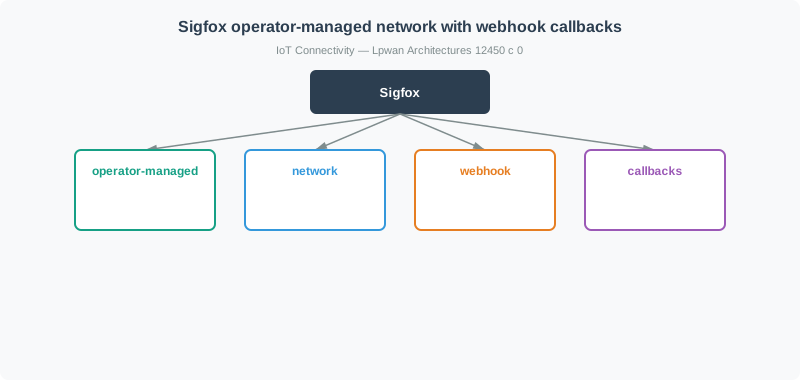
Sigfox provides a fully managed network. Devices use ultra‑narrowband to operator base stations; backend routes messages to customer callbacks.
Figure 23.2: Sigfox operator-managed network with webhook callbacks
Characteristics: - Very small payloads (uplink‑focused), extremely low power - Coverage and QoS tied to operator footprint - Simple device model (no gateway to manage)
Quick Check: Sigfox Message Limits
23.8 NB‑IoT / LTE‑M Architecture
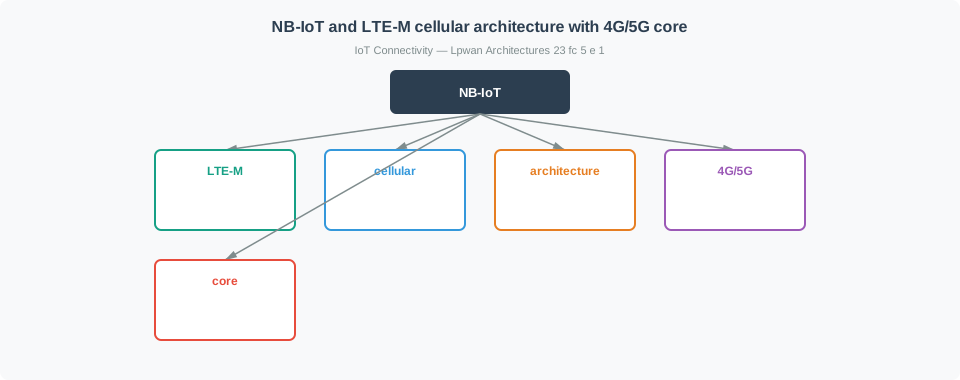
Cellular LPWAN integrates with 4G/5G core. Devices attach to eNodeB/gNodeB; data egresses via EPC/5GC to application servers.
Figure 23.3: NB-IoT and LTE-M cellular architecture with 4G/5G core
Design notes: - Licensed spectrum, mobility, and SIM/eSIM lifecycle - Power‑saving modes: PSM/eDRX for multi‑year battery life - Best for nationwide coverage and operator‑managed SLAs
23.9 Videos
LPWAN Overview
LPWAN Overview
Lesson 4 — positioning LPWAN technologies and design trade-offs.
Explore these AI-generated architectural diagrams that visualize key LPWAN concepts covered in this chapter:
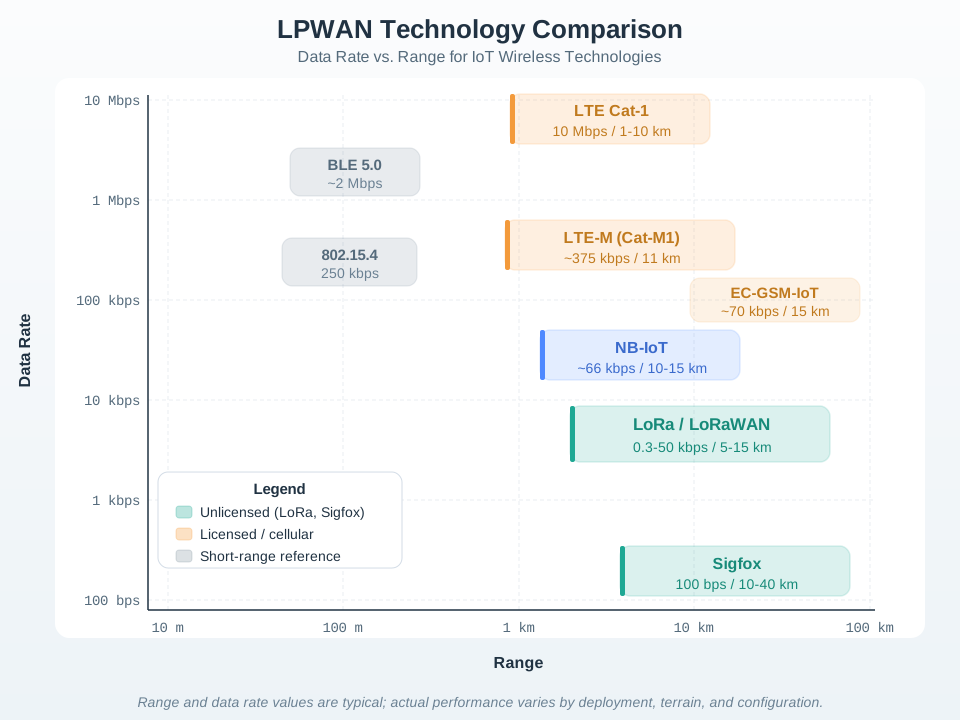
Visual: LPWAN Technology Landscape
LPWAN technology comparison diagram
This visualization compares the three major LPWAN technologies, highlighting their positioning in terms of range (2-50 km), data rate (100 bps to 1 Mbps), and battery life (5-20 years).
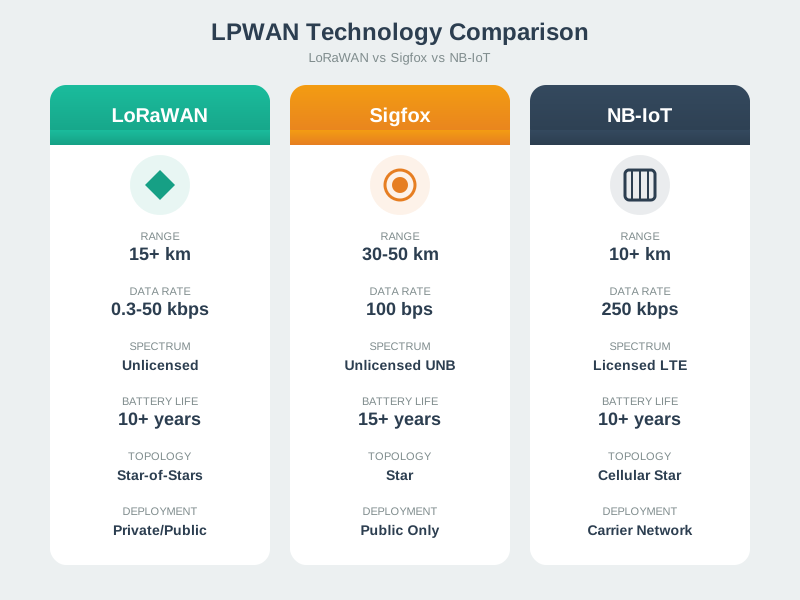
Visual: LPWAN Technology Comparison Matrix
LPWAN comparison in geometric style
A structured comparison showing the key trade-offs between unlicensed (LoRaWAN, Sigfox) and licensed (NB-IoT) LPWAN technologies for IoT deployments.
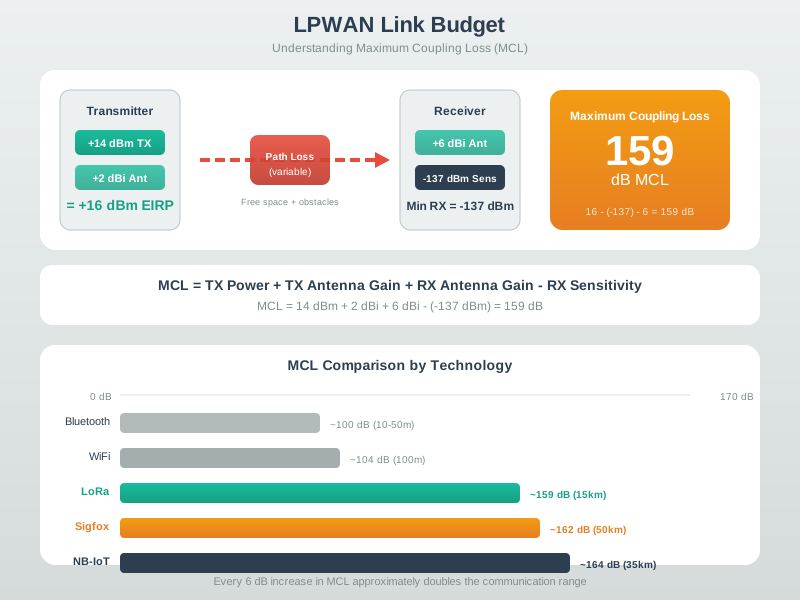
Visual: LPWAN Link Budget Analysis
LPWAN link budget visualization
Understanding link budget is essential for LPWAN deployment planning, showing how range is achieved through a combination of transmit power, receiver sensitivity, and spreading factors.
Interactive: M2M Gateway Protocol Translation
23.11 Concept Relationships
LPWAN network architectures connect to broader networking and IoT deployment concepts:
Architectural Patterns:
Star-of-Stars Topology: LoRaWAN’s architecture is a specialized star topology with multi-gateway redundancy. Compare with traditional network topologies in Network Topologies.
Edge Gateway Patterns: LPWAN gateways are edge devices performing protocol translation and aggregation. See Edge-Fog Computing.
Protocol Stack Integration:
Physical/MAC Layer: LoRa modulation and LoRaWAN MAC layer specifics. See LoRaWAN Overview for technical details.
Network Layer: How LoRaWAN network servers route packets vs. cellular core network routing. See Routing Fundamentals.
Deployment Models:
Private vs Public Networks: LoRaWAN allows both; cellular LPWAN requires operator. See Network Ownership Models.
WSN Comparison: LPWAN is single-hop (device→gateway); WSN is multi-hop (mesh). See Wireless Sensor Networks.
Technology Trade-offs:
LoRaWAN Classes: Class A/B/C trade power for downlink latency. See LPWAN Comparison for detailed analysis.
Cellular Integration: NB-IoT/LTE-M use existing cellular infrastructure. See Cellular IoT Fundamentals.
Scalability and Capacity:
Gateway Density: Urban vs rural deployment density requirements. Related to Coverage Planning.
Device Scaling: How star-of-stars enables 10,000+ devices per gateway. See Massive IoT.
1. Assuming LPWAN Gateways Provide Internet Connectivity
LoRaWAN and Sigfox gateways are radio relay points, not internet gateways. Internet connectivity for devices requires the cloud network server. Local data processing requires separate edge compute infrastructure.
2. Not Planning for Gateway Overlap in LoRaWAN
LoRaWAN requires messages to be received by at least one gateway. Coverage holes occur when a gateway fails and there is no overlap. Deploy gateways with 30-40% overlap to ensure coverage redundancy.
3. Ignoring LoRaWAN Air Time Limits
LoRaWAN regions have regulatory duty cycle limits (1% in EU868, fair access in US915). Applications that exceed these limits will have messages dropped by the network server without error indication. Calculate and respect air time budgets.
Label the Diagram
💻 Code Challenge
Order the Steps
:
23.12.1 LPWAN Technology Selection Decision Tree (Variant View)
This decision flowchart provides an alternative approach to selecting the optimal LPWAN technology based on deployment requirements, ownership model, and technical constraints:
Figure 23.4: LPWAN technology selection decision tree guiding choices based on infrastructure ownership, coverage requirements, bidirectional needs, payload size, and latency constraints. LoRaWAN (teal) for private networks or flexible public deployment. Sigfox (orange) for ultra-simple uplink-focused applications with tiny payloads. NB-IoT (blue) for carrier-grade reliability with deep penetration. LTE-M (purple) for mobile assets requiring low latency and voice.
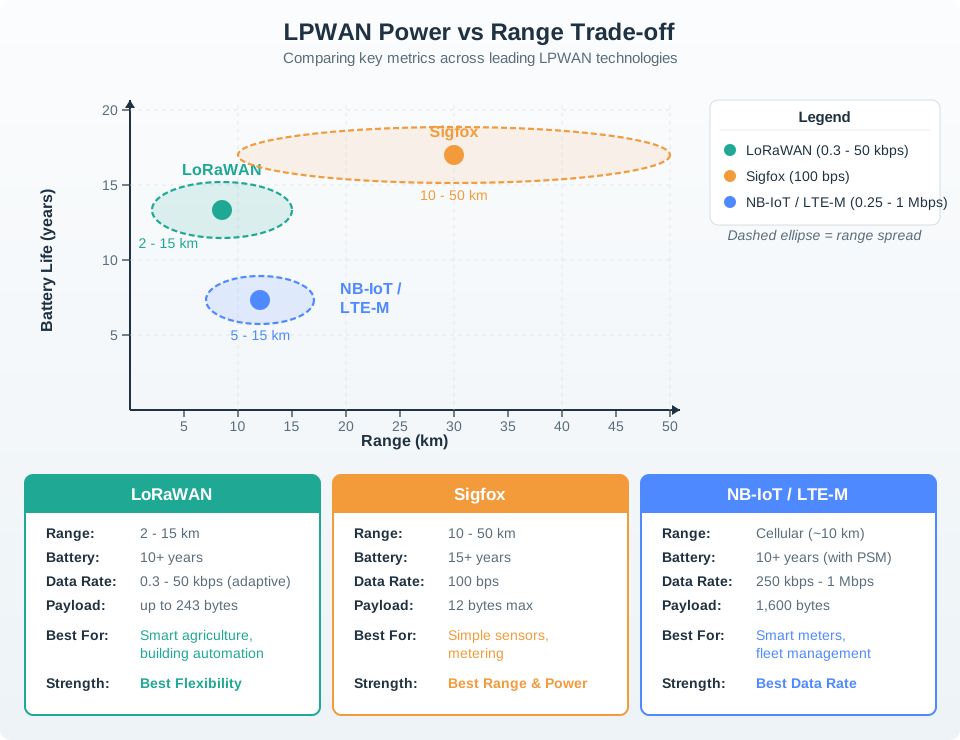
23.12.2 LPWAN Power vs Range Trade-off (Variant View)
This scatter-plot style diagram visualizes the fundamental trade-offs between power consumption, range, and data rate across LPWAN technologies:
Figure 23.5: LPWAN technology positioning showing LoRaWAN (teal) balanced for flexibility with adaptive data rates and private network option, Sigfox (orange) optimized for ultra-low power and maximum range with constrained payload, NB-IoT/LTE-M (navy) leveraging cellular infrastructure for reliability and higher data rates. Trade-off summary shows each technology’s strengths.