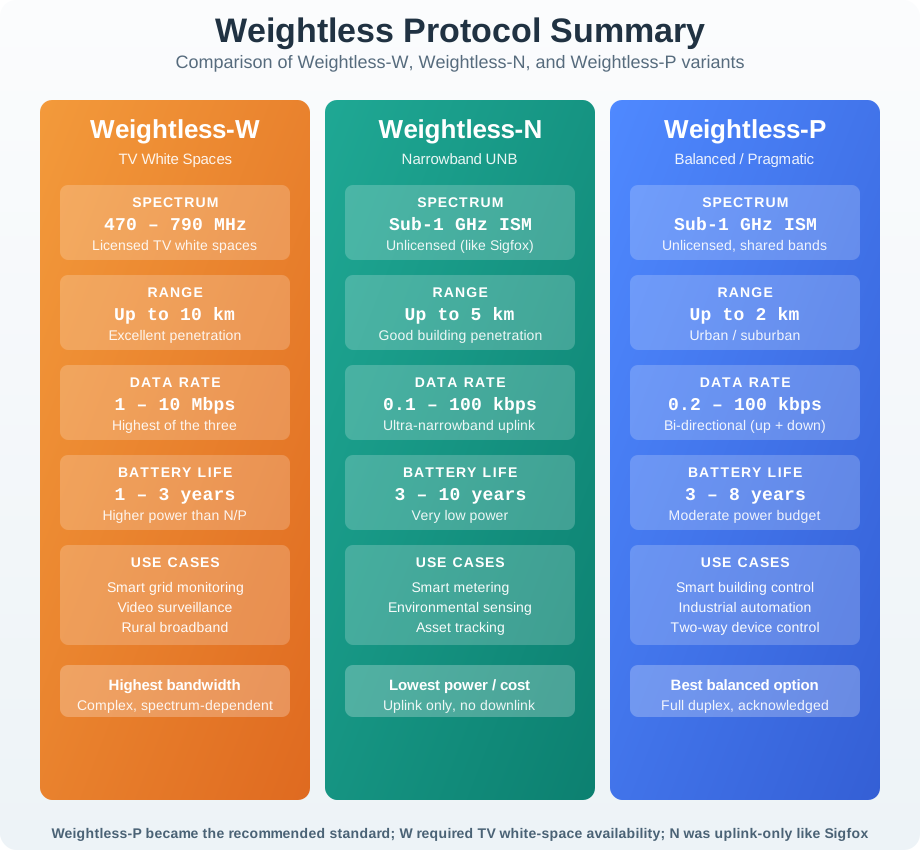
Weightless is an open-standard LPWAN from the Weightless SIG with three variants: Weightless-W (TV White Space spectrum, best range), Weightless-N (one-way, Sigfox-like simplicity), and Weightless-P (bidirectional, ISM bands, best overall balance). Its open standard allows any vendor to implement, unlike proprietary Sigfox.
35.1 Introduction
⏱️ ~10 min | ⭐⭐ Intermediate | 📋 P09.C17A.U01
Weightless is an open-standard LPWAN technology developed by the Weightless Special Interest Group (Weightless SIG), a non-profit standards organization. Unlike Sigfox (proprietary, single operator) or NB-IoT (cellular-licensed), Weightless offers an open standard that any vendor can implement. The technology comes in three variants—Weightless-W, Weightless-N, and Weightless-P—each optimized for different use cases and spectrum allocations.
Learning Objectives
By the end of this chapter, you will be able to:
Distinguish the three Weightless variants (W, N, P) and analyze their technical differences
Explain the Weightless SIG’s open-standard philosophy and evaluate its market implications
Select appropriate use cases for each Weightless variant based on application requirements
Analyze TV White Space spectrum utilization and assess its regulatory constraints
Compare Weightless against LoRaWAN and Sigfox to justify technology selection decisions
Calculate link budgets for Weightless-W and Weightless-P deployments
35.2 Prerequisites
Before diving into this chapter, you should be familiar with:
LPWAN Fundamentals: Understanding core LPWAN concepts including long-range communication, ultra-low power operation, and trade-offs between range, data rate, and battery life provides essential context for Weightless technologies
Networking Basics: Knowledge of wireless communication fundamentals, frequency bands, modulation schemes, and network topologies helps understand Weightless variants’ technical differences
LoRaWAN: Familiarity with LoRaWAN architecture and capabilities provides a comparison baseline for evaluating Weightless’s market positioning and technical approach
Key Concepts
Weightless Standard: An open LPWAN standard from the Weightless SIG with three variants: N (uplink-only), P (bidirectional), and W (TV White Space); designed as an open alternative to proprietary LPWAN technologies.
Weightless-P (Primary): The main Weightless variant with full bidirectional communication, ADR (Adaptive Data Rate), acknowledgments, and operation in unlicensed sub-GHz bands.
TV White Space (Weightless-W): Unused TV broadcast spectrum enabling very long range (50+ km) communication; requires access to a geolocation database to determine available frequencies.
Weightless SIG: The Special Interest Group developing and maintaining the Weightless specifications; membership-based, with open access to specification documents.
35.3 For Beginners: What is Weightless?
Imagine you’re shopping for a car, and the dealer says “We have three models: the Economy for city driving, the Truck for hauling cargo, and the Luxury for long highway trips.” Each vehicle is optimized for different needs. Weightless is similar—it’s not one technology but three different versions (Weightless-W, Weightless-N, and Weightless-P), each designed for different IoT use cases.
Why three versions? Because there’s no “one size fits all” in IoT. Some applications need to send data both ways (sensors receiving commands), some only need to send (simple tracking), some need TV white space spectrum, and some need bidirectional communication with good battery life. Rather than forcing everyone to use one design, Weightless offers options.
The key innovation of Weightless-W is using TV white spaces—unused TV broadcast frequencies that became available when TV went digital. Imagine empty radio channels that no one is using—Weightless-W borrows these for long-range IoT communication. This gives excellent range and penetration through buildings.
Weightless-N is the simplest variant—one-way communication only (device to base station), ultra-low power, perfect for “report sensor reading every hour” applications. Weightless-P adds two-way communication, making it suitable for devices that need to receive commands or confirmations.
Term
Simple Explanation
Weightless-W
Original variant using TV white space spectrum (bidirectional)
Weightless-N
Narrow-band variant—one-way communication only (ultra low power)
Weightless-P
Two-way communication variant—best balance of features
TV White Space
Unused TV broadcast frequencies available for unlicensed use
Open Standard
Anyone can implement—no single company controls it
ISM Band
Industrial, Scientific, Medical—unlicensed radio frequencies
Bidirectional
Two-way communication (device can send and receive)
Unidirectional
One-way only (device only sends, doesn’t receive)
Sensor Squad: The Open Standard Alternative
“Weightless sounds like a superhero name!” said Lila the LED.
Max the Microcontroller grinned. “It’s actually a family of open LPWAN standards created as an alternative to proprietary technologies. The Weightless SIG (Special Interest Group) designed three variants: W, N, and P – each targeting different use cases.”
“The coolest thing about Weightless-W,” said Sammy the Sensor, “is that it uses TV white spaces – unused TV frequencies that penetrate buildings incredibly well. Imagine sending your sensor data through walls and floors with ease because you’re using the same frequencies that TV signals use to reach inside every house!”
Bella the Battery noted: “Being an open standard means no single company controls it. Any manufacturer can build Weightless devices without paying licensing fees. That’s the same philosophy as WiFi and Bluetooth – open standards that anyone can implement. It drives down costs for everyone!”
35.4 The Weightless SIG
The Weightless Special Interest Group was founded in 2012 to develop open standards for LPWAN communications. The organization includes members from across the IoT ecosystem: chipset manufacturers, network operators, system integrators, and end users.
Philosophy:
Figure 35.1: Weightless LPWAN technology summary
Alternative Views: Weightless Architecture Visualizations
Weightless networks follow a star topology similar to LoRaWAN and Sigfox. End devices communicate directly with base stations (not through mesh routing), which reduces complexity and power consumption. The core network handles authentication, data routing, and application server integration.
Weightless Spectrum Usage
Figure 35.3: Weightless spectrum allocation across variants
Weightless-W’s use of TV white space spectrum provides excellent range and building penetration due to lower frequencies (470-790 MHz). However, TV white space availability varies by region and requires database coordination to avoid interfering with TV broadcasts.
Open standard: Anyone can implement (unlike Sigfox)
Multiple variants: Different solutions for different needs
Spectrum flexibility: TV White Space and ISM bands
Vendor choice: No single vendor lock-in
Figure 35.4: Weightless LPWAN Protocol Variants: W, N, and P Specifications
Alternative View: Variant Selection Decision Tree
This decision tree helps select the appropriate Weightless variant based on application requirements: throughput needs, spectrum availability, and bidirectional communication.
35.5 Videos
LPWAN Context: Weightless in the Landscape
LPWAN Overview and Weightless Context
From slides — where Weightless fits among LPWAN technologies.
35.6 Use Cases
Weightless is designed for applications requiring: - Wide area coverage (urban and rural) - Low power consumption (multi-year battery life) - Low data rate communications - Cost-effective connectivity - Open standards (no vendor lock-in)
Example applications:
Traffic sensors (original motivating application)
Environmental monitoring
Smart agriculture
Asset tracking
Smart metering
Industrial sensing
35.7 Weightless Variants Comparison
Feature
Weightless-W
Weightless-N
Weightless-P
Spectrum
TV White Space (470-790 MHz)
Sub-GHz ISM
Sub-GHz ISM (868/915 MHz)
Data Rate
1 kbps - 10 Mbps
100 bps
200 bps - 100 kbps
Range
5+ km
3 km
2-5 km
Direction
Bidirectional
Uplink only
Bidirectional
Power
Medium
Ultra-low
Low
Status
Limited adoption
Discontinued
Active
Best For
High bandwidth, rural
Simple sensors
Most IoT applications
Key Insight: Weightless-P has emerged as the primary variant due to its balance of features and simpler deployment (no TV White Space database required).
Knowledge Check: Weightless Variants
35.8 Weightless Variant Selector
Use this tool to find the most suitable Weightless variant based on your requirements.
Show code
viewof needBidirectional = Inputs.radio(["Yes","No"], {value:"Yes",label:"Bidirectional communication required?"})viewof tvwsAvailable = Inputs.radio(["Yes","No"], {value:"No",label:"TV White Space spectrum available?"})viewof dataRateNeeded = Inputs.radio(["<1 kbps","1–100 kbps",">100 kbps"], {value:"1–100 kbps",label:"Data rate needed"})
Show code
{let recommendation, color, reason;if (tvwsAvailable ==="Yes"&& dataRateNeeded ===">100 kbps") { recommendation ="Weightless-W"; color ="#3498DB"; reason ="TV White Space at 470–790 MHz supports up to 10 Mbps — the only Weightless variant capable of high data rates. Note: requires geolocation database and cognitive radio hardware (+$30–50/device)."; } elseif (needBidirectional ==="No"&& dataRateNeeded ==="<1 kbps") { recommendation ="Weightless-N (Discontinued)"; color ="#E74C3C"; reason ="Weightless-N matched this profile (uplink-only, 100 bps, ultra-low power) but has been discontinued. Use Weightless-P as the modern replacement — it supports uplink-only operation patterns with ADR."; } else { recommendation ="Weightless-P"; color ="#16A085"; reason ="Weightless-P (868/915 MHz ISM) is the active, practical variant. It supports 200 bps–100 kbps ADR, full bidirectional communication, and simple ISM deployment without TV White Space regulatory complexity."; }returnhtml`<div style="background:#2C3E50;color:#fff;padding:16px 20px;border-radius:6px;font-family:Arial,sans-serif;margin-top:8px;"> <div style="font-size:0.8em;opacity:0.75;margin-bottom:4px;">Recommended Variant</div> <div style="font-size:1.5em;font-weight:bold;color:${color};margin-bottom:8px;">${recommendation}</div> <div style="font-size:0.88em;line-height:1.5;opacity:0.9;">${reason}</div> <div style="margin-top:10px;padding:8px;background:rgba(255,255,255,0.08);border-radius:4px;font-size:0.8em;"> ⚠️ In practice, consider LoRaWAN as the default for new deployments — its ecosystem (50+ module vendors, $2–5 modules) outweighs Weightless-P's open-standard advantage for most use cases. </div> </div>`;}
Putting Numbers to It
How does Weightless-W’s lower frequency (470-790 MHz TVWS) compare to Weightless-P (868 MHz ISM) for range? Consider free-space path loss (FSPL).
Path loss formula: \(\text{FSPL (dB)} = 20\log_{10}(d) + 20\log_{10}(f) + 32.45\) where \(d\) = distance (km), \(f\) = frequency (MHz)
Frequency advantage: Weightless-W has 3.2 dB less path loss (lower frequency propagates better). With 20 dBm TX power and -124 dBm sensitivity (144 dB link budget): - Weightless-W margin at 5 km: \(144 - 102 = 42\text{ dB}\) (good for in-building penetration) - Weightless-P margin: \(144 - 105.2 = 38.8\text{ dB}\) (3.2 dB less penetration)
Range difference (assuming 100 dB path loss needed for reliability): - Weightless-W: FSPL = 100 dB → solve for \(d\): \(d = 10^{(100 - 55.6 - 32.45)/20} = 3.3\text{ km}\) - Weightless-P: FSPL = 100 dB → \(d = 10^{(100 - 58.8 - 32.45)/20} = 2.3\text{ km}\)
Conclusion: Weightless-W achieves 43% longer range (3.3 km vs 2.3 km) due to superior propagation at lower TVWS frequencies, but regulatory complexity limits deployments!
35.9 Worked Example: TV White Space Link Budget
Scenario: A city deploys Weightless-W traffic sensors using TV white space spectrum at 600 MHz. How does the link budget compare to LoRaWAN at 868 MHz?
35.9.1 Weightless-W at 600 MHz
Transmit power: 20 dBm (100 mW, typical TVWS limit)
Receiver sensitivity: -124 dBm (Weightless-W narrowband mode)
Maximum link budget: 20 - (-124) = 144 dB

FSPL at 5 km, 600 MHz:
  FSPL = 20*log10(5) + 20*log10(600) + 32.45
  FSPL = 13.98 + 55.56 + 32.45 = 101.99 dB

Link margin at 5 km: 144 - 102 = 42 dB
  (Sufficient for 2 concrete walls at 15 dB each + 12 dB fade margin)
35.9.2 LoRaWAN at 868 MHz (for comparison)
Transmit power: 14 dBm (25 mW, EU regulatory limit)
Receiver sensitivity: -137 dBm (LoRa SF12)
Maximum link budget: 14 - (-137) = 151 dB

FSPL at 5 km, 868 MHz:
  FSPL = 20*log10(5) + 20*log10(868) + 32.45
  FSPL = 13.98 + 58.77 + 32.45 = 105.20 dB

Link margin at 5 km: 151 - 105.2 = 45.8 dB
35.9.3 Comparison
Parameter
Weightless-W (600 MHz)
LoRaWAN (868 MHz)
Link budget
144 dB
151 dB
FSPL at 5 km
102 dB
105.2 dB
Link margin at 5 km
42 dB
45.8 dB
Building penetration
3.2 dB better (lower frequency)
Baseline
Effective indoor margin
~45 dB
~45.8 dB
Key Insight: Despite LoRaWAN’s superior receiver sensitivity (-137 vs -124 dBm), Weightless-W’s lower frequency (600 vs 868 MHz) provides 3.2 dB better building penetration, making their effective indoor performance nearly identical. The real differentiator is spectrum access: TVWS requires database coordination and varies by region, while ISM bands are universally available.
35.10 Market Position: Weightless vs LoRaWAN vs Sigfox
Understanding why Weightless has limited market adoption despite technical merit:
Factor
Weightless
LoRaWAN
Sigfox
Chipset vendors
2-3
15+ (Semtech, STM, Nordic)
5+
Module cost (2025)
$15-25
$5-12
$3-8
Global networks
< 10
200+ in 180 countries
70+ countries
Developer community
Small
500K+ developers
100K+
Standardization
Weightless SIG (open)
LoRa Alliance (open)
Sigfox SA (proprietary)
First deployment
2015
2015
2012
2025 connections
< 500K
~300M
~20M
Why Weightless Lost Market Share:
Spectrum uncertainty: TVWS regulations varied by country and changed frequently, making Weightless-W deployments risky for long-term projects
Timing: LoRaWAN and Sigfox had 2-3 year head start in building ecosystem momentum
Single-protocol modules: Unlike LoRa (which can pair with any network stack), Weightless required dedicated silicon with limited alternative uses
Lesson for IoT Protocol Selection: Technical superiority alone does not determine market success. Ecosystem health – chipset availability, developer tools, community support, and deployment track record – often matters more than raw specifications for long-term IoT deployments spanning 10-15 years.
35.11 Decision Framework: When to Consider Weightless
Despite limited market adoption, there are specific scenarios where Weightless remains worth evaluating.
Consider Weightless-P when:
Vendor lock-in is unacceptable: Government or military applications requiring open standards with multiple supplier options
Bidirectional ISM band: Need two-way communication without cellular costs, but LoRaWAN Class A latency (seconds to hours for downlink) is too slow
Adaptive data rate range: Application requires 200 bps to 100 kbps flexibility – wider than LoRaWAN’s 250 bps to 50 kbps range
Consider Weightless-W when:
Dense urban with deep indoor: TV white space frequencies (470-790 MHz) penetrate concrete better than 868/915 MHz ISM bands
TVWS regulatory support exists: UK (Ofcom), US (FCC), Singapore, and several African nations have mature TVWS frameworks
High data rate LPWAN: Need >50 kbps at long range – Weightless-W supports up to 10 Mbps, far exceeding LoRaWAN’s 50 kbps maximum
Default to LoRaWAN or NB-IoT unless one of the above conditions applies. Ecosystem health matters more than specifications for 10+ year deployments.
Trade-off: Open Standard vs Ecosystem Size
The Weightless paradox illustrates a fundamental tension in IoT technology selection:
Open standards (Weightless, LoRaWAN) allow anyone to build compatible hardware, theoretically driving down costs
Ecosystem momentum (LoRaWAN, NB-IoT) ensures chipset availability, community support, and long-term viability
Weightless proves that being open is necessary but not sufficient. LoRaWAN succeeded with an open standard AND aggressive ecosystem building (Semtech’s chipset subsidies, The Things Network community, 500K+ developers). Weightless had the open standard but not the ecosystem investment.
Common Pitfalls
1. Selecting Weightless for a Region Without Ecosystem Support
Weightless module availability and network infrastructure is limited compared to LoRaWAN or NB-IoT. Verify chipset and module availability, network operator presence, and development tool support before committing to Weightless.
2. Overlooking TVWS Database Requirements for Weightless-W
Weightless-W operation in TV White Space requires querying a geolocation database to obtain available frequency assignments — this is a regulatory requirement. Devices must have GPS or network-provided location data to query the database.
Label the Diagram
💻 Code Challenge
Order the Steps
:
35.12 Concept Relationships
Three Variants = Different Physics Trade-offs: Weightless-W (TV White Space, 470-790 MHz) offers superior building penetration (lower frequency) but requires cognitive radio complexity (geolocation database, spectrum sensing). Weightless-N (ultra-narrowband) maximizes battery life (uplink-only, no receiver) but sacrifices downlink (no firmware OTA, no commands). Weightless-P (ISM band) balances bidirectionality with deployment simplicity. Each variant optimizes ONE dimension at expense of others.
Open Standard does not equal Market Success: Weightless SIG published open specifications (anyone can implement), unlike Sigfox (proprietary). But openness without ecosystem support creates fragmentation — multiple vendors with incompatible implementations, no reference platform, no interoperability testing. LoRaWAN Overview succeeded with BOTH open standard AND ecosystem coordination (LoRa Alliance certification program).
35.13 See Also
LPWAN Landscape:
LPWAN Fundamentals - Core concepts (link budget, duty cycle, ADR) applicable to all Weightless variants
LoRaWAN Overview - Market-dominant LPWAN for comparison. LoRa Alliance model (open spec + chip vendor + certification) is what Weightless lacked
NB-IoT Fundamentals - Cellular alternative with existing infrastructure advantage