46 XMPP Protocol
46.1 Introduction
Extensible Messaging and Presence Protocol (XMPP) is an open-standard communication protocol based on XML (Extensible Markup Language) designed for real-time messaging and presence information. Originally developed for instant messaging (Jabber), XMPP has evolved to support IoT applications, particularly those requiring real-time communication, service discovery, and presence-based interactions.
By the end of this chapter, you will be able to:
- Explain XMPP’s federated architecture and decentralized model
- Distinguish between the three core stanza types (message, presence, IQ) and their IoT roles
- Compare XMPP with MQTT and AMQP for IoT applications
- Evaluate XMPP’s strengths and weaknesses for real-time IoT
- Select the appropriate protocol (XMPP, MQTT, or AMQP) given a set of IoT application requirements
46.2 Prerequisites
Before diving into this chapter, you should be familiar with:
- MQTT Protocol: Understanding MQTT’s publish-subscribe model and lightweight approach provides essential context for comparing XMPP’s different design philosophy and overhead trade-offs
- Application Protocols: Knowledge of application-layer protocols and messaging patterns helps understand XMPP’s position in the IoT protocol landscape
- Networking Basics: Understanding client-server vs peer-to-peer architectures, XML/JSON data formats, and network communication fundamentals is essential for grasping XMPP’s federated architecture
- XMPP (Extensible Messaging and Presence Protocol): An XML-based open standard protocol for real-time communication including instant messaging, presence information, and publish-subscribe messaging.
- XMPP JID (Jabber ID): A structured address format (user@domain/resource) uniquely identifying each XMPP entity; analogous to an email address for XMPP routing.
- Pub-Sub (XEP-0060): An XMPP Extension Protocol for publish-subscribe messaging; servers maintain nodes to which publishers post items and subscribers receive notifications.
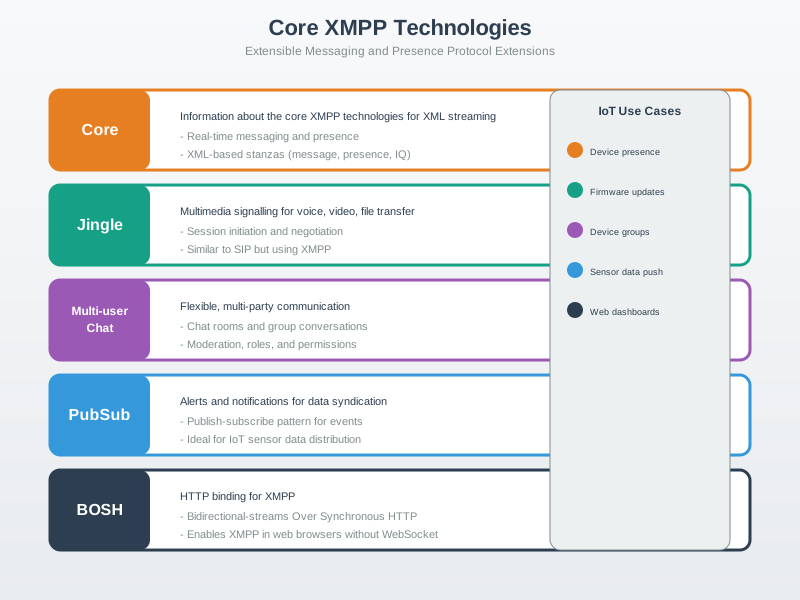
- BOSH (Bidirectional Streams over Synchronous HTTP): An XMPP transport protocol using long-polling HTTP for environments where direct TCP connections are blocked by firewalls or proxies.
- IoT XMPP Extensions (XEP-0323/0324/0325): XMPP Extension Protocols specifically designed for IoT: sensor data (0323), provisioning (0324), and control (0325).
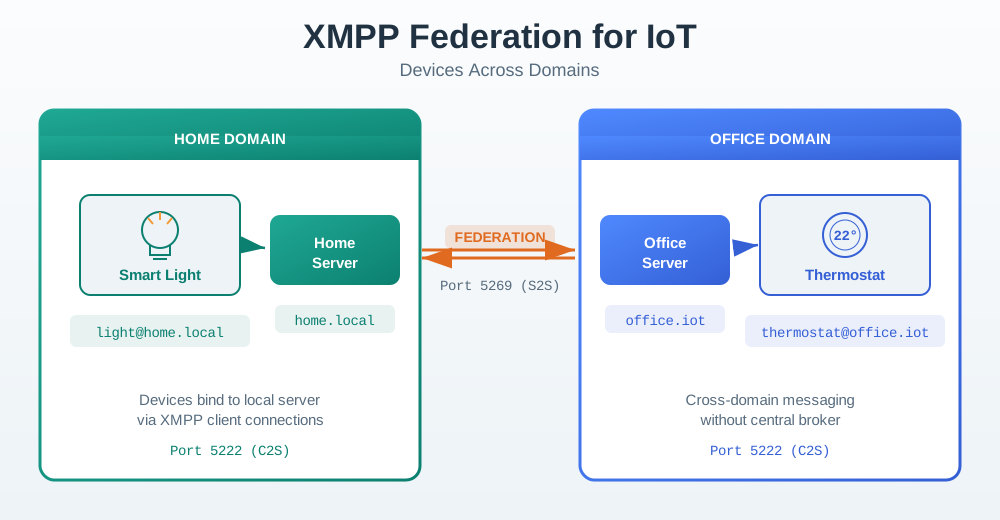
- XMPP Federation: The ability of XMPP servers from different domains to exchange messages, enabling IoT devices on different servers to communicate seamlessly.
46.4 🌱 Getting Started (For Beginners)
Analogy: XMPP is like email for devices—decentralized, open, and designed for real-time chat.
Just like you can email anyone regardless of their provider (Gmail can email Outlook), XMPP lets devices on different servers communicate with each other.
“XMPP is the protocol behind instant messaging apps like Google Talk and WhatsApp?” asked Sammy the Sensor. “How does a chat protocol work for IoT?”
Max the Microcontroller explained: “XMPP gives every device an address like an email – sammy@home-server.local. Devices can send messages to each other, broadcast their status (‘I’m online!’ or ‘Battery low!’), and request information. It’s like giving every sensor its own chat account.”
“The coolest feature is federation,” said Lila the LED. “Just like you can email someone on a different server (Gmail to Outlook), XMPP devices on different servers can talk to each other. Your home sensors on one server can communicate with the city grid on another server without any custom integration.”
Bella the Battery appreciated the presence feature: “Every device can broadcast whether it’s online, offline, or in a special state like ‘low battery.’ Other devices automatically know your status without polling. It’s like seeing the green dot next to a friend’s name in a chat app – instant awareness of who’s available!”
This diagram shows the three core XMPP stanza types: <message> for one-way communication, <presence> for status broadcasting, and <iq> for request-response interactions.
| Feature | XMPP | MQTT |
|---|---|---|
| Origin | Instant messaging (Jabber) | IoT sensors |
| Format | XML (verbose) | Binary (compact) |
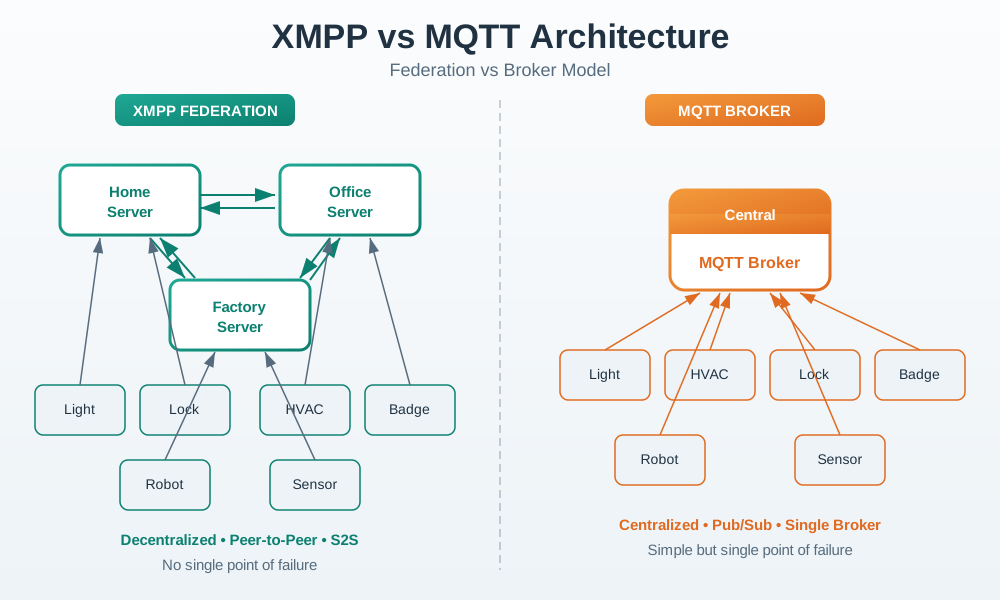
| Architecture | Decentralized (federated) | Centralized (broker) |
| Presence | Built-in (“online/offline”) | Not native |
| Best for | Real-time chat, collaboration | Sensor data, telemetry |
XMPP was built for chat, so it knows if devices are “online” or “offline”:
| Presence State | Meaning | IoT Example |
|---|---|---|
| Available | Device is online and responsive | Sensor is active |
| Away | Device is online but busy | Sensor in low-power mode |
| Unavailable | Device is offline | Sensor powered down |
Why this matters for IoT: You can see which devices are connected without polling them!
Before diving deeper, test your understanding:
- How is XMPP different from MQTT architecturally?
- Hint: Think email vs central server
- What does “presence” mean in XMPP?
- Hint: Online/offline status
- When might you choose XMPP over MQTT?
- Hint: Real-time collaboration, chat-like features
Answers explored in the chapter below!
46.5 XMPP Overview
46.5.1 What is XMPP?
XMPP is a communication protocol for message-oriented middleware based on Extensible Markup Language (XML). It enables real-time exchange of structured data between networked entities.
Key characteristics:
- Open standard: IETF specifications (RFC 6120, 6121, 6122)
- XML-based: Human-readable, extensible message format
- Decentralized: No central server required (federated model)
- Real-time: Low-latency message exchange
- Extensible: Custom extensions (XEPs - XMPP Extension Protocols)
46.6 Videos
46.6.1 XMPP Architecture
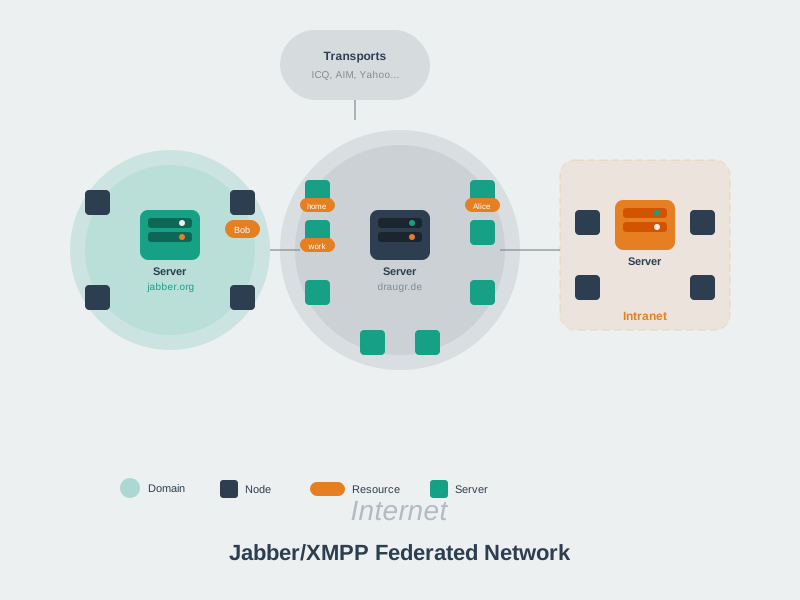
XMPP’s federated architecture allows servers operated by different organizations to communicate. Unlike MQTT’s centralized broker, XMPP servers form a distributed network where user@serverA.com can message device@serverB.org, similar to email federation.
XMPP’s built-in presence system enables real-time awareness of device status. When a device goes offline, its server broadcasts unavailable presence to all subscribers. This eliminates the need for polling or heartbeat mechanisms to detect disconnections.
XMPP’s PubSub extension (XEP-0060) provides publish-subscribe messaging similar to MQTT topics. Devices publish sensor readings to nodes, and subscribers receive notifications. Unlike MQTT, XMPP PubSub supports node hierarchies, access control, and persistent item storage.
Deepen your understanding of XMPP and related concepts:
Interactive Learning:
- Simulations Hub - Try the Protocol Comparison Tool to compare XMPP vs MQTT vs AMQP side-by-side with interactive message flow visualization
- Explore the Network Topology Visualizer to understand how XMPP’s federated architecture differs from centralized broker models
Visual Learning:
- Videos Hub - Watch “Messaging Protocols Overview” (Lesson 4) for context on XMPP vs AMQP/MQTT in real-world messaging scenarios
- Review real-time messaging pattern demonstrations showing presence, federation, and use cases
Assessment:
- Quizzes Hub - Test your protocol selection skills with “Application Protocol Selection” quiz covering when to use XMPP vs alternatives
- Practice calculating bandwidth overhead and cost trade-offs for different protocols
Knowledge Gaps:
- Knowledge Gaps Hub - Review common misconceptions about XMPP’s overhead, federation model, and IoT suitability
46.6.2 History and Evolution
Timeline:
- 1999: Jeremie Miller creates Jabber (XMPP precursor)
- 2004: IETF standardizes XMPP (RFCs 3920-3923)
- 2011: Updated XMPP specifications (RFCs 6120-6122)
- 2013+: XEP-0323 to XEP-0326 (IoT extensions)
Original purpose:
- Instant messaging (alternative to proprietary protocols like ICQ, AIM)
- Presence (online/offline/away status)
- Contact lists (roster management)
Modern applications:
- IoT device communication (machine-to-machine)
- Smart grid monitoring and control
- Social networking services
- Gaming (real-time multiplayer)
- VoIP signaling
Misconception: “XMPP’s XML overhead makes it impractical for all IoT applications—always use MQTT instead.”
Reality: While XMPP messages are 3.5-7.9× larger than MQTT (280 bytes vs 40 bytes for a temperature reading), this overhead is negligible for mains-powered devices on unlimited bandwidth networks.
Real-World Example - Smart Home Thermostat:
A Wi-Fi-connected smart home thermostat sends status updates every 5 minutes (288 messages/day):
| Metric | XMPP (280 bytes) | MQTT (40 bytes) | Impact |
|---|---|---|---|
| Daily bandwidth | 78.75 KB | 11.25 KB | +67.5 KB/day |
| Monthly bandwidth | 2.37 MB | 0.34 MB | +2.03 MB/month |
| Annual cost ($0.10/GB) | $0.03 | $0.004 | +$0.026/year |
| Power (Wi-Fi active) | ~500 mW | ~500 mW | Same (Wi-Fi dominates) |
Cost per device: $0.026/year extra for XMPP
When XMPP’s overhead IS justified (mains-powered thermostat): - ✓ Rich presence: Users see “Thermostat online, target 22°C, current 21°C” without polling - ✓ Human interaction: Natural language commands via chat: “Set temperature to 23°C” - ✓ Message history: Review temperature changes and user interactions over time - ✓ Service discovery: Thermostat auto-advertises capabilities (heat/cool/fan modes) - ✓ Federation: Thermostats from different manufacturers communicate via open XMPP
When XMPP overhead is NOT justified (battery-powered soil sensor): - ✗ Battery-powered devices (need MQTT’s efficiency) - ✗ High-frequency telemetry (100+ msgs/hour → significant bandwidth) - ✗ Constrained networks (cellular with data caps → use CoAP/MQTT) - ✗ Simple sensor readings (no human interaction needed)
Bottom Line: XMPP’s overhead is irrelevant when power and bandwidth are unlimited, and its rich features (presence, metadata, federation) significantly improve user experience for interactive devices. Choose protocol based on use case requirements, not blanket assumptions.
46.7 Knowledge Check
Test your understanding of XMPP protocol with these questions.
46.7.1 Messaging Protocol Flow Comparison (Variant View)
This sequence diagram contrasts XMPP’s presence-aware messaging with MQTT’s lightweight pub/sub pattern, highlighting architectural differences:
:
46.8 Summary
This chapter explored XMPP (Extensible Messaging and Presence Protocol) - an open-standard XML-based protocol for real-time communication:
- Protocol Foundation: XMPP originated as Jabber for instant messaging, now extended for IoT with real-time, human-readable XML communication
- Key Features:
- Presence: Built-in status indicators (online/offline/away) for devices and users
- Federated Architecture: Decentralized model where servers communicate peer-to-peer, no central authority required
- Extensibility: Custom extensions (XEPs) for IoT, gaming, multimedia, and more
- IoT Extensions: XEP-0323 through XEP-0326 define sensor data formats, control commands, and discovery mechanisms
- Addressing: JIDs (Jabber IDs) like
sensor@iot.local/room1identify entities with user, domain, and resource components - Comparison with Other Protocols:
- vs. MQTT: XMPP adds presence and rich metadata but has higher overhead (XML vs binary)
- vs. AMQP: XMPP is simpler, federated; AMQP offers stronger message guarantees
- vs. CoAP: XMPP is persistent and real-time; CoAP is lightweight and RESTful
- Best Use Cases: Social IoT applications, presence-based systems, chat-enabled devices, gaming integrations, and scenarios requiring message history
- Trade-offs: XML verbosity increases bandwidth usage but provides human-readability and extensibility
XMPP excels in scenarios where presence awareness, real-time interaction, and social features are important, making it ideal for human-device interaction applications.
46.9 Further Reading
Standards:
- RFC 6120: XMPP Core
- RFC 6121: XMPP Instant Messaging and Presence
- RFC 6122: XMPP Address Format
- XEP-0323 to XEP-0326: IoT Extensions
Books:
- “XMPP: The Definitive Guide” by Saint-Andre et al.
- “Professional XMPP Programming with JavaScript and jQuery”
Online Resources:
- XMPP Standards Foundation: xmpp.org
- XMPP IoT: xmpp-iot.org
- XEP Index: xmpp.org/extensions
46.10 References
46.11 Concept Relationships
Presence is the Killer Feature: XMPP’s presence stanzas (available/away/unavailable) eliminate polling for device status. Contrast with MQTT: to check if 400 nurses are online, MQTT requires subscribing to 400 hospital/presence/nurse-* topics + tracking retained messages manually. XMPP: roster query returns all online contacts instantly. This architectural difference (built-in vs bolt-on presence) drives protocol selection for human-device interaction.
Federation Creates Decentralization: XMPP servers communicate peer-to-peer (like email). Device alice@home.iot can message bob@office.iot across organizational boundaries without central broker. Contrast with MQTT: requires shared broker or custom bridge. Federation enables cross-organization IoT without vendor lock-in, but adds complexity (server-to-server routing, trust management).
XML Overhead is Real But Often Irrelevant: Worked example (hospital) shows XMPP uses 56% more bandwidth than MQTT for sensor telemetry (97 bytes vs 62 bytes per message). BUT for mains-powered devices on unlimited bandwidth (WiFi hospital network), this costs $2.52/year for 1,000 sensors. The 56% overhead becomes irrelevant when power and bandwidth are unconstrained. Choose protocol based on features needed (presence, routing, discovery), not blanket efficiency assumptions.
Hybrid Architecture Wisdom: Hospital case study demonstrates optimal solution = MQTT for high-volume telemetry (1,000 environmental sensors) + XMPP for interactive devices (nurse call buttons, medication dispensers). One protocol ≠ all traffic. Recognize different traffic patterns (high-volume/low-overhead vs low-volume/high-semantics) and match protocols accordingly.
46.12 See Also
Protocol Comparisons:
- MQTT Fundamentals - XMPP Pub/Sub uses MQTT as transport layer. Understanding MQTT topics + QoS essential for XMPP Pub/Sub (XEP-0060) over MQTT.
- AMQP Fundamentals - AMQP provides enterprise messaging with routing/transactions. XMPP provides presence + federation. When to use each: AMQP for guaranteed delivery workflows, XMPP for presence-aware real-time.
- CoAP Protocol - CoAP = RESTful, lightweight, request-response. XMPP = chat-based, presence-aware, push messaging. Complementary patterns for different use cases.
XMPP Extensions (XEPs):
- XMPP IoT Extensions - XEP-0323 (sensor data), XEP-0324 (provisioning), XEP-0325 (control), XEP-0326 (concentrators). Standard formats for IoT on XMPP.
- XMPP PubSub (XEP-0060) - Publish-subscribe on XMPP. Nodes, subscriptions, access control, persistent items. Alternative to MQTT topics with richer semantics.
Federation Architecture:
- Decentralized Networks - XMPP’s federated model compared to centralized (MQTT/AMQP broker) and distributed (blockchain) architectures.
- Identity and Authentication - XMPP uses JIDs (user@domain/resource) for addressing. Federated authentication via SASL.
Real-World Use Cases:
- Social IoT - XMPP enables devices with social relationships (friend lists, status updates, chat). Example: smart home devices that “know” each other.
- Smart Hospital Communication - Worked example (nurse call system) expands on XMPP presence for healthcare.
Hands-On Exploration:
- Try XMPP Client Simulator (Simulations Hub) to connect to public XMPP server, browse roster, send presence, subscribe to contacts.
- Use Protocol Overhead Analyzer to compare XMPP vs MQTT vs AMQP message sizes for your payload.
Advanced Topics:
- XMPP on Constrained Devices - XMPP-IoT optimizations for embedded systems (binary encoding, stream management, compression).
- Cloud Integration - XMPP to cloud platform bridges (XMPP → AWS IoT Core via custom lambda, XMPP → Azure via IoT Hub protocol gateway).
46.13 What’s Next
You have covered XMPP’s federated architecture, stanza types, and IoT extensions. The table below maps where to go depending on your learning goal.
| Chapter | Focus | Why Read It |
|---|---|---|
| AMQP Fundamentals | Enterprise message queuing with guaranteed delivery and flexible routing | Compare XMPP’s federation model with AMQP’s centralized exchange/queue architecture for enterprise IoT |
| AMQP vs MQTT and Use Cases | Structured protocol selection framework | Apply the same decision framework to evaluate when XMPP’s presence features justify its XML overhead |
| IoT Protocols Review | Side-by-side review of all major IoT application protocols | Consolidate protocol knowledge and practice selecting the right protocol for a given scenario |
| Big Data Overview | Data collection, storage, and analysis at scale | Understand what happens to the sensor data that XMPP (and MQTT/AMQP) deliver — the analytics pipeline downstream |
| Edge and Fog Computing | Distributing compute closer to devices | Assess how XMPP’s federated server model maps onto edge deployments and how to reduce cloud dependency |
| Social IoT and Ad-hoc Routing | Device social relationships, trust, and opportunistic networking | Explore the “social IoT” paradigm that XMPP’s presence and roster management directly enable |