18 Ad Hoc DTN and Social Routing
18.1 Learning Objectives
By the end of this chapter series, you will be able to:
- Justify DTN adoption: Explain when and why Delay-Tolerant Networks are needed over traditional routing
- Compare routing strategies: Evaluate epidemic, context-aware, and social routing trade-offs quantitatively
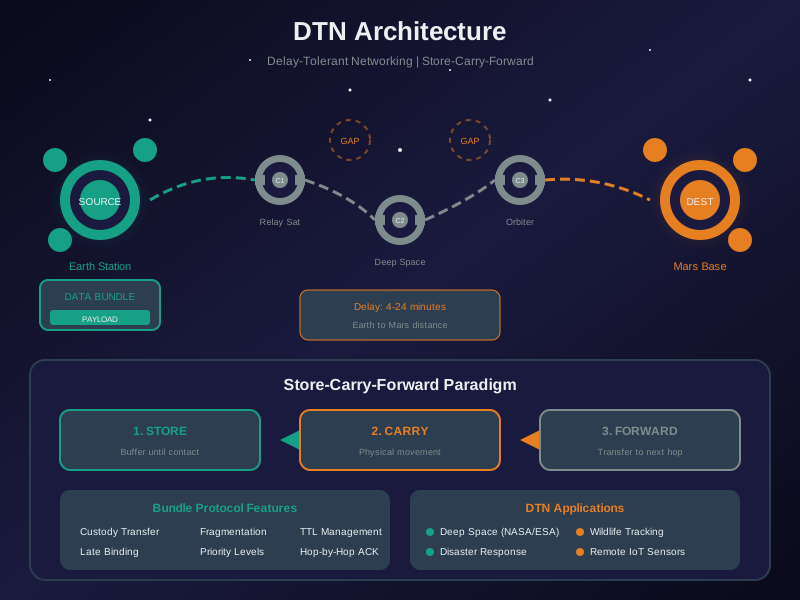
- Apply store-carry-forward: Demonstrate how DTN nodes buffer, transport, and relay messages opportunistically
- Design DTN-based solutions: Select the right DTN routing strategy for real-world IoT scenarios
- Assess DTN performance: Calculate delivery ratios, overhead, and latency for different routing approaches
Minimum Viable Understanding
- DTN solves disconnected networking: When no continuous end-to-end path exists (wildlife tracking, rural areas, disaster zones), DTN uses a store-carry-forward paradigm where nodes physically carry data until they encounter the next relay.
- Three routing strategies trade off delivery vs. overhead: Epidemic routing floods messages for ~95% delivery but 1000% overhead; context-aware and social routing achieve ~88% delivery with only 200% overhead by forwarding selectively.
- Social routing exploits predictable human/animal patterns: Rather than flooding or random forwarding, SocialCast and PRoPHET use encounter history, colocation probability, and mobility patterns to choose the best carriers.
Sensor Squad: Message in a Bottle Network
Sammy the Sensor is stuck on a remote island with no phone signal. He needs to get a weather report to Lila the LED on the mainland. There is no bridge, no cable, and no Wi-Fi.
“How do I send my message?” Sammy asks.
Max the Microcontroller has an idea: “Put your message in a bottle and throw it in the ocean! Passing ships will pick it up and carry it. When a ship gets close to the mainland, it hands the bottle to another ship heading that way.”
This is exactly how Delay-Tolerant Networks work:
- Store – Sammy puts the message in a bottle (the node saves the data)
- Carry – A ship picks it up and sails with it (the node physically moves)
- Forward – When the ship meets another going toward Lila, it passes the bottle along
Bella the Buzzer adds: “But what if we throw hundreds of bottles? That is wasteful! Instead, let us only give the bottle to ships that we KNOW visit the mainland regularly. The fishing boat goes there every Tuesday!”
That is the difference between epidemic routing (throw bottles everywhere) and social routing (give the bottle to the fishing boat that regularly visits the destination). Social routing is smarter and wastes less energy.
For Beginners: What Are Delay-Tolerant Networks?
Most networks assume you can always find a path from sender to receiver, like making a phone call where both phones must be connected at the same time. But what happens when there is no continuous connection?
Delay-Tolerant Networks (DTN) handle exactly this problem. Think of it like the postal system before trains existed: you give your letter to a traveler heading in the right direction, and they physically carry it. Along the way, they might hand it to someone going even closer to the destination.
When do we need DTN?
- A sensor on a wild animal that only encounters a base station once a week
- Rural villages where a bus with Wi-Fi visits once daily
- A disaster zone where cell towers are destroyed
- Deep space communication with minutes or hours of signal delay
Three ways DTN routes messages:
| Strategy | How It Works | Analogy |
|---|---|---|
| Epidemic | Give a copy to everyone you meet | Telling gossip to everyone at a party |
| Context-Aware | Give to people likely heading the right direction | Asking a bus driver going downtown |
| Social | Give to people who regularly see the recipient | Asking a coworker who sits near the recipient |
Key takeaway: DTN trades speed for reliability. Your message might take hours or days, but it will arrive even when no real-time connection exists.
Chapter Series
This topic is covered in four focused chapters:
- DTN Fundamentals and Store-Carry-Forward - Core DTN concepts, disconnected network challenges, and the store-carry-forward paradigm
- DTN Epidemic Routing - Flooding-based protocols, buffer management, and Spray-and-Wait optimization
- DTN Social Routing - Context-aware routing, utility functions, and SocialCast protocol
- DTN Applications - Real-world deployments including wildlife tracking, rural connectivity, and hybrid architectures
18.2 Learning Path
Start here if you’re new to DTN:
18.3 DTN Architecture Overview
The following diagram illustrates how DTN fits into the broader ad hoc routing landscape and where each routing strategy applies.
18.4 Quick Reference
| Chapter | Key Topics | Difficulty |
|---|---|---|
| DTN Fundamentals | Store-carry-forward, disconnected networks, DTN vs TCP/IP | Intermediate |
| Epidemic Routing | Message flooding, TTL, buffer management, Spray-and-Wait | Intermediate |
| Social Routing | Utility functions, SocialCast, bounded replication | Advanced |
| Applications | DakNet, ZebraNet, hybrid architectures, disaster recovery | Intermediate |
18.5 Prerequisites
Before starting this series, you should be familiar with:
- Ad Hoc Routing: Proactive (DSDV) - Traditional proactive routing
- Ad Hoc Routing: Reactive (DSR) - On-demand routing
- Ad Hoc Routing: Hybrid (ZRP) - Zone-based routing
- Multi-Hop Fundamentals - Multi-hop networking basics
18.6 Key Concepts Preview
Delay-Tolerant Networks address scenarios where:
- No continuous end-to-end path exists
- Nodes are mobile and encounters are opportunistic
- Latency tolerance ranges from minutes to days
- Traditional routing protocols fail completely
18.6.1 Store-Carry-Forward Paradigm
The fundamental mechanism of DTN is the store-carry-forward paradigm, which replaces the traditional assumption of an always-available path.
18.6.2 Core DTN Mechanisms
- Store: Buffer packets in local memory
- Carry: Physically transport packets while moving
- Forward: Transfer packets on opportunistic contacts
18.6.3 Routing Strategy Comparison
18.6.4 When to Use Each Strategy
18.7 Worked Example: Wildlife Tracking in a National Park
Scenario: A national park deploys 200 sensor collars on elephants to track their movement, health, and proximity to park boundaries. The park has 5 base stations, but elephants roam across 10,000 km2 and are rarely within range of any base station. Rangers also carry mobile receivers.
Challenge: How should sensor data (GPS coordinates, temperature, activity level) be delivered from elephant collars to the central monitoring system?
Step 1: Assess Connectivity
- Elephants encounter base stations: ~once every 3-7 days
- Elephants encounter each other: ~2-5 times per day at watering holes
- Rangers encounter elephants: ~1-3 times per day on patrols
- Conclusion: No continuous path exists – DTN is required
Step 2: Select Routing Strategy
- Data is not time-critical (daily updates are sufficient)
- Elephants have predictable patterns (watering holes at dawn/dusk, migration corridors)
- Buffer space on collars is limited (512 KB)
- Battery must last 2 years
Analysis of options:
| Strategy | Delivery | Overhead | Battery Impact | Buffer Use |
|---|---|---|---|---|
| Epidemic | ~95% | ~1000% | Very high (floods to all encounters) | Exceeds 512 KB |
| Context-Aware | ~88% | ~200% | Moderate | Fits in 512 KB |
| Social (PRoPHET) | ~88% | ~200% | Low (selective forwarding) | Fits in 512 KB |
Putting Numbers to It
DTN routing strategy directly impacts resource consumption. Using overhead ratio \(\eta = \frac{total\_messages}{original\_messages}\), Worked example: 200 elephant collars, 10KB/day, 5 encounters/day. Epidemic: replicate to all encounters → \(\eta \approx 10\) (1000% overhead). Buffer: \(10KB \times 7\,days \times 10\,copies = 700KB\) (exceeds 512 KB!). Social routing: forward only to higher-probability nodes → \(\eta \approx 2\) (200%). Buffer: \(10 \times 7 \times 2 = 140KB\) (fits). Battery: Epidemic TX \(= 5\,encounters \times 10KB \times 8\,bits / 250\,kbps = 1.6s/day\). Social TX \(= 0.8s/day\) (2 effective encounters). Over 2 years, epidemic uses 2× more radio-on time, and the 5× higher message overhead (\(\eta = 10\) vs \(\eta = 2\)) drives proportionally higher buffer wear and processing load.
Step 3: Design the Solution
Selected approach: Social routing using PRoPHET with encounter history.
- Encounter tracking: Each collar maintains a delivery probability table for known nodes
- Forwarding rule: Forward data only to nodes with higher delivery probability to any base station
- Probability update: When elephant A encounters base station B, A’s probability for B increases. When A meets elephant C, C’s probability for B also increases (transitivity)
- Buffer management: FIFO eviction with priority for boundary-alert messages
Step 4: Expected Performance
- Delivery ratio: ~88% of sensor readings reach the monitoring system
- Average latency: 2-4 days (acceptable for non-emergency tracking)
- Buffer usage: ~300 KB average (within 512 KB limit)
- Battery savings: ~2x less radio-on time vs. epidemic routing (5x fewer message copies reduces buffer wear and processing overhead), extending collar life to 2+ years
- Emergency alerts (boundary crossings): Sent via epidemic routing for maximum delivery guarantee
Key Insight: The hybrid approach uses social routing for routine data and epidemic routing for critical alerts, balancing resource efficiency with delivery guarantees.
Common Pitfalls in DTN Design
Assuming traditional routing will work: Many IoT deployments start with TCP/IP assumptions. If nodes are mobile and connectivity is intermittent, your protocol stack needs DTN support from the beginning – retrofitting is extremely difficult.
Choosing epidemic routing by default: Epidemic routing has the highest delivery ratio, but its resource cost is often unsustainable for battery-powered IoT devices. Always evaluate whether 88% delivery with social routing suffices before accepting 5x more overhead.
Ignoring buffer limits: DTN nodes must store messages for extended periods. If buffer size is not planned for worst-case scenarios (e.g., a node goes days without encountering a relay), messages will be silently dropped.
Underestimating latency requirements: DTN latency is measured in hours or days, not milliseconds. If your application truly needs real-time data (alarms, control signals), DTN is the wrong approach – consider hybrid architectures with cellular fallback.
Neglecting encounter pattern analysis: Social routing is only effective when movement patterns are predictable. Deploying PRoPHET in scenarios with truly random mobility (e.g., ocean buoys in chaotic currents) yields no benefit over epidemic routing.
Forgetting message TTL: Without time-to-live settings, stale messages circulate indefinitely, wasting buffer space and energy. Always set appropriate TTL values based on data freshness requirements.
18.8 DTN Routing Strategy Calculator
Use this calculator to estimate buffer requirements and radio overhead for different DTN routing strategies based on your scenario parameters.
18.9 Knowledge Checks
Test your understanding of DTN and social routing concepts before diving into the detailed chapters.
## Worked Example: DakNet vs Cellular – Rural Connectivity Cost Comparison {#dtn-daknet-cost}
Worked Example: Connecting 40 Villages in Rural India
Scenario: A state government in Rajasthan wants internet connectivity for 40 villages within 80 km of a district headquarters. Each village has a community center needing daily email, government form submissions, and crop price updates. Two approaches are evaluated.
Option A – DakNet (DTN bus relay):
A Wi-Fi access point ($120) at each village community center. A ruggedized laptop ($400) serves as the local kiosk. A bus-mounted relay ($800, including UPS and directional antenna) automatically exchanges data when passing through each village. Three buses cover 40 villages on existing routes.
| Cost Item | Amount |
|---|---|
| 40 village APs | $4,800 |
| 40 kiosk laptops | $16,000 |
| 3 bus-mounted relays | $2,400 |
| Hub server at district HQ | $3,000 |
| Installation and training | $8,000 |
| Year 1 total | $34,200 |
| Annual operating (power, maintenance) | $6,000/year |
Latency: Data reaches the district hub within 4-8 hours (depends on bus schedule). Return data arrives on the next bus pass, typically within 12-24 hours for a round trip.
Option B – Cellular (4G towers):
Each village needs a cellular base station or signal booster within range. The closest existing tower is 15-25 km from most villages.
| Cost Item | Amount |
|---|---|
| 8 micro-cell towers (covering 5 villages each) | $320,000 |
| Backhaul fiber/microwave links | $160,000 |
| Site acquisition and permits | $40,000 |
| Installation | $80,000 |
| Year 1 total | $600,000 |
| Annual operating (power, lease, maintenance) | $96,000/year |
Latency: Real-time (< 100 ms). Always-on connectivity for voice, video, and data.
Decision matrix:
| Factor | DakNet (DTN) | Cellular | Winner |
|---|---|---|---|
| Year 1 cost | $34,200 | $600,000 | DakNet (17x cheaper) |
| 5-year TCO | $58,200 | $984,000 | DakNet (17x cheaper) |
| Latency | 4-24 hours | < 100 ms | Cellular |
| Bandwidth per session | 10-50 MB (batch transfer during bus pass) | Unlimited (continuous) | Cellular |
| Reliability | Depends on bus schedule (rain delays, breakdowns) | 99.5% uptime | Cellular |
| Maintenance complexity | Low (village-level equipment is simple) | High (tower maintenance requires specialists) | DakNet |
| Scalability to new villages | $520/village (AP + laptop) | $75,000/village (new tower or extension) | DakNet |
| Real-time applications | Impossible (email, forms only) | Full (voice, video, browsing) | Cellular |
Rajasthan’s decision: Deploy DakNet immediately for $34,200 to provide basic connectivity within 3 months. Plan cellular deployment over 3-5 years as government budget allows. When cellular arrives, repurpose DakNet kiosks as community computer centers.
Key Insight: DTN is not a permanent replacement for real-time connectivity – it is a bridge technology that delivers 80% of the value at 6% of the cost. The 40 villages gained access to government services, crop prices, and email within 90 days instead of waiting 3-5 years for cellular infrastructure. For non-real-time applications (which represent the majority of rural communication needs), the 4-24 hour delay is acceptable when the alternative is no connectivity at all.
18.10 Concept Relationships
| Concept | Relationship | Connected Concept |
|---|---|---|
| DTN Store-Carry-Forward | Enables communication across | Disconnected Network Partitions |
| Epidemic Routing | Trades delivery reliability for | Resource Consumption (5× overhead) |
| Social Routing | Exploits predictable patterns achieving | 88% Delivery with 200% Overhead |
| Hybrid Architectures | Combine traditional infrastructure with | DTN for Coverage Gaps |
| Buffer Management | Prevents resource exhaustion during | Extended Storage Periods |
18.11 See Also
- DTN Fundamentals and Store-Carry-Forward - Core DTN concepts
- DTN Epidemic Routing - Flooding-based protocols
- DTN Social Routing - Context-aware forwarding
- DTN Applications - Real-world deployments
- Ad Hoc Routing: Reactive (DSR) - Connected network comparison
18.12 Summary
Delay-Tolerant Networks represent a fundamental paradigm shift in how we think about IoT communication:
| Aspect | Traditional Routing | DTN Routing |
|---|---|---|
| Connectivity | Continuous path required | Works with no end-to-end path |
| Latency | Milliseconds to seconds | Minutes to days |
| Mechanism | Store-and-forward (brief) | Store-carry-forward (extended) |
| Node role | Stationary relays | Mobile data carriers |
| Best for | Connected infrastructure | Remote, mobile, intermittent scenarios |
Key takeaways from this series:
- DTN enables IoT where traditional networking cannot – wildlife tracking, rural connectivity, disaster recovery, and space networks all depend on tolerating disconnections
- Routing strategy selection matters enormously – epidemic routing wastes 5x more resources than social routing for only 7% higher delivery ratio
- Social patterns are powerful – when node movement is predictable, encounter-based routing achieves near-epidemic delivery with dramatically lower overhead
- Hybrid approaches work best in practice – combining social routing for routine data with epidemic routing for critical alerts gives the best balance of efficiency and reliability
- Buffer management is a first-class design concern – unlike traditional networks, DTN nodes may hold messages for days, making buffer sizing and eviction policies critical
18.13 What’s Next
| If you want to… | Read this |
|---|---|
| Understand DTN fundamentals and store-carry-forward | DTN Fundamentals |
| Study epidemic routing and flooding strategies | Epidemic Routing |
| Explore social and community-based routing | Social Routing |
| Apply DTN to real-world IoT scenarios | DTN Applications |
| Review all ad hoc networking concepts | Ad Hoc Networks Review |