35 UAV Swarm Coordination
More
Depth: Practitioner
Progress saves as you read. Mark sections complete as you go; your progress appears in the sidebar.
35.1 Start Simple
This section: Start Simple — Picture three aircraft mapping a flooded field when one loses its link.
Remove One Aircraft and Keep the Mission Bounded
Picture three aircraft mapping a flooded field when one loses its link. The others must not guess that its area is complete. They need a clear rule for reassignment, collision space, and return.
A gateway means a device or service that joins two message paths. A payload means the useful reading, image, or command carried inside a message. A swarm coordinates roles; it does not become one mind.
Assign one area to each aircraft. Delay a report, remove one link, drain one battery, repeat a task, and restart the coordinator. Record identity, role, area, time, state, version, handoff, and unresolved gap.
This runway does not prove flight safety or full autonomy. The deeper sections explain role allocation, shared state, communication limits, conflict handling, energy, fallback, and mission evidence.
Start with a mission that moves, loses energy, and changes its radio path while it works. In UAV Swarm Coordination, the practical question is what the aircraft must sense, relay, decide, and prove before the flight or network role is safe enough to trust.
35.2 Learning Objectives
This section: Learning Objectives
By the end of this chapter, you will be able to:
- Compare centralized, distributed, and leader-follower UAV swarm coordination models.
- Explain how task allocation, formation control, and collision avoidance interact.
- Identify the records a UAV must share before another aircraft can trust its role or task state.
- Design fallback behavior for stale links, lost leaders, low energy, and payload backlog.
- Build a compact readiness record for a coordinated UAV mission.
35.3 Coordinate Roles, Not Aircraft
This section: Coordinate Roles, Not Aircraft — If you only need the operating rule, this layer is enough: a swarm is useful only when each current role, task owner, peer record, traffic priority, and fallback action is explicit.
If you only need the operating rule, this layer is enough: a swarm is useful only when each current role, task owner, peer record, traffic priority, and fallback action is explicit.
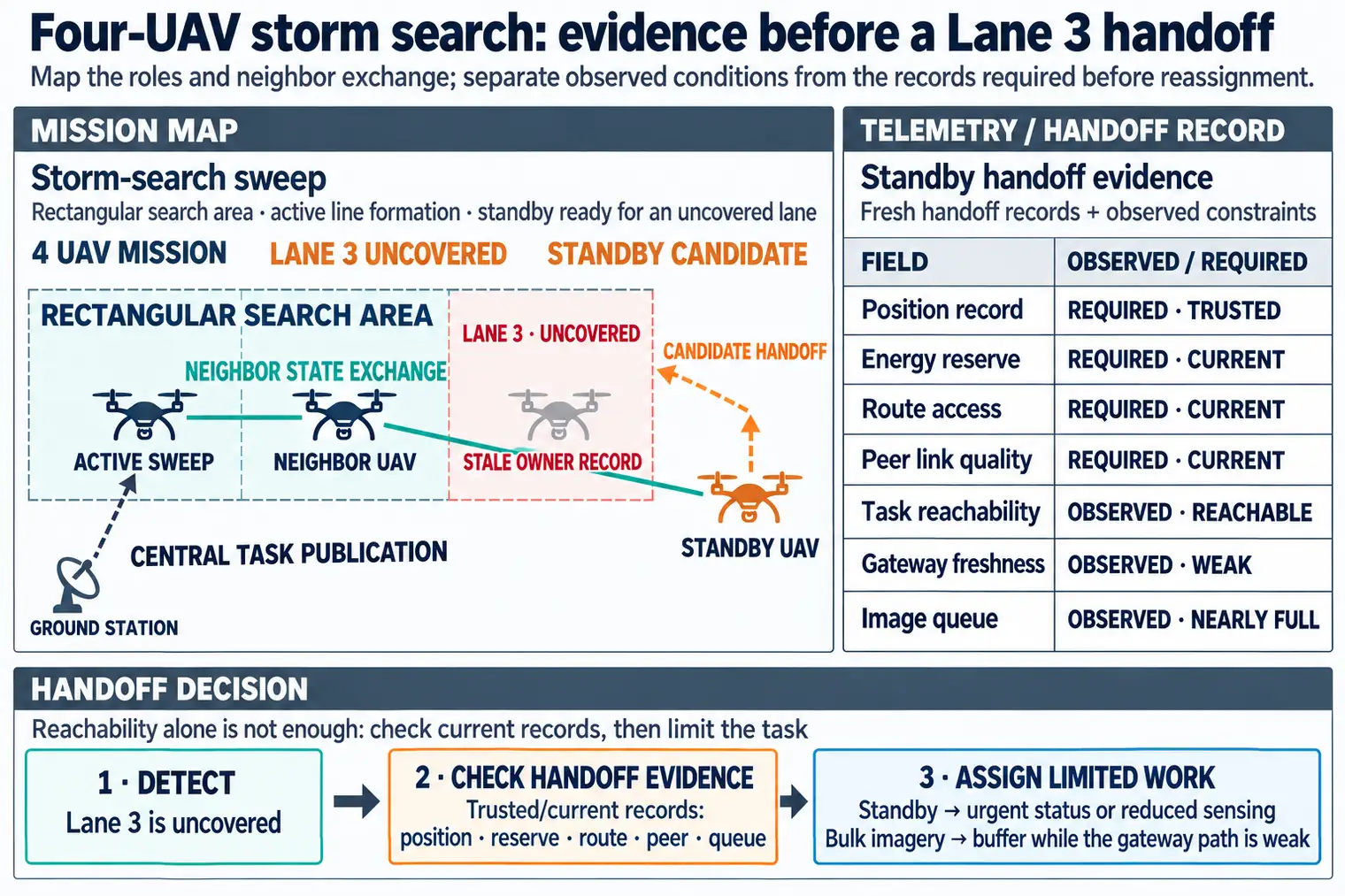
Mobile summary: Treat a swarm as coordinated only when roles, owners, peer freshness, gateway path, and fallback behavior are current enough to trust.
Role
Name whether each UAV is sensing, relaying, leading, following, carrying a gateway path, standing by, returning, or holding a fallback position.
Owner
Every lane, cell, relay point, image set, and handoff should have one current owner plus a conflict rule for duplicate claims.
Fallback
The record should say who reassigns, who pauses, who buffers, who relays, who returns, and which state change forces the next check.
35.4 Search Sweep Handoff Record
This section: Search Sweep Handoff Record — For the storm-search example, the useful record is not "four UAVs flew together." It is the ownership and reassignment trail that keeps the search complete when one aircraft disappears.
For the storm-search example, the useful record is not "four UAVs flew together." It is the ownership and reassignment trail that keeps the search complete when one aircraft disappears.
35.5 Why Swarm State Goes Stale
This section: Why Swarm State Goes Stale — Coordination state ages because every aircraft is moving, spending energy, changing payload queues, and seeing a different network.
Coordination state ages because every aircraft is moving, spending energy, changing payload queues, and seeing a different network. A decision that was correct moments ago can become wrong without a visible crash.
- Peer age: a neighbor position, leader reference, or task claim needs a timestamp and expiry rule.
- Ownership drift: duplicate owners and uncovered work appear when reassignment messages arrive late or conflict rules are missing.
- Payload pressure: a UAV can be physically available but unable to accept more sensing work because its queue or gateway path is saturated.
- Fallback coupling: energy, spacing, link quality, and task progress must be checked together before a handoff is trusted.
This section:
This section:
This section:
- A UAV swarm is a coordinated mission system, not simply a group of aircraft in the same area.
- Centralized control is easiest to supervise, but depends heavily on the ground link and controller availability.
- Distributed coordination is more resilient to individual aircraft loss, but it consumes bandwidth and requires disciplined state sharing.
- Leader-follower control is useful for formations, but the design must define leader replacement.
- Every coordination decision should include records: task owner, neighbor age, link state, route state, energy reserve, payload state, and fallback action.
This section:
35.6 Prerequisites
This section: Prerequisites
Revisit these chapters if the terms are unfamiliar:
- UAV Networks Introduction: UAV roles, mission fit, and first readiness checks.
- UAV Network Features and Challenges: mobility, energy, link, payload, and operations trade-offs.
- UAV Fundamentals and Topologies: topology choices and gateway assumptions.
- FANET Fundamentals: aerial ad hoc links, neighbor state, and route behavior.
35.7 How This Chapter Fits
This section: How This Chapter Fits — The earlier UAV chapters describe what a UAV can do and how UAV links form a flying ad hoc network.
The earlier UAV chapters describe what a UAV can do and how UAV links form a flying ad hoc network. This chapter asks how multiple UAVs make one mission decision at a time: who covers which area, who relays which traffic, who leads a formation, who replaces a weak node, and what records prove the answer is still current.
The overview depth layer shows the coordination role map that anchors mission intent, peer state, task state, formation state, gateway path, and fallback records.
35.8 Coordination Models
This section: Coordination Models — No coordination model is best in every mission.
No coordination model is best in every mission. The right choice depends on link reliability, mission dynamics, operator oversight, failure tolerance, and how quickly aircraft must react.
35.8.1 Centralized control
The ground station assigns tasks, approves role changes, and can give operators a clear mission picture.
Use it when the ground link is reliable, the mission is supervised closely, and the task plan changes slowly.
Failure to check: what happens when the controller or ground link is unavailable?
35.8.2 Distributed local agreement
Each UAV shares current state with nearby peers and the group updates task ownership from local records.
Use it when aircraft may lose ground contact, the scene changes during flight, or peer replacement matters.
Failure to check: what state is shared, how fresh is it, and how are conflicts resolved?
35.8.3 Leader-follower behavior
One UAV publishes a reference path, formation frame, or task priority while followers maintain relative behavior.
Use it for repeatable movement patterns, corridor surveys, or formation flight where a reference aircraft simplifies control.
Failure to check: who becomes leader if the leader loses energy, link quality, or position confidence?
35.9 Coordination State Records
This section: Coordination State Records — Swarm decisions become unsafe when aircraft act on stale or incomplete state.
Swarm decisions become unsafe when aircraft act on stale or incomplete state. A coordination message should be small enough to send often, but specific enough to support a decision.
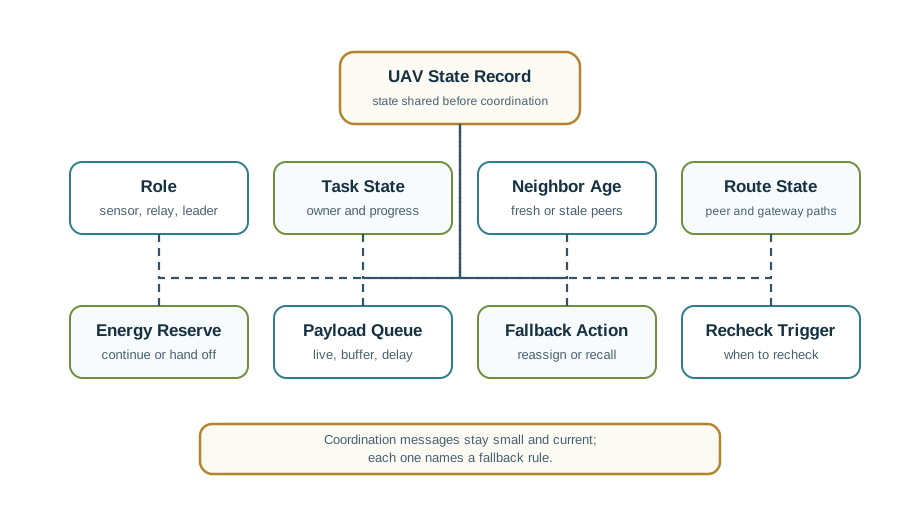
Role Sensor, relay, gateway candidate, leader, follower, standby, or returning aircraft.
Task state Current assignment, progress, assigned area, conflict flag, and handoff request.
Neighbor freshness When peer position, link quality, and role information were last heard.
Route state Whether the aircraft has a current path to peers, a leader, a relay, or a gateway.
Energy reserve Whether the UAV can continue, must hand off, should become relay-only, or must return.
Payload queue Whether collected data can be sent live, summarized, buffered, or delayed.
Fallback action Reassign task, tighten formation, widen spacing, buffer data, switch leader, or recall.
Recheck trigger The event that forces the mission plan to be checked again.

35.10 Task Allocation Loop
This section: Task Allocation Loop — Task allocation is the process of deciding which UAV owns each mission task.
Task allocation is the process of deciding which UAV owns each mission task. In a search, the task may be a grid cell. In a relay mission, it may be a temporary relay position. In an inspection mission, it may be an asset segment, image set, or gateway handoff.
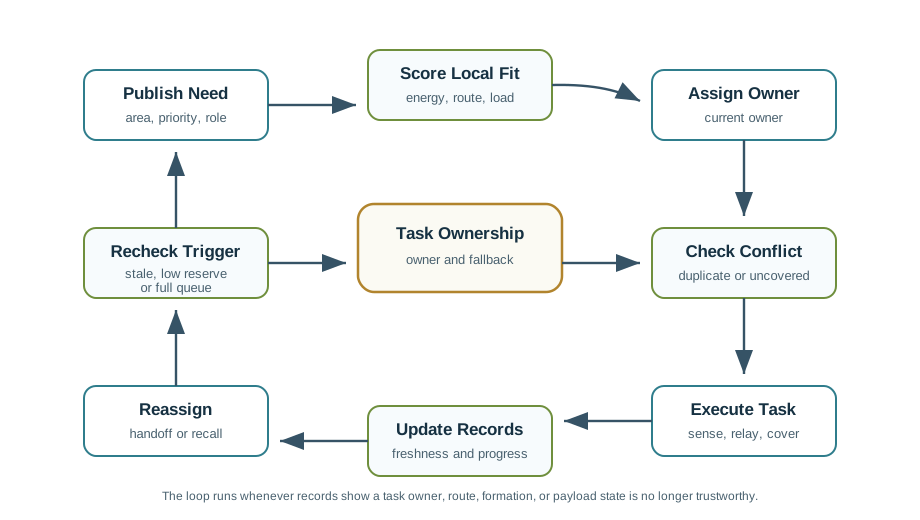
- Publish the task need: area, priority, data type, deadline, and required role.
- Score local fit: distance, energy reserve, payload readiness, link state, route state, and current load.
- Assign ownership: a ground controller, leader, or peer group selects the current owner.
- Check conflicts: detect duplicate ownership, uncovered areas, unsafe spacing, or stale task state.
- Execute with records: keep publishing progress, link freshness, energy reserve, and payload queue.
- Reassign when needed: move the task when an aircraft returns, loses contact, fills a buffer, or reaches a recheck trigger.
35.11 Trajectory Handoff Records
This section: Trajectory Handoff Records — Formation motion and task ownership should meet in a handoff record.
Formation motion and task ownership should meet in a handoff record. Before changing a path, record:
- Segment ownership: the lane, orbit sector, relay position, or search cell being transferred.
- Fresh records: trusted position, route state, payload state, link state, task progress, and timestamp.
- Receiving gate: energy reserve, safe path access, payload capacity, link quality, and return feasibility.
- Fallback action: whether the source aircraft holds, returns, buffers data, repeats a segment, or hands off again.
- Recheck trigger: the neighbor, gateway, energy, safety, or payload condition that forces a new coordination decision.
35.12 Formation Control
This section: Formation Control — Formation control keeps aircraft in useful relative positions.
Formation control keeps aircraft in useful relative positions. It is not the same as task allocation: a UAV can own a task while also following a spacing rule, leader reference, or collision-avoidance constraint.
Many swarm controllers can be described as local agreement rules. In consensus control, each aircraft repeatedly updates a value from its own state and its neighbours’ current values until headings, estimates, rendezvous points, or timing choices converge closely enough for the mission. Flocking rules use the same local flavour: keep separation from near neighbours, align velocity with the group, and maintain cohesion toward the formation. Coverage and allocation algorithms add the mission layer by deciding which area, role, or resource each aircraft should own. These methods can degrade gracefully when the communication graph weakens, but only if the record names neighbour freshness, graph assumptions, convergence criteria, and the fallback for stale or missing peers.
35.12.1 Line or sweep
Useful for corridor coverage, shoreline inspection, or search lanes. The check record is lane width, overlap, neighbor freshness, and what happens when one lane drops out.
35.12.2 Wedge or trail
Useful when a leader provides a path reference and followers preserve spacing. The check record is leader health, follower spacing, and leader replacement.
35.12.3 Grid or area cover
Useful when tasks are cells or zones. The check record is assigned cells, uncovered cells, duplicate coverage, and reassignment timing.
35.12.4 Relay chain
Useful when the group must preserve a communication path. The check record is hop freshness, gateway reachability, traffic priority, and buffer behavior.
35.13 Search Sweep Coordination
This section: Search Sweep Coordination — Scenario: A field team needs four UAVs to search a rectangular area after a storm.
Scenario: A field team needs four UAVs to search a rectangular area after a storm. The mission needs current status messages during flight and can tolerate delayed upload for high-resolution imagery.
Mission service: locate areas that need human inspection and return inspection records to the field team.
Coordination model:
- Start with centralized task publication from the ground station.
- Use distributed local agreement for task reassignment if a UAV loses contact with the ground station but still hears peers.
- Use a line formation for the active sweep, with a standby UAV ready to take an uncovered lane.
Task records:
- Each UAV publishes lane id, progress, neighbor freshness, energy reserve, payload queue, and gateway path state.
- Status notes are prioritized over bulk imagery.
- Imagery can buffer until a gateway path is fresh enough or the UAV returns.
Fallback behavior:
- If one lane loses its UAV, a neighboring UAV marks the lane as uncovered and the standby UAV takes ownership.
- If a UAV has low reserve, it stops accepting new lane segments and hands off the remaining task.
- If gateway quality is weak, status notes use the freshest available relay path while imagery buffers.
This example stays traceable because it separates mission service, task ownership, formation spacing, traffic priority, and fallback behavior.
35.14 Coordination Readiness Checklist
This section: Coordination Readiness Checklist — Use this checklist before trusting a coordinated UAV mission.
Use this checklist before trusting a coordinated UAV mission.
Mission intent The swarm has a specific service, not just a flight pattern.
Selected model The design states whether control is centralized, distributed, leader-follower, or a deliberate hybrid.
Rejected model The design records at least one plausible model that was rejected and why.
Task ownership Every task has an owner, conflict rule, and reassignment rule.
Formation behavior Spacing, leader reference, or lane behavior is defined separately from task ownership.
State freshness Decisions use current neighbor, route, energy, payload, and gateway records.
Traffic priority Operator commands and urgent status are not hidden behind bulk payload transfer.
Fallback owner A person, controller, or rule can pause, reassign, recall, or accept degraded service.
35.15 Common Pitfalls and Misconceptions
This section: Common Pitfalls and Misconceptions
Several UAVs flying in the same area are not automatically coordinated. Swarm coordination requires task ownership, state sharing, conflict handling, and fallback behavior.
Distributed coordination can survive some failures, but it also requires bandwidth, conflict resolution, and trust in local state. A stable supervised mission may be simpler and safer with centralized control plus a defined fallback.
Formation control answers “where should this UAV be relative to the others?” Task allocation answers “what is this UAV responsible for?” A traceable design keeps both records.
A peer position or task assignment that was useful moments ago can become wrong quickly. Coordination decisions should include freshness, not only the latest value seen.
A UAV that can fly the formation may still fail the mission if its data queue grows faster than the gateway path can drain it. Treat payload state as a coordination record.
35.16 Interactive Checks
This section: Interactive Checks
This section:
This section:
This section:
This section:
This section:
This section:
35.17 Summary
This section: Summary
This chapter treated UAV swarm coordination as a traceable design problem:
- Coordination models: centralized, distributed, leader-follower, and deliberate hybrids.
- Task allocation: the loop that publishes tasks, scores local fit, assigns ownership, checks conflicts, executes, and reassigns.
- Formation control: the spacing or reference behavior that must be checked separately from task ownership.
- Coordination records: role, task state, neighbor freshness, route state, energy reserve, payload queue, and fallback action.
- Fallback behavior: the planned response when a UAV, leader, link, gateway, energy state, or payload path becomes unreliable.
35.18 What’s Next
This section: What’s Next
- To understand the topology choices behind a coordinated swarm, read UAV Network Topologies.
- To study trajectory-specific coordination, read UAV Trajectory Swarm Coordination.
- To connect coordination to FANET routing, read FANET Fundamentals.
- To check the production-ready decision process, read UAV Networks: Production Checks.
35.19 Key Takeaway
This section: Key Takeaway — UAV swarms need explicit coordination rules for role assignment, separation, coverage, communication, leader loss, and degraded operation.
UAV swarms need explicit coordination rules for role assignment, separation, coverage, communication, leader loss, and degraded operation. More aircraft only help when coordination scales safely.
Find help
3 reviewed answers.
Where should I start in a module?
Open the module page from the sidebar to see its chapters in order. Use the module map to return to a topic you need.
Modules and pathsReviewed
What can I try when a project does not work?
Check the symptom, then work through the diagnostic steps. Keep the error message and the smallest example that reproduces it.
When you are stuckReviewed
How do interactive examples work?
Use the interactive guide to check how examples and simulations work before changing your project.
Interactive examples guideReviewed