57 M2M Applications and Node Types
57.1 Learning Objectives
By the end of this chapter, you will be able to:
- Classify M2M Applications: Categorize M2M use cases across diverse sectors and explain the value each delivers
- Classify Node Types: Distinguish between low-end, mid-end, and high-end M2M nodes based on technical specifications
- Match Nodes to Applications: Select appropriate node types for specific M2M deployments using cost-power-capability trade-offs
- Evaluate Node Capabilities: Assess processing, memory, connectivity, and battery requirements against application constraints
- Design Hierarchical Deployments: Combine node tiers into layered architectures for real-world M2M systems
57.2 Prerequisites
Before diving into this chapter, you should be familiar with:
- M2M Communication Overview: Introduction to machine-to-machine concepts
- M2M vs IoT Evolution: Understanding the distinction between M2M and IoT
- Hardware and Device Characteristics: Familiarity with embedded systems
MVU – Minimum Viable Understanding
If you only have 5 minutes, focus on these three essentials:
- M2M spans 8+ sectors – smart grid, healthcare, transport, supply chain, environment, buildings, industry, and agriculture each have distinct M2M requirements
- Three node tiers exist – low-end (sense only, years on battery, $1-10), mid-end (local processing, IP-capable, $10-100), and high-end (full computation, multimedia, $100+)
- Match node to need – always select the lowest-capability node that meets application requirements to minimize cost and power consumption
57.3 Introduction
Sensor Squad: M2M Node Types
Sammy the Sensor says: “Not all machines are equally powerful! Think of us like different sizes of delivery trucks.”
Lila the Light Sensor explains: “I’m a low-end node – like a bicycle courier. I deliver one small package (temperature reading) very efficiently with almost no fuel (battery). I can keep going for YEARS!”
Max the Motion Sensor adds: “I’m a mid-end node – like a delivery van. I can carry more packages and even sort them on the way (local processing). But I need to refuel more often.”
Bella the Buzzer chimes in: “High-end nodes are like big trucks with GPS and refrigeration – they can do everything but use a LOT of fuel!”
The lesson: Always pick the smallest vehicle that can do the job. Sending a big truck to deliver a letter wastes fuel (battery) and money!
For Beginners: M2M Node Types
Think of M2M nodes like different types of workers:
- Low-End Nodes = Security cameras that just watch and report (simple, low power, long battery)
- Mid-End Nodes = Smart assistants that can process some requests locally (moderate capability)
- High-End Nodes = Full computers that can do complex analysis (powerful, energy hungry)
Why different types? Cost and power. A simple temperature sensor doesn’t need a smartphone processor – it would be wasteful and drain batteries quickly. An agricultural sensor in a remote field needs to last years on a coin cell battery, while a hospital gateway needs to process hundreds of patient data streams in real-time.
M2M enables automation across diverse sectors, from smart grids to precision agriculture. This chapter explores the breadth of M2M applications and the device hierarchy that makes them possible – a critical design decision that determines the cost, power efficiency, and capability of every M2M deployment.
How It Works: M2M Node Hierarchy in Action
Consider a smart building HVAC system with 500 sensors across 20 floors:
Step 1: Low-End Nodes (400 temperature sensors)
- Simple 8-bit MCU reads thermistor every 5 minutes
- Zigbee radio transmits 4-byte reading to floor gateway
- Coin cell battery lasts 5+ years
- Cost: $5 each = $2,000 total
Step 2: Mid-End Nodes (20 floor gateways)
- 32-bit ARM processor aggregates 20 sensors per floor
- Runs local PID control loop for damper actuators
- Ethernet connection to central server
- Cost: $50 each = $1,000 total
Step 3: High-End Node (1 building server)
- Multi-core Linux machine runs optimization algorithms
- Correlates occupancy data with weather forecasts
- Provides dashboard for facility managers
- Cost: $2,000
Total system cost: $5,000 vs. $35,000 if all 500 sensors were mid-end nodes
The key principle: Each tier handles what it does best – low-end nodes sense cheaply, mid-end nodes process locally, high-end nodes optimize globally.
57.4 M2M Applications
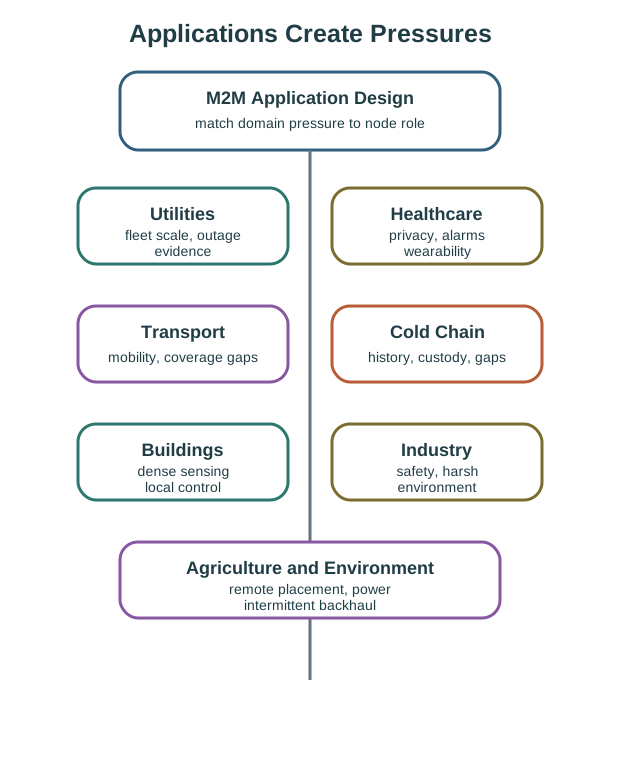
M2M communication enables automation across diverse sectors. The following diagram shows the breadth of M2M application domains and the communication patterns that connect them.
57.4.1 1. Smart Grid and Utilities
Smart grid M2M automates electricity distribution from generation to consumption. Scale: A single utility may manage 10+ million smart meters, each reporting every 15 minutes.
- Automated Meter Reading (AMR) – eliminates manual meter readers, saving utilities $5-15 per meter per year
- Demand Response Management – adjusts loads during peak hours; a 2% reduction can save millions in avoided generation
- Grid Monitoring and Fault Detection – sensors on transformers detect failures before cascading blackouts
- Power Quality Analysis – voltage and frequency monitoring ensures regulatory compliance
- Outage Detection and Restoration – smart meters report “last gasp” signals when power is lost, enabling rapid fault localization
57.4.2 2. Healthcare
Healthcare M2M enables continuous patient monitoring outside hospital walls, reducing readmission rates by up to 25%.
- Remote Patient Monitoring – ECG, blood pressure, and SpO2 sensors transmit to clinical dashboards
- Wearable Health Devices – continuous glucose monitors (CGMs) report readings every 5 minutes
- Medication Compliance Tracking – smart pill bottles detect when caps are opened, alerting caregivers to missed doses
- Hospital Asset Tracking – RFID/BLE tags on wheelchairs and infusion pumps reduce search time by 70%
- Emergency Alert Systems – fall detectors in wearables automatically call emergency services with GPS coordinates
57.4.3 3. Intelligent Transport Systems (ITS)
ITS connects vehicles, infrastructure, and traffic management systems. Data volume: A connected vehicle generates up to 25 GB of data per hour from 100+ sensors.
- Fleet Management – GPS + OBD-II data enables route optimization, reducing fuel costs 10-15%
- Vehicle Diagnostics (OBD-II) – engine fault codes transmitted in real-time prevent roadside breakdowns
- Traffic Optimization – inductive loops and cameras at intersections feed adaptive signal timing algorithms
- Parking Guidance – magnetometers in parking bays report occupancy to mobile apps, reducing circling time
- Electronic Toll Collection – RFID/DSRC enables free-flow tolling at highway speeds without stopping
57.4.4 4. Supply Chain Management
Supply chain M2M provides end-to-end visibility from factory to customer. Impact: M2M-enabled supply chains reduce inventory carrying costs by 20-30%.
- Asset Tracking – GPS/cellular trackers on shipping containers report location every 15 minutes
- Inventory Management – RFID tags on pallets enable automatic receiving, reducing warehouse labor
- Cold Chain Monitoring – temperature/humidity sensors in refrigerated trucks alert if thresholds are breached
- Warehouse Automation – autonomous guided vehicles (AGVs) coordinate via M2M to avoid collisions
- Last-Mile Delivery Tracking – real-time delivery ETAs improve customer satisfaction scores
57.4.5 5. Environmental Monitoring
Environmental M2M deploys sensors in remote, harsh locations requiring extreme longevity. Challenge: Sensors may need 5-10 year battery life in locations without grid power.
- Weather Stations – distributed sensors report temperature, humidity, pressure, and wind at 1-minute intervals
- Air Quality Monitoring – PM2.5, O3, NO2, and CO sensors provide hyperlocal pollution maps
- Water Quality Sensors – pH, dissolved oxygen, and turbidity monitoring for rivers and reservoirs
- Flood Warning Systems – river level gauges trigger alerts when water rises above threshold levels
- Wildlife Tracking – GPS collars on endangered species report location via satellite M2M links
57.4.6 6. Building Automation
Building automation M2M connects HVAC, lighting, security, and fire systems. Savings: M2M-enabled building management reduces energy consumption by 15-30%.
- HVAC Control – occupancy sensors adjust temperature zone-by-zone, avoiding heating empty rooms
- Energy Management – sub-metering identifies energy waste patterns across floors and tenants
- Security Systems – access control (badge readers), CCTV, and intrusion detection integrated into single M2M platform
- Elevator Monitoring – vibration and motor current sensors predict maintenance needs before failures
- Fire Detection – networked smoke/heat detectors provide exact fire location for faster evacuation routing
57.4.7 7. Industrial Automation
Industrial M2M (IIoT) connects manufacturing equipment for efficiency and safety. Reliability: Industrial M2M often requires 99.999% uptime (5.26 minutes downtime per year).
- Manufacturing Process Control – PLCs and SCADA systems coordinate production lines in real-time
- Predictive Maintenance – vibration and temperature sensors predict bearing failures 2-4 weeks in advance
- Quality Assurance – vision systems inspect products at line speed, rejecting defects automatically
- Robotic Coordination – multi-robot cells communicate via deterministic M2M for synchronized assembly
- Safety Monitoring – gas detectors and emergency shutdown systems protect workers from hazards
57.4.8 8. Agriculture
Precision agriculture uses M2M to optimize resource use. ROI: Smart irrigation alone can reduce water consumption by 30-50% while improving crop yields.
- Precision Farming – GPS-guided tractors apply fertilizer at variable rates based on soil sensor maps
- Irrigation Control – soil moisture sensors trigger drip irrigation only where and when needed
- Livestock Monitoring – accelerometer collars detect lameness, estrus, and illness in cattle
- Crop Health Sensing – multispectral cameras on drones identify disease and nutrient deficiency
- Weather-Based Automation – local weather stations trigger frost protection or shade deployment automatically
Video: Machine to Machine Smart Homes
Video: Internet Connected Washing Machine
57.5 M2M Node Types
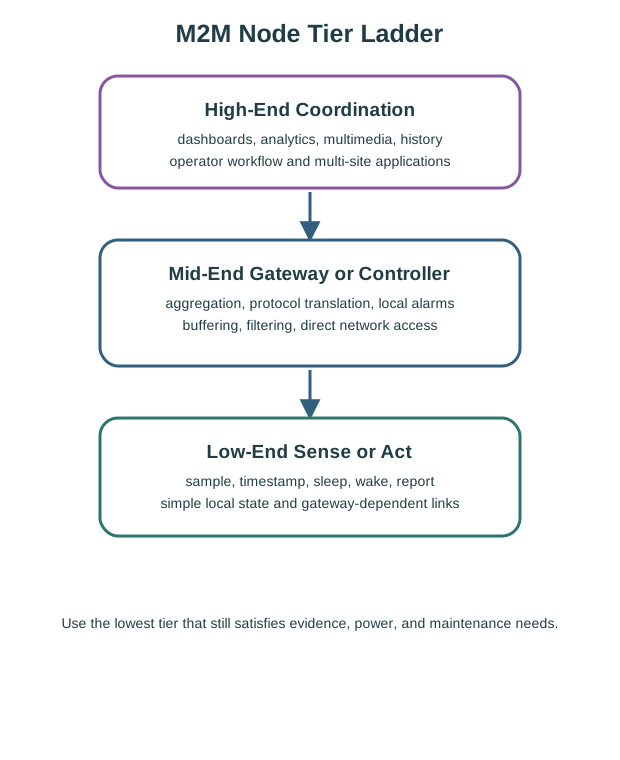
M2M devices span a wide spectrum of capabilities, categorized into three tiers. Understanding this hierarchy is essential because selecting the wrong node tier is one of the most expensive mistakes in M2M system design – over-specifying wastes money and battery, while under-specifying causes system failures.
57.5.1 Low-End Nodes
Low-end nodes are the workhorses of M2M – deployed in the largest quantities and designed for extreme power efficiency. They typically run bare-metal firmware or a minimal RTOS (like FreeRTOS or Zephyr) with no operating system overhead.
Putting Numbers to It
Battery life calculations for low-end nodes: The 5-10 year battery life claim depends on careful power budgeting. For a soil moisture sensor reporting hourly via LoRa:
Power budget breakdown:
- Sleep mode: 1 µA @ 3.3V = 3.3 µW × 3,595 seconds/hour = 0.0033 mWh/hour
- Sensor read (5 seconds): 5 mA @ 3.3V = 16.5 mW × (5s/3600s) = 0.023 mWh/hour
- LoRa transmit (2 seconds at SF7): 120 mA @ 3.3V = 396 mW × (2s/3600s) = 0.22 mWh/hour
- Total per hour: 0.0033 + 0.023 + 0.22 = 0.246 mWh
Battery capacity: CR2450 coin cell = 620 mAh @ 3V = 1,860 mWh
Lifetime: \(1,860 \text{ mWh} / (0.246 \text{ mWh/hour} \times 24 \text{ hours/day}) = 315 \text{ days}\) — only 10 months, not 5 years!
The fix – store-and-forward: Instead of hourly LoRa transmits, buffer 10 readings and transmit once every 10 hours. Transmit time increases to 4 seconds (more data), but frequency drops 10×: - LoRa cost: 0.44 mWh per 10 hours = 0.044 mWh/hour (vs. 0.22) - New total: 0.0033 + 0.023 + 0.044 = 0.070 mWh/hour - Lifetime: 1,860 / (0.070 × 24) = 1,107 days = 3.0 years
To reach 5 years, use LoRa SF12 (better link budget allows lower power at -20 dBm instead of 14 dBm), or transmit daily instead of every 10 hours.
Characteristics:
- Minimal processing power (8-16 bit MCU, e.g., ATmega328P, MSP430)
- Very low power consumption (< 1mW idle)
- Limited memory (KB range) – firmware must fit in 32-128 KB flash
- No IP stack (IEEE 802.15.4, BLE) – require a gateway for internet connectivity
- Battery-powered, long lifetime (3-10 years on coin cell)
Capabilities:
- Basic sensing and actuation (read sensor, toggle relay)
- Simple data aggregation (min/max/average over time window)
- Auto-configuration (join network, accept parameters)
- Deep sleep/wake cycles (sleep 99.9% of time, wake to sample and transmit)
Real-World Examples:
- Soil moisture probes in vineyards (report once per hour, last 5 years)
- Door/window contact sensors in buildings (report on state change)
- Temperature tags in cold chain logistics (sample every 5 minutes)
- Parking bay occupancy sensors (magnetometer under pavement)
Example Specifications:
| Parameter | Typical Value |
|---|---|
| MCU | 8-bit, 16 MHz (ATmega328P) |
| RAM | 2-8 KB |
| Flash | 32-128 KB |
| Power | 10-50 uA active, <1 uA sleep |
| Battery | 3-5 years on CR2032 coin cell |
| Connectivity | Zigbee, BLE, LoRa |
| Unit Cost | $1-10 |
57.5.2 Mid-End Nodes
Mid-end nodes bridge the gap between simple sensors and full computing platforms. They can run a lightweight IP stack, perform local data processing, and make autonomous decisions without cloud connectivity.
Characteristics:
- Moderate processing (32-bit MCU, ARM Cortex-M3/M4/M7)
- Medium power consumption (10-100 mA when active)
- More memory (256 KB - 1 MB RAM, 1-4 MB flash)
- IP stack support (IPv6, 6LoWPAN, MQTT, CoAP)
- Gateway capability – can aggregate data from low-end nodes
Capabilities:
- Complex sensing with signal processing (FFT, filtering, feature extraction)
- Local data processing and edge analytics (anomaly detection, thresholding)
- Quality of Service (QoS) enforcement – prioritize critical messages
- Protocol translation – bridge between Zigbee/BLE sensors and IP networks
- Over-the-air (OTA) firmware updates
Real-World Examples:
- Smart electricity meters (measure consumption, compute tariffs, report via NB-IoT)
- Home automation hubs (aggregate Zigbee sensors, expose via Wi-Fi to cloud)
- Industrial vibration monitors (FFT analysis on-device, report only anomalies)
- GPS asset trackers (position + cellular for logistics fleet)
Example Specifications:
| Parameter | Typical Value |
|---|---|
| MCU | 32-bit ARM Cortex-M4, 80-200 MHz |
| RAM | 256 KB - 1 MB |
| Flash | 1-4 MB |
| Power | 10-100 mA active |
| Battery | 6-18 months (rechargeable or larger cell) |
| Connectivity | Wi-Fi, LTE-M, NB-IoT |
| Unit Cost | $10-100 |
57.5.3 High-End Nodes
High-end nodes are full computing platforms capable of running Linux, processing multimedia, and hosting complex applications. They serve as gateways, edge servers, or sophisticated endpoint devices.
Characteristics:
- High processing power (application processors: ARM Cortex-A, x86)
- Significant memory (1-8 GB RAM, 16-256 GB storage)
- Multimedia capabilities (video encoding/decoding, audio processing)
- Multiple simultaneous connectivity options (cellular + Wi-Fi + Ethernet + Bluetooth)
- Full operating system (Linux, Android, Windows IoT)
Capabilities:
- Machine learning inference at the edge (TensorFlow Lite, ONNX Runtime)
- Multimedia streaming and recording (1080p/4K video)
- Real-time dashboards and user interfaces
- Multi-protocol gateway (aggregate hundreds of low/mid-end nodes)
- QoS guarantees with traffic shaping and prioritization
Real-World Examples:
- Industrial edge gateways (aggregate factory floor sensors, run ML models)
- Connected vehicles (process LIDAR, cameras, radar for ADAS)
- Medical imaging devices (portable ultrasound with AI-assisted diagnosis)
- Video surveillance cameras with on-device person detection
- Retail kiosks with touchscreens and inventory management
Example Specifications:
| Parameter | Typical Value |
|---|---|
| CPU | Multi-core ARM Cortex-A, 1-2 GHz |
| RAM | 1-8 GB |
| Storage | 16-256 GB (eMMC or SSD) |
| Power | 1-10 W active |
| Battery | Hours to days (often mains-powered) |
| Connectivity | 4G/5G, Wi-Fi, Ethernet, Bluetooth |
| Unit Cost | $100-1000+ |
57.6 Node Type Comparison
57.6.1 Selection Criteria
| Factor | Low-End | Mid-End | High-End |
|---|---|---|---|
| Cost | $1-10 | $10-100 | $100-1000+ |
| Power | uW-mW | mW-100mW | W |
| Battery Life | 3-10 years (coin cell) | 6-18 months | Hours-days (often mains) |
| Maintenance | None (deploy and forget) | Periodic OTA updates | Regular updates + monitoring |
| Connectivity | Gateway-dependent | IP-capable | Multi-network |
| Processing | Sense and report only | Local analytics + filtering | Full computation + ML |
| Typical Quantity | 1,000s-1,000,000s | 100s-10,000s | 10s-1,000s |
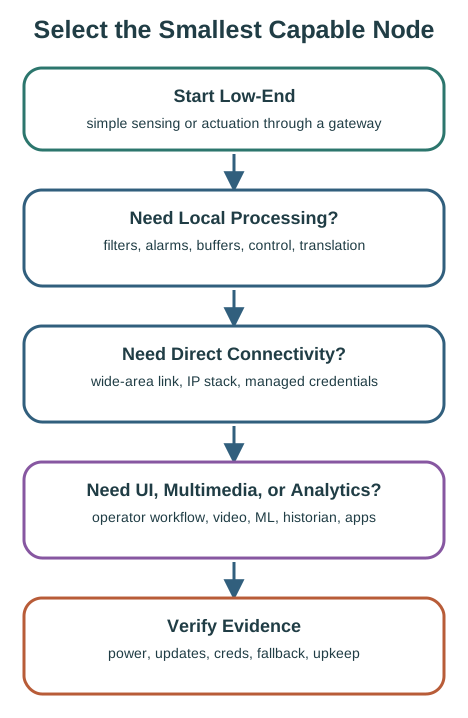
57.6.2 Node Selection Decision Framework
When choosing a node tier, apply the minimum viable capability principle – select the lowest-cost tier that meets ALL application requirements:
57.6.3 Worked Example: Smart Building M2M Deployment
Consider a 20-floor office building deploying M2M for energy management:
| Component | Node Tier | Quantity | Justification |
|---|---|---|---|
| Room temperature sensors | Low-end | 400 (20 per floor) | Simple sensing, 5-year battery, $5 each = $2,000 |
| Occupancy sensors | Low-end | 200 (10 per floor) | PIR motion detection, battery powered, $8 each = $1,600 |
| Floor-level gateways | Mid-end | 20 (1 per floor) | Aggregate 30 sensors via Zigbee, forward via Wi-Fi, $50 each = $1,000 |
| HVAC zone controllers | Mid-end | 60 (3 per floor) | PID control, actuate dampers, $80 each = $4,800 |
| Building management server | High-end | 1 | Dashboard, ML for predictive comfort, $2,000 |
Total hardware cost: ~$11,400 for 681 devices. If all sensors were mid-end ($50 each), cost would triple to $33,800 – demonstrating why the tiered approach saves 66% on hardware costs.
57.7 Interactive: M2M Node Tier Power Budget Calculator
Explore how reporting frequency affects battery life for M2M sensor nodes.
57.8 Knowledge Check
57.9 Worked Example: Industrial Facility M2M Deployment
Real-World Scenario: Manufacturing Plant M2M Architecture
Problem: A food processing facility with 500 monitoring points needs M2M automation for quality control and regulatory compliance. Requirements include temperature monitoring (250 points), pressure sensing (100 points), flow meters (75 points), door/access sensors (50 points), and vibration monitors (25 points). Design the optimal M2M node architecture to minimize 10-year total cost of ownership (TCO).
Step 1: Node Tier Selection
| Component | Node Tier | Quantity | Unit Cost | Justification |
|---|---|---|---|---|
| Temperature sensors | Low-end | 250 | $5 | Simple sensing, 5-year battery, $1,250 total |
| Door/access sensors | Low-end | 50 | $8 | PIR motion + magnetic contact, battery powered, $400 total |
| Pressure sensors | Mid-end | 100 | $45 | Analog signal processing, IP67 rating, $4,500 total |
| Flow meters | Mid-end | 75 | $65 | Local flow rate calculation, Modbus RTU, $4,875 total |
| Vibration monitors | Mid-end | 25 | $80 | FFT analysis on-device, anomaly detection, $2,000 total |
| Floor gateways | Mid-end | 10 | $120 | Aggregate 50 sensors via Zigbee, forward via Wi-Fi, $1,200 total |
| SCADA server | High-end | 1 | $5,000 | Dashboard, ML predictive maintenance, regulatory reporting |
Step 2: Calculate Total Hardware Cost
- Low-end nodes: 300 devices × average $5.50 = $1,650
- Mid-end nodes: 210 devices × average $58 = $12,180
- High-end server: 1 × $5,000 = $5,000
- Total hardware: $18,830 for 511 devices
Step 3: Calculate 10-Year TCO
| Cost Category | Low-End Only (All $50 mid-end) | Hybrid Tiered Architecture |
|---|---|---|
| Hardware (upfront) | $25,550 | $18,830 |
| Battery replacement (years 3,6,9) | $7,650 (300 × $8.50 × 3) | $4,950 (300 × $5.50 × 3) |
| Maintenance truck rolls | $15,000 (50 failures × $300) | $9,000 (30 failures × $300) |
| Software/cloud | $12,000 | $12,000 |
| 10-Year TCO | $60,200 | $44,780 |
Step 4: Savings Calculation
- Cost reduction: $60,200 - $44,780 = $15,420 saved (25.6%)
- Per-device savings: $15,420 ÷ 511 = $30.18 per device over 10 years
- Break-even: Year 4.2 (hardware savings + reduced maintenance offset initial complexity)
Key Insight: The hierarchical approach with low-end sensors aggregating to mid-end gateways saves 25.6% over 10 years compared to using uniform mid-end devices everywhere. At 10,000+ devices (large industrial site), savings scale to $300K+.
Architecture diagram would show:
- 300 low-end sensors (Zigbee, 5-year battery) in a star topology around 10 floor gateways
- 200 mid-end devices (IP-capable, Modbus/Wi-Fi) connecting directly to the SCADA server
- SCADA server aggregating all data, running predictive models, and exposing REST API for ERP integration
Try It Yourself: M2M Node Selection Calculator
Scenario: You’re designing an M2M system for a 10-floor office building with: - 100 room temperature sensors (read every 5 min) - 50 occupancy sensors (PIR motion, event-driven) - 10 HVAC zone controllers (continuous PID loops) - 1 building management server (analytics + dashboard)
Your Task:
- Classify each component into low-end, mid-end, or high-end tiers
- Calculate total hardware cost using these prices:
- Low-end node: $5
- Mid-end node: $50
- High-end node: $2,000
- Estimate 5-year TCO including:
- Hardware (one-time)
- Battery replacement: low-end every 5 years ($0), mid-end every 18 months ($5), high-end mains-powered ($0)
- Connectivity: mid-end Wi-Fi ($0), high-end internet ($50/month)
What to Observe:
- How does the tiered approach compare to using all mid-end nodes?
- What percentage of total cost comes from batteries vs. hardware?
- Which tier dominates ongoing operational costs?
Hint: The correct classification yields ~$7,600 total 5-year TCO vs. $37,500 for uniform mid-end deployment.
57.10 Decision Framework: M2M Application-to-Node-Tier Matching
M2M Node Selection Matrix
Use this framework to select the appropriate node tier for your M2M application. Score each factor (0-3 points), then sum to determine the recommended tier.
57.10.1 Factor Scoring System
| Factor | 0 Points | 1 Point | 2 Points | 3 Points |
|---|---|---|---|---|
| Data complexity | On/off binary | Simple analog (temp) | Multi-sensor fusion | Multimedia (video/audio) |
| Processing needs | None (sense only) | Averaging/filtering | Edge analytics | ML inference |
| Connectivity | No IP needed | IP optional | IP required | Multi-protocol |
| Power availability | Battery, 5+ years | Battery, 1-3 years | Rechargeable | Mains powered |
| Deployment quantity | 10,000+ | 1,000-10,000 | 100-1,000 | <100 |
| Environmental | Indoor, benign | Outdoor, protected | Harsh (IP67) | Extreme (explosion-proof) |
57.10.2 Tier Selection Based on Total Score
| Total Score | Recommended Tier | Typical Cost per Device | Examples |
|---|---|---|---|
| 0-6 points | Low-End | $1-10 | Door sensors, simple temperature tags, parking bay magnetometers |
| 7-12 points | Mid-End | $10-100 | Smart meters, GPS trackers, industrial vibration monitors |
| 13-18 points | High-End | $100-1000+ | Video surveillance, autonomous vehicles, medical imaging |
57.10.3 Application-Specific Recommendations
Smart Grid (Utilities):
- Residential smart meters: Mid-end (score 9) — IP connectivity, local tariff calculation, 10-year battery
- Distribution transformer monitors: Mid-end (score 10) — Cellular M2M, real-time voltage/current analytics
- Substation SCADA: High-end (score 15) — Multi-protocol, historian database, fail-safe control
Healthcare:
- Wearable heart rate monitors: Low-end (score 5) — BLE, simple PPG sensor, coin cell battery
- Patient bedside gateways: Mid-end (score 11) — Aggregate multiple wearables, Wi-Fi, local alarms
- Portable ultrasound: High-end (score 16) — Real-time image processing, AI-assisted diagnosis
Industrial Automation:
- Proximity sensors: Low-end (score 3) — Binary output, AS-interface
- PID loop controllers: Mid-end (score 12) — Local control logic, Modbus/Ethernet
- Edge AI vision inspection: High-end (score 17) — TensorFlow Lite inference, GigE cameras
Agriculture:
- Soil moisture probes: Low-end (score 4) — LoRa, report hourly, 5-year battery
- Weather stations: Mid-end (score 9) — Multi-sensor, cellular, solar powered
- Autonomous tractors: High-end (score 18) — GPS RTK, computer vision, CANBUS
Decision Rule: Always select the LOWEST tier that meets ALL requirements — upgrading one tier doubles cost, downgrading risks functionality.
57.11 Common Mistake: Ignoring Gateway Aggregation Ratios
Pitfall: Gateway Sizing Without Aggregation Analysis
The Problem: Architects often size M2M gateways based on theoretical device count (“supports 500 devices”) without analyzing actual data throughput, processing load, or aggregation ratios. This leads to either over-provisioned (wasted money) or under-provisioned (performance degradation) gateways.
Real-World Example: A logistics company deployed M2M gateways rated for “1,000 GPS trackers” in shipping yards. After 600 trackers were deployed, gateways began dropping messages. Root cause: The rating assumed 1 report/minute per tracker, but actual tracking rate was 10 reports/minute during active loading (6× higher load). The gateway CPU (protocol translation overhead) was the bottleneck, not network bandwidth.
How to Detect This Mistake:
- Symptom: Gateway CPU utilization >80% while network bandwidth <50%
- Symptom: Message queue depth growing continuously (backlog accumulation)
- Symptom: Increasing message latency as device count grows (e.g., 50ms at 100 devices → 500ms at 500 devices)
- Symptom: Gateway crashes or reboots when all devices report simultaneously (e.g., alarm condition)
How to Fix It:
Step 1: Calculate Actual Aggregation Load
Gateway load has three components:
Total Load = (Data Throughput) + (Protocol Overhead) + (Aggregation Processing)
Data Throughput = Devices × Message Size × Report Frequency
Protocol Overhead = Messages/sec × Translation Time (Modbus→MQTT = 5-10 ms)
Aggregation Processing = Aggregation Functions × Window Size × Complexity
Step 2: Example Calculation
Scenario: 500 temperature sensors reporting via Modbus RTU to MQTT gateway
| Parameter | Value | Calculation |
|---|---|---|
| Devices | 500 sensors | Given |
| Report rate | 4 readings/hour | Every 15 minutes |
| Message size | 50 bytes (raw Modbus) | Register value + metadata |
| Translation time | 8 ms per message | Modbus parsing + MQTT publish |
| Aggregation | 10-min rolling average | Mean over 40 readings per sensor |
Data throughput: 500 × 50 bytes × (4/3600) msg/sec = 27.8 bytes/sec (negligible)
Protocol overhead: (500 × 4/3600) msg/sec × 8 ms = 4.44 ms CPU per second (0.4% CPU)
Aggregation processing: 500 sensors × 40 samples × mean() = 20,000 operations every 10 min ≈ 33 ops/sec
If gateway CPU can handle 10,000 ops/sec, utilization = 33/10,000 = 0.33% for aggregation.
Conclusion: This gateway is massively over-provisioned. Could handle 10,000+ devices easily.
Step 3: Gateway Right-Sizing Formula
Max Devices = MIN(
Bandwidth Limit / (Message Size × Report Frequency),
CPU Limit / (Translation Time × Report Frequency),
Memory Limit / (Buffer Size per Device)
)
For the logistics GPS example (actual load 10 msg/min, 100 bytes each):
- Bandwidth: 1 Mbps / (100 bytes × 10/60) = 7,500 devices (not the bottleneck)
- CPU: 4 cores @ 1 GHz / (8 ms × 10/60) = 3,000 devices (THIS is the limit!)
- Memory: 2 GB / (10 KB buffer) = 200,000 devices (not the bottleneck)
Correct gateway rating: 3,000 devices at 10 msg/min, not 1,000 devices at 1 msg/min.
Prevention Strategy:
- Always specify reporting rate when sizing gateways (not just device count)
- Benchmark protocol translation on target hardware before deployment
- Plan for burst traffic (2-3× normal rate during alarm conditions)
- Monitor gateway CPU/memory in production — if >70%, time to scale up
- Use horizontal scaling — add gateways instead of bigger gateways when CPU-bound
Quick Reference: Gateway CPU is often the bottleneck when translating between protocols (Modbus→MQTT, BACnet→CoAP). Network bandwidth is rarely the limit in M2M deployments.
57.12 Common Pitfalls in M2M Node Selection
Avoid These M2M Design Mistakes
Over-specifying nodes: Using a $50 Wi-Fi module where a $3 BLE sensor would suffice. Multiplied across 10,000 devices, this wastes $470,000.
Ignoring battery replacement costs: A sensor with 6-month battery life in 10,000 remote locations means 20,000 truck rolls per year at $50-100 each = $1-2M/year in maintenance.
Assuming IP connectivity everywhere: Many M2M deployments are in locations without Wi-Fi or cellular coverage (underground, rural, inside metal enclosures). Plan for non-IP protocols + gateways.
Forgetting scale economics: At 100 devices, node cost dominates. At 100,000 devices, connectivity fees and maintenance dominate total cost of ownership.
Single-tier thinking: Not all devices in a system need the same capability. The hierarchical low/mid/high approach typically reduces total system cost by 40-70% compared to a uniform mid-end deployment.
57.13 Concept Relationships
| Concept | Relationship | Connected Concept |
|---|---|---|
| Low-End Nodes | Foundation for | Hierarchical M2M Architecture |
| Mid-End Nodes | Act as | Protocol Translation Gateways |
| High-End Nodes | Enable | Cloud-Based Analytics Platforms |
| Battery Life | Inversely proportional to | Transmission Frequency |
| Node Tier Selection | Determines | Total Cost of Ownership |
| Gateway Aggregation | Reduces | Cellular Connectivity Costs |
57.14 Summary
This chapter explored M2M applications and node types:
Key Takeaways:
Application Diversity: M2M spans eight major sectors – smart grids, healthcare, transport, supply chain, environment, buildings, industry, and agriculture – each with distinct latency, reliability, and data volume requirements
Three-Tier Node Hierarchy: Low-end (sense only, years on battery, $1-10), mid-end (IP-capable, local processing, $10-100), high-end (full computation, multimedia, $100-1000+)
Minimum Viable Capability: Always select the lowest-cost node tier that meets ALL application requirements – over-specifying wastes money, battery, and maintenance effort
Hierarchical Architecture: Low-end nodes aggregate to mid-end gateways (protocol translation + filtering), which connect to high-end cloud/edge systems – reducing bandwidth, cost, and latency
Total Cost of Ownership: Node hardware cost is only part of the equation – connectivity fees, battery replacement, and maintenance scale dramatically with device quantity
Real-World Scale: Smart grid deployments reach 10+ million nodes; the cost difference between a $3 and $50 node at this scale is the difference between a viable and unviable business case
57.15 What’s Next
| If you want to… | Read this |
|---|---|
| Understand M2M service platforms and network layers | M2M Platforms and Networks |
| Study M2M vs IoT evolution | M2M vs IoT Evolution |
| Explore M2M communication fundamentals | M2M Overview and Fundamentals |
| Get hands-on with M2M lab exercises | M2M Communication Lab |
| Review M2M architectures and standards | M2M Architectures and Standards |
57.16 See Also
Explore these related chapters to deepen your understanding of M2M systems:
- M2M Communication Overview - Foundational M2M concepts and architecture
- M2M vs IoT Evolution - Historical progression from M2M to modern IoT
- M2M Platforms and Networks - Service platform architecture and network types
- M2M Design Patterns - Best practices for power optimization and resilience
- Edge Computing - Local processing strategies for M2M gateways
Related Chapters
- M2M Communication Overview - Introduction and key concepts
- M2M vs IoT Evolution - Historical context
- M2M Platforms and Networks - Service platforms and network architectures
- Wireless Sensor Networks - WSN concepts related to M2M