63  S2aaS Concepts & Models

In 60 Seconds

S2aaS applies cloud economics to physical sensors: IaaS provides raw sensor access, PaaS adds managed networks with processing, SaaS delivers ready-to-use analytics. Three stakeholders interact – sensor owners (deploy hardware), platform operators (handle billing and quality), and data consumers (pay for capabilities). Revenue sharing (70-85% to owners, 15-30% platform fee) incentivizes all parties. S2aaS reduces consumer sensing costs by 80-90%.

63.1 Learning Objectives

By the end of this chapter, you will be able to:

  • Explain S2aaS Model: Articulate Sensing-as-a-Service and its paradigm shift from dedicated infrastructure
  • Distinguish Service Layers: Differentiate between IaaS, PaaS, and SaaS for sensing systems
  • Analyze the S2aaS Ecosystem: Explain the roles of sensor owners, platform operators, and data consumers
  • Trace Historical Evolution: Map the development from dedicated sensing to marketplace models
  • Configure Discovery Mechanisms: Implement sensor discovery based on capabilities, location, or criteria
  • Evaluate S2aaS Economics: Calculate ROI and cost-benefit tradeoffs for S2aaS versus dedicated deployments
Minimum Viable Understanding (MVU)

If you only have 10 minutes, focus on these three essentials:

  1. What S2aaS is: Sensing-as-a-Service lets you rent access to sensor data instead of deploying your own sensors – analogous to how cloud computing lets you rent servers instead of buying them. Sensor owners monetize their infrastructure; data consumers avoid capital expense.

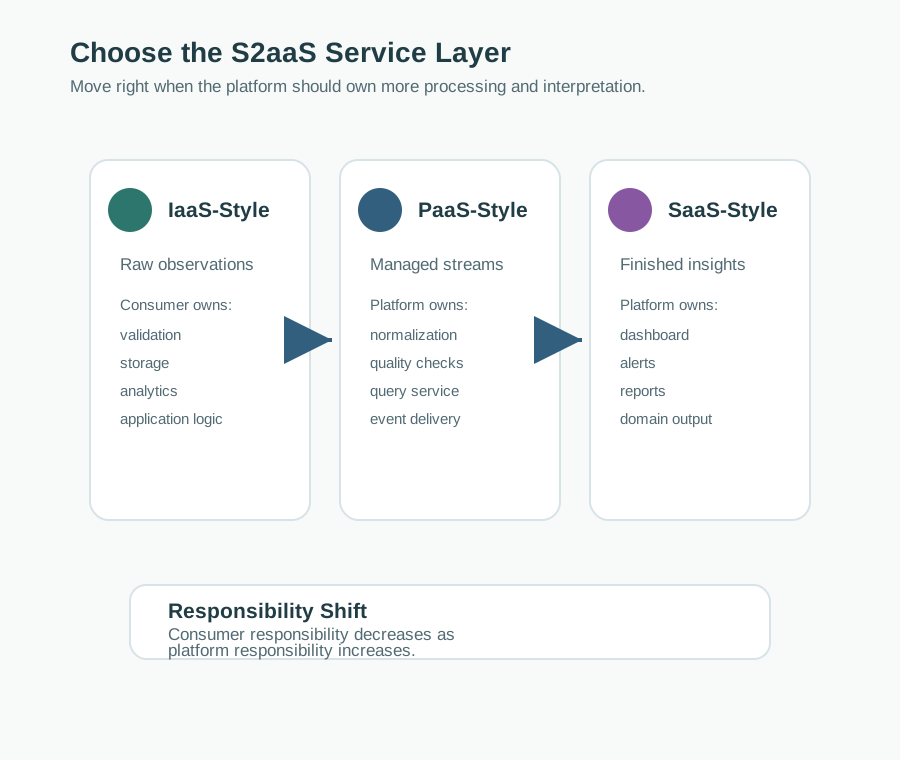
  2. Three service layers: IaaS gives raw sensor access (you manage everything else), PaaS provides a managed sensor network with data collection and processing, SaaS delivers ready-to-use analytics and insights. Each layer increases abstraction and reduces consumer responsibility.

  3. The marketplace ecosystem: Three stakeholders interact – sensor owners (deploy and maintain hardware), platform operators (run the marketplace, handle billing, ensure quality), and data consumers (pay for sensing capabilities). Revenue sharing (70-85% to owners, 15-30% platform fee) incentivizes all parties.

Key metric to remember: S2aaS can reduce sensing costs by 80-90% for consumers while generating new revenue streams for infrastructure owners. A university needing 500 air quality sensors can spend $120K on a 2-year S2aaS subscription instead of $750K deploying their own network.

63.2 Prerequisites

Before diving into this chapter, you should be familiar with:

  • Wireless Sensor Networks: Understanding traditional WSN architectures helps appreciate the paradigm shift to shared, service-oriented sensing infrastructure
  • Sensor Fundamentals and Types: Knowledge of sensor characteristics and data types is essential for designing virtualization layers that abstract physical sensors
  • IoT Reference Models: Familiarity with the 7-level IoT architecture helps understand where S2aaS platforms operate and how they integrate sensing with cloud services
The Challenge: Sensors are Expensive to Deploy and Maintain

The Problem: Owning sensor infrastructure is costly and complex:

  • Capital expense: Hardware ($100-$1,000+ per sensor), installation, permits, site surveys
  • Operating expense: Power, cellular/Wi-Fi connectivity, cloud storage, maintenance
  • Expertise required: Calibration, data quality assurance, domain knowledge for each sensor type
  • Scale complexity: Deploying thousands of sensors across a city requires massive logistics

Why Traditional Approaches Fall Short:

  • Different applications need different sensor types and locations
  • Utilization varies dramatically (weather sensors idle during stable conditions)
  • Technology changes rapidly (3-5 year obsolescence cycles)
  • Geographic coverage requires investment that no single organization can justify

What We Actually Need:

  • Access to sensor data without owning the physical infrastructure
  • Pay-per-use model matching sensing costs to actual consumption
  • Virtual sensors that aggregate and abstract physical deployments
  • Standard APIs enabling seamless switching between providers

The Solution: Sensing-as-a-Service (S2aaS) applies the cloud computing model to sensors: rent sensing capability instead of buying it. Just as AWS eliminated the need to own data centers, S2aaS eliminates the need to own sensor networks. A startup can access 10,000 air quality sensors across 50 cities for $5,000/month instead of spending $10 million to deploy their own.

Imagine you want to monitor air quality across your city for a research project. You could spend $500,000 buying and installing 500 sensors, or you could pay $5,000/month to access data from sensors the city already installed. This is Sensing-as-a-Service - renting access to sensors instead of owning them.

The Sharing Economy for Sensors:

Think of S2aaS like Airbnb for sensors: - Sensor Owners (like homeowners): Deploy sensors for their own use, then rent them out to earn passive income - Data Consumers (like travelers): Pay for temporary access to sensor data without buying expensive hardware - Platform (like Airbnb): Connects owners and consumers, handles payments, ensures quality

Real-World Example:

A city installs 1,000 air quality sensors for pollution monitoring (cost: $1 million). Instead of letting them sit idle at night: - University researchers rent access for climate studies ($10,000/year) - Health department uses data for respiratory illness tracking ($15,000/year) - Real estate company analyzes data for property valuations ($20,000/year) - City recovers investment in 2-3 years instead of 10!

Three Service Levels (like cloud computing):

  1. IaaS (Infrastructure): Rent raw sensor access - you handle everything else (like renting a car)
  2. PaaS (Platform): Access sensor network with basic processing included (like Uber - you don’t drive)
  3. SaaS (Software): Get ready-to-use analytics and insights (like Uber Eats - food arrives at your door)
Term Simple Explanation Everyday Analogy
S2aaS Rent sensor access instead of buying sensors Netflix vs buying DVDs
Multi-Tenancy Multiple users share same sensors safely Apartment building with private units
Sensor Virtualization Software representation of physical sensor Uber app representing real cars
Data Marketplace Platform to buy/sell sensor data eBay for sensor data
Pay-Per-Use Pay only for data you actually consume Electric bill (pay for kwh used)
Sensor Discovery Finding available sensors by location/type Google Maps searching “coffee near me”

Who Benefits:

  • Sensor Owners: Monetize infrastructure (instead of $0 return, earn revenue)
  • Data Consumers: Avoid $500K capital expense, get immediate access, pay only $5K/month when needed
  • Society: Less electronic waste (shared sensors vs duplicate deployments), lower barriers for researchers/startups

Why This Matters for IoT:

Traditional model: Every application deploys dedicated sensors (wasteful, expensive, redundant). S2aaS model: Share sensor infrastructure (efficient, affordable, accessible). This democratizes IoT - small startups and researchers can access sensing capabilities previously limited to large organizations with big budgets!

Sensing-as-a-Service is like having a library for sensors - instead of buying every book (sensor), you can borrow the ones you need!

63.2.1 The Sensor Squad Adventure: The Neighborhood Sharing Club

One sunny day, the Sensor Squad was helping their neighborhood. Sammy the Temperature Sensor lived at the Johnson house, Lux the Light Sensor lived at the Garcia house, Motio the Motion Detector lived at the Park house, and Pressi the Pressure Sensor lived at the Chen house.

“I wish I knew how sunny it is in my backyard,” said Mrs. Johnson. “But I don’t have a light sensor!”

“I wish I knew the temperature!” said Mr. Garcia. “But I don’t have a temperature sensor!”

Everyone wanted data from sensors they didn’t own. Buying new sensors for everyone would cost so much money!

Then Lux had a brilliant idea: “What if we SHARE? I can tell Mrs. Johnson how sunny it is, and Sammy can tell Mr. Garcia the temperature. We’ll create a SENSOR SHARING CLUB!”

The Sensor Squad got to work. They built a special clubhouse (the cloud platform) where all their readings were collected. Now anyone in the neighborhood could ask for sensor data:

  • The ice cream truck driver checked Sammy’s temperature readings to know which streets would have kids outside
  • The garden club used Lux’s light data to plan the best sunny spots for their flowers
  • The mail carrier used Motio’s motion data to know when dogs were in the yard
  • The delivery company used Pressi’s weight readings to find flat, sturdy surfaces for packages

Instead of everyone buying their OWN sensors (which would cost thousands of dollars!), they paid a small monthly fee to access the Sensor Squad’s data. The families who owned the sensors earned money back, and everyone saved tons of cash!

“This is amazing!” cheered the neighborhood. “We’re getting sensor data for just a few dollars a month instead of buying expensive equipment!”

63.2.2 Key Words for Kids

Word What It Means
Sensing-as-a-Service Renting access to sensors instead of buying your own - like Netflix for sensor data
Data Marketplace A place where people can buy and sell sensor information, like an online store for data
Multi-Tenancy When many different people share the same sensor, but each gets their own private data
Sensor Virtualization Making one physical sensor appear as many “virtual” sensors for different users
Pay-Per-Use Paying only for the sensor data you actually use, like paying for electricity by the hour

63.2.3 Try This at Home!

Create Your Own Sensor Sharing Club!

  1. Find “sensors” around your house (these can be pretend):
    • A thermometer = temperature sensor
    • A window = light sensor (is it sunny or cloudy?)
    • Your eyes = motion sensor (is anyone walking by?)
    • A bathroom scale = pressure/weight sensor
  2. Make a “Sensor Menu” on paper:
    • Temperature reading: 5 cents
    • Light level (sunny/cloudy/dark): 3 cents
    • Motion alert (someone walked by!): 2 cents
    • Weight measurement: 4 cents
  3. Play “Sensor Service” with family:
    • Family members “pay” with play money or tokens
    • They request data: “Is it sunny outside?”
    • You check your “light sensor” (the window) and report back!
  4. Keep track of your “earnings” - see how much money you’d make if this were real!

Discussion Questions:

  • Why is it cheaper to share sensors instead of everyone buying their own?
  • What data would YOU want to buy from a neighbor’s sensor?
  • What data should NEVER be shared? (Hint: cameras inside houses!)

64 Sensing as a Service

Key Concepts
  • Sensing-as-a-Service (SaaS): Cloud-based model where sensing capabilities are offered as services, abstracting underlying sensor infrastructure from applications
  • Sensor Virtualization: Creating software abstractions of physical sensors, allowing applications to access sensing data without managing hardware
  • Service-Oriented Architecture (SOA): Architectural pattern where system capabilities are exposed as services with well-defined interfaces
  • Sensor Discovery: Mechanisms for applications to find and access available sensing services based on capabilities, location, or other criteria
  • Data Marketplace: Platforms where sensor data can be shared, traded, or monetized, enabling new business models for sensing infrastructure
  • Multi-Tenancy: Multiple independent applications sharing common sensor infrastructure while maintaining data isolation and security

64.1 Sensing as a Service (S2aaS)

⏱️ ~12 min | ⭐⭐ Intermediate | 📋 P05.C15.U01

Sensing-as-a-Service architecture diagram showing three tiers: sensor owners at the bottom deploying physical sensors and IoT devices, a central cloud platform in the middle virtualizing and aggregating sensor data streams, and multiple data consumers at the top accessing sensing services through standardized APIs, with a marketplace layer connecting providers and consumers through service discovery and billing

S2aaS Architecture
Figure 64.1: Sensing-as-a-Service architecture showing the marketplace model that connects sensor owners with data consumers through a cloud platform.

Comparison diagram of three cloud service models applied to sensing: Infrastructure-as-a-Service showing raw sensor hardware access with consumer managing protocols and processing; Platform-as-a-Service showing sensor network with managed data pipeline and APIs for consumer applications; Software-as-a-Service showing fully managed analytics where consumer only interacts with dashboards and query interfaces; abstraction level increases from IaaS to SaaS

Service Models
Figure 64.2: Service models for sensing infrastructure showing IaaS, PaaS, and SaaS options for sensor data consumers.

Sensing as a Service (S2aaS) represents a paradigm shift in how sensing infrastructure is deployed, managed, and monetized. Rather than requiring each application or organization to deploy and maintain dedicated sensing infrastructure, S2aaS enables shared sensor networks where sensing capabilities are provided as a service, similar to how cloud computing delivers computational resources on demand.

Cross-Hub Connections

Expand Your Learning:

This chapter on S2aaS core concepts connects to resources across the module’s learning ecosystem:

  • Knowledge Map: Explore how S2aaS fits into the broader IoT architecture landscape, connecting service-oriented sensing with cloud computing, WSN, and business models
  • Quizzes Hub: Test your understanding of S2aaS concepts including multi-tenancy, sensor virtualization, data ownership models, and pricing strategies
  • Simulations Hub: Experiment with interactive S2aaS marketplace simulators to understand sensor discovery, pricing dynamics, and multi-tenant resource allocation
  • Videos Hub: Watch guided tutorials on sensor cloud architecture, data marketplace design patterns, and real-world S2aaS platform implementations

Related Deep Dives:

Architectural Comparisons:

64.2 Definition

Sensing as a Service (S2aaS) is a service model where sensor infrastructure, data collection, processing, and analytics are provided as on-demand, pay-per-use services rather than requiring organizations or individuals to own and operate their own dedicated sensing systems. S2aaS enables sensor owners to monetize their infrastructure while allowing data consumers to access sensing capabilities without capital investment.

64.2.1 Core Concept

In the S2aaS model, sensors and sensor networks become shared resources, much like cloud computing transformed dedicated servers into shared, on-demand infrastructure. Sensor owners (individuals, organizations, municipalities) deploy and maintain sensing infrastructure, while multiple consumers access sensor data and analytics through service interfaces.

Side-by-side comparison diagram: left side shows Traditional Siloed Model where three separate organizations each deploy their own dedicated sensors (300+ sensors each, $1M total) serving only their single application with redundant coverage; right side shows S2aaS Shared Model where a single shared sensor deployment (1,000 sensors, $500K) serves all three organizations through a cloud platform with separate API access, reducing cost per organization

S2aaS vs traditional sensing model

Traditional Model (Total cost: $1M for 1,000 sensors, 3 applications):

  • Each organization deploys dedicated sensors
  • High capital and operational costs
  • Underutilized infrastructure (each deployment serves one application)
  • Redundant deployments in same areas
  • Limited scalability

S2aaS Model (Total cost: $500K shared, 3 consumers pay $264K/year):

S2aaS layered architecture diagram showing physical sensor infrastructure (temperature, air quality, noise, vibration sensors) at the bottom, sensor virtualization middleware in the middle that abstracts hardware heterogeneity and exposes uniform virtual sensor objects, multiple tenant applications at the top consuming sensor data through standardized REST and MQTT APIs, with horizontal billing and access control layers ensuring data isolation and usage tracking between tenants

S2aaS architecture visualization
Figure 64.3: The S2aaS architecture separates physical sensing infrastructure from application consumers through virtualization and service layers. Sensor owners register their devices with the platform, which exposes standardized APIs to multiple tenants. This enables efficient resource sharing while maintaining data isolation, quality guarantees, and usage-based billing for each consumer.

Sensor data marketplace diagram showing data producers (sensor owners: municipalities, building owners, vehicle fleets) on the left publishing data streams with quality and pricing metadata, a central marketplace platform in the middle managing sensor discovery catalog and subscription matching, and data consumers on the right (researchers, businesses, city planners) subscribing to sensor feeds and paying per-data-point or subscription fees

S2aaS data marketplace concept
Figure 64.4: The S2aaS marketplace enables sensor owners to monetize their infrastructure while allowing researchers, businesses, and government agencies to access sensing capabilities without capital investment. Like app stores transformed software distribution, sensor marketplaces are creating new economic models for IoT data sharing and collaborative sensing.
  • Shared sensor infrastructure
  • Pay-per-use pricing
  • Higher utilization efficiency
  • Reduced redundancy
  • Dynamic scalability

S2aaS layer model showing physical infrastructure layer with deployed sensors, IaaS layer providing sensor access, PaaS layer offering data collection storage and processing, and SaaS layer delivering ready-to-use analytics and applications to consumers

S2aaS Layer Model
Figure 64.5: Sensing-as-a-Service layer model from physical infrastructure to analytics delivery

64.2.2 Service Layers

Sensing-as-a-Service three-tier architecture showing data flow from Physical Infrastructure (buildings, streets, vehicles, industrial sites) through IaaS Layer (temperature sensors, air quality monitors, traffic cameras, motion detectors, smart meters), PaaS Layer (data collection, storage, processing, API gateway, query and aggregation), SaaS Layer (traffic alerts, air quality reports, occupancy analytics, predictive maintenance) to Data Consumers (research apps, smart city services, business analytics)

S2aaS Three-Tier Architecture
Figure 64.6: Sensing-as-a-Service three-tier architecture showing data flow from Physical Infrastructure through IaaS, PaaS, and SaaS layers to Data Consumers.

Sensing-as-a-Service Three-Tier Architecture

Layer Components Function Analogy
Data Consumers Research Apps, Smart City Services, Business Analytics Use sensor data End users
SaaS Layer Traffic Alerts, Air Quality Reports, Occupancy Analytics, Predictive Maintenance Ready-to-use insights Netflix (content delivered)
PaaS Layer Data Collection, Storage, Processing, API Gateway, Query & Aggregation Sensor network platform Uber (service, not car ownership)
IaaS Layer Temperature Sensors, Air Quality Monitors, Traffic Cameras, Motion Detectors, Smart Meters Raw sensor access Renting equipment
Physical Infrastructure Buildings, Streets, Vehicles, Industrial Sites Where sensors are deployed Real-world locations

Data Flow: Physical Infrastructure → IaaS (sensors) → PaaS (platform) → SaaS (analytics) → Data Consumers

Infrastructure as a Service (IaaS) - Sensor Level: Raw access to physical sensors and actuators, similar to virtual machines in cloud computing.

Example: Renting access to specific sensors (temperature, air quality, cameras) deployed in locations of interest.

Platform as a Service (PaaS) - Sensor Network Level: Access to sensor network platforms providing data collection, storage, and basic processing without managing individual sensors.

Example: Using a smart city sensor network platform to collect traffic and environmental data without deploying own sensors.

Software as a Service (SaaS) - Analytics Level: High-level applications and analytics built on sensor data, delivered as ready-to-use services.

Example: Subscribe to traffic congestion alerts, air quality reports, or occupancy analytics without dealing with sensors or data processing.

64.3 Introduction to Sensing as a Service

Diagram showing sensor cloud architecture with three layers: physical sensors at bottom, virtualization middleware in center providing abstraction and multi-tenancy, and cloud-based service layer at top delivering sensing capabilities to multiple applications
Figure 64.7: Sensor Cloud architecture enabling Sensing as a Service by virtualizing physical sensor infrastructure
Detailed architectural diagram showing sensor cloud components: physical sensor networks feeding into virtualization layer with resource pooling and multi-tenant isolation, middleware providing service provisioning and API gateway, and user access layer with authentication, authorization, and billing management
Figure 64.8: Detailed sensor cloud architecture showing virtualization layer, service provisioning, and user access
Comprehensive Sensing-as-a-Service platform architecture diagram showing three main components: (1) Set of end-users on left accessing services through Web Portal interface, (2) Central cloud platform (depicted as blue cloud) containing key services including Virtualization for sensor abstraction, Management for resource allocation, Composition for service orchestration, Database for data persistence, Caching for performance optimization, and Pricing for billing - with SCSP (Sensor Cloud Service Provider) at bottom, (3) Physical sensor nodes deployment field on right (green area) showing diverse sensors (circles, squares, triangles in different colors representing different sensor types) owned by Set of sensor Owners - bidirectional arrows show data flow from physical sensors through cloud services to end-users
Figure 64.9: Source: NPTEL IoT Course (IIT Kharagpur)
Traditional WSN architecture diagram showing sensor nodes communicating through gateway to single dedicated application, illustrating one-to-one relationship between sensor deployment and application
Figure 64.10: Traditional Wireless Sensor Network architecture recap showing static deployment and dedicated applications
Diagram highlighting traditional WSN limitations: inflexible single-purpose deployment, low utilization rates with sensors idle most of time, high per-application cost, and inability to share resources across multiple use cases
Figure 64.11: Limitations of traditional WSNs - inflexibility, underutilization, and dedicated nature
Comparison diagram contrasting traditional WSN (dedicated, single-tenant, static) with sensor cloud (virtualized, multi-tenant, dynamic service provisioning), highlighting key architectural differences in resource allocation and application coupling
Figure 64.12: Key differences between sensor cloud and traditional WSN - virtualization, multi-tenancy, and service orientation
Detailed comparison table showing evolution from WSN to sensor cloud across dimensions: ownership model (dedicated to shared), resource allocation (static to dynamic), scalability (limited to elastic), cost structure (CAPEX to OPEX), and service delivery (application-specific to multi-tenant platform)
Figure 64.13: Comparison of WSN and sensor cloud characteristics showing architectural evolution

The evolution of Sensing as a Service reflects broader trends in shared economies, cloud computing, and the proliferation of IoT devices creating opportunities for infrastructure sharing and monetization.

64.3.1 Historical Evolution

Timeline diagram showing four eras of sensing evolution: Pre-2010 Dedicated Sensing Era with application-specific siloed deployments and high costs; 2010-2015 Cloud-Enabled Sensing with better data management but still siloed ownership; 2015-2020 Sensor Proliferation with explosion of connected devices but under-utilized infrastructure; 2020-Present Sensing Marketplaces where platforms enable sensor owners to monetize infrastructure and consumers to access sensing on-demand

S2aaS historical evolution timeline

Dedicated Sensing Era (Pre-2010): Organizations deployed application-specific sensor networks for particular use cases, resulting in high costs and limited reuse. A single environmental monitoring project might spend $1M deploying sensors that served only one application.

Cloud-Enabled Sensing (2010-2015): Cloud platforms enabled better data management and sharing, but sensor deployment remained siloed. AWS IoT (2015) and Azure IoT Hub (2016) provided managed backends, but each organization still owned its own sensors.

Sensor Proliferation (2015-2020): Explosion of smart devices, smartphones, vehicles, and public infrastructure created vast sensing capacity, much of it underutilized. By 2020, an estimated 30 billion connected devices generated sensing data, but utilization rates for most deployments remained below 10%.

Sensing Marketplaces (2020-Present): Platforms emerge enabling sensor owners to monetize infrastructure and data consumers to access sensing capabilities on-demand. Examples include Thingful (sensor search engine), Waze (crowdsourced traffic sensing), and PurpleAir (community air quality networks).

64.3.2 Drivers of S2aaS Adoption

Economic Efficiency: Sharing sensor infrastructure reduces costs for all participants through economies of scale and higher utilization.

Reduced Deployment Barriers: Accessing existing sensors eliminates need for capital investment, permitting, installation, and maintenance.

Broader Coverage: Leveraging diverse sensor owners creates denser, more comprehensive coverage than any single organization could achieve.

Faster Time-to-Insight: Immediate access to operational sensors enables rapid prototyping and deployment of sensing applications.

Sustainability: Sharing infrastructure reduces electronic waste and energy consumption from redundant deployments.

64.3.3 S2aaS Ecosystem

S2aaS Business Model showing ecosystem value flow between Sensor Owners (municipalities, building owners, vehicle fleets, individuals, sensing companies), Platform Operators (marketplace, cloud infrastructure, analytics, API gateway, payment processing), and Data Consumers (researchers, businesses, city planners, emergency services, app developers) with sensor data, processed data, usage fees, revenue sharing of 70 to 85 percent, and transaction fees of 15 to 30 percent

S2aaS Business Model
Figure 64.14: S2aaS Business Model showing ecosystem value flow between Sensor Owners, Platform Operators, and Data Consumers with revenue sharing and transaction fees.

This variant shows the temporal flow of value creation in S2aaS, from initial sensor deployment through monetization, helping understand the investment-to-revenue timeline.

Value chain timeline showing S2aaS investment-to-revenue flow: Year 0 sensor deployment and platform registration costs, Year 1 first consumer subscriptions covering operating costs, Year 2-3 multi-tenant monetization scaling, break-even at Year 3 compared to traditional single-purpose deployment which never recovers costs, with ongoing revenue stream thereafter

S2aaS value chain timeline

Key Insight: S2aaS transforms sensor infrastructure from a pure cost center (traditional model) into a revenue-generating asset. The timeline shows that break-even typically occurs at 3 years with multi-tenant monetization, compared to never recovering costs with single-purpose deployment.

S2aaS Business Model and Ecosystem Value Flow

Stakeholder Role Examples
Sensor Owners Deploy & maintain infrastructure Municipalities, Building Owners, Vehicle Fleets, Individuals, Sensing Companies
Platform Operators Marketplace & technical infrastructure Marketplace Provider, Cloud Infrastructure, Analytics Services, API Gateway, Payment Processing
Data Consumers Pay for sensing capabilities Researchers, Businesses, City Planners, Emergency Services, App Developers

Value Flows:

Flow From To Details
Sensor Data Owners Platform Raw measurements, telemetry
Processed Data Platform Consumers Analytics, insights, APIs
Usage Fees Consumers Platform Pay-per-use pricing
Revenue Share Platform Owners 70-85% of usage fees
Transaction Fee Platform retains - 15-30% of transactions

Economic Model: Owners monetize infrastructure → Platform facilitates transactions → Consumers access data affordably → Win-win-win ecosystem

Sensor Owners/Providers:

  • Municipalities with smart city infrastructure
  • Building owners with environmental monitoring
  • Vehicle fleets with mobile sensors
  • Individuals with personal devices
  • Specialized sensing companies

Data Consumers/Users:

  • Researchers needing environmental data
  • Businesses requiring market intelligence
  • City planners analyzing mobility patterns
  • Emergency responders needing situational awareness
  • Application developers building IoT services

Platform Operators:

  • Marketplace providers connecting owners and consumers
  • Cloud platforms hosting sensor data
  • Analytics service providers
  • API and integration platforms

The S2aaS business model described above relies on revenue sharing between sensor owners and the platform operator. Let’s calculate the economics for a city’s air quality sensor network being monetized through three service tiers.

Given deployment:

  • 500 air quality sensors deployed by city at $300/sensor = $150,000 capital cost
  • Monthly operating cost: $3/sensor cellular connectivity + $2/sensor maintenance = $2,500/month
  • Platform charges 20% transaction fee, owners keep 80%

Service tier pricing (per sensor per month):

  • IaaS (raw data access): $8/sensor/month
  • PaaS (processed data + API): $15/sensor/month
  • SaaS (analytics dashboard): $25/sensor/month

Consumer subscriptions after 6 months:

  • 3 research institutions: 100 sensors each @ IaaS = 300 sensors × $8 = $2,400/month
  • 5 businesses: 40 sensors each @ PaaS = 200 sensors × $15 = $3,000/month
  • 2 city departments: 50 sensors each @ SaaS = 100 sensors × $25 = $2,500/month
  • Total monthly revenue: $2,400 + $3,000 + $2,500 = $7,900/month

Revenue distribution:

  • Platform fee (20%): \(7{,}900 \times 0.20 = \$1{,}580/\text{month}\)
  • Sensor owner share (80%): \(7{,}900 \times 0.80 = \$6{,}320/\text{month}\)

City owner net income:

  • Monthly revenue: $6,320
  • Monthly operating cost: $2,500
  • Monthly net income: \(\$6{,}320 - \$2{,}500 = \$3{,}820/\text{month}\)

Break-even calculation:

  • Initial investment: $150,000
  • Monthly net income: $3,820
  • Payback period: \(\$150{,}000 \div \$3{,}820 = 39.3 \text{ months} \approx 3.3 \text{ years}\)

Utilization rate:

  • Total sensors deployed: 500
  • Sensors subscribed by consumers: \(300 + 200 + 100 = 600\) subscriptions
  • Average utilization per sensor: \(600 \div 500 = 1.2\) tenants/sensor (multi-tenancy!)

Result: The city recoups its $150,000 investment in 3.3 years while providing $7,900/month in sensing value to the community. Multi-tenancy enables 120% utilization (600 subscriptions from 500 sensors), generating $15.80/sensor/month revenue where traditional single-purpose deployment would earn $0.

Interactive S2aaS Revenue Calculator

Adjust the parameters to model your own S2aaS deployment economics:

Key insight: Multi-tenancy is the economic engine of S2aaS. The same physical sensor generates revenue from multiple consumers (research @ $8, business @ $15, city @ $25 simultaneously), amplifying ROI beyond what any single-tenant model could achieve. The 20% platform fee is justified by enabling this 1.2x utilization multiplier.

64.4 Sensor Discovery and Registration

Time: ~8 min | Level: Intermediate | Ref: P05.C15.U02

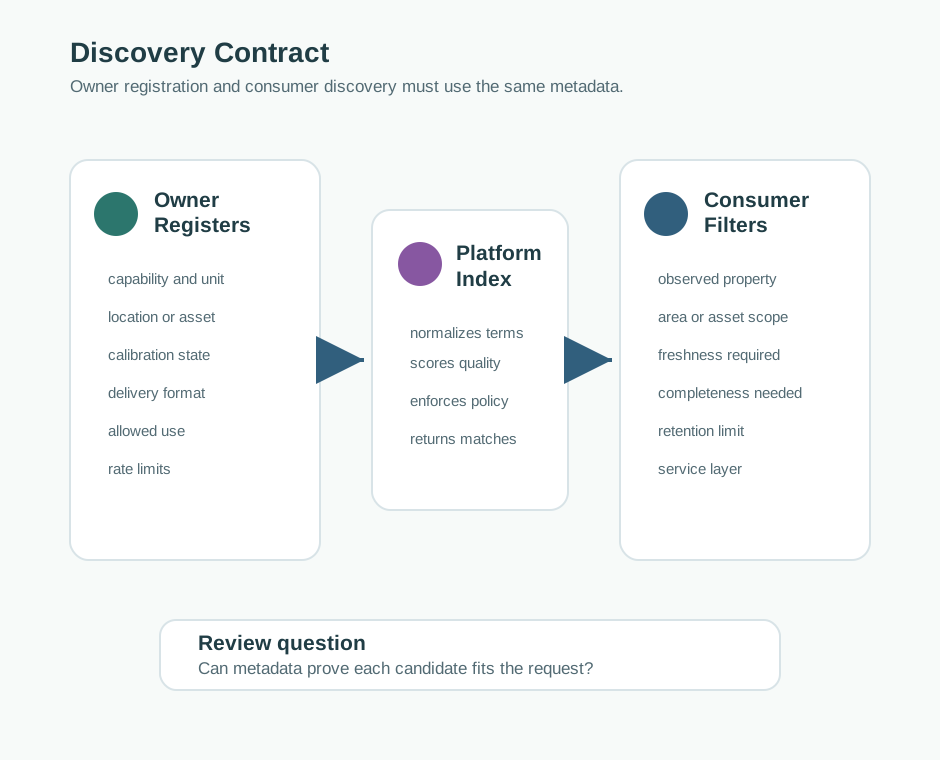
A critical component of any S2aaS platform is the ability for consumers to discover available sensors and for owners to register their infrastructure. Without effective discovery, the marketplace cannot function – consumers cannot find the sensors they need, and owners cannot attract paying customers.

64.4.1 Discovery Mechanisms

Diagram showing four S2aaS sensor discovery mechanisms: Geospatial discovery using geographic bounding boxes and radius queries, Capability-based discovery filtering by measured phenomena and resolution, QoS-based discovery selecting sensors meeting accuracy and uptime thresholds, and Economic discovery optimizing cost across coverage requirements, all feeding into a unified S2aaS discovery API

S2aaS sensor discovery mechanisms

S2aaS platforms typically support four discovery mechanisms:

Discovery Type Query Example Use Case
Geospatial “Air quality sensors within 2km of city center” Researchers studying urban pollution patterns
Capability-based “All sensors measuring PM2.5 with 1-minute resolution” Health agencies tracking particulate matter
QoS-based “Temperature sensors with accuracy better than ±0.5 degrees C and 99.9% uptime” Industrial process monitoring requiring high reliability
Economic “Cheapest combination of 50 sensors covering downtown district” Budget-constrained startups needing minimum viable coverage

64.4.2 Sensor Registration Process

When sensor owners register their infrastructure with an S2aaS platform, they provide a sensor profile that includes:

  1. Physical attributes: Location (GPS coordinates), deployment environment (indoor/outdoor), physical access constraints
  2. Sensing capabilities: Measured phenomena, measurement range, accuracy, resolution, sampling rate
  3. Connectivity: Communication protocol (MQTT, CoAP, HTTP), data format (JSON, binary), update frequency
  4. Quality guarantees: Expected uptime, calibration schedule, maintenance windows
  5. Pricing preferences: Minimum acceptable price, exclusive vs. shared access tiers, volume discounts

Sequence diagram showing sensor registration flow: sensor owner submits profile (physical attributes, sensing capabilities, connectivity details, quality guarantees, pricing) to S2aaS platform API; platform validates and assigns sensor ID, indexes in discovery database, creates billing account, and returns registration confirmation with API credentials; sensor then begins publishing data to platform

S2aaS sensor registration process

64.4.3 Worked Example: Sensor Discovery API Call

Below is an example of how a consumer might query an S2aaS discovery API to find suitable sensors:

// POST /api/v1/discover
{
  "query": {
    "location": {
      "type": "circle",
      "center": { "lat": 51.5074, "lng": -0.1278 },
      "radius_km": 5
    },
    "capabilities": {
      "phenomena": ["temperature", "humidity", "PM2.5"],
      "min_accuracy": { "temperature": 0.5, "PM2.5": 5.0 },
      "min_sampling_rate_hz": 0.017
    },
    "quality": {
      "min_uptime_percent": 99.0,
      "max_data_latency_seconds": 60
    },
    "budget": {
      "max_monthly_cost_usd": 500,
      "billing_model": "pay-per-use"
    }
  },
  "sort_by": "quality_score",
  "limit": 20
}
// Response
{
  "total_matches": 47,
  "results": [
    {
      "sensor_id": "SNS-4821",
      "owner": "City of London Environmental Services",
      "location": { "lat": 51.5085, "lng": -0.1257 },
      "distance_km": 0.23,
      "capabilities": {
        "phenomena": ["temperature", "humidity", "PM2.5", "PM10", "NO2"],
        "accuracy": { "temperature": 0.3, "PM2.5": 3.0 },
        "sampling_rate_hz": 0.067
      },
      "quality_score": 94.2,
      "uptime_30d": 99.7,
      "pricing": {
        "pay_per_use": "$0.002/reading",
        "monthly_unlimited": "$45/month",
        "annual_discount": "$480/year"
      },
      "last_reading": "2026-01-29T10:15:00Z"
    }
  ]
}

This discovery API enables consumers to find sensors matching their precise requirements, compare pricing options, and subscribe programmatically – just as cloud providers let you discover and provision compute resources via APIs.

64.5 Common S2aaS Pitfalls and Misconceptions

Pitfall 1: Assuming S2aaS data quality equals dedicated deployment quality. Shared sensors may have different calibration schedules, maintenance priorities, and data quality guarantees than dedicated infrastructure. Always verify the sensor’s accuracy specifications and calibration history before relying on S2aaS data for critical applications.

Pitfall 2: Ignoring data ownership and licensing terms. When you subscribe to S2aaS data, you typically receive a license to use the data, not ownership. Redistributing, reselling, or publishing raw S2aaS data without explicit permission can violate terms of service. Always review the data license before building commercial products on S2aaS feeds.

Pitfall 3: Underestimating vendor lock-in risks. Each S2aaS platform uses proprietary APIs, data formats, and billing models. If you build your application tightly coupled to one platform’s API, switching providers later can be expensive. Use abstraction layers and standard data formats (SenML, OGC SensorThings) to reduce lock-in.

Pitfall 4: Overlooking latency and reliability differences between tiers. Basic S2aaS tiers may have higher latency (minutes, not seconds) and lower uptime guarantees (95% vs. 99.9%). If your application requires real-time data or mission-critical reliability, budget for premium tiers or deploy dedicated backup sensors for critical locations.

Pitfall 5: Confusing “access to more sensors” with “better data.” More sensors does not automatically mean better insights. Sensor placement, calibration, and data quality matter far more than quantity. A well-calibrated network of 50 sensors can outperform a poorly maintained network of 500 for most analytics tasks.

Knowledge Check

Test your understanding of fundamental concepts with these questions.

Scenario: Urban Air Quality Monitoring Network

You’re the environmental officer for a mid-sized city (population: 500,000) that invested $500,000 deploying 500 air quality sensors across the metropolitan area two years ago. Each sensor measures: - PM2.5 and PM10 particulate matter - NO2 (nitrogen dioxide) - O3 (ozone) - Temperature and humidity - Reporting interval: Every 15 minutes

Your Current Situation:

The city deployed these sensors for regulatory compliance (EPA air quality monitoring requirements). The sensors operate 24/7, sending data to the city’s environmental dashboard. However: - Utilization: City only uses data for regulatory reports (quarterly) - Dashboard views: 20-30 users per month (mostly city staff) - Revenue generated: $0 (public service, no monetization) - Ongoing costs: $50,000/year (maintenance, cellular connectivity, cloud storage)

The Opportunity:

A local university’s climate research department contacts you. They want to conduct a 2-year study on: - Urban heat island effects - Air quality correlation with traffic patterns - Impact of green spaces on local air quality - Public health outcomes related to pollution exposure

Their Traditional Options:

Option A: Deploy Own Sensor Network

Hardware: 500 sensors × $1,000 = $500,000
Installation: 500 sites × $300 (permits, mounting, connectivity) = $150,000
Maintenance: $50,000/year × 2 years = $100,000
Total cost: $750,000 for 2-year study
Timeline: 12-18 months for permitting, procurement, deployment
Result: Duplicate infrastructure (city has 500 sensors, university adds 500 more)

Option B: Request Data Sharing (Traditional Approach)

Cost: Free (public data)
Timeline: 6-12 months (data sharing agreements, legal review, data format negotiations)
Limitations:
- Only quarterly reports available (not real-time)
- City's dashboard not designed for research queries
- No API access, must manually download CSVs
- Limited historical data (city only retains 6 months)
Result: Partial data access, significant friction

Think About:

  1. The city has already spent $500K on sensors that collect data 24/7. What percentage of that data’s potential value is the city capturing if only 20-30 people view quarterly reports?
  2. If the university deploys 500 duplicate sensors, what’s the total community cost (city’s $500K + university’s $750K = $1.25M for the same geographic coverage)?
  3. How could the city turn its “sunk cost” infrastructure into a revenue-generating asset?

Key Insight:

The city’s sensor infrastructure is under-utilized. Each sensor collects 96 readings per day × 5 metrics = 480 data points per sensor per day. That’s 240,000 data points citywide daily, but the city only uses a tiny fraction for quarterly compliance reports.

The Solution - Sensing-as-a-Service (S2aaS):

The city creates a Sensing-as-a-Service platform that monetizes existing infrastructure without impacting primary mission (pollution monitoring).

Service Tiers:

Tier 1: Basic Access ($2,000/month)

  • Real-time API access to all 500 sensors
  • Historical data: 30 days
  • API rate limit: 1,000 requests/hour
  • Update frequency: 15-minute intervals (same as sensors)

Tier 2: Research Access ($5,000/month) ← University selects this

  • Everything in Basic tier, plus:
  • Historical data: 2 years (full dataset)
  • API rate limit: 10,000 requests/hour
  • Custom aggregations (hourly, daily, weekly averages)
  • CSV/JSON bulk export
  • Priority support

Tier 3: Enterprise Access ($15,000/month)

  • Everything in Research tier, plus:
  • Real-time WebSocket streaming
  • Dedicated account manager
  • Custom analytics dashboard
  • SLA: 99.9% uptime guarantee

Financial Analysis:

City’s Economics (S2aaS Provider):

Infrastructure investment (sunk cost): $500,000 (already spent 2 years ago)
Ongoing costs: $50,000/year (maintenance, connectivity, cloud)
S2aaS revenue potential:
  - University (Research tier): $5,000/month × 24 months = $120,000
  - Health department: $2,000/month × 24 months = $48,000
  - Real estate analytics company: $15,000/month × 12 months = $180,000
Total revenue (2 years): $348,000
Net revenue after costs: $348,000 - $100,000 = $248,000 profit
ROI on initial investment: Recover 49.6% of $500K CAPEX in 2 years
Break-even: 4 years at current revenue (vs. never with free-only model)

University’s Economics (S2aaS Consumer):

S2aaS subscription: $5,000/month × 24 months = $120,000
vs. Deploy own network: $750,000
Savings: $630,000 (84% cost reduction)
Timeline: Immediate access (vs. 12-18 months deployment)
Additional benefits:
  - No maintenance burden (city handles hardware)
  - Can cancel after 2 years (no stranded assets)
  - Access to 2 years of historical data (impossible with new deployment)

Multi-Tenancy Benefits:

The same 500 sensors now serve multiple stakeholders simultaneously: 1. City Environmental Department: Regulatory compliance monitoring (original use case) 2. University: Climate research (S2aaS customer #1) 3. County Health Department: Respiratory illness correlation studies (S2aaS customer #2) 4. Real Estate Analytics Startup: Air quality impact on property values (S2aaS customer #3)

Infrastructure utilization increases from 5% (city-only) to 90% (multi-tenant) with zero additional hardware cost.

Real-World Impact: This S2aaS pattern is transforming smart cities: - Barcelona Smart City: Monetizes 20,000+ sensors for traffic, air quality, noise (generates €5M annually) - Singapore SenseNet: 100,000 sensors shared across government agencies and private companies - Chicago Array of Things: Research sensor network enabling 50+ academic studies via S2aaS model

The key principle: Infrastructure sharing maximizes ROI - sensor owners monetize sunk costs, consumers avoid capital expense, society reduces duplicate deployments and e-waste.

{ “question”: “A S2aaS provider owns 5,000 environmental sensors (temp, humidity, CO2) deployed across a city. A customer wants guaranteed exclusive access to 500 sensors for 1 year. How should the provider price this?”, “options”: [ { “text”: “Standard rate: $10/sensor/month = $60K/year”, “correct”: false, “feedback”: “Incorrect. Exclusivity premium pricing: Standard multi-tenant model: 500 sensors serve 10 customers at $10/month = $50K/month revenue (100x revenue per sensor via multi-tenancy). Exclusive access: Customer gets all 500 sensors, no sharing → provider loses 9 customers → must charge 3-4x standard rate to compensate. Calculation: $10 standard × 10 customers = $100/sensor/month effective revenue. Exclusive customer should pay approximately $100/sensor/month, but negotiate to $30-40/month accounting for: (1) reduced platform overhead (single customer), (2) bulk commitment reduces sales cost, (3) customer’s willingness to pay for exclusivity. Why customer wants exclusivity: Mission-critical application (can’t risk shared resources), competitive advantage (competitors can’t access data), data privacy (no co-tenants). Alternative model: Offer "dedicated virtual sensors" - physically shared but logically isolated with QoS guarantees - at $15-20/month (middle ground). This mirrors cloud pricing: Shared EC2 instance ($0.10/hr), Dedicated host ($2/hr) - 20x premium for exclusivity.” }, { “text”: “Premium rate with exclusivity: $30-40/sensor/month = $180-240K/year (lost multi-tenancy revenue)”, “correct”: true, “feedback”: “Correct! Exclusivity premium pricing: Standard multi-tenant model: 500 sensors serve 10 customers at $10/month = $50K/month revenue (100x revenue per sensor via multi-tenancy). Exclusive access: Customer gets all 500 sensors, no sharing → provider loses 9 customers → must charge 3-4x standard rate to compensate. Calculation: $10 standard × 10 customers = $100/sensor/month effective revenue. Exclusive customer should pay approximately $100/sensor/month, but negotiate to $30-40/month accounting for: (1) reduced platform overhead (single customer), (2) bulk commitment reduces sales cost, (3) customer’s willingness to pay for exclusivity. Why customer wants exclusivity: Mission-critical application (can’t risk shared resources), competitive advantage (competitors can’t access data), data privacy (no co-tenants). Alternative model: Offer "dedicated virtual sensors" - physically shared but logically isolated with QoS guarantees - at $15-20/month (middle ground). This mirrors cloud pricing: Shared EC2 instance ($0.10/hr), Dedicated host ($2/hr) - 20x premium for exclusivity.” }, { “text”: “Lower rate due to bulk commitment: $5/sensor/month = $30K/year”, “correct”: false, “feedback”: “Not quite. Consider that Exclusivity premium pricing: Standard multi-tenant model: 500 sensors serve 10 customers at $10/month = $50K/month revenue (100x revenue per sensor via multi-tenancy). Exclusive access: Custom…” }, { “text”: “Free - exclusive access encourages platform adoption”, “correct”: false, “feedback”: “That is not correct. Review: Exclusivity premium pricing: Standard multi-tenant model: 500 sensors serve 10 customers at $10/month = $50K/month revenue (100x revenue per sensor via multi-tenancy). Exclusive access: Custom…” } ], “difficulty”: “medium”, “explanation”: “Exclusivity premium pricing: Standard multi-tenant model: 500 sensors serve 10 customers at $10/month = $50K/month revenue (100x revenue per sensor via multi-tenancy). Exclusive access: Customer gets all 500 sensors, no sharing → provider loses 9 customers → must charge 3-4x standard rate to compensate. Calculation: $10 standard × 10 customers = $100/sensor/month effective revenue. Exclusive customer should pay approximately $100/sensor/month, but negotiate to $30-40/month accounting for: (1) reduced platform overhead (single customer), (2) bulk commitment reduces sales cost, (3) customer’s willingness to pay for exclusivity. Why customer wants exclusivity: Mission-critical application (can’t risk shared resources), competitive advantage (competitors can’t access data), data privacy (no co-tenants). Alternative model: Offer "dedicated virtual sensors" - physically shared but logically isolated with QoS guarantees - at $15-20/month (middle ground). This mirrors cloud pricing: Shared EC2 instance ($0.10/hr), Dedicated host ($2/hr) - 20x premium for exclusivity.” } { “question”: “Why does Sensing-as-a-Service (S2aaS) typically improve ROI for sensor owners?”, “options”: [ { “text”: “It guarantees that each customer deploys their own dedicated sensor network”, “correct”: false, “feedback”: “Incorrect. S2aaS increases utilization by serving multiple consumers from the same deployed sensors, turning sunk infrastructure cost into recurring revenue while avoiding duplicate deployments.” }, { “text”: “It enables multi-tenant monetization of existing sensing infrastructure via APIs and service tiers”, “correct”: true, “feedback”: “Correct! S2aaS increases utilization by serving multiple consumers from the same deployed sensors, turning sunk infrastructure cost into recurring revenue while avoiding duplicate deployments.” }, { “text”: “It eliminates all maintenance and connectivity costs for the sensor owner”, “correct”: false, “feedback”: “Not quite. S2aaS increases utilization by serving multiple consumers from the same deployed sensors, turning sunk infrastructure cost into recurring revenue while avoiding duplicate deployments.” }, { “text”: “It reduces the amount of sensor data collected to near zero”, “correct”: false, “feedback”: “That is not correct. S2aaS increases utilization by serving multiple consumers from the same deployed sensors, turning sunk infrastructure cost into recurring revenue while avoiding duplicate deployments.” } ], “difficulty”: “medium”, “explanation”: “S2aaS increases utilization by serving multiple consumers from the same deployed sensors, turning sunk infrastructure cost into recurring revenue while avoiding duplicate deployments.” } { “question”: “A researcher needs PM2.5 data from 200 sensors across a metropolitan area for a 6-month air quality study. The S2aaS platform returns 350 matching sensors, but 40% have uptime below 95% in the last 30 days. What is the best strategy?”, “options”: [ { “text”: “Subscribe to all 350 sensors to maximize geographic coverage regardless of quality”, “correct”: false, “feedback”: “Incorrect. The optimal approach combines reliable S2aaS sensors as the backbone with selective use of lower-quality sensors where no alternatives exist, applying metadata flags to distinguish data quality levels. This maximizes coverage while maintaining analytical integrity. Option A ignores quality (leading to noisy data that could invalidate research conclusions). Option B sacrifices coverage (leaving geographic blind spots). Option D is the most expensive and time-consuming approach – deploying 140 dedicated sensors would take months and cost roughly $140K-$280K versus a few hundred dollars more per month for additional S2aaS subscriptions. The key insight is that S2aaS enables tiered data quality strategies that are impossible with all-or-nothing dedicated deployments.” }, { “text”: “Only subscribe to the 210 sensors with 95%+ uptime and accept coverage gaps”, “correct”: false, “feedback”: “Not quite. Consider that The optimal approach combines reliable S2aaS sensors as the backbone with selective use of lower-quality sensors where no alternatives exist, applying metadata flags to distinguish data qualit…” }, { “text”: “Subscribe to the 210 reliable sensors as primary sources, and selectively add lower-quality sensors in areas with no reliable alternatives, applying data quality flags”, “correct”: true, “feedback”: “Correct! The optimal approach combines reliable S2aaS sensors as the backbone with selective use of lower-quality sensors where no alternatives exist, applying metadata flags to distinguish data quality levels. This maximizes coverage while maintaining analytical integrity. Option A ignores quality (leading to noisy data that could invalidate research conclusions). Option B sacrifices coverage (leaving geographic blind spots). Option D is the most expensive and time-consuming approach – deploying 140 dedicated sensors would take months and cost roughly $140K-$280K versus a few hundred dollars more per month for additional S2aaS subscriptions. The key insight is that S2aaS enables tiered data quality strategies that are impossible with all-or-nothing dedicated deployments.” }, { “text”: “Deploy 140 dedicated sensors to fill the gaps left by unreliable S2aaS sensors”, “correct”: false, “feedback”: “That is not correct. Review: The optimal approach combines reliable S2aaS sensors as the backbone with selective use of lower-quality sensors where no alternatives exist, applying metadata flags to distinguish data qualit…” } ], “difficulty”: “medium”, “explanation”: “The optimal approach combines reliable S2aaS sensors as the backbone with selective use of lower-quality sensors where no alternatives exist, applying metadata flags to distinguish data quality levels. This maximizes coverage while maintaining analytical integrity. Option A ignores quality (leading to noisy data that could invalidate research conclusions). Option B sacrifices coverage (leaving geographic blind spots). Option D is the most expensive and time-consuming approach – deploying 140 dedicated sensors would take months and cost roughly $140K-$280K versus a few hundred dollars more per month for additional S2aaS subscriptions. The key insight is that S2aaS enables tiered data quality strategies that are impossible with all-or-nothing dedicated deployments.” } { “question”: “Which S2aaS service layer would be most appropriate for a logistics company that simply wants daily reports showing "which of our 50 warehouse locations had temperatures exceeding 25 degrees C yesterday" without managing any sensors or data processing?”, “options”: [ { “text”: “IaaS – they need raw sensor access to build custom temperature monitoring”, “correct”: false, “feedback”: “Incorrect. The logistics company wants ready-to-use insights ("which warehouses exceeded 25 degrees C") without managing sensors, data pipelines, or analytics code. This maps directly to the SaaS layer, which delivers pre-built applications and reports. IaaS would require the company to build its own data processing pipeline from raw sensor feeds. PaaS would require them to write custom queries and build their own reporting dashboard. The SaaS layer handles everything – sensor access, data collection, threshold analysis, and report generation – for a single subscription fee. This is analogous to using a fully-managed SaaS tool like Salesforce instead of building your own CRM on AWS infrastructure.” }, { “text”: “PaaS – they need a sensor network platform with data collection and storage APIs”, “correct”: false, “feedback”: “Not quite. Consider that The logistics company wants ready-to-use insights ("which warehouses exceeded 25 degrees C") without managing sensors, data pipelines, or analytics code. This maps directly to the SaaS layer, …” }, { “text”: “A hybrid IaaS/PaaS approach combining raw access with platform processing”, “correct”: false, “feedback”: “That is not correct. Review: The logistics company wants ready-to-use insights ("which warehouses exceeded 25 degrees C") without managing sensors, data pipelines, or analytics code. This maps directly to the SaaS layer, …” }, { “text”: “SaaS – they need ready-to-use temperature exceedance reports delivered as a service”, “correct”: true, “feedback”: “Correct! The logistics company wants ready-to-use insights ("which warehouses exceeded 25 degrees C") without managing sensors, data pipelines, or analytics code. This maps directly to the SaaS layer, which delivers pre-built applications and reports. IaaS would require the company to build its own data processing pipeline from raw sensor feeds. PaaS would require them to write custom queries and build their own reporting dashboard. The SaaS layer handles everything – sensor access, data collection, threshold analysis, and report generation – for a single subscription fee. This is analogous to using a fully-managed SaaS tool like Salesforce instead of building your own CRM on AWS infrastructure.” } ], “difficulty”: “medium”, “explanation”: “The logistics company wants ready-to-use insights ("which warehouses exceeded 25 degrees C") without managing sensors, data pipelines, or analytics code. This maps directly to the SaaS layer, which delivers pre-built applications and reports. IaaS would require the company to build its own data processing pipeline from raw sensor feeds. PaaS would require them to write custom queries and build their own reporting dashboard. The SaaS layer handles everything – sensor access, data collection, threshold analysis, and report generation – for a single subscription fee. This is analogous to using a fully-managed SaaS tool like Salesforce instead of building your own CRM on AWS infrastructure.” } { “question”: “A smart city S2aaS platform charges sensor owners a 20% transaction fee and guarantees 80% revenue share. If a sensor owner’s 100 air quality sensors generate $50,000/year in subscription revenue, what is the owner’s net revenue, and what is the platform’s minimum subscriber count needed to cover its $2M annual operating cost (assuming all owners have similar revenue)?”, “options”: [ { “text”: “Owner nets $40,000/year; platform needs 200 equivalent sensor owners to break even”, “correct”: true, “feedback”: “Correct! The owner receives 80% revenue share: $50,000 x 0.80 = $40,000/year. The platform retains 20%: $50,000 x 0.20 = $10,000/year per owner. To cover $2M operating costs: $2,000,000 / $10,000 = 200 equivalent sensor owners. This illustrates why S2aaS platforms need significant scale to be viable – the 15-30% transaction fee model only works with a large number of active sensor owners and consumers. Platform operators must invest heavily in marketplace development, quality assurance, and network effects before reaching profitability. This is similar to the "marketplace cold start" problem faced by Uber, Airbnb, and other two-sided platforms.” }, { “text”: “Owner nets $50,000/year; platform needs 100 equivalent sensor owners to break even”, “correct”: false, “feedback”: “Incorrect. The owner receives 80% revenue share: $50,000 x 0.80 = $40,000/year. The platform retains 20%: $50,000 x 0.20 = $10,000/year per owner. To cover $2M operating costs: $2,000,000 / $10,000 = 200 equivalent sensor owners. This illustrates why S2aaS platforms need significant scale to be viable – the 15-30% transaction fee model only works with a large number of active sensor owners and consumers. Platform operators must invest heavily in marketplace development, quality assurance, and network effects before reaching profitability. This is similar to the "marketplace cold start" problem faced by Uber, Airbnb, and other two-sided platforms.” }, { “text”: “Owner nets $40,000/year; platform needs 400 equivalent sensor owners to break even”, “correct”: false, “feedback”: “Not quite. Consider that The owner receives 80% revenue share: $50,000 x 0.80 = $40,000/year. The platform retains 20%: $50,000 x 0.20 = $10,000/year per owner. To cover $2M operating costs: $2,000,000 / $10,000 = 2…” }, { ”text”: ”Owner nets $10,000/year; platform needs 200 equivalent sensor owners to break even”, ”correct”: false, ”feedback”: ”That is not correct. Review: The owner receives 80% revenue share: $50,000 x 0.80 = $40,000/year. The platform retains 20%: $50,000 x 0.20 = $10,000/year per owner. To cover $2M operating costs: $2,000,000 / $10,000 = 2…” } ], “difficulty”: “medium”, “explanation”: “The owner receives 80% revenue share: $50,000 x 0.80 = $40,000/year. The platform retains 20%: $50,000 x 0.20 = $10,000/year per owner. To cover $2M operating costs: $2,000,000 / $10,000 = 200 equivalent sensor owners. This illustrates why S2aaS platforms need significant scale to be viable – the 15-30% transaction fee model only works with a large number of active sensor owners and consumers. Platform operators must invest heavily in marketplace development, quality assurance, and network effects before reaching profitability. This is similar to the "marketplace cold start" problem faced by Uber, Airbnb, and other two-sided platforms.” }

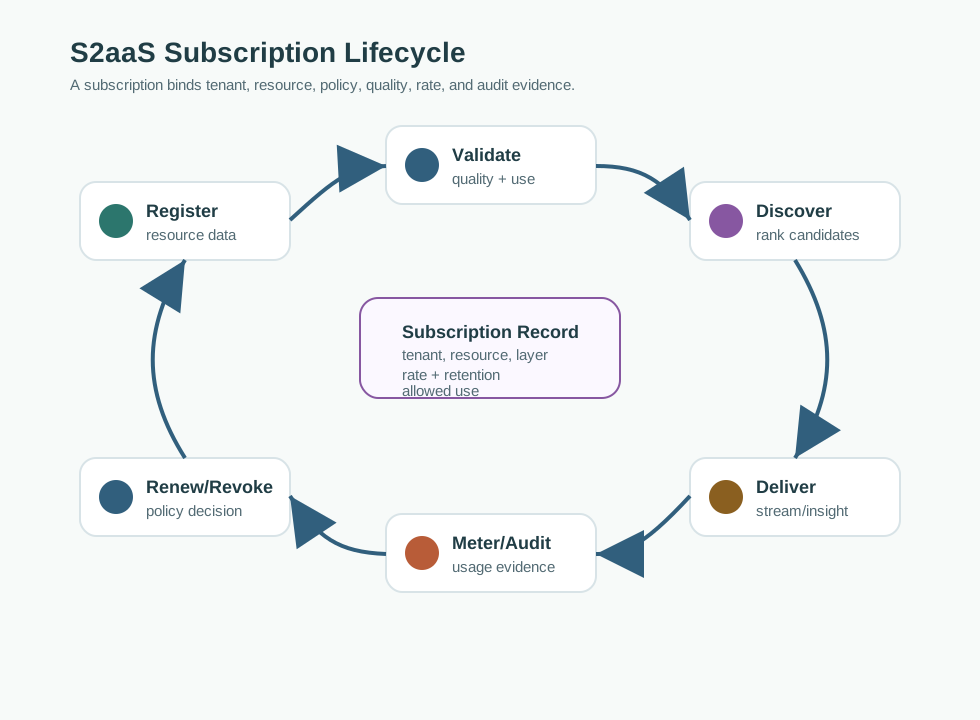
How It Works: S2aaS Transaction from Discovery to Data Delivery

Let’s trace a complete S2aaS transaction showing how a consumer discovers sensors, subscribes to data, and receives readings through the platform.

Step 1: Consumer Defines Requirements (Application Layer)

  • Transportation company needs real-time traffic data for routing optimization
  • Requirements: 100 sensors covering downtown area, 1-minute update frequency, 99% uptime SLA
  • Budget: $5,000/month for sensor access

Step 2: Platform Discovery Query (Marketplace Layer)

  • Consumer submits a discovery query with the target area, traffic-flow sensor type, one-minute update rate, uptime SLA, and monthly budget
  • Platform searches registry of 50,000 registered sensors
  • Geospatial filtering: 2,500 sensors within downtown bounding box
  • Type filtering: 150 sensors measuring traffic flow
  • QoS filtering: 120 sensors meeting 99% uptime guarantee
  • Budget ranking: Sorts by price (lowest first)

Step 3: Sensor Selection and Pricing (Matching Layer)

  • Platform returns 120 matching sensors with pricing: $30-80/sensor/month depending on location quality
  • Consumer selects 100 sensors: total cost $4,200/month (within budget)
  • Platform calculates revenue split: 75% to sensor owners ($3,150), 25% platform fee ($1,050)

Step 4: Contract Establishment (Service Layer)

  • Platform creates service agreement: data license, SLA terms, billing schedule
  • Each sensor owner receives notification: “New consumer subscribed to your sensor SM-4728, earning $35/month”
  • Consumer receives API credentials and endpoint URLs

Step 5: Data Flow Activation (Infrastructure Layer)

  • Platform configures data routing: sensor readings → platform ingestion → consumer API endpoint
  • Each sensor continues normal operation (still serves original owner plus new consumer)
  • Multi-tenancy isolation: Consumer A sees only their subscribed sensors, Consumer B sees different set

Step 6: Real-Time Data Delivery (Operational Layer)

  • Every minute, 100 sensors publish traffic flow readings
  • Platform ingests a normalized sensor event containing the sensor ID, timestamp, traffic count, and average speed
  • Platform applies quality checks: timestamp valid, values in expected range, sensor active
  • Platform forwards to consumer via MQTT topic: sensors/traffic/SM-4728
  • Consumer application receives stream and updates routing algorithms

Step 7: Billing and Usage Tracking (Financial Layer)

  • Platform meters usage: 100 sensors × 1,440 readings/day = 144,000 data points/day
  • Monthly invoice: $4,200 charged to consumer credit card
  • Platform distributes: $3,150 to 100 sensor owners ($31.50 each on average), $1,050 platform revenue
  • Sensor owners see passive income without any additional work

Key S2aaS Principles Demonstrated:

  1. Discovery efficiency: Consumer finds 100 sensors in seconds (vs. months to deploy own network)
  2. Pay-per-use model: Only pay for subscribed sensors, cancel anytime (no capital expense)
  3. Multi-tenancy: Same sensors serve original owner + new consumer simultaneously (2x utilization)
  4. Revenue sharing: Sensor owners monetize existing infrastructure (new revenue stream)
  5. Platform mediation: Handles discovery, billing, QoS enforcement (owners and consumers focus on their domains)

What Makes This S2aaS (vs Traditional):

  • No hardware deployment: Consumer gets data without installing 100 traffic sensors ($300K saved)
  • Instant activation: Service live in hours (vs. 6-12 months for traditional deployment)
  • Elastic scaling: Need 200 sensors next month? Subscribe to 100 more (no hardware lead time)
  • Risk transfer: Sensor maintenance, calibration, uptime are owner’s responsibility (not consumer’s)
Concept Check: S2aaS Service Layer Selection

Objective: Determine whether S2aaS or traditional deployment is more economical for a 3-year project.

Your Scenario: You need temperature and humidity data from 200 locations in an office park to optimize HVAC energy consumption. Project timeline: 3 years.

Option A: Traditional Deployment (Own Sensors)

Cost Category Calculation Amount
Sensor hardware 200 sensors x $150/sensor $30,000
Installation labor 200 x $50 install $10,000
Gateway hardware 4 gateways x $300 $1,200
Cellular connectivity 4 SIMs x $3/month x 36 months $432
Cloud storage/processing $100/month x 36 months $3,600
Calibration/maintenance 200 sensors x $20/year x 3 years $12,000
Total 3-Year Cost $57,232

Option B: S2aaS Subscription

Cost Category Calculation Amount
SaaS subscription 200 sensors x $8/month x 36 months $57,600
Total 3-Year Cost $57,600

Initial Analysis: Costs are nearly identical! But wait…

Hidden Factors to Consider:

  1. Time-to-Value: Traditional = 2-3 months deployment. S2aaS = 1 day activation. Energy savings start 3 months earlier with S2aaS → $9,000 additional savings (3 months x $3,000/month energy reduction).

  2. Sensor Failures: Traditional deployment: 15% annual failure rate. 200 sensors x 0.15 = 30 failures/year x 3 years = 90 failed sensors. Replacement cost: 90 x $150 = $13,500. S2aaS: Provider’s responsibility → $0 cost to you.

  3. Obsolescence Risk: After 3 years, you own 200 used sensors with no residual value. S2aaS: Cancel subscription, no stranded assets.

  4. Opportunity Cost: Traditional requires 1 engineer dedicating 20% time to sensor management (troubleshooting, firmware updates, data quality). 0.2 FTE x $100K salary x 3 years = $60,000. S2aaS: Provider handles operations → 0 FTE.

Revised TCO Analysis:

Cost Factor Traditional S2aaS Difference
Direct costs $57,232 $57,600 +$368
Delayed value $9,000 $0 -$9,000
Sensor failures $13,500 $0 -$13,500
Operational overhead $60,000 $0 -$60,000
True 3-Year TCO $139,732 $57,600 58% savings with S2aaS

Experiments to Try:

  1. Change timeline to 10 years: Traditional becomes more economical (amortize capital expense over longer period). Find the break-even point.

  2. What if you already own sensors? Recalculate Traditional TCO without hardware cost. When does S2aaS still win? (Answer: operational overhead and maintenance costs still favor S2aaS after year 4-5)

  3. Scale to 2,000 sensors: Traditional cost grows linearly. S2aaS may offer volume discounts. Calculate the inflection point.

  4. Add revenue-sharing scenario: What if you deploy sensors AND rent them out via S2aaS? Calculate when infrastructure investment pays for itself through multi-tenancy revenue.

Key Insight: S2aaS wins on total cost of ownership even when direct costs are comparable, due to operational savings, faster time-to-value, and risk transfer. The sharing economy model works for sensors just as it works for cloud computing.

64.6 Concept Relationships

Concept Relationship Connected Concept
S2aaS Applies Cloud Economics – rent capability instead of buying hardware
IaaS Layer Provides Raw Sensor Access – analogous to virtual machines in cloud computing
PaaS Layer Offers Managed Sensor Network – collection, storage, processing included
SaaS Layer Delivers Ready Analytics – insights and applications without infrastructure management
Multi-Tenancy Enables Cost Reduction – one sensor serving 10 consumers generates 10x revenue
Revenue Sharing Incentivizes Sensor Deployment – owners earn 70-85%, platform takes 15-30%
Discovery Mechanisms Critical For Marketplace Efficiency – geospatial, capability, QoS, budget-based search

Common Pitfalls

S2aaS is not simply “sensors connected to a cloud API.” It requires a virtualization layer that abstracts physical sensors into logical services, enabling multi-tenancy (multiple consumers sharing one sensor), tiered pricing, and data quality guarantees. Building without this abstraction layer makes multi-tenant monetization impossible without rewriting the platform.

Consumers need to trust the data they purchase. Publishing raw readings without quality scores (accuracy, calibration date, coverage, reliability metrics) leads to consumer churn when data quality varies unexpectedly. Always design the quality scoring pipeline (0–100 composite score) before opening the marketplace.

S2aaS involves sensor owners, data consumers, and platform providers with different incentives. Designing only for consumers (lower price, more data) alienates owners (need revenue, privacy control). Always model all three stakeholder value propositions before defining the business model.

S2aaS has distinct layers: sensing (physical sensors), virtualization (logical sensor abstraction), service (API + pricing + quality), and consumer (applications). Mixing business logic with sensing code, or putting virtualization in the consumer application, creates brittle architectures that break when sensor hardware changes.

64.7 Summary

64.7.1 Key Takeaways

This chapter established the foundational concepts of Sensing-as-a-Service (S2aaS), a paradigm that transforms how organizations access and use sensor data:

Concept Key Point Why It Matters
S2aaS Definition On-demand sensor data as a pay-per-use service Eliminates capital expense for sensor infrastructure
Service Layers IaaS (raw access), PaaS (managed platform), SaaS (ready analytics) Consumers choose their level of responsibility
Historical Evolution Dedicated (pre-2010) to Cloud-enabled to Marketplaces (2020+) Understanding trajectory helps predict future trends
Adoption Drivers Cost reduction, faster deployment, broader coverage 80-90% cost savings for consumers over dedicated deployments
Ecosystem Roles Owners monetize, platforms facilitate, consumers access Win-win-win model incentivizes all stakeholders
Business Model Revenue sharing (70-85% to owners, 15-30% platform) Sustainable economics require marketplace scale
Sensor Discovery Geospatial, capability, QoS, and budget-based search Efficient matching connects supply with demand

64.7.2 Concepts to Remember

  • S2aaS is to sensors what cloud computing is to servers: rent capability instead of buying hardware
  • Multi-tenancy enables the economic model: one sensor serving 10 customers generates 10x revenue versus single-purpose deployment
  • Discovery mechanisms are critical infrastructure: without effective search, the marketplace fails
  • Data quality varies: always verify accuracy, calibration, and uptime guarantees before depending on S2aaS data for critical applications
  • Vendor lock-in is a real risk: use abstraction layers and standard data formats (SenML, OGC SensorThings) to maintain portability

64.7.3 What You Can Now Do

After completing this chapter, you should be able to:

  1. Explain S2aaS to a non-technical stakeholder using the cloud computing analogy
  2. Recommend the appropriate service layer (IaaS/PaaS/SaaS) for a given use case
  3. Identify the three ecosystem roles and describe how value flows between them
  4. Calculate basic S2aaS economics (cost savings, ROI, break-even timeline)
  5. Design a sensor discovery query matching capabilities, location, quality, and budget constraints

64.8 What’s Next

If you want to… Read this
Understand S2aaS data ownership and privacy S2aaS Data Ownership
Explore S2aaS value creation and challenges S2aaS Value Creation and Challenges
Study S2aaS architecture patterns S2aaS Architecture Patterns
Explore real-world S2aaS platforms S2aaS Real-World Platforms
Review all S2aaS concepts S2aaS Review

64.9 See Also