51 M2M Overview & Fundamentals
51.1 Learning Objectives
By the end of this chapter, you will be able to:
- Explain M2M Communication: Articulate the core concepts and data flow in machine-to-machine systems
- Compare Communication Patterns: Distinguish between point-to-point, point-to-server, and publish-subscribe M2M architectures and select the appropriate pattern for a given use case
- Distinguish M2M from IoT: Articulate the evolution from M2M to comprehensive IoT architectures using the SIC test (Single-purpose, Isolated, Cost-constrained)
- Classify M2M Applications: Categorize M2M use cases across eight industry sectors with their scale, data rate, and latency characteristics
- Differentiate M2M Node Types: Categorize devices by capability level (low-end, mid-end, high-end) with cost and power implications
- Design M2M Solutions: Apply a systematic process (requirements, node selection, communication pattern, data volume calculation, ROI analysis) to design practical M2M systems
- Diagnose Common Pitfalls: Detect over-engineering, protocol translation gaps, and hidden cellular costs in M2M deployments
For Kids: Meet the Sensor Squad!
M2M communication is like having walkie-talkies that let machines talk to each other without needing a person to pass messages!
51.1.1 The Sensor Squad Adventure: The Vending Machine Mystery
One day, Sammy the Temperature Sensor was walking past the school cafeteria when he noticed something amazing. The vending machine was talking! Not out loud, of course, but with invisible radio waves.
“What are you saying?” asked Sammy, curious about all the beeping inside.
The vending machine, named Vinnie, explained: “I just told the warehouse that I’m running low on apple juice! Without anyone pressing a button, my sensors counted the drinks and sent a message. Tomorrow morning, the delivery truck will know exactly what to bring.”
Lila the Light Sensor was amazed. “So machines can order their own supplies?”
“That’s M2M - Machine-to-Machine communication!” said Vinnie proudly. “My friend at the gas station does the same thing. When the underground fuel tank gets low, it automatically tells the fuel company to send more. No human has to check or call anyone!”
Max the Motion Detector added, “That’s like how the ATM at the bank talks to the computer far away to check if you have enough money before giving you cash. The machines figure it out themselves!”
Bella the Button realized something important: “So M2M is when machines have their own conversations to get work done, and humans only find out when something needs attention!”
51.1.2 Key Words for Kids
| Word | What It Means |
|---|---|
| M2M (Machine-to-Machine) | When machines send messages directly to other machines without a person in the middle |
| Telemetry | Sending measurements from far away, like a thermometer reporting temperature to a computer |
| Gateway | A translator device that helps different machines understand each other |
| Autonomous | When something can work and make decisions all by itself |
51.1.3 Try This at Home!
The Silent Conversation Game: See how machines communicate without words!
- Find a TV remote control and a TV. When you press the remote, an invisible beam tells the TV what to do - that’s like M2M!
- If you have a digital thermostat at home, watch how the display shows the temperature. The sensor is constantly “talking” to the display without anyone asking.
- Notice your refrigerator - when it gets too warm inside, the motor turns on automatically. The temperature sensor inside is “telling” the motor what to do - M2M in action!
- Ask a grown-up: “Does our home have any devices that talk to the internet by themselves?” (Like a smart meter, doorbell camera, or pet feeder)
51.2 Prerequisites
Before diving into this chapter, you should be familiar with:
- Machine-to-Machine (M2M) Communication: Understanding the M2M overview chapter provides essential context for M2M architectures, platforms, and the evolution from M2M to IoT
- IoT Reference Models: Knowledge of layered IoT architectures helps position M2M systems within the broader ecosystem
- Networking Basics for IoT: Familiarity with network protocols, addressing, and communication patterns
Key Concepts
- Machine-to-Machine (M2M): Direct autonomous communication between devices without human intervention, characterized by the SIC test (Single-purpose, Isolated, Cost-constrained)
- SIC Test: The diagnostic framework distinguishing M2M from IoT — a device is M2M when it is single-purpose, isolated (no cross-domain analytics), and cost-constrained (battery/compute limited)
- Point-to-Point Communication: The simplest M2M pattern where two devices communicate directly via a dedicated link (serial, Bluetooth, Zigbee) — no intermediary broker required
- Point-to-Server Communication: Centralized M2M topology where all devices report to a single collection server — simplifies management but creates a single point of failure
- Publish-Subscribe: Decoupled M2M pattern using a message broker where publishers send to topics and subscribers receive — scales to millions of devices without server-side changes
- Global M2M Connection: Over 15 billion M2M connections worldwide by 2025 across fleet management (GNSS trackers), smart metering (AMI), and industrial automation (SCADA/DCS)
- M2M vs IoT: M2M predates IoT and focuses on device connectivity; IoT adds internet-scale connectivity, cloud analytics, and semantic interoperability across application domains
51.3 Minimum Viable Understanding (MVU)
In one sentence: M2M (Machine-to-Machine) communication enables autonomous device-to-device data exchange without human intervention, using point-to-point or gateway-mediated architectures across three device tiers (low-end sensors, mid-end controllers, high-end multimedia nodes).
Remember this rule: When evaluating whether a use case needs M2M or full IoT, apply the SIC test: Single-purpose (one specific function), Isolated (no cross-system data sharing needed), Cost-constrained (no cloud budget). If all three are true, M2M is likely sufficient. If any are false, consider IoT.
Key mental model: Think of M2M like a direct phone call between two machines – simple, private, purpose-built. IoT is like a social network – everyone connected, sharing data, and enabling new applications from combined information. M2M came first and still works perfectly when simplicity and reliability matter more than flexibility.
51.4 Getting Started (For Beginners)
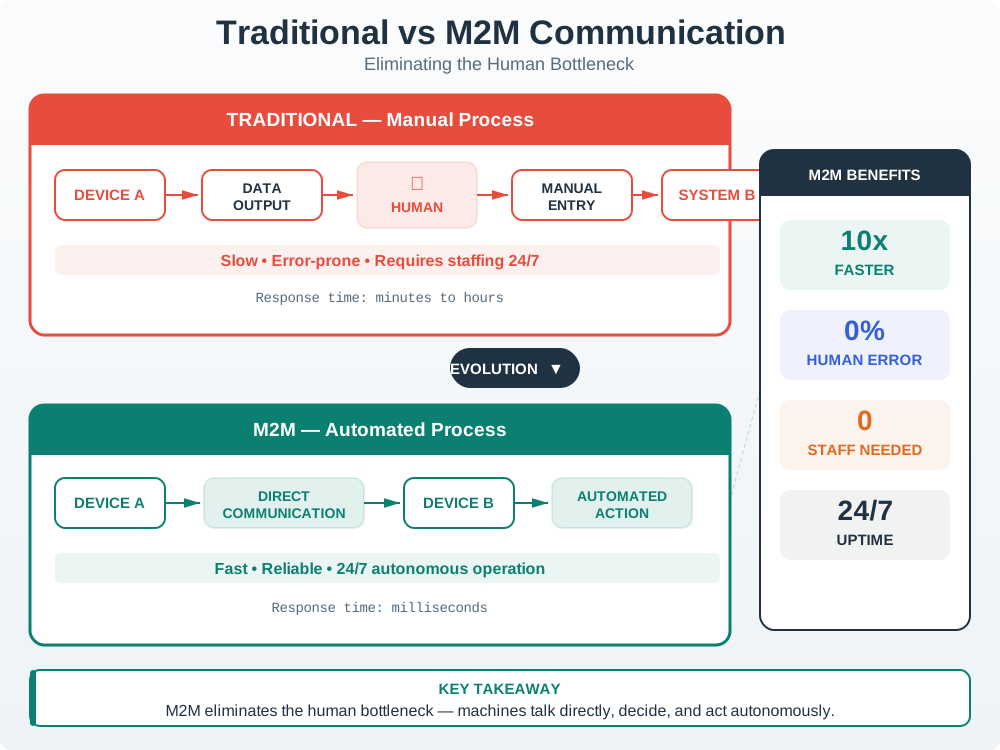
51.4.1 What is M2M? (Simple Explanation)
M2M = Machines talking to machines, without humans in the loop
Before IoT became a buzzword, engineers called this “M2M” or “machine-to-machine communication.”
51.4.2 Real-World M2M Examples
You encounter M2M systems every day:
| M2M System | What Talks | What Happens | Human Involvement |
|---|---|---|---|
| ATM Network | ATM <-> Bank servers | Dispenses cash, checks balance | None after you insert card |
| Fleet Tracking | Truck GPS <-> Dispatch center | Reports location every minute | None (automatic) |
| Vending Machines | Machine <-> Supplier | “I’m low on Coke, send more” | None until restocking |
| Utility Meters | Smart meter <-> Power company | Reports usage every 15 min | None (no meter reader!) |
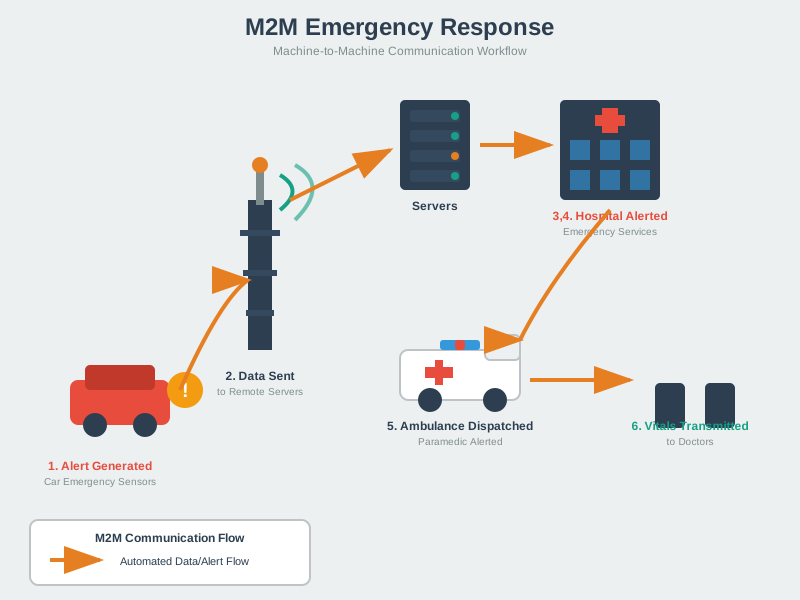
| Medical Monitors | Heart monitor <-> Hospital | Alerts doctors if abnormal | Only if alert triggered |
51.4.3 M2M Communication Patterns
M2M systems follow distinct data flow patterns depending on the application. Understanding these patterns helps you choose the right architecture for your use case.
When to use each pattern:
| Pattern | Best For | Example | Latency |
|---|---|---|---|
| Point-to-Point | Simple control loops, legacy systems | SCADA PLC to actuator | < 10ms |
| Point-to-Server | Centralized monitoring, fleet tracking | GPS trackers to dispatch | 1-30s |
| Publish-Subscribe | Multi-consumer data, scalable systems | Smart meters to utility platform | 1-60s |
51.5 M2M vs IoT: Evolution and Comparison
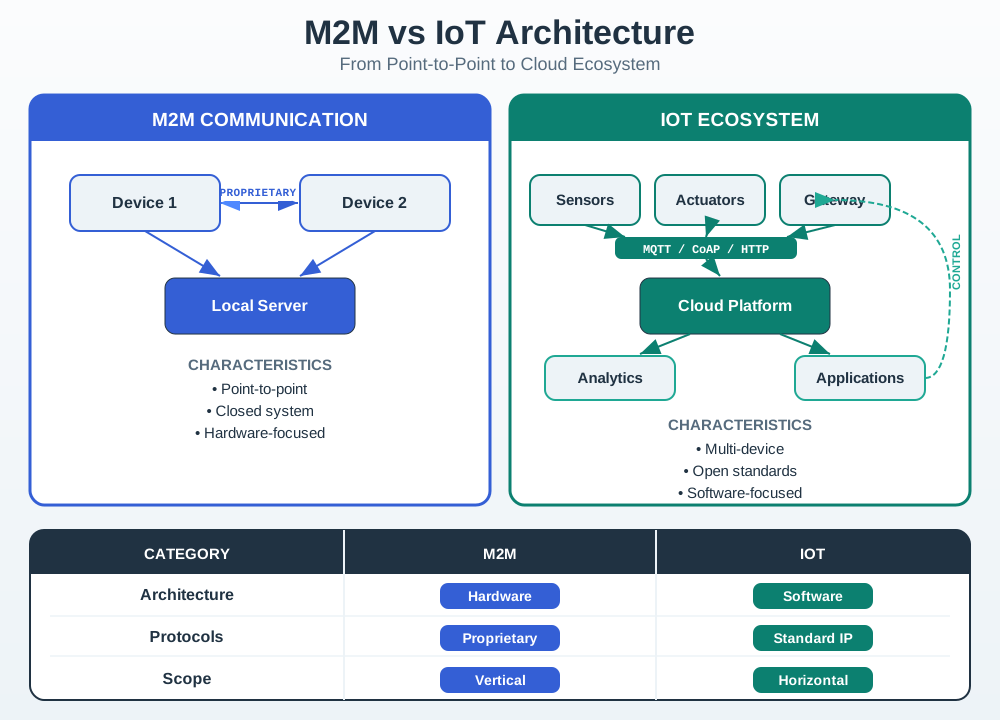
While M2M and IoT share similarities, they represent different evolutionary stages of connected devices.
51.5.1 Key Differences
| Characteristic | M2M | IoT |
|---|---|---|
| Focus | Machines | Sensors |
| Architecture | Hardware-based | Software-based |
| Application Scope | Vertical applications | Horizontal applications |
| Deployment | Deployed in a closed system | Connects to a larger network |
| Communication Pattern | Machines communicating with machines | Machines, humans, applications interconnected |
| Protocols | Uses non-IP protocol | Uses IP protocols |
| Cloud Dependency | Can use cloud, but not required | Uses the cloud |
| Network Type | Point-to-point communication | IP networks |
| Communication Direction | Often one-way communication | Bidirectional communication |
| Purpose | Monitor and control | Multiple applications; multilevel |
| Integration | Limited integration options | Unlimited via software/APIs |
| Data Structure | Structured data | Structured and unstructured data |
Summary Comparison:
| Aspect | M2M | IoT |
|---|---|---|
| Scope | Device-to-device | Device-to-cloud-to-device |
| Communication | Point-to-point or point-to-server | Many-to-many via internet |
| Protocols | Proprietary (often) | Standardized (MQTT, CoAP, HTTP) |
| Data | Limited processing | Big data analytics, AI/ML |
| Integration | Vertical silos | Horizontal platforms |
| Scalability | Hundreds to thousands | Millions to billions |
| Examples | SCADA, Industrial HMI | Smart cities, Consumer IoT |
Think of it this way: M2M is like two fax machines talking. IoT is like email – connected to everything, accessible from anywhere.
51.5.2 The M2M-to-IoT Evolution Timeline
Key Takeaway
In one sentence: M2M (Machine-to-Machine) communication enables autonomous device-to-device data exchange without human intervention, forming the foundation that evolved into modern IoT through standardization and cloud connectivity.
Remember this: M2M is the reliable, proven predecessor of IoT - when you need simple, direct device communication for specific purposes like fleet tracking or utility metering, M2M patterns often work better than over-engineered IoT solutions.
Tradeoff Decision Guide: M2M vs IoT Approaches
| Factor | M2M Approach | IoT Approach | When to Choose |
|---|---|---|---|
| Protocol Flexibility | Proprietary (vendor lock-in risk) | Standardized (MQTT, CoAP, HTTP) | IoT when multi-vendor interoperability needed |
| Integration Complexity | Simple (point-to-point) | Complex (cloud platform required) | M2M for single-purpose applications |
| Data Analytics | Limited (local processing) | Extensive (cloud AI/ML, big data) | IoT when insights from data are valuable |
| Deployment Cost | Lower (no cloud infrastructure) | Higher (cloud subscriptions, APIs) | M2M for cost-sensitive deployments |
| Scalability | Limited (100s-1000s devices) | Massive (millions of devices) | IoT when scale exceeds 10K devices |
| Time-to-Market | Faster (simpler stack) | Slower (more components) | M2M for MVP or proof-of-concept |
| Remote Access | Limited (VPN/dedicated lines) | Universal (apps, dashboards) | IoT when consumer or mobile access needed |
| Maintenance | On-site (firmware updates) | OTA updates via cloud | IoT when devices are geographically distributed |
Quick Decision Rule: Choose M2M for proven, single-purpose industrial applications (fleet tracking, utility metering, SCADA) where simplicity and reliability matter more than cloud features. Choose IoT when you need multi-application data sharing, consumer interfaces, or AI-driven analytics.
How It Works: M2M Communication in a Vending Machine
Let’s trace how a vending machine uses M2M to automatically manage inventory and maintenance, demonstrating the complete sense-decide-act cycle.
Step 1: Continuous Sensing (Device Layer)
- Inventory sensors count remaining items per slot (e.g., 12 Coke cans, 3 juice boxes)
- Temperature sensor monitors refrigeration (target: 2-4°C)
- Payment system tracks sales transactions with timestamps
- All sensors operate continuously without human supervision
Step 2: Local Decision Making (Edge Logic)
- Microcontroller checks inventory levels every hour
- Triggers “restock alert” when any item drops below threshold (< 10 units)
- Detects temperature anomaly if reading exceeds 6°C for 10+ minutes
- No cloud connectivity required for these decisions – purely local logic
Step 3: M2M Message Transmission (Communication Layer)
- Vending machine composes a compact status payload with the machine ID, location, active alerts, temperature, and latest sale timestamp
- Sends via cellular M2M SIM card to warehouse management server
- Uses lightweight protocol (MQTT or proprietary TCP) optimized for small messages
- Transmission occurs every 4 hours for status, immediately for critical alerts
Step 4: Central Server Processing (Application Layer)
- Warehouse server receives messages from 500 vending machines across the city
- Aggregates restock requests by geographic zone
- Generates optimized delivery route: “Truck 3: service machines VM-1234, VM-1267, VM-1290 (same building cluster)”
- No human involvement until route is ready for driver
Step 5: Automated Action (Workflow Layer)
- Server sends a restock confirmation back to the vending machine with the scheduled service time
- Next day, delivery driver receives pre-loaded manifest showing exactly which items each machine needs
- Driver restocks, presses “completed” button on handheld device
- System updates machine status: inventory reset, next check scheduled for 4 hours
Key M2M Principles Demonstrated:
- Autonomous sensing: Inventory/temperature sensors operate continuously without human input
- Local intelligence: Machine decides when to trigger alerts based on pre-programmed thresholds
- Automated communication: Data flows machine → server → warehouse system without manual data entry
- Closed-loop action: System triggers physical action (restock delivery) based on sensor data
- Minimal human role: Humans only refill machines; all monitoring/scheduling is automated
What Makes This M2M (vs IoT)?
- Single purpose: System only manages vending machine inventory/maintenance (no cross-domain data sharing)
- Isolated: Data stays within vendor’s private network (not exposed to public internet or third-party apps)
- Cost-constrained: Uses simple M2M SIM card ($2/month) instead of full IoT cloud platform ($20+/month)
If the vendor later decided to offer “mobile app ordering” (consumer-facing) or “predictive analytics from weather + sales data” (cross-domain), they would need to evolve from M2M to full IoT architecture.
51.6 M2M Applications
M2M enables automation across diverse sectors. The following diagram illustrates the breadth of M2M application domains and their key characteristics.
51.6.1 Domain Details and Scale
Each M2M application domain has distinct characteristics in terms of device density, data rates, and latency requirements:
| Domain | Typical Scale | Data Rate | Latency Requirement | Communication Pattern |
|---|---|---|---|---|
| Smart Grid | 100K-10M meters | 64-256 bytes/15 min | Minutes (billing), seconds (fault) | Point-to-Server via gateways |
| Healthcare | 10-1000 per hospital | 100 bytes-10KB/sec | Milliseconds (critical alarms) | Point-to-Point and Point-to-Server |
| Transport | 1K-100K vehicles | 100 bytes/30 sec | Seconds (tracking), ms (safety) | Point-to-Server via cellular |
| Supply Chain | 10K-1M assets | 64 bytes/event | Minutes | Point-to-Server via LPWAN |
| Environmental | 100-10K stations | 256 bytes/5-60 min | Minutes to hours | Point-to-Server via satellite/cellular |
| Building | 100-10K per building | 10-100 bytes/min | Seconds (HVAC), ms (fire) | Point-to-Point and local bus |
| Industrial | 100-10K per plant | 10 bytes-1KB/sec | Microseconds to ms (control loops) | Point-to-Point (fieldbus) |
| Agriculture | 100-10K per farm | 64 bytes/hour | Minutes to hours | Point-to-Server via LPWAN |
51.7 M2M Node Types
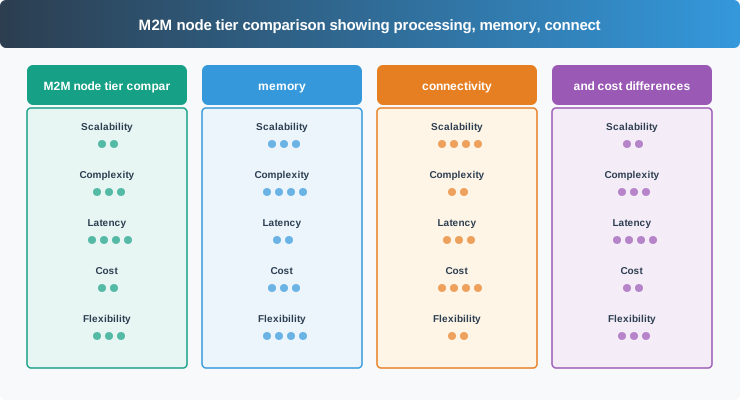
M2M devices span a spectrum of capabilities, categorized into three tiers. Choosing the right node type is a fundamental design decision that affects cost, power consumption, communication range, and system complexity.
51.7.1 Low-End Nodes
Characteristics:
- Minimal processing power (8-16 bit MCU)
- Very low power consumption (< 1mW idle)
- Limited memory (KB range)
- No IP stack (IEEE 802.15.4, BLE)
- Battery-powered, long lifetime (years)
Putting Numbers to It
Low-end nodes achieve multi-year battery life through aggressive duty cycling. Consider a soil moisture sensor with a 2000 mAh battery:
Active mode (transmitting once per hour): 50 mA for 2 seconds Sleep mode (remaining time): 10 μA
Average current over 1 hour cycle:
\[I_{avg} = \frac{50 \times 10^{-3} \times 2 + 10 \times 10^{-6} \times 3598}{3600} = \frac{0.1 + 0.036}{3600} = 37.8 \text{ μA}\]
Battery life:
\[\text{Life} = \frac{2000 \text{ mAh}}{0.0378 \text{ mA}} = 52{,}910 \text{ hours} = 6.04 \text{ years}\]
If we increased reporting to once every 10 minutes (6x more frequent), average current becomes 217 μA, reducing battery life to just 1.05 years. This shows why low-end nodes carefully balance sensing frequency against power constraints.
Interactive Battery Life Calculator
Adjust the parameters to explore the impact of reporting frequency on battery life:
Capabilities:
- Basic sensing and actuation
- Simple data aggregation
- Auto-configuration
- Sleep/wake cycles
Applications:
- Environmental monitoring
- Smart agriculture sensors
- Building sensor networks
51.7.2 Mid-End Nodes
Characteristics:
- Moderate processing (32-bit MCU, ARM Cortex-M)
- Medium power consumption
- More memory (MB range)
- IP stack support (IPv6, 6LoWPAN)
- Possible mobility
Capabilities:
- Complex sensing and actuation
- Local data processing
- Quality of Service (QoS) support
- Power and traffic control
- Localization
Applications:
- Home automation
- Asset management
- Industrial monitoring
51.7.3 High-End Nodes
Characteristics:
- High processing power (Application processors)
- Significant memory (GB range)
- Multimedia capabilities (video, audio)
- Multiple connectivity options
- Often mobile
Capabilities:
- Complex data processing
- Multimedia streaming
- Real-time communication
- User interfaces
- QoS guarantees
Applications:
- Smartphones as M2M devices
- Vehicular systems (V2X)
- Medical imaging devices
- Surveillance systems
51.8 Worked Example: M2M System Design for Fleet Fuel Monitoring
A trucking company with 300 diesel trucks wants to reduce fuel theft (estimated $180,000/year loss) and optimize fuel purchasing. Walk through the M2M design process:
51.8.1 Step 1: Define Requirements
| Requirement | Value | Rationale |
|---|---|---|
| Devices | 300 fuel level sensors | One per truck tank |
| Data rate | 128 bytes every 5 minutes | Fuel level + GPS + timestamp + truck ID |
| Latency tolerance | 5 minutes | Fuel theft detection needs near-real-time |
| Battery/Power | Vehicle-powered (12V/24V) | No battery constraint |
| Coverage | Nationwide routes | Rural and urban |
| Budget | < $50,000 hardware + < $2,000/month ongoing | Must show ROI within 12 months |
51.8.2 Step 2: Select Node Type
Since trucks have 12V/24V power and need cellular coverage nationwide:
- Node type: Mid-end (ARM Cortex-M with cellular modem)
- Connectivity: LTE-M (nationwide coverage, low power during idle, ~$3-6/SIM/month)
- Unit cost: ~$45 per sensor module (fuel level sensor + MCU + LTE-M modem + GPS)
- Total hardware: 300 x $45 = $13,500
- Monthly SIM cost: 300 x $5 = $1,500/month
51.8.3 Step 3: Select Communication Pattern
Point-to-Server via cellular: Each truck sensor sends directly to a central M2M server every 5 minutes. No gateway needed since each truck has its own cellular connection.
51.8.4 Step 4: Calculate Data Volume
Per truck: 128 bytes x 12/hour x 24 hours = 36,864 bytes/day = ~36 KB/day
Fleet total: 36 KB x 300 trucks = 10,800 KB/day = ~10.5 MB/day
Monthly: 10.5 MB x 30 = ~315 MB/month (well within LTE-M data plans)
51.8.5 Step 5: ROI Analysis
| Cost Category | Year 1 | Ongoing/Year |
|---|---|---|
| Hardware (300 sensors) | $13,500 | – |
| Installation (1 hour/truck x $50) | $15,000 | – |
| SIM subscriptions | $18,000 | $18,000 |
| Server/software | $5,000 | $3,000 |
| Total | $51,500 | $21,000 |
| Fuel theft savings | $180,000 | $180,000 |
| Net benefit Year 1 | $128,500 | – |
| ROI | 250% | – |
Design Insight
This example demonstrates a classic M2M use case: single-purpose monitoring (fuel levels), direct-to-server communication (no gateway complexity), proven cellular connectivity, and clear financial ROI. This does NOT need IoT – no cloud AI/ML, no cross-system integration, no consumer-facing apps. A straightforward M2M architecture delivers the required value at lower complexity and cost.
51.9 Common Pitfalls and Misconceptions
Understanding what goes wrong in M2M deployments is as valuable as understanding what goes right. These are the most frequent mistakes practitioners make.
Pitfall 1: Over-Engineering with IoT When M2M Suffices
The mistake: Deploying a full IoT stack (cloud platform, API gateway, microservices, dashboard) for a simple monitoring application that only needs point-to-server telemetry.
Real example: A parking garage installed smart sensors to detect occupied spaces. The vendor built a full AWS IoT platform with Lambda functions, DynamoDB, API Gateway, and a React dashboard. Total cost: $85,000/year. An M2M solution with sensors reporting to a local server via LoRa would have cost $8,000/year for the same functionality.
The fix: Apply the SIC test from the MVU section. If the application is Single-purpose, Isolated, and Cost-constrained, start with M2M. You can always migrate to IoT later if requirements change.
Pitfall 2: Ignoring Legacy Protocol Translation
The mistake: Assuming all M2M devices speak IP and can connect directly to modern platforms. Many industrial M2M devices use Modbus RTU (serial RS-485), HART, Profibus, or other non-IP protocols.
Real example: A water treatment plant tried to connect 150 Modbus flow meters directly to their new cloud platform. The project stalled for 6 months until they realized they needed protocol translation gateways. Each gateway translates Modbus RTU to MQTT, aggregating data from 15-20 sensors.
The fix: Always audit existing device protocols before designing your architecture. Budget for gateways (typically $200-500 each) that handle protocol translation, data aggregation, and local buffering.
Pitfall 3: Underestimating Cellular M2M Costs at Scale
The mistake: Calculating per-device SIM costs without accounting for activation fees, minimum commitments, overage charges, roaming, and SIM management overhead.
Naive calculation: 10,000 devices x $3/SIM/month = $30,000/month
Putting Numbers to It
Gateway aggregation dramatically reduces cellular costs. Compare two architectures for 10,000 sensors:
Option A: Direct Cellular (each sensor has a SIM):
\[\text{Monthly Cost}_A = 10{,}000 \times \$3 = \$30{,}000/\text{month}\]
Option B: Gateway Aggregation (100 sensors per gateway, 100 gateways with cellular):
\[\text{Gateway Cost} = 100 \times \$200 = \$20{,}000 \text{ (one-time)}\] \[\text{Monthly SIM Cost}_B = 100 \times \$5 = \$500/\text{month}\]
5-year total cost comparison:
\[\text{TCO}_A = \$30{,}000 \times 60 = \$1{,}800{,}000\] \[\text{TCO}_B = \$20{,}000 + (\$500 \times 60) = \$50{,}000\]
Gateway approach saves $1.75M over 5 years (97% reduction). Even accounting for gateway maintenance ($5K/year), savings exceed $1.72M.
Actual costs with hidden fees:
| Cost Element | Monthly | Annual |
|---|---|---|
| SIM subscriptions (10,000 x $3) | $30,000 | $360,000 |
| Platform management fee | $2,000 | $24,000 |
| SIM activation fees (Year 1) | – | $20,000 |
| Overage charges (~5% of devices) | $1,500 | $18,000 |
| SIM replacements (~2%/year) | $200 | $2,400 |
| Total | $33,700 | $424,400 |
The fix: Get detailed pricing including ALL fees before committing. Consider LPWAN (LoRa, Sigfox) for low-data-rate applications – costs can be 5-10x lower than cellular at scale.
51.10 In Plain English: M2M Communication
Worked Example: Comparing M2M vs IoT Cost for 500-Device Fleet Tracking Deployment
Scenario: A logistics company needs to track 500 delivery trucks across a metropolitan area. Requirements: GPS location every 5 minutes, geofencing alerts, monthly mileage reports. Budget: $50,000 initial + $10,000/year operational.
Option A: Pure M2M Approach
Architecture:
- 500 cellular M2M trackers (GPS + 2G/3G modem)
- Simple proprietary protocol (binary, 20 bytes per message)
- Direct cellular connection to company’s server (no cloud platform)
- On-premise server running custom tracking software
Hardware Costs:
| Component | Unit Cost | Quantity | Total |
|---|---|---|---|
| M2M GPS tracker | $60 | 500 | $30,000 |
| Installation (per truck) | $20 | 500 | $10,000 |
| On-premise server | $8,000 | 1 | $8,000 |
| Total hardware | $48,000 |
Annual Operational Costs:
| Component | Unit Cost | Quantity | Annual Total |
|---|---|---|---|
| Cellular data (2 MB/month) | $2/device/month | 500 | $12,000 |
| Server maintenance | $100/month | 12 months | $1,200 |
| Software support | $0 (in-house) | N/A | $0 |
| Total annual | $13,200 |
Data Volume Calculation:
- 500 trucks x 12 reports/hour x 24 hours = 144,000 messages/day
- Binary message size: 20 bytes (tracker ID + GPS coords + timestamp)
- Daily data: 144,000 x 20 bytes = 2.88 MB/day = 86 MB/month
- Per-device data: 86 MB / 500 = 0.17 MB/device/month (rounds to 2 MB plan)
5-Year Total Cost of Ownership:
- Initial: $48,000
- Operational: $13,200/year x 5 years = $66,000
- 5-Year TCO: $114,000 ($228 per device over 5 years)
Option B: Modern IoT Platform Approach
Architecture:
- 500 IoT trackers (GPS + 4G LTE-M modem)
- MQTT protocol with JSON payloads (150 bytes per message)
- Cloud IoT platform (AWS IoT Core or Azure IoT Hub)
- Cloud-based dashboards, analytics, geofencing
Hardware Costs:
| Component | Unit Cost | Quantity | Total |
|---|---|---|---|
| IoT GPS tracker (LTE-M) | $95 | 500 | $47,500 |
| Installation (per truck) | $20 | 500 | $10,000 |
| No server needed | $0 | 0 | $0 |
| Total hardware | $57,500 |
Annual Operational Costs:
| Component | Unit Cost | Quantity | Annual Total |
|---|---|---|---|
| Cellular data (10 MB/month) | $3.50/device/month | 500 | $21,000 |
| Cloud IoT platform | $0.50/device/month | 500 | $3,000 |
| Cloud dashboard/analytics | $200/month | 12 months | $2,400 |
| Total annual | $26,400 |
Data Volume Calculation:
- 500 trucks x 12 reports/hour x 24 hours = 144,000 messages/day
- JSON message size: 150 bytes (includes metadata, readable format)
- MQTT overhead: +30 bytes (topic, headers)
- TLS overhead: +80 bytes (encryption)
- Total per message: 260 bytes (vs 20 bytes M2M)
- Daily data: 144,000 x 260 bytes = 37.4 MB/day = 1,122 MB/month = 1.1 GB/month
- Per-device data: 1.1 GB / 500 = 2.2 MB/device/month (rounds to 10 MB plan)
5-Year Total Cost of Ownership:
- Initial: $57,500
- Operational: $26,400/year x 5 years = $132,000
- 5-Year TCO: $189,500 ($379 per device over 5 years)
Cost Comparison:
| Metric | M2M Approach | IoT Approach | Difference |
|---|---|---|---|
| Initial investment | $48,000 | $57,500 | IoT +$9,500 (20%) |
| Annual operational | $13,200 | $26,400 | IoT +$13,200 (100%) |
| 5-year TCO | $114,000 | $189,500 | IoT +$75,500 (66%) |
| Cost per device (5-year) | $228 | $379 | IoT +$151 (66%) |
Decision Analysis:
M2M Approach Wins if Company Values:
- Lower TCO: Saves $75,500 over 5 years (66% savings)
- Data ownership: On-premise server, no cloud vendor dependency
- Bandwidth efficiency: Binary protocol uses 13x less data (86 MB vs 1.1 GB monthly)
- Network resilience: Can use legacy 2G/3G networks (wider coverage in rural areas)
IoT Approach Wins if Company Values:
- Rich analytics: Built-in ML models for route optimization, predictive maintenance
- Faster deployment: Cloud dashboards ready out-of-box (M2M requires custom development)
- Scalability: Adding 500 more trucks is instant (no server capacity planning)
- Mobile apps: IoT platforms provide iOS/Android apps (M2M requires custom development)
- API ecosystem: Integrate with third-party services (weather, traffic, ERP systems)
Verdict for This Scenario:
Initial budget: $50,000 initial + $10,000/year operational - M2M: $48,000 initial + $13,200/year = Exceeds budget by $3,200/year - IoT: $57,500 initial + $26,400/year = Exceeds budget by $16,400/year
Neither approach fits budget as-is. Hybrid solution:
Hybrid Approach (Recommended):
- Use M2M trackers ($60 each) for hardware cost savings
- Connect to cloud IoT platform instead of on-premise server
- Reduces operational cost by eliminating server maintenance
- Gains cloud analytics without paying for expensive IoT hardware
Hybrid Costs:
- Initial: $48,000 (M2M hardware + installation)
- Annual: $12,000 (cellular) + $3,000 (cloud platform) + $2,400 (dashboards) = $17,400/year
Still over budget. Final optimization:
- Reduce reporting frequency: 5 minutes → 10 minutes (halves data/cellular cost)
- Annual: $6,000 (cellular) + $3,000 (cloud) + $2,400 (dashboards) = $11,400/year
- Fits budget: $48,000 initial + $11,400/year operational ✅
Key Lessons:
- IoT platform cost scales linearly with device count — 500 devices x $0.50/month = $3,000/year adds up
- JSON overhead is 13x larger than binary — 150 bytes vs 20 bytes impacts cellular costs
- Hybrid approaches optimize cost — M2M hardware + cloud platform = best of both
- Reporting frequency is the biggest cost lever — halving frequency halves cellular costs
- Budget constraints favor M2M — when TCO matters more than features, M2M wins
Decision Framework: M2M vs IoT Selection Matrix
Use this framework to decide between pure M2M, pure IoT, or hybrid approaches:
| Factor | Pure M2M | Hybrid (M2M HW + Cloud) | Pure IoT | Scoring Weight |
|---|---|---|---|---|
| Device count | 100-10,000 | 100-100,000+ | 10-1,000,000+ | High |
| Budget per device (5-year) | $50-200 | $100-300 | $200-500+ | Critical |
| Data rate | <1 KB/min | <10 KB/min | 1 KB/sec+ | Medium |
| Analytics requirements | Basic (dashboards only) | Moderate (trends, alerts) | Advanced (ML, predictions) | High |
| Third-party integrations | None | API-based (limited) | Extensive ecosystem | Medium |
| Network coverage | 2G/3G sufficient | 3G/4G preferred | 4G/5G required | Low |
| Deployment timeline | 6-12 months | 3-6 months | 1-3 months | Medium |
| Vendor dependency risk | Low (self-hosted) | Medium (cloud platform) | High (full stack cloud) | Critical (for some) |
Scoring System:
Pure M2M (Traditional) Scores High if:
- Budget per device < $200 over 5 years (10 points)
- Device count 100-10,000 (8 points)
- Data rate < 1 KB/min (7 points)
- Analytics needs are basic dashboards only (6 points)
- No third-party integrations needed (5 points)
- Vendor independence is critical (10 points)
- Total score: 46+ points → Choose M2M
Pure IoT (Cloud-Native) Scores High if:
- Budget per device > $300 over 5 years (2 points)
- Device count > 10,000 (10 points)
- Data rate > 1 KB/sec (8 points)
- Analytics needs include ML/predictions (10 points)
- Need extensive third-party integrations (9 points)
- Fast deployment timeline < 3 months (8 points)
- Total score: 47+ points → Choose IoT
Hybrid (M2M Hardware + Cloud Platform) Scores High if:
- Budget per device $200-300 over 5 years (7 points)
- Device count 1,000-100,000 (9 points)
- Data rate 1-10 KB/min (8 points)
- Analytics needs are moderate (trends, alerts) (7 points)
- Need some API integrations (6 points)
- Deployment timeline 3-6 months (6 points)
- Total score: 40-46 points → Choose Hybrid
Real-World Decision Examples:
| Use Case | Device Count | Budget/Device | Data Rate | Analytics | Decision | Justification |
|---|---|---|---|---|---|---|
| Water Utility Smart Meters | 50,000 | $150 (5-yr) | 100 bytes/hour | Basic (billing) | Pure M2M | Low budget, basic analytics, high device count, proven ROI |
| Fleet Tracking Startup | 500 | $400 (5-yr) | 200 bytes/5 min | Advanced (route ML) | Pure IoT | Small scale, VC-funded, need fast growth, analytics critical |
| Smart Agriculture | 5,000 | $250 (5-yr) | 500 bytes/15 min | Moderate (alerts) | Hybrid | Mid-scale, limited budget, need some cloud features |
| Industrial SCADA | 200 | $1,000 (5-yr) | 10 KB/sec | Advanced (real-time) | Pure IoT (or on-prem) | Low device count, high-value, real-time requirements |
| Asset Tracking (Construction) | 10,000 | $180 (5-yr) | 50 bytes/10 min | Basic (location map) | Pure M2M | Budget-constrained, simple tracking, no analytics needed |
| Connected Healthcare | 50,000 | $350 (5-yr) | 1 KB/min | Advanced (patient insights) | Pure IoT | Healthcare outcomes justify cost, compliance needs cloud security |
Quick Decision Rules:
Choose Pure M2M if:
- SIC test passes (Single-purpose, Isolated, Cost-constrained)
- Budget per device < $200 over 5 years
- Data rate < 1 KB/minute
- No need for ML/analytics beyond basic dashboards
- Vendor lock-in is unacceptable
- Proven use case (smart metering, simple tracking)
Choose Pure IoT if:
- Budget allows $300-500+ per device over 5 years
- Need rapid deployment (<3 months)
- Analytics and ML are core value proposition
- Extensive third-party integrations required
- Device count > 10,000 (cloud scales effortlessly)
- Startup/growth mode (need to move fast)
Choose Hybrid if:
- Budget is $200-300 per device over 5 years
- Want cloud benefits without expensive IoT hardware
- Analytics needs are moderate (not basic, not advanced)
- Existing M2M hardware can be repurposed
- Want optionality to migrate to full IoT later
- Mid-scale deployment (1,000-100,000 devices)
Common Mistakes:
- IoT everywhere: Choosing IoT for smart meters because “cloud is modern” — wastes $150/device over 5 years
- M2M stubbornness: Choosing M2M for a startup that needs to scale fast — 12-month development time kills business
- Ignoring hybrid: Assuming binary choice (M2M or IoT) — hybrid optimizes cost AND features
- Forgetting cellular: Choosing 10 MB/month cellular plan when 2 MB suffices — 5x overspend
- Over-engineering analytics: Deploying full ML platform for simple “show me on a map” use case
Common Mistake: Underestimating Cellular Data Costs at Scale
The Mistake: A smart city project deployed 10,000 parking sensors to detect space occupancy. Each sensor was specified with a “low-cost” $2/month cellular plan (2 MB/month data allowance). The engineer calculated: “2 MB is plenty — we only send 50-byte messages every 2 minutes.” The project launched, and the first monthly cellular bill was $47,000 instead of the expected $20,000.
What Went Wrong:
Specification Assumptions (Incorrect):
- Message size: 50 bytes (sensor ID + occupancy state + timestamp)
- Frequency: Every 2 minutes = 720 messages/day
- Daily data: 720 x 50 bytes = 36 KB/day = 1.08 MB/month
- Expected cost: 10,000 sensors x $2/month = $20,000/month
Actual Deployment Reality:
Hidden Overhead #1: Protocol Overhead
| Layer | Overhead | Details |
|---|---|---|
| Application payload | 50 bytes | Sensor data (as specified) |
| JSON encoding | +45 bytes | {"sensor_id":"PS-0042","occupied":true,"timestamp":1707408000} |
| MQTT protocol | +30 bytes | Topic name, QoS flags, packet headers |
| TLS 1.3 encryption | +80 bytes | Record header, MAC, padding |
| TCP/IP headers | +40 bytes | IP header (20 bytes) + TCP header (20 bytes) |
| Cellular network overhead | +20% | Re-transmissions, keep-alive packets |
| Actual per-message size | ~300 bytes | 6x larger than “payload only” estimate |
Hidden Overhead #2: Device Behavior
| Overhead Source | Data Volume | Cause |
|---|---|---|
| TLS handshake | 4 KB per connection | Sensor reconnects every 6 hours (battery saving mode) |
| MQTT keep-alive | 2 bytes per 60 seconds | Cellular NAT timeout prevention |
| Retransmissions | +15% of data | 15% packet loss in underground parking garages |
| Firmware updates | 500 KB per device | OTA update pushed to 10,000 sensors in month 1 |
| Diagnostic telemetry | 200 bytes every 30 min | Battery level, signal strength, GPS location |
Actual Data Calculation:
| Component | Per Device | 10,000 Devices | Monthly Total |
|---|---|---|---|
| Sensor messages | 720/day x 300 bytes = 216 KB/day = 6.48 MB/month | 64.8 GB | |
| TLS handshakes | 4 KB x 120 reconnects = 480 KB/month | 4.8 GB | |
| MQTT keep-alive | 2 bytes x 1,440/day x 30 days = 86 KB/month | 860 MB | |
| Retransmissions | +15% of above = 1.05 MB/month | 10.5 GB | |
| Firmware update (one-time) | 500 KB | 5,000 MB = 5 GB | |
| Diagnostic telemetry | 200 bytes x 48/day x 30 = 288 KB/month | 2.88 GB | |
| Total per device | 8.4 MB/month (vs 1.08 MB estimated) | 88.7 GB/month |
Cost Reality:
- 10,000 sensors x 8.4 MB/month = 88.7 GB/month total
- Cellular carrier charges: $2/month for 2 MB, then $5/month for 10 MB
- 10,000 sensors all upgraded to $5/month plan
- Actual cost: 10,000 x $5/month = $50,000/month (vs $20,000 estimated)
- Annual overage: ($50,000 - $20,000) x 12 months = $360,000/year over budget
Cascading Failures:
- Budget crisis: Smart city project allocated $240,000/year for cellular, actual cost $600,000/year — project threatened with cancellation
- Emergency cost cutting: Disabled diagnostic telemetry to save bandwidth — lost visibility into failing sensors
- Firmware update disaster: One-time 500 KB OTA update consumed 5 GB across fleet, costing extra $12,000 that month
- Carrier throttling: After exceeding data caps, carrier throttled sensors to 2G speeds (128 kbps) — TLS handshakes timed out, 30% of sensors offline
The Fix — Multi-Layer Optimization:
Optimization 1: Binary Protocol (Not JSON)
// Before: JSON (95 bytes + MQTT + TLS = 205 bytes)
{"sensor_id":"PS-0042","occupied":true,"timestamp":1707408000}

// After: Binary (12 bytes + MQTT + TLS = 122 bytes)
// Format: [2-byte sensor_id][1-byte occupied][4-byte timestamp][5-byte reserved]
byte payload[12] = {
    0x00, 0x2A,              // Sensor ID 42 (2 bytes)
    0x01,                    // Occupied = true (1 byte)
    0x65, 0xC8, 0x22, 0x00,  // Unix timestamp (4 bytes)
    0x00, 0x00, 0x00, 0x00, 0x00  // Reserved (5 bytes)
};
// Savings: 95 bytes → 12 bytes (87% reduction)
Optimization 2: Connection Persistence
// Before: Reconnect every 6 hours (4 KB TLS handshake x 4 = 16 KB/day)
// After: Persistent connection with 30-second keep-alive (2 bytes x 2,880 = 5.7 KB/day)
// Savings: 16 KB → 5.7 KB/day (64% reduction)

void setup() {
    mqttClient.setKeepAlive(30);  // 30-second heartbeat
    mqttClient.setAutoReconnect(true);  // Reconnect on failure only
}
Optimization 3: Event-Driven Reporting (Not Periodic)
// Before: Report every 2 minutes (720 messages/day)
// After: Report only when state changes (car arrives or leaves)
//        + hourly heartbeat if no change (24 messages/day)

void loop() {
    bool current_state = readOccupancySensor();

    if (current_state != previous_state) {
        // State changed - report immediately
        publishMessage(current_state);
        previous_state = current_state;
        last_report_time = millis();
    } else if (millis() - last_report_time > 3600000) {
        // No change for 1 hour - send heartbeat
        publishMessage(current_state);
        last_report_time = millis();
    }
}
// Typical parking: 10 state changes/day + 24 heartbeats = 34 messages/day (95% reduction)
Optimization 4: Firmware Update via Wi-Fi (When Available)
// Use parking garage Wi-Fi for firmware updates (free)
// Only use cellular for sensor messages
if (WiFi.available()) {
    checkFirmwareUpdate();  // 500 KB over Wi-Fi (free)
} else {
    // Skip OTA updates over cellular
}
// Savings: 500 KB/device = 5 GB fleet-wide = $12,000/month
Metrics After Optimization:
| Metric | Before | After | Improvement |
|---|---|---|---|
| Message size | 300 bytes (JSON + overhead) | 122 bytes (binary + overhead) | 59% reduction |
| Messages per day | 720 (every 2 min) | 34 (event-driven) | 95% reduction |
| Daily data per device | 216 KB | 4.1 KB | 98% reduction |
| Monthly data per device | 8.4 MB | 0.15 MB | 98.2% reduction |
| Monthly cellular cost | $50,000 (10 MB plan) | $20,000 (2 MB plan) | 60% savings |
| Annual cost | $600,000 | $240,000 | $360,000 saved |
Cost Analysis:
Cost of mistake:
- Annual overage: $360,000/year
- Emergency firmware fix: 200 hours @ $150/hour = $30,000
- Reputation damage: Smart city project labeled “failure” in local media (unmeasurable)
- Total: $390,000 (year 1)
Cost of fix (if done initially):
- Binary protocol implementation: 40 hours @ $150/hour = $6,000
- Event-driven logic: 24 hours @ $150/hour = $3,600
- Connection persistence: 16 hours @ $150/hour = $2,400
- Total: $12,000 (vs $390,000 cost of mistake) = 3,250% ROI
Key Lessons:
- Never trust “payload only” data estimates — protocol overhead is 3-6x payload size
- TLS handshakes are expensive — 4 KB per connection, minimize reconnections
- Event-driven beats periodic — 95% bandwidth reduction for low-activity sensors
- Binary beats JSON — 87% reduction in payload size (JSON is human-readable, not bandwidth-optimal)
- Cellular overage is non-linear — exceeding 2 MB cap jumps to $5/month (2.5x cost increase)
- OTA updates over cellular = budget killer — 500 KB x 10,000 devices = 5 GB = $12K one-time hit
- Always prototype at scale — 10-sensor pilot doesn’t reveal fleet-wide cellular costs
Try It Yourself: Calculate M2M vs IoT Deployment Costs
Objective: Compare total cost of ownership (TCO) for an M2M approach versus full IoT platform for a simple monitoring use case.
Scenario: You are deploying 200 industrial sensors to monitor temperature, humidity, and vibration in a warehouse. Requirements: - Data reporting every 15 minutes - Simple dashboard for operators - SMS alerts when thresholds are exceeded - 5-year deployment lifespan
Your Task: Calculate 5-year TCO for both approaches and determine break-even point.
M2M Approach Costs:
| Item | Unit Cost | Quantity | Total |
|---|---|---|---|
| Low-end sensor nodes (BLE) | $15 | 200 | $3,000 |
| Gateways (1 per 50 sensors) | $200 | 4 | $800 |
| Cellular M2M SIMs (per gateway) | $2/month | 4 x 60 months | $480 |
| On-premise server (one-time) | $2,000 | 1 | $2,000 |
| Custom software development | $10,000 | 1 | $10,000 |
| 5-Year M2M Total | $16,280 |
IoT Platform Approach Costs:
| Item | Unit Cost | Quantity | Total |
|---|---|---|---|
| Wi-Fi-enabled sensor nodes | $45 | 200 | $9,000 |
| IoT cloud platform (per device/month) | $0.50/month | 200 x 60 months | $6,000 |
| Dashboard template (SaaS) | $50/month | 60 months | $3,000 |
| No custom software needed | $0 | - | $0 |
| 5-Year IoT Total | $18,000 |
Analysis Questions:
Which approach has lower 5-year TCO? M2M saves $1,720 (9.5%) over 5 years
What is the break-even point? Calculate when cumulative costs cross:
- M2M: $16,000 upfront, $8/month operational (cellular)
- IoT: $9,000 upfront, $158/month operational (cloud + SaaS)
- Break-even: Solve
16000 + 8x = 9000 + 158x→x = 46.7 months(3.9 years) - M2M is more expensive for first 3.9 years, then becomes cheaper
What if deployment scales to 1,000 sensors?
- M2M: $16,280 + ($15 x 800 sensors) + ($800 for 16 more gateways) + ($384 for 16 more SIMs) = $29,464
- IoT: $18,000 + ($45 x 800) + ($24,000 for 800 more device-months) = $78,000
- M2M advantage grows at scale: 62% savings
What if requirement changes to “mobile app for field technicians”?
- M2M: Must rebuild custom system to add mobile APIs = $15,000+ additional
- IoT: Platform already provides mobile SDK = $0 additional (just build UI)
- IoT flexibility advantage offsets cost at this point
Key Insights:
- M2M has higher upfront cost (custom software) but lower operational cost (cheaper connectivity)
- IoT has lower upfront cost (no custom dev) but scales poorly (per-device platform fees)
- Sweet spot for M2M: 500+ devices, 3+ year lifespan, requirements won’t change
- Sweet spot for IoT: < 500 devices, evolving requirements, need consumer features
Try This: Open a spreadsheet and model your own scenario with different device counts, timeframes, and cloud platform pricing. Find the inflection point where M2M becomes more economical than IoT.
51.11 Concept Relationships
| Concept | Relationship | Connected Concept |
|---|---|---|
| M2M Communication | Foundation For | IoT – M2M patterns evolved into IoT through standardization and cloud connectivity |
| Point-to-Server Pattern | Requires | Gateway – aggregates multiple devices and translates protocols before cloud uplink |
| Low-End Nodes | Enable | Battery Operation – years of battery life from low-power 8-bit MCU and duty cycling |
| Protocol Translation | Bridges | Legacy and Modern – Modbus/BACnet to MQTT/HTTP for brownfield integration |
| SIC Test | Determines | M2M vs IoT Decision – Single-purpose, Isolated, Cost-constrained criteria guide architecture choice |
| Gateway Aggregation | Reduces | Cellular Costs – one SIM per gateway (50 devices) vs one SIM per device (50x savings) |
| Publish-Subscribe | Decouples | Producers and Consumers – devices publish without knowing who subscribes (scalability benefit) |
51.12 Summary
This chapter introduced Machine-to-Machine (M2M) communication fundamentals:
- M2M Definition: Autonomous device-to-device data exchange without human intervention, predating and forming the foundation for modern IoT
- Communication Patterns: Three core patterns – point-to-point (direct device links), point-to-server (centralized collection via gateways), and publish-subscribe (scalable multi-consumer distribution)
- M2M vs IoT Evolution: M2M focuses on single-purpose, proprietary, point-to-point communication; IoT extends to multi-purpose, standardized, cloud-connected platforms. Use the SIC test (Single-purpose, Isolated, Cost-constrained) to decide which approach fits
- Application Domains: Eight major sectors (smart grid, healthcare, transport, supply chain, environment, buildings, industrial, agriculture), each with distinct scale, data rate, and latency characteristics
- Node Categories: Low-end (8-16 bit MCU, KB memory, years battery, <$5), mid-end (32-bit ARM, MB memory, IPv6, $10-50), high-end (application processor, GB memory, multimedia, $50-500+)
- Gateway Role: Protocol translation (e.g., Modbus RTU to MQTT) enabling legacy device integration – critical for brownfield deployments
- Common Pitfalls: Over-engineering with IoT when M2M suffices, ignoring protocol translation needs, and underestimating cellular costs at scale
51.12.1 Key Formulas and Rules of Thumb
| Metric | Formula / Rule |
|---|---|
| Daily data volume | message_size x messages_per_hour x 24 |
| Fleet monthly data | daily_per_device x num_devices x 30 |
| Gateway sizing | 1 gateway per 100-500 low-end devices (depends on range and data rate) |
| SIC test | If Single-purpose AND Isolated AND Cost-constrained => M2M; otherwise => IoT |
| Battery life estimate | battery_capacity_mAh / (active_current x duty_cycle + sleep_current x (1 - duty_cycle)) |
| Break-even ROI | total_deployment_cost / annual_savings (aim for < 18 months) |
Related Chapters
Continue Learning:
- M2M Architectures and Standards - Platform architecture and ETSI requirements
- M2M Design Patterns - Best practices and common mistakes
- M2M Case Studies - Industry implementations
- M2M Communication Lab - Hands-on ESP32 exercises
Foundational Context:
- IoT Reference Models - M2M in IoT stack
- MQTT - M2M messaging protocol
- CoAP - Constrained M2M protocol
51.13 Knowledge Check
51.14 What’s Next
| If you want to… | Read this |
|---|---|
| Study M2M architectures and standards | M2M Architectures and Standards |
| Understand M2M vs IoT evolution | M2M vs IoT Evolution |
| Explore M2M design patterns | M2M Design Patterns |
| Study M2M implementations in depth | M2M Implementations |
| Review all M2M concepts | M2M Communication Review |
51.15 See Also
- M2M Implementations – Production patterns for smart metering, protocol translation, and service orchestration
- Gateway Architectures – Deep dive into protocol translation, aggregation, and store-and-forward patterns
- IoT Reference Architectures – Broader architectural frameworks showing how M2M fits in modern IoT systems
- MQTT Protocol – Lightweight publish-subscribe protocol commonly used in M2M deployments
- LoRaWAN – Long-range wireless ideal for low-power M2M sensor networks