31 FANET-VANET Integration
More
Depth: Practitioner
Progress saves as you read. Mark sections complete as you go; your progress appears in the sidebar.
31.1 Start Simple
This section: Start Simple
31.1.1 Prove the Air-to-Road Hand-Off
After a flood, an aircraft spots a blocked road and meets a rescue vehicle moving toward the area. The warning may go straight to that vehicle, through a roadside unit, by another aircraft, or later when a useful contact appears. The mission owner must decide which path fits the warning’s age and consequence.
Keep the two kinds of motion separate. Record aircraft position and time, vehicle position and time, contact quality, message age, priority, available exits, and permission to hold data. State who receives each class of information and what happens if the contact ends halfway through transfer. Fast movement makes a recent path stale quickly.
Then test the hand-off. Change vehicle direction. Lose the roadside unit. Move the aircraft behind an obstacle. Fill local storage. Deliver an older copy after a fresh one. Check that urgent warnings choose a live path, delayed files keep their original time, duplicates do not create repeat work, and missed contact remains visible.
This run does not prove one route for every speed, height, or fleet size. It proves a bounded air-to-road decision. The deeper sections compare the two moving networks, direct contact, roadside hand-off, aerial relay, carry-later behavior, and the records needed to review each choice.
Keep the hand-off record short and exact. Which aircraft saw the event? Which road unit needs it? How fresh is each position? How long may the message wait? Which contact is live now? Is a roadside exit present? May the aircraft hold a copy? Who owns a missed contact? What tells the receiver that the warning is old?
Test each answer while both sides move. Cross paths at different angles. Shorten the contact. Block the roadside exit. Use a second aircraft. Fill one store. Repeat an old warning. Check the chosen route, arrival time, order, and copies. Keep urgent safety work on a path that meets its bound; let bulk evidence wait only when the mission decision permits it.
Start with a mission that moves, loses energy, and changes its radio path while it works. In FANET-VANET Integration, the practical question is what the aircraft must sense, relay, decide, and prove before the flight or network role is safe enough to trust.
31.2 Learning Objectives
This section: Learning Objectives
By the end of this chapter, you will be able to:
- Explain how UAV FANETs can support vehicle networks without treating vehicles and UAVs as the same mobility problem.
- Identify the main air-to-ground link roles: vehicle contact, roadside contact, aerial relay, and gateway exit.
- Build an integration record that includes position freshness, link quality, message priority, gateway state, and buffer state.
- Choose when to forward immediately, hand off to a roadside path, relay through the aerial network, or store-carry-forward.
- Check FANET-VANET decisions using decision logs instead of brittle speed, altitude, or fleet-size assumptions.
31.3 Separate Mobility Before Paths
This section: Separate Mobility Before Paths — If you only need the routing rule, use this layer: choose a FANET-VANET path after checking vehicle motion, UAV motion, link freshness, message priority, gateway state, and buffer permission separately.
If you only need the routing rule, use this layer: choose a FANET-VANET path after checking vehicle motion, UAV motion, link freshness, message priority, gateway state, and buffer permission separately.
Figure 31.3 shows FANET-VANET integration offers vehicle, roadside, aerial relay, gateway, and buffered handoff paths.
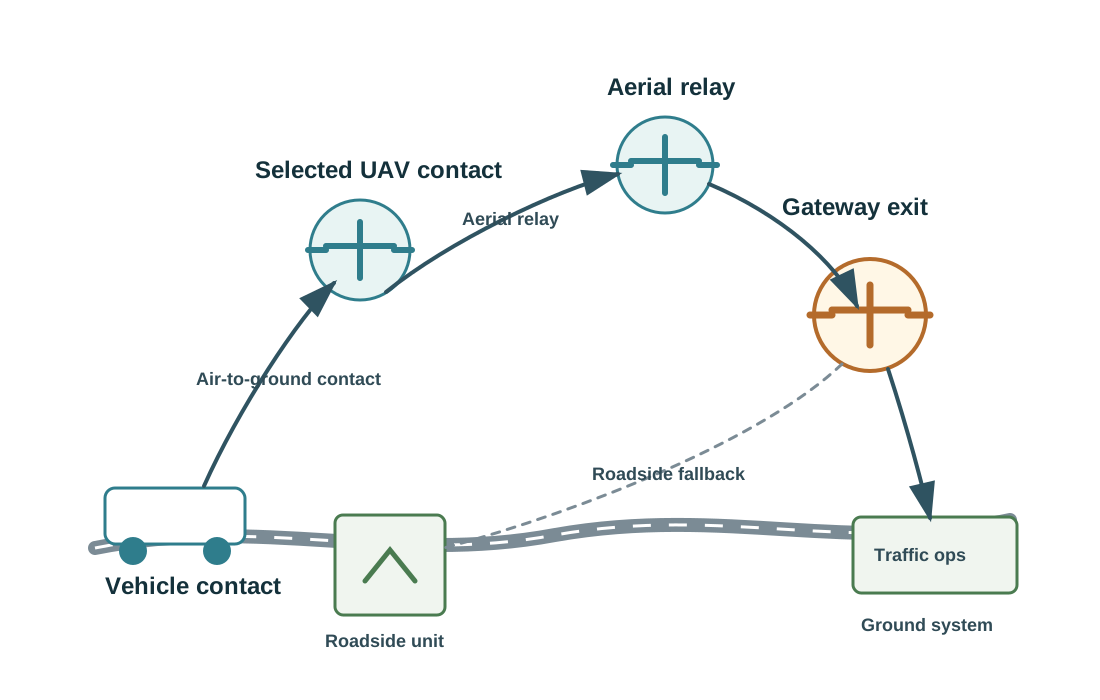
Mobile summary: Treat the road network and UAV network as separate moving layers, then choose vehicle contact, roadside handoff, aerial relay, gateway exit, or buffer from current records.
Vehicle side
Record road position, heading, contact window, source or destination role, and whether the message must reach nearby vehicles now.
Aerial side
Record UAV position, altitude, route intent, relay role, gateway reachability, and how long the air-to-ground contact remains useful.
Decision side
Choose vehicle contact, roadside handoff, aerial relay, gateway exit, or buffer based on priority and current records.
31.4 Road Incident Record
This section: Road Incident Record — For the rural road obstruction example, the key is not one universal route.
For the rural road obstruction example, the key is not one universal route. The urgent warning and the operations summary have different freshness needs.
Urgent warning
Forward from the reporting vehicle to the freshest UAV contact, then toward nearby vehicles or responders while the contact is current.
Operations summary
Buffer a compact summary when the gateway exit is weak, and forward it after a roadside or gateway path becomes trustworthy.
Handoff log
Record selected path, rejected gateway path, buffer reason, expiry rule, delivery outcome, and any vehicle-facing gap.
31.5 Why Air-Ground Contacts Age
This section: Why Air-Ground Contacts Age — A contact that was correct a few seconds ago can become wrong when either side moves or the message priority changes.
A contact that was correct a few seconds ago can become wrong when either side moves or the message priority changes.
- Road drift: vehicles leave the contact area or change relevance as the incident queue moves.
- Flight drift: the UAV route, altitude, or relay role changes the air-to-ground link faster than a static plan suggests.
- Gateway drift: the best local warning path may not be the best path to traffic operations.
- Priority drift: a delayed summary can be buffered, but a safety alert may expire if it waits for the same gateway.
This section:
This section:
This section:
- VANET nodes move on roads; FANET nodes move in 3D mission paths. Integration has to respect both mobility models.
- A UAV can observe a road segment, relay vehicle messages, bridge disconnected vehicle groups, or hand traffic to a roadside or ground gateway.
- Air-to-ground contacts are useful only while their records are fresh enough for the current message priority.
- Store-carry-forward remains valid when no current vehicle, roadside, or aerial gateway path is trustworthy.
This section:
31.6 Prerequisites
This section: Prerequisites
Before continuing, revisit these chapters if any of the terms are unfamiliar:
- FANET Fundamentals: covers aerial topology records, routing choices, and buffering.
- FANET Gateway Optimization: explains gateway candidate records and handoff logs.
- UAV FANETs and Integration: places FANET links in the larger ground-network handoff map.
- Networking Basics: covers routing, packets, and network roles.
31.7 What Integration Means
This section: What Integration Means — FANET-VANET integration is a bridge between two moving networks.
FANET-VANET integration is a bridge between two moving networks. The vehicle side may include cars, trucks, buses, roadside equipment, and traffic-control systems. The aerial side may include observation UAVs, relay UAVs, and gateway UAVs. The integration point is the set of air-to-ground contacts and handoff decisions that move information between these layers. The ground-side half of that bridge — V2X taxonomy, VANET fundamentals, and the DSRC/WAVE protocol stack — is covered in Transportation and Vehicles, so this chapter assumes that foundation and focuses on the aerial handoff built on top of it.
31.7.1 Vehicle contact
A UAV may exchange alerts, map updates, or sensor summaries with vehicles in its current contact area.
31.7.2 Roadside contact
A UAV may hand data to a roadside unit, field gateway, or temporary command post when that path is fresher than vehicle relay.
31.7.3 Aerial relay
A UAV may forward vehicle-originated data through other UAVs when the nearest ground exit is not directly reachable.
31.7.4 Buffered delivery
When no current path is trustworthy, the UAV can carry lower-priority data until a better vehicle, roadside, or gateway contact appears.
The overview depth layer shows the integration map that anchors vehicle, roadside, aerial relay, gateway, and traffic-operations paths.
31.8 Air-to-Ground Decision Records
This section: Air-to-Ground Decision Records — An air-to-ground contact should not be trusted only because it exists on a planning diagram.
An air-to-ground contact should not be trusted only because it exists on a planning diagram. The node making the decision should know what records are current and what records are stale.
31.8.1 Vehicle state
Record vehicle position, heading, contact time, and whether the vehicle is a source, relay, or destination for the message.
31.8.2 UAV state
Record UAV position, altitude, route intent, and whether it can remain near the road segment long enough to serve the message.
31.8.3 Link state
Track air-to-ground signal quality, packet delivery history, line-of-sight risk, and measurement freshness.
31.8.4 Message priority
Separate safety alerts, operational control, routine telemetry, and delayed summaries. They do not need the same forwarding rule.
31.8.5 Gateway state
Know which roadside, vehicle, aerial, or ground gateway path can move the data out of the local contact area.
31.8.6 Buffer state
Record whether data is allowed to wait, how long it can wait, and why it was carried instead of forwarded immediately.
31.9 Message Flow Patterns
This section: Message Flow Patterns — The same mission can use several message paths.
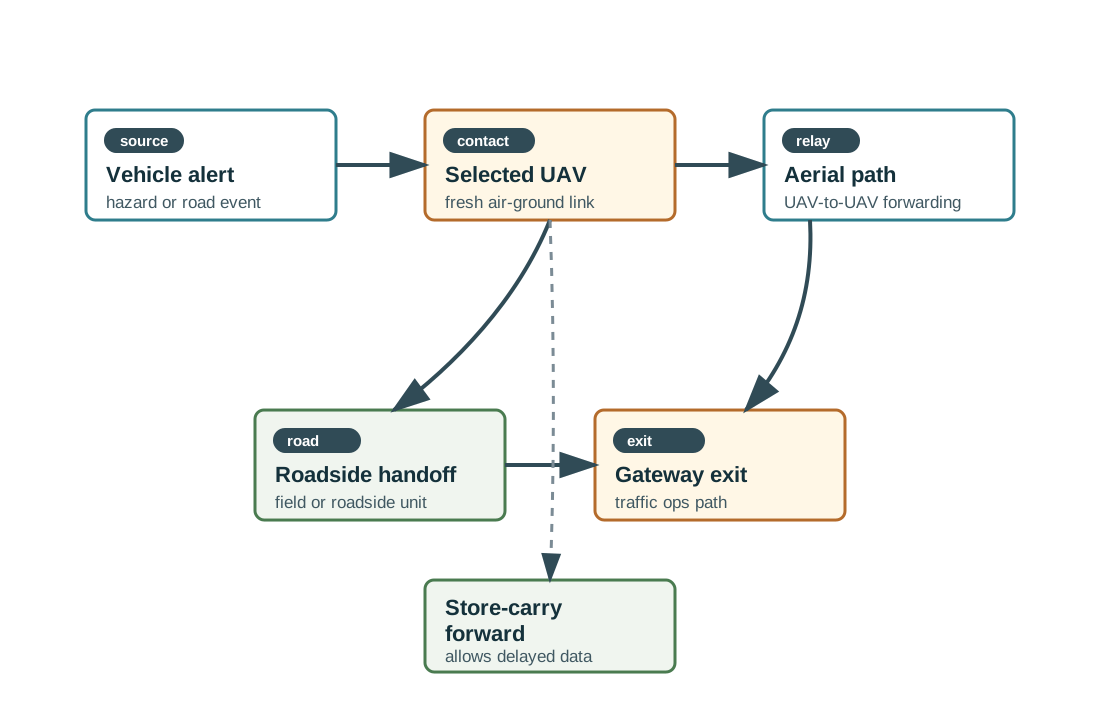
The same mission can use several message paths. The design should state which path is preferred for each traffic class and what fallback is used when the preferred path is unavailable.
31.9.1 Safety alert
Forward immediately through the freshest useful contact. Prefer the path that can reach affected vehicles or responders soonest.
31.9.2 Road observation
Forward through the aerial relay or roadside path when available. Buffer if the observation remains useful after a short delay.
31.9.3 Operations telemetry
Send through the gateway path when available. Lower-rate summaries can wait during temporary partitions.
31.9.4 Bulk records
Carry until a stable gateway contact appears. This protects link capacity for urgent messages.
31.10 Handoff Record
This section: Handoff Record — FANET-VANET integration needs logs that explain handoff choices.
FANET-VANET integration needs logs that explain handoff choices. These records help distinguish a design problem from a normal temporary partition.
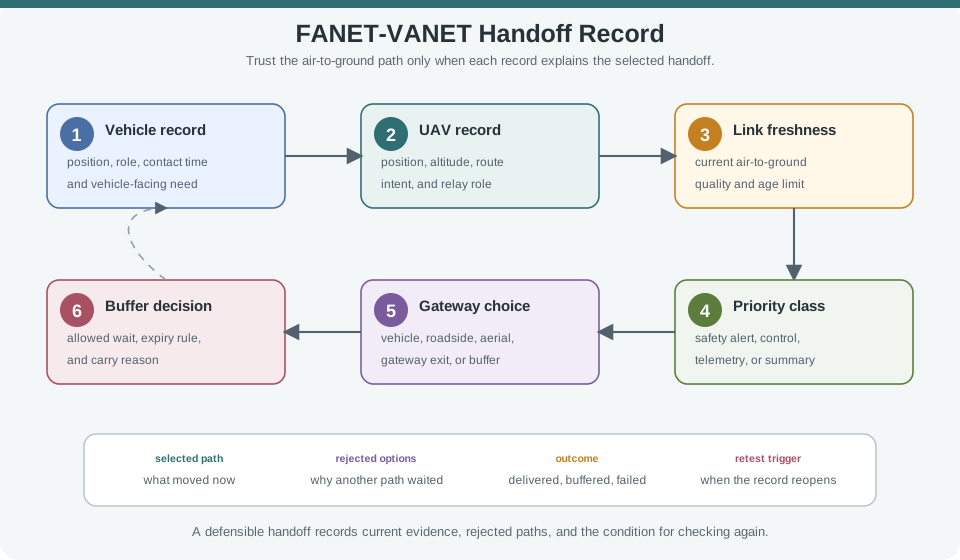
A useful handoff record includes:
- Source and destination role: vehicle, UAV, roadside unit, ground gateway, or traffic operations.
- Record freshness: when the vehicle state, UAV state, and link state were last observed.
- Priority class: safety alert, control, telemetry, observation, or delayed records.
- Selected path: vehicle contact, aerial relay, roadside handoff, gateway exit, or buffer.
- Rejected alternatives: why another path was not used.
- Outcome: delivered, buffered, retried, expired, or failed with reason.
31.11 Worked Example: Rural Road Incident
This section: Worked Example: Rural Road Incident — Scenario: A vehicle reports a road obstruction in a sparse area.
Scenario: A vehicle reports a road obstruction in a sparse area. A UAV has a current air-to-ground contact with the reporting vehicle. Another UAV has a fresher path to a roadside unit. A gateway UAV can forward to traffic operations, but the direct path is temporarily weak.
Decision record:
31.11.1 Safety alert
The obstruction alert is forwarded immediately from the reporting vehicle to the nearest UAV, then to the UAV with the fresher roadside path.
31.11.2 Vehicle warning
Nearby vehicles receive the warning from the UAV while the contact is fresh. The message is small and priority is high.
31.11.3 Operations update
The gateway path is weak, so the UAV stores a compact operations summary and forwards it when the gateway path improves.
31.11.4 Decision note
The log records that the gateway path was rejected for the immediate alert but used later for the operations summary.
Result: The urgent vehicle-facing alert moves immediately through the best current contact, while lower-priority operations records wait for a more trustworthy gateway path.
31.12 Readiness Checklist
This section: Readiness Checklist
Use this checklist before accepting a FANET-VANET design:
31.12.1 Mobility
- Are vehicle and UAV motion modeled separately? Vehicles follow road constraints, while UAVs follow mission paths in three dimensions. Separate position and motion records help assess whether both sides can sustain a useful contact.
- Are stale position records expired? Record observation times for each side. Movement can make a recent path stale quickly, so an old position should not continue to imply that a contact is available.
- Is the contact useful for the message priority? Judge freshness and available paths against how long the message may wait. Urgent alerts need a current useful path; delayed records may be carried when the mission permits waiting.
31.12.2 Links
- Is air-to-ground quality measured recently? Record signal quality, packet delivery history, and observation time together. Vehicle and UAV movement can make an earlier contact stale, so judge freshness against the current message priority.
- Is roadside or gateway reachability known? Compare current exits to determine whether data can leave the local contact area through a useful path.
- Is line-of-sight risk recorded when relevant? Include this risk in the link record so a handoff decision can be reviewed alongside measurement freshness and the selected or rejected paths.
31.12.3 Traffic
- Are safety alerts separated from delayed records? Different priorities need different forwarding rules. Urgent alerts should use the freshest useful contact, while delayed records may wait for a more trustworthy path when permitted.
- Is buffer permission explicit? Record whether the data may wait, how long it may wait, and why it was carried instead of forwarded. Retain its original time so its age remains visible.
- Are lower-priority flows prevented from blocking urgent traffic? Carrying bulk records until a stable gateway contact appears can protect scarce link capacity for urgent messages.
31.12.4 Handoff log
- Are selected and rejected paths logged? Record the chosen contact or buffering decision and why alternatives were not used. Include record freshness and priority class so the choice can be understood in its original conditions.
- Are handoff outcomes visible? Distinguish delivered, buffered, retried, expired, and failed outcomes, with a reason for failure. A selected path alone does not show whether delivery occurred.
- Can a delivery gap be explained after the mission? Connect the outcome to contact conditions and buffer reasons. These records help distinguish a design problem from a temporary partition.
31.13 Knowledge Check
This section: Knowledge Check
31.14 Common Pitfalls
This section: Common Pitfalls
Vehicles follow road constraints; UAVs follow mission paths in 3D. Integration logic needs separate records for each side.
Urgent alerts should move quickly, but delayed records can wait for a better gateway path. Priority classes protect scarce contact time.
An old contact can make a path look useful after a vehicle or UAV has moved away. Expire stale records and log the observation time.
A roadside unit or temporary field gateway can be a better handoff than a weak direct gateway path. Compare all current exits.
When a message is carried instead of forwarded, record why it was allowed to wait and when it should expire.
31.15 Concept Relationships
This section: Concept Relationships
- VANET describes vehicle-to-vehicle and vehicle-to-roadside communication in road environments.
- FANET adds aerial relays, observation, and gateway paths.
- Air-to-ground contact connects one vehicle-side path to one aerial-side path.
- Gateway state determines how the message leaves the local contact area.
- Buffer state protects data during temporary partitions.
- Handoff record explains selected paths, rejected alternatives, and outcomes.
31.16 Further Reading
This section: Further Reading
- Vehicular ad hoc networking literature for vehicle-to-vehicle and vehicle-to-roadside message patterns.
- FANET routing literature for aerial relay, gateway selection, and 3D topology records.
- Delay-tolerant networking literature for store-carry-forward behavior during intermittent contacts.
- Transportation operations and UAV operating guidance from the relevant authority for safety, command, and airspace responsibilities.
31.17 Summary
This section: Summary — FANET-VANET integration joins aerial UAV networks with road-based vehicle networks.
FANET-VANET integration joins aerial UAV networks with road-based vehicle networks. Good designs avoid brittle fixed mobility assertions. They classify traffic, keep vehicle and UAV records fresh, compare vehicle, roadside, aerial, and gateway paths, buffer data that can wait, and log each selected or rejected handoff so the mission can be checked.
31.18 What’s Next
This section: What’s Next
- UAV Fundamentals and Topologies: revisit the wider UAV networking foundation.
- FANET Gateway Optimization: revisit gateway candidate and handoff records.
- UAV Network Features and Challenges: continue into UAV network constraints and design pressures.
- UAV Networks: Production Checks: consolidate UAV network readiness practice.
31.19 Key Takeaway
This section: Key Takeaway — UAV, FANET, and VANET integration needs mobility prediction, safety boundaries, priority messaging, and reliable handoff between air and ground networks.
UAV, FANET, and VANET integration needs mobility prediction, safety boundaries, priority messaging, and reliable handoff between air and ground networks.
Find help
3 reviewed answers.
Where should I start in a module?
Open the module page from the sidebar to see its chapters in order. Use the module map to return to a topic you need.
Modules and pathsReviewed
What can I try when a project does not work?
Check the symptom, then work through the diagnostic steps. Keep the error message and the smallest example that reproduces it.
When you are stuckReviewed
How do interactive examples work?
Use the interactive guide to check how examples and simulations work before changing your project.
Interactive examples guideReviewed