32  UAV Network Fundamentals

In 60 Seconds

UAV networks (FANETs – Flying Ad Hoc Networks) use drones as mobile sensors, aerial base stations, or data relays. Key constraints: 15-45 minute flight time, 3D mobility at 10-30 m/s causing topology changes every few seconds, and payload-energy tradeoffs. Primary applications include disaster response (deploy in minutes vs hours for ground teams), precision agriculture (cover entire farms in one flight), and search-and-rescue (thermal imaging from altitude).

32.1 Learning Objectives

By the end of this chapter, you will be able to:

  • Define UAV Networks: Explain what UAV networks are and their role in IoT systems
  • Distinguish UAV Roles: Differentiate between UAVs as mobile sensors, aerial base stations, and data relays
  • Describe FANETs: Explain the architecture and key features of Flying Ad Hoc Networks
  • Apply UAV Solutions: Match real-world applications (disaster response, agriculture, search and rescue) to appropriate UAV configurations
  • Assess UAV Constraints: Evaluate the unique challenges of 3D mobility, battery constraints, and dynamic topology

UAV networks are like teams of flying robot helpers that work together in the sky, kind of like a superhero squad with wings!

32.1.1 The Sensor Squad Adventure: The Flying Rescue Team

One summer day, Sammy the Temperature Sensor heard exciting news on the radio: “A hiker is lost in the big forest, and the rescue team needs help finding them!”

Suddenly, a buzzing sound filled the air. Sammy looked up to see a group of drones - flying robots called UAVs - zooming overhead in a perfect formation.

“Wow, look at them work together!” said Lila the Light Sensor, watching the drones spread out across the forest like a team searching for treasure.

Max the Motion Detector, who was attached to one of the drones, explained through his radio: “We’re a FANET - a Flying Ad-hoc Network! Each drone can see part of the forest with cameras and heat sensors. When one drone spots something interesting, it tells the other drones instantly. We’re like flying eyes that can cover the whole forest in minutes instead of days!”

Bella the Button asked, “But how do you all know where to fly? And what if one drone runs out of battery?”

“Great questions!” said Max. “We talk to each other through the air like walkie-talkies. If Drone 1 finds a clue, it tells Drone 2, who passes the message to Drone 3, until it reaches the rescue team on the ground. It’s like playing telephone, but super fast! And when someone’s battery gets low, they fly back to recharge while the others keep searching.”

Just then, one drone’s thermal camera spotted a warm shape below the trees. “Found them!” The message zipped from drone to drone to drone until the rescue helicopter knew exactly where to go. The lost hiker was saved - all because the flying sensor squad worked as a team!

32.1.2 Key Words for Kids

Word What It Means
UAV (Unmanned Aerial Vehicle) A flying robot, also called a drone, that can fly without a pilot inside
FANET Flying Ad-hoc Network - a team of drones that talk to each other while flying
Swarm A group of drones working together, like a flock of birds but smarter
Relay Passing a message from one drone to another to another, like a bucket brigade

32.1.3 Try This at Home!

The Drone Relay Race: Understand how drones pass messages!

  1. Gather 4-5 family members or friends and stand in a line about 10 feet apart
  2. The first person (the “Ground Station”) whispers a message like “Found the lost hiker at the big oak tree”
  3. Each person passes the message to the next, but here’s the twist: you can only whisper to the person NEXT to you (just like drones have limited range!)
  4. See if the message arrives correctly at the end. This is exactly how drone networks relay information over long distances!
  5. Bonus challenge: Try it where one person in the middle has to step out (drone battery died!) - can you find another way to pass the message? That’s why mesh networks are so important!
MVU: Minimum Viable Understanding

Core concept: UAV networks (FANETs) are flying ad-hoc networks where drones serve as mobile sensor platforms, flying base stations, or data relays that can be deployed in minutes. Why it matters: Drones provide instant coverage where ground infrastructure is destroyed, inaccessible, or too expensive to build permanently. Key takeaway: Choose star topology for simple missions with one control point, mesh for resilient multi-drone swarms, and hierarchical for large-scale operations with ground integration.

32.2 Prerequisites

Before diving into this chapter, you should be familiar with:

  • Networking Basics: Understanding fundamental networking concepts including topology types, routing, and wireless communication principles is essential for grasping UAV network architectures
  • Wireless Sensor Networks: Knowledge of WSN architectures, energy constraints, and data collection strategies provides context for how UAVs can extend or complement ground-based sensor networks
  • Multi-Hop Fundamentals: Familiarity with multi-hop routing and relay strategies helps understand how UAVs form mesh networks and communicate beyond direct radio range

32.3 Getting Started (For Beginners)

New to UAV Networks? Start Here!

Drones aren’t just flying cameras—they’re becoming key players in IoT networks. Here’s why UAVs matter for the future of connectivity.

32.3.1 What are UAV Networks? (Simple Explanation)

UAV = Unmanned Aerial Vehicle (drone)

UAV networks are groups of drones that communicate with each other and with ground systems. Think of them as “flying cell towers” or “mobile sensor platforms.”

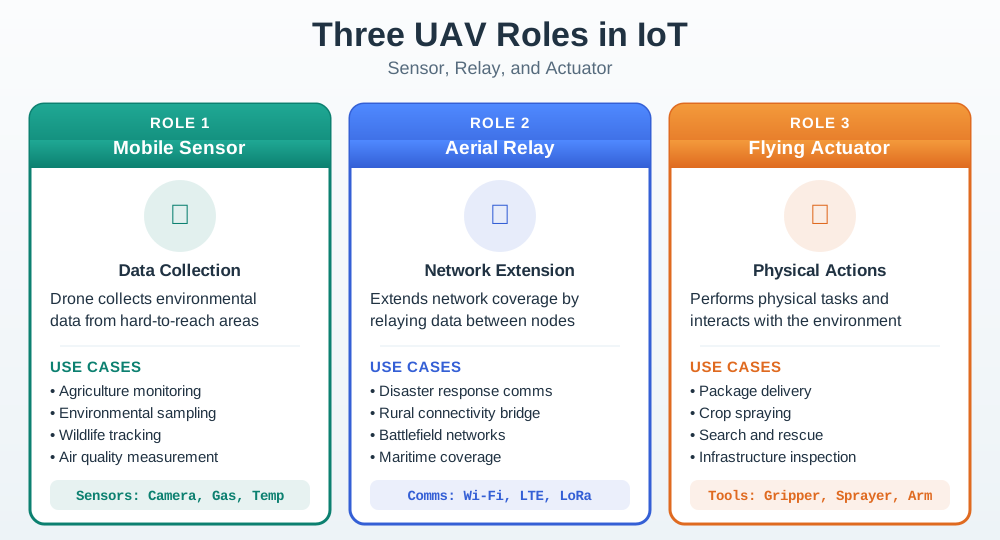
Three Ways Drones Work in IoT:

Three UAV roles in IoT: 1) Mobile Sensor Platform where drone collects environmental data (example: agricultural monitoring with thermal camera), 2) Flying Base Station where drone provides network coverage to ground devices (example: emergency Wi-Fi hotspot after disaster), 3) Data Relay where drone forwards data between devices (example: bridge link between isolated sensor networks)
Figure 32.1: Three UAV roles in IoT: 1) Mobile Sensor Platform where drone collects environmental data, 2) Flying Base Station where drone provides network coverage to ground devices, 3) Data Relay where drone forwards data between devices.
Decision tree for UAV role selection with three paths: Mobile Sensor Platform for wide-area data collection (agriculture, inspection, mapping) requiring onboard sensors and large flight area; Flying Base Station for network connectivity (disaster response, events, remote areas) requiring high-bandwidth radio and stable hover; Data Relay for connecting isolated systems (bridging networks, extending range) requiring multiple radios and mobile trajectory
Figure 32.2: Alternative View: Role Selection Decision Tree - This decision tree helps students select the appropriate UAV role for their application.

32.3.2 Why Drones? What Can They Do That Others Can’t?

Capability Ground Networks Drone Networks
Coverage area Fixed, limited Mobile, adjustable
Deployment speed Days to months Minutes
Access to remote areas Expensive infrastructure Fly directly there
Disaster response May be destroyed Deployed immediately
Line of sight Blocked by buildings Above obstacles

Consider how altitude affects UAV coverage area. A UAV flying at altitude \(h\) with an omnidirectional antenna provides coverage with radius \(r\) determined by the radio horizon:

\[r = \sqrt{2 h R_e}\]

where \(R_e = 6,371\) km is Earth’s radius. For a UAV at 100m altitude:

\[r = \sqrt{2 \times 0.1 \times 6371} = \sqrt{1274.2} \approx 35.7 \text{ km}\]

Coverage area: \(A = \pi r^2 = \pi \times 35.7^2 \approx 4,000 \text{ km}^2\)

At 300m altitude: \(r = \sqrt{2 \times 0.3 \times 6371} \approx 61.8\) km, \(A \approx 12,000 \text{ km}^2\) (3× larger!)

However, path loss increases with altitude. Free-space path loss at 2.4 GHz: \[L = 20\log_{10}(d) + 20\log_{10}(f) - 147.6\]

For a UAV at 300 m altitude and a ground receiver 300 m horizontal distance away, slant range \(d = \sqrt{300^2 + 300^2} \approx 424\) m. At 2.4 GHz: \(L = 20\log_{10}(424) + 20\log_{10}(2.4 \times 10^9) - 147.6 \approx 52.5 + 187.6 - 147.6 = 92.5\) dB. This illustrates the altitude-coverage-power trade-off.

32.3.3 FANET: Flying Ad Hoc Networks

When multiple drones work together, they form a FANET (Flying Ad Hoc Network):

FANET (Flying Ad Hoc Network) showing 4 drones communicating air-to-air in mesh topology, Drone 1 communicating with ground control station, Drones 3 and 4 collecting data from ground sensors, with note that network auto-reconfigures as drones move in 3D space
Figure 32.3: FANET (Flying Ad Hoc Network) showing 4 drones communicating air-to-air in mesh topology, Drone 1 communicating with ground control station, Drones 3 and 4 collecting data from ground sensors.

Key FANET Features:

  • Drones talk to each other (air-to-air)
  • Drones talk to ground (air-to-ground)
  • Network reconfigures as drones move

UAV flight path planning showing waypoint navigation, obstacle avoidance zones, coverage area patterns, and optimized routes for efficient sensor data collection missions over terrain

Flight Path Planning
Figure 32.4: UAV flight path planning illustrating waypoint navigation, obstacle avoidance, and optimized coverage patterns for efficient sensor network data collection and surveillance missions.

UAV executing a planned flight path over terrain with ground sensor nodes, showing real-time trajectory adjustments, sensor coverage zones, and multi-hop data relay to ground control station

Flight Path Execution
Figure 32.5: Flight path execution showing a UAV navigating through waypoints while collecting data from ground sensors and adapting to real-time conditions.

32.3.4 Real-World UAV Network Applications

1. Disaster Response

Hurricane destroys cell towers, then deploy drone network so victims can call for help.

2. Smart Agriculture

Drone swarm flies over 1000-acre farm, captures crop health data, and transmits to farmer’s dashboard.

3. Search and Rescue

Multiple drones search forest, share coordinates in real-time, and find missing hiker faster.

4. Event Coverage

Large festival needs temporary drone cell towers so everyone can post to social media.

32.3.5 Challenges: Why UAV Networks are Tricky

Challenge Why It’s Difficult
3D Movement Drones move up/down/sideways constantly; topology changes every second
Battery Life Drones have 20-40 min flight time; must land and recharge
Communication Range Air-to-ground link weakens with distance and obstacles
Coordination Multiple drones must avoid collisions and share tasks
Weather Wind, rain affect both flight and radio signals

32.3.6 Self-Check: Understanding the Basics

Before continuing, make sure you can answer:

  1. What is a UAV network? A network of drones communicating with each other and ground systems
  2. What is FANET? Flying Ad Hoc Network—self-organizing network of cooperating UAVs
  3. Why use drones instead of fixed towers? Rapid deployment, mobile coverage, access to disaster/remote areas
  4. What’s the main challenge with UAV networks? 3D mobility causes rapidly changing network topology; limited battery life

32.4 Introduction to UAV Networks

Unmanned Aerial Vehicles (UAVs), commonly known as drones, are transforming IoT architectures by providing aerial sensing, mobile base stations, and rapid deployment capabilities. UAV networks, particularly Flying Ad Hoc Networks (FANETs), enable dynamic, three-dimensional communication infrastructures for applications ranging from disaster response to smart agriculture.

UAV Network Ecosystem flowchart: UAV fleet supports mission types (surveillance, data collection, relay/communications, delivery) operating in network types (FANET for UAV-UAV, UAV-WSN, UAV-VANET, UAV-infrastructure) facing key challenges (3D mobility, energy constraints, topology changes, regulations) enabling applications (disaster response, smart agriculture, search & rescue, infrastructure inspection)
Figure 32.6: UAV Network Ecosystem flowchart showing UAV fleet supporting mission types, operating in network types, facing key challenges, and enabling applications.
Key Concepts
  • UAV Networks: Networks formed by Unmanned Aerial Vehicles (drones) that can serve as mobile sensor platforms or aerial communication relays
  • Flying Ad Hoc Network (FANET): Self-organizing wireless network formed by multiple UAVs cooperating without ground infrastructure
  • Aerial Base Station: UAV functioning as temporary wireless access point providing coverage to ground IoT devices or users
  • Three-Dimensional Mobility: UAVs move in 3D space with fast, dynamic topologies requiring specialized routing and coordination protocols
  • Coverage Extension: Using UAVs to provide temporary connectivity in disaster areas or remote locations lacking infrastructure
  • Swarm Coordination: Multiple UAVs working cooperatively, distributing sensing or communication tasks across the fleet

32.5 Knowledge Check

Test Your Understanding

Question 1: A coastal city needs to monitor ocean water quality across a 50 km stretch of coastline that has no road access. Measurements are needed weekly. Which UAV role is most appropriate?

  1. Data relay – drones forward data between coastal sensor buoys
  2. Aerial base station – drones provide Wi-Fi coverage to beachgoers
  3. Mobile sensor platform – drones carry water quality sensors along the coastline
  4. Static surveillance – drones hover in fixed positions along the coast

c) Mobile sensor platform. The drone carries water quality sensors (pH, turbidity, dissolved oxygen) and flies along the 50 km coastline collecting data. This is ideal because: (1) no ground infrastructure is needed in the inaccessible coastal area, (2) weekly flights are well within operational capability, (3) a fixed-wing UAV can cover 50 km efficiently, and (4) the drone collects data directly rather than relying on pre-deployed buoys.

Question 2: During a FANET search and rescue mission, Drone 3 discovers a heat signature (possible survivor) but is outside direct radio range of the ground control station. How does the information reach rescuers?

  1. Drone 3 stores the data and delivers it when it flies back to base
  2. Drone 3 relays the message through intermediate drones (multi-hop) to reach the ground station
  3. Drone 3 uses satellite communication to bypass the drone network
  4. The mission fails because direct communication is required

b) Multi-hop relay through intermediate drones. This is a core FANET capability – drones form a mesh network where messages hop from drone to drone until they reach the destination. Drone 3 sends the coordinates to the nearest drone in range, which forwards to the next, and so on until the ground station receives the survivor location. This eliminates the need for every drone to be in direct range of the base.

Question 3: Why is battery life the most critical constraint for multi-drone missions, and what is the typical flight time for a commercial quadcopter?

  1. 2-4 hours – battery technology has advanced significantly
  2. 20-40 minutes – lithium polymer batteries limit flight duration
  3. 8-12 hours – solar panels extend flight time indefinitely
  4. Battery is not a constraint because drones can be tethered to ground power

b) 20-40 minutes. Most commercial multi-rotor drones have 20-40 minutes of flight time on a single battery charge. This is the dominant constraint because: (1) the drone must constantly fight gravity, consuming enormous energy, (2) heavier payloads (sensors, cameras) reduce flight time further, (3) wind conditions increase energy consumption, and (4) return-to-base reserves must be maintained. Fixed-wing drones achieve longer flights (1-2 hours) but cannot hover. This constraint drives fleet sizing – 24/7 coverage requires 3-4x more drones than are airborne at any time.

32.6 Interactive: Disaster Response Fleet Calculator

Estimate how many drones are needed for emergency area coverage:

32.7 Worked Example: Disaster Response FANET Sizing

Scenario: Hurricane Maria knocks out all cellular infrastructure across a 25 km^2 coastal region. An emergency response team must deploy a drone-based communication network within 2 hours to restore connectivity for 500 ground responders using smartphones.

Step 1: Coverage requirement

  • Area to cover: 25 km^2
  • Each drone provides a Wi-Fi hotspot with 300 m radius coverage = 0.283 km^2 per drone
  • Minimum drones for full coverage: 25 / 0.283 = 89 drones (hexagonal packing)
  • With 20% overlap for handoff: 107 drones airborne

Step 2: Flight time constraint

  • Battery life per drone: 25 minutes (heavy payload – Wi-Fi radio + battery pack)
  • Swap time (land, replace battery, relaunch): 8 minutes
  • Effective duty cycle: 25 / (25 + 8) = 75.8%
  • Drones needed to maintain 107 airborne: 107 / 0.758 = 142 total drones

Let’s calculate the energy budget for a multi-rotor UAV carrying a 500g Wi-Fi hotspot payload. A DJI Phantom-class quadcopter has:

Battery capacity: \(E = 5000\) mAh at 15.2 V = \(5 \times 15.2 = 76\) Wh = \(273,600\) J

Hover power consumption: \(P_{hover} = 180\) W (baseline) + \(P_{payload}\)

Payload power penalty: \(P_{payload} = \frac{m_{payload}}{m_{max}} \times 50\text{ W} = \frac{500}{1000} \times 50 = 25\) W

Total power: \(P_{total} = 180 + 25 = 205\) W

Flight time: \(t = \frac{E}{P_{total}} = \frac{76 \times 3600}{205} \approx 1,334\) seconds \(= 22.2\) minutes

With 20% reserve for safe landing: \(t_{effective} = 0.8 \times 22.2 \approx 18\) minutes

Adding 8 minutes for battery swap means achieving 24/7 coverage requires: \(\frac{24 \times 60}{18} \approx 80\) battery swaps per day per position. With 107 coverage positions: \(107 \times 80 = 8,560\) swaps/day—demonstrating the massive logistical challenge of drone-based persistent coverage.

Step 3: Backhaul

  • Each drone connects to a mesh of relay drones
  • Relay drones (no Wi-Fi hotspot, just inter-drone links) connect the mesh to a portable satellite terminal
  • Relay chain: 3 high-altitude relay drones at 150 m altitude, each covering 2 km radius for drone-to-drone links
  • Total relay drones: 3 airborne + 1 spare rotating = 4 relay drones

Step 4: Cost and logistics

Component Quantity Unit Cost Total
DJI-class hotspot drones 142 $2,500 $355,000
Relay drones (long-range) 4 $8,000 $32,000
Battery packs (4 per drone) 584 $150 $87,600
Portable satellite terminal 1 $15,000 $15,000
Ground charging stations 10 $3,000 $30,000
Total deployment cost $519,600

Comparison: Deploying temporary cell towers (COWs – Cells on Wheels) for the same area would require 8 units at $250,000 each, take 24-48 hours to deploy, and cost $2M total. The FANET solution deploys in 2 hours at 1/4 the cost.

Named reference: Project Loon (Alphabet) and AT&T’s Flying COW program demonstrated drone-based connectivity during Hurricane Maria (2017) in Puerto Rico, providing LTE coverage to 200,000+ users from tethered drones.

32.8 Decision Table: UAV Role Selection

Application Need Recommended Role Topology Fleet Size Why
Post-earthquake connectivity Aerial base station Star (each drone = AP) 50-150 Ground infrastructure destroyed; need fast coverage
Crop health survey, 500-acre farm Mobile sensor platform Predefined waypoint 1-3 Systematic coverage; no real-time comms needed
Wildlife tracking in national park Data relay (data mule) Scheduled sweep 2-5 Collect data from scattered ground sensors
Wildfire perimeter mapping Mobile sensor + relay Mesh 10-20 Real-time thermal imaging with multi-hop relay to command post
Marathon event, 42 km route Aerial base station Linear chain 15-25 Temporary coverage along route; sequential handoff

Common Pitfalls

A UAV-mounted access point is fundamentally different from a ground access point — it moves at 15–25 m/s, has 20–45 minute battery life, experiences Doppler-shifted signals, and operates in 3D space. Standard Wi-Fi protocols (802.11 association, beacon intervals) are designed for stationary APs and perform poorly on mobile UAVs. Always use protocols designed for high-mobility nodes.

UAV network designs that ignore battery replacement logistics fail in production. A continuous coverage mission requires 3× battery capacity (one flying, one charging, one spare) per UAV. Design battery swap schedules before deployment — 20-minute coverage gaps during swapping are unacceptable for emergency response.

Most countries require registration, licensed pilots, and line-of-sight operations for commercial UAV use above 50m AGL. Deploying UAVs for IoT sensing without checking local CAA/FAA regulations risks fines and equipment seizure. Legal requirements must be part of any UAV IoT deployment plan.

UAV coverage calculations done on flat maps fail when deployed in mountainous or urban terrain. Wind exceeding 10 m/s reduces flight time by 30–50% and may prevent UAV positioning at specific coordinates. Always include terrain analysis and weather constraints in UAV deployment planning.

32.9 Summary

This chapter introduced the fundamentals of UAV networks and their role in IoT systems:

  • UAV Roles: Drones serve three primary functions in IoT—mobile sensor platforms for data collection, aerial base stations for network coverage, and data relays for extending connectivity
  • FANET Concept: Flying Ad Hoc Networks enable multiple UAVs to self-organize and communicate without fixed infrastructure, adapting to dynamic mission requirements
  • Key Applications: Real-world uses include disaster response, precision agriculture, search & rescue, and temporary event coverage
  • Unique Challenges: 3D mobility creates rapidly changing topologies, limited battery life constrains operations, and coordination complexity increases with swarm size

32.10 Knowledge Check

32.11 What’s Next

If you want to… Read this
Study UAV network features and challenges in depth UAV Network Features and Challenges
Explore UAV network topologies UAV Network Topologies
Understand FANET fundamentals FANET Fundamentals
Get hands-on with the interactive UAV lab UAV/FANET Interactive Lab
Review all UAV network concepts UAV Networks: Production and Review