33 UAV Energy-Aware Mission Planning
More
Depth: Practitioner
Progress saves as you read. Mark sections complete as you go; your progress appears in the sidebar.
33.1 Start Simple
This section: Start Simple — Start with a mission that moves, loses energy, and changes its radio path while it works.
Start with a mission that moves, loses energy, and changes its radio path while it works. In UAV Energy-Aware Mission Planning, the practical question is what the aircraft must sense, relay, decide, and prove before the flight or network role is safe enough to trust.
The mathematical gist. A 22.2 V, 10.0 Ah pack holds 222 Wh at nameplate, but a 20% reserve leaves 177.6 Wh for planned work. With 40 mΩ internal resistance, 25 A cruise causes 1.00 V sag while a 45 A climb causes 1.80 V, leaving 20.4 V and less cutoff headroom. After a two-week gap at 2% monthly self-discharge, about 9,899 mAh remains. Mission planning must check both stored energy and the worst-current segment.

Figure 33.3 shows the LiPo pack whose internal resistance causes greater voltage sag during climbing than cruising.

33.2 Learning Objectives
This section: Learning Objectives
By the end of this chapter, you will be able to:
- Build a UAV energy budget from measured pack, route, payload, dwell-time, climb, and return records.
- Separate usable mission energy from reserve energy and return-to-home energy.
- Explain why the farthest reachable point, not just the final waypoint, controls the return reserve.
- Choose energy-aware route adjustments without hiding safety, payload, or data-collection trade-offs.
- Create a traceable mission record that supports repeatable improvement across flights.
33.3 Protect Reserve Before Work
This section: Protect Reserve Before Work — If you only need the operating rule, this layer is enough: plan the required mission, protect return reserve from the worst active point, then add optional work only when measured records leave enough margin.
If you only need the operating rule, this layer is enough: plan the required mission, protect return reserve from the worst active point, then add optional work only when measured records leave enough margin.
Figure 33.4 shows energy records, route estimates, reserve gates, and live checks determine whether to accept, trim, split, or return.
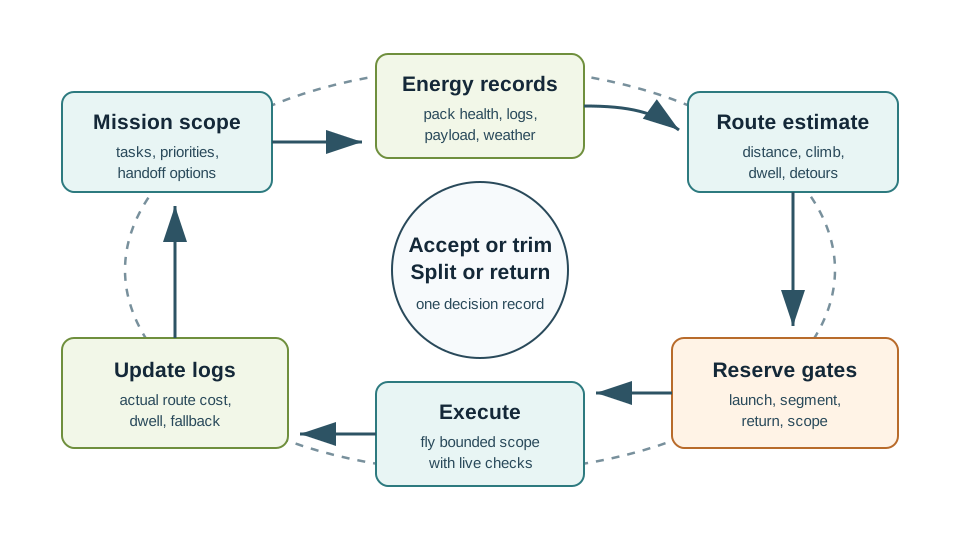
Mobile summary: Protect return reserve first; optional work only stays in scope while measured energy, route, payload, weather, and fallback records still pass.
Measure
Use logs from the actual aircraft, battery condition, payload mode, weather window, route, climb, dwell, and communication behavior.
Gate
Separate mission energy, return energy, uncertainty, and reserve so optional work cannot spend the energy needed for fallback.
Learn
Use live and post-flight records to update route cost, dwell cost, retry cost, wind sensitivity, and future scope gates.
33.4 Roof Inspection Scope Record
This section: Roof Inspection Scope Record — For the roof-inspection example, the record should make the scope decision obvious to the next operator: what must be collected, what can be skipped, and which gate protects return.
For the roof-inspection example, the record should make the scope decision obvious to the next operator: what must be collected, what can be skipped, and which gate protects return.
This section:
This section:
This section:
- Flight time printed in a specification sheet is not a mission plan. Use measured logs from the actual aircraft, payload, weather window, and battery condition.
- Reserve is a gate, not spare energy to spend at the end of the route.
- Return-to-home must remain feasible from every active part of the mission area.
- Hover, slow passes, climbs, retransmissions, and repeated route corrections can matter as much as straight-line distance.
- A good plan explains what will be skipped, shortened, handed off, or recalled when the energy gate tightens.
This section:
33.6 Prerequisites
This section: Prerequisites
Revisit these chapters if the terms are unfamiliar:
- UAV Trajectory Control: bounded path adjustments and feedback loops.
- UAV Network Topologies: gateway exits, relay patterns, and physical link records.
- UAV Swarm Coordination: role handoff and task ownership.
- FANET Fundamentals: aerial ad hoc links and routing choices.
33.7 How This Chapter Fits
This section: How This Chapter Fits — Trajectory control asks how the aircraft should move.
Trajectory control asks how the aircraft should move. Energy-aware mission planning asks whether the aircraft should keep accepting that motion plan. It sits between mission design and in-flight control: the planner sets the budget and reserve gates, while the controller checks those gates whenever route, link, weather, payload, or safety records change.
The overview depth layer shows the energy-aware planning loop that anchors mission scope, measured energy records, route estimate, reserve gates, execution with live checks, and post-flight updates.
33.8 Energy Budget Record
This section: Energy Budget Record — An energy plan should be written as a record, not as a single remaining-battery number.
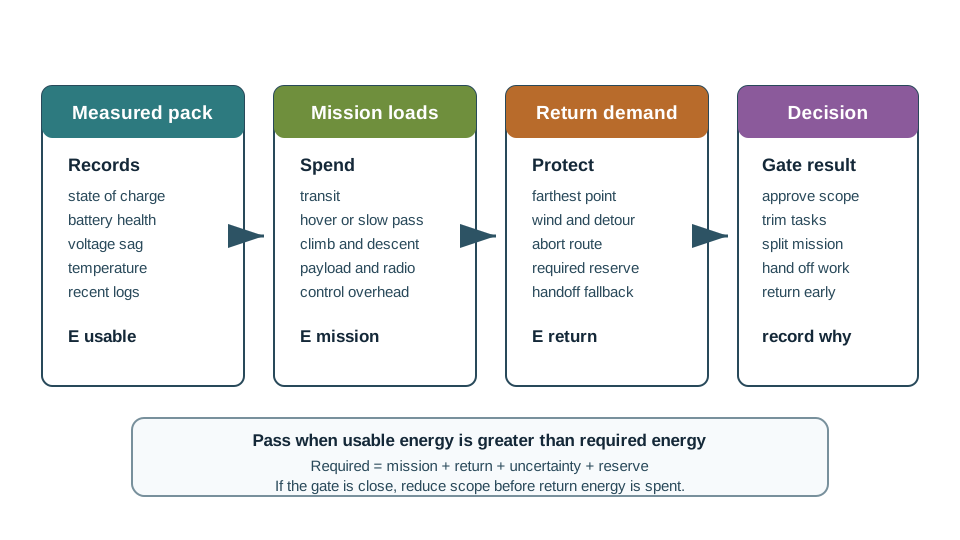
An energy plan should be written as a record, not as a single remaining-battery number. The record separates what the mission is allowed to spend from what must remain available for return, uncertainty, and fallback.
Let be mission energy, transit, dwell, climb, payload, control overhead, return, uncertainty, and protected reserve.
The plan is acceptable only when the measured usable pack energy is greater than the required energy for the current mission scope. If the inequality is close, the correct action is not to hope that the battery lasts. Reduce the mission, change the route, split the flight, or hand off work.
33.8.1 Pack records
Record pack energy, state of charge, battery health, temperature condition, voltage sag under load, and the source of the estimate.
Weak records: assuming a rated flight time.
Strong records: recent flight logs from the same aircraft, payload, and operating profile.
33.8.2 Route records
Record planned distance, climb and descent segments, no-fly detours, expected wind exposure, and the farthest reachable point from base.
Weak records: endpoint distance only.
Strong records: route cost checked at each waypoint or mission segment.
33.8.3 Payload records
Record sensor, radio, compute, gimbal, lighting, and storage behavior. Payload draw may be smaller than propulsion, but dwell and retransmission time can make it mission-critical.
Weak records: one generic payload number.
Strong records: measured draw and time-on-task for the selected collection mode.
33.8.4 Fallback records
Record the recall rule, skipped-task rule, handoff target, loiter limit, and data-loss risk if the mission cannot continue.
Weak records: “return if battery is low.”
Strong records: a named gate that triggers a specific fallback action.
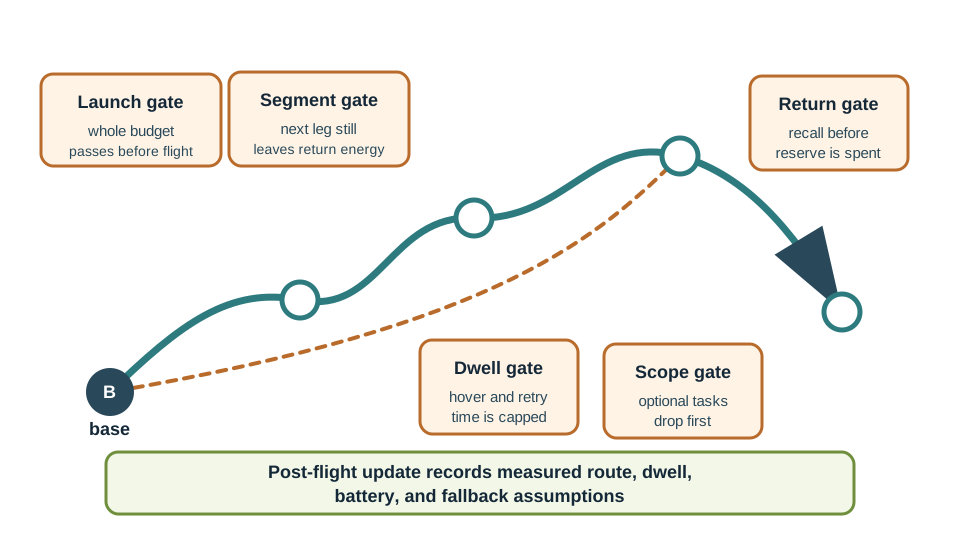
33.9 Reserve Gates
This section: Reserve Gates — Reserve gates convert an energy estimate into a decision.
Reserve gates convert an energy estimate into a decision. They prevent the mission from spending return energy on optional work.
- Launch gate: the aircraft does not launch unless the route, reserve, return, and uncertainty budget all pass.
- Segment gate: each new segment must leave enough energy to return from the worst reachable point after the segment starts.
- Dwell gate: hovering, slow passes, repeated photos, and link retries have a time limit tied to the energy budget.
- Scope gate: low-priority tasks are skipped before the return gate is threatened.
- Return gate: the aircraft returns or hands off when the current reserve is no longer enough for safe continuation.
- Post-flight gate: the measured energy use updates the next planning record.
33.10 Route Planning Decisions
This section: Route Planning Decisions — Energy-aware routing is not just shortest-path routing.
Energy-aware routing is not just shortest-path routing. A shorter route can still be worse when it forces repeated climbs, slow passes in poor wind, long hover periods, or weak-link retries.
33.10.1 Waypoint order
Visit nearby tasks together when this reduces route length and repeated climb. Do not blindly sort by task number or by final destination.
Check question: does this order keep return feasible from the farthest active point?
33.10.2 Dwell and collection mode
Choose hover, slow fly-by, fast fly-by, or deferred collection based on data need, link quality, and energy reserve.
Check question: what is the maximum dwell time before the task is skipped or handed off?
33.10.3 Altitude profile
Avoid unnecessary up-and-down profiles. Keep altitude changes tied to payload need, link geometry, terrain clearance, or safety constraints.
Check question: which climb is essential, and which is only a habit from a previous mission?
33.10.4 Split or handoff
Split the mission when one flight would spend too much reserve on distant or low-priority work. In a multi-UAV mission, hand off only when the receiving aircraft also has a valid reserve record.
Check question: does the handoff reduce risk, or just move hidden energy debt to another aircraft?
33.11 Worked Example: Inspection Mission Scope
This section: Worked Example: Inspection Mission Scope — Consider a roof-inspection mission with five waypoints, two photo dwell points, and one optional thermal sweep.
Consider a roof-inspection mission with five waypoints, two photo dwell points, and one optional thermal sweep. The planning team has recent measured logs from the same airframe and payload. The numbers below are not universal platform values; they are the team’s measured planning inputs for this specific setup.
Measured usable energy The battery record shows usable pack energy after health and weather adjustment. The planner keeps a separate reserve instead of treating the whole pack as spendable.
Base route The base route includes outbound travel, waypoint-to-waypoint travel, return distance from the farthest reachable point, and a small route-uncertainty allowance.
Dwell tasks Two photo points require short stable dwell. The thermal sweep is useful but optional, so it is placed behind a scope gate.
Decision If the launch and segment gates pass, the aircraft flies the required photo route. If live energy drops faster than expected, the thermal sweep is skipped before return energy is threatened.
The important learning point is the decision structure. The team does not ask, “Can the UAV probably finish?” It asks:
- What energy records are measured rather than assumed?
- Which tasks are mandatory, optional, or handoff candidates?
- Which segment contains the worst return demand?
- Which gate will shorten the mission before return reserve is spent?
- What post-flight data will update the next plan?
33.12 UAV-WSN Data Collection
This section: UAV-WSN Data Collection — In UAV-assisted wireless sensor networks, the aircraft may act as a data mule, temporary gateway, or emergency collector.
In UAV-assisted wireless sensor networks, the aircraft may act as a data mule, temporary gateway, or emergency collector. Energy planning must balance route efficiency with data urgency.
33.12.1 Buffer urgency
Sensors with full or time-critical buffers may need earlier collection. The route should record why urgency justifies extra travel.
33.12.2 Contact quality
A weak link can turn a brief pass into a long dwell. The plan should include a retry limit and a fallback, such as collecting a smaller summary or returning later.
33.12.3 Cluster collection
Dense deployments can reduce flight cost by collecting through a cluster head or temporary relay, but this shifts energy and reliability assumptions to the ground network.
33.12.4 Mission scope
When reserve tightens, the aircraft should drop low-priority nodes before risking the return gate. The skipped-node list becomes part of the mission record.
33.13 Common Pitfalls
This section: Common Pitfalls
Planning from rated flight time. Rated endurance is useful for screening platforms, but mission planning needs measured logs for the actual aircraft, payload, route, battery condition, and weather window.
Treating reserve as a percentage only. A percentage can be a policy, but the operational question is whether the aircraft can return from the worst active point while still preserving required margin.
Optimizing distance while ignoring dwell. Data collection, retries, inspection holds, and station-keeping can consume more budget than the extra distance saved by a clever route.
Letting optional work consume mandatory return energy. Optional sweeps, extra photos, and extended relay service should have explicit scope gates.
Failing to update the next plan. Post-flight logs should update route cost, dwell cost, wind sensitivity, battery health assumptions, and fallback timing.
33.14 Readiness Checklist
This section: Readiness Checklist
Before a mission is accepted, verify these items:
Measured records The budget is based on recent logs or controlled measurements, not only on a datasheet.
Worst return point The return requirement is checked from the farthest reachable point in the active mission, not only from the final waypoint.
Dwell limit Every hover, retry, slow pass, or station-keeping task has a maximum allowed time.
Scope order The plan clearly identifies which tasks are mandatory, optional, skipped first, or handed off.
Fallback action The return, loiter, handoff, or abort behavior is named and tied to a specific gate.
Post-flight update The team knows which log fields will update the next mission budget.
33.15 Concept Relationships
This section: Concept Relationships
33.15.1 Energy budget and route scope
The energy budget limits which route segments, dwell tasks, and optional collections can be accepted.
33.15.2 Return reserve and safety state
Return reserve is a safety gate. It must survive optional work, link retries, and route detours.
33.15.3 Payload work and dwell time
Payload energy is not only watts. It is also the time spent holding position while the payload collects, transmits, or retries.
33.15.4 Post-flight logs and future planning
Energy planning improves when each flight leaves measured records about actual route cost, dwell cost, battery behavior, and fallback triggers.
33.16 Interactive Checks
This section: Interactive Checks
This section:
This section:
33.17 Summary
This section: Summary — Energy-aware mission planning is the discipline of deciding what a UAV is allowed to attempt with its current battery, route, payload, weather, and fallback records.
Energy-aware mission planning is the discipline of deciding what a UAV is allowed to attempt with its current battery, route, payload, weather, and fallback records. The central habit is to separate mission energy, return energy, uncertainty, and reserve instead of collapsing them into one remaining-battery number. The safest plans protect return feasibility from every active point, place optional work behind scope gates, and use post-flight logs to improve the next plan.
33.18 See Also
This section: See Also
33.18.1 UAV Trajectory Control
UAV Trajectory Control: dynamic path adjustment strategies and feedback loops.
33.18.2 UAV Swarm Coordination
UAV Swarm Coordination: multi-UAV task ownership, role handoff, and formation behavior.
33.18.3 UAV Missions and Collision Avoidance
UAV Missions and Collision Avoidance: mission pattern and detect-and-avoid decisions that must respect energy gates.
33.18.4 Wireless Sensor Networks
Wireless Sensor Networks: ground sensor networks that UAVs can serve as mobile collectors or temporary gateways.
33.18.5 Energy-Aware Design
Energy-Aware Design: general energy-constrained IoT design principles.
33.19 What’s Next
This section: What’s Next
33.19.1 Mission patterns and avoidance
33.19.2 Multi-UAV trajectory coordination
33.19.3 Trajectory implementation labs
33.19.4 UAV production checks
33.20 Key Takeaway
This section: Key Takeaway — UAV energy planning must reserve capacity for flight, sensing, communication, return-to-home, and contingencies.
UAV energy planning must reserve capacity for flight, sensing, communication, return-to-home, and contingencies. A route that consumes the safety margin is not operationally viable.
Find help
3 reviewed answers.
Where should I start in a module?
Open the module page from the sidebar to see its chapters in order. Use the module map to return to a topic you need.
Modules and pathsReviewed
What can I try when a project does not work?
Check the symptom, then work through the diagnostic steps. Keep the error message and the smallest example that reproduces it.
When you are stuckReviewed
How do interactive examples work?
Use the interactive guide to check how examples and simulations work before changing your project.
Interactive examples guideReviewed