34 Practice: UAV Missions and Avoidance
More
Depth: Practitioner
Progress saves as you read. Mark sections complete as you go; your progress appears in the sidebar.
34.1 Start Simple
This section: Start Simple — Start with a mission that moves, loses energy, and changes its radio path while it works.
Start with a mission that moves, loses energy, and changes its radio path while it works. In Lab: UAV Missions and Avoidance, the practical question is what the aircraft must sense, relay, decide, and prove before the flight or network role is safe enough to trust.
34.2 Learning Objectives
This section: Learning Objectives
By the end of this chapter, you will be able to:
- Match common UAV mission patterns to coverage, inspection, relay, transit, and search objectives.
- Explain a detect-and-avoid loop using sensing, prediction, risk classification, maneuver selection, verification, and fallback.
- Build a coverage record that separates footprint, track spacing, overlap policy, route length, energy gate, and readiness records.
- Avoid brittle mission decisions based on rated endurance, endpoint-only return, or generic separation values.
- Define a mission readiness packet that supports repeatable improvement without hiding safety or data-quality trade-offs.
34.3 Mission Fit Starts With Records
This section: Mission Fit Starts With Records — A UAV mission pattern is not good because it looks familiar.
A UAV mission pattern is not good because it looks familiar. It is good when the pattern matches the data goal, coverage need, energy reserve, avoidance basis, communication state, and fallback rule for the operating context.
Figure 34.3 shows coverage, boundary, inspection, search, transit, and relay missions serve different data goals.
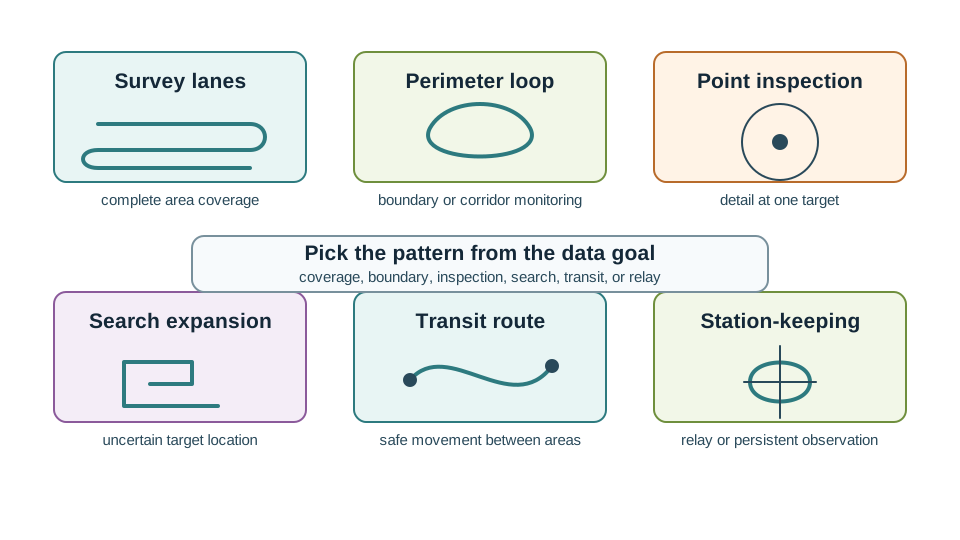
Mobile summary: Choose the pattern from the record the mission must produce, then check energy, avoidance, communications, and fallback before adding optional work.
The chapter's discipline is to turn mission choice into a record: what must be collected, what may be skipped, what conflict sources matter, what gate protects return energy, and how the next sortie learns from the last one.
34.4 Mission Readiness Packet
This section: Mission Readiness Packet — Keep the data goal, selected pattern, coverage assumptions, avoidance basis, energy gates, link and role state, skipped-work policy, fallback rule, and post-flight checks in one packet.
Keep the data goal, selected pattern, coverage assumptions, avoidance basis, energy gates, link and role state, skipped-work policy, fallback rule, and post-flight checks in one packet. Each field should answer a real readiness question.
Use the packet to compare alternatives. A perimeter loop may fit a fence inspection better than survey lanes. Station-keeping may preserve relay service but fail area coverage. Optional close-up photos should be cut before return reserve is threatened.
34.5 Avoidance Changes Mission Scope
This section: Avoidance Changes Mission Scope — Detect-and-avoid is not only a sensor event.
Detect-and-avoid is not only a sensor event. It changes the mission state: the route may widen, pause, detour, drop optional work, hand off a role, or return. Each maneuver can also change energy reserve, coverage quality, data freshness, and communication risk.
That is why the mission record keeps conflict sources, prediction windows, rejected maneuvers, gate decisions, fallback actions, and skipped areas visible. Without that state, a safe-looking path can hide why the mission no longer meets its data goal.
This section:
This section:
This section:
- A mission pattern is only useful when it matches the records the task needs.
- Avoidance is a decision loop, not a single sensor or a single distance number.
- Separation, altitude, airspace, and operating rules must come from the applicable operating context and local approval process.
- Coverage plans should record assumptions about footprint, overlap, turns, dwell, wind, and skipped areas.
- Mission completion should never spend return energy or ignore fallback behavior.
This section:
34.6 Prerequisites
This section: Prerequisites
Revisit these chapters if the terms are unfamiliar:
- UAV Energy-Aware Mission Planning: reserve gates, return feasibility, and mission scope decisions.
- UAV Trajectory Control: bounded path adjustment and decision records.
- UAV Swarm Coordination: role ownership, handoff, and multi-UAV coordination.
- FANET Fundamentals: aerial links, gateway exits, and routing trade-offs.
34.7 How This Chapter Fits
This section: How This Chapter Fits — Energy planning decides whether the mission should proceed.
Energy planning decides whether the mission should proceed. Trajectory control decides how to adjust the path. Mission and avoidance planning decides which path family is appropriate and how the aircraft should remain safe while executing it.
The overview depth layer shows the mission pattern map that anchors survey, perimeter, point-inspection, search, transit, and station-keeping choices to the data goal.
34.8 Mission Pattern Selection
This section: Mission Pattern Selection — Choose a pattern from the mission records, not from habit.
Choose a pattern from the mission records, not from habit. The same area may need different paths depending on whether the goal is mapping, inspection, relay, search, delivery, or repeated monitoring.
34.8.1 Survey lanes
Parallel lanes provide systematic area coverage.
Use when the data goal is complete coverage with a known footprint and overlap policy.
Planning risk: turns, wind drift, terrain change, and weak overlap assumptions can create gaps.
34.8.2 Perimeter loop
A loop or racetrack follows a boundary, road, fence, pipeline, river, or incident perimeter.
Use when the data goal is repeated observation of a line or boundary.
Planning risk: the route may over-serve easy segments and under-serve high-risk turns or occluded areas.
34.8.3 Point inspection
Short approach, dwell, orbit, or spiral patterns gather focused records at a site.
Use when detail matters more than area coverage.
Planning risk: dwell time can erode reserve and may expose the aircraft to obstacles or local wind effects.
34.8.4 Search expansion
Expanding square, sector, or probability-weighted paths grow from a starting region.
Use when likely locations are uncertain and data value changes over time.
Planning risk: a simple geometric expansion can ignore updated information or blocked areas.
34.8.5 Transit route
Point-to-point motion moves the aircraft between mission areas or gateway positions.
Use when the main goal is reaching a place safely and efficiently.
Planning risk: shortest routes can hide airspace, obstacle, communication, and return-energy constraints.
34.8.6 Station-keeping
Holding position or a small patrol preserves relay, observation, or gateway service.
Use when the mission needs stable presence more than broad movement.
Planning risk: holding can drain energy and leave other areas uncovered.
34.9 Detect-And-Avoid Loop
This section: Detect-And-Avoid Loop — Detect-and-avoid should be treated as a bounded loop with named records and fallback behavior.
Detect-and-avoid should be treated as a bounded loop with named records and fallback behavior. The exact sensors and separation thresholds depend on aircraft, operating context, approval basis, environment, and mission risk. The traceable structure is more durable than any single universal number.
Inspect Figure 34.1 and look for the gate that can reject an apparently clear avoidance maneuver.
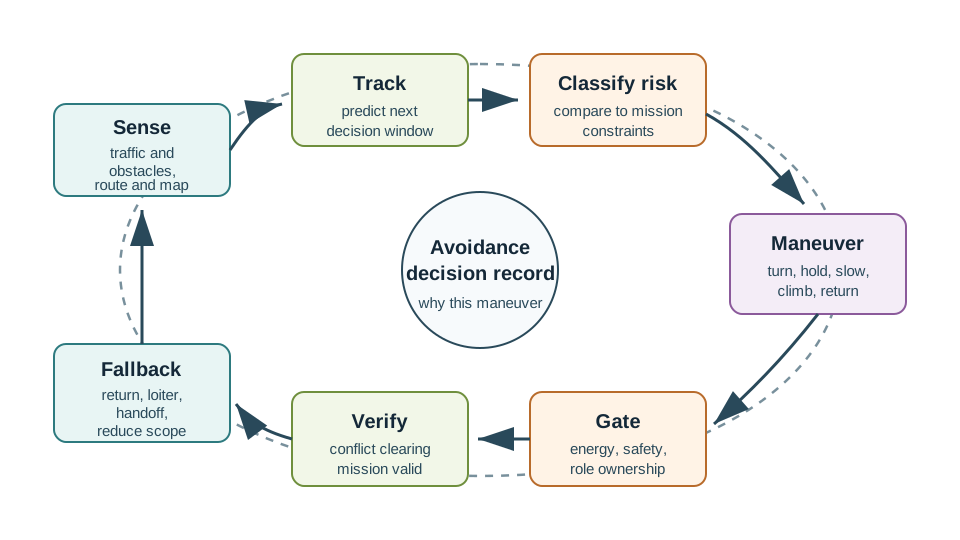
Follow Figure 34.1 from sensor and peer records to track, risk, and route choice. The aircraft may slow, stop, climb, fall, turn, widen its path, wait, hand off, or return. The next gate rejects a move that breaks the energy reserve, route bounds, payload state, or control rights. A check then asks whether space is growing and the mission remains safe. If the risk stays, use a saved fallback such as return, safe wait, smaller scope, or task transfer. Keep the source, time window, rejected moves, gate result, missed area, and fallback in the record. Avoidance is a governed choice, not a blind turn.
- Sense: collect relevant records from onboard sensors, cooperative signals, map constraints, route state, and operator context where available.
- Track: estimate where the aircraft, obstacles, and other traffic are likely to be during the next decision window.
- Classify risk: compare predicted conflict against the mission’s approved separation, geofence, altitude, and operating constraints.
- Choose a maneuver: slow, stop, climb, descend, turn, widen route, hold, hand off, or return.
- Gate the maneuver: reject a maneuver that violates energy reserve, path constraints, payload state, or role ownership.
- Verify: confirm that the conflict is clearing and the mission can continue.
- Record fallback: if the conflict persists, return, loiter at a safe point, reduce scope, or transfer the task.
Do not hardcode one separation distance into every mission document. A small indoor test, a closed field exercise, a low-altitude inspection, and an approved airspace operation have different constraints. The mission record should cite the rule source, approval basis, safety case, geofence, and operational envelope used for that flight.
34.10 Coverage Record
This section: Coverage Record — Coverage planning should produce a record that another planner can inspect.
Coverage planning should produce a record that another planner can inspect. The core calculation is simple, but the assumptions around it matter.
Track spacing should follow the ground footprint and the planned overlap fraction; tighter overlap means closer lanes and more flight time.
Use Figure 34.2 to connect sensor footprint and overlap to the route estimate. The pattern makes lane distance visible, but turn distance, dwell time, and the protected return allowance must still be included in the mission budget.
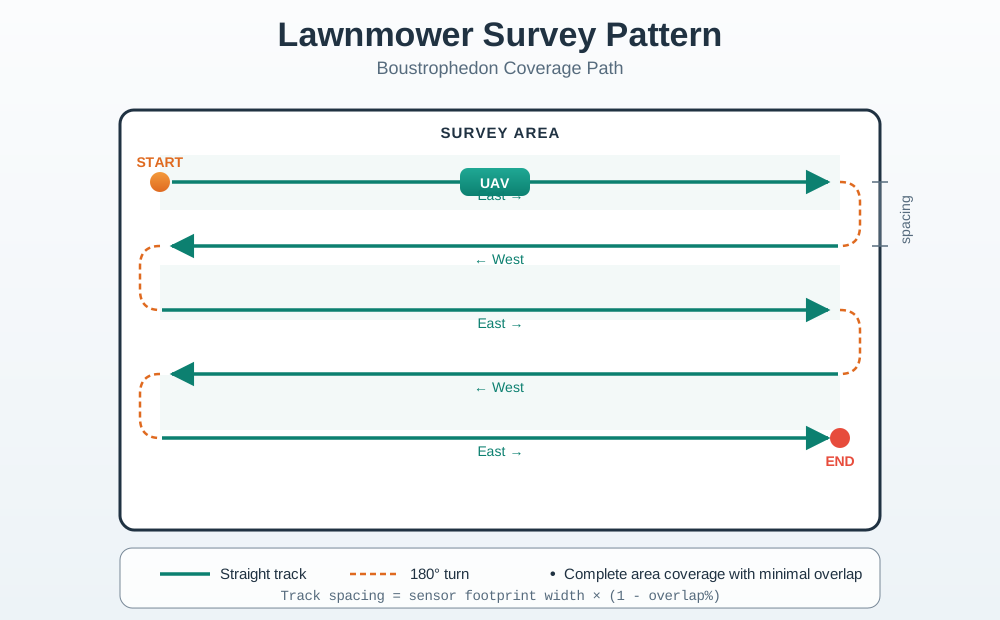
Read Figure 34.2 from the first parallel track across the survey area, follow the alternating turns, and compare adjacent lanes against the footprint width and required overlap. Narrower spacing improves coverage margin but adds distance and turns; wider spacing saves energy but risks gaps. Carry the chosen spacing, turn allowance, reserve, and abort trigger into the mission record.
Footprint records Record how footprint was estimated and what changes it: altitude, sensor field of view, payload mode, ground relief, and stabilization.
Overlap policy State why the selected overlap is enough for the task. Mapping, inspection, thermal screening, and search do not need the same policy.
Route estimate Include lane length, turn overhead, climb and descent, dwell time, return route, and no-fly or obstacle detours.
Quality gate Define what counts as acceptable coverage and what will trigger a re-fly, skipped-area note, or alternate collection.

34.11 Lab Practice: Build A Mission Record
This section: Lab Practice: Build A Mission Record — Use this practice workflow for a survey, inspection, or search mission.
Use this practice workflow for a survey, inspection, or search mission. It avoids pretending that one set of numbers applies to every aircraft.
Run it: Before you write the coverage assumptions in step 3, make the pattern real in the coverage workbench below instead of guessing numbers. Select a scenario preset (Field survey, Solar inspection, Search grid, or Emergency map) to match your data goal, choose a Route pattern (Lawnmower, Spiral, or Sector), then press Play or Step and read the footprint, route length, turn overhead, coverage, and skipped-area metrics. Carry those observed values into the pattern choice (step 2) and the coverage assumptions (step 3) of your mission record; keep the avoidance, energy-gate, and post-flight reasoning on the steps below.
- Define the data goal: complete map, boundary condition, detailed inspection, relay uptime, search probability, or transit.
- Choose a pattern: survey lanes, perimeter loop, point inspection, search expansion, transit, or station-keeping.
- Record coverage assumptions: footprint, overlap, path spacing, altitude envelope, route constraints, and quality gate.
- Add avoidance records: conflict sources, sensor limits, geofence, operating rules, approved separation basis, and fallback behavior.
- Apply energy gates: launch gate, segment gate, dwell gate, scope gate, and return gate.
- Define post-flight outputs: flown path, skipped regions, avoidance events, battery behavior, data-quality result, and corrective action.
A team must inspect a corridor after a storm. The required records are damage location and passable access route, not high-resolution mapping of every surface. The team chooses a perimeter-style route along the corridor with short point-inspection dwells at suspected damage sites.
The mission record lists mandatory segments, optional extra photos, blocked areas, return points, and dwell limits. If wind or conflict records increase, the aircraft skips optional close-up photos before the return gate is threatened. After flight, the team checks actual path, skipped sites, image quality, avoidance events, and reserve at landing before planning the next sortie.
34.12 Mission Readiness Checklist
This section: Mission Readiness Checklist
Pattern fit The chosen pattern matches the data goal and does not over-collect low-value data.
Avoidance basis The plan states the relevant conflict sources, operating limits, separation basis, and fallback behavior.
Energy gates Return feasibility survives the selected route, dwell time, and optional work.
Coverage record Footprint, overlap, path spacing, route estimate, quality gate, and skipped-area handling are documented.
Communication and role state Gateway reachability, handoff ownership, and lost-link behavior are defined before launch.
Post-flight records The plan identifies which logs and observations will update the next mission.
34.13 Common Pitfalls
This section: Common Pitfalls
Using a favorite pattern for every mission. Survey lanes are useful for coverage, but they can be wasteful for boundary inspection, point inspection, or relay work.
Treating avoidance as one sensor. A sensor is only part of the loop. The plan also needs prediction, risk classification, maneuver choice, energy gate, verification, and fallback.
Hardcoding separation values without context. Separation and altitude assumptions must be tied to the operating context, approval basis, route, aircraft, and environment.
Ignoring dwell and turn overhead. A route can pass straight-line distance checks while failing because turns, loitering, retries, and inspection dwells consume time and energy.
Failing to record skipped work. Skipped regions and optional tasks are not failures when they are part of the plan. They become failures when nobody records what was skipped and why.
34.14 Concept Relationships
This section: Concept Relationships
34.14.1 Mission pattern and data goal
The pattern should be selected from the data needed: coverage, boundary monitoring, inspection detail, search probability, transit, or relay service.
34.14.2 Avoidance loop and fallback
Avoidance decisions should leave a record of detected conflict, selected maneuver, rejected maneuver, safety gate, energy gate, and fallback action.
34.14.3 Coverage record and quality gate
Coverage is not only path length. It also depends on footprint, overlap, ground relief, data quality, skipped areas, and re-fly policy.
34.14.4 Energy gate and mission scope
Optional photos, extra passes, and long station-keeping should be cut before return energy is threatened.
34.15 Interactive Checks
This section: Interactive Checks
This section:
This section:
34.16 Summary
This section: Summary — UAV mission and avoidance planning connects the task goal to a pattern, a coverage record, an avoidance loop, an energy gate, and a fallback plan.
UAV mission and avoidance planning connects the task goal to a pattern, a coverage record, an avoidance loop, an energy gate, and a fallback plan. The chapter’s main discipline is traceability: every mission should explain why the pattern was chosen, which records must be collected, what can be skipped, how conflicts are handled, and how the next plan will learn from the last flight.
34.17 See Also
This section: See Also
34.17.1 UAV Energy-Aware Mission Planning
UAV Energy-Aware Mission Planning: reserve gates and scope decisions.
34.17.2 UAV Trajectory Control
UAV Trajectory Control: path adjustment and decision records.
34.17.3 UAV Swarm Coordination
UAV Swarm Coordination: multi-UAV role ownership and handoff.
34.17.4 UAV Trajectory Labs and Implementation
UAV Trajectory Labs and Implementation: implementation practice after the planning concepts are clear.
34.17.5 Energy-Aware Design
Energy-Aware Design: broader energy-constrained system design.
34.18 What’s Next
This section: What’s Next
34.18.1 Multi-UAV trajectory coordination
34.18.2 Trajectory implementation labs
34.18.3 Hardware simulation lab
34.18.4 UAV production checks
34.19 Key Takeaway
This section: Key Takeaway — Mission trajectory labs should validate path assumptions, link availability, data delivery, energy reserve, and safety constraints.
Mission trajectory labs should validate path assumptions, link availability, data delivery, energy reserve, and safety constraints. Logs and telemetry are the records that show the plan works.
Find help
3 reviewed answers.
Where should I start in a module?
Open the module page from the sidebar to see its chapters in order. Use the module map to return to a topic you need.
Modules and pathsReviewed
What can I try when a project does not work?
Check the symptom, then work through the diagnostic steps. Keep the error message and the smallest example that reproduces it.
When you are stuckReviewed
How do interactive examples work?
Use the interactive guide to check how examples and simulations work before changing your project.
Interactive examples guideReviewed