30 FANET Gateway Optimization
More
Depth: Practitioner
Progress saves as you read. Mark sections complete as you go; your progress appears in the sidebar.
30.1 Start Simple
This section: Start Simple — A gateway means the boundary system that joins the aerial devices to another network or service.
Choose One Relay and Prove the Handoff
A gateway means the boundary system that joins the aerial devices to another network or service.
Start with a mission that moves, loses energy, and changes its radio path while it works. In FANET Gateway Optimization, the practical question is what the aircraft must sense, relay, decide, and prove before the flight or network role is safe enough to trust.
Select among two aircraft, then weaken the ground link, drain one battery, add load, and force a handoff. Keep candidate identities, positions, energy, peer and ground links, gateway score, rule version, selection, rejection reasons, buffered data, and handoff result.
This mission test covers chosen conditions, not every flight or failure. The deeper sections compare selection metrics, single and layered gateways, hold-down rules, buffering, handoff, and audit logs.
30.2 Learning Objectives
This section: Learning Objectives
By the end of this chapter, you will be able to:
- Explain why a FANET uses selected gateway UAVs instead of asking every UAV to reach the ground directly.
- Build a gateway candidate record using ground-link, peer-reachability, energy, motion, load, and handoff records.
- Compare single-gateway, multi-gateway, and layered gateway patterns without relying on brittle fixed ratios.
- Describe how hold-down rules and handoff preparation reduce route flapping.
- Check gateway decisions after a mission using logs that explain selection, rejection, buffering, and handoff outcomes.
30.3 Overview: Gateways Are Two-Sided Bridges
This section: Overview: Gateways Are Two-Sided Bridges — If you only need the decision rule, use this layer: a FANET gateway is ready only when it can still serve both sides of the bridge, the aerial peers and the ground or backhaul exit.
If you only need the decision rule, use this layer: a FANET gateway is ready only when it can still serve both sides of the bridge, the aerial peers and the ground or backhaul exit.
Figure 30.3 shows a FANET gateway bridges the aerial mesh and the ground-control and backhaul paths.
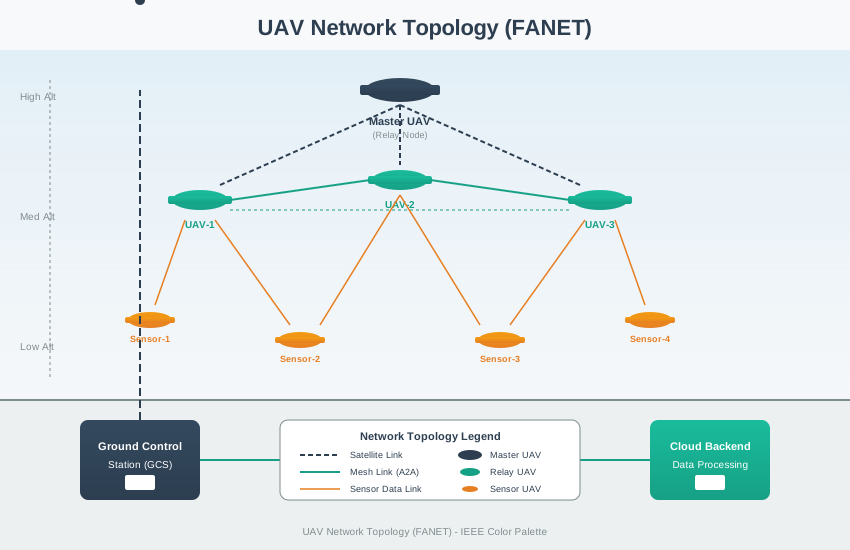
Mobile summary: A gateway candidate is useful only when it can bridge peer traffic to the exit path, carry the relay load safely, and hand off before the role becomes unstable.
Ground side
Check the current exit path, expected movement, load, priority traffic, and whether the ground-facing link will remain useful.
Aerial side
Check peer reachability, neighbor freshness, route cost, and whether the gateway choice strands a UAV sub-area.
Handoff side
Name the overlap window, hold-down rule, replacement candidate, buffered traffic behavior, and decision log fields.
30.4 Practitioner: Build The Handoff Record
This section: Practitioner: Build The Handoff Record — For the utility corridor example, Candidate B wins because it protects the whole path during the next segment, not because it has the strongest single measurement.
For the utility corridor example, Candidate B wins because it protects the whole path during the next segment, not because it has the strongest single measurement.
Selected candidate
Record Candidate B's ground link, peer reachability, energy reserve, motion path, load, and overlap window with the current gateway.
Rejected candidate
Record Candidate A as rejected for weak peer reachability, with the condition that would reopen it: peer routing improves or the mission path changes.
Traffic shift
Move urgent control and status first, keep low-priority buffered data bounded, and log any delivery gap during the overlap.
30.5 Under the Hood: Why Gateways Flap
This section: Under the Hood: Why Gateways Flap — Gateway flapping happens when the selection rule reacts to small record changes faster than the network can stabilize.
Gateway flapping happens when the selection rule reacts to small record changes faster than the network can stabilize.
- Measurement noise: two candidates alternate because each briefly looks better on one link metric.
- One-sided scoring: the selected gateway optimizes ground signal while peer reachability or queue load degrades.
- Late handoff: the team waits for failure, then shifts traffic while routes and buffers are already unstable.
- Missing log fields: the mission cannot explain whether the change protected delivery or only moved the bottleneck.
This section:
This section:
This section:
- A gateway is an aerial bridge between the FANET and a ground or backhaul network.
- A good gateway candidate must be useful to both sides: the ground exit and the aerial peers.
- Scores are optional tools; record quality and mission priority matter more than memorizing one set of weights.
- Gateway handoff should begin before the current gateway fails, and the reason for the handoff should be logged.
This section:
30.6 Prerequisites
This section: Prerequisites
Before continuing, revisit these chapters if any of the terms are unfamiliar:
- FANET Fundamentals: explains aerial link types, topology records, routing choices, and store-carry-forward behavior.
- UAV FANETs and Integration: shows how FANETs connect to ground systems, vehicles, and mission records.
- UAV Fundamentals and Topologies: introduces UAV network roles, formations, and constraints.
- Multi-Hop Fundamentals: covers relay paths and path maintenance.
30.7 What a FANET Gateway Does
This section: What a FANET Gateway Does — A gateway UAV performs two jobs at once.
A gateway UAV performs two jobs at once. It remains part of the aerial network, and it maintains an exit path toward a non-aerial system. That second job may use a ground station, a field gateway, a vehicle-side relay, satellite equipment, or another backhaul link depending on the mission.
The gateway role changes the traffic pattern:
30.7.1 Direct peer traffic
UAVs exchange telemetry, alerts, and neighbor records with other aerial nodes. The gateway must not break this local path while serving the ground exit.
30.7.2 Aggregated upload
The gateway may forward summaries, event messages, or buffered data from several peers. Its load can rise faster than a normal relay node.
30.7.3 Ground-facing control
Some missions send commands, task updates, or safety-relevant acknowledgments through the gateway. These flows need priority and traceability.
30.7.4 Handoff responsibility
When the gateway is no longer a good bridge, it should prepare another candidate before the old path becomes unusable.
The overview depth layer shows the two-sided gateway role map that anchors the peer, ground, load, and handoff responsibilities.
30.8 Candidate Records
This section: Candidate Records — Gateway selection is a record-quality problem.
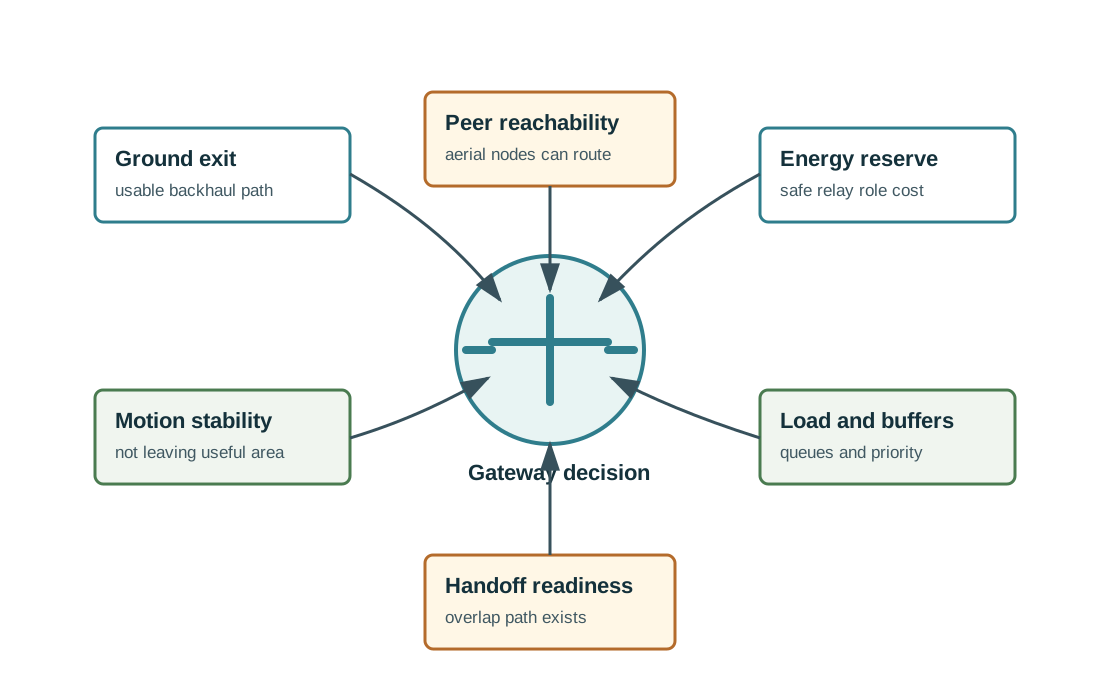
Gateway selection is a record-quality problem. A candidate that has a strong ground link but cannot reach its peers is not a good gateway. A candidate in the center of the aerial group but with a weak ground exit is also risky. The selection record should explain the tradeoff.
30.8.1 Ground exit quality
Record whether the candidate can reach the ground or backhaul path now, and whether that link is likely to remain useful for the next mission segment.
30.8.2 Peer reachability
Check whether nearby UAVs can reach the candidate directly or through a short aerial path. The gateway should not strand a sub-area.
30.8.3 Energy reserve
Gateway duty usually means extra relay work. The candidate needs enough reserve to serve the role and still leave the mission safely.
30.8.4 Motion stability
The candidate should not be about to turn, descend, leave the area, or lose line of sight unless another gateway is already ready.
30.8.5 Load and buffers
Track current relay load, queued traffic, and priority classes. A less central node may be better if the central node is overloaded.
30.8.6 Handoff readiness
A candidate is more valuable when it can overlap with the current gateway long enough to shift traffic cleanly.
30.9 Selection Patterns
This section: Selection Patterns — There is no single correct number of gateways for every FANET.
There is no single correct number of gateways for every FANET. The right pattern depends on mission shape, coverage area, ground receiver capacity, traffic priority, and how much redundancy is needed.
30.9.1 Single gateway
Useful for small or short missions where one UAV can reach the ground and peers reliably. It is simple, but it creates one fragile exit path.
30.9.2 Multiple gateways
Useful when the aerial team covers a wider area, carries mixed traffic, or needs redundancy. Selection must avoid overlapping gateways that compete for the same ground path.
30.9.3 Layered gateway
Useful when altitude layers or mission roles differ. A lower UAV may collect local data while a higher UAV provides the stronger exit path.
30.9.4 Mobile collector
Useful when a continuous path is unavailable. The gateway role may move with the UAV that can later deliver buffered data.
30.9.5 Named Algorithm: Distributed Sub-Area Gateway Selection
Luo et al. (2015) describe a published instantiation of the multi-gateway and layered-gateway patterns above: a distributed gateway-selection algorithm for UAV networks. Instead of scoring every UAV against one global rule, the whole coverage area is partitioned into sub-areas that together cover the full communication area, and each sub-area elects its own gateway starting from whichever node inside it is currently most stable. The partition boundaries are not fixed either: sub-area size is adjusted dynamically from UAV-interconnection and topology metrics, and those metrics are re-optimized over several iterations until the partition settles into a stable state. The algorithm stays distributed because each UAV only needs to hold information about the UAVs within its own 2-hop neighborhood to take part in this local election, rather than depending on a global view. That 2-hop neighbor requirement is a concrete version of the peer-reachability record above: it is exactly the evidence a candidate needs before it can be trusted as a sub-area’s gateway.
30.9.6 When a Score Helps
A score can help compare candidates, but the weights must be a design decision, not a universal rule. A practical selection process is:
- Screen out unsafe candidates: reject candidates without a usable exit path, peer path, or energy reserve.
- Compare records: rank the remaining candidates using mission-specific priorities.
- Check handoff cost: prefer a candidate that can overlap with the current gateway before traffic shifts.
- Record the reason: store why the candidate was selected and why alternatives were rejected.
For example, a mission with urgent alerts may weigh ground exit quality and peer reachability more heavily. A sparse sensing mission may accept slower delivery and prioritize energy reserve plus buffer capacity.
30.10 Handoff and Reselection
This section: Handoff and Reselection — Gateway handoff should be proactive.
Gateway handoff should be proactive. Waiting until the gateway disappears from the network turns a controlled handoff into a failure recovery event.
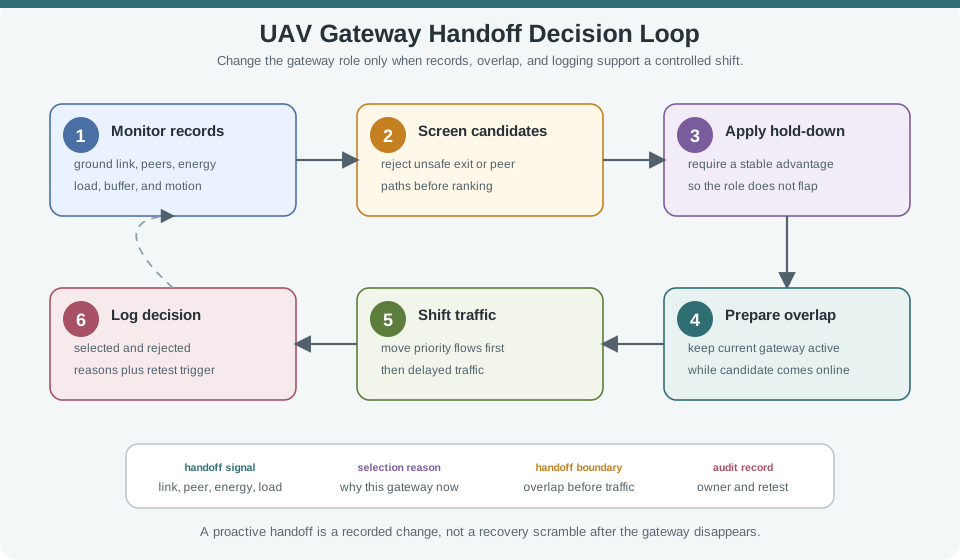
Common handoff signals include:
- The current gateway ground link is degrading.
- Peer reachability through the gateway is shrinking.
- The gateway is approaching an energy reserve limit.
- Traffic load is building faster than the gateway can forward.
- The flight plan indicates the gateway will soon leave the useful area.
- A better candidate has remained better long enough to avoid flapping.
The last point matters. Without a hold-down or hysteresis rule, two similar candidates can trade the role repeatedly. That route flapping burns control traffic and makes logs harder to interpret. The rule does not need to be a fixed percentage; it only needs to be explicit, tested, and appropriate for the mission.
30.11 Inspection Team Ground Exit
This section: Inspection Team Ground Exit — Scenario: A UAV team is inspecting a damaged utility corridor.
Scenario: A UAV team is inspecting a damaged utility corridor. Three UAVs are collecting local observations, one UAV is closer to the field gateway, and another UAV will soon pass through a better line-of-sight position.
Gateway decision record:
30.11.1 Current gateway
The current gateway has a usable ground exit but rising buffer load. It can remain active long enough for an overlap handoff.
30.11.2 Candidate A
Candidate A has the best ground view but weak peer reachability. It would strand one inspection UAV unless routing changes first.
30.11.3 Candidate B
Candidate B has slightly lower ground-link quality, better peer reachability, enough energy reserve, and a predictable path through the next segment.
30.11.4 Decision
Candidate B is selected for planned handoff. Candidate A remains a backup only if peer routing improves or the mission path changes.
Result: The design chooses the candidate that protects the whole path, not merely the candidate with the strongest ground-facing signal. The handoff log records peer reachability, load state, the overlap window, and the rejected candidate reason.
30.12 Readiness Checklist
This section: Readiness Checklist
Use this checklist before accepting a FANET gateway design:
30.12.1 Candidate quality
- Is the ground exit current and useful? Check whether the candidate can reach the ground or backhaul now and whether that path is likely to remain useful through the next mission segment.
- Can aerial peers reach the candidate? Check direct reachability or a short aerial path. A strong ground link does not make a useful bridge if peers cannot send traffic through it.
- Is the candidate about to leave the useful area? Review motion and route intent alongside link records. An approaching turn, descent, or loss of line of sight should prompt handoff preparation before the path becomes unusable.
30.12.2 Role cost
- Does gateway duty fit the energy reserve? Account for the extra relay work associated with serving aerial peers and the ground exit. The candidate needs enough reserve for that role and for leaving the mission safely.
- Is relay load visible? Track current forwarding load and queued traffic together. A central position may be less useful when the candidate is overloaded, so reachability alone should not settle selection.
- Are buffers tied to traffic priority? Record priority classes alongside queue state so forwarding decisions reflect mission needs. Lower-priority data may wait while urgent traffic receives attention, and growing queues can signal a need for handoff.
30.12.3 Handoff
- Is there a planned overlap path? Check whether the current gateway and its replacement can remain useful long enough to shift traffic. Preparing this overlap before the old path fails supports a controlled handoff.
- Is there a hold-down rule to avoid flapping? Similar candidates can repeatedly exchange the role as measurements change. Use an explicit, tested rule suited to the mission to reduce those repeated changes and their control traffic.
- Are fallback candidates known? Keep their ground links, peer reachability, energy reserve, and handoff readiness visible. A backup remains useful only while its records support the role, so record the conditions that affect its suitability.
30.12.4 Decision records
- Are selection and rejection reasons logged? Connect the chosen candidate to the ground link, peer reachability, energy, motion, and load records that supported the decision. Rejected alternatives help explain the tradeoff later.
- Are stale measurements expired? Candidate quality depends on current records. Keep measurement freshness visible so an earlier useful path does not continue to support selection after conditions change.
- Can the mission log explain delivery failures? Link selection decisions with buffered data and handoff outcomes. These records help reviewers examine whether a delivery gap accompanied shrinking peer reachability, a degrading ground exit, rising load, or an unsuccessful handoff.
30.13 Knowledge Check
This section: Knowledge Check
30.14 Common Pitfalls
This section: Common Pitfalls
The best ground-facing link can still be a poor gateway if aerial peers cannot route through it. Check both sides of the bridge.
Scores are useful only when their inputs and weights match the mission. Document why a scoring rule fits the current traffic and safety priorities.
A gateway can become the busiest UAV in the team. Monitor queue state, priority traffic, and whether lower-priority data should wait.
A gateway handoff should be prepared before the old gateway disappears. Overlap makes the transition traceable and less disruptive.
When a candidate is not selected, record why. Rejection reasons help explain later routing gaps and improve future mission planning.
30.15 Concept Relationships
This section: Concept Relationships
- FANET gateway connects aerial forwarding to a ground or backhaul path.
- Candidate records combine ground link, peer reachability, energy reserve, motion, load, and handoff readiness.
- Selection pattern decides whether one, multiple, layered, or mobile gateways fit the mission.
- Hold-down rule prevents repeated gateway changes from small measurement swings.
- Handoff log makes gateway decisions traceable after the mission.
30.16 Further Reading
This section: Further Reading
- MANET and FANET routing literature for gateway election and multi-hop route maintenance concepts.
- Delay-tolerant networking literature for buffered delivery when no continuous exit path exists.
- Geographic routing literature for position-aware relay and gateway-candidate decisions.
- UAV operations guidance from the relevant operating authority for command, control, reserve energy, and safety responsibilities.
30.17 Summary
This section: Summary — FANET gateway optimization is the process of choosing which UAVs bridge the aerial network to ground or backhaul systems.
FANET gateway optimization is the process of choosing which UAVs bridge the aerial network to ground or backhaul systems. A strong design avoids one-size-fits-all thresholds. It screens candidates, compares current records, protects peer reachability, monitors role cost, prepares handoff before failure, and logs the decision so the mission can be checked.
30.18 What’s Next
This section: What’s Next
- FANET-VANET Integration: connect aerial gateways to vehicle and roadside systems.
- FANET Fundamentals: revisit the topology and routing records behind this chapter.
- UAV FANETs and Integration: revisit the broader route map for aerial and ground handoffs.
- UAV Networks: Production Checks: consolidate UAV network readiness practice.
30.19 Key Takeaway
This section: Key Takeaway — Select UAV gateways by coverage, latency, backhaul, handoff behavior, energy reserve, and mission priority.
Select UAV gateways by coverage, latency, backhaul, handoff behavior, energy reserve, and mission priority. A gateway is useful only while it remains reachable and operational.
Find help
3 reviewed answers.
Where should I start in a module?
Open the module page from the sidebar to see its chapters in order. Use the module map to return to a topic you need.
Modules and pathsReviewed
What can I try when a project does not work?
Check the symptom, then work through the diagnostic steps. Keep the error message and the smallest example that reproduces it.
When you are stuckReviewed
How do interactive examples work?
Use the interactive guide to check how examples and simulations work before changing your project.
Interactive examples guideReviewed