32 UAV Trajectory Control
More
Depth: Practitioner
Progress saves as you read. Mark sections complete as you go; your progress appears in the sidebar.
32.1 Start Simple
This section: Start Simple — Picture a small aircraft carrying a medicine pack across a flooded area.
Keep One Flight Inside a Safe Choice
Picture a small aircraft carrying a medicine pack across a flooded area. Wind rises, the radio path fades, and the battery falls faster than planned. The pilot and flight system must decide whether to continue, change course, hand off the link, or return.
Write the mission as a set of limits. Name the route, load, safe height, no-fly areas, energy reserve, link need, landing choices, and person who can stop the flight. Keep planned and measured state apart so later review can show when the plan stopped matching the air.
Test wind, blocked position fixes, a lost link, weak energy, a changed landing site, and a delayed command. Check that the aircraft chooses a known safe state when inputs disagree. A smooth path on a screen is not proof that the real flight has room to recover.
Keep the immediate return or landing choice on the aircraft when a remote service cannot answer in time. Send history upward for fleet study, but never make a time-bound safety move wait for a distant link.
This opening does not approve an airframe or route. Practitioner builds the mission and evidence ledger. Under the Hood examines path choice, state estimates, link handoff, energy cost, and the limits used by the control law.
Use a short release check. Is the route clear? Is the energy reserve real? Can the craft land without a link? Does the pilot know who may stop the trip? Can the team replay each choice? If any answer is no, the flight plan is not ready.
Start with a mission that moves, loses energy, and changes its radio path while it works. In UAV Trajectory Control, the practical question is what the aircraft must sense, relay, decide, and prove before the flight or network role is safe enough to trust.
32.2 Learning Objectives
This section: Learning Objectives
By the end of this chapter, you will be able to:
- Explain how UAV trajectory control connects mission objectives, network records, safety constraints, and energy reserve.
- Compare waypoint shift, orbit center shift, radius change, dwell-time control, altitude adjustment, and station-keeping.
- Distinguish a network problem from an energy, payload, gateway, or safety problem before moving the aircraft.
- Build a trajectory adjustment record with selected and rejected actions.
- Define fallback behavior when a path update cannot be executed safely.
32.3 Overview: Make One Bounded Path Change
This section: Overview: Make One Bounded Path Change — If you only need the operating rule, this layer is enough: trajectory control should classify the problem, change one bounded part of the path, and preserve the records that keep the aircraft useful and safe.
If you only need the operating rule, this layer is enough: trajectory control should classify the problem, change one bounded part of the path, and preserve the records that keep the aircraft useful and safe.
Figure 32.3 shows records, classification, safety checks, execution, verification, and fallback bound trajectory changes.
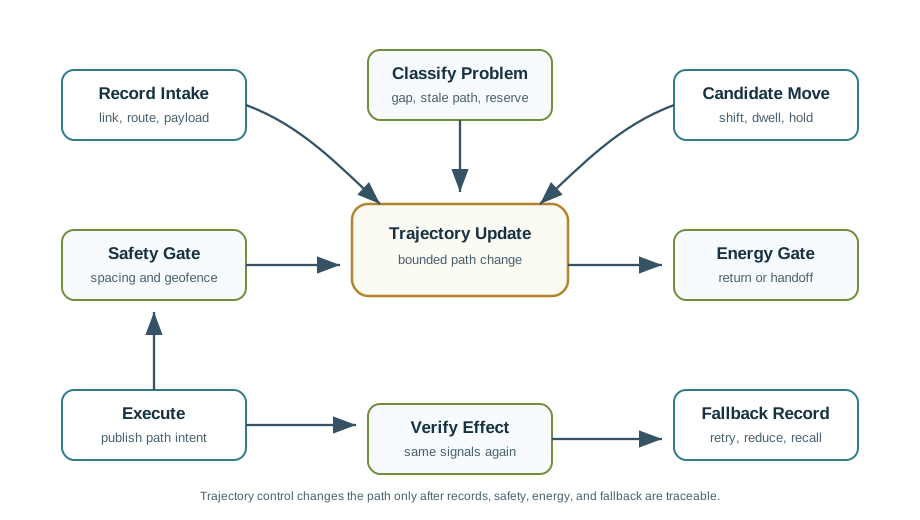
Mobile summary: Make one bounded path change, verify the same records again, and use the fallback before energy or safety margin is spent.
Classify
Name the pressure first: stale status, weak gateway, payload backlog, low reserve, route conflict, coverage gap, or safety constraint.
Adjust
Choose a waypoint shift, dwell change, orbit shift, altitude band, route spacing change, or station-keeping behavior that targets that pressure.
Verify
Compare the same records after the move, then keep, reverse, reduce, hand off, buffer, or recall the mission according to the fallback rule.
32.4 Corridor Relay Record
This section: Corridor Relay Record — For the utility corridor example, the useful record is a small decision trace.
For the utility corridor example, the useful record is a small decision trace. It explains why the aircraft moved, what it refused to change, and how the team will know whether the adjustment worked.
32.5 Why Trajectory Control Oscillates
This section: Why Trajectory Control Oscillates — A trajectory controller becomes unstable when it reacts to every noisy record as if it were a mission fact.
A trajectory controller becomes unstable when it reacts to every noisy record as if it were a mission fact. The safe design separates fast flight stabilization from slower mission-level path changes.
- Measurement noise: one stale link sample should not trigger a large route change without confirming gateway, payload, energy, and safety context.
- Coupled effects: a dwell that helps urgent status can drain reserve, delay later tasks, and grow the payload queue.
- Exit-path risk: moving toward a weak segment can break the gateway-facing leg unless the record keeps that path explicit.
- Fallback timing: if the controller waits too long to reduce, hand off, or recall, the aircraft may spend the reserve that made fallback possible.
This section:
This section:
This section:
- A trajectory is not just a path; it is a time-ordered motion plan tied to mission records.
- Trajectory changes should not be triggered by one weak metric alone. Link, gateway, payload, energy, safety, and mission context must be checked together.
- Slowing, hovering, widening a route, or shifting an orbit can improve one area while harming energy reserve, coverage elsewhere, or gateway reachability.
- A safe controller separates fast flight stabilization from slower mission-level path adjustment.
- Every trajectory update should leave a decision record that explains why the move was made and what will cause the next check.
This section:
32.6 Prerequisites
This section: Prerequisites
Revisit these chapters if the terms are unfamiliar:
- UAV Network Topologies: topology choices, gateway exits, and physical link records.
- UAV Swarm Coordination: task ownership, formation behavior, and state freshness.
- FANET Fundamentals: aerial ad hoc links and routing choices.
- UAV Energy-Aware Mission Planning: battery reserve, return planning, and energy constraints.
32.7 How This Chapter Fits
This section: How This Chapter Fits — Topology decides who can talk to whom.
Topology decides who can talk to whom. Swarm coordination decides who owns each task. Trajectory control decides how the aircraft should move when current records show the plan is no longer good enough. This chapter focuses on the mission-level trajectory decisions that sit above low-level flight stabilization and below production readiness checks.
The overview depth layer shows the trajectory control loop that anchors record intake, problem classification, bounded trajectory update, safety gate, energy gate, execution, verification, and fallback record.
32.8 Control Loop
This section: Control Loop — A trajectory controller should make one bounded adjustment at a time, then verify whether the records improved.
A trajectory controller should make one bounded adjustment at a time, then verify whether the records improved. This keeps trajectory control from becoming an uncontrolled chase after noisy metrics.
- Collect records: link freshness, route state, gateway exit, payload queue, energy reserve, safety state, and mission progress.
- Classify the problem: coverage gap, stale link, gateway weakness, payload backlog, route conflict, low reserve, or safety risk.
- Generate candidate adjustments: shift waypoint, shift orbit center, change route spacing, adjust speed or dwell time, change altitude band, or station-keep.
- Apply safety and energy gates: reject any adjustment that violates separation, geofence, return reserve, role handoff, or payload constraints.
- Execute the bounded change: send the new trajectory intent and keep the previous safe behavior available.
- Verify the effect: compare the same signals after the aircraft has had time to follow the new path.
- Record fallback: if the records do not improve, choose a different adjustment, reduce the mission, buffer data, hand off role, or recall.
32.9 Adjustment Strategies
This section: Adjustment Strategies — Trajectory control is not one algorithm.
Trajectory control is not one algorithm. It is a family of adjustments, each with a different failure mode.
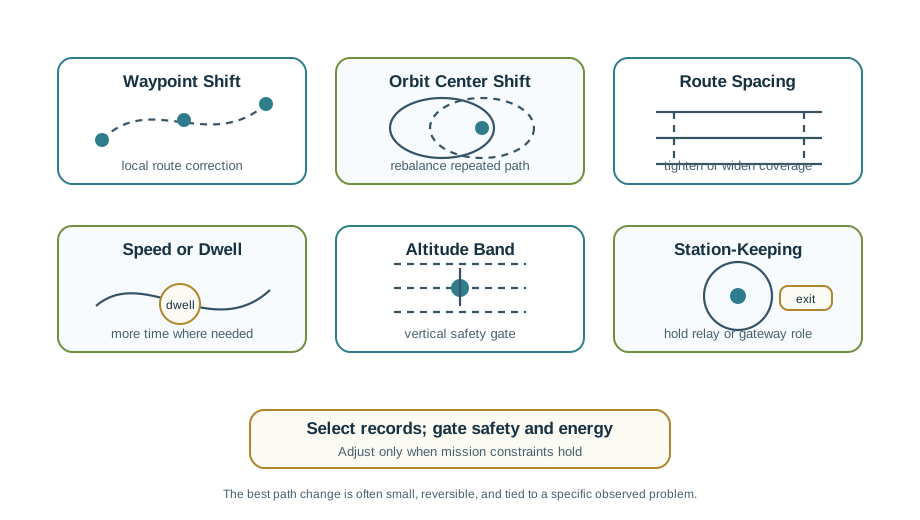
32.9.1 Waypoint shift
Move the next waypoint or small route segment toward a mission area that needs attention.
Use when the path is close to correct but one local area is under-served.
Check risk: a small shift may break the next gateway, safety, or task handoff assumption.
32.9.2 Orbit center shift
Move the center of a circular or racetrack path toward a persistent demand area.
Use when a repeated path should spend more useful time near one part of the mission area.
Check risk: improving one side of the orbit can weaken coverage or gateway reachability elsewhere.
32.9.3 Route spacing change
Widen or tighten path spacing for coverage, sensing, or relay quality.
Use when the issue is area coverage, repeated gaps, or too much duplicate path overlap.
Check risk: tighter spacing costs time and energy; wider spacing can hide missed areas.
32.9.4 Speed or dwell change
Slow down, speed up, or pause briefly over a section of interest.
Use when payload collection, link quality, or inspection confidence depends on time over an area.
Check risk: dwell time can consume energy and delay later tasks.
32.9.5 Altitude band change
Change altitude within the allowed mission envelope to improve visibility, link geometry, or separation.
Use when the route shape is acceptable but vertical position is part of the problem.
Check risk: altitude can affect coverage, payload quality, wind exposure, and separation rules.
32.9.6 Station-keeping
Hold a position or small patrol pattern to preserve relay, gateway, or observation service.
Use when current traffic needs a stable point more than broad movement.
Check risk: holding position can drain reserve and leave other tasks uncovered.
32.9.7 Named Algorithm: Queue-Triggered Radius and Center Adjustment
Fadlullah et al. (2016) describe a dynamic trajectory-control algorithm that grounds the orbit-center-shift and route-spacing-change strategies above in one concrete trigger: each UAV’s own relay-queue occupancy. When a UAV’s queue occupancy crosses a threshold, that UAV is treated as congested, and the resulting delay is attributed to the busy communication link it sits on. The ground control station reads that busy-link signal and issues the trajectory command: shift the orbit center toward the congested link to relieve it, or, when the goal is broader coverage rather than congestion relief, widen the orbit radius so the same aircraft reaches more of the area without adding a UAV. The published worked example moves a congested UAV’s orbit center by a bounded 20-meter step rather than a full re-plan, which is the same bounded-adjustment-then-verify discipline the control loop above already uses.
32.10 FANET Radius and Load Lab
This section: FANET Radius and Load Lab — Use the controls to rehearse the decision before a flight.
Use the controls to rehearse the decision before a flight. A single UAV can act as one aerial gateway, while a multi-UAV FANET can distribute sensing and relay work. A star keeps coordination simple but makes the center aircraft a dependency; a mesh offers alternate aerial paths but spends more airtime on coordination. Neither topology removes intermittent links, ground-gateway limits, or the need for a safe local fallback.
Before accepting the result, state which aircraft owns sensing, relay, and gateway roles; what happens when an aerial link disappears; which node may redistribute work; and how the aerial network reaches the ground service. A better toy score cannot authorize an unsafe or unobservable trajectory.
32.11 Trajectory Decision Record
This section: Trajectory Decision Record — The trajectory decision record is the artifact that prevents path changes from becoming untraceable behavior.
The trajectory decision record is the artifact that prevents path changes from becoming untraceable behavior. It should be compact enough to update during testing and precise enough to audit after a mission.
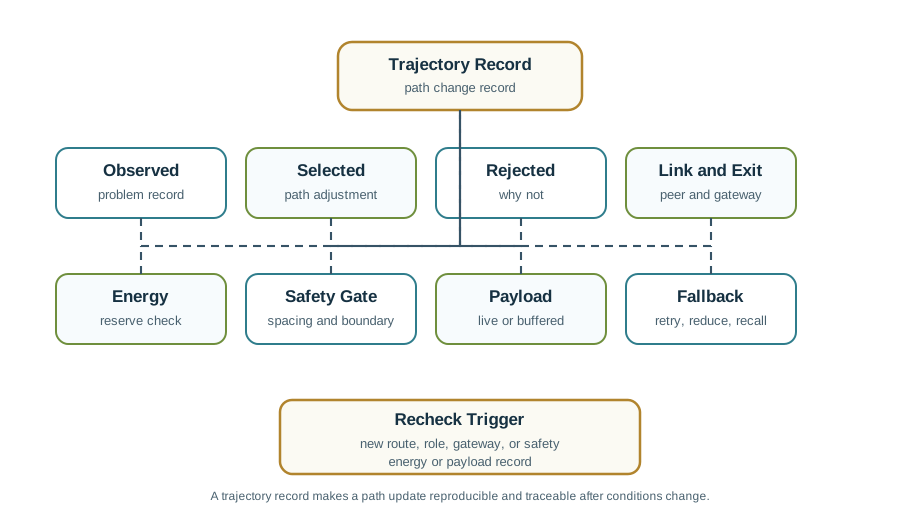
Observed problem What records show the current path is not good enough?
Selected adjustment What bounded path change will be tried first?
Rejected adjustment Which plausible adjustment was rejected, and why?
Link and gateway state Does the new path preserve the required peer, relay, or gateway exit?
Energy reserve Can the aircraft execute the change and still preserve return or role-handoff reserve?
Safety gate Does the change respect separation, geofence, altitude, obstacle, and operator constraints?
Payload state Does the path support live, summarized, buffered, or delayed payload behavior?
Recheck trigger What records force the next trajectory check?
32.12 Worked Example: Inspection Relay Path
This section: Worked Example: Inspection Relay Path — Scenario: A utility crew is using a UAV as an inspection relay along a damaged corridor.
Scenario: A utility crew is using a UAV as an inspection relay along a damaged corridor. The UAV follows a racetrack path near the crew while collecting status notes and buffering high-resolution images for later upload.
Observed problem:
- Urgent status notes from the far segment are delayed.
- The gateway path near the crew remains fresh.
- The image queue is growing but can wait.
- Energy reserve is acceptable only if the UAV does not extend the full route.
Rejected adjustment:
- Expanding the entire racetrack was rejected because it would increase route length and reduce return margin while helping only one segment.
Selected adjustment:
- Shift the near-side waypoint toward the far segment.
- Add a short dwell at the relay-friendly point.
- Keep the gateway-facing leg unchanged so urgent status still has an exit.
- Continue buffering high-resolution images until the gateway path is stronger.
Fallback behavior:
- If urgent status still does not improve, the UAV hands the relay role to a standby aircraft or marks the far segment as delayed.
- If reserve drops below the mission rule, the UAV stops accepting new relay tasks and returns.
- If the payload queue becomes too large, the mission records pending upload instead of marking delivery complete.
This worked example is useful because the trajectory change is bounded and record-based. It does not assume that a larger route, slower speed, or extra aircraft is automatically better.
32.13 Selection Checklist
This section: Selection Checklist — Use this checklist before accepting a trajectory update.
Use this checklist before accepting a trajectory update.
Start with the mission State whether the path is serving sensing, relay, access, gateway, inspection, search, or handoff.
Classify traffic Separate control, telemetry, urgent status, summaries, and bulk payload data.
Check topology Confirm that the new path still supports the selected topology or intentionally changes it.
Check coordination Confirm that the path change does not create task overlap, formation conflict, or uncovered work.
Check energy Confirm return, handoff, or reduced-service behavior before extending a path or adding dwell time.
Check safety Reject changes that need unapproved altitude, unsafe spacing, obstacle shortcuts, or operator ambiguity.
Check payload State whether payload data is live, summarized, buffered, or delayed after the trajectory change.
Record fallback Define what happens if the records do not improve after the adjustment.
32.14 Common Pitfalls
This section: Common Pitfalls
Moving the aircraft because one metric worsened can damage gateway reachability, safety, payload delivery, or energy reserve. Classify the problem before adjusting the path.
Low-level stabilization keeps the aircraft flying. Mission-level trajectory control changes where the aircraft goes and why. Do not mix fast safety loops with slower mission decisions.
A path can cover more area while weakening the gateway. Every trajectory update should state how traffic exits the aerial network.
Slowing or holding position can improve a local task while draining reserve. Dwell time needs an energy gate and a fallback.
If the record does not say why a plausible adjustment was rejected, the next teammate cannot tell whether it was checked or missed.
32.15 Interactive Checks
This section: Interactive Checks
This section:
This section:
This section:
This section:
This section:
This section:
32.16 Summary
This section: Summary
This chapter treated UAV trajectory control as a record-driven mission decision:
- Control loop: collect records, classify the problem, select a bounded adjustment, gate it for safety and energy, execute, verify, and record fallback.
- Strategies: waypoint shift, orbit center shift, route spacing change, speed or dwell change, altitude band change, and station-keeping.
- Decision record: observed problem, selected adjustment, rejected adjustment, link and gateway state, energy reserve, safety gate, payload state, fallback action, and recheck trigger.
- Worked example: a corridor relay adjustment that preserved urgent status delivery while allowing bulk imagery to buffer.
- Check habit: trajectory control should improve the mission without hiding gateway, safety, energy, payload, or coordination risk.
32.17 What’s Next
This section: What’s Next
- To examine energy feasibility in more detail, read UAV Energy-Aware Mission Planning.
- To coordinate several aircraft trajectories, read UAV Trajectory Swarm Coordination.
- To study mission patterns and avoidance, read UAV Missions and Avoidance.
- To connect trajectory control to production readiness, read UAV Networks: Production Checks.
32.18 Key Takeaway
This section: Key Takeaway — Trajectory control affects network quality as much as flight path.
Trajectory control affects network quality as much as flight path. Route planning should consider link availability, gateway reachability, energy reserve, sensing windows, and safe fallback positions.
Find help
3 reviewed answers.
Where should I start in a module?
Open the module page from the sidebar to see its chapters in order. Use the module map to return to a topic you need.
Modules and pathsReviewed
What can I try when a project does not work?
Check the symptom, then work through the diagnostic steps. Keep the error message and the smallest example that reproduces it.
When you are stuckReviewed
How do interactive examples work?
Use the interactive guide to check how examples and simulations work before changing your project.
Interactive examples guideReviewed