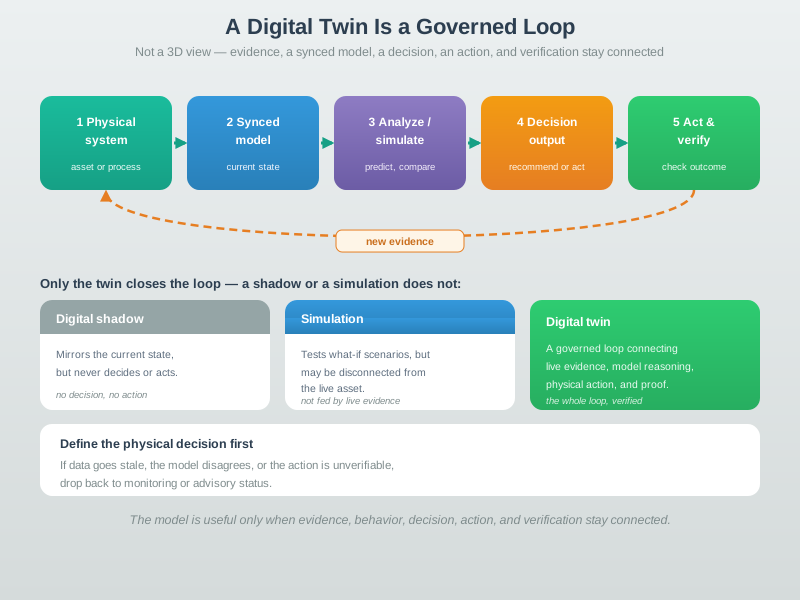
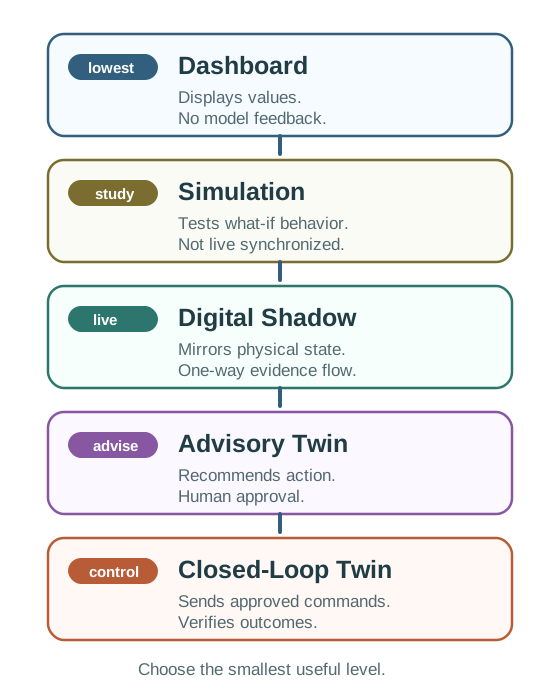
A digital twin is a virtual replica that maintains bidirectional synchronization with its physical counterpart – this bidirectional data flow is what distinguishes it from a dashboard (display only) or digital shadow (one-way physical-to-virtual). The evolution path is: dashboard (read-only) to digital shadow (one-way sync) to digital twin (closed-loop control). Typical ROI: 10-30% reduction in maintenance costs and 20-50% fewer unplanned downtime events, with payback periods of 3-18 months depending on asset value.
25.1 Learning Objectives
By the end of this chapter, you will be able to:
Define digital twins and differentiate them from traditional simulations, dashboards, and digital shadows using the bidirectional synchronization criterion
Trace the evolution from disconnected simulation through digital shadow to full digital twin, explaining what each stage adds
Explain how bidirectional synchronization enables closed-loop control between physical assets and their virtual counterparts
Classify real-world systems as dashboards, digital shadows, or digital twins by evaluating their data flow characteristics
Identify the key value streams (predictive maintenance, optimization, what-if analysis) that justify digital twin investments
Apply the digital twin decision framework to determine the appropriate level of digital modeling for a given IoT scenario
Minimum Viable Understanding
Core Concept: A digital twin is a synchronized virtual replica of a physical system that maintains bidirectional communication - receiving real-time sensor data to mirror current state, AND sending control commands back to optimize the physical system. This bidirectional flow distinguishes true digital twins from simpler concepts like monitoring dashboards (no intelligence) or digital shadows (one-way data only).
Why It Matters: Understanding this distinction prevents costly mistakes. Many “digital twin” products are actually just dashboards or 3D visualizations with no predictive or control capabilities. True digital twins enable predictive maintenance (saving 10-40% on maintenance costs), what-if scenario testing (without risking real equipment), and autonomous optimization (systems that improve themselves). Misclassifying your system means missing these value-generating capabilities.
Key Takeaway: Ask two questions to identify a true digital twin: (1) Does it receive continuous sensor data from the physical system? (2) Can it send control commands or optimizations back? Both must be YES for a digital twin; only #1 = digital shadow; neither = simulation or dashboard.
For Kids: Meet the Sensor Squad!
A digital twin is like having a magical mirror that shows you everything happening somewhere else - AND can predict the future!
25.1.1 The Sensor Squad Adventure: The Magic Mirror of Sensor City
In Sensor City, the Sensor Squad had a problem. Their friend Bella the Battery Monitor was getting tired running around checking on all the machines in the big factory. “I wish I could see what’s happening everywhere without running back and forth!” she sighed.
That’s when Sammy the Signal Sensor had an amazing idea! “Let’s build a Magic Mirror!” This wasn’t an ordinary mirror - it was a digital twin! The Sensor Squad installed sensors on every machine in the factory. Lila the Light Sensor tracked when lights flickered (a sign of electrical problems). Max the Motion Detector noticed when machines shook too much. Sammy listened for strange sounds that meant trouble.
All these sensors sent their information to the Magic Mirror, which showed a virtual copy of the entire factory! Now Bella could sit in the control room and see EVERYTHING at once. But here’s the really cool part - the Magic Mirror was SMART! It learned patterns. When Lila reported “Machine 5’s temperature indicator light is flickering more than usual,” the Magic Mirror could predict: “In 3 hours, that machine will overheat!” This gave the Squad time to fix it BEFORE it broke!
The Magic Mirror could even do “what-if” experiments. “What if we ran all machines at full speed?” Max wondered. Instead of risking the real machines, they tested it on the Magic Mirror first. The virtual factory showed them exactly what would happen - without breaking anything real! That’s the superpower of digital twins: see everything, predict problems, and test ideas safely!
25.1.2 Key Words for Kids
Word
What It Means
Digital Twin
A virtual copy of something real (like a factory or city) that updates with live information
Synchronization
Keeping the virtual copy and real thing matching, like a mirror that never lies
Prediction
Using patterns to figure out what will happen next, like weather forecasting
Simulation
Testing “what if” questions safely on the virtual copy instead of the real thing
25.1.3 Try This at Home!
Build Your Own “Digital Twin” of Your Room!
Draw a map of your bedroom on paper (this is your “digital twin”)
Place small stickers or marks where things are: bed, desk, toys, door
Now close your eyes and have someone move ONE thing in your real room
Open your eyes and try to spot what changed - then update your drawing!
Level Up: Predict what your room will look like after you clean it by drawing the “future state” first, then actually clean and see if your prediction matched!
This is exactly what engineers do with digital twins - they keep a virtual copy updated and use it to understand and predict what happens in the real world!
The Challenge: Testing Physical Systems is Expensive and Risky
The Problem: Physical systems are notoriously difficult to experiment with:
Testing: Breaking things to understand failure modes is costly—a jet engine blade failure destroys a $20M engine
What-if scenarios: You cannot rewind time to try different maintenance schedules or operating conditions
Scale: You cannot easily duplicate physical infrastructure to test parallel approaches
Safety: Some tests are simply too dangerous to perform on live systems (emergency shutdowns, extreme conditions)
Why It’s Hard:
Real systems have complex interdependencies that cascade in unpredictable ways
Failures often happen too fast to observe or in inaccessible locations
Historical data captures what DID happen, not what WOULD happen under different conditions
Physical experiments require shutting down production, costing millions in downtime
What We Need:
A virtual replica that behaves exactly like the real system under all conditions
The ability to simulate what-if scenarios safely before touching real equipment
Predictive models that forecast failures weeks before they happen
A way to optimize operations without risking production systems
The Solution: Digital twins—synchronized virtual replicas that mirror physical systems in real-time. Unlike traditional simulations, digital twins maintain bidirectional connections: they receive live sensor data to stay current with reality, and they can send optimized commands back to control physical systems. This chapter explores how digital twins enable safe experimentation, predictive maintenance, and continuous optimization across manufacturing, smart buildings, healthcare, and smart cities.
Key Concepts
Digital Twin Definition: A real-time virtual replica of a physical entity that mirrors its state, behavior, and lifecycle
Physical-Digital Connection: Bidirectional data flow: sensors feed real-world data to the virtual model; the model drives physical actuation
Digital Twin vs Simulation: Simulations run in isolation from the physical world; digital twins maintain continuous synchronization with their physical counterpart
Digital Twin vs BIM: Building Information Modeling creates static 3D models; digital twins add real-time sensor data and dynamic state
Twin Categories: Asset twin (individual component), process twin (operational workflow), system twin (integrated subsystems), enterprise twin (organization-wide)
NASA Origin: Digital twin concept originated from NASA’s Apollo program — mirror simulations of spacecraft used for mission planning and emergency response
Value Proposition: Digital twins enable remote monitoring, predictive maintenance, simulation-based optimization, and anomaly detection without physical intervention
25.2 Introduction
⏱️ ~8 min | ⭐⭐ Intermediate | 📋 P05.C01.U02
Singapore has built a complete digital twin of the entire city—every building, road, utility pipe, and tree. Called “Virtual Singapore,” this nationwide digital twin allows planners to simulate how new construction will affect wind flow, test evacuation routes during emergencies, and predict flooding before it happens. When a real sensor detects rising water levels in one district, the digital twin updates instantly, triggering predictive models that forecast which neighborhoods will flood next.
This is the power of digital twins: not just models of what might happen, but living digital replicas that mirror the real world in real-time, enabling us to predict, prevent, and optimize like never before.
Digital twins represent one of the most transformative concepts in IoT architecture. Unlike static simulations or one-way monitoring systems, digital twins create a bidirectional bridge between physical and digital worlds, enabling unprecedented levels of system understanding, prediction, and control.
How It Works: Digital Twin Synchronization Cycle
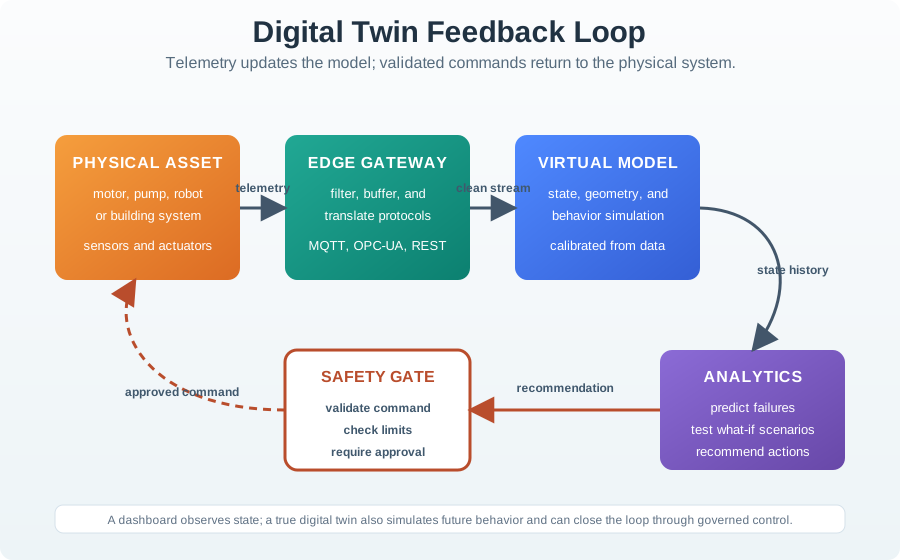
The core digital twin operation follows a continuous four-step cycle:
Step 1 - Physical Sensors Capture State: Temperature, vibration, pressure, position sensors on the physical asset measure current conditions every second (or millisecond for fast-changing systems). Each reading includes a timestamp and sensor ID.
Step 2 - Data Flows to Digital Model: Sensor readings transmit via MQTT, CoAP, or HTTP to the cloud/edge platform. The digital twin’s state database updates to match the physical asset’s current condition. This is the physical-to-digital flow.
Step 3 - Analytics and Prediction: The digital twin runs physics-based simulations or machine learning models on the current state. For example: “Current vibration pattern indicates bearing will fail in 14 days.” This predictive capability is what separates twins from dashboards.
Step 4 - Commands Flow Back to Physical: Based on predictions, the twin generates optimization commands and sends them to actuators on the physical asset. For example: “Reduce motor speed by 10% to extend bearing life.” This is the digital-to-physical flow, completing the bidirectional loop.
Continuous Loop: Steps 1-4 repeat constantly (typically every 1-60 seconds depending on the application). The twin stays synchronized with reality through this never-ending cycle.
Real Example: A wind turbine twin receives blade vibration data every 100ms (Step 1-2), predicts that current wind gusts will cause fatigue damage (Step 3), and commands the pitch actuator to adjust blade angle by 2 degrees to reduce stress (Step 4). The cycle completes in under 500ms.
Key Insight: The bidirectional synchronization (Steps 2 and 4) is what makes this a twin, not a shadow. If Step 4 is missing, you have only one-way monitoring.
For Beginners: What is a Digital Twin?
Think of a digital twin like a video game character that mirrors your real movements in real-time. If you raise your hand, your character raises their hand instantly. If the character gets injured in the game, sensors could alert you to check your actual arm.
Now imagine that same concept applied to a factory machine, a building, or even an entire city. Every sensor reading from the real thing updates the digital version immediately. Every change you make to the digital version can be tested safely before applying it to the real thing.
That’s a digital twin: a synchronized virtual copy that lets you monitor, analyze, and experiment without touching the actual physical system.
Common Misconception: “Digital Twin = 3D Model”
The Misconception: A digital twin is a 3D visualization of physical equipment.
Why It’s Wrong:
3D models are static geometry - no behavior
Digital twins include physics simulations
Real twins sync with live sensor data
Value comes from prediction, not visualization
Many effective twins have no 3D component
Real-World Example:
Wind turbine “digital twin” (marketing): 3D spinning animation
Actual digital twin: Physics model predicting bearing wear
The Correct Understanding: | Component | 3D Model | Digital Twin | |———–|———-|————–| | Geometry | ✓ | Optional | | Physics simulation | ✗ | ✓ | | Live sensor data | ✗ | ✓ | | Predictive capability | ✗ | ✓ | | What-if scenarios | ✗ | ✓ | | Value | Visualization | Decision support |
A true digital twin is a behavioral model that predicts and optimizes. Visualization is optional.
Common Misconception: Digital Twin vs. Simulation
Misconception: “A digital twin is just a fancy 3D model or simulation.”
Reality: While simulations run on assumptions and hypothetical scenarios, digital twins are continuously synchronized with real-world data from actual sensors. A simulation predicts what MIGHT happen; a digital twin shows what IS happening right now and uses that real-time state to predict what WILL happen next.
Example: A building simulation might say “If temperature reaches 75°F, the HVAC should activate.” A digital twin says “Room 305’s temperature is currently 76.2°F (measured 2 seconds ago), the HVAC activated 30 seconds ago but temperature is still rising, predict it will peak at 78°F in 5 minutes based on current trends, and recommend increasing fan speed by 20%.”
The key difference is continuous bidirectional synchronization with physical reality, not just running physics models in isolation.
Key Takeaway
In one sentence: A digital twin is a synchronized virtual replica that mirrors its physical counterpart in real-time, enabling safe experimentation, predictive maintenance, and continuous optimization.
Remember this rule: Start simple with telemetry mirroring before adding simulation and prediction capabilities; the value comes from behavioral modeling, not 3D visualization.
25.2.1 Digital Twin Core Architecture
The following diagram illustrates the fundamental components and data flows that define a digital twin system.
Core digital twin architecture showing bidirectional synchronization between physical and digital worlds
Figure 25.1: Core digital twin architecture showing bidirectional synchronization between physical and digital worlds
This architecture shows the bidirectional flow that defines a true digital twin:
Physical to Digital: Sensors continuously stream data from the physical asset to update the digital model
Analytics Layer: The digital model feeds prediction and analytics engines
Digital to Physical: Optimization recommendations flow back as control commands to actuators
25.3 From Simulation to Digital Twin
⏱️ ~10 min | ⭐⭐ Intermediate | 📋 P05.C01.U03
Understanding Simulation vs Monitoring
Core Concept: Simulation predicts what might happen using mathematical models; monitoring observes what is actually happening using real sensors; digital twins combine both, using real-time data to continuously calibrate simulations for accurate prediction.
Why It Matters: Many organizations confuse these approaches and choose the wrong one for their needs. A factory using pure simulation cannot detect when real equipment degrades. A factory using pure monitoring cannot predict failures before they happen. Digital twins merge these capabilities: real sensor data grounds predictions in reality, while simulation models extrapolate future states. This combination enables proactive decisions that neither approach achieves alone.
Key Takeaway: If your goal is “What will happen next?” you need a digital twin; if your goal is only “What is happening now?” monitoring suffices; if your goal is “What could happen under different conditions?” simulation alone works.
The journey to digital twins has evolved through several stages, each adding more sophistication to how we model physical systems.
25.3.1 The Evolution Spectrum
The following diagram illustrates how digital modeling has evolved from disconnected simulations to fully synchronized digital twins.
Evolution from simulation through digital shadow to digital twin
Figure 25.2: Evolution from simulation through digital shadow to digital twin
Traditional Simulation represents the earliest form of digital modeling. Engineers create mathematical models to predict system behavior under various conditions. However, these simulations are disconnected from real-world data—they model what MIGHT happen based on assumptions, not what IS happening in reality.
Digital Shadow introduced the first connection to real systems. Sensors stream data from physical entities to digital representations, creating a one-way flow of information. The digital model updates based on reality, but changes to the digital model don’t affect the physical system. This is like a mirror—it reflects reality but can’t change it.
Digital Twin completes the bidirectional connection. Not only does real-time sensor data update the digital model, but insights and commands from the digital side can flow back to control and optimize the physical system. The physical and digital exist in continuous synchronization, each informing and improving the other.
Three-stage evolution diagram: Simulation (gray) showing disconnected model with no physical connection; Digital Shadow (teal) showing one-way sensor data flow from physical system to digital representation; Digital Twin (orange) showing bidirectional continuous synchronization between physical system and digital model enabling both monitoring and control
Figure 25.3: Evolution from disconnected simulation (gray) through digital shadow with one-way sensor data flow (teal) to full digital twin with bidirectional synchronization (orange) between physical and digital systems.
Alternative View:
Figure 25.4: Mirror Analogy View: This analogy helps beginners understand the critical difference between a digital shadow and a digital twin. A regular mirror (digital shadow) only reflects what you do - it’s one-way and passive. A “magic mirror” (digital twin) is bidirectional: it reflects your state, but also predicts your future based on current patterns AND can take actions to help you (like adjusting the room). The key insight: digital twins don’t just observe - they predict and intervene.
Key Differences:
Aspect
Simulation
Digital Shadow
Digital Twin
Data Connection
None
One-way (Physical → Digital)
Bidirectional
Real-time State
No
Partially
Yes
Predictive Capability
Limited
Good
Excellent
Control Capability
None
None
Yes
Use Case
Design phase
Monitoring
Full lifecycle management
25.3.2 Digital Twin Value Proposition
The following diagram shows how digital twins deliver value across different domains.
Digital twin value streams across predictive maintenance, optimization, and what-if analysis
Figure 25.5: Digital twin value streams across predictive maintenance, optimization, and what-if analysis
For Beginners: Why Digital Twins Matter
Think about how valuable it would be to know BEFORE something breaks that it’s going to fail. Your car could tell you “Your brake pads will wear out in 3,000 miles” instead of waiting for a warning light when they’re almost gone.
Digital twins make this possible by:
Learning patterns: The digital model learns what “normal” looks like for your equipment
Detecting anomalies: When sensor readings deviate from normal, it notices immediately
Predicting failures: Using historical patterns, it can forecast when components will fail
Recommending actions: It suggests maintenance BEFORE costly breakdowns occur
This is why manufacturing companies report 10-40% savings on maintenance costs with digital twins - they fix things at the optimal time, not too early (wasting money) or too late (expensive emergency repairs).
25.4 Decision Framework: Do You Need a Digital Twin?
Use this decision tree to determine whether your project needs a full digital twin, a digital shadow, or simple monitoring.
Decision framework for selecting the right level of digital modeling
Figure 25.6: Decision framework for selecting the right level of digital modeling
Common Pitfalls When Adopting Digital Twins
Pitfall 1 – Skipping the shadow stage. Organizations often attempt to build a full digital twin with bidirectional control from day one. In practice, you should start with a digital shadow (one-way monitoring) to validate sensor data quality, calibrate your models against real-world behavior, and build operational trust before enabling automated control loops. Jumping straight to closed-loop control with uncalibrated models can cause the twin to issue harmful commands.
Pitfall 2 – Overinvesting in visualization instead of behavior models. Teams spend months building photorealistic 3D renderings of their assets when the actual value comes from physics-based behavioral models that predict failure and optimize performance. A well-calibrated thermal degradation model in a spreadsheet delivers more ROI than a beautiful 3D factory walkthrough with no predictive capability.
Pitfall 3 – Ignoring sensor data quality. A digital twin is only as accurate as the data feeding it. Deploying a twin on top of unreliable, intermittent, or poorly calibrated sensors produces a “digital hallucination” rather than a digital twin. Before building the twin, audit your sensor infrastructure: verify sampling rates are adequate, calibration is current, and network reliability meets the twin’s update frequency requirements.
Pitfall 4 – Treating the twin as a one-time project. Digital twins require continuous maintenance. Physical assets degrade, operating conditions change, and the models must be recalibrated regularly. Budget for ongoing model validation (comparing twin predictions against actual outcomes) and plan for sensor replacement and recalibration cycles.
Pitfall 5 – Underestimating latency requirements. Different use cases demand different synchronization speeds. Predictive maintenance may tolerate minutes-old data, but autonomous control loops may require sub-second updates. Failing to match your data pipeline latency to your use case leads to either wasted infrastructure spend (over-engineering) or dangerous control delays (under-engineering).
Interactive: Digital Twin Sync Concepts
Try It Yourself: Design Your First Digital Twin
Challenge: Design a simple digital twin for a coffee machine in an office building.
Starting point:
Physical system: Coffee machine with temperature sensor, water level sensor, and usage counter
Requirements: Predict when maintenance is needed, optimize brewing temperature, track daily usage patterns
Your task:
Sketch the bidirectional data flow (what sensors send UP to the twin, what commands the twin sends DOWN to the machine)
Define 3 properties, 2 telemetry streams, and 1 command the twin should support
Identify one predictive capability the twin could provide (hint: look at the Scottish Water example)
Estimate the minimum sync frequency needed (hint: does coffee temperature change in seconds or minutes?)
Expected outcome: You should be able to classify this as a digital twin (not a shadow) because it has bidirectional control. The twin could predict filter replacement needs based on usage patterns, adjust brewing temperature based on bean type, and send descaling commands when mineral buildup is detected.
What to observe: If you only display sensor data without sending any commands back, you’ve built a digital shadow, not a twin. The key test: “Can the virtual model change the physical system’s behavior?”
25.5 Concept Relationships
Understanding how digital twin concepts interconnect helps you apply them correctly in real systems.
Concept
Relationship
Connected Concept
Digital Twin
Extends
Digital Shadow (adds bidirectional control and closed-loop optimization)
Bidirectional Synchronization
Enables
Predictive Maintenance (physical state updates model, model commands preventive actions)
Physical-to-Digital Data Flow
Feeds
Analytics and Simulation (real-time sensor data calibrates predictive models)
Digital-to-Physical Commands
Implements
Autonomous Optimization (twin-generated setpoints control physical actuators)
Simulation Models
Distinguish
Dashboards (simulations predict future states; dashboards only display current state)
Real-time State Mirroring
Requires
Continuous Sensor Streams (staleness >5 min degrades decision quality)
Edge Computing
Supports
Twin Responsiveness (local processing reduces latency for time-critical control)
Digital twins defined: Synchronized virtual replicas that maintain bidirectional connections with physical systems - receiving sensor data AND sending control commands
Evolution path: Disconnected simulations → digital shadows (one-way monitoring) → full digital twins (bidirectional control)
Common misconceptions: Digital twins are not just 3D models or visualization dashboards - the value comes from behavioral modeling and prediction
Key differentiator: Bidirectional synchronization enabling both monitoring and autonomous control
Value streams: Predictive maintenance (10-40% savings), real-time optimization (5-15% savings), and zero-risk what-if analysis
25.7.1 Quick Reference: System Classification
Question
Dashboard
Digital Shadow
Digital Twin
Receives real-time sensor data?
Maybe
Yes
Yes
Predicts future states?
No
Yes
Yes
Sends control commands?
No
No
Yes
Typical use
Visibility
Monitoring + Alerts
Full automation
Putting Numbers to It
Bandwidth Requirements for Real-Time Twin Synchronization: How much network capacity do you actually need?
Key insight: Doubling update frequency doubles both bandwidth and storage costs linearly. Choose sync frequency based on decision-making needs, not sensor capabilities.
Show code
viewof numAssets = Inputs.range([1,500], {value:50,step:1,label:"Assets (turbines, machines, etc.)"})viewof sensorsPerAsset = Inputs.range([1,100], {value:12,step:1,label:"Sensors per asset"})viewof syncHz = Inputs.range([0.016,100], {value:1,step:0.1,label:"Sync frequency (Hz)"})viewof bytesPerReading = Inputs.range([8,256], {value:64,step:8,label:"Bytes per reading"})
25.8 Worked Example: Digital Twin ROI for a Water Treatment Plant
Scenario: Scottish Water operates a water treatment plant in Edinburgh serving 250,000 households. The plant has 340 IoT sensors monitoring flow rates, chemical dosing, turbidity, pH, and chlorine residual across 12 treatment stages. They are evaluating whether to build a digital twin.
Current Operations (Without Digital Twin):
Metric
Annual Value
Unplanned downtime
14 incidents/year x 6 hrs average = 84 hrs
Cost per hour of downtime
GBP 18,000 (emergency repairs + tanker water + regulatory fines)
Annual unplanned downtime cost
GBP 1,512,000
Chemical over-dosing (conservative buffer)
22% above optimal = GBP 340,000 waste
Energy waste (pumps running at fixed speed)
GBP 180,000/year above optimal
Total annual inefficiency
GBP 2,032,000
Digital Twin Investment:
Component
Cost
Physics-based simulation model (fluid dynamics + chemical kinetics)
GBP 280,000
50 additional sensors (filling coverage gaps)
GBP 45,000
Azure Digital Twins platform (3-year license)
GBP 120,000
Integration engineering (6 months, 2 engineers)
GBP 180,000
Annual maintenance + model recalibration
GBP 65,000/year
Total Year 1
GBP 625,000
Annual recurring
GBP 185,000 (platform + maintenance)
Expected Improvements with Digital Twin:
Improvement Area
Mechanism
Annual Saving
Predictive maintenance
Twin detects pump bearing degradation 14 days before failure
84 hrs → 12 hrs downtime = GBP 1,296,000 saved
Chemical optimisation
Twin simulates dosing in real-time, reduces buffer from 22% to 5%
GBP 263,000 saved
Energy optimisation
Twin adjusts pump speeds to match actual demand curves
GBP 135,000 saved
What-if scenarios
Test capacity expansion virtually before physical changes
GBP 80,000 avoided engineering costs
Total annual savings
GBP 1,774,000
ROI Calculation:
Year 1 net: GBP 1,774,000 - GBP 625,000 = +GBP 1,149,000 (payback in 4.2 months)
Key Insight: The digital twin ROI is directly proportional to the cost of unplanned downtime. Assets where a single failure hour costs more than GBP 5,000 almost always justify the investment. Below GBP 500/hour, a simpler digital shadow (monitoring without simulation) is usually sufficient.