29 Flying Ad-Hoc Networks (FANETs)
More
Depth: Practitioner
Progress saves as you read. Mark sections complete as you go; your progress appears in the sidebar.
29.1 Start Simple
This section: Start Simple — Picture three survey aircraft mapping smoke after a wildfire.
Choose the Next Hop for the Next Few Seconds
Picture three survey aircraft mapping smoke after a wildfire. The nearest aircraft now may turn away, lose height, or run low on power before a large image reaches it. A route drawn at take-off cannot prove that the next message has a usable path.
A gateway is the device or station that carries mission data into another network. For one aircraft, record position, height, direction, energy, nearby peers, waiting data, and the age of each record. Name the ground receiver, the message priority, and the latest time at which the result remains useful.
Turn one aircraft, remove another, block the ground path, fill a waiting queue, and lower the energy limit. Check whether the chosen relay is still reachable, whether old neighbour records expire, whether urgent data takes the safer path, and whether stored data survives a short gap.
This short mission does not prove every flight plan or radio. The deeper sections compare route styles, moving link evidence, energy cost, ground paths, partitions, and security limits for the full flying network.
Start with a mission that moves, loses energy, and changes its radio path while it works. In Flying Ad-Hoc Networks (FANETs), the practical question is what the aircraft must sense, relay, decide, and prove before the flight or network role is safe enough to trust.
29.2 Learning Objectives
This section: Learning Objectives
By the end of this chapter, you will be able to:
- Explain what makes a FANET different from ground mobile ad hoc networks and road-constrained vehicular networks.
- Identify the main aerial and ground-facing link types used in UAV team missions.
- Describe the topology records a UAV needs before it can make a routing decision.
- Choose among table-driven, on-demand, position-based, predictive, and store-carry-forward routing patterns based on mission conditions.
- Build a readiness checklist that keeps FANET designs focused on connectivity, safety, energy, and proof instead of unsupported performance promises.
29.3 Routes Move With Aircraft
This section: Routes Move With Aircraft — If you only need the intuition, this layer is enough: a FANET route is useful only while the aircraft positions, link quality, mission priority, and gateway path still make sense.
If you only need the intuition, this layer is enough: a FANET route is useful only while the aircraft positions, link quality, mission priority, and gateway path still make sense. A static path can become stale in seconds.
Use Figure 29.1 to see why an airborne route needs current facts about motion, radio links, flight energy, and hostile use of the open channel.
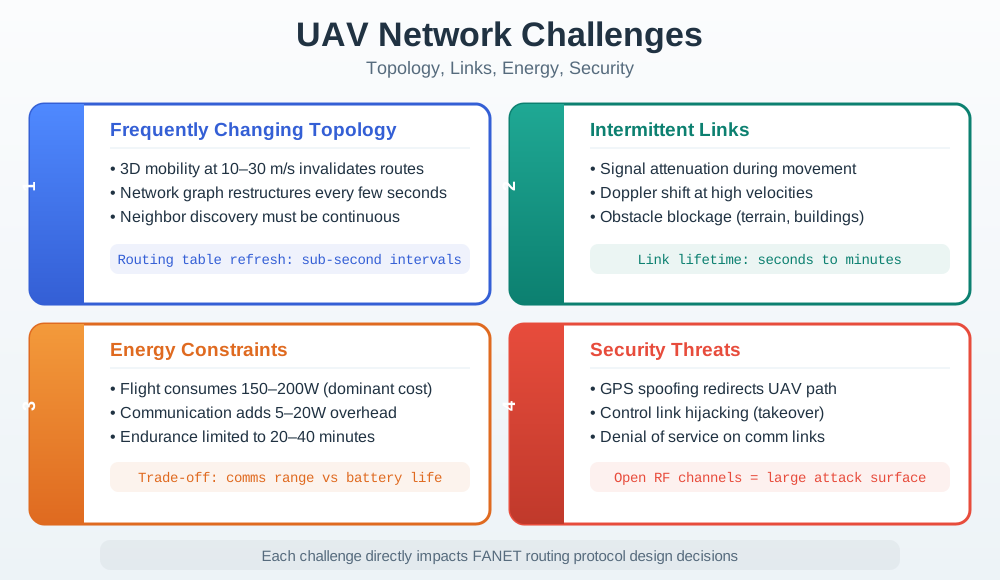
Read Figure 29.1 around its four pressures. Three-axis motion and fast route updates mean an old neighbor may no longer be safe. Fading, Doppler shift, and blocked paths can break a link even when two aircraft look close on a map. More radio range is not free because flight already uses most of the power. GPS spoofing and control-link capture add hostile change to the same route choice. These limits act together. Each forward decision therefore needs fresh place and link facts, plus energy, gateway, and security state.
Mobile summary: A FANET forwarding choice should be based on current 3D position, heading, neighbor freshness, link quality, route and buffer state, and gateway reachability.
3D position
Forwarding depends on latitude, longitude, altitude, heading, speed, and expected movement.
Fresh neighbors
A neighbor record needs age, signal history, packet success, and whether the UAV is moving toward usefulness.
Exit path
Mission traffic often needs a ground, vehicle, satellite, or backhaul gateway before it is complete.
29.4 Practitioner: Build the Routing Record
This section: Practitioner: Build the Routing Record — Before choosing a routing pattern, write a short record for the packet class.
Before choosing a routing pattern, write a short record for the packet class. A high-priority safety alert should not use the same forwarding rule as a low-priority image summary that can wait for a gateway pass.
Packet class
Name the traffic: telemetry, alert, map update, inspection image, command, or delayed sensor collection.
Allowed delay
State whether the packet must move now, may be buffered, or should be discarded when the route is stale.
Routing mode
Choose table-driven, on-demand, position-based, predictive, or store-carry-forward from the current evidence.
Safety limit
Record when routing traffic must yield to flight energy, collision avoidance, return-to-base, or command priority.
29.5 Why FANET Decisions Age Quickly
This section: Why FANET Decisions Age Quickly — FANET routing fails when the control record is older than the airspace reality.
FANET routing fails when the control record is older than the airspace reality. A route table, predicted path, or gateway choice can be correct when computed and wrong by the time a packet reaches the next hop.
- Geometry changes: altitude and heading can change usable distance even when a map view looks close.
- Link changes: line of sight, antenna orientation, interference, and packet loss can change faster than mission plans.
- Priority changes: safety alerts, commands, telemetry, and bulk imagery deserve different delay and retry rules.
- Partition changes: sparse UAV teams may need buffering until a relay or gateway becomes useful again.
This section:
This section:
This section:
The minimum model is a moving group of aircraft that may relay for one another without one fixed path. Each route choice needs a recent three-dimensional position, a current neighbor and link record, and a rule for data that cannot move now. Planned flight can help predict a useful contact, but wind, obstacles, energy reserve, or a changed mission can invalidate that plan. The record must therefore say when it was observed and whether the payload may wait, move by another relay, or return through a ground gateway.
- A FANET is an ad hoc network whose nodes are UAVs moving in 3D space.
- Links change because UAVs move horizontally, change altitude, turn, return to base, lose line of sight, or hand off to ground systems.
- Routing decisions need fresh local records: position, neighbor state, link quality, intended path, and whether buffering is acceptable.
- Position-based and predictive routing are common FANET tools, but sparse missions also need store-carry-forward behavior.
This section:
29.6 Prerequisites
This section: Prerequisites
Before continuing, revisit these chapters if any of the terms are unfamiliar:
- UAV FANETs and Integration: shows how FANETs connect to ground gateways, vehicle networks, and mission records.
- UAV Fundamentals and Topologies: introduces UAV network roles, formations, and operating constraints.
- Multi-Hop Fundamentals: explains relay paths, hop selection, and path maintenance.
- Networking Basics: covers layers, routing, addressing, and packet movement.
29.7 What Is a FANET?
This section: What Is a FANET? — A Flying Ad Hoc Network (FANET) is a self-organizing network formed by UAVs without relying on one fixed communication path.
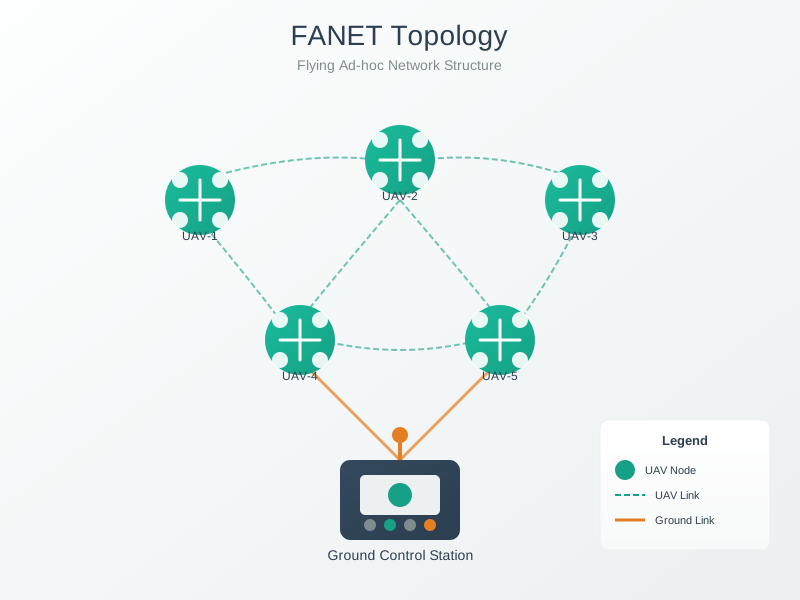
A Flying Ad Hoc Network (FANET) is a self-organizing network formed by UAVs without relying on one fixed communication path. A FANET may include a ground station, gateways, or sensor systems, but the defining feature is that UAVs can forward traffic for each other while the aerial topology changes.
The same mission can contain several link roles at once:
29.7.1 Same-layer UAV links
UAVs at similar altitude exchange telemetry, task state, and neighbor information. These links are useful for formation awareness and local forwarding.
29.7.2 Cross-layer UAV links
UAVs at different altitudes bridge layers. A higher UAV may relay summary traffic while lower UAVs inspect or collect data.
29.7.3 Ground gateway links
One or more UAVs connect the aerial path to a ground station, field gateway, or command post. Gateway choice can change as the mission moves.
29.7.4 Sensor collection links
UAVs may collect data from isolated ground sensors, then carry or relay that data when a better path appears.
29.7.5 Vehicle or roadside links
Some missions exchange warnings, map updates, or camera summaries with nearby vehicles or roadside systems.

29.8 FANETs vs Ground Ad Hoc
This section: FANETs vs Ground Ad Hoc — Read the pressures as one route test rather than as separate features.
Ground mobile ad hoc networks and vehicular networks already deal with movement, but FANETs add several extra pressures:
Read the pressures as one route test rather than as separate features. Height and heading change which neighbors can help, sparse spacing makes each relay more important, and flight energy limits how long extra radio work can continue. A planned path offers useful hints, but it does not remove blocked links or sudden return-to-base events. The gateway is also part of the route: data has not met its mission goal merely because it crossed the aerial mesh. The selected next hop must remain useful long enough to move this traffic toward its real exit.
- 3D topology: altitude is part of the route, not just a drawing detail.
- Sparse neighbors: UAV missions often spread nodes apart to cover an area, so every relay choice matters.
- Fast path aging: a route can become less useful as UAVs turn, climb, descend, or pass behind obstacles.
- Planned mobility: flight plans can make some movement predictable, but wind, safety limits, task changes, and return-to-base events still change the topology.
- Energy and payload constraints: routing traffic competes with sensing, compute, flight time, and safety reserve.
- Gateway dependence: many FANETs are only useful if the aerial path eventually reaches a ground, vehicle, satellite, or backhaul connection.
The design question is therefore record-based: what does the node know now, how fresh is that knowledge, and which forwarding choice remains useful long enough to deliver the traffic?
29.9 Topology Records
This section: Topology Records — A FANET node should not forward based only on a static route table.
A FANET node should not forward based only on a static route table. It needs a compact routing record that describes the local topology and the mission state.
29.9.1 Position and altitude
The node records its own position, altitude, and the advertised positions of nearby UAVs. Altitude changes can shorten or lengthen the true path.
29.9.2 Heading and velocity
Direction matters because a neighbor moving toward the destination is more useful than a neighbor that is about to leave the useful region.
29.9.3 Neighbor table freshness
Each neighbor entry needs a timestamp or freshness state. Stale neighbor data is worse than no neighbor data because it can create false confidence.
29.9.4 Link state
Signal quality, packet delivery history, interference hints, and line-of-sight risk help separate reachable neighbors from reliable forwarders.
29.9.5 Route and buffer state
The node tracks whether a route is currently usable, whether a predictive path is planned, and whether packets may be buffered until contact returns.
29.9.6 Gateway state
For traffic that must leave the aerial network, the node tracks which gateway is reachable, overloaded, moving away, or reserved for higher priority traffic.
The overview depth layer introduces the compact topology record that keeps FANET routing tied to current mission state.
29.10 Routing Choices
This section: Routing Choices — FANET routing is not one protocol choice for every mission.
FANET routing is not one protocol choice for every mission. It is a decision about how much topology state is worth maintaining and how quickly that state becomes stale.
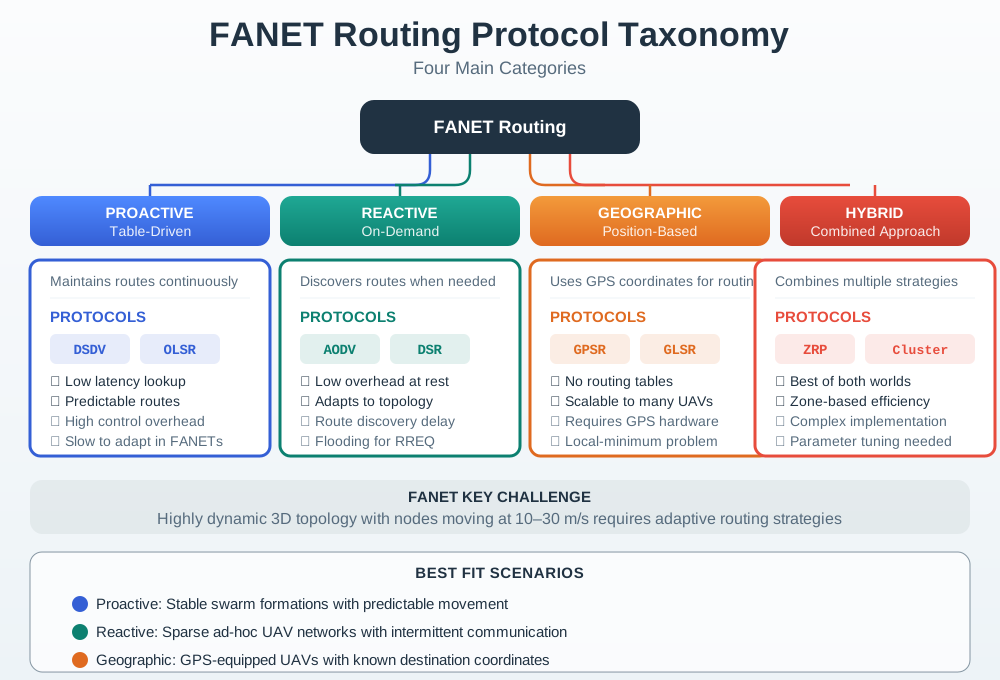
29.10.1 Table-driven routing
Maintains routes proactively. This can work for small or stable aerial formations, but it becomes expensive when neighbor state changes faster than tables can remain useful.
29.10.2 On-demand routing
Discovers routes only when traffic needs them. This can be acceptable when route discovery is short compared with route usefulness.
29.10.3 Position-based routing
Uses location and neighbor information to choose the next hop. It reduces dependence on a complete route table and fits many mobile aerial paths.
29.10.4 Predictive routing
Uses mission plans, headings, or expected contact windows to route toward where nodes will be, not only where they are now.
29.10.5 Store-carry-forward
Buffers traffic when no useful forwarder exists, then forwards after a later contact. This is essential for sparse or disrupted missions.
29.10.6 Position-Based Routing In Practice: Greedy Forwarding and Voids
Position-based routing is not just “use GPS instead of a table.” The forwarding rule itself, often called greedy forwarding, is simple: each node compares the last known position of its current neighbors against the destination’s position, then forwards to whichever neighbor is geographically closest to the destination. No route-discovery flood or full end-to-end route table is needed, but the node still needs fresh neighbor position records and a way to learn the destination’s position.
Greedy forwarding fails at a void: a location where every current neighbor is farther from the destination than the node itself, so no next hop makes progress. Sparse aerial neighbors and altitude changes can create such gaps. In a two-dimensional planar graph, perimeter or face routing can forward around a void until greedy progress resumes. A 3D FANET needs a void-recovery method designed for its topology; a planar face walk cannot be assumed to work in 3D.
For an aerial mission this matters operationally, not only theoretically: a UAV relying on position-based routing should log when greedy forwarding is making progress and when its 3D void-recovery method is invoked, because a persistent void calls for another validated path or a relay repositioning without proving the destination unreachable.
29.11 Layered Link Checks
This section: Layered Link Checks — A FANET design usually mixes several link types.
A FANET design usually mixes several link types. Check each layer separately before approving a route:
| Link layer | Carries | Records to check |
|---|---|---|
| Aerial mesh | UAV relay, coordination, and shared mission state | Position, altitude, neighbor freshness, link quality, route state, and buffer state |
| Gateway path | Traffic leaving the aerial network | Gateway candidate ranking, backhaul quality, handover trigger, and standby path |
| Ground integration | Vehicles, fixed infrastructure, WSN sinks, or operator systems | Identifier mapping, timestamp preservation, protocol translation, and delivery ownership |
| Operations feedback | Incident, degraded-link, handover, buffer, and replay records | Who acts when an aerial link, gateway, or ground link degrades |
29.12 Temporary Inspection Corridor
This section: Temporary Inspection Corridor — Scenario: A small UAV team inspects a linear asset after a storm.
Scenario: A small UAV team inspects a linear asset after a storm. The team must exchange telemetry, deliver high-priority alerts quickly, and upload inspection summaries when a ground gateway becomes reachable.
This case uses three delivery rules because its data does not share one deadline. Live telemetry follows current position and link facts. A safety alert takes the first sound route that meets its urgent limit. A large inspection record may wait for a stronger gateway contact. The evidence record must keep those choices apart so a delayed bulk upload cannot be mistaken for a failed alarm path, and a fast alert cannot justify the same energy cost for every routine message.
Design record:
- Mission service: telemetry, safety alerts, low-rate image summaries, and delayed bulk upload.
- Topology model: UAVs form a loose corridor with some same-layer links and one higher relay when available.
- Routing mode: position-based forwarding for live telemetry, predictive forwarding for planned inspection passes, and store-carry-forward for segments with no reliable forwarder.
- Gateway rule: prefer the gateway with fresh link records and enough remaining capacity for the current priority class.
- Buffer rule: safety alerts are forwarded immediately when any suitable path exists; routine summaries can wait for a better gateway contact.
- Decision record: neighbor freshness, chosen next hop, reason for buffering, gateway handoff record, and any delivery failure reason.
Result: The design does not promise one fixed route across the whole corridor. It uses the best current records for urgent traffic and accepts delayed delivery for lower priority data when the aerial path is temporarily partitioned.
29.13 Readiness Checklist
This section: Readiness Checklist
Use this checklist before accepting a FANET design:
29.13.1 Topology
Confirm that each route uses current height, heading, neighbor age, and local spacing, then state what happens when the aircraft enters a sparse part of the mission.
- Are position, altitude, and heading part of the route decision?
- Is stale neighbor information detected?
- Does the design account for sparse areas?
29.13.2 Routing
Match the route method to path stability, record why discovery is worth its delay, and keep a buffer or return rule for the moment no useful relay exists.
- Is the selected routing mode matched to topology stability?
- Is route discovery justified when used?
- Is there a fallback when no forwarder is available?
29.13.3 Gateway
- Is gateway selection tied to live records? Check reachability, backhaul quality, remaining capacity, and whether the gateway is moving away or reserved for higher priority traffic. A planned contact alone does not prove a usable exit.
- Does the design avoid a single fragile exit path? Check the standby path and handover trigger alongside the aerial route; crossing the mesh does not establish final delivery.
- Are handoffs recorded? Preserve message priority, age, delivery ownership, and failure state so later review can connect the gateway change to its delivery outcome.
29.13.4 Operations
- Are priority classes clear? Distinguish live telemetry, safety alerts, and routine summaries because their useful delivery deadlines differ. Gateway capacity and route choices should reflect the current traffic priority.
- Does buffering respect mission urgency? Forward safety alerts immediately when a suitable path exists; routine summaries may wait for better contact when their deadlines allow delay. Record why data waits.
- Are failure reasons visible after the mission? Keep neighbor freshness, chosen next hop, buffer decisions, and gateway handoffs connected to delivery records. This helps distinguish an accepted delay from a failed urgent delivery.
29.14 Knowledge Check
This section: Knowledge Check
29.15 Common Pitfalls
This section: Common Pitfalls
Flight plans are useful context, but they are not proof that a link will exist. A design still needs live neighbor and link checks.
Horizontal separation alone can hide the true 3D distance between UAVs. Include altitude when estimating whether a neighbor remains useful.
Old neighbor state can make a route look valid after the neighbor has moved away or become a poor forwarder. Record freshness and expire stale entries.
Aerial forwarding is only part of the system when data must leave the FANET. Track gateway reachability, handoff conditions, and delivery records.
Sparse FANETs may have temporary gaps. Low-priority but useful data can often be buffered and delivered later instead of being discarded immediately.
29.16 Concept Relationships
This section: Concept Relationships — The concepts form one decision chain.
The concepts form one decision chain. The FANET supplies the moving network boundary. Three-dimensional records describe which neighbor is useful now. Position-based routing chooses from those current facts, while predictive routing adds a bounded claim about future motion. If neither method finds a viable next hop, store-carry-forward protects data whose deadline allows delay. Gateway selection then connects the aerial path with the ground service that owns final delivery. A route is complete only when each handoff preserves message priority, age, owner, and failure state.
- FANET extends ad hoc networking into UAV-based 3D movement.
- 3D topology records keep neighbor and link decisions tied to current mission state.
- Position-based routing uses current location and neighbor records for local next-hop choices.
- Predictive routing adds movement expectations or planned contact windows.
- Store-carry-forward protects useful data when no current forwarder exists.
- Gateway selection connects the aerial path to ground or vehicle systems.
29.17 Further Reading
This section: Further Reading — Use the sources by question.
Use the sources by question. MANET material defines route discovery and repair. Delay-tolerant work explains storage across broken paths. Geographic routing shows how local position can guide a next hop and what happens at a dead end. UAV surveys add flight motion, energy, and gateway effects. Operating guidance supplies the airspace, safety, and command limits that a network paper cannot decide. Record which claim each source supports and check its date, scenario, and authority before carrying it into a mission plan.
- IETF MANET materials for ad hoc routing terminology and route-maintenance concepts.
- Delay-tolerant networking literature for store-carry-forward behavior in intermittent networks.
- Geographic routing literature, including GPSR-style greedy forwarding and perimeter recovery concepts.
- UAV networking survey literature for aerial mobility, energy, and topology-management tradeoffs.
- Aviation and mission operations guidance from the relevant operating authority for airspace, safety, and command responsibilities.
29.18 Summary
This section: Summary — FANET fundamentals start with a simple idea: UAVs can form an ad hoc network in the air.
FANET fundamentals start with a simple idea: UAVs can form an ad hoc network in the air. The difficult part is keeping forwarding decisions tied to current 3D records. Useful designs describe the aerial link types, collect fresh topology and link state, choose routing behavior that matches the mission, buffer lower priority data during temporary partitions, and record gateway handoffs so the mission can be checked afterward.
29.19 What’s Next
This section: What’s Next — Continue by testing the three boundaries introduced here.
Continue by testing the three boundaries introduced here. Gateway optimization decides how traffic leaves the aircraft group. Vehicle integration adds another moving network and identity handoff. The broader integration map shows where aerial, ground, and service owners meet. Production checks then turn the chosen route into pass limits for link age, energy reserve, delivery, buffering, recovery, and operator response.
- FANET Gateway Optimization: choose and evaluate aerial-to-ground gateway paths.
- FANET-VANET Integration: connect aerial networks to vehicles and roadside systems.
- UAV FANETs and Integration: use the broader integration map for FANET missions.
- UAV Networks: Production Checks: consolidate UAV network design and proof checks.
29.20 Key Takeaway
This section: Key Takeaway — FANETs are ad hoc networks in motion.
FANETs are ad hoc networks in motion. Routing must account for changing 3D positions, link freshness, energy reserves, gateway reachability, and mission priority.
Find help
3 reviewed answers.
Where should I start in a module?
Open the module page from the sidebar to see its chapters in order. Use the module map to return to a topic you need.
Modules and pathsReviewed
What can I try when a project does not work?
Check the symptom, then work through the diagnostic steps. Keep the error message and the smallest example that reproduces it.
When you are stuckReviewed
How do interactive examples work?
Use the interactive guide to check how examples and simulations work before changing your project.
Interactive examples guideReviewed