55 M2M vs IoT: Evolution and Comparison
55.1 Learning Objectives
By the end of this chapter, you will be able to:
- Compare M2M and IoT: Distinguish between M2M communication and broader IoT ecosystems
- Trace M2M Evolution: Explain how M2M evolved into modern IoT architectures through three converging forces
- Analyze Key Differences: Contrast scope, protocol, and scalability distinctions between M2M and IoT
- Apply M2M Patterns: Choose appropriate patterns for closed vs open systems
- Evaluate Migration Strategies: Assess approaches for transitioning legacy M2M systems toward IoT architectures
55.2 Prerequisites
Before diving into this chapter, you should be familiar with:
- M2M Communication Overview: Introduction to machine-to-machine concepts and autonomous device communication
- Networking Basics for IoT: Understanding network protocols, addressing, and communication patterns
Minimum Viable Understanding (MVU)
If you only have 5 minutes, focus on these essentials:
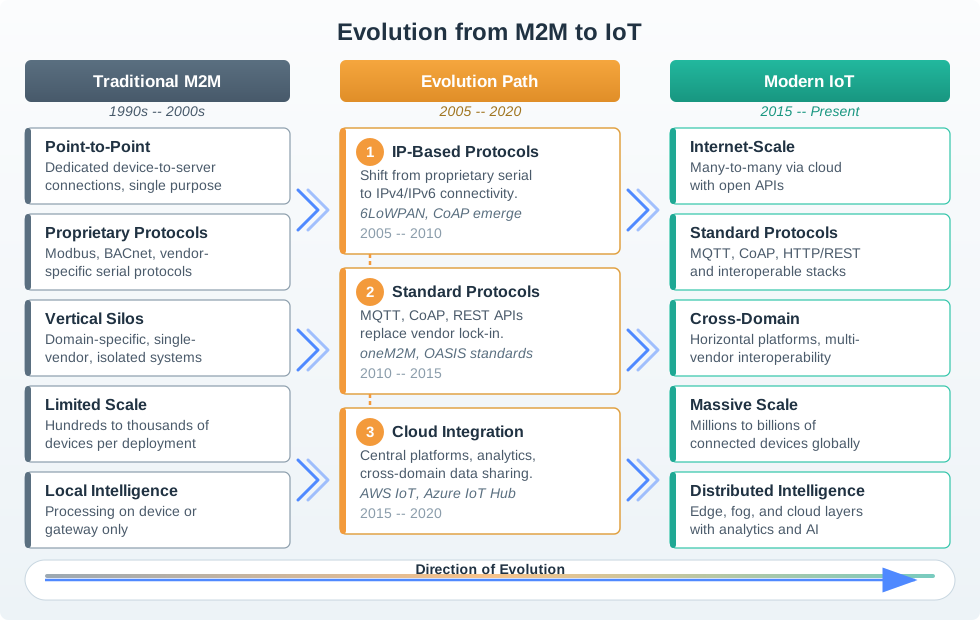
- M2M = closed, point-to-point, proprietary protocols, device-centric (thousands of devices)
- IoT = open, cloud-centric, standardized protocols, data-centric (billions of devices)
- Evolution: M2M (1990s-2000s) laid the foundation; IoT (2010s+) added cloud, analytics, and interoperability
- Decision rule: Choose M2M patterns for deterministic, isolated automation; choose IoT patterns when you need cloud analytics, remote access, or multi-vendor interoperability
Everything else in this chapter expands on these four points.
55.3 Introduction
For Beginners: M2M vs IoT
Think of M2M as the grandparent of IoT. M2M started in the 1990s with vending machines calling headquarters to report they were empty. IoT is the grandchild that grew up with smartphones, cloud computing, and AI.
Quick comparison:
- M2M: Vending machine → Phone line → Company server (closed system)
- IoT: Smart light → Wi-Fi → Cloud → Your phone app → Alexa → Your friend’s app (open ecosystem)
Both involve machines talking to each other, but IoT added internet connectivity, cloud platforms, and cross-device interoperability.
Sensor Squad: The Machine Chat Room
Hey Sensor Squad! Imagine two robots in a factory – Robot A picks up a box, and Robot B stacks it on a shelf. They talk directly to each other: “Box ready!” “Got it!” That is M2M – machines talking straight to each other, like two friends whispering secrets.
Now imagine those same robots can also talk to a computer in the cloud, which then tells your phone: “100 boxes stacked today!” and lets you say “Stack faster!” from your couch. That is IoT – machines talking to clouds, apps, and people everywhere!
Think of it this way:
- M2M = Walkie-talkies between two people (private, direct, simple)
- IoT = A group video call where everyone can join (open, connected, powerful)
M2M is the cool older sibling that taught IoT everything, but IoT grew up and made even more friends!
While M2M and IoT share similarities, they represent different evolutionary stages of connected devices. Understanding this evolution helps architects choose appropriate patterns for different applications.
How It Works: M2M to IoT Migration Pattern
The Gateway Bridge Strategy – How legacy M2M systems transition to IoT platforms:
Step 1: Legacy M2M (Point-to-Point)
- 500 vending machines with GSM modems
- Each machine SMS to central server: “Machine 042 low on Coke”
- Server dispatches restocking trucks
- Cost: $5/month × 500 = $2,500/month cellular
Step 2: Add IoT Platform Layer (Year 3)
- Deploy MQTT broker in cloud
- Install protocol gateway at central server
- Gateway converts: SMS → MQTT publish to
fleet/region1/machine042/inventory - No changes to 500 machines – they still send SMS
- New consumers subscribe: analytics team, predictive maintenance, finance dashboard
Step 3: Gradual Device Modernization (Years 4-7)
- Replace 100 machines/year with MQTT-native hardware during natural refresh cycle
- New machines publish directly to broker ($3/month LTE data vs. $5/month SMS)
- Old machines continue via gateway until replaced
- Cost reduces gradually: Year 4 = $2,300/month, Year 7 = $1,500/month
Step 4: Full IoT Platform (Year 8)
- All machines MQTT-native
- Multiple teams consume data independently
- ML models predict demand patterns
- Third-party delivery services bid on restocking routes via public API
Key principle: Evolutionary migration via gateways avoids the “forklift upgrade” that kills business cases.
55.4 M2M to IoT Evolution
Academic Resource: Stanford IoT Course - Industrial M2M Architecture
Source: Stanford University IoT Course - Industrial M2M architecture demonstrating autonomous machine-to-machine communication across manufacturing, logistics, and global operations
55.4.1 Historical Timeline
The transition from M2M to IoT did not happen overnight. It was a gradual evolution driven by decreasing hardware costs, standardization efforts, and the rise of cloud computing.
Key inflection points in the M2M-to-IoT transition:
- 2005: First ETSI M2M standardization efforts began, moving away from purely proprietary approaches
- 2008: IPv6 adoption accelerated, providing address space for billions of devices
- 2012: oneM2M global standard launched, unifying regional M2M standards
- 2014: MQTT became an OASIS standard, establishing a lightweight publish-subscribe protocol for IoT
- 2015: AWS IoT and Azure IoT Hub launched, bringing cloud-native device management to the mainstream
55.5 Key Differences
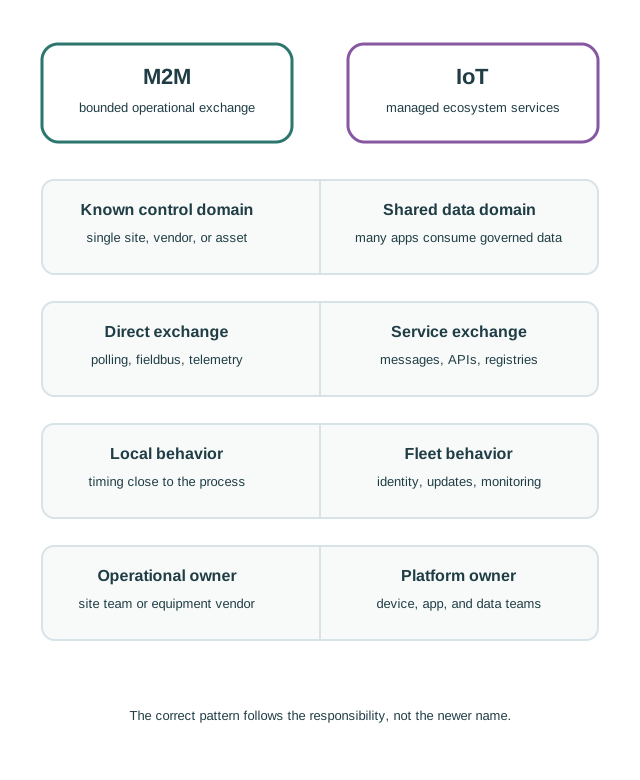
Understanding the architectural differences between M2M and IoT is critical for choosing the right approach for a given project. While M2M focuses on direct, reliable device communication, IoT emphasizes data-driven, cloud-connected ecosystems.
55.5.1 Comparison Table
| Aspect | M2M | IoT |
|---|---|---|
| Scope | Device-to-device | Device-to-cloud-to-device |
| Communication | Point-to-point or point-to-server | Many-to-many via internet |
| Protocols | Proprietary (Modbus, BACnet, DNP3) | Standardized (MQTT, CoAP, HTTP/2) |
| Data | Limited local processing | Big data analytics, AI/ML |
| Integration | Vertical silos, single-vendor | Horizontal platforms, multi-vendor |
| Scalability | Hundreds to thousands | Millions to billions |
| Connectivity | Cellular (2G/3G), serial, RS-485 | Wi-Fi, BLE, LoRaWAN, 5G, satellite |
| Management | Manual provisioning per device | Automated fleet management at scale |
| Security | Air-gap, physical isolation | TLS/DTLS, certificates, zero-trust |
| Cost per Device | $50-500 (specialized hardware) | $1-50 (commodity hardware) |
| Examples | SCADA, Industrial HMI, Telemetry | Smart cities, Consumer IoT, IIoT |
55.5.2 Worked Example: Vending Machine Evolution
To make these differences concrete, consider how a vending machine connected system evolved:
M2M Era (2005):
- A vending machine has a GSM modem that dials a proprietary server daily
- Uses a custom binary protocol to report: stock levels, coin counts, temperature
- The company’s dispatching software reads reports and schedules restocking
- No external integration – a completely closed system
- Cost: $200 GSM module + $15/month cellular plan per machine
IoT Era (2020):
- The vending machine connects via 4G/LTE to an AWS IoT Core cloud platform
- Publishes MQTT messages in JSON format every 15 minutes
- A Lambda function processes data, triggering SNS notifications when stock is low
- A public API lets third-party delivery services bid on restocking routes
- Mobile app shows real-time machine status to franchise owners worldwide
- ML model predicts demand patterns and pre-positions inventory
- Cost: $8 LTE module + $3/month cloud services per machine
Putting Numbers to It
M2M vs IoT cost comparison at scale: For a vending machine fleet of 10,000 units, the economic transformation from M2M to IoT is dramatic:
M2M era (2005) costs:
- Hardware: $200 GSM module × 10,000 = $2,000,000 upfront
- Cellular: $15/month/machine × 10,000 × 12 = $1,800,000/year
- Server: Proprietary software license $50,000/year + $20,000 hardware
- Integration: Closed system, no API — custom development for each new feature
- 5-year TCO: $2M + ($1.82M × 5) + $350K = $11.45M
IoT era (2020) costs:
- Hardware: $8 LTE module × 10,000 = $80,000 upfront (97.5% reduction)
- Cellular: $3/month data × 10,000 × 12 = $360,000/year (80% reduction)
- Cloud: AWS IoT Core + Lambda + S3 = $0.50/machine/month = $60,000/year
- Platform: Open APIs enable third-party integrations at zero incremental cost
- 5-year TCO: $80K + ($420K × 5) = $2.18M (81% reduction)
ROI from data value (not possible in M2M era): - ML demand prediction → 15% inventory waste reduction = $500K/year savings - Third-party route optimization API → 20% delivery cost reduction = $300K/year - Customer mobile app → 8% sales increase = $1.2M/year additional revenue
Net 5-year value: \((11.45M - 2.18M) + (1.0M \times 5) = 9.27M + 5.0M = \$14.27M\) improvement from migrating M2M to IoT.
Key Insight
The same physical machine (vending machine) evolved from a closed M2M island into a node in a connected IoT ecosystem. The hardware cost dropped 96%, while the value of the data increased dramatically through cloud analytics and third-party integration.
55.6 When to Choose M2M Patterns
Key Takeaway
In one sentence: M2M patterns are optimal for closed, deterministic systems requiring reliable automation; IoT patterns are better for open ecosystems needing interoperability and cloud analytics.
Remember this rule: M2M is point-to-point with domain-specific protocols; IoT adds cloud connectivity, standardized protocols, and cross-domain integration. Choose M2M patterns when you need reliable, deterministic automation in a closed system.
55.6.1 Decision Flowchart
Use this flowchart to guide your architectural decision:
55.6.2 Choose M2M When:
- Closed System: No need for external integrations
- Deterministic Requirements: Predictable, real-time response needed (e.g., < 10 ms control loops)
- Legacy Integration: Working with existing industrial protocols (Modbus, BACnet, DNP3)
- Local Control: Processing and decisions stay on-premises
- Security Through Isolation: Air-gapped networks preferred (critical infrastructure, defense)
- Regulatory Compliance: Industry-specific certifications that predate IoT standards (IEC 61850 for power grids)
55.6.3 Choose IoT When:
- Cloud Analytics: Need big data processing and AI/ML for predictive insights
- Remote Access: Users need global access via web dashboards and mobile apps
- Multi-Vendor: Devices from different manufacturers must interoperate seamlessly
- Ecosystem: Third-party integrations, developer platforms, and APIs are required
- Consumer-Facing: End-users interact with devices directly (smart home, wearables)
- Rapid Scaling: Need to go from hundreds to millions of devices without re-architecting
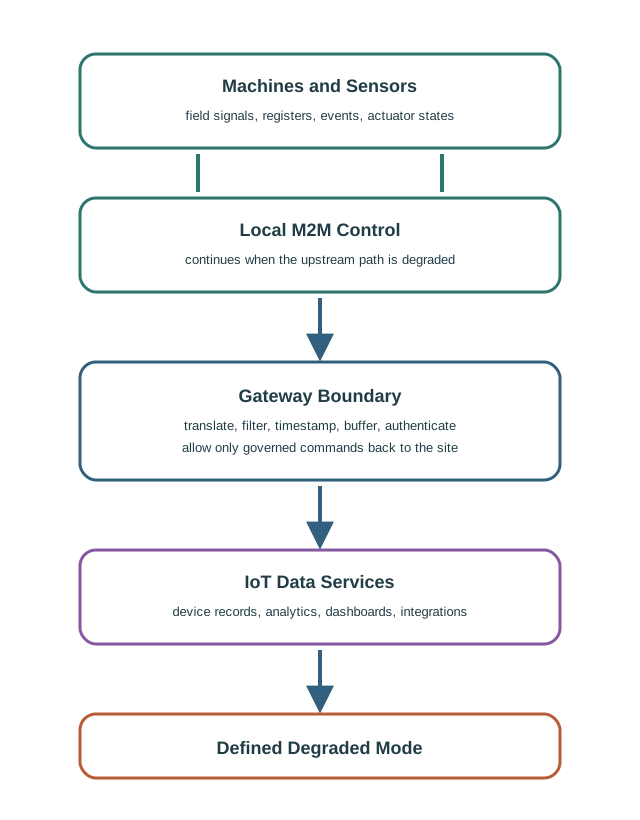
55.6.4 Hybrid Approach: The Gateway Pattern
In practice, many modern deployments use a hybrid approach where M2M and IoT coexist:
The gateway is the bridge between worlds: it maintains the deterministic, low-latency M2M control loops locally while forwarding data to the cloud for analytics. This is the most common pattern in industrial IoT (IIoT) deployments today.
Common Pitfall: Forcing IoT on M2M Systems
A frequent mistake is replacing a working M2M control loop with a cloud-dependent IoT architecture. If a factory’s PLC-to-actuator control loop currently runs at 5 ms and you route it through the cloud, you introduce 50-200 ms latency plus the risk of internet outages. Keep deterministic control loops local; add cloud connectivity alongside them, not instead of them.
55.7 Code Example: M2M-to-IoT Protocol Translation Gateway
This Python example demonstrates the hybrid gateway pattern discussed above. It bridges legacy Modbus RTU devices to an MQTT cloud platform, performing protocol translation, data normalization, and store-and-forward during connectivity loss:
import json
import time
from collections import deque
class M2MtoIoTGateway:
"""Protocol translation gateway bridging M2M devices to IoT cloud.
Reads Modbus register data from legacy devices, normalizes it
to JSON, publishes via MQTT, and queues messages during outages
for store-and-forward delivery.
"""
def __init__(self, gateway_id):
self.gateway_id = gateway_id
self.devices = {}
self.cloud_connected = True
self.offline_queue = deque(maxlen=10000)
self.stats = {"translated": 0, "published": 0, "queued": 0, "forwarded": 0}
def register_device(self, device_id, register_map):
"""Register a Modbus device with its register-to-metric mapping.
Args:
device_id: Unique device identifier (e.g., "plc-pump-03").
register_map: Dict mapping register addresses to metric names
and scale factors. Example:
{40001: {"name": "temperature", "scale": 0.1, "unit": "C"},
40002: {"name": "pressure", "scale": 0.01, "unit": "bar"}}
"""
self.devices[device_id] = {"register_map": register_map, "last_values": {}}
def translate_registers(self, device_id, raw_registers):
"""Convert raw Modbus registers to normalized IoT JSON payload.
Args:
raw_registers: Dict of {register_addr: raw_int_value}.
Returns:
Normalized JSON-serializable dict ready for MQTT publish.
"""
if device_id not in self.devices:
return None
device = self.devices[device_id]
payload = {
"gateway": self.gateway_id,
"device": device_id,
"timestamp": int(time.time()),
"readings": {},
}
for addr, raw_val in raw_registers.items():
if addr in device["register_map"]:
mapping = device["register_map"][addr]
scaled = raw_val * mapping["scale"]
payload["readings"][mapping["name"]] = {
"value": round(scaled, 3),
"unit": mapping["unit"],
}
self.stats["translated"] += 1
return payload
def publish(self, payload):
"""Publish to MQTT cloud or queue if offline."""
topic = f"iot/{payload['gateway']}/{payload['device']}/telemetry"
message = json.dumps(payload, separators=(",", ":"))
if self.cloud_connected:
# Simulated MQTT publish
self.stats["published"] += 1
return {"status": "published", "topic": topic, "bytes": len(message)}
else:
self.offline_queue.append((topic, message))
self.stats["queued"] += 1
return {"status": "queued", "queue_depth": len(self.offline_queue)}
def drain_queue(self):
"""Forward queued messages when connectivity restores."""
forwarded = 0
while self.offline_queue and self.cloud_connected:
topic, message = self.offline_queue.popleft()
forwarded += 1
self.stats["forwarded"] += forwarded
return forwarded
# Example: Industrial pump monitoring
gw = M2MtoIoTGateway("factory-gw-01")
# Register a Modbus PLC with register mappings
gw.register_device("plc-pump-03", {
40001: {"name": "motor_temp", "scale": 0.1, "unit": "C"},
40002: {"name": "discharge_pressure", "scale": 0.01, "unit": "bar"},
40003: {"name": "flow_rate", "scale": 0.1, "unit": "L/min"},
40004: {"name": "vibration", "scale": 0.001, "unit": "mm/s"},
})
# Simulate reading Modbus registers and translating
raw = {40001: 523, 40002: 345, 40003: 187, 40004: 1250}
payload = gw.translate_registers("plc-pump-03", raw)
result = gw.publish(payload)
print("Online publish:", json.dumps(payload, indent=2))
# Simulate network outage
gw.cloud_connected = False
for i in range(3):
raw[40001] += 5 # Temperature rising
payload = gw.translate_registers("plc-pump-03", raw)
result = gw.publish(payload)
print(f"Offline: {result}")
# Reconnect and drain
gw.cloud_connected = True
fwd = gw.drain_queue()
print(f"\nReconnected: forwarded {fwd} queued messages")
print(f"Stats: {gw.stats}")
# Output:
# Online publish: {
# "gateway": "factory-gw-01",
# "device": "plc-pump-03",
# "timestamp": 1738900000,
# "readings": {
# "motor_temp": {"value": 52.3, "unit": "C"},
# "discharge_pressure": {"value": 3.45, "unit": "bar"},
# "flow_rate": {"value": 18.7, "unit": "L/min"},
# "vibration": {"value": 1.25, "unit": "mm/s"}
# }
# }
# Offline: {'status': 'queued', 'queue_depth': 1}
# Offline: {'status': 'queued', 'queue_depth': 2}
# Offline: {'status': 'queued', 'queue_depth': 3}
#
# Reconnected: forwarded 3 queued messages
# Stats: {'translated': 4, 'published': 1, 'queued': 3, 'forwarded': 3}The gateway performs the three core functions of the hybrid M2M-to-IoT pattern: protocol translation (Modbus registers to JSON), data normalization (raw integer values to scaled engineering units), and store-and-forward (queueing during connectivity loss). The local Modbus control loop continues running uninterrupted during internet outages – only cloud analytics is deferred.
55.8 Knowledge Check
55.9 Worked Example: Legacy Factory M2M-to-IoT Migration
Real-World Scenario: Automotive Parts Manufacturer Migration
Context: An automotive parts factory operates 120 CNC machines connected via a 15-year-old M2M SCADA system using Modbus RTU over RS-485. The plant manager wants to add predictive maintenance and real-time production dashboards accessible from mobile devices globally. Calculate the migration cost, timeline, and ROI for a hybrid M2M-to-IoT transition.
Step 1: Current M2M System Analysis
| Component | Technology | Quantity | Replacement Cost | Notes |
|---|---|---|---|---|
| CNC machine PLCs | Modbus RTU, RS-485 | 120 | $0 | Keep existing — still functional |
| M2M serial concentrators | RS-485 → Ethernet | 6 (20 machines each) | $0 | Keep existing |
| Local SCADA server | Windows Server 2008 | 1 | $15,000 | Must upgrade (EOL OS) |
| Operator HMI terminals | Dedicated panels | 12 | $0 | Keep for local control |
Current capabilities: Local monitoring only, no remote access, no predictive analytics, alarm logs stored locally (last 30 days only).
Step 2: Hybrid Architecture Design
Add IoT layer while preserving M2M control loops:
| New Component | Technology | Quantity | Unit Cost | Total Cost |
|---|---|---|---|---|
| IoT edge gateways | Modbus → MQTT translator | 6 (1 per concentrator) | $800 | $4,800 |
| Cloud platform | AWS IoT Core + Lambda | N/A | $450/month | $5,400/year |
| Time-series database | AWS Timestream | N/A | $180/month | $2,160/year |
| Dashboard licenses | Grafana Cloud | 25 users | $15/user/month | $4,500/year |
| Implementation services | System integrator | 120 hours | $150/hour | $18,000 |
Total upfront cost: $4,800 (gateways) + $15,000 (SCADA upgrade) + $18,000 (services) = $37,800
Ongoing annual cost: $5,400 (IoT Core) + $2,160 (DB) + $4,500 (dashboards) = $12,060/year
Step 3: Migration Timeline
| Phase | Duration | Activities | Risk Mitigation |
|---|---|---|---|
| Phase 1: Planning | 2 weeks | Document Modbus register maps, define KPIs, design data model | Shadow production for 1 week before go-live |
| Phase 2: Gateway Install | 3 weeks | Install 6 gateways, configure MQTT topics, test connectivity | Install one gateway first, validate for 1 week |
| Phase 3: Cloud Setup | 2 weeks | Configure IoT Core, set up Timestream, build Grafana dashboards | Use staging environment first |
| Phase 4: Pilot | 4 weeks | Run 20 machines (1 gateway) in parallel with old SCADA | Validate data accuracy ±1% |
| Phase 5: Rollout | 6 weeks | Deploy remaining 5 gateways, train 25 users | Staged: 1 gateway per week |
| Phase 6: Optimization | Ongoing | Tune ML models, add new dashboards, optimize costs | Monthly review meetings |
Total timeline: 17 weeks (4.25 months) from kickoff to full deployment.
Step 4: ROI Calculation (5-Year Horizon)
Costs:
- Upfront: $37,800
- Year 1 ongoing: $12,060
- Years 2-5 ongoing: $12,060 × 4 = $48,240
- Total 5-year cost: $37,800 + $12,060 + $48,240 = $98,100
Benefits:
| Benefit Category | Mechanism | Annual Value |
|---|---|---|
| Reduced unplanned downtime | Predictive maintenance catches bearing failures 2-3 weeks early | 120 machines × 8 hours/year avoided × $500/hour (lost production) = $480,000 |
| Lower maintenance costs | Condition-based vs time-based servicing (avoid unnecessary maintenance) | 120 machines × $1,200/year savings = $144,000 |
| Improved OEE | Real-time dashboards reduce setup time by 5% | 120 machines × 6,000 hours/year × 5% × $500/hour = $18,000 |
| Remote troubleshooting | Avoid on-site visits for 60% of issues | 50 visits/year avoided × $400/visit = $20,000 |
Total annual benefit: $480,000 + $144,000 + $18,000 + $20,000 = $662,000/year
5-Year NPV (10% discount rate):
NPV = -$37,800 (upfront) + ($662,000 - $12,060) × [(1 - 1.1^-5) / 0.1] NPV = -$37,800 + $649,940 × 3.791 NPV = -$37,800 + $2,463,534 NPV = $2,425,734
Payback period: $37,800 / ($662,000 - $12,060) = 0.058 years = 21 days
Key Insight: The hybrid approach preserves the deterministic Modbus control loops (5 ms latency, proven reliability) while adding cloud analytics that deliver 24× ROI over 5 years. Pure IoT (replacing Modbus with cloud control) would introduce unacceptable latency risk; pure M2M (no cloud) would forego $2.4M in benefits.
55.10 Interactive: M2M-to-IoT Migration ROI Calculator
Explore the economic trade-offs of migrating from a legacy M2M system to a hybrid IoT architecture.
55.11 Decision Framework: M2M vs IoT Pattern Selection
When to Choose M2M, IoT, or Hybrid
Use this scoring system to determine the optimal architecture pattern for your application.
55.11.1 Scoring Matrix
For each factor, select the description that best matches your requirements and note the score:
| Factor | Pure M2M (Score 3) | Hybrid M2M+IoT (Score 2) | Pure IoT (Score 1) |
|---|---|---|---|
| Latency requirement | <10 ms deterministic | 50-500 ms acceptable | >1 second acceptable |
| Connectivity | Air-gapped network | Intermittent internet | Always-on internet |
| Interoperability | Single vendor acceptable | Some third-party needed | Multi-vendor essential |
| Analytics needs | Local dashboards sufficient | Edge + cloud analytics | Cloud ML/AI required |
| Remote access | On-premises only | Regional access needed | Global access required |
| Device lifespan | 10-20 years (industrial) | 5-10 years | 2-5 years (consumer) |
| Compliance | IEC 61850, ISA-95 | Hybrid standards | GDPR, cloud-native |
| Security model | Physical isolation | Defense-in-depth | Zero-trust cloud |
55.11.2 Total Score Interpretation
Sum your scores across all 8 factors:
| Total Score | Recommended Pattern | Architecture | Example Use Cases |
|---|---|---|---|
| 20-24 | Pure M2M | Modbus/BACnet/DNP3, local SCADA, no internet | Power grid substations, nuclear plants, critical infrastructure |
| 12-19 | Hybrid M2M+IoT | M2M control loops + IoT gateway for cloud analytics | Factory automation, smart buildings, water treatment |
| 8-11 | Pure IoT | MQTT/CoAP/HTTP, cloud-native, no legacy protocols | Smart home, consumer wearables, fleet tracking |
55.11.3 Decision Tree for Edge Cases
If your score is borderline (18-20 or 11-13), use this tiebreaker:
Q1: Is real-time control a safety issue?
- YES → Choose Pure M2M or Hybrid (never Pure IoT for safety-critical)
- NO → Continue to Q2
Q2: Do you need ML/AI analytics?
- YES and cloud access available → Choose Hybrid or Pure IoT
- YES but air-gapped → Choose Pure M2M with on-premises ML edge servers
- NO → Choose Pure M2M
Q3: What is the 10-year TCO sensitivity?
- Cloud costs >$100/device/year → Choose Pure M2M (one-time capex)
- Cloud costs $10-100/device/year → Choose Hybrid
- Cloud costs <$10/device/year → Choose Pure IoT
55.11.4 Real-World Scoring Examples
Example 1: Hospital Patient Monitoring
| Factor | Choice | Score |
|---|---|---|
| Latency | 50-500 ms acceptable (bedside alarms local, cloud for trends) | 2 |
| Connectivity | Intermittent (elevator/basement dead zones) | 2 |
| Interoperability | Multi-vendor (wearables, monitors, infusion pumps) | 1 |
| Analytics | Cloud ML for early sepsis prediction | 1 |
| Remote access | Doctors need global access via mobile | 1 |
| Device lifespan | 5-10 years (medical equipment) | 2 |
| Compliance | HIPAA (cloud with BAA) | 1 |
| Security | Zero-trust with TLS + PHI encryption | 1 |
| TOTAL | 11 → Pure IoT with local bedside gateway for alarms |
Example 2: Oil Refinery SCADA
| Factor | Choice | Score |
|---|---|---|
| Latency | <10 ms (emergency shutdown loops) | 3 |
| Connectivity | Air-gapped (no internet on process network) | 3 |
| Interoperability | Single vendor (ABB, Siemens) acceptable | 3 |
| Analytics | Local historian + HMI | 3 |
| Remote access | On-premises control room only | 3 |
| Device lifespan | 20+ years (industrial) | 3 |
| Compliance | IEC 61511 (safety instrumented systems) | 3 |
| Security | Physical isolation, Purdue Model Level 0-2 | 3 |
| TOTAL | 24 → Pure M2M — never connect to internet |
Example 3: Smart Building HVAC
| Factor | Choice | Score |
|---|---|---|
| Latency | 1-5 second PID control loops | 2 |
| Connectivity | Wi-Fi available but intermittent | 2 |
| Interoperability | BACnet (multi-vendor chillers, VAVs) | 2 |
| Analytics | Cloud for energy optimization | 1 |
| Remote access | Facility manager needs mobile access | 1 |
| Device lifespan | 10-15 years (HVAC equipment) | 2 |
| Compliance | ASHRAE 90.1 (energy) | 2 |
| Security | BACnet/SC + TLS to cloud | 2 |
| TOTAL | 14 → Hybrid M2M+IoT (BACnet local + MQTT to cloud) |
55.12 Common Mistake: Replacing Deterministic M2M with Best-Effort IoT
Pitfall: Routing Safety-Critical Control Through the Cloud
The Problem: In the rush to “modernize” legacy M2M systems, architects sometimes replace deterministic local control loops with cloud-dependent IoT architectures. This introduces non-deterministic latency, internet dependency, and single points of failure that violate safety requirements.
Real-World Disaster Example: A water treatment plant migrated its PLC-controlled chemical dosing system from Modbus RTU (local, 5 ms latency) to an IoT platform where pH sensors reported to AWS IoT Core, which then sent dosing commands back to actuators via MQTT. During a minor internet outage (30 minutes), the dosing system failed to adjust pH, leading to water quality violations and a $1.2M fine from regulators.
Why This Happens:
- Misunderstanding latency: “50 ms cloud round-trip is fast enough for everything” (it’s not — control loops need <10 ms)
- Overlooking reliability: “Cloud has 99.9% uptime” (yes, but 0.1% = 8.76 hours/year of potential control system failure)
- Underestimating jitter: Cloud latency varies 10-100× depending on traffic (e.g., 20 ms typical, but 2,000 ms during AWS region congestion)
How to Detect This Mistake:
| Symptom | Diagnostic | Root Cause |
|---|---|---|
| Control loop instability (oscillations) | Plot actuator response time vs setpoint changes | Variable cloud latency causing PID tuning mismatch |
| System failures during internet outages | Check uptime correlation with ISP outages | No local control fallback |
| Regulatory non-compliance | Audit real-time response requirements | Safety-critical actions routed through cloud |
| Increased bandwidth costs | Monitor MQTT traffic volume | Sending ALL sensor data to cloud (not just exceptions) |
How to Fix It: The Hybrid Pattern
Step 1: Identify Control vs Monitoring Paths
| Data Flow | Latency Requirement | Route |
|---|---|---|
| pH sensor → PLC | <5 ms | Local Modbus RTU (M2M) — NEVER through cloud |
| PLC → dosing pump | <5 ms | Local Modbus RTU (M2M) — NEVER through cloud |
| PLC → historian | <1 second | Local storage (M2M) |
| Historian → cloud | Minutes acceptable | MQTT to AWS IoT (IoT) — for dashboards only |
Step 2: Architecture Correction
WRONG (cloud in the control loop):
pH Sensor → MQTT → Cloud → Lambda → MQTT → Dosing Pump
Latency: 50-2000 ms (non-deterministic)
Availability: 99.9% (depends on internet)
CORRECT (local control + cloud monitoring):
pH Sensor → PLC (Modbus RTU) → Dosing Pump
↓ (historian log)
MQTT → Cloud → Dashboard
Latency: <5 ms (deterministic local control)
Availability: 99.999% (PLC continues during internet outage)
Step 3: Decision Rule for Safety-Critical Systems
Use this formula to determine if a control loop can go through the cloud:
Can Route Through Cloud? = ALL of the following are TRUE:
1. Maximum acceptable latency > 500 ms
2. System can tolerate 99.9% availability (8.76 hours/year offline acceptable)
3. Non-safety-critical (failure does not cause injury, environmental damage, or regulatory violation)
4. Fallback mode exists (local control during cloud outage)
If ANY condition is FALSE, keep the control loop local (M2M).
Step 4: Regulatory Compliance Mapping
| Industry | Standard | Control Loop Latency | Can Use Cloud Control? |
|---|---|---|---|
| Power Grid | IEC 61850 GOOSE | <4 ms | ❌ NO — local M2M only |
| Industrial Safety | IEC 61511 SIL 3 | <10 ms | ❌ NO — local M2M only |
| Water Treatment | EPA SCADA Security | <100 ms | ❌ NO — local M2M with cloud monitoring OK |
| Building HVAC | ASHRAE 90.1 | 1-5 seconds | ✅ YES — if fallback mode (fixed setpoint during outage) |
| Fleet Tracking | None | >10 seconds | ✅ YES — cloud-native OK |
Prevention Checklist:
Quick Test: Physically disconnect the internet cable. If the system cannot maintain safe operation for 24 hours, you have made this mistake. Fix it before deployment.
Try It Yourself: M2M-to-IoT Migration Planning
Scenario: Your company operates 1,000 industrial pumps with legacy HART protocol sensors (4-20mA analog + digital overlay). Current SCADA system has been running for 15 years. Leadership wants “IoT analytics” without disrupting operations.
Your Task:
- Design a migration path that avoids replacing 1,000 HART sensors
- Calculate costs for:
- Gateway hardware to bridge HART to MQTT
- Cloud platform fees ($0.50/device/month)
- Avoided cost of replacing sensors ($500 each)
- Define success metrics:
- Predictive maintenance alerts (target: 2-week lead time for bearing failures)
- Energy optimization (target: 8% pump efficiency improvement)
- Zero disruption to existing control loops
What to Observe:
- How many gateways do you need? (Each gateway handles ~50 HART devices)
- What’s the ROI timeline? (Avoided sensor replacement vs. gateway + cloud costs)
- What functionality stays local vs. moves to cloud?
Hint: The hybrid pattern should show positive ROI within 6-12 months from energy savings alone, even before counting avoided downtime from predictive maintenance.
55.13 Concept Relationships
| Concept | Relationship | Connected Concept |
|---|---|---|
| M2M Communication | Evolved into | Modern IoT Ecosystems |
| Proprietary Protocols | Replaced by | Standardized IP Protocols (MQTT, CoAP) |
| Point-to-Point M2M | Extended via | Cloud-Centric IoT Platforms |
| Gateway Pattern | Bridges | Legacy M2M and Modern IoT |
| Deterministic Control | Requires | Local M2M (not cloud-routed) |
| Cloud Analytics | Augments | M2M Control Loops (hybrid pattern) |
55.14 Summary
This chapter traced the evolution from M2M to IoT and provided frameworks for choosing between them.
Key Takeaways:
- Historical Context: M2M emerged in the 1990s with SCADA and telemetry; IoT built on this foundation starting around 2010 with cloud platforms and standardized protocols
- Architectural Differences: M2M uses point-to-point communication in vertical silos; IoT uses cloud-centric, many-to-many communication in horizontal platforms
- Protocol Evolution: Proprietary protocols (Modbus, BACnet, DNP3) gave way to IP-based standards (MQTT, CoAP, HTTP/2), reducing vendor lock-in and enabling interoperability
- Scale Transformation: From thousands of devices per deployment (M2M) to billions globally (IoT), enabled by low-cost hardware and cloud elasticity
- Focus Shift: From device control and monitoring (M2M) to data analytics, AI services, and cross-domain integration (IoT)
- Hybrid Gateway Pattern: Most real-world deployments use a hybrid approach – keeping deterministic M2M control loops locally while adding IoT cloud connectivity through gateways
- Decision Framework: Choose pure M2M for air-gapped, deterministic systems; choose IoT for cloud analytics and multi-vendor ecosystems; choose hybrid when you need both
Practical Rule of Thumb
If your system needs sub-10ms deterministic control, keep M2M protocols locally. If your system needs data analytics or remote access, add IoT cloud connectivity. If you need both (most industrial deployments do), use the hybrid gateway pattern.
55.15 What’s Next
| If you want to… | Read this |
|---|---|
| Explore M2M applications and node types | M2M Applications and Node Types |
| Understand M2M platforms and network layers | M2M Platforms and Networks |
| Study M2M overview and fundamentals | M2M Overview and Fundamentals |
| Get hands-on with M2M lab exercises | M2M Communication Lab |
| Review M2M architectures and standards | M2M Architectures and Standards |
55.16 See Also
Explore these related chapters to deepen your understanding of M2M evolution:
- M2M Communication Overview - Foundational M2M architecture and autonomous operation principles
- M2M Applications and Node Types - Industry use cases and device classification strategies
- M2M Design Patterns - Common pitfalls and best practices for resilient M2M systems
- Edge Computing Architecture - Local processing strategies for hybrid M2M/IoT deployments
- Protocol Translation Gateways - Bridging legacy and modern protocols
Related Chapters
- M2M Communication Overview - Introduction and key concepts
- M2M Applications and Node Types - Industry applications and device hierarchy
- M2M Platforms and Networks - Service platforms and network architectures
- M2M Labs and Exercises - Hands-on practice with M2M concepts
- Cellular IoT Fundamentals - Cellular M2M networks