4 DSDV Proactive Routing
More
Depth: Practitioner
Progress saves as you read. Mark sections complete as you go; your progress appears in the sidebar.
4.1 Start Simple
This section: Start Simple — Picture a rescue node that forwards immediately but uses yesterday’s next hop after the team moves.
Watch One Ready Route Become Stale
Picture a rescue node that forwards immediately but uses yesterday’s next hop after the team moves. A ready table helps only when changes and invalid routes are visible.
A protocol means an agreed set of message and behavior rules used by communicating systems.
Send a marked packet on a stable path, move one relay, and send again during and after convergence. Keep node identities, protocol and table versions, sequence number, metric, next hop, update time, delivery, loss, and recovery result.
This test covers selected movement and routes, not every mobile network. The deeper sections explain advertisements, sequence numbers, metrics, settling, loops, overhead, and route expiry.
4.2 Start With a Route Table That Is Ready Before Demand
This section: Start With a Route Table That Is Ready Before Demand — DSDV tells the network to keep routes ready before a packet asks for them.
DSDV tells the network to keep routes ready before a packet asks for them. Each node maintains destination entries, sequence numbers, and next hops so forwarding can happen quickly when data arrives.
That promise is useful only when the cost of constant upkeep fits the IoT deployment. Start with one destination entry and ask how the node knows it is fresh. The sequence-number story is the heart of DSDV.
4.3 DSDV Updates for Ready Routes
This section: DSDV Updates for Ready Routes — Destination-Sequenced Distance Vector (DSDV) is a proactive ad-hoc routing protocol.
Destination-Sequenced Distance Vector (DSDV) is a proactive ad-hoc routing protocol. Each node keeps a table for every known destination, including the next hop, hop count, and a destination sequence number. When an application has a packet to send, the node can forward immediately from the table instead of first flooding a route discovery request.
That ready-route behavior is useful only when the network can afford the maintenance cost. DSDV is easiest to defend in relatively stable ad-hoc IoT networks where many nodes communicate often enough that low route-lookup delay matters. It is harder to justify when traffic is rare, nodes move quickly, or battery and airtime budgets cannot absorb repeated table exchanges.
Think of DSDV as a promise between neighbors: “I will keep telling you what I know about every destination, and I will mark that knowledge with a freshness number.” The route table is not a cache that fills only after use. It is a maintained control-plane data structure. That distinction matters for IoT devices because a quiet sensor still has to spend receive time, table memory, and processing budget to keep the mesh ready for traffic that may never arrive.
The practical question is whether the saved route-discovery delay is visible to the service. A mobile robot team exchanging coordination messages, a temporary field mesh with awake relays, or a warehouse cart network may benefit from immediate forwarding. A sleepy star-like telemetry estate usually does not. The learner should evaluate DSDV by pairing every benefit with the upkeep that creates it: route entries require memory, advertisements require airtime, listening requires energy, and topology changes require fresh sequence-number propagation.
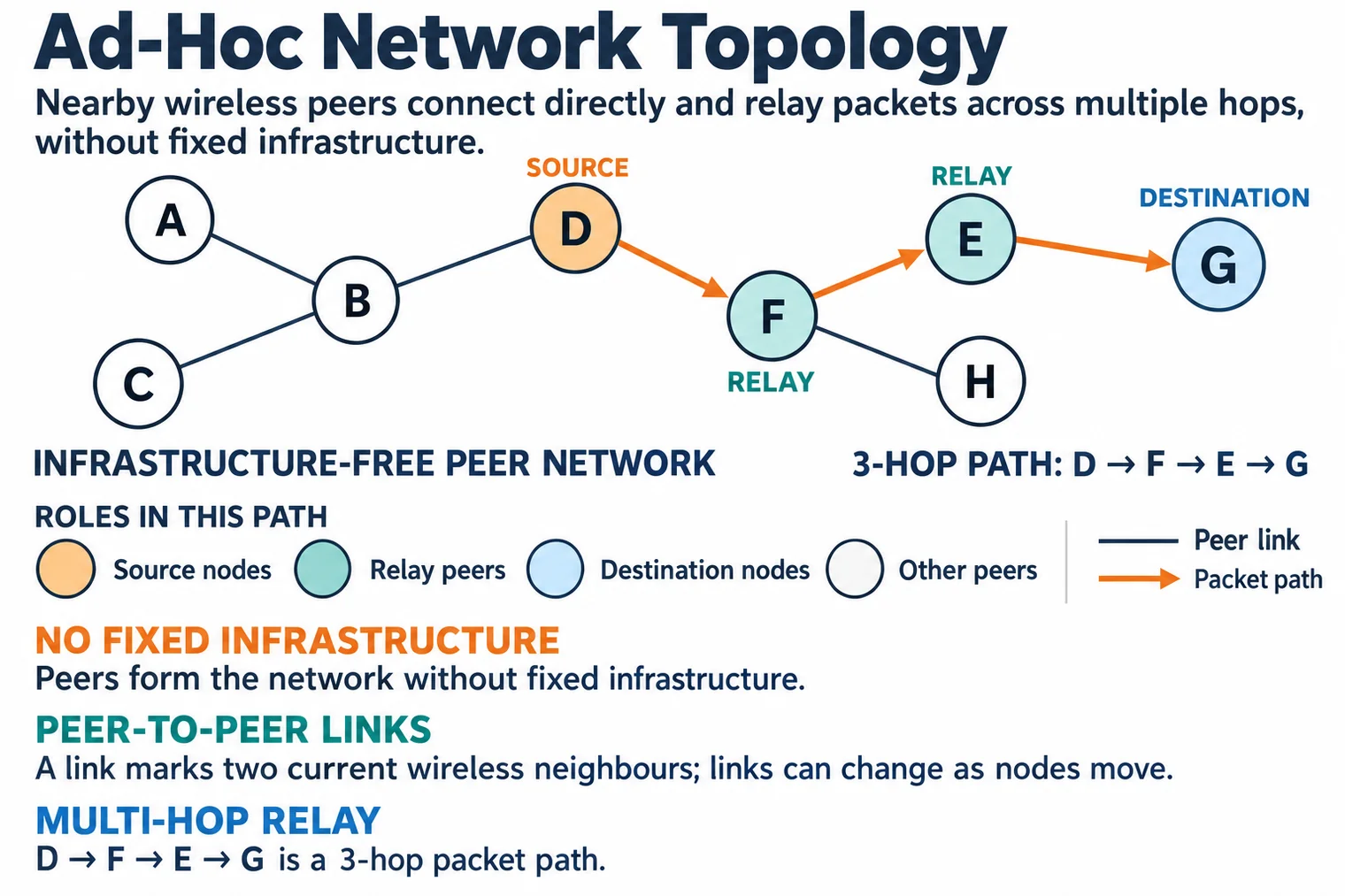
DSDV assumes an infrastructure-free mesh where neighbors can relay for each other.
4.3.1 Route Already Known
When an application packet arrives, DSDV uses the destination entry already held in the routing table to select a next hop. The node does not first need to flood an on-demand route discovery request. This reduces first-packet delay when a usable route is already maintained, making ready tables valuable for frequent communication where route setup delay matters.
The lookup depends on route information kept current before the packet arrives. Periodic and triggered updates maintain destination entries, while sequence numbers help distinguish newer information from stale paths. After movement or a link failure, a stored next hop may remain outdated during convergence. Evaluate immediate forwarding together with route freshness and the cost of maintaining that readiness.
4.3.2 Freshness Before Distance
DSDV compares destination sequence numbers before comparing hop counts. The sequence number identifies how fresh the advertised route information is, while hop count describes its distance. A route with a higher sequence number takes priority even if it requires more hops, because an older, shorter route may describe a topology that has changed.
When sequence numbers match, the lower hop count wins within that freshness generation. This ordering helps nodes reject stale paths after movement or link failure. Its effectiveness depends on newer route information reaching the nodes that need it. Lost or delayed updates can leave outdated next hops installed, so route reviews should track sequence numbers, selected next hops, and invalidation over time.
4.3.3 Continuous Control Cost
DSDV maintains routing information before application demand, so quiet application periods still carry routing costs. Periodic updates refresh route state, and triggered updates spread important changes when links fail or routes become unavailable. Sending advertisements uses airtime, receiving them requires listening energy, and maintaining entries consumes memory and processing. These demands share the device’s resources with useful sensing or control traffic.
The cost is harder to justify when maintained destinations are rarely contacted or batteries cannot absorb repeated table exchanges. Assess the update interval, packet size, radio duty cycle, and relay energy under representative traffic. Compare the measured upkeep with the service benefit from reduced route-discovery delay, including the additional maintenance required after topology changes.
4.3.4 Topology Sensitivity
Fast movement or unstable links can make tables age faster than the network can converge.
Choose DSDV only when the value of immediate forwarding is worth the periodic and triggered update burden.
4.4 DSDV Route-Freshness Contract
This section: DSDV Route-Freshness Contract — A DSDV design review should not stop at “the table has a path.” The review has to prove that each node can maintain fresh enough route state for the service.
A DSDV design review should not stop at “the table has a path.” The review has to prove that each node can maintain fresh enough route state for the service. That means recording route entries, update cadence, link-change triggers, stale-route handling, and the measured cost paid by relay nodes.
Use the table as a contract, not just a display. For each important destination, the reviewer should be able to explain why the selected next hop is current, why an older shorter path was rejected, what happens when that next hop fails, and how much route-maintenance traffic the device must hear while doing its sensing or control work. This makes the review concrete enough to compare against DSR, AODV-style discovery, a static route set, or a gateway tree.
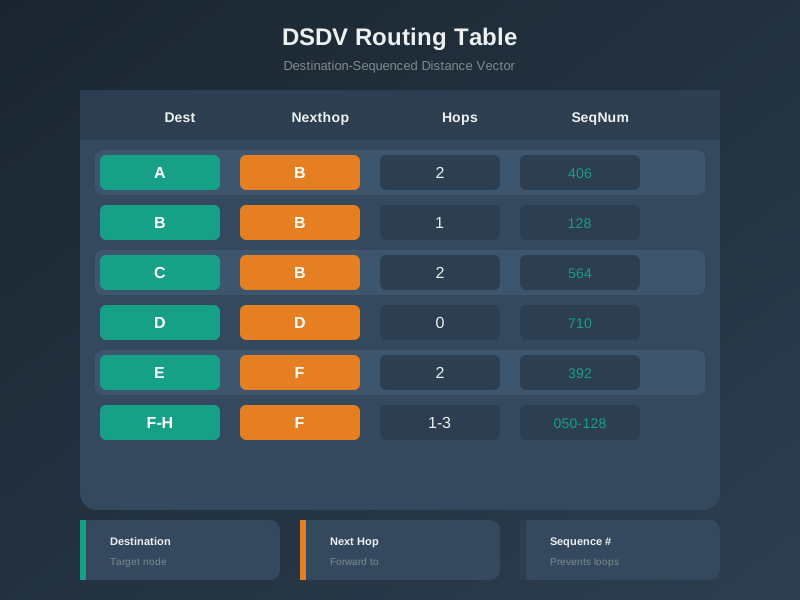
A DSDV table is useful because it combines next-hop reachability with a freshness number.
4.4.1 DSDV Review Ledger
| Review item | What to capture | Approval evidence | Failure sign |
|---|---|---|---|
| Traffic fit | Which nodes talk often, which flows need low first-packet delay, and which flows can tolerate discovery delay. | Frequent traffic makes ready tables useful in the actual operating pattern. | Most updates maintain routes that the application rarely uses. |
| Table state | Destination, next hop, hop count, sequence number, and the age of the installed route. | Route entries change predictably when neighbors move, fail, or recover. | Stale entries survive because update loss or settling time hides topology changes. |
| Update burden | Periodic update interval, triggered update behavior, packet size, radio duty cycle, and relay energy. | Control traffic stays below the airtime and energy budget under representative traffic. | Routing maintenance consumes more capacity than the useful sensor or control traffic can tolerate. |
| Recovery drill | Broken-link detection, infinity metric propagation, replacement route adoption, and operator-visible telemetry. | Nodes stop using the failed path and converge on a valid alternative within the service tolerance. | Nodes keep forwarding into a black hole or oscillate between stale alternatives. |
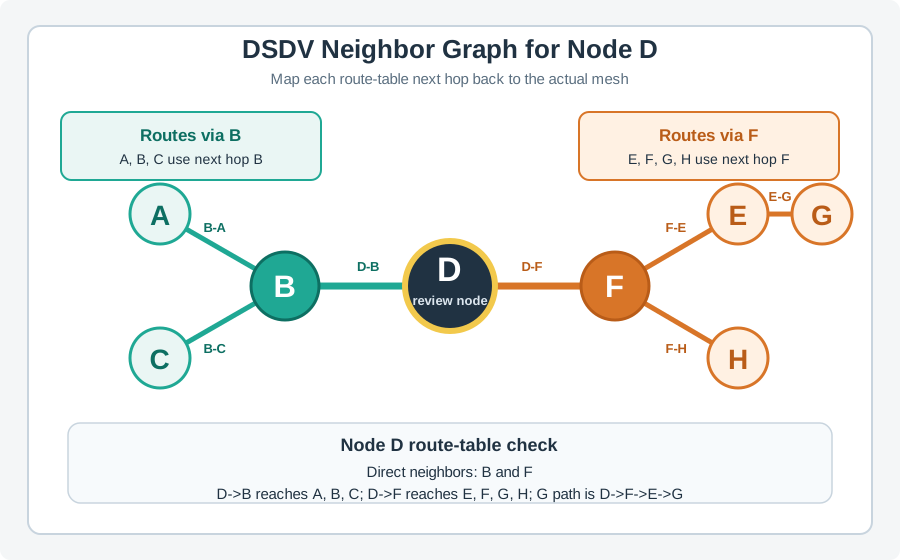
A route review should map table entries back to the actual neighbor graph, not just to protocol labels.
Inspect Figure 4.4 and ask why destination freshness is compared before hop count at node D.
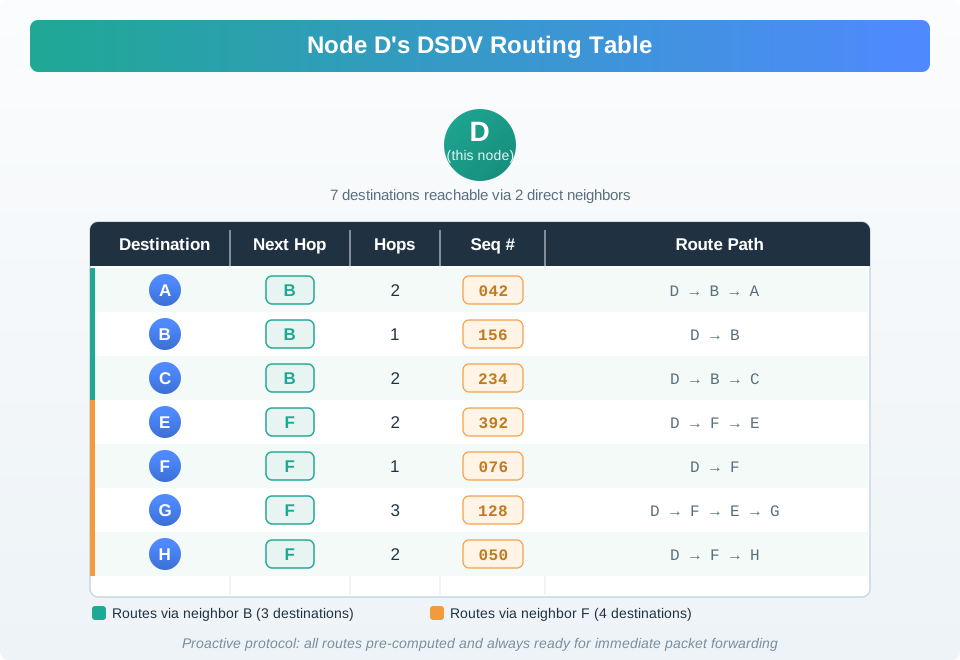
Read Figure 4.4 from the next-hop map into node D’s route entries. Destinations A and B forward through B, while E and G use F, so the table turns a multi-hop topology into one immediate action per destination. Hop count estimates distance, but the destination sequence number records freshness. The comparison shows why a newer advertisement wins even when an older path might look shorter; hop count breaks ties only within the same freshness generation. This ordering prevents a stale route from displacing current knowledge after movement. The table therefore supports DSDV’s operating bargain: forwarding is immediately available, provided periodic updates keep sequence state current and invalid routes are withdrawn.
Node D can forward immediately because it already has next-hop entries for the network.
4.5 DSDV Sequence Numbers
This section: DSDV Sequence Numbers — Classic distance-vector routing can form loops when neighbors advertise outdated reachability after a link fails.
Classic distance-vector routing can form loops when neighbors advertise outdated reachability after a link fails. DSDV adds destination sequence numbers so nodes can identify which advertisement is newer. The destination normally advances its own sequence number for valid routes, and broken routes are advertised with a newer sequence number and an infinite metric so neighbors stop using the old path.
The update stream has two parts. Periodic updates keep the table synchronized during normal operation. Triggered updates spread important changes faster when a link fails or a route becomes unavailable. Some implementations also damp updates so brief instability does not create repeated oscillation. These mechanisms improve correctness, but they do not remove the basic cost: every node stores and advertises route state for many destinations.
The subtle point is that freshness and distance are separate decisions. A lower hop count is attractive only after the sequence number says the route information belongs to the same freshness generation. If a two-hop route has an older destination sequence number than a three-hop route, the two-hop path may simply be a stale story about a topology that no longer exists. That is how DSDV avoids many count-to-infinity failures that ordinary distance-vector protocols can suffer after a link break.
The cost of that safety is propagation discipline. A failure has to be detected, converted into an unreachable metric with newer freshness information, and carried far enough that neighbors stop preferring old good news. If updates are lost, delayed, or suppressed too aggressively, the table can look complete while packets still follow a dead next hop. Under-the-hood testing therefore watches sequence numbers, invalidation messages, and selected next hops over time, not just the final path after the network has settled.
Use Figure 4.5 to separate DSDV’s ready-route gain from its update cost by tracing the stored table and selection rule into the forward result.
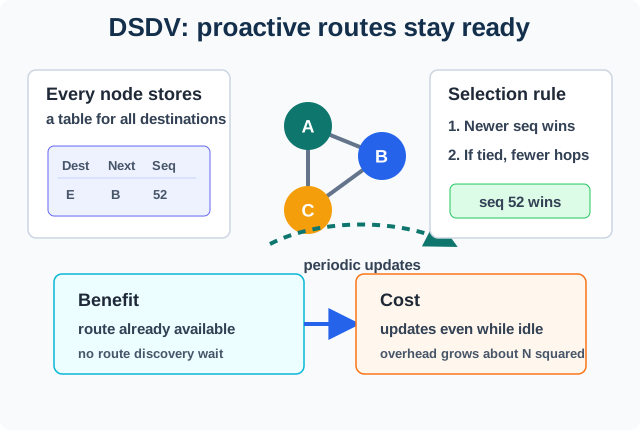
Read Figure 4.5 from the table entry to the comparison rule. Check the destination sequence number first, then use hop count only to break a tie within the same freshness generation, and finally follow the selected next hop into forwarding. This explains why data forwarding is simple after convergence while the control plane must keep paying to refresh and invalidate route state.
Failure recovery depends on how quickly newer route information replaces stale entries.
4.5.1 Fresh Route Rule
For a given destination, compare the sequence number in a received advertisement with the number in the installed route entry. A higher destination sequence number marks newer information and can replace the older entry even when the advertised hop count is larger. A shorter distance does not outweigh newer route knowledge; hop count decides between routes with matching sequence numbers.
This rule helps a node move away from stale information after topology changes. The advertised metric still matters: a broken route can carry a newer sequence number together with an infinite metric, marking it unreachable. To verify the decision, record the received sequence number, metric, and resulting table entry, then check how the selected next hop changes during recovery.
4.5.2 Equal Freshness Rule
When two routes to the same destination carry matching sequence numbers, their advertisements belong to the same freshness generation. The node then compares hop counts and prefers the route with fewer hops. This separates the freshness decision from the distance decision: sequence numbers establish which information is newer, while hop count selects the shorter route when freshness is equal. A lower hop count does not justify replacing an entry with older destination information. To review this decision, compare the destination sequence numbers first, then the hop counts and selected next hop. The table record should show that distance decided the choice only after freshness matched.
4.5.3 Broken Route Rule
When a next hop fails, the affected route is advertised with an infinite metric and a newer destination sequence number. The metric marks the route as unreachable, while the sequence number identifies the invalidation as newer than the previous reachability information. Together, these fields allow neighbours to displace stale entries that still describe a usable path. Recovery depends on detecting the failure and propagating that invalidation far enough through the network. Lost, delayed or excessively suppressed updates can leave packets following a dead next hop. A recovery trace should therefore record the invalidation message, sequence number, metric and subsequent next-hop changes, including adoption of a valid replacement route.
4.5.4 Scale Rule
Table memory and update traffic grow as the number of destinations grows, so the design must measure overhead for the real node count and update interval.
Do not treat DSDV sequence numbers as application packet counters. Their role is route freshness and loop avoidance inside the routing control plane.
4.6 Summary
This section: Summary — DSDV is a proactive distance-vector protocol for ad-hoc networks.
DSDV is a proactive distance-vector protocol for ad-hoc networks. It keeps route tables ready at each node, so forwarding can begin with a lookup instead of on-demand discovery. Its key protection is the destination sequence number: newer route information wins before hop count is considered, which helps nodes reject stale paths after topology changes.
The trade-off is continuous maintenance. Periodic and triggered updates consume airtime, energy, memory, and attention from relay nodes. DSDV is most defensible when the topology is fairly stable, traffic is frequent enough to benefit from ready routes, and fault drills prove that sequence-number updates suppress stale paths within the service tolerance.
4.7 Key Takeaway
This section: Key Takeaway
Use DSDV when ready routes are worth the control-plane cost. Approve it with evidence for route freshness, update overhead, stale-route suppression, and recovery after real link changes.
4.8 See Also
This section: See Also
Find help
3 reviewed answers.
Where should I start in a module?
Open the module page from the sidebar to see its chapters in order. Use the module map to return to a topic you need.
Modules and pathsReviewed
What can I try when a project does not work?
Check the symptom, then work through the diagnostic steps. Keep the error message and the smallest example that reproduces it.
When you are stuckReviewed
How do interactive examples work?
Use the interactive guide to check how examples and simulations work before changing your project.
Interactive examples guideReviewed