68 S2aaS Deployment Models
68.1 Learning Objectives
By the end of this chapter, you will be able to:
- Compare deployment architectures: Evaluate centralized cloud versus federated edge-cloud hybrid models with quantitative criteria
- Apply decision frameworks: Use structured criteria (latency, data sovereignty, scale, budget) to select the optimal deployment model for a given scenario
- Design centralized platforms: Implement global sensor aggregation with unified data access, replication, and failover
- Design federated architectures: Build edge-cloud hybrids with local processing, conflict resolution, and cloud synchronization
- Calculate deployment costs: Estimate bandwidth, compute, and operational costs for both deployment models
- Plan migration paths: Identify when and how to evolve from centralized to federated deployment as requirements change
68.2 Prerequisites
- S2aaS Multi-Layer Architecture: Understanding of physical sensors, virtualization, and API gateway layers
- Edge Computing: Knowledge of edge and fog processing concepts
Key Concepts
- Centralized Deployment: All sensor data flows to a single cloud platform for processing and storage — simpler management and global analytics, but 50–200ms latency and data sovereignty challenges
- Federated Edge-Cloud Hybrid: Data processed at regional edge nodes with summaries synchronized to the cloud — achieves <10ms local latency, 80–95% bandwidth reduction, and GDPR-compliant regional data residency
- Data Sovereignty: The legal requirement that data is stored and processed within specific national or regional boundaries — critical for healthcare (HIPAA), financial (PCI-DSS), and EU (GDPR) deployments
- Edge Node: A local processing unit (industrial PC, gateway server) that handles sensor data ingestion, validation, normalization, and real-time analytics close to the data source
- Consistency Model: The guarantee about data synchronization between distributed nodes — strong consistency (all nodes see same data immediately) vs. eventual consistency (nodes converge over time, lower latency)
- Data Locality: The architectural principle of processing data as close to the source as possible to reduce latency, bandwidth, and sovereignty risks
- Federated Learning: Training ML models on distributed edge data without centralizing the raw data — enables global model improvements while respecting data sovereignty requirements
68.3 Minimum Viable Understanding (MVU)
If you only have 10 minutes, focus on these three essentials:
Centralized deployment sends all sensor data to a single cloud platform. This is simpler to manage and enables global cross-sensor analytics, but it incurs high bandwidth costs (all raw data travels to cloud), adds latency (50-200ms round-trip), and creates data sovereignty challenges (data leaves its region of origin).
Federated edge-cloud hybrid processes data locally at edge nodes and synchronizes only aggregates or metadata with the cloud. This achieves low latency (<10ms local), reduces bandwidth by 80-95%, and keeps data in its region for GDPR compliance – but requires complex synchronization logic and consistency management across distributed nodes.
Decision framework: Choose centralized when you need global analytics across all regions and can tolerate 50-200ms latency (research, historical analysis, reporting). Choose federated when you need real-time response (<100ms), must comply with data residency laws (GDPR, China PIPL), operate over bandwidth-constrained links, or require local continuity during cloud outages.
Key metric to remember: Federated architectures reduce cloud bandwidth costs by 80-95% compared to centralized models by transmitting aggregates instead of raw data. For a 10,000-sensor deployment sampling at 1Hz, this means transmitting ~50 KB/s instead of ~1 MB/s.
For Beginners: S2aaS Deployment Models
Think of deployment models like two different ways to organize a chain of weather stations across a country:
Centralized Model – “Everything Goes to Headquarters”
Imagine every weather station in the country sends its readings directly to one big office in the capital city. The office collects all the data, makes reports, and answers questions from anyone who calls.
- Good: The office has ALL the data, so it can compare weather across the whole country easily
- Bad: If the phone lines to the office go down, nobody gets any data. And sending all that data costs a lot in phone bills!
Federated Model – “Regional Offices with Headquarters”
Now imagine each region has its own local weather office that collects data from nearby stations. These regional offices make local forecasts immediately. They also send daily summaries to the national headquarters.
- Good: Local forecasts are super fast (the data does not travel far). If headquarters goes offline, regions keep working
- Bad: The national office only has summaries, not every single reading. And managing 10 regional offices is harder than managing 1 headquarters
When to Choose Which:
| You Need… | Choose… | Why? |
|---|---|---|
| Compare data from everywhere | Centralized | All data in one place |
| Instant local responses | Federated | Data stays close |
| Comply with privacy laws | Federated | Data stays in its country |
| Simple management | Centralized | One system to maintain |
| Work during internet outages | Federated | Local offices keep running |
Real-World Analogy: Fast food chains use a federated model – each restaurant cooks food locally (low latency!) and sends daily sales summaries to headquarters (reduced data). Imagine if every burger order had to be approved by headquarters first – that is essentially the centralized model’s latency problem!
For Kids: Meet the Sensor Squad!
Where should we keep all our sensor data? Let us find out with the Sensor Squad!
68.3.1 The Sensor Squad Adventure: The Two Library Systems
The Sensor Squad had sensors all over town – Sammy the Temperature Sensor at the school, Lila the Light Sensor at the park, Max the Motion Sensor at the mall, and Bella the Barometer at the beach.
Every day, all four sensors sent their readings to the Big Cloud Library in the center of town. The Cloud Library kept EVERY reading and anyone could visit to look things up.
But one rainy Tuesday, the road to the Cloud Library flooded! Nobody could get their data!
“My school needs the temperature RIGHT NOW to decide if we should close!” said the principal.
“The park needs light readings to turn on the sprinklers!” said the gardener.
Sammy had an idea: “What if each neighborhood had a SMALL library too? We could keep our readings there for quick access, and send copies to the Big Library when the road is clear!”
So they built Mini Libraries in each neighborhood:
- The School Mini Library kept Sammy’s temperature readings nearby – the principal could check them in 1 second!
- The Park Mini Library stored Lila’s light data – the gardener got instant updates!
- Each Mini Library sent a daily summary to the Big Cloud Library
Now when the road flooded again, the neighborhoods still had their data! And the Big Library still got summaries for the whole-town reports.
68.3.2 Key Words for Kids
| Word | What It Means |
|---|---|
| Centralized | One big place stores everything – like one giant library for the whole city |
| Federated | Many small places store local data, sharing summaries with the big place |
| Latency | How long you wait for your data – like waiting in line at the library |
| Bandwidth | How much data you can send at once – like the width of the road to the library |
| Resilience | Keeping things working even when something breaks – like having a backup plan |
68.3.3 Try This at Home!
- Put a thermometer in your room and another outside
- Centralized test: Write EVERY reading on paper and walk it to a family member in another room. Time how long each trip takes!
- Federated test: Keep your own notebook of readings. At dinner, share just the high and low temperatures. Much less walking!
- Which method was faster for YOU to check your room temperature? Which gave your family member more detail?
68.4 Implementation Deployment Models
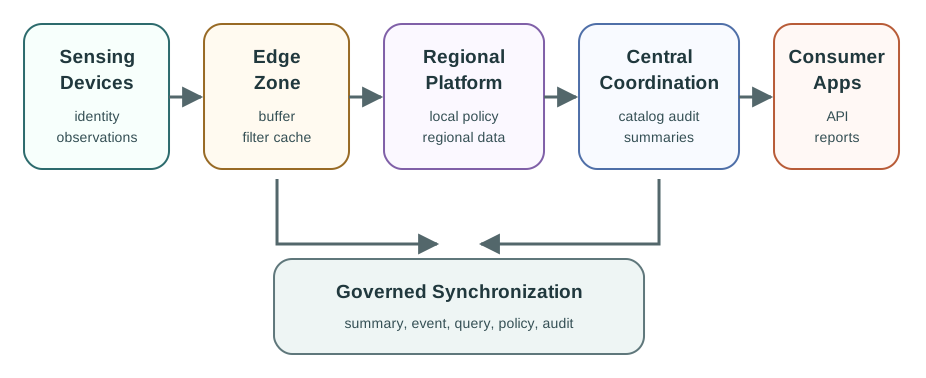
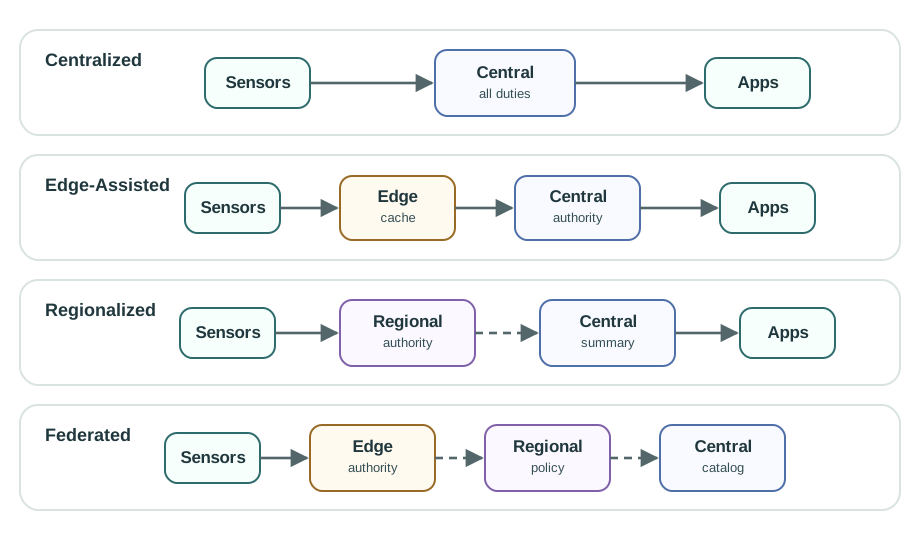
The deployment model determines how sensor data flows through the S2aaS platform – from physical sensors to end consumers. This architectural decision has profound implications for latency, cost, resilience, regulatory compliance, and operational complexity. Two primary models dominate production S2aaS deployments: centralized cloud platforms and federated edge-cloud hybrids.
How It Works: Deployment Model Decision Process
When designing an S2aaS platform, architects follow a systematic decision process to choose between centralized and federated models:
Step 1 – Measure Latency Requirements:
- Real-time control systems (traffic lights, industrial safety): Need <100ms → Federated
- Analytics dashboards, historical reporting: Can tolerate 500ms+ → Centralized
- Example: A smart traffic system processing camera feeds for collision avoidance needs <50ms response, ruling out centralized cloud (typical 100-200ms round-trip)
Step 2 – Assess Data Sovereignty Constraints:
- GDPR (EU), PIPL (China), LGPD (Brazil) often require data stay in-region
- If raw sensor data contains personally identifiable information (PII), federated keeps it local
- Example: German factory sensor data revealing production secrets must stay in Germany per Works Council rules
Step 3 – Calculate Bandwidth Economics:
- Centralized: All raw data to cloud = high egress costs (grows linearly with sensors)
- Federated: Only aggregates to cloud = 80-95% bandwidth reduction
- Break-even threshold: Typically 2,000-5,000 sensors depending on data rates
Step 4 – Evaluate Operational Expertise:
- Centralized: Single cloud region, simpler ops (2-person team can manage)
- Federated: Distributed nodes, sync complexity (requires 5+ person team with distributed systems experience)
Decision Rule: Start centralized unless you have concrete constraints (latency <100ms, regulatory mandate, bandwidth >$1K/month). Migrate to federated when pain points materialize, not speculatively.
68.4.1 Model 1: Centralized Cloud Platform
All sensor data flows to a central cloud platform that provides global access:
Architecture Characteristics:
- Data Flow: All raw sensor data transmitted over WAN to central cloud region
- Processing: All analytics, aggregation, and transformation performed in cloud
- Storage: Single data lake with global replication for redundancy
- API Access: Unified endpoint serving all consumers regardless of geography
Advantages:
- Simplified management: Single platform to deploy, monitor, and update – reduces DevOps team size by 50-70% compared to distributed management
- Global cross-sensor analytics: Correlate data from any sensor worldwide without cross-region data movement
- Economies of scale: Bulk cloud pricing for storage and compute (50-80% cheaper per unit than distributed edge nodes)
- Simpler consistency model: Single source of truth eliminates eventual consistency challenges
Challenges:
- High bandwidth costs: Transmitting all raw data from 10,000 sensors at 1Hz generates ~1 MB/s continuous traffic; at $0.09/GB (AWS egress), this costs ~$230/month per region
- Latency for real-time applications: 50-200ms cloud round-trip time makes sub-100ms control loops impossible
- Single point of failure risk: Cloud region outage affects ALL consumers and ALL sensors simultaneously
- Data sovereignty and privacy: Raw sensor data crossing borders may violate GDPR (EU), PIPL (China), LGPD (Brazil), or sector-specific regulations
Alternative View: Deployment Model Decision Tree
This variant provides a decision framework for choosing between centralized and federated architectures based on operational requirements.
Quick Reference:
- Centralized: Best for global analytics, simpler ops, regulatory flexibility
- Federated: Best for real-time control, GDPR compliance, bandwidth-constrained links
68.4.2 Model 2: Federated Edge-Cloud Hybrid
Edge nodes process data locally while synchronizing with cloud for global access:
Architecture Characteristics:
- Data Flow: Raw data stays at edge; only aggregates, metadata, and alerts flow to cloud
- Processing: Local analytics at edge (real-time), global analytics in cloud (batch/periodic)
- Storage: Distributed – full-resolution data at edge (7-30 day retention), aggregated data in cloud (long-term)
- API Access: Local endpoints for low-latency access, global endpoint for cross-region queries
Advantages:
- Low latency: <10ms for local applications accessing edge-processed data (vs. 50-200ms for cloud round-trip)
- Reduced bandwidth costs: Transmitting only aggregates reduces cloud traffic by 80-95%, saving $180-220/month per region for a 10,000-sensor deployment
- Better resilience: Edge continues serving local consumers during cloud outages (autonomous operation for hours or days)
- Data locality for privacy compliance: Raw data never leaves its geographic region, achieving GDPR/PIPL compliance by design
Putting Numbers to It
Compare bandwidth costs for centralized vs federated deployment with 10,000 sensors sampling at 1Hz:
Centralized model (all raw data to cloud):
\[\text{Data rate} = 10{,}000 \times 1 \text{ Hz} \times 100 \text{ bytes} = 1 \text{ MB/s} = 2.592 \text{ TB/month}\]
At $0.09/GB egress cost:
\[\text{Monthly cost} = 2{,}592 \text{ GB} \times \$0.09 = \$233/\text{month}\]
Federated model (only 5% aggregates to cloud):
\[\text{Cloud sync} = 2.592 \times 0.05 = 129.6 \text{ GB/month}\] \[\text{Monthly cost} = 129.6 \times \$0.09 = \$11.66/\text{month}\]
Annual bandwidth savings: \((\$233 - \$11.66) \times 12 = \$2{,}656\). Adding edge node cost ($300/month = $3,600/year), net annual savings is still $2,656 - $3,600 = -$944 first year. But at 50,000 sensors, bandwidth savings reach $13,280/year while edge cost stays $3,600/year, yielding $9,680 net annual savings.
68.5 Bandwidth Cost Calculator
Use this calculator to compare centralized versus federated bandwidth costs for your own deployment:
Challenges:
- Complex synchronization logic: Conflict resolution when edge and cloud states diverge (requires CRDT or vector clock mechanisms)
- Consistency across federated nodes: Eventually consistent by default; strong consistency requires distributed consensus protocols (added latency)
- Higher deployment and maintenance complexity: Managing 10-50 edge nodes plus cloud infrastructure requires 2-3x more operational expertise
- Edge resource constraints: Edge nodes have limited compute and storage compared to cloud (typically 8-64 GB RAM, 256 GB-2 TB storage)
68.5.1 Hybrid Synchronization Patterns
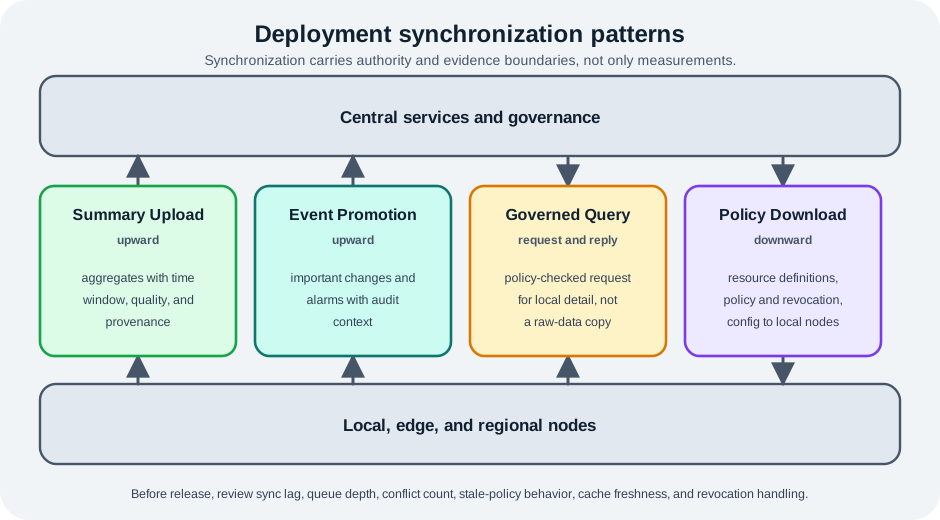
The synchronization strategy is the most critical design decision in federated architectures. Three patterns dominate production deployments:
| Sync Pattern | Bandwidth Savings | Cloud Latency | Complexity | Best For |
|---|---|---|---|---|
| Periodic Batch | 90-95% | Minutes to hours | Low | Historical analytics, compliance |
| Event-Driven | 85-90% | Seconds | Medium | Anomaly detection, alerting |
| Tiered | 70-85% | Varies by tier | High | Mixed workloads, multi-tenant |
68.5.2 Deployment Model Comparison
| Factor | Centralized | Federated Edge-Cloud |
|---|---|---|
| Latency | 50-200ms (cloud RTT) | <10ms (local edge) |
| Bandwidth Cost | High (all raw data) | Low (aggregates only, 80-95% reduction) |
| Resilience | Single point of failure | Local continuity during outages |
| Data Sovereignty | Complex compliance | Native locality (GDPR by design) |
| Management | Simple, unified (1 team) | Complex, distributed (2-3x ops effort) |
| Analytics | Global, cross-region (real-time) | Local (real-time) + global (periodic sync) |
| Initial Cost | Lower (cloud-only) | Higher (edge hardware + cloud) |
| Scaling Cost | Linear (bandwidth grows with sensors) | Sub-linear (edge absorbs local growth) |
| Best For | Research, global insights, small scale | Real-time control, GDPR, large scale |
### Migration Path: Centralized to Federated
Many S2aaS platforms start centralized and evolve to federated as they grow. This migration typically follows three phases:
Phase 1 – Centralized Foundation (0-1,000 sensors): Deploy cloud-only with all data flowing to central platform. Focus on API design, tenant management, and analytics. Bandwidth costs are manageable at this scale.
Phase 2 – Edge Caching (1,000-10,000 sensors): Add edge nodes as read-through caches. Sensors still push to cloud, but local consumers read from edge cache for lower latency. This introduces edge infrastructure without changing the data flow.
Phase 3 – Full Federation (10,000+ sensors): Edge nodes become primary data processors. Raw data stays at edge; only aggregates sync to cloud. Local applications bind to edge endpoints. Cloud becomes the coordination and global analytics layer.
Worked Example: Deployment Model Cost Comparison
Scenario: A smart city S2aaS platform operates 5,000 environmental sensors across 3 regions (Europe, North America, Asia-Pacific). Each sensor samples 5 metrics at 0.1 Hz (every 10 seconds). The platform serves 20 tenants including local governments, research institutions, and commercial analytics companies.
Given:
- Sensors: 5,000 (split roughly 2,000 / 1,500 / 1,500 across regions)
- Data rate per sensor: 5 metrics x 0.1 Hz x 50 bytes/reading = 25 bytes/second
- Total raw data rate: 5,000 x 25 = 125,000 bytes/s = ~125 KB/s = ~10.8 GB/day
- Cloud egress pricing: $0.09/GB (AWS standard)
- Cloud compute: $500/month (analytics cluster)
- Cloud storage: $0.023/GB/month (S3 standard)
- Edge node cost: $200/month per node (leased hardware + maintenance)
- 3 GDPR-regulated tenants in Europe requiring data residency
Option A: Centralized Cloud (US-East)
Monthly costs:
Ingress bandwidth: 10.8 GB/day x 30 = 324 GB/month (free inbound)
Storage (1 year retention): 324 GB/month x 12 = 3,888 GB = $89/month
Compute (analytics): $500/month
API egress to tenants: ~200 GB/month x $0.09 = $18/month
Total: $607/month
Issues:
- EU latency: 120-180ms (US-East to Europe)
- GDPR violation: EU sensor data stored in US
- Solution for GDPR: Deploy EU cloud region (+$500/month)
- Revised total: $1,107/month
Option B: Federated (3 edge zones + cloud)
Monthly costs:
Edge nodes: 3 regions x $200 = $600/month
Edge storage (30-day local): included in edge cost
Cloud sync (aggregates only): 10.8 GB/day x 5% = 0.54 GB/day
= 16.2 GB/month x $0.09 = $1.46/month
Cloud storage (aggregates, 1 year): 16.2 GB/month x 12 = 194 GB = $4.47/month
Cloud compute (global analytics): $300/month (smaller workload)
Total: $906/month
Benefits:
- Local latency: <10ms in all regions
- GDPR compliant by design (EU data stays in EU)
- 95% bandwidth reduction to cloud
- Local continuity during cloud outages
Comparison:
| Metric | Centralized | Federated |
|---|---|---|
| Monthly cost | $1,107 (with EU region) | $906 |
| EU latency | 20-50ms (EU region) | <10ms (edge) |
| GDPR compliance | Requires EU cloud region | Native |
| Resilience | Regional failover | Full local autonomy |
| Global analytics | Real-time | Periodic sync (5-min delay) |
| Operational complexity | Low | Medium-High |
Result: The federated model saves $201/month (18%) while delivering better latency, native GDPR compliance, and higher resilience. The cost advantage grows with scale – at 50,000 sensors, federated saves $2,000+/month due to bandwidth reduction.
Key Insight: The break-even point where federated becomes cheaper than centralized typically occurs at 2,000-5,000 sensors, depending on data rates and cloud pricing. Below this threshold, the operational simplicity of centralized deployment usually outweighs the bandwidth savings of federation.
Try It Yourself: Cost-Benefit Analysis for Your S2aaS Platform
Scenario: You are designing an S2aaS platform for a smart agriculture network across 3 regions (North America, Europe, South America). Use this worksheet to decide between centralized and federated deployment.
Step 1 – Define your sensor deployment:
- Number of sensors per region: __________ (example: 2,000 / 1,500 / 1,000)
- Sample rate per sensor: __________ (example: every 60 seconds)
- Bytes per reading: __________ (example: 150 bytes)
Step 2 – Calculate bandwidth for centralized model:
- Readings per day per sensor: 86,400 / sample_interval = __________
- Daily data per sensor: readings × bytes = __________ KB
- Total daily data: sensors × daily_per_sensor = __________ GB
- Monthly cloud egress cost: daily_GB × 30 × $0.09/GB = $__________
Step 3 – Calculate bandwidth for federated model:
- Edge aggregation ratio: __________ (typical: 10x reduction)
- Cloud sync data per day: total_daily / aggregation_ratio = __________ GB
- Monthly cloud egress cost: daily_GB × 30 × $0.09/GB = $__________
- Edge node cost: 3 regions × $300/node = $900/month
- Total federated cost: cloud + edge = $__________
Step 4 – Compare:
- Centralized monthly cost: $__________ (Step 2)
- Federated monthly cost: $__________ (Step 3)
- Savings: $__________ / month
- Break-even on edge nodes: $900 / savings = __________ months
Step 5 – Assess non-cost factors:
- Latency requirement: < __________ ms (if <100ms → federated)
- Data sovereignty required? Yes / No (if yes → federated)
- Team has distributed systems expertise? Yes / No (if no → centralized simpler)
Decision: Based on cost savings of $__________ /month, latency needs, and regulatory requirements, I recommend __________ deployment model.
What to Observe:
- If sensor count < 2,000: Centralized usually wins (operational simplicity)
- If sensor count > 5,000: Federated usually wins (bandwidth savings)
- If GDPR/PIPL apply: Federated required regardless of cost
- If latency < 100ms: Federated required regardless of cost
Common Misconception: “Federated Always Beats Centralized”
The Misconception: Many architects assume that federated edge-cloud deployments are universally superior because they offer lower latency and better GDPR compliance, and therefore should be the default choice for every S2aaS platform.
Why It Is Wrong: Federated architectures introduce significant operational complexity that can outweigh their benefits at small to medium scale:
- Operational overhead: Managing 10-50 edge nodes requires specialized skills (distributed systems, conflict resolution, edge monitoring) that a centralized deployment does not need. This typically adds $50-100K/year in staffing costs.
- Consistency challenges: Data that exists at the edge but has not yet synced to cloud creates “split brain” scenarios. A tenant querying global analytics may see different results than one querying the edge – leading to trust issues and debugging nightmares.
- Edge hardware lifecycle: Edge nodes require firmware updates, hardware replacement, and physical security. A centralized cloud deployment has none of these concerns.
Real-World Impact:
- Startup case study: A 200-sensor air quality startup deployed a federated architecture “for future scale.” The 3-person engineering team spent 60% of time managing edge infrastructure instead of building features. After 6 months, they migrated to centralized and shipped 4x faster.
- Enterprise case study: A 50,000-sensor industrial platform migrated FROM centralized TO federated when cloud bandwidth costs exceeded $15,000/month and GDPR fines threatened their EU business. The migration took 8 months and required hiring 3 additional SRE engineers.
Correct Approach: Start centralized. Migrate to federated when you hit concrete pain points – bandwidth costs exceeding budget, latency requirements below 100ms, regulatory mandates for data residency, or resilience requirements for mission-critical local operations. Design your API abstraction layer from day one so the migration is an infrastructure change, not an application rewrite.
Knowledge Check
Test your understanding of S2aaS deployment models with these questions.
Worked Example: Federated Edge Deployment for a Smart Factory Network
Scenario: A manufacturing company operates 5,000 industrial sensors across three factory campuses in Germany, Poland, and Czech Republic. They need real-time anomaly detection (<100ms) for production line safety while complying with strict EU data residency requirements. You must design the deployment architecture.
Given:
- Sensors: 5,000 (2,000 in Germany, 1,500 in Poland, 1,500 in Czech Republic)
- Data rate: 20 bytes per sensor every 500ms (40 Hz)
- Required latency: <100ms for safety-critical anomaly detection
- Regulatory: GDPR requires manufacturing data stay within EU; German Works Council requires raw data stay in Germany
- Cloud costs: AWS Frankfurt at $0.09/GB egress, $500/month compute
- Edge costs: $300/node/month (3 nodes, one per campus)
Step 1 – Evaluate centralized cloud architecture:
Centralized (Frankfurt):
Raw data rate: 5,000 sensors × 40 Hz × 20 bytes = 4 MB/s = 10.4 TB/month
Cloud egress: 10.4 TB × $0.09/GB × 1024 = $960/month
Compute: $500/month
Total: $1,460/month
Latency analysis:
Poland to Frankfurt: 40-60ms + 20ms processing = 60-80ms (within <100ms)
Czech to Frankfurt: 50-70ms + 20ms processing = 70-90ms (within <100ms)
Compliance issues:
- Raw German sensor data processed in same Frankfurt region ✓
- But all raw data centralized violates German Works Council data sovereignty preference
Step 2 – Design federated edge-cloud hybrid:
Edge nodes (one per campus):
Local processing: Anomaly detection runs on edge (5-10ms local latency)
Data reduction: Edge transmits only anomalies + 1-minute aggregates (95% reduction)
Cloud sync: 10.4 TB × 5% = 520 GB/month to Frankfurt cloud
Cost breakdown:
Edge infrastructure: 3 nodes × $300 = $900/month
Cloud storage (aggregates): 520 GB × $0.023/GB = $12/month
Cloud compute (global analytics): $300/month (reduced workload)
Cloud egress (minimal): ~$50/month
Total: $1,262/month
Savings: $1,460 - $1,262 = $198/month (14% reduction)
Step 3 – Calculate latency improvement:
Local anomaly detection latency:
Sensor → Edge: <5ms (local network)
Edge processing: 5-10ms (dedicated ML inference)
Total: <15ms << 100ms requirement
Improvement: 60-90ms centralized → 10-15ms federated = 75-83% latency reduction
Step 4 – Verify compliance:
Data residency:
- Raw German sensor data: Stays in Germany edge node ✓
- Raw Polish data: Stays in Poland edge node ✓
- Raw Czech data: Stays in Czech Republic edge node ✓
- Cloud (Frankfurt): Receives only aggregates (no raw production secrets) ✓
GDPR Article 44 (data transfers):
- All edge nodes within EU ✓
- Cloud also within EU (Frankfurt) ✓
- No cross-border transfers of raw data ✓
Result: Federated edge-cloud deployment achieves 10-15ms latency (6x better than centralized), saves $198/month (14%), and natively satisfies German Works Council data sovereignty requirements by keeping raw factory data on-premise. The edge nodes provide autonomous operation during cloud outages, critical for 24/7 manufacturing.
Key Insight: The break-even point for federated architectures depends on both bandwidth savings AND compliance costs. If centralized violated Works Council rules, the company would need separate cloud regions per country ($1,500/month), making federated 40% cheaper. Regulatory requirements often tip the cost analysis in favor of federated deployments even when pure bandwidth calculations favor centralized.
Decision Framework: Selecting Deployment Architecture for Your S2aaS Platform
Use this structured framework to choose between centralized cloud and federated edge-cloud architectures based on quantifiable criteria:
| Criterion | Weight | Centralized Score (0-10) | Federated Score (0-10) | Notes |
|---|---|---|---|---|
| Latency Requirements | 30% | 4 (50-200ms typical) | 9 (<10ms local) | If real-time control required, federated wins |
| Data Sovereignty | 25% | 3 (complex multi-region) | 10 (native locality) | GDPR/PIPL mandates favor federated |
| Bandwidth Costs | 20% | 5 (full raw data) | 10 (80-95% reduction) | Scales with sensor count; federated advantage grows |
| Operational Complexity | 15% | 9 (simple, unified) | 4 (distributed management) | Requires 2-3x more DevOps expertise for federated |
| Initial Capital | 10% | 10 (cloud-only, $0) | 3 (edge hardware upfront) | Federated requires $5-20K per edge node |
Scoring Method:
- Assign scores 0-10 for each criterion (10 = strongly favors that option)
- Multiply each score by its weight
- Sum weighted scores
Example Calculation (Smart City Air Quality):
Centralized:
(4 × 0.30) + (3 × 0.25) + (5 × 0.20) + (9 × 0.15) + (10 × 0.10) = 5.4
Federated:
(9 × 0.30) + (10 × 0.25) + (10 × 0.20) + (4 × 0.15) + (3 × 0.10) = 7.6
Result: Federated recommended (7.6 vs 5.4)
Thresholds for Decision:
- Score difference < 1.0: Consider hybrid approach (central + regional edge caches)
- Score 8.0+: Strong recommendation for that architecture
- Score < 4.0: Architecture may not meet basic requirements
Common Adjustments:
- Mission-critical systems: Double latency weight to 60%
- Experimental platforms: Double operational complexity weight (prefer simple)
- Multi-tenant commercial: Increase sovereignty weight to 35% (compliance critical)
Quick Rules of Thumb:
- Centralized if: <2,000 sensors, batch analytics, no real-time control, single-region users
- Federated if: >10,000 sensors, <100ms latency SLA, GDPR compliance required, bandwidth costs >$1,000/month
- Hybrid if: In the middle range, or evolving from centralized to federated
Common Mistake: Underestimating Federated Synchronization Complexity
The Mistake: Many architects design federated S2aaS deployments assuming that “edge nodes just sync data to the cloud periodically” without planning for the conflict resolution, consistency guarantees, and failure recovery mechanisms required for production systems.
Real-World Failure Example: A smart agriculture platform deployed 20 edge nodes (one per farm) syncing soil sensor data to a central cloud every 5 minutes. During a 3-hour internet outage at one farm: - Edge node buffered 36 batches of sensor readings (3 hours ÷ 5 min) - When connectivity restored, edge replayed all 36 batches to cloud - Cloud had ALSO received data from neighboring farm’s sensors (which overlap some fields) - Conflict: Two different moisture readings for same GPS coordinate at same timestamp - Platform had NO conflict resolution policy – data corruption in 20% of readings - Farmers lost trust; 3-month data re-calibration project required
What Went Wrong:
- No vector clocks or causal ordering: System couldn’t determine which reading was “newer”
- No merge semantics: When edge and cloud disagreed, system picked one arbitrarily
- No reconciliation monitoring: Operators didn’t know conflicts were happening until farmers complained
Correct Approach – Design Synchronization Protocol Before Deployment:
| Sync Aspect | Naive Approach | Production-Ready Approach |
|---|---|---|
| Conflict Detection | Last-write-wins (timestamp) | Vector clocks + sensor ID (source of truth) |
| Merge Strategy | Overwrite | CRDTs (Conflict-free Replicated Data Types) or application-specific rules |
| Failure Recovery | Retry until success | Exponential backoff + dead-letter queue after 10 retries |
| Consistency Model | Strong (fails during partition) | Eventual with bounded staleness (max 5-min delay) |
| Monitoring | None | Conflict counter, sync lag metric, reconciliation dashboard |
Worked Example – Production Sync Protocol:
Edge node: Farm A
Cloud: Central aggregator
Overlap: 5 GPS coordinates shared with Farm B
Scenario: Edge node offline 3 hours (180 min)
During outage:
- Edge buffers: 36 batches × 100 sensors = 3,600 readings
- Cloud receives from Farm B: 5 shared sensors × 36 batches = 180 readings for overlap zone
When connectivity restored:
1. Edge sends batches with vector clock: [Farm_A: 36, Farm_B: 0]
2. Cloud compares: Cloud has [Farm_A: 0, Farm_B: 36] for overlap coordinates
3. Conflict detected: Both farms claim readings for same GPS at T=10:00
4. Resolution rule: Prefer source farm (Farm A) for its assigned sensors
5. Cloud overwrites Farm B's readings for Farm A's sensors ONLY
6. Logs conflict: "180 readings from Farm B superseded by Farm A (authoritative source)"
Result: Deterministic, auditable conflict resolution
Production Checklist for Federated Sync:
Cost of Getting This Wrong: The agriculture platform spent $150K on data re-calibration, lost 3 customers, and had to re-architect the sync layer. The production-ready approach would have cost $20K upfront (2 weeks of senior architect time). Prevention is 7× cheaper than remediation.
Cross-Hub Connections
Expand Your Learning:
This chapter on S2aaS deployment models connects to resources across the module’s learning ecosystem:
- Knowledge Map: Explore how deployment model decisions connect to edge computing, cloud architecture, and data sovereignty concepts
- Quizzes Hub: Test your understanding of centralized vs. federated architectures, bandwidth calculations, and GDPR compliance
- Simulations Hub: Experiment with edge-cloud network simulators to visualize latency and bandwidth tradeoffs
Related Deep Dives:
- Edge-Fog Computing – Detailed edge and fog architecture patterns
- S2aaS Multi-Layer Architecture – Physical, virtualization, and API layers
- S2aaS Data Ownership – Data sovereignty and governance frameworks
Architectural Comparisons:
- Fog Fundamentals – Fog computing as a deployment strategy
- Digital Twins Architecture – Federated digital twin synchronization patterns
68.6 Concept Relationships
Understanding how deployment model concepts interconnect helps make informed architecture decisions:
| Concept | Relationship | Connected Concept |
|---|---|---|
| Centralized Cloud Platform | Trades | High Bandwidth Costs for Simplified Management (all data flows to one region) |
| Federated Edge-Cloud Hybrid | Achieves | Low Latency (<10ms) through Local Processing (data stays near source) |
| Data Sovereignty Requirements (GDPR/PIPL) | Mandate | Federated Architecture (raw data stays in region of origin) |
| Synchronization Patterns (Periodic/Event/Tiered) | Determine | Cloud Bandwidth Savings (90%/85%/70% reduction respectively) |
| Edge Caching | Bridges | Centralized and Federated Models (migration path) |
| Vector Clocks / CRDTs | Enable | Conflict Resolution in Federated Systems (eventual consistency) |
| Break-Even Threshold (2K-5K sensors) | Defines | When Federated Becomes Cheaper (bandwidth savings exceed edge costs) |
Common Pitfalls
1. Choosing Centralized Deployment for Latency-Critical Applications
Industrial control systems requiring <10ms response cannot use centralized cloud deployment (50–200ms latency). Choose edge-cloud hybrid deployment for real-time control, alerting, and local automation — centralize only for long-term analytics and reporting.
2. Ignoring Data Sovereignty Until Deployment
Discovering GDPR or HIPAA compliance requirements after building a centralized platform requires expensive data migration and re-architecture. Map data residency requirements at the design stage — EU sensor data must stay in EU regions, US healthcare data in US regions.
3. Underestimating Federated Synchronization Complexity
Federated edge-cloud hybrid sounds simple but requires: conflict resolution when edge nodes diverge, bandwidth-efficient sync protocols (delta compression, batch uploads), and handling edge node outages gracefully. Plan 3–4× more development time for federated architectures compared to centralized.
4. Not Defining the Consistency Model Explicitly
Using eventual consistency for alarm data (acceptable for analytics) but not for billing data (requires strong consistency) creates subtle bugs. Define the consistency model per data type explicitly — real-time alarms and billing require strong consistency; historical telemetry can use eventual consistency.
68.7 Summary
This chapter covered the two primary deployment models for S2aaS platforms and the decision framework for selecting between them:
- Centralized Cloud Platforms: Simplify management with a single unified platform and enable real-time global cross-sensor analytics, but incur high bandwidth costs (all raw data to cloud), add 50-200ms latency, and create data sovereignty challenges requiring multi-region cloud deployments
- Federated Edge-Cloud Hybrids: Achieve <10ms local latency, reduce cloud bandwidth by 80-95%, and provide native GDPR compliance through data locality, but require complex synchronization (periodic batch, event-driven, or tiered sync patterns) and 2-3x more operational expertise
- Synchronization Patterns: Three production patterns – periodic batch (90-95% bandwidth savings, minutes latency), event-driven (85-90% savings, seconds latency), and tiered (70-85% savings, variable latency) – each suited to different workload profiles
- Decision Framework: Choose centralized for global analytics, batch workloads, and small scale (<2,000 sensors); choose federated for real-time control, regulatory compliance, bandwidth-constrained links, and large scale (>10,000 sensors)
- Migration Path: Start centralized, add edge caching at 1,000-5,000 sensors, migrate to full federation at 10,000+ sensors – designing API abstractions from day one to enable infrastructure changes without application rewrites
- Cost Analysis: Federated becomes cheaper than centralized at the 2,000-5,000 sensor threshold, with savings growing sub-linearly as edge nodes absorb local data growth
68.8 See Also
Deployment Architecture:
- S2aaS Multi-Layer Architecture - Physical, virtualization, and API layers
- Edge-Fog Computing - Edge and fog processing fundamentals
Implementation Patterns:
- S2aaS Deployment Considerations - Data pipelines, SLA management, security, billing
- S2aaS Architecture Patterns - Four-layer platform design
Governance & Compliance:
- S2aaS Data Ownership - Data sovereignty and governance frameworks
- Privacy & Compliance - GDPR, PIPL regulations
68.9 What’s Next
| If you want to… | Read this |
|---|---|
| Explore real-world S2aaS platform implementations | S2aaS Real-World Platforms |
| Study deployment considerations and SLA management | S2aaS Deployment Considerations |
| Understand multi-layer S2aaS architecture | S2aaS Multi-Layer Architecture |
| Review all S2aaS concepts | S2aaS Review |
| Explore S2aaS architecture patterns | S2aaS Architecture Patterns |