61 M2M Communication: Review
61.1 Learning Objectives
By the end of this chapter, you will be able to:
- Evaluate M2M architectures: Critically assess five-layer M2M communication systems for real-world deployment scenarios
- Distinguish M2M from IoT: Articulate the architectural, connectivity, and scale differences and when each approach is appropriate
- Analyze protocol migration trade-offs: Evaluate the costs, benefits, and risks of transitioning from proprietary to IP-based M2M
- Design hybrid edge-cloud systems: Determine when to use local M2M intelligence versus cloud-based IoT processing
- Apply device lifecycle management: Plan registration, provisioning, firmware updates, and decommissioning for large-scale M2M deployments
- Solve M2M capacity planning problems: Calculate data volumes, buffer requirements, and network capacity for production M2M systems
61.2 Prerequisites
Required Chapters:
- M2M Fundamentals - Machine-to-machine basics
- M2M Communication - Protocols
- Cellular IoT - Connectivity
Technical Background:
- Industrial automation concepts
- Telemetry systems
- Remote monitoring
M2M vs IoT Quick Reference:
| Aspect | M2M | IoT |
|---|---|---|
| Focus | Point-to-point | Ecosystem |
| Connectivity | Cellular/wired | Any |
| Intelligence | Local | Distributed |
| Scale | Limited | Massive |
| Protocols | Often proprietary | Standard (MQTT, CoAP) |
| Integration | Vertical silos | Horizontal, interoperable |
Estimated Time: 45 minutes
Key Concepts
- M2M Service Platform Architecture: The four-domain model (device, network, application, service) standardized by ETSI M2M and oneM2M, separating device protocols from application APIs
- Sequence Number in DSDV: A destination-assigned number that increases monotonically, ensuring fresher route information always takes priority regardless of hop count — core to loop prevention
- ETSI Scheduling Requirements: Standards-defined constraints preventing M2M devices from simultaneously accessing the network — critical for preventing thundering herd scenarios
- oneM2M CSE: Common Service Entity — the logical node in oneM2M architecture that provides registration, subscription, data storage, and notification services to M2M applications
- Gateway Protocol Translation: Converting between legacy fieldbus protocols (Modbus, BACnet) and modern M2M protocols (MQTT, CoAP) at the network edge
- Autonomous Operation: The defining M2M requirement that devices continue functioning (sensing, deciding, actuating) without human intervention or continuous server connectivity
- Data Pipeline Validation: The gateway-level stage that checks sensor readings for plausibility (range, rate-of-change, CRC) before forwarding to the aggregation and storage stages
61.3 MVU: Minimum Viable Understanding
Core concept: M2M (Machine-to-Machine) communication enables autonomous device-to-device interactions through a five-layer architecture: Field Devices, Gateways, Networks, Service Platforms, and Applications. Unlike IoT, M2M emphasizes local intelligence and domain-specific deployments.
Why it matters: M2M forms the foundation of modern IoT. Understanding M2M architecture helps engineers design systems that work reliably even without internet connectivity – critical for industrial, remote, and safety-critical deployments where cloud dependency is a liability.
One-sentence summary: M2M provides the reliable, autonomous device communication backbone that IoT ecosystems build upon for cloud-scale interoperability.
Common Pitfall
Treating M2M as “old technology” that should always be replaced by cloud IoT. In reality, M2M’s local autonomy and edge processing remain essential for remote sites, safety-critical systems, and intermittently connected deployments. The best modern systems use hybrid architectures: M2M for edge control plus IoT for cloud analytics.
Related Chapters
Deep Dives:
- M2M Fundamentals - Machine-to-machine communication basics
- M2M Implementations - Protocol implementations
- Cellular IoT - M2M connectivity
Comparisons:
- IoT Reference Models - M2M vs broader IoT ecosystems
- S2aaS Fundamentals - Shared vs dedicated infrastructure
- Wireless Sensor Networks - WSN vs M2M architectures
Products:
- Application Domains - Industrial M2M use cases
- IoT Use Cases - Fleet management examples
Learning:
- Quizzes Hub - M2M assessment questions
- Videos Hub - M2M protocol tutorials
For Beginners: How to Use This Review
What is this chapter? This is a consolidation chapter for M2M (Machine-to-Machine) concepts. Use it to review and reinforce your understanding.
When to use:
- After completing M2M fundamentals and implementations
- When preparing for assessments
- As a quick reference during projects
Key Review Topics:
| Topic | What to Remember |
|---|---|
| M2M Architecture | Five layers: Field, Gateway, Network, Platform, Application |
| Protocols | MQTT, CoAP, HTTP/REST for M2M; Modbus for legacy |
| Use Cases | Industrial automation, utilities, fleet management |
| M2M vs IoT | Scope, connectivity, standardization differences |
| Edge vs Cloud | When local M2M intelligence beats cloud processing |
Recommended Path:
- Review M2M Fundamentals first
- Study M2M Implementations
- Use this chapter for final review
- Test with the knowledge check questions at the end
Sensor Squad: The Machine Walkie-Talkies
Meet the Sensor Squad! Sammy, Lila, Max, and Bella are tiny robot sensors working in a big factory.
“How do machines talk to each other when there is no internet?” asked Sammy the temperature sensor.
“It is like walkie-talkies!” explained Lila the light sensor. “In M2M, machines talk directly to each other – no internet needed! A sensor in a factory can tell a motor to slow down without asking a computer in the cloud.”
Max the motion sensor added: “Think of it this way: M2M is like two friends passing notes in class – direct and fast. IoT is like posting on a message board – everyone can see it, but it takes longer.”
Bella the pressure sensor smiled: “And the gateway is like the teacher’s desk where notes get translated. If one friend writes in English and the other reads Spanish, the gateway translates!”
Key ideas for kids:
- M2M = Machines talking directly to each other (like walkie-talkies)
- IoT = Machines talking through the internet (like video calls)
- Gateway = The translator that helps different machines understand each other
- Edge processing = The machine makes its own decisions without asking the cloud (like knowing to grab an umbrella when you see dark clouds, without checking the weather app)
61.4 M2M Communication Architecture
The M2M communication architecture follows a five-layer model, where each layer addresses a specific concern from physical data collection through to domain-specific applications. Understanding this layered structure is essential for designing reliable M2M systems.
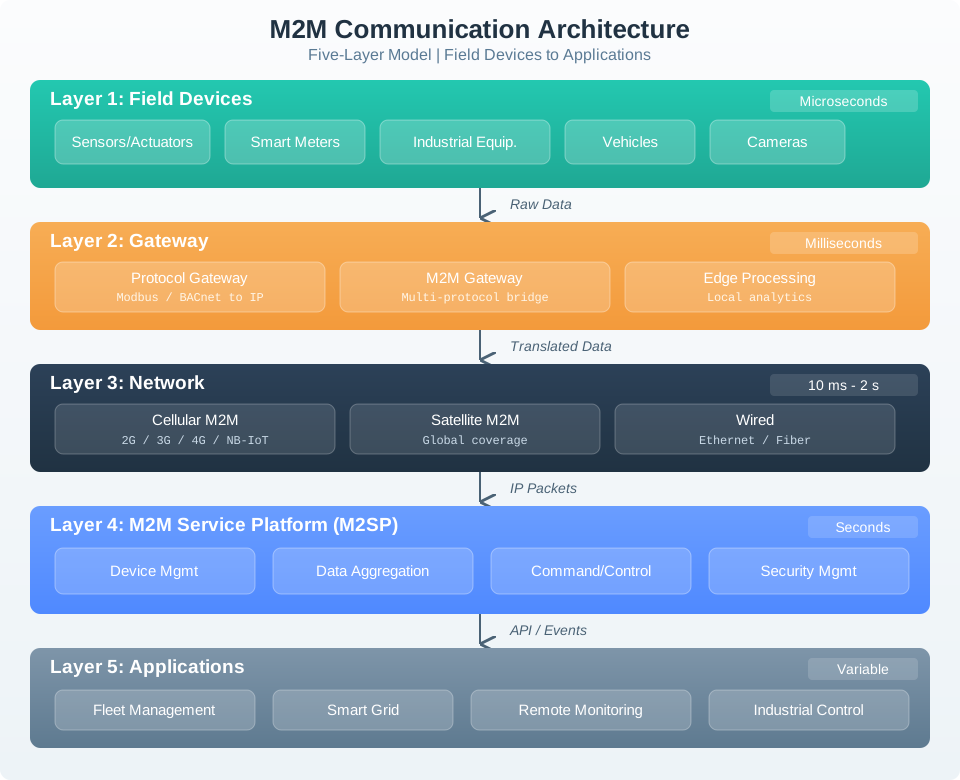
M2M Communication Architecture (Five-Layer System)
| Layer | Components | Function | Typical Latency |
|---|---|---|---|
| Layer 1: Field | Sensors/Actuators, Smart Meters, Industrial Equipment, Vehicles | Data collection and actuation | Microseconds |
| Layer 2: Gateway | Protocol Gateway (Modbus to IP), M2M Gateway (multi-protocol), Edge Processing | Protocol translation, local analytics | Milliseconds |
| Layer 3: Network | Cellular M2M (2G/3G/4G/NB-IoT), Satellite M2M, Wired (Ethernet/Fiber) | Wide-area connectivity | 10ms-2s |
| Layer 4: M2SP | Device Management, Data Aggregation, Command and Control, Security Management | Central management and orchestration | Seconds |
| Layer 5: Application | Fleet Management, Smart Grid, Remote Monitoring, Industrial Control | Domain-specific services | Variable |
Data Flow: Field Devices → Gateways → Network → M2M Platform → Applications
M2M Service Platform (M2SP) Core Functions:
- Device Management: Registration, provisioning, firmware updates, health monitoring
- Data Aggregation: Store and forward, buffering, compression, time-series alignment
- Command and Control: Bi-directional messaging, actuator control, acknowledgment tracking
- Security Management: Authentication, encryption, access control, audit logging
Design Insight: Why Gateways Are the Most Critical Layer
In practice, the gateway layer (Layer 2) is where most M2M integration challenges arise. Gateways must simultaneously:
- Speak multiple protocols – legacy Modbus RTU on one side, MQTT/CoAP on the other
- Buffer data during outages – store hours or days of readings if the network is down
- Make local decisions – safety-critical logic cannot wait for cloud round-trips
- Manage constrained resources – typically running on ARM processors with limited RAM
A well-designed gateway is the difference between an M2M system that works in the lab and one that works in the field.
61.4.1 Knowledge Check: M2M Architecture
{ “question”: “In a five-layer M2M architecture, which layer is responsible for translating between legacy industrial protocols (such as Modbus) and modern IP-based protocols (such as MQTT)?”, “options”: [ { “text”: “Layer 1: Field Devices – sensors generate protocol-agnostic raw data”, “correct”: false, “feedback”: “Incorrect. The gateway layer (Layer 2) is specifically responsible for protocol translation. Field devices (Layer 1) typically use legacy protocols like Modbus or RS-485. The gateway translates these into IP-based protocols before data enters the network layer. While the M2SP could theoretically handle translation, placing it at the gateway reduces network overhead (no need to send raw Modbus frames over cellular) and enables local processing even when the network is unavailable.” }, { “text”: “Layer 2: Gateway – protocol translation is a core gateway function”, “correct”: true, “feedback”: “Correct! The gateway layer (Layer 2) is specifically responsible for protocol translation. Field devices (Layer 1) typically use legacy protocols like Modbus or RS-485. The gateway translates these into IP-based protocols before data enters the network layer. While the M2SP could theoretically handle translation, placing it at the gateway reduces network overhead (no need to send raw Modbus frames over cellular) and enables local processing even when the network is unavailable.” }, { “text”: “Layer 3: Network – the cellular network handles protocol conversion”, “correct”: false, “feedback”: “Not quite. Consider that The gateway layer (Layer 2) is specifically responsible for protocol translation. Field devices (Layer 1) typically use legacy protocols like Modbus or RS-485. The gateway translates these into IP-bas…” }, { “text”: “Layer 4: M2SP – the service platform translates all incoming protocols”, “correct”: false, “feedback”: “That is not correct. Review: The gateway layer (Layer 2) is specifically responsible for protocol translation. Field devices (Layer 1) typically use legacy protocols like Modbus or RS-485. The gateway translates these into IP-bas…” } ], “difficulty”: “medium”, “explanation”: “The gateway layer (Layer 2) is specifically responsible for protocol translation. Field devices (Layer 1) typically use legacy protocols like Modbus or RS-485. The gateway translates these into IP-based protocols before data enters the network layer. While the M2SP could theoretically handle translation, placing it at the gateway reduces network overhead (no need to send raw Modbus frames over cellular) and enables local processing even when the network is unavailable.” }## M2M vs IoT: Key Differences {#arch-m2m-rev-comparison}
While M2M and IoT are often used interchangeably, they have important architectural and scope differences. Understanding these distinctions helps engineers choose the right approach for a given deployment.
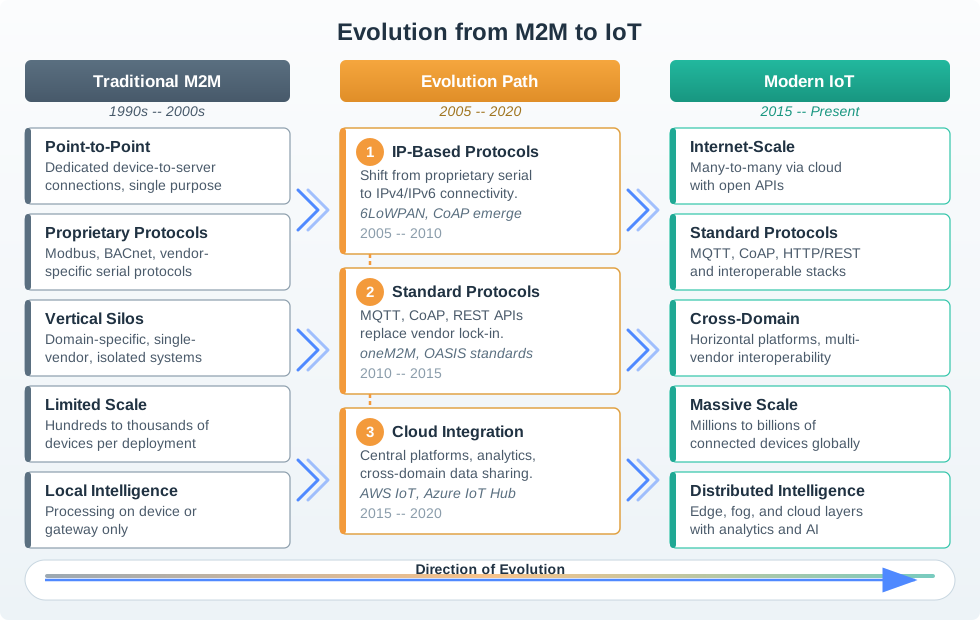
M2M vs IoT: Detailed Comparison
| Aspect | Traditional M2M | Modern IoT | Practical Implication |
|---|---|---|---|
| Scope | Point-to-point, domain-specific | Internet-scale, cross-domain | M2M simpler to deploy; IoT enables new business models |
| Connectivity | Cellular, wired, proprietary | Any (Wi-Fi, Cellular, LPWAN) | M2M works in restricted networks; IoT needs IP |
| Intelligence | Local (device/gateway) | Distributed (Edge/Fog/Cloud) | M2M faster local response; IoT enables analytics |
| Scale | Hundreds to thousands | Millions to billions | M2M simpler management; IoT needs platforms |
| Protocols | Often proprietary | Standard (MQTT, CoAP, HTTP) | M2M locked to vendor; IoT interoperable |
| Integration | Vertical, siloed | Horizontal, interoperable | M2M domain-optimized; IoT cross-functional |
| Cost model | Per-device licensing | Platform subscription | M2M predictable per-unit; IoT scales differently |
Evolution Path: M2M to IoT
| Stage | Key Changes | Timeline |
|---|---|---|
| IP-based M2M | Transition from proprietary to IP protocols | 2005-2010 |
| Standard Protocols | Adoption of MQTT, CoAP, REST APIs | 2010-2015 |
| Cloud Integration | Central platforms, analytics, cross-domain sharing | 2015-2020 |
| Hybrid Systems | M2M edge autonomy + IoT cloud intelligence | 2020-present |
Result: Traditional M2M (closed, domain-specific) evolves into IoT ecosystems (open, interoperable, cloud-connected), but the best modern systems retain M2M’s local intelligence as an essential component.
61.4.2 Knowledge Check: M2M vs IoT
{ “question”: “A hospital deploys bedside patient monitors that must trigger alarms within 500 milliseconds of detecting abnormal vital signs. The hospital also wants to aggregate patient data for long-term health analytics. Which architecture best fits this scenario?”, “options”: [ { “text”: “Pure M2M – all processing on the bedside device, no cloud connectivity needed”, “correct”: false, “feedback”: “Incorrect. The hybrid approach is optimal here. The 500ms alarm requirement cannot reliably be met through a cloud round-trip (which typically takes 50-500ms for network alone, plus processing time). Local M2M processing ensures the alarm fires immediately regardless of network conditions. Meanwhile, cloud-based IoT analytics can process aggregated data for trend analysis, predictive health insights, and cross-patient pattern detection – tasks that do not need sub-second latency. This is the classic pattern: M2M for real-time control, IoT for analytics and management.” }, { “text”: “Pure IoT – send all vital signs to cloud for real-time analysis and alerting”, “correct”: false, “feedback”: “Not quite. Consider that The hybrid approach is optimal here. The 500ms alarm requirement cannot reliably be met through a cloud round-trip (which typically takes 50-500ms for network alone, plus processing time). Local M2M p…” }, { “text”: “Hybrid – M2M local alarming for sub-500ms response, plus IoT cloud upload for long-term analytics”, “correct”: true, “feedback”: “Correct! The hybrid approach is optimal here. The 500ms alarm requirement cannot reliably be met through a cloud round-trip (which typically takes 50-500ms for network alone, plus processing time). Local M2M processing ensures the alarm fires immediately regardless of network conditions. Meanwhile, cloud-based IoT analytics can process aggregated data for trend analysis, predictive health insights, and cross-patient pattern detection – tasks that do not need sub-second latency. This is the classic pattern: M2M for real-time control, IoT for analytics and management.” }, { “text”: “Pure IoT with edge caching – cloud processes everything but caches data locally during outages”, “correct”: false, “feedback”: “That is not correct. Review: The hybrid approach is optimal here. The 500ms alarm requirement cannot reliably be met through a cloud round-trip (which typically takes 50-500ms for network alone, plus processing time). Local M2M p…” } ], “difficulty”: “medium”, “explanation”: “The hybrid approach is optimal here. The 500ms alarm requirement cannot reliably be met through a cloud round-trip (which typically takes 50-500ms for network alone, plus processing time). Local M2M processing ensures the alarm fires immediately regardless of network conditions. Meanwhile, cloud-based IoT analytics can process aggregated data for trend analysis, predictive health insights, and cross-patient pattern detection – tasks that do not need sub-second latency. This is the classic pattern: M2M for real-time control, IoT for analytics and management.” }
Common Misconception: “M2M is obsolete - everything should be cloud-based IoT”
The Misconception: Many developers believe traditional M2M architectures are outdated and all systems should migrate to cloud-connected IoT platforms for better scalability and features.
The Reality: M2M architectures remain critical for specific use cases where cloud dependency is problematic.
Real-World Example - Remote Oil Pipeline Monitoring:
A petroleum company operates 500 remote pump stations across the Australian Outback. Each station has sensors monitoring pressure, flow rate, and equipment status.
Cloud-IoT Approach Challenges:
- Cellular coverage: Only 60% of stations have reliable coverage
- Satellite connectivity: $500/month per station × 500 = $250,000/month (unsustainable)
- Network outages: Average 15% downtime per month in remote areas
- Critical failures: Pressure anomalies require <30 second response (cloud round-trip: 3-8 seconds when connected, infinite when disconnected)
M2M Approach Success:
- Local gateway at each station with edge processing
- Sensors connect via local RS-485 Modbus (no internet required)
- Gateway runs local control logic: Detects pressure anomaly (>10 PSI deviation) → Automatically shuts safety valve within 2 seconds
- Opportunistic cloud sync: When cellular available, upload hourly summaries (not real-time data)
- Data volume: 99.5% reduction (send anomalies + hourly summaries, not all sensor readings)
- Cost: $50/month cellular for 300 connected stations = $15,000/month (vs $250,000/month satellite)
- Reliability: 100% uptime for safety-critical control (works offline)
Quantified Benefits:
- 94% cost reduction: $15K vs $250K monthly connectivity
- Zero safety incidents: Local control continues during network outages (previous cloud-only system had 3 incidents during connectivity loss)
- 99.5% bandwidth reduction: Edge filtering eliminates unnecessary cloud traffic
- <2 second emergency response: Local M2M control vs 3-8+ second cloud round-trip
Lesson: Cloud-IoT excels for analytics, visualization, and management, but M2M’s local intelligence and autonomy remain essential for remote, safety-critical, or intermittently-connected deployments. Modern systems often use hybrid architectures: M2M for edge control + IoT for cloud analytics.
61.5 M2M Device Lifecycle Management
Managing the full lifecycle of M2M devices – from initial registration through active operation to eventual decommissioning – is one of the most operationally challenging aspects of large-scale M2M deployments.
 M2M device lifecycle state diagram showing transitions from Registered through Provisioned, Active, Suspended, Maintenance, Degraded, and Decommissioned states, with arrows indicating valid transitions and their triggers.
Device Lifecycle States and Operations:
| State | Description | Platform Actions |
|---|---|---|
| Registered | Device manufactured, identity created | Generate device ID, assign security keys |
| Provisioned | Credentials and configuration assigned | Push initial config, set reporting intervals |
| Active | Device online and reporting data | Monitor health, collect telemetry, process commands |
| Suspended | Temporarily disabled | Block data ingestion, retain device state |
| Maintenance | Undergoing firmware update or repair | Queue commands, apply updates, verify post-update |
| Degraded | Partial functionality (e.g., weak battery) | Adjust reporting frequency, schedule maintenance |
| Decommissioned | Permanently removed from service | Revoke credentials, archive data, release resources |
Production Considerations for Large-Scale M2M:
At scale (10,000+ devices), lifecycle management becomes a critical operational challenge:
- Staged firmware rollouts: Never update all devices simultaneously – roll out to 1%, verify, then expand to 10%, 50%, 100%
- Automated health monitoring: Devices that miss 3 consecutive heartbeats transition to “Degraded” automatically
- Credential rotation: Security keys should rotate every 90 days for active devices
- Data retention: Decommissioned device data must be archived per regulatory requirements (often 5-7 years for utilities)
Putting Numbers to It
For a firmware rollout to N devices with failure rate p, the expected number of bricked devices is \(E[failed] = N \times p\). Worked example: Deploying firmware with 1% failure rate (\(p = 0.01\)) to 100,000 devices simultaneously risks \(100000 \times 0.01 = 1000\) bricked devices. A staged rollout (1% batch = 1,000 devices) limits initial risk to \(1000 \times 0.01 = 10\) failures, allowing rollback before fleet-wide impact.
Interactive Staged Rollout Risk Calculator
61.6 M2M Platform Design Patterns
Production M2M platforms must handle multi-protocol support, reliable message delivery, and data aggregation. This section reviews the key architectural patterns.
Pattern 1: Multi-Protocol Gateway
An M2M gateway must translate between field-level protocols and platform-level protocols:
| Field Protocol | Transport | Platform Protocol | Translation Complexity |
|---|---|---|---|
| Modbus RTU | RS-485 serial | MQTT | Medium – register mapping to topic structure |
| Modbus TCP | Ethernet | CoAP | Low – both IP-based, similar request/response |
| CANbus | CAN bus | HTTP/REST | High – real-time bus to request/response |
| OPC UA | Ethernet | AMQP | Low – both support pub/sub and request/response |
| Proprietary | Various | WebSocket | Variable – requires reverse engineering |
Pattern 2: Store-and-Forward with QoS
M2M systems must handle intermittent connectivity gracefully:
Device → [Local Buffer] → [Gateway Queue] → [Network] → [Platform Ingestion]
                ↓                  ↓                            ↓
          QoS 0: Fire       QoS 1: At        QoS 2: Exactly
and forget least once once delivery- QoS 0 (fire and forget): Telemetry that can tolerate occasional loss (e.g., ambient temperature every 5 minutes)
- QoS 1 (at least once): Important data that must arrive but duplicates are acceptable (e.g., energy meter readings)
- QoS 2 (exactly once): Critical data where duplicates cause problems (e.g., billing events, actuator commands)
Pattern 3: Data Aggregation Pipeline
For high-frequency sensors, raw data is too voluminous for cloud transmission. Edge aggregation reduces data volume:
| Aggregation Function | Input | Output | Volume Reduction |
|---|---|---|---|
| Time-window average | 60 readings/min | 1 average/min | 60x |
| Change-of-value | Continuous stream | Only when delta > threshold | 10-100x |
| Min/Max/Mean summary | All readings in window | 3 values per window | 20x |
| Anomaly-only | All readings | Only readings outside bounds | 100-1000x |
Real-World Scale: What These Patterns Look Like at 100,000 Devices
At 100,000 M2M devices reporting every 30 seconds:
- Raw ingestion rate: 3,333 messages/second (200,000 messages/minute)
- Daily data volume: 288 million messages = approximately 14 GB (at 50 bytes per message)
- Monthly storage: 420 GB raw, approximately 42 GB after 10x aggregation
- Platform requirements: Multi-node cluster with message broker (e.g., EMQX, HiveMQ), time-series database (e.g., InfluxDB, TimescaleDB), and auto-scaling ingestion workers
The aggregation patterns above are not optional at this scale – they are survival requirements.
61.6.1 Knowledge Check: M2M Platform Design
{ “question”: “A water utility has 50,000 smart meters that report hourly consumption readings. Each reading is 100 bytes. The utility needs to retain raw data for 7 years for regulatory compliance. How much total storage is required, and what is the most practical storage strategy?”, “options”: [ { “text”: “3 TB total – store everything in a single relational database with annual partitioning”, “correct”: false, “feedback”: “Incorrect. The calculation: 50,000 meters x 24 readings/day x 100 bytes x 365 days x 7 years = 3.07 TB. While this is manageable, querying 7 years of raw data in a single database is impractical. The tiered approach keeps recent data "hot" (queryable in milliseconds) in a time-series database like InfluxDB, while archiving older data to cost-effective compressed object storage. Both tiers retain raw data for compliance, but the hot tier also maintains pre-computed aggregations (hourly, daily, monthly summaries) for fast dashboard queries. Option C fails because regulatory compliance typically requires raw data retention, not just summaries.” }, { “text”: “30 TB total – use cloud object storage (S3) with no aggregation since storage is cheap”, “correct”: false, “feedback”: “Not quite. Consider that The calculation: 50,000 meters x 24 readings/day x 100 bytes x 365 days x 7 years = 3.07 TB. While this is manageable, querying 7 years of raw data in a single database is impractical. The tiered appr…” }, { “text”: “300 GB total – apply 100x aggregation to reduce storage, keeping only daily summaries”, “correct”: false, “feedback”: “That is not correct. Review: The calculation: 50,000 meters x 24 readings/day x 100 bytes x 365 days x 7 years = 3.07 TB. While this is manageable, querying 7 years of raw data in a single database is impractical. The tiered appr…” }, { “text”: “3 TB raw total – use tiered storage: hot tier (recent 90 days in time-series DB) plus cold tier (older data in compressed object storage) with both raw and aggregated views”, “correct”: true, “feedback”: “Correct! The calculation: 50,000 meters x 24 readings/day x 100 bytes x 365 days x 7 years = 3.07 TB. While this is manageable, querying 7 years of raw data in a single database is impractical. The tiered approach keeps recent data "hot" (queryable in milliseconds) in a time-series database like InfluxDB, while archiving older data to cost-effective compressed object storage. Both tiers retain raw data for compliance, but the hot tier also maintains pre-computed aggregations (hourly, daily, monthly summaries) for fast dashboard queries. Option C fails because regulatory compliance typically requires raw data retention, not just summaries.” } ], “difficulty”: “medium”, “explanation”: “The calculation: 50,000 meters x 24 readings/day x 100 bytes x 365 days x 7 years = 3.07 TB. While this is manageable, querying 7 years of raw data in a single database is impractical. The tiered approach keeps recent data "hot" (queryable in milliseconds) in a time-series database like InfluxDB, while archiving older data to cost-effective compressed object storage. Both tiers retain raw data for compliance, but the hot tier also maintains pre-computed aggregations (hourly, daily, monthly summaries) for fast dashboard queries. Option C fails because regulatory compliance typically requires raw data retention, not just summaries.” }***
61.7 Visual Reference Gallery
Explore these AI-generated visualizations that complement the M2M concepts reviewed in this chapter. Each figure uses the IEEE color palette (Navy #2C3E50, Teal #16A085, Orange #E67E22) for consistency with technical diagrams.
Visual: M2M Architecture Overview
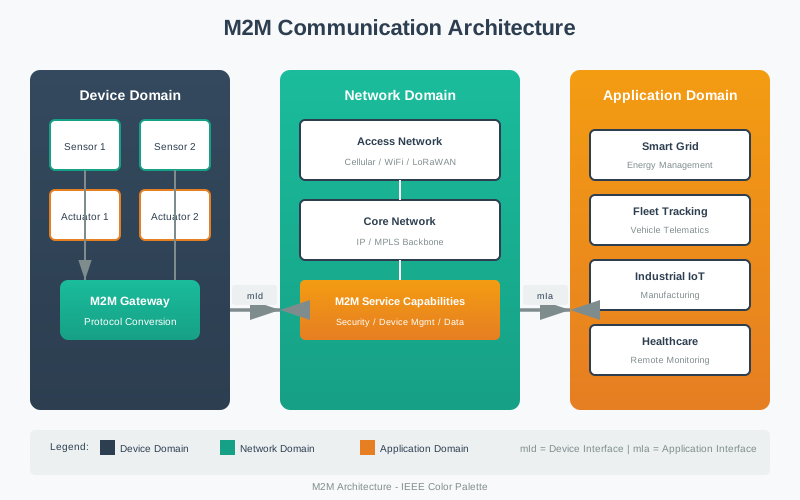
This visualization provides an overview of the five-layer M2M architecture discussed in this chapter, from field devices through to application services.
Visual: IP-based M2M Network
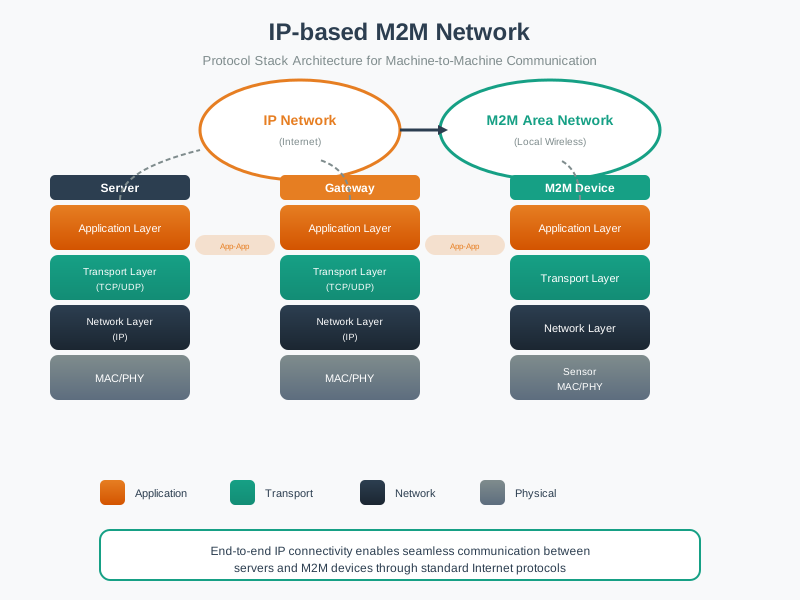
This figure illustrates the evolution from proprietary M2M protocols to IP-based networks, a key concept in understanding the M2M to IoT transition covered in this review.
Visual: M2M Area Network
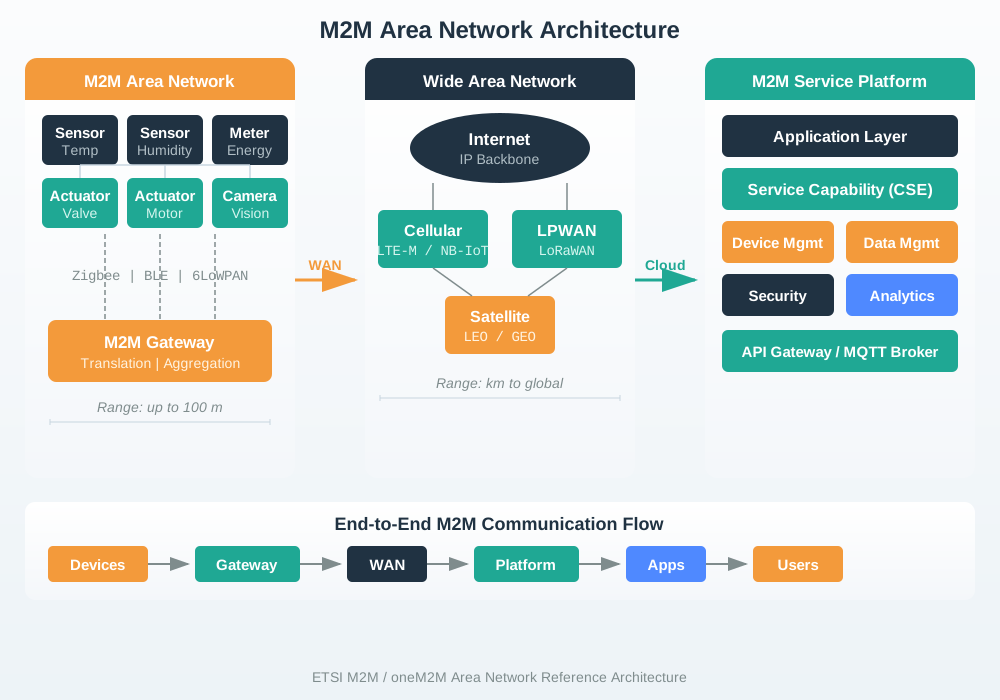
This visualization depicts M2M area network concepts including device clustering, gateway aggregation, and the network layer architecture covered in the M2M vs IoT comparison.
Visual: M2M Device Hierarchy
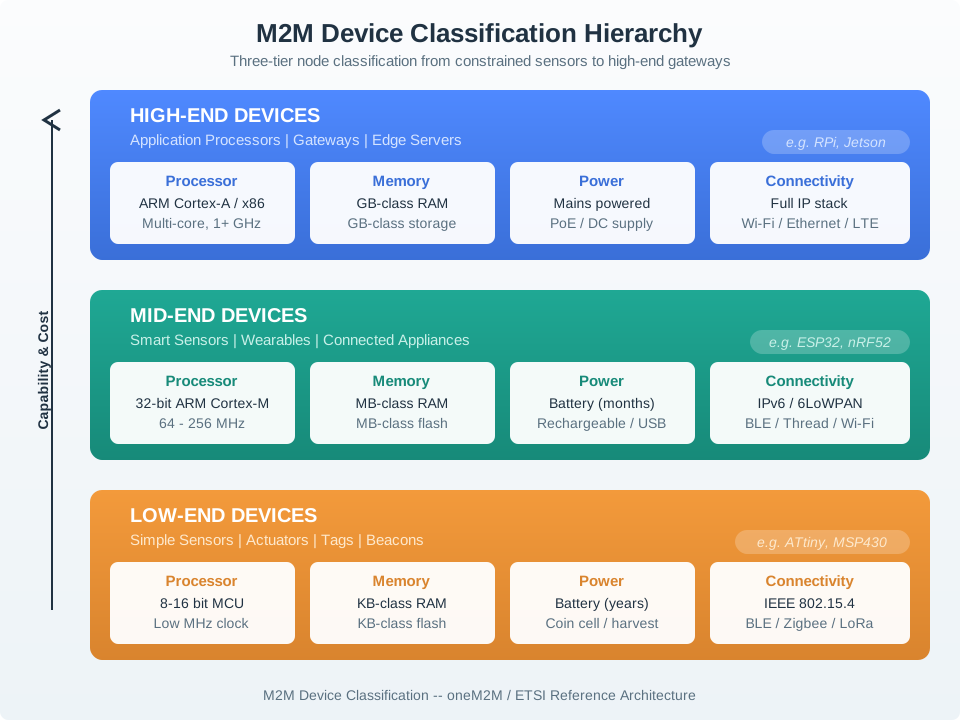
This figure illustrates the node hierarchy discussed in this chapter, showing the classification of M2M devices from simple sensors to high-end multimedia devices.
Worked Example: M2M to IoT Migration Cost-Benefit Analysis
Scenario: Utility company operates 50,000 smart meters on proprietary 2G cellular M2M ($15/month per SIM, 2G sunset in 2025). Migration options: NB-IoT or LoRaWAN.
Current M2M Costs (2G cellular): - Monthly connectivity: 50,000 × $15 = $750,000/month = $9M/year - Hardware: Sunk cost (meters deployed 2015-2020, 10-year lifespan) - 2G sunset forcing migration by 2025
Option 1 - NB-IoT Migration:
- New meter modules: 50,000 × $25 = $1.25M (one-time)
- Installation labor: 50,000 × $40 = $2M (truck rolls)
- Monthly connectivity: 50,000 × $2/month = $100K/month = $1.2M/year
- Benefits: Lower latency (<1s), existing cellular infrastructure, carrier manages network
Option 2 - LoRaWAN Private Network:
- Gateway infrastructure: 500 gateways × $400 = $200K
- Gateway installation/backhaul: 500 × $600 = $300K
- New meter modules: 50,000 × $18 = $900K
- Installation labor: 50,000 × $40 = $2M
- Monthly cost: $20K/year gateway backhaul + $15K/year maintenance = $35K/year
- Benefits: No per-device fees, complete data ownership, future-proof
5-Year Total Cost of Ownership:
| Cost Category | M2M (2G status quo) | NB-IoT | LoRaWAN Private |
|---|---|---|---|
| Migration (year 0) | $0 (forced by sunset) | $3.25M | $3.4M |
| Annual connectivity | $9M | $1.2M | $0.035M |
| 5-year total | $45M (if 2G available) | $9.25M | $3.575M |
Result: LoRaWAN saves $5.675M vs. NB-IoT over 5 years. Payback vs. NB-IoT in 10 months.
Strategic decision: LoRaWAN for dense urban (>100 meters/km²), NB-IoT for rural sparse deployment (<20 meters/km²) where gateway infrastructure is uneconomical.
Decision Framework: M2M vs. Cloud IoT Platform Selection
| Requirement | Traditional M2M | Modern Cloud IoT | Recommendation |
|---|---|---|---|
| Deployment location | Single site/region | Multi-region global | M2M for single-site, IoT for multi-region |
| Data integration | Standalone vertical silo | Cross-domain horizontal platform | IoT if integration needed |
| Device count | 100s to 10,000s | 10,000s to millions | M2M <10K, IoT >10K |
| Real-time local control | Critical (<100ms) | Optional (cloud round-trip acceptable) | M2M if local control mandatory |
| Internet dependency | Can operate offline | Requires connectivity | M2M for intermittent connectivity |
| Protocol standardization | Proprietary acceptable | Open standards required | IoT for interoperability |
| TCO optimization | Capex-heavy (own infrastructure) | Opex-heavy (subscription) | M2M if 5+ year confirmed, IoT for flexible scale |
Example - Oil Pipeline Monitoring (remote, 500 sensors, local control critical, intermittent satellite): - M2M gateway at each pump station: Local control continues during satellite outages, alarms trigger shutdowns in <1s - IoT cloud platform: Receives hourly summaries when connected, long-term analytics - Hybrid: M2M for edge autonomy + IoT for fleet intelligence
Common Mistake: Proprietary M2M Protocols Creating Vendor Lock-In
The Mistake: Deploying 20,000-device M2M system with vendor’s proprietary protocol, assuming “we can migrate later if needed.”
Real Case: Industrial manufacturer deployed Siemens proprietary M2M platform (2012-2020). Wanted to integrate with AWS IoT Core in 2020 for ML analytics.
Migration Challenges:
- Proprietary protocol incompatible with MQTT/HTTP (no direct AWS integration)
- Options: (A) Replace all 20,000 devices ($8M), (B) Build protocol gateway ($500K engineering + $120K annual licenses)
- Chose gateway, but:
- 200ms translation latency added to every message
- Data format limitations (proprietary payloads lost precision in translation)
- Single point of failure (gateway down = entire fleet offline)
- Vendor obsolescence risk (Siemens deprecated platform in 2023, forcing re-architecture)
Total cost: $500K gateway development + $360K licenses (3 years) + $1.2M re-architecture (2023) = $2.06M
Correct Approach (Standards-Based from Day 1): - Use open protocols (MQTT, CoAP, HTTP) even in M2M deployments - Vendor can provide managed service, but protocol must be standard - Example: Deploy MQTT broker from vendor, but devices speak standard MQTT - Migration cost: Change broker endpoint (zero device replacement)
Protocol Interoperability Test (before committing): 1. Can this device connect to Eclipse Mosquitto (open-source MQTT broker)? 2. Can AWS IoT Core ingest this device’s messages without translation? 3. Can we export historical data in standard format (JSON, CSV)?
If any answer is “no” → Locked in. If all “yes” → Portable.
Industry Example: Smart metering standard migration from Elster proprietary (2010) to DLMS/COSEM open standard (2018) cost utilities $1.5B collectively. Those who used gateway approach (vs. device replacement) saved 60% but still paid $600M.
61.8 Concept Relationships
| Concept | Relationship | Connected Concept |
|---|---|---|
| Five-Layer Architecture | Structures | M2M Systems – Field Devices, Gateways, Networks, Service Platforms, Applications address specific engineering concerns |
| Gateway Layer | Critical For | Protocol Translation – bridges legacy Modbus/BACnet to modern MQTT/HTTP for cloud connectivity |
| Device Lifecycle | Requires | State Management – registration, provisioning, activation, maintenance, decommissioning for 10K+ devices |
| Hybrid Architecture | Combines | M2M Local Autonomy with IoT Cloud Capabilities for both reliability and intelligence |
| Store-and-Forward | Enables | Offline Resilience – local buffering prevents data loss during connectivity outages |
| Edge Processing | Reduces | Cloud Load and Latency – local decision-making for latency-critical scenarios (< 5 seconds) |
| Firmware Management | Uses | Staged Rollout – gradual deployment (1% → 10% → 100%) enables rollback if issues detected |
Common Pitfalls
1. Reviewing Concepts Without Applying Them Numerically
M2M review exercises often test conceptual recall, not quantitative reasoning. Practice calculating: bandwidth for 1,000 devices × payload size × frequency; buffer size for 30-minute outage × message rate; backoff interval to prevent thundering herd. Numbers reveal misconceptions that definitions hide.
2. Memorizing Architecture Diagrams Without Understanding Trade-offs
Students memorize the ETSI 4-layer architecture without knowing why each layer exists. The separation between device domain and network domain exists specifically to allow protocol translation at the gateway — without this separation, replacing a sensor protocol requires changes to the application layer.
3. Confusing oneM2M and ETSI M2M Scope
ETSI M2M is the European standard focused on scheduling, congestion control, and security requirements. oneM2M is the global body defining the CSE resource tree and REST API. They overlap significantly but address different aspects. Know which standard covers which requirement before citing them in designs.
4. Underestimating SDN Relevance to M2M Networks
Software Defined Networking is not just for data centers. M2M networks benefit from SDN by enabling dynamic QoS prioritization (medical alerts over telemetry), automated failover, and network slicing for different device classes. Review SDN concepts alongside M2M architecture for a complete picture.
61.9 Summary
Chapter Summary
This chapter reviewed Machine-to-Machine (M2M) communication as both a foundational technology and a living component of modern IoT architectures.
Key Takeaways:
Five-Layer Architecture: M2M systems follow a layered model – Field Devices, Gateways, Networks, Service Platforms, Applications – with each layer addressing specific engineering concerns from physical data collection to domain-specific services.
M2M vs IoT: M2M emphasizes point-to-point, domain-specific, locally intelligent systems with often proprietary protocols. IoT extends this to internet-scale, cross-domain, cloud-connected ecosystems with standard protocols. Neither is obsolete – modern systems use both.
Gateway Criticality: The gateway layer is where most real-world integration challenges arise, requiring multi-protocol translation, data buffering for connectivity outages, and local decision-making for safety-critical scenarios.
Device Lifecycle Management: Production M2M deployments require systematic management of devices through registration, provisioning, activation, maintenance, and decommissioning states – especially critical at scale (10,000+ devices).
Hybrid Architecture: The most effective modern deployments combine M2M’s local autonomy (edge processing, offline operation, sub-second response) with IoT’s cloud capabilities (analytics, cross-domain integration, management dashboards).
Evolution Context: M2M evolved from proprietary non-IP systems (pre-2010) through IP-based standardization (2010-2015) to today’s hybrid edge-cloud architectures, providing historical context for understanding modern IoT.
The bottom line: M2M is not a legacy technology to be replaced – it is the operational foundation that IoT builds upon. Engineers who understand both M2M and IoT can design systems that are both locally reliable and globally intelligent.
61.10 Further Reading
Chen, M., et al. (2014). “Machine-to-Machine Communications: Architectures, Standards and Applications.” KSII Transactions on Internet and Information Systems, 6(2), 480-497.
Wu, G., et al. (2011). “M2M: From mobile to embedded internet.” IEEE Communications Magazine, 49(4), 36-43.
ETSI TS 102 690 (2013). “Machine-to-Machine communications (M2M); Functional architecture.”
oneM2M Technical Specification (2016). “TS-0001: Functional Architecture.” Available at onem2m.org.
Vermesan, O. and Friess, P. (2014). Internet of Things – From Research and Innovation to Market Deployment. River Publishers. Chapters 3-4 on M2M evolution.
61.11 Comprehensive Review Exercises
Test your understanding with these scenario-based exercises and knowledge check questions. Each exercise presents a realistic M2M deployment challenge.
61.11.1 Additional Knowledge Check: M2M Decision Making
{ “question”: “A mining company deploys vibration sensors on 200 conveyor belt motors across 5 underground tunnels. Tunnels have no cellular coverage. Surface processing plant has broadband internet. What M2M architecture should they use?”, “options”: [ { “text”: “Wi-Fi mesh network throughout all tunnels connecting directly to cloud analytics platform”, “correct”: false, “feedback”: “Incorrect. Underground environments make wireless connectivity extremely challenging (signal attenuation through rock). Wired RS-485/Modbus is proven in mining – it is noise-resistant, supports long cable runs (up to 1,200m), and requires no wireless spectrum. The gateway at each tunnel entrance aggregates sensor data from 40 motors, performs local vibration analysis (detecting bearing wear patterns that indicate imminent failure), and forwards alerts plus summary data over fiber to the surface plant. The surface M2M platform provides cross-tunnel fleet analytics and syncs to cloud for historical trending. This is classic M2M architecture: local autonomy (gateway detects critical vibration in milliseconds, can trigger emergency motor shutdown without network round-trip) plus centralized management (surface platform coordinates maintenance scheduling across all tunnels). Option A fails because Wi-Fi mesh underground is unreliable and expensive to install. Option D is impossible since satellite signals cannot penetrate underground.” }, { “text”: “Wired RS-485 bus in each tunnel connecting to a gateway at tunnel entrance, with fiber backhaul to surface plant where an M2M platform aggregates data and syncs to cloud”, “correct”: true, “feedback”: “Correct! Underground environments make wireless connectivity extremely challenging (signal attenuation through rock). Wired RS-485/Modbus is proven in mining – it is noise-resistant, supports long cable runs (up to 1,200m), and requires no wireless spectrum. The gateway at each tunnel entrance aggregates sensor data from 40 motors, performs local vibration analysis (detecting bearing wear patterns that indicate imminent failure), and forwards alerts plus summary data over fiber to the surface plant. The surface M2M platform provides cross-tunnel fleet analytics and syncs to cloud for historical trending. This is classic M2M architecture: local autonomy (gateway detects critical vibration in milliseconds, can trigger emergency motor shutdown without network round-trip) plus centralized management (surface platform coordinates maintenance scheduling across all tunnels). Option A fails because Wi-Fi mesh underground is unreliable and expensive to install. Option D is impossible since satellite signals cannot penetrate underground.” }, { “text”: “Each sensor stores data on SD card; technicians collect data weekly during inspections”, “correct”: false, “feedback”: “Not quite. Consider that Underground environments make wireless connectivity extremely challenging (signal attenuation through rock). Wired RS-485/Modbus is proven in mining – it is noise-resistant, supports long cable runs …” }, { “text”: “Satellite M2M terminals at each motor for real-time cloud connectivity underground”, “correct”: false, “feedback”: “That is not correct. Review: Underground environments make wireless connectivity extremely challenging (signal attenuation through rock). Wired RS-485/Modbus is proven in mining – it is noise-resistant, supports long cable runs …” } ], “difficulty”: “medium”, “explanation”: “Underground environments make wireless connectivity extremely challenging (signal attenuation through rock). Wired RS-485/Modbus is proven in mining – it is noise-resistant, supports long cable runs (up to 1,200m), and requires no wireless spectrum. The gateway at each tunnel entrance aggregates sensor data from 40 motors, performs local vibration analysis (detecting bearing wear patterns that indicate imminent failure), and forwards alerts plus summary data over fiber to the surface plant. The surface M2M platform provides cross-tunnel fleet analytics and syncs to cloud for historical trending. This is classic M2M architecture: local autonomy (gateway detects critical vibration in milliseconds, can trigger emergency motor shutdown without network round-trip) plus centralized management (surface platform coordinates maintenance scheduling across all tunnels). Option A fails because Wi-Fi mesh underground is unreliable and expensive to install. Option D is impossible since satellite signals cannot penetrate underground.” }## What’s Next
| If you want to… | Read this |
|---|---|
| Explore Software Defined Networking | Software Defined Networking |
| Study M2M architectures in depth | M2M Architectures and Standards |
| Explore M2M design patterns | M2M Design Patterns |
| Get hands-on with M2M lab exercises | M2M Communication Lab |
| Study M2M implementations | M2M Implementations |
61.12 See Also
- M2M Implementations – Detailed implementation patterns for smart metering, protocol translation, and service orchestration
- M2M Fundamentals – Hub page for the complete M2M chapter series
- Gateway Architectures – Comprehensive gateway design patterns including edge processing and buffering strategies
- Edge Computing – Modern edge architectures that extend M2M gateway concepts with local intelligence
- Device Management – Lifecycle management strategies for large-scale M2M and IoT deployments