48 S2aaS Multi-Layer Architecture
48.1 Start Simple
Keep Meaning Through Every Service Layer
Picture a farm that offers soil readings to a water planner. The reading begins at a field probe, passes through a site unit, enters a shared list, and reaches a buyer’s model. Each layer can delay, rename, filter, or deny the same record.
Trace one value from field to use. Name the source, place, unit, event time, quality mark, owner, allowed purpose, and rule version. At each handoff, write what is added, changed, stored, or rejected. Keep one identity so a buyer can follow the value back to the field state.
Test a lost site link, a changed unit, a stale list entry, a buyer with old rights, a full store, and two layers that disagree. Check the weak mode and the repair path. A clean buyer view does not prove that the lower layers kept the original meaning.
Keep urgent water control at the farm when shared layers are late or unsure. The wider service can plan and compare, but it should not become a hidden time-bound control path.
This opening does not choose a vendor or final layer count. Practitioner assigns each boundary and owner. Under the Hood examines discovery, access, data handling, charging, scale, and the records that join layer failures into one review.
Use a short release check. Can each layer name what it changed? Does the same source id survive? Is age plain? Does denied use stay denied? Can the farm act when the wider path fails? If any answer is no, repair that handoff first.
Start with one sensor stream that another team wants to reuse. In S2aaS Multi-Layer Architecture, the practical question is who owns the sensing resource, what quality is promised, and what policy keeps the service safe to consume.
48.2 Learning Objectives
By the end of this chapter, you will be able to:
- Explain the major layers in an S2aaS implementation without tying them to a specific vendor stack.
- Define layer contracts for physical sensing, edge intake, virtual resources, service APIs, and operations records.
- Describe how observations move from raw device output to governed consumer delivery.
- Identify the policy, quality, provenance, and audit metadata that must survive each handoff.
- Explain how virtual resources decouple consumers from physical sensor changes.
- Write a simple layer handoff check that blocks delivery when quality, policy, or audit context is missing.
48.3 Prerequisites
This chapter builds on:
- S2aaS Deployment Models, which explained where responsibilities can run.
- S2aaS Implementation Considerations, which covered production readiness, tenant isolation, operations, and lifecycle controls.
- S2aaS Concepts and Service Models, which introduced virtual sensors, discovery contracts, and subscription lifecycle.
48.4 Concept Map
An S2aaS layer is a responsibility boundary. The platform should be able to say what each boundary promises and how the next layer can trust it.
48.4.1 Physical and Edge
Device identity, observation capture, protocol translation, buffering, calibration state, gateway health, and local failure signals.
48.4.2 Virtual Resource
Stable resource identity, observed property, quality state, transformation, provenance, tenant scope, and policy binding.
48.4.3 Service Delivery
Discovery, subscription, API or stream delivery, request checks, rate limits, retention, revocation, and consumer-facing audit.
48.5 Layer Contracts
The compact layer contract model in the overview depth layer is intentionally about responsibilities, not tool names.
Each layer contract should answer five questions:
- What does this layer receive?
- What does this layer emit?
- What identity or resource name does this layer own?
- What quality, policy, provenance, or audit context must be attached?
- What happens when the layer is degraded, delayed, unavailable, or replaced?
If a layer passes a value upward without freshness, unit, provenance, quality state, and policy context, the next layer cannot safely turn that value into a service.
48.6 Layer 1: Physical Sensing
The physical layer contains deployed sensors, actuators when relevant, local power, enclosure, calibration, location or asset binding, and device identity. This layer produces observations and device health signals.
48.6.1 Responsibilities
- Identify the physical device or source.
- Capture observations with units and timestamps.
- Report health, calibration, firmware, power, and connectivity state.
- Expose location, zone, asset, or feature-of-interest metadata.
48.6.2 Do Not Hide
- Unknown calibration state.
- Device replacement.
- Stale timestamps.
- Unit changes.
- Maintenance mode.
- Failed or partial observations.
The physical layer should not decide who may consume a commercial or governed service. It supplies measurements and device proof. Higher layers turn that proof into virtual resources with policy and delivery terms.
48.7 Layer 2: Edge Intake and Normalization
Gateways and edge services translate protocols, buffer observations, normalize payloads, suppress obvious duplicates, attach local context, and keep collection working during temporary outages. In some deployments, the edge also performs local filtering, aggregation, or event detection.
A good edge intake contract emits:
- A normalized observation format.
- Stable source identity and sequence information.
- Local receive time and original observation time.
- Unit, observed property, and location or asset scope.
- Quality flags such as delayed, estimated, maintenance, duplicate, or out-of-range.
- Replay status so downstream layers can avoid double counting.
Protocol translation is not the same as service validation. A gateway may convert a payload into JSON, but the platform still needs quality checks, policy binding, resource modeling, and audit before the data becomes a reusable S2aaS product.
48.8 Layer 3: Virtual Resource Model
The virtual resource layer is the main S2aaS boundary. It turns physical or edge observations into stable service objects. A virtual resource may represent one sensor, a zone aggregate, a fused signal, an event stream, a report, or a derived indicator.
48.8.1 Virtual Resource Contract
- Stable resource id and display name.
- Observed property and unit.
- Owner, steward, and allowed consumer roles.
- Quality model and freshness rule.
- Provenance rule linking outputs back to sources.
- Retention, purpose, redistribution, and revocation policy.
48.8.2 Why It Matters
Consumers can keep using the same resource while physical sensors are replaced, gateways move, sampling changes, or processing moves from central to edge. The virtual resource protects the service contract from infrastructure churn.
48.9 Layer 4: Service Delivery and API
The service delivery layer exposes governed resources through APIs, streams, dashboards, reports, exports, and webhooks. This layer should enforce policy before data leaves the platform boundary.
Delivery checks should cover:
- Tenant identity and subscription status.
- Purpose, retention, redistribution, and rate terms.
- Requested quality level and current quality state.
- Delivery interface: API, stream, export, dashboard, or report.
- Audit logging for who received what, when, under which policy.
- Revocation and deletion rules before cached or exported data is served.
The API should expose virtual resources and quality state. It should not require consumers to know the physical sensor id, gateway queue, database table, or internal processing job unless that detail is explicitly part of the audit or provenance view.
48.10 Operations and Governance Plane
Operations is not a separate afterthought. It cuts across every layer and keeps layer contracts true over time.
Before operations and Governance Plane, inspect Figure 48.1 to compare “versions” with “access data”. Their juxtaposition makes S2aaS control plane showing monitoring, policy versioning, revocation, incident response, and lifecycle controls across physical, edge, virtual, and service layers visible.
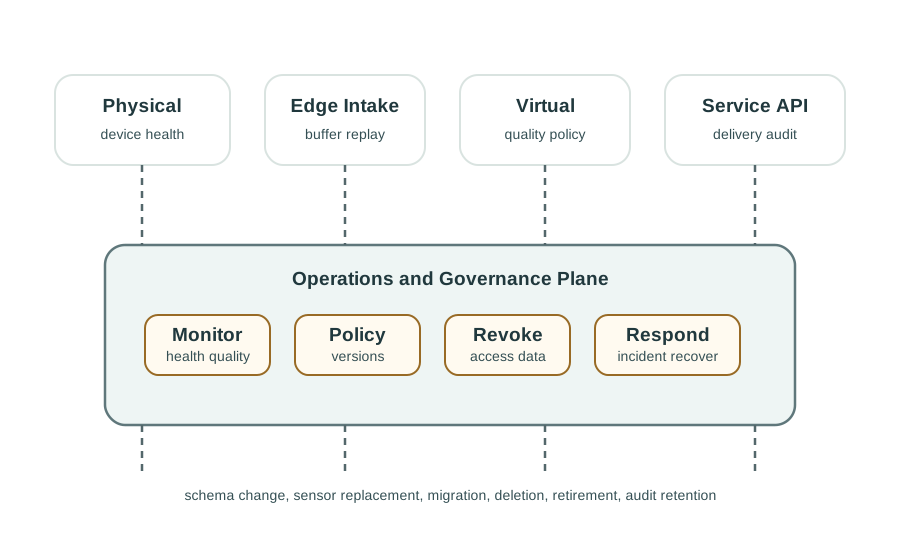
Read Figure 48.1 from “versions” to “access data”. Taken together, “versions” and “access data” express S2aaS control plane showing monitoring, policy versioning, revocation, incident response, and lifecycle controls across physical, edge, virtual, and service layers. For operations and Governance Plane, the observed relationship between “versions” and “access data” is evidence that “versions” carries into the next decision.
The operations plane should track:
- Device and gateway health.
- Observation freshness, completeness, and quality state.
- Policy version, subscription state, and revocation status.
- API errors, denied requests, export failures, and delivery delays.
- Sync lag when edge, regional, or central layers exchange data.
- Incidents, runbook actions, customer communications, and recovery proof.
- Schema changes, sensor replacement, migration, retirement, and deletion.
48.11 Responsibility Stack Check
Use the implementation responsibility stack as a quick audit before promoting a multi-layer design:
| Layer | Responsibility to prove | Record that must cross the handoff |
|---|---|---|
| Physical sensing | Observation, calibration, device identity, location or asset scope, and health state | Source identity, timestamp, unit, property, sequence, and device health |
| Edge handling | Translation, buffering, filtering, aggregation, and local resilience | Normalized event, quality state, gateway receive state, and rejected-message reason |
| Platform services | Registry, virtual resource, policy enforcement, tenant isolation, storage, metering, and audit | Resource mapping, policy binding, provenance, transformation, and audit trail |
| Service delivery | API, stream, dashboard, export, or report with purpose and quality controls | Tenant, purpose, retention, revocation, rate, output format, and delivery status |
| Consumer application | Use the service output without bypassing quality, freshness, or allowed-use metadata | Display or decision record that preserves quality and fallback behavior |
48.12 Handoff Flow
Layered architecture only works if handoffs preserve context. A clean handoff is not simply “send the value upward.” It is a documented package of observation, quality, identity, policy, and audit records.
Before handoff Flow, inspect Figure 48.2 to compare “Record” with “Audit”. Their juxtaposition makes S2aaS handoff flow showing raw observation, normalized event, virtual resource update, governed delivery, and audit record visible.
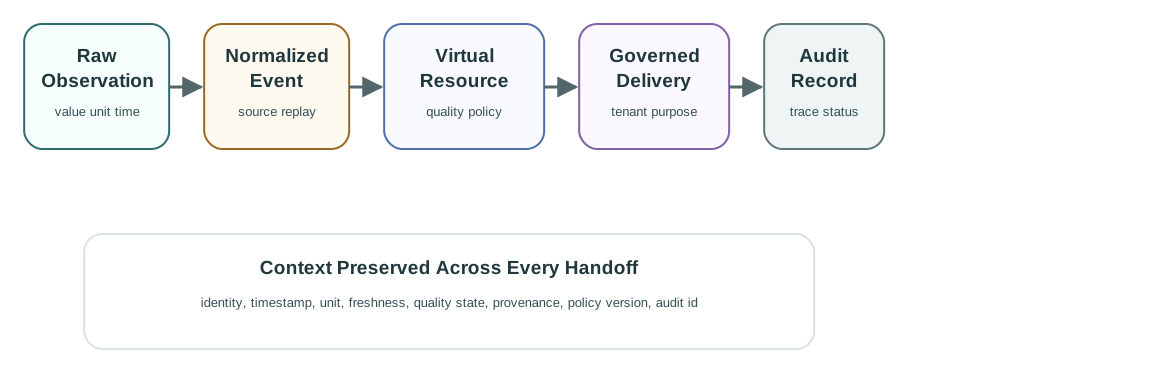
Read Figure 48.2 from “Record” to “Audit”. Taken together, “Record” and “Audit” express S2aaS handoff flow showing raw observation, normalized event, virtual resource update, governed delivery, and audit record. For handoff Flow, the observed relationship between “Record” and “Audit” is evidence that “Record” carries into the next decision.
48.12.1 Raw Observation to Normalized Event
Attach source identity, timestamp, unit, observed property, sequence, and gateway receive state.
48.12.2 Normalized Event to Virtual Resource
Apply resource mapping, quality rules, provenance, transformation, and policy binding.
48.12.3 Virtual Resource to Delivery
Check tenant, purpose, quality, rate, retention, revocation, and delivery format.
48.12.4 Delivery to Audit Record
Record request, resource, tenant, policy version, quality state, output form, and operator-visible status.
48.13 Layer Independence and Coupling
Layering is useful only when layers can evolve independently without losing accountability.
48.13.1 Safe Physical Change
A sensor is replaced with a newer model. The physical and edge layers update source identity and calibration metadata, while the virtual resource id and consumer API remain stable.
48.13.2 Safe Processing Change
A derived comfort score moves from central processing to edge processing. The virtual resource contract stays stable, but provenance and processing-version metadata change.
48.13.3 Safe API Change
A new export format is added. Existing API routes and stream topics remain valid, and consumers opt into the new format through subscription terms.
48.13.4 Safe Policy Change
A retention rule changes. The policy version updates, active subscriptions are checked, caches and exports are checked, and audit records show which policy applied.
48.14 Worked Example: Room Comfort S2aaS
Scenario: A building platform exposes room comfort as a governed S2aaS resource. The signal uses temperature, humidity, occupancy-derived context, and ventilation state.
Layered design:
- Physical sensing reports temperature and humidity readings, device health, calibration state, and room scope.
- Edge intake normalizes units, buffers during network outages, marks delayed readings, and attaches gateway receive time.
- The virtual resource layer exposes
room-comfort-zone-aas a stable resource with quality state and provenance back to source readings. - Service delivery offers a dashboard, API endpoint, and scheduled report with different retention and purpose rules.
- Operations monitors stale readings, sensor replacement, policy version, denied requests, export failures, and consumer-visible degraded modes.
Decision: Consumers should subscribe to the room comfort virtual resource, not to individual physical sensors. This lets the platform replace a faulty humidity sensor, move aggregation to the edge, or change a comfort algorithm without breaking the consumer-facing service.
48.15 Multi-Layer Readiness Checklist
- Every layer has a named owner and contract.
- Physical observations include identity, timestamp, unit, observed property, and health state.
- Edge intake records normalization, replay, buffering, and delayed-state proof.
- Virtual resources have stable ids, quality rules, policy binding, and provenance.
- API delivery enforces tenant, purpose, retention, rate, quality, and revocation terms.
- Audit records connect request, resource, tenant, policy version, quality state, and delivery path.
- Degraded modes are visible at the API or report level.
- Sensor replacement does not change consumer-facing resource identity.
- Policy and schema changes are versioned and checked across layers.
- Operators can trace an incident from consumer complaint to API request, virtual resource, edge event, and physical source.
48.16 Knowledge Check
48.17 Concept Relationships
- Physical sensing produces observations and health records.
- Edge intake normalizes, buffers, filters, and labels local state.
- Virtual resources stabilize identity, quality, policy, and provenance.
- Service delivery enforces subscriptions, purpose, retention, rate, revocation, and audit.
- Operations records keep incidents, policy changes, schema changes, and lifecycle actions visible across all layers.
- Layer handoffs preserve context so the platform can explain why a consumer received or did not receive data.
48.18 Common Pitfalls
48.18.1 Skipping Virtual Resources
Direct physical-device APIs make every hardware change a consumer-facing change and leave no clear place for policy, quality, and provenance.
48.18.2 Losing Context at Handoff
Passing only a numeric value upward strips away freshness, unit, calibration, provenance, and policy proof needed for governed reuse.
48.18.3 Putting Operations in One Layer
Monitoring, incident response, revocation, deletion, and lifecycle control must cross all layers, not live only in the API gateway.
48.18.4 Edge Data Needs Trust Checks
Edge processing still needs quality rules, replay handling, policy versioning, and audit context before delivery.
48.19 References and Further Reading
- OGC SensorThings API, for resource-oriented modeling of Things, Datastreams, Sensors, Observations, and Features of Interest.
- W3C SOSA/SSN, for describing sensors, observations, procedures, observed properties, and systems.
- IETF RFC 8428, for Sensor Measurement Lists (SenML) as a compact representation for sensor observations.
- oneM2M functional architecture, for common service-layer responsibilities and resource modeling in IoT systems.
- MQTT Version 5.0 specification, for publish/subscribe messaging concepts commonly used between devices, gateways, and services.
- NIST Cybersecurity Framework, for organizing monitoring, incident response, recovery, and governance activities across system layers.
48.20 Overview: Handoffs Carry The Contract
If you only need the operating rule, this layer is enough: each S2aaS layer may transform the data, but it must not drop the identity, quality, provenance, policy, and audit context that lets the next layer trust it.
Before overview: Handoffs Carry The Contract, inspect Figure to compare "Intake" with "monitor". Their juxtaposition makes multi-layer S2aaS contracts preserve identity, quality, policy, provenance, and audit records as data crosses responsibility boundaries visible.
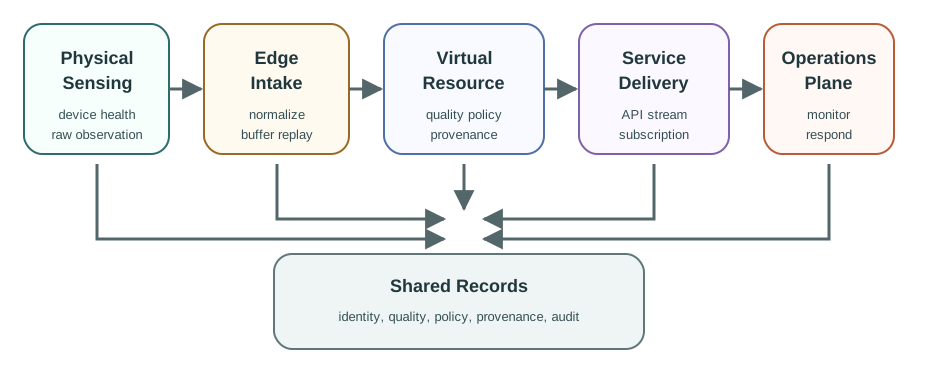
Read Figure from "Intake" to "monitor". Taken together, "Intake" and "monitor" express multi-layer S2aaS contracts preserve identity, quality, policy, provenance, and audit records as data crosses responsibility boundaries. For overview: Handoffs Carry The Contract, the observed relationship between "Intake" and "monitor" is evidence that "Intake" carries into the next decision.
Mobile summary: Physical sensing, edge intake, virtual resources, service delivery, and operations can change independently only when shared records preserve identity, quality, policy, provenance, and audit context.
Observation proof
Physical and edge layers preserve source, time, unit, sequence, receive state, replay state, health, calibration, and local failure signals.
Service proof
The virtual resource maps the event to stable identity, quality rules, provenance, transformation version, tenant scope, and policy binding.
Delivery proof
The service layer checks purpose, retention, rate, quality, revocation, output format, and audit before a consumer receives data.
48.21 Room Comfort Handoff Record
For a room comfort S2aaS resource, the handoff record should make a consumer complaint traceable across the full stack.
Treat room Comfort Handoff Record as one connected review. Begin with physical to edge: record sensor id, room scope, observed property, timestamp, unit, calibration state, health state, and maintenance mode. With that boundary fixed, examine edge to virtual resource: add gateway receive time, normalized value, replay or duplicate state, delay flag, quality state, transformation version, and rejected-message reason. Then connect it to virtual resource to delivery: bind the event to room-comfort-zone-a, provenance id, owner, steward, allowed purpose, tenant scope, quality rule, and retention policy. Close the review by checking delivery to audit: record tenant, request purpose, policy version, output form, cache or export path, quality state, revocation check, and delivery status. The order matters: each later judgment depends on the owner, state, constraint, or failure evidence retained by the preceding step, so the resulting record can support the next chapter decision.
Operator trace
A stale-data incident should connect the consumer request back to the virtual resource, edge event, physical source, policy version, and recovery action.
Delivery block
Do not deliver when freshness, unit, provenance, policy binding, tenant scope, or audit fields are missing from the current handoff.
48.22 Why Layer Boundaries Leak
Layering can hide risk when teams treat boundaries as technical adapters instead of accountability contracts. A message can cross a boundary while losing the exact fields needed for privacy, quality, billing, revocation, or incident response.
Treat why Layer Boundaries Leak as one connected review. Begin with identity leak: a physical replacement changes the source but the virtual resource does not expose provenance or calibration change. With that boundary fixed, examine quality leak: delayed, replayed, estimated, suppressed, or maintenance data is delivered as normal service output. Then connect it to policy leak: API checks are correct, but stream topics, exports, caches, or reports bypass purpose and revocation rules. Close the review by checking audit leak: logs prove a request happened but cannot connect the request to the physical source, policy version, quality state, or operator action. The order matters: each later judgment depends on the owner, state, constraint, or failure evidence retained by the preceding step, so the resulting record can support the next chapter decision.
48.23 Summary
S2aaS multi-layer architecture separates physical sensing, edge intake, virtual resources, service delivery, and operations records. The most important design work is defining layer contracts. Each handoff should preserve identity, quality state, provenance, policy context, and audit records. Virtual resources give consumers stable service objects while devices, gateways, processing locations, and APIs evolve. Operations and governance must remain visible across the full stack so incidents, revocation, deletion, migration, and quality changes can be explained.
48.24 What’s Next
- Reuse designs in S2aaS Architecture Patterns.
- Evaluate tool and platform choices in S2aaS Implementation Platforms.
- Use S2aaS Readiness Check after completing the S2aaS section.
48.25 Key Takeaway
A multi-layer S2aaS architecture separates device, edge, platform, API, and customer-facing concerns. Each layer needs clear ownership, trust boundaries, and quality controls.